Hangman’s Knot

I just realized the other day that I’ve reached a small landmark as far as this site is concerned – this post will be the 100th western that I have written about. I had to think about what movie I ought to feature to mark the occasion, and it left me with something of a dilemma. My first instinct was to go for a big, important, genre defining picture, one which has stamped its authority all over the western landscape. But then I paused and thought again: is that really representative of the kind of movies I usually turn my attention to? Well not really. For the most part, I’ve written up the films that don’t always draw the attention of the critics, that don’t get ranked high in the “Best of” lists. Sure there are a few heavyweights in there, but they tend to be the exception. So in the end, I opted for something low-key, a bit of a sleeper and an imperfect work – Hangman’s Knot (1952). This might seem an offbeat choice but it reflects what I’d like to think of as the spirit of this site by being a movie from my favourite decade in cinema and featuring two of my favourite performers.

The plot concerns a dreadful mistake and its consequences for those involved. Major Stewart (Randolph Scott) is in charge of a small band of Confederate soldiers who we see setting up an ambush for a squad of Union troops. The aim is to relieve the Yankees of the gold shipment they’re guarding and thus shore up the war effort. The plan goes almost like clockwork and Stewart’s men wipe out the enemy. The sting in the tail though comes in the form of the dying words of their victims’ commanding officer – the war has been over for weeks. In that moment Stewart sees himself transformed from heroic military tactician into common criminal. A discussion with the surviving troops, and the reckless killing of the one man who could be made to testify to their innocence, leads to the decision to head home with the spoils in tow. However, gold is always a powerful draw, and it’s not long before others are on their trail. A self-appointed posse, bounty hunters in reality, have caught the scent and are in pursuit of Stewart’s little party. In desperation, a stagecoach is hijacked and the fugitives head for the temporary shelter of an isolated swing station. It’s here that the second part of the drama is played out, as Stewart and his men find themselves holed up in the stage halt and under pressure from both without and within. The posse have hemmed them in with little hope of a clean escape, while the atmosphere is growing ever more poisonous as both the hostility of the hostages and the men’s own personal differences raise tensions.

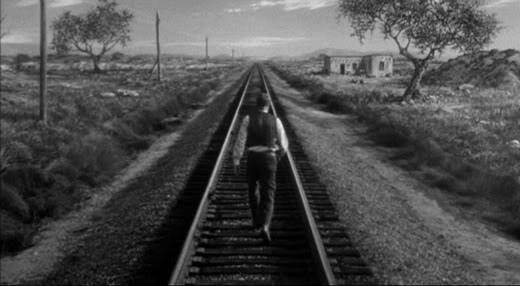
Roy Huggins is most famous as the writer of some highly successful and influential television shows (including The Fugitive and The Rockford Files), but his solitary effort as a cinema director plays out like a rehearsal for the Boetticher/Scott pictures that would come later in the decade. The theme, casting, locations and structure of Hangman’s Knot all contribute to the feeling that you’re watching a kind of unpolished Budd Boetticher movie. The opening scenes of the ambush shot around Lone Pine, with their bleak, fatalistic tone, immediately evoke such thoughts. This is especially true when the gung-ho mood abruptly turns into one of horrified realisation. Then there’s the theme of greed and it’s corrupting influence that is gradually expanded upon as the story progresses. With the second act, comes a change of location – the restrictive, almost suffocating, confines of the swing station – where the pressurized atmosphere brought on by greed for gold intensifies for those trapped inside and those laying siege outside. These rising tensions are further exacerbated by the presence of Donna Reed’s Northern nurse, provoking a three-way contest for her affections between Scott, Lee Marvin’s hot-headed subordinate, and Richard Denning’s would-be fiance. This brings to the surface a sentiment that can often be detected in westerns of the period; the contrast between the essential nobility of the southerner (personified by Scott) and the base materialism of the northerner (Denning in this instance), although it’s tempered somewhat by the fact that Marvin is also thrown into the mix to represent the less savoury side of the Confederacy.

It’s hard to find fault with the casting of the movie, though the oversimplified characterization is one of the main weaknesses. I’ve already tried to draw attention to what I see as the parallels between Hangman’s Knot and Scott’s later work with Boetticher, but the reasons why the movie isn’t quite in that class need to be addressed too. One of the features that distinguished the Ranown pictures was the complexity of the characters, both the heroes and the villains. In truth, there was a blurring of the lines defining the good and bad men in those films. That’s not really the case here, where everyone’s development follows a much more traditional path. Apart from a sense of guilt over the ill-timed ambush, Scott’s character carries none of the emotional baggage that made his best roles so memorable. That’s not meant as a criticism of his performance though – an actor can only play a part as it’s written, and the script doesn’t offer much opportunity to add depth. The same problem arises with Lee Marvin; where Seven Men from Now gave him the chance to play a layered and subversively attractive villain, Hangman’s Knot demands a more straightforward, and far less interesting, portrayal. Similarly, the posse in pursuit of Stewart’s band is a collection of stereotypical figures without charm, and lacking the necessary menace too. Perhaps the most successful character is the green youth played by Claude Jarman Jr, whose innocence symbolizes hope for the future and the possibility of a new beginning. Both he and the operators of the stagecoach stop are suggestive of the idea of America as a family torn apart by the Civil War. Of course they also represent the prospect of reconciliation, the offer of “adoption” at the end emphasizing this.

The R1 Columbia/Sony DVD of Hangman’s Knot, which has been available for a long time now, presents the movie in the correct academy ratio, and the image is reasonable although there are some issues with the transfer too. Colours are generally strong throughout but there is some damage to the print. This is most obvious during the indoor scenes in the second half of the movie, the earlier exterior work looks to be in much better shape. Even so, it’s not what I’d term a major distraction at any point. It’s a fast paced film which packs a lot of story into its brisk 81 minute running time and concludes most satisfactorily. I think it’s an underrated western, but I can understand the reasons why that may be so. Still, whatever deficiencies it has, there are plenty of positive points too, not least the way it looks ahead to the Ranown cycle. In fact, and I’m going to stick my neck out here, I think it’s a better and more rewarding movie than something like Westbound – others may disagree of course. Anyway, I recommend any fans of Randolph Scott, or Budd Boetticher for that matter, check this one out if they haven’t already done so.
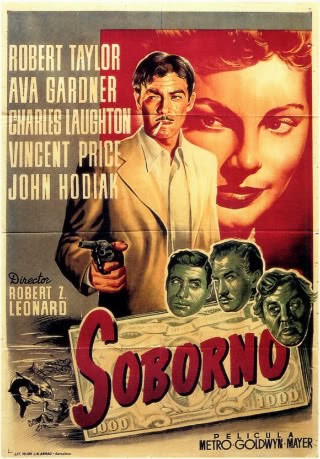
The Bribe

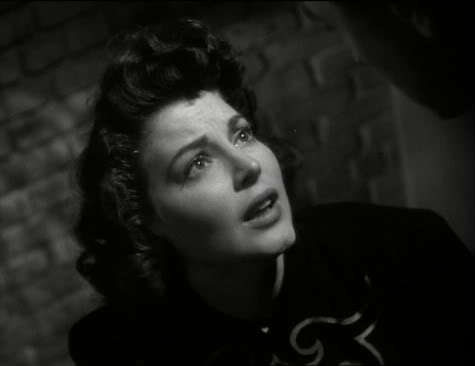
The last non-western I looked at had Ava Gardner suffering in an exotic setting. The Bribe (1949) sees the same actress back sweating it out in a far-flung place, but the results are much more satisfying this time. The film is a borderline noir that employs some of the staples of the form to excellent effect. There’s also a first-rate cast who work hard, yet it’s not a movie without some problems. It opens and closes very strongly; the issue is the overpadded mid-section which ought to have had some of its excess fat trimmed off in the editing room. Even so, the finished product is still worthwhile viewing, largely due to some highly memorable visuals and a couple of fine performances.

Rigby (Robert Taylor) is a federal agent investigating a racket involving smuggled war surplus engines. He’s first seen on the balcony of his hotel room on a steamy Central American island, one of those places where even the lethargic ceiling fans seem worn down by the oppressive heat. There’s a violent storm brewing outside while an internal one is already in the process of churning up the hero’s emotions. As Rigby sweats and smokes, his weary voiceover leads us into a flashback sequence that will occupy the first half of the picture. It all starts off with one of those earnest briefings by the Feds, so beloved of post-war noir, which establishes Rigby’s undercover role. He’s been sent to the island of Carlotta to nail a gang of smugglers and his only lead is a couple of suspects, a married couple in fact. Tug Hintten (John Hodiak) and his wife Elizabeth (Ava Gardner) are two down on their luck expatriates scratching out a living on the island; he’s an ex-pilot with a drink problem, reduced to slumming it as a bartender, while she sings in the same night club. Almost inevitably, Elizabeth is drawn to Rigby, his quiet assurance contrasting sharply with the drunken pessimism of her weak and ineffectual husband. The problem is that the feeling is mutual and Rigby slowly finds himself torn between his sense of professionalism and his desire for Elizabeth. To further complicate matters, it’s soon apparent that Hintten is not working alone. Carwood (Vincent Price) has the appearance of just another tourist but he’s awfully keen on making Rigby’s acquaintance, and Bealer (Charles Laughton) is one of those rumpled chisellers who always have an angle to pitch. Suddenly, Rigby’s life has become very complicated – he knows these four are all bound together as conspirators and he knows his duty, but his attraction to Elizabeth is skewing his judgement and is also being used by the villains as a lever to encourage him to turn a blind eye. As the storm breaks and the flashback leads us to the present, it’s clear that we’ve reach the critical moment. Rigby stands at a moral crossroads; does he take the path of honour and do his job or does he follow the call of his heart? If he’s to choose the former then he has to find some means of doing so without damning the woman he’s falling in love with. Now this is an interesting setup, but the development of the romance slows the pace of the film badly. It’s only in the second half, when matters are forced to a head, that the movie picks up speed again and coasts along towards a quite literally explosive finale amid the carnival celebrations on the island.

For a man with such an extensive filmography, Robert Z Leonard is a director whose work I’m not familiar with. A quick glance through his credits explains that though – he specialized in movies which hold little or no interest for me. However, he, along with cameraman Joseph Ruttenberg, does a fine job of blending classical noir iconography with a melodramatic crime story. Even some decidedly turgid romantic moments are made all the more bearable by the clever use of shadows and light filtered through louvred doors. The fact that The Bribe was an MGM production might give one pause for though too. It may well have been the studio that best typified the heyday of Hollywood, but I wouldn’t rank it among my favourites. The house style usually demanded a kind of populist gloss that tended to preclude any notion of realism or grit. In the case of this movie though, the artificiality that marked out MGM actually works in its favour, that heightened sense of unreality adding to the exotic flavour of the setting. From a purely visual perspective, The Bribe looks splendid. The biggest issue is the way the script allows the essentially uneventful middle of the story to drag on for far too long.

I mentioned in the introduction that there are a couple of fine performances, but I’ll work up to that gradually. I found John Hodiak’s work the weakest of the five main players. His first scene where he’s supposed to be drunk felt amateurish and unconvincing, like a guy who never touched a drop doing an impression of a lush. However, he spends most of the remainder of the movie laid up in his sick-bed so there’s no opportunity to see whether he could have added another dimension to his role. It has to be said that Robert Taylor and Ava Gardner made for an extremely attractive leading couple, and they do have a certain chemistry on-screen. Gardner looks breathtakingly beautiful in some shots and it’s clear that this was a woman capable of making any man reappraise his ethics. Taylor was an actor who I think gets slated too often by critics. His looks often meant that he was underestimated, but age and maturity came to his rescue. His post-war work gets better with each passing year as his tough reserve was increasingly reflected in his features. I reckon his western roles bring out the best in him but he also made some first class noir pictures too; The Bribe may not be his finest, but it’s not bad either. Vincent Price was another who improved as the years passed, and his role as the slimy and conniving Carwood represents a step along that path. Right at the top of the heap though is Charles Laughton, giving a performance that’s slyly captivating. His perpetually unshaven Bealer is a clever combination of the sleazy and the pitiful. In a role that could easily have become deeply unattractive, his expressive features and carefully modulated voice create a character who pulls off the not inconsiderable feat of being simultaneously repulsive and sympathetic.

A while back, I was on the point of ordering the Warner Archive version of The Bribe, but then noticed that the film was also available on pressed disc from Spain. So, I ended up buying the release from Absolute. From reading online comments and looking at screencaps, I think the Spanish release is broadly comparable to the R1 disc. The film hasn’t undergone any restoration and there are minor scratches and marks on the print. Still, there are no serious issues and the contrast and clarity are generally strong. Absolute provide the theatrical trailer and the English soundtrack only; the Spanish subtitles can be disabled via the setup menu. There’s also a booklet of viewing notes included, in Spanish of course, that features the original poster art and lots of attractive stills. The film is an entertaining  yet imperfect slice of noir exotica. Ultimately, the characters, with the possible exception of Carwood, revert to traditional morality and thus dilute the darkness that the script flirts with. It may not be full-blown noir and the script could use a bit of tightening but it’s well worth seeing, if only for Gardner’s beauty and Laughton’s low-life charm.

Rough Night in Jericho

poster316-2

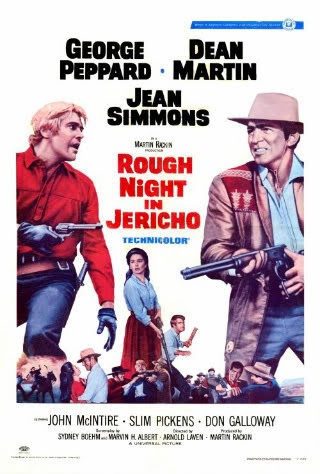
My last post looked at a superior little film scripted by Sydney Boehm, and that writer is the common thread linking into this one. Where The Raid was rich and fairly original in terms of theme, Rough Night in Jericho (1967) is an altogether simpler and, ultimately, less rewarding experience. That’s not to say it’s a bad movie, just that the plot treads a more worn path and the characterization has less depth and complexity. Generally, it’s a picture with lower ambitions, aiming for entertainment as opposed to any notions of profundity. What is does have in its favour are unusual casting, some instances of striking photography, and a couple of first class set pieces.

The tale told here is a familiar one: a town which, through weakness, has allowed itself to succumb gradually to the tyranny of one man. The town is Jericho and the man is Alex Flood (Dean Martin), a former lawman who has come to realize that there’s a better percentage (51% to be precise) to be had in simply ruling the roost. Bit by bit, Flood has acquired a controlling interest in just about every enterprise of value in the town. The one business he has yet to muscle in on is the stage line run by Molly Lang (Jean Simmons), twice widowed and Flood’s former lover. Working on the principle of fighting fire with fire, Molly has taken on a couple of partners she hopes will prove capable of facing down Flood. These men are Ben Hickman (John McIntire) and Dolan (George Peppard), two ex-peacekeepers who also want to try and turn a profit. The movie opens with Flood ambushing the new stagecoach driven by his would-be rivals, and establishes the confrontational tone that runs throughout. When the two men limp into town the first view to greet them is a graphic illustration of Flood’s handiwork – the corpse of a man who crossed him strung up from the hanging tree. With Hickman laid up in bed in Molly’s house recuperating from a gunshot wound sustained in the ambush, Dolan is essentially on his own. He’s a gambler, a man who always does the arithmetic in his head before acting, and he dislikes the odds stacked against him. While he neither likes nor approves of Flood and his tactics, he can’t see that anything’s to be gained in taking him on. The first half of the film basically involves these two natural rivals circling each other warily without either one of them wanting to overtly provoke the other. The scales are finally tipped by two factors: Dolan’s inability to crack the stubborn resolve of his aging partner, and a crude assault on Molly by Flood’s henchmen. When the gauntlet is thrown down, Dolan is bound to a path than can only lead relentlessly to a final showdown with Flood.

£10

Director Arnold Laven’s television credits far exceed his movie work, and I think that background is highlighted in certain aspects of Rough Night in Jericho. A large proportion of the action takes place within the confines of the town – particularly Molly’s home and Flood’s saloon – where both the filming and editing have a TV vibe about them. Whenever the characters venture out into the wilderness around Jericho there’s a far more cinematic atmosphere about it all, probably due to Russell Metty’s presence behind the camera. For the most part, Laven’s work on this picture is competent if not spectacular, though the final stalking scene in the brush is both overextended and clumsy in its editing. There are, however, two memorable sequences that raise the quality considerably. The first is a long, brutal fight between George Peppard and Slim Pickens with the weapons of choice ranging from a bullwhip to chains. Even now the scene carries some clout, and I can only wonder how audiences back in 1967 reacted to the savagery on display. The other notable scene comes towards the end when an exciting and well-staged shootout takes place in the saloon, John McIntire’s shotgun creating some particularly satisfying mayhem.

And now to the casting. Dean Martin is, somewhat unfairly I think, never going to lauded as a great actor, but his easy-going charm and natural affability meant he was never an unwelcome addition to any production. His portrayal of Alex Flood turns all expectations completely on their head though. Nearly all traces of the usual Dino persona are washed away as he plays Flood as a man without a shred of common decency. His actions right from the beginning – humiliating a deputy, orchestrating a lynching, sadistically beating a woman, back-shooting –  prove there can be no doubt as to his ruthlessness. While it’s certainly a shock to see him in such an unsympathetic role I think he just about carries it off. George Peppard is also effective as the reluctant hero up against Flood and his hired killers, his mostly sombre clothes and cheroot hinting at a reference to Leone and Corbucci. John McIntire was always a reliable presence in movies, especially westerns, and his cool professionalism acts as a stabilising force here. English actress Jean Simmons had already demonstrated her ability to slot comfortably into the world of the old west with her role in The Big Country, and does so again in this film. Her tough widow is the only significant female part amid all the macho posturing and she’s perfectly credible as a frontier survivor. It has to be said though that she – along with Peppard – is involved in one of the least successful scenes in the whole movie. It’s a comic interlude that sees Molly and Dolan matching one another drink for drink before collapsing into bed. The scene isn’t especially badly played or filmed, but it’s tone is completely at odds with the rest of the picture and it draws attention to itself for all the wrong reasons.

The German DVD of Rough Night in Jericho by Koch Media has the film looking wonderful in anamorphic scope. Colour and detail levels appeared acceptably high to my eyes, and I wasn’t aware of any significant print damage. The disc offers either the original English soundtrack or a German dub – there are no subtitles to worry about. Extras consist of the trailer, a gallery and an inlay card with notes in German. At this point, I ought to mention that the film is due to go in sale in the UK at the end of this month via Pegasus. If the transfer is up to the standard of the company’s other recent Universal releases then it should represent a viable (and more economical) alternative. This is a film whose plot offers nothing new or startling to western fans, who will have seen countless variations on the tale. Nevertheless, there’s a good deal of entertainment to be had along the way, and the cast all do a perfectly satisfactory job. It’s a solid and unpretentious late-60s western whose strengths and weaknesses just about balance each other out.

The Raid

poster312

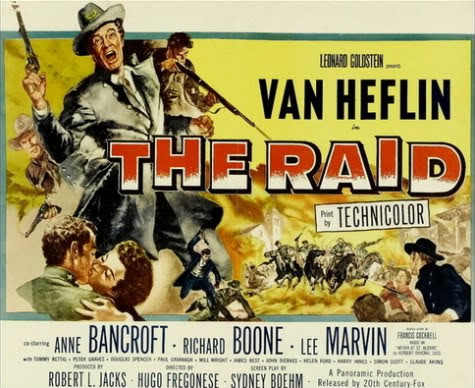
There is no conflict as dirty, socially corrosive and tragic as a civil war. Friends and neighbours, those whose similarities are every bit as pronounced as their differences, suddenly find themselves sworn enemies at one another’s throats. Any story which uses such a conflict as its backdrop automatically has an enormous amount of built-in dramatic potential. Yet despite that, there’s a hazard too – commercial success is by no means guaranteed. Movies based around the American Civil War were traditionally regarded as box office poison, and I don’t think such an aversion is some affectation confined to the United States. There are few nations which haven’t fallen victim to internal bloodletting, and the scars of these events never fully heal in the public consciousness – it’s hard to get past the essential ugliness of a country tearing itself apart from within. However, a movie can still remain compelling, and indeed worthwhile, in the face of these obstacles. The trick is to sidestep the cloying piety that can sink a script and instead focus on the real human effects of a land and people divided. The Raid (1954) is such a film.

The story is based on a real event during the Civil War – one of those peripheral actions that occur in most conflicts. It opens with a small band of Confederate POWs staging a breakout from a Union prison close to the Canadian border. The aim of the fugitives, under the command of Major Benton (Van Heflin), is to cross into neutral territory and reorganise themselves there. Benton has in mind using the neighbouring country as a springboard to attack the North. His plan is to marshal his forces and unexpectedly raid the border towns, both as an act of revenge for Sherman’s pillage of the South and as a means of drawing vital troops away from the front line and thus relieving the pressure on Lee. The target for the first of these incursions is St Albans, Vermont. Benton arrives in town posing as a Canadian businessman looking to invest in local property, but really scouting the lay of the land and paving the way for his comrades to join him. The basic plan is to clean out the banks, providing much needed funds for buying munitions, and then to torch the town and cause as much havoc as possible before beating a hasty retreat back across the border. On paper, this sounds like a viable proposition but complications inevitably arise. There are three troublesome flies in Benton’s jar of ointment: Katy Bishop (Anne Bancroft), the young widow running the boarding house where Benton’s lodging; Captain Foster (Richard Boone), the one-armed veteran in charge of St Albans’ small military force; and Lieutenant Keating (Lee Marvin), whose bitter hatred of the North means he’s something of a loose cannon among Benton’s otherwise highly disciplined force. These three people, and Benton, are a perfect illustration of the effects of civil warfare. All of them have been damaged, either physically or emotionally, by the war and all represent different aspects of the mindset it has created – Keating’s volatile sadism, Katy’s dignified struggle against loneliness, Foster’s self-loathing, and Benton’s juggling of professionalism and sentiment. One key scene highlights the moral dilemma faced by a man in Benton’s peculiar and precarious position. Having just saved the townsfolk from mortal danger (and himself too, as it happens), he returns to his lodgings only to be confronted with that which he least expected – the gratitude and acceptance of the local community. A combination of shock, humility, and horror at his own duplicity briefly flit across Benton’s features. In this moment, everything we need to know about how this kind of war divides loyalties, even internally, is deftly expressed. Still, Benton is a man of principle and, despite any moral qualms he may be experiencing, he forges ahead towards his objective. By the time the actual raid occurs the viewers have been granted a glimpse into the hearts and minds of those from both sides of the divide, making the climax all the more tense and charged.

£9

Argentine director Hugo Fregonese came to Hollywood in 1949 and made a number of films that have largely been forgotten outside of film buff circles. There may not be any masterpieces among his credits but he displayed a very strong visual sense and his work remains interesting at the very least. Apache Drums, produced by Val Lewton, is a little neglected gem that’s ripe for rediscovery, while Saddle Tramp and Harry Black and the Tiger have points in their favour too. The Raid is one of his best efforts, looking handsome and maintaining suspense throughout. The reenactment of the titular raid (a bit of research indicates that the real event resulted in considerably less damage) makes for an exciting climax and it’s well staged by Fregonese and his cameraman, Lucien Ballard. Van Heflin does very well as Major Benton, looking tough and authoritative enough to be believable as the commander of the raiders, and also showing the right degree of sensitivity when necessary. He hadn’t the looks to make a career as a romantic lead but his understated performances generally had a very attractive human quality. Once again, Richard Boone seems to get right into the character he’s playing; the gruffness of Foster initially seems to stem from his bitterness over his war injury but, as the story progresses, it’s apparent that his reserved demeanour has a deeper psychological root. Both actors bring quite subtle nuances to their respective characterizations and there’s nothing one-dimensional about either of them. Personally, I found it refreshing that Anne Bancroft’s widow was used as a softening influence on both Boone and Heflin, and wasn’t there merely to provide an excuse for some superfluous romance. Her presence is integral to the development of the plot and the shifting emotions of the two men staying under her roof, but not as a stereotypical Hollywood siren. Heading up an especially strong supporting cast, Lee Marvin turns in another memorable performance as the vengeful and dangerous Keating. His “bull in a china shop” approach acts as a counterweight to Van Heflin’s measured caution and helps to up the tension.

To the best of my knowledge, the only DVD release of The Raid is the Spanish edition from Impulso/Fox. Generally, whilst apparently unrestored, the disc is one of their reasonable efforts. The film may have been 1.66:1 originally, but this transfer presents it in Academy ratio (1.33:1) – if it’s open-matte it may be slightly zoomed as the framing looks a little tight to my eyes on occasion. However, I wouldn’t say it was seriously compromised. The colour and detail levels are quite strong, and it’s pleasing to look at. The extras are the usual gallery and text items, and the Spanish subtitles can be disabled from the setup menu. The film approaches its subject matter intelligently and avoids forcing judgements on the viewer. The combination of a strong, capable cast, a tight script and professional direction adds up to a pacy and entertaining look at an intriguing episode from the Civil War. Recommended.


Singapore

relx40f

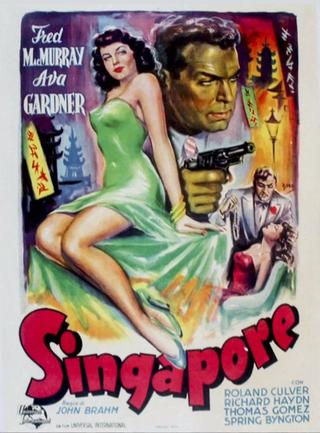
Sometimes it’s hard to know how to categorize a movie; it may have certain familiar and identifiable features that one associates with a particular genre, yet either fails to capitalize on these or mixes in the traits of another type of movie. Of course that’s not necessarily a bad thing, and a touch of the unexpected can enliven a stale formula. But not always. Singapore (1947) has many of the trappings that are associated with film noir: dark, shadowy imagery, a flashback, a voiceover narration, a slightly unscrupulous protagonist, a mysterious woman. Still, it’s not a noir picture; there’s too much melodramatic romance and half-hearted adventure tossed in there. Ultimately, it’s a movie that flirts with a handful of genres and suffers a bit of an identity crisis as a result. Besides that, it’s just not very good.

Matt Gordon (Fred MacMurray) is a pearl smuggler – we learn this when he’s pulled in to the custom’s office the moment his plane touches down in Singapore. With the war over, he’s returning to his old haunts and the authorities suspect that he’s likely to return to his old trade too. As Gordon wanders through the hotel where he formerly resided, he’s suddenly assailed by memories. A flashback sequence sees him in the days leading up to the Japanese attack and introduces the old lover whose loss still preys on his mind. Gordon and Linda Grahame (Ava Gardner) had one of those whirlwind romances that are often found in wartime movies. Just as the couple are about to tie the knot the bombing raids commence, and he races back to his hotel to recover the fortune in pearls he has stashed there. Failing to recover his treasure, he returns to find the chapel in ruins and Linda missing presumed dead. And so we’re up to speed – Gordon has come back to Singapore hoping his pearls may still be retrievable. As he awaits the opportunity to check out his old quarters and see if the loot is still there, he spies Linda. The woman he thought had perished in the bombed out chapel is alive and well, but has no recollection of who he is. Amnesia – we’re back in noir territory, right? Wrong. Loss of memory can serve as a great plot device when it involves blanking out secrets that carry a threat or danger. In Singapore, that’s not the case at all and the story becomes bogged down in a soapy love triangle that really only has two sides. Sure, there’s an attempt to milk some suspense and intrigue from the secondary business of two cartoon villains (Thomas Gomez and George Lloyd) also seeking the elusive pearls, but again the absence of any real threat hamstrings that element.

PDVD_001-45

Casablanca struck gold when it placed its two eternal lovers in an exotic locale, but a movie needs more than that to succeed. Lots of films have tried to tap into that vibe (Macao, Calcutta, Saigon etc.) but the results have been variable at best. For me, Singapore fails on two levels; the central romance and half-hearted mystery just aren’t engaging, and the leads don’t have any spark together. Although both MacMurray and Gardner are good enough in their respective roles they have no chemistry whatsoever, and that’s a major issue when the script revolves around an apparent grand passion. As if that weren’t enough, the chief stumbling block preventing the couple from picking up where they left off – Gardner’s post-amnesia marriage to a planter – rings hollow and utterly fails to convince. As the villain, Thomas Gomez is surprisingly toothless and his character’s borderline incompetence means that we never seriously doubt MacMurray’s ability to get the upper hand. Director John Brahm made a number of noir-tinged melodramas that have much to recommend them, but Singapore is certainly among his weaker efforts. I’m generally a fan of his work and he does his best to inject some style into this humdrum production. The angles are varied and the sets are cleverly lit to enhance the atmosphere as far as possible. Still, apart from a short sequence which sees MacMurray struggling to extract his hidden pearls while avoiding the attentions of the law next door, there’s precious little tension on view.

As far as I’m aware, the only current commercial release of Singapore is the recent DVD from Universal in France. Generally, the film has been presented well; the transfer does exhibit some dirt and speckles but this is really only noticeable right at the beginning. The image is satisfactorily sharp and contrast is consistent throughout. There are no extra features offered and the French subtitles are optional and can be disabled via the setup menu – burnt-in captions do appear though on a handful of occasions when text is displayed, but this is too rare and minor to be regarded as a black mark. I guess I’ve made it clear enough that this isn’t an especially good or memorable movie. Singapore was later remade as the Errol Flynn vehicle Istanbul and while that’s no great shakes either, it’s arguably a stronger film. This one is attractively shot and Ava Gardner looks wonderful as always, but that’s about it. I can’t say I got much out of the movie and it’s not one I’d recommend tracking down.


Jubal

Shakespeare and westerns really don’t sound like they go together. However, in the case of the former, the universality of his themes means that the location and period in which the drama takes place is largely irrelevant. And as for the latter, the genre is so flexible that pretty much anything can be tackled within its framework. William Wellman’s Yellow Sky has been described as a reworking of The Tempest, while Jubal (1956) sees the ideas central to Othello transported to a ranch in Wyoming. In a way, the isolated simplicity of the west provides an ideal backdrop for the presentation of such timeless concepts. Like an uncluttered stage, the absence of the trappings of civilization helps to better focus attention on the more important aspects of the story.

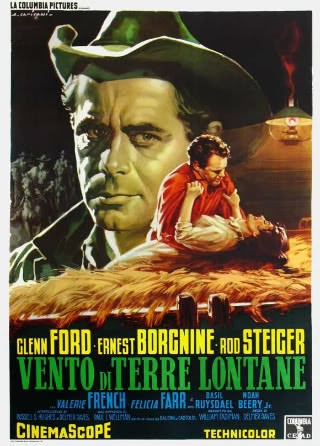
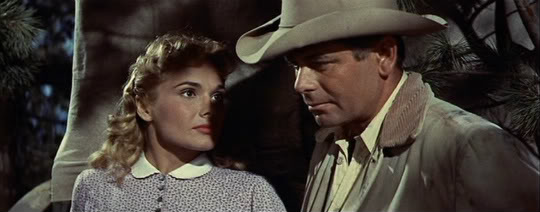
Jubal Troop (Glenn Ford) is a wanderer, a man who has spent his life running; he claims that he’s been trying to escape the bad luck that’s always dogged his steps. In reality though, he’s been running away from himself, or rather his own perceived inadequacies that stem from traumatic childhood experiences. When ranch boss Shep Horgan (Ernest Borgnine) takes him in and offers him a job and a chance to make a fresh start, it looks as though his streak of ill-fortune may be coming to an end. In spite of Jubal’s initial optimism, he soon realizes that he’s actually walked into a highly volatile situation. Shep is one of those salt of the earth types, brimming with hospitality and geniality yet lacking certain social graces. It’s this cheerful disdain for (or ignorance of) the niceties of polite society that has apparently pushed his young Canadian wife, Mae (Valerie French), away from him. I say apparently, because Mae merely uses this as an excuse – it’s clear enough that the remote ranch life and lack of social contact play an equally significant role in shaping her dissatisfaction. Almost as soon as Jubal arrives on the scene Mae begins to show an interest in the newcomer. On top of all this, there’s the problem of Pinky (Rod Steiger), Shep’s current top man and the previous recipient of Mae’s attention. Where Jubal resists Mae’s advances on the grounds that it would be a betrayal of the one man who ever handed him a break, Pinky never displayed such qualms. Now that he’s been sidelined by the new arrival, his resentment and natural antagonism bubble closer to the surface. Due as much to his own petty and spiteful nature as Jubal’s dedication to his job and his boss, Pinky finds himself falling out of favour both as a lover and an employee. It’s this displacement that triggers Pinky’s pent-up jealousy and latent misanthropy. When the opportunity arises, he slyly plants the seeds of doubt in Shep’s mind. And it’s from this point that the classical tragedy at the heart of the story starts to develop fully.

Delmer Daves had a real affinity for the western, his films within the genre all displaying an extremely fitting sense of time and place. In addition, he also had a great eye for telling composition and the use of landscape. His best movies look beautiful, and Jubal takes advantage of the breathtaking vistas that the location shooting in Wyoming offered. The exteriors have a kind of clean, bracing quality to them reminiscent of the mountain air their backgrounds suggest. These wide open spaces are representative both of the freshness of Jubal’s new life and also the remoteness of Shep’s ranch. However, Daves was no slouch when it came to interiors either; he, and cameraman Charles Lawton, create some extremely moody and tense imagery when the action moves indoors. It’s not always easy to achieve effective depth of focus and shadow density when filming in colour, yet Daves and Lawton manage to pull it off time and time again. When you’re telling a story as thematically dark as this it’s vital to keep the mood of the visuals in tune with the plot – Jubal always looks and feels just right at all the critical moments. What’s more, although Daves’ endings had a tendency to be a letdown in comparison to what went before, this movie maintains the correct tone right up to the rolling of the credits.

Glenn Ford was an excellent choice to play Jubal Troop, his edgy affability and that slight unease were well suited to the role. The character has an innate nobility and honesty, but there are demons lurking there too, torturing the man with personal doubt and a devalued sense of self-esteem. Ford had a gift for projecting all these qualities on the screen; perhaps that’s why he seemed at home playing in both psychologically complex westerns and film noir. In the following year’s 3:10 to Yuma, Ford and Felicia Farr played out one of the most touching and affecting romantic interludes it’s been my pleasure to see on film. This picture also features a romance between the two, just not as memorable or emotionally loaded as what was to come. Part of the problem is the weaker role handed to Ms Farr, but she still manages to convey something of that bittersweet tenderness in her scenes with Ford that would prove so effective in their next collaboration. The other, and much more substantial, female role was that of Valerie French. There was certainly nothing likeable about the part of Mae, whose infidelity (both real and imagined) sets three men at each other’s throats. Her frustrated sexiness is well realized and, by the end, in spite of her deceit, it’s hard not to feel some sympathy for her fate. Ernest Borgnine’s cuckolded husband draws even more pity though; the way he positively radiates a love for life means that his betrayal really hits home. His brash good humour makes him a favourite of the men, but also leaves him blissfully unaware of the coldness of his wife. When it suddenly dawns on Shep just how much of a fool he’s been, Borgnine’s highly expressive features show very clearly how deeply Mae’s playing around behind his back has affected him. Rod Steiger was always an extremely showy actor, forever in danger of allowing his intensity to spill over into inappropriate grandstanding. As the scheming and reprehensible Pinky, he just about manages to stay the right side of the line – although his tendency towards showboating does raise its head as the movie nears its climax. Among the supporting cast, Charles Bronson makes a strong impression as a hired hand who befriends Ford, and whose intervention at two critical moments help save the day.

Jubal has been available on DVD for a long time via Columbia/Sony in the US. The disc boasts a very good anamorphic scope transfer that looks rich and colourful. There are no extras offered, unless you count the preview snippets for other western titles from the company. The film remains an excellent example of Delmer Daves’ skill at telling a mature and thoughtful western tale. I think the fact that both the director and the star went on to make the better known 3:10 to Yuma a year later has overshadowed this picture to an extent. I’d say that anyone who enjoyed that movie will also appreciate the work on show here. This is yet another strong entry in the western’s golden decade, and fully deserving of any fan’s attention.

Terror in a Texas Town

poster34-2

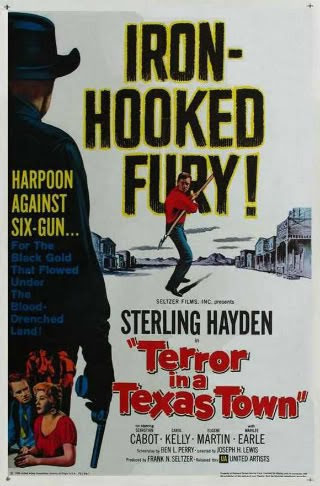
So many westerns have hinged on the conflicts that arise over land: the need to expand settlements, the presence of gold or silver, grazing rights, the relentless progress of the railroad. However, not too many have dealt with oil. Terror in a Texas Town (1958) uses the issue of oil to explain the actions of its characters (especially the villains) yet it’s not this that interests us as viewers. At the heart of the story lies a good old-fashioned tale of justice and revenge. As such, we have a very traditional plot, even one that could become mundane in other hands. Nevertheless, director Joseph H Lewis and uncredited writer Dalton Trumbo between them manage to craft a highly unusual western that probes around the genre’s boundaries.

The entire film is told in flashback, the opening scene cut short at the crucial moment and its resolution only revealed right at the end. The grandly named Prairie City, Texas is one of those typical western towns, dusty, sleepy places where nothing much seems to happen. Be that as it may, the leading citizen, McNeil (Sebastian Cabot), is in the process of shaking things up. He’s engaged in a land grab; having learned that the surrounding area is literally swimming in oil, he has called in an old acquaintance to help him run the homesteaders off their property with a view to seizing it for himself. His henchman of choice is Johnny Crale (Ned Young), an old-school enforcer and gunman who’s had his right hand shot off in the course of his work and who’s fast becoming a relic of a previous era. Crale’s first assignment is to kill a man, a kind of coaxer to encourage the others. As it turns out, this is an unfortunate selection – an old Swede patiently tending the land until his son returns from the sea. The son, George Hansen (Sterling Hayden), cuts an incongruous figure when he arrives, awkwardly dressed in his ill-fitting city clothes and lugging a heavy sea chest on his shoulder. The scene in the saloon, where Crale tells Hansen of the murder of his father (leaving out the crucial detail of who did the deed) is so well filmed – just two guys and a girl sitting around a table in a deserted bar, yet absolutely riveting in its very simplicity. The viewer is a step ahead of the apparently slow-witted Swede in knowing the identity of the killer, and it’s fascinating to watch the movie’s two protagonists, with their contrasting characters, probing for an insight into each other. Of course, Hansen is nowhere near as dumb as his appearance suggests. Before long, he’s got the measure of both McNeil and Crale and finds himself drawn inevitably towards the almost surreal showdown that started the movie.

£39

Joseph H Lewis is probably best known for two remarkable noir pictures, Gun Crazy and The Big Combo, yet Terror in a Texas Town (his last movie before moving to TV) is both powerful and individualistic enough to be mentioned in the same breath. It’s an extremely low budget affair, shot on sets with a very limited cast, that turns its lean production into an asset. The dialogue is trimmed down to the bare necessities, thus lending it greater impact, and every shot is loaded with significance. One example is the scene where Hansen returns to find the Mexican settler he’s befriended has been gunned down by Crale. A simple cut to the tight grouping of the man’s grieving widow and children tells us all we need to know about the effect this killing has had, far more eloquent and touching than reams of sentimental dialogue or exposition. The unique set piece that frames the story, the duel between a six-shooter and a harpoon, is more than a mere artistic quirk, it sums up the idea at the heart of the story: a simple outsider with primitive tools taking on the might of the exploiters. Trumbo’s leftist take on events and characterization is one of the key factors that makes the film so compelling.

Sterling Hayden’s sheer physical bulk always ensured he maintained a powerful presence on screen, and he used that attribute to great effect as the stoic and immovable George Hansen. He’s very convincing as the foreigner who has to measure his words carefully and think before he expresses himself. The fact that it’s this Swede, and his Mexican friend, who stands up to the criminal excesses of unchecked capitalism highlights the way America (as Trumbo no doubt perceived it) had become ineffectual and complacent when it came to facing the threat of corporate greed. Ned Young, as the physically deformed and morally confused enforcer, is a marvelously ambiguous figure. He’s clearly a bad man, both his background and the murders he commits during the film attest to that. Still, he remains a multi-dimensional character; he’s a reluctant killer, motivated less by money than a kind of morbid curiosity about the psychology of fear and death. The true villain is Sebastian Cabot’s McNeil, the very embodiment of a corrupted and heartless American society. This bloated figure, exuding a fake bonhomie, is the archetypical avaricious businessman with the law in his pocket – the unattractive face of a new west. Personally, I’m struck by the parallels between McNeil (and his ultimate fate) and Gabriele Ferzetti’s Morton in Leone’s Once Upon A Time In The West.

Terror in a Texas Town has been available on DVD for a long time now from MGM in the US. The movie has been given a strong anamorphic widescreen transfer that does justice to Lewis and cameraman Ray Rennahan’s compositions. I suppose the biggest complaint is the amount of grain visible, not something that generally bothers me but there is an awful lot of it. The disc offers no extras except the theatrical trailer. The film has also been released in the UK by Optimum. I don’t have that disc to compare but being a title licensed from MGM, it’s likely to be broadly similar in terms of quality. I have a lot of time for this movie; I love its low budget urgency and the offbeat style. The involvement of Sterling Hayden, Ned Young and Dalton Trumbo conjures up the ghost of HUAC and the blacklist, while the plotting and characterization are further reminders of a period of US history that remains both fascinating and tragic. This movie seems proud of its own B status and proves that lower budgets don’t have to mean lower quality. It gets a definite thumbs up from me.


The Naked Edge

poster314-1

I guess it’s inevitable that cinema, like most any form of artistic expression, will be influenced by the body of work that already exists. Remakes, reimaginings and homages seem to have been with us forever, and one figure who’s arguably been imitated more than any other is Alfred Hitchcock. Both the stories he was drawn to and the filming techniques that he frequently employed have been referenced so many times that there’s a subgenre of “Hitchcock style” thrillers. The Naked Edge (1961) may not be all that well-known but it certainly belongs in that category. Of course, as with most (all?) imitations, it fails to live up to the standards of the movies it alludes to – once a filmmaker sets out on this path he necessarily sacrifices a lot of his own individuality. Still, that doesn’t mean that the movie in question can’t be entertaining in its own right; after all, half the fun for the viewer comes from recognizing the source of inspiration.

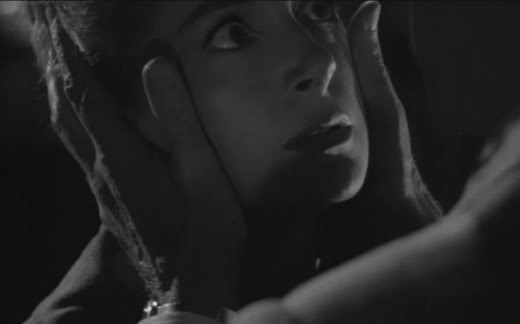
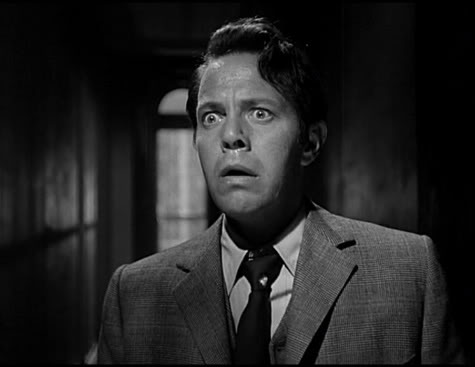
The pre-credits sequence opens proceedings in lurid fashion with a murder – a businessman taking a knife to the guts – and hurls the viewer right into the action. There follows a trial where the evidence of George Radcliffe (Gary Cooper), an American resident in London, appears instrumental in securing the conviction of Donald Heath (Ray McAnally) for the murder of their boss and the accompanying theft of the firm’s money. Heath, naturally perhaps, protests his innocence and Radcliffe hastily exits the emotive atmosphere of Old Bailey with his former colleague’s accusations of treachery ringing in his ears. Even at this early stage, the clouds of suspicion are gathering around Radcliffe; the unrecovered loot, his talk of suddenly acquired wealth and an edgy encounter with a disbarred solicitor (Eric Portman) initially stir doubts. Jump forward six years and we find Radcliffe now heading a successful partnership and clearly wealthy. However, it’s only when a long-lost blackmail letter is delivered to his wife that we get to the nub of the matter. Radcliffe’s wife, Martha (Deborah Kerr), may have harboured a few mild suspicions before, but the letter that explicitly accuses her husband of murdering his employer and using the stolen money to finance his own business plants a particularly stubborn seed. A combination of apparent evasiveness by Radcliffe when asked any questions about the murder and subsequent trial and some downright suspicious behaviour on his part cause Martha’s doubts to grow. The deeper she delves into the past, the more convinced she becomes that the full truth may not have come out in court. With her marriage starting to crumble in this sea of distrust, it gradually dawns on Martha that her own life may be in jeopardy too.

£38

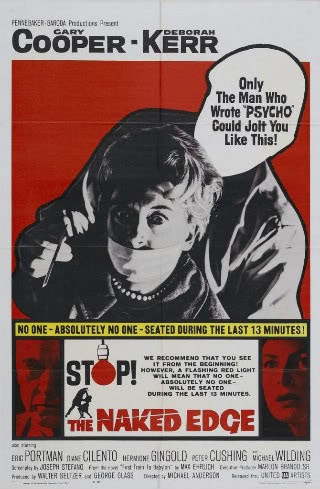
A few years earlier, Michael Anderson had directed another “woman in peril” picture – Chase a Crooked Shadow – and in my review of that I commented on his tendency to indulge in some self-conscious effects. The Naked Edge was clearly trying to tap into a Hitchcock vibe (the poster prominently highlights the involvement of Psycho screenwriter Joseph Stefano), and Anderson’s direction makes use of countless low angle shots and zooms. Of course, this isn’t an especially bad thing as we’re treated to some nicely composed shots that accentuate the tension. The climax, where preparations are meticulously laid for an attempt on Martha’s life, consists of a whole series of well-judged shots cut together expertly. Where the film does become overly derivative, and indeed contrived, is in the poor handling of the dialogue. It reaches the point where I found myself imagining the writers sitting around and scratching their heads over how they could mangle the words a bit more to ensure the ambiguity of Radcliffe’s character was rammed home. I feel a lighter touch would have sufficed.

Cooper’s performance in the lead contains enough of the man’s own natural diffidence and reserve to get the job done satisfactorily. This was Coop’s last screen role and, even if he doesn’t look exactly ill, he does exude an air of age and weariness. In all honesty, I generally find it difficult to watch performances from actors when I know they hadn’t long to live afterwards – it’s even harder when the person is someone whose work I’ve grown to admire. Whenever Cooper talks about safeguarding his future I can’t help but get that hollow, sinking sensation. In the role of Martha, Deborah Kerr was handed what was really the pivotal role; she’s the one from whose perspective the unfolding events are seen. In order for the viewer to retain doubts it was necessary for Kerr to convincingly portray a woman who could never be quite sure of anything herself. I think she managed that, never allowing histrionics to overwhelm her character and thus alienate the audience. For the most part, the supporting roles are fairly small yet highly memorable. No-one possessing even a passing familiarity with British cinema of the period  could fail to be impressed by a cast list that features: the aforementioned Eric Portman and Ray McAnally, Peter Cushing, Michael Wilding, Wilfrid Lawson, Diane Cilento, Hermione Gingold and Joyce Carey to name but a few.

The Naked Edge is out on DVD in the UK from Cornerstone/Palladium. The film is letterboxed (not anamorphic) at about 1.66:1, which would fit a film of this vintage. The transfer is generally good and fairly clean, although I did notice at least one cue blip. There is a certain softness to the image at times and the black levels are decidedly on the grey side. While I wouldn’t term it a displeasing transfer, it could stand some improvement too – even so, it’s never less than watchable. There are no subtitles offered and no extras. So, how do I rate it as a movie? As I’ve already said, the whole “woman coming to distrust a suspicious husband” storyline invites obvious comparisons with Hitchcock; Anderson’s direction throughout only compounds that, and there’s a short sequence that replicates one of Hitch’s more heavily criticised ploys. On the whole though, I think the film is generally successful in keeping the atmosphere tense and the viewer guessing. Let’s call this a cautious recommendation.


Payroll

poster96_zpsmeo0wngl1

As British cinema entered a new decade in the 1960s it was possible to discern a shift in attitude, a gradual move away from the style that been dominant in the post-war years. Previously, films had concentrated largely (though by no means exclusively) on the middle classes and the concerns that occupied them. That aspect had been especially noticeable in crime pictures and thrillers; and while it’s not without its attractions and merits, it did impose certain restrictions and sometimes led to an oversanitized or slightly twee form of storytelling that set it apart from the grittier fare that US audiences were exposed to. Naturally, there were exceptions, but they were fairly thin on the ground. However, a film like Payroll (1961) fixed the spotlight squarely on the professional criminals of the lower classes, and the result was a much more explicit portrayal of violence and sexual relations than had been the case before.

Payroll is a heist movie and develops according to the usual formula for such films: planning, execution, and the inevitable unravelling of everything. The story follows three interconnected strands, all of which are vital in bringing about the final resolution. Thus, we see the tale of the criminals, the accomplice, and an unfortunate victim all become bound together in a heady mix of violence, sex and double-cross. The opening has plans being laid to snatch the payroll of a Newcastle factory. The four man gang engaged in this little conspiracy is headed up by Johnny Mellors (Michael Craig), who acts as both the brains and the muscle of the quartet. What initially appears to be a straightforward job is complicated by the decision of the management of the factory to alter their procedure. Abandoning their old methods for having cash delivered, they choose to employ a new security firm with a seemingly impenetrable armoured car at its disposal. Naturally, this necessitates a change of tack on Mellors’ part, and so he puts the squeeze on his inside man, Pearson (William Lucas), to seek out the specs of the armoured car in order to establish its weaknesses. The reason behind Pearson’s involvement with these types is an old and familiar one – a desire to make a quick buck. His wife, Katie (Francoise Prevost), is a war refugee and a greedy woman, frustrated by her nondescript husband’s failure to make good on the potential she thought he had. A weak man living in the shadow of a sneering woman’s disapproval is a prime candidate for corruption, and so Pearson bows to the pressure brought to bear on two fronts. When the subsequent robbery turns sour and leaves two men dead, one of whom is the driver and boss of the security firm, the cracks in Mellors’ plan start to show themselves. Pearson finds himself facing the dual threat of a duplicitous and adulterous wife while also being stalked by a vengeful and suspicious widow (Billie Whitelaw). At the same time, Mellors is struggling to hold in check the increasingly volatile forces within his spooked gang. Ultimately, the sour combination of murder, illicit relationships and plain rotten luck bring matters to a head, and a bleakly satisfying conclusion.

£38]

One of the pleasures of watching British thrillers of this vintage is the glimpse we get of cities and landscapes now transformed. The location filming around Newcastle adds to the gritty and realistic feel of the piece by placing the characters in the down at heel urban world that the genteel classes didn’t inhabit. It’s not hard to see why these men and women might find themselves driven by their desire to escape the drab surroundings. Director Sidney Hayers shot a lot of the movie around run down businesses and decaying lockups, all of which add to the aura of despair. He also did fine work when it came to dealing with the action scenes; the heist itself, a brutal street mugging, and a grotesque double murder in a swamp all reveal an urgent and dispassionate style that’s highly effective.

The casting was also spot on, with Michael Craig displaying the kind of machismo and edgy charm that fits right in with his role as the ruthless gang boss. Of the others making up the criminal foursome, Kenneth Griffith probably comes off best as the jittery, conscience-stricken weak link. Of course, William Lucas is arguably even more successful in conveying human frailty as Pearson; a thoroughly beaten man who’s driven to the very edge of reason by his own guilt and the provocation of his grasping spouse. Francoise Prevost really nailed her portrayal of a latter-day femme fatale, goading her husband into crime before betraying him sexually, and finally crossing up her lover for profit. The other female role, that of Billie Whitelaw’s avenging widow, is equally powerful. The mask-like set of her features takes on a terrible aspect as her relentless quest for righteous retribution drives one man out of his mind and another to his death.

Payroll has been released on DVD in the UK by Optimum and it looks very good. The film is presented in a progressive and anamorphic transfer at 1.66:1, and the print used is in particularly good shape. The image is clean and sharp, and I can’t honestly say I was aware of any significant damage. As usual with Optimum titles, there are no extras offered and no subtitles. However, the movie itself is a genuine keeper. If you’re looking for a hard-edged British thriller with steel in its guts then you won’t go far wrong with Payroll. It has that post-noir feel to it that’s enormously attractive, and I strongly recommend checking it out.


House by the River

I know everyone won’t agree but I’ve always felt that film noir works well in a gothic setting, where the atmosphere is necessarily thick and crimes (particularly crimes of passion) are a basic ingredient. In addition, the social constraints that govern the characters’ lives and actions help to increase the feeling of pressure, while the ornately forbidding homes where many such stories are played out can be just as menacing in their own way as any rain-slicked urban sidewalk. I think the fact that noir isn’t a real genre is one of its great strengths; this lends it a flexibility allowing theme, mood and look to assume as much importance as time and place. Fritz Lang’s House by the River (1950), dripping in heavy gothic atmosphere, confined for the most part to the titular house, and exploiting the suffocating moral code of its period setting, is most definitely film noir. It’s an interesting and at times visually striking work, but not an entirely successful one. However, I’ll go into the reasons for that later.

Stephen Byrne (Louis Hayward) is a writer, but not an especially successful one. He is first seen seated outside his riverside home and working on a manuscript. When a neighbour comments on a foul animal carcass that the current has been carrying up and down the waterway for days, he remarks that it’s a similar story with his writing – his publisher keeps returning it. Despite the light tone of these comments, the river, and its tendency to return anything tossed into it, plays a significant (and even vaguely supernatural) part in the plot. While his professional shortcomings only serve to hint at a weakness in Stephen’s character, the sly, lustful glances he steals at his attractive housemaid make that flaw obvious. Taking advantage of his wife’s absence, he decides to try his hand at seducing the help. However, his inadequacies manifest themselves again and he botches the attempt. What’s worse is that in an effort to prevent the girl’s cries from alerting the neighbours to his philandering, he accidentally strangles her. These early scenes inside the opulent yet oppressive home, all carved furniture and flock wallpaper, are particularly well staged and shot; the extreme angles and the high contrast photography conveying a sense of claustrophobic menace and terror. Having his brother John (Lee Bowman) stumble on the killing might appear to be just one more calamity to befall this man. Nevertheless, it turns out to be something of a godsend. John, with his stiff leg and retiring manner, is the polar opposite of Stephen, a kind and considerate man whose sense of civic duty is only exceeded by his loyalty to his brother. So, when Stephen begs for his help in covering up what he claims was merely a tragic miscalculation, John agrees to bail him out. With the body of the unfortunate servant bundled into an old wood sack, the two brothers row out on the river at night and dump the evidence. But it’s from this point on that the story begins to twist and turn like the meandering river and continues to do so until the literal and metaphorical tide brings everything back home. As events unfold, the contrasting characters of the two brothers are thrown into sharp relief, John’s stoicism and honour growing as the crisis deepens while Stephen’s venal and deceitful nature gradually consumes him.

Fritz Lang’s films, by his own admission, all deal with human weakness and the criminal actions that follow. House by the River can be viewed as a meditation on moral weakness and its corrosive effects; murder, the destruction of family relationships, and the final descent into madness. The small central cast and Lang’s moody visuals ensure that the tension is never relaxed yet the film doesn’t quite satisfy. When this happens the finger of blame can often be pointed at the writing or direction. However, that’s not the case here; I can’t fault Lang’s work and the story is logical enough in context, although it has to be said the ending is both abrupt and a little too contrived for my liking. No, the problem as I see it is more of focus and characterization. It’s important for any film to have a lead who’s capable of stirring at least some sympathy or sense of identification with the audience. In House by the River the lead is Louis Hayward’s Stephen, and he is such a vile excuse for a man that it’s quite impossible to empathize in any way. In the comments on an earlier post I mentioned that Louis Hayward has never been a favourite of mine, but that’s not the issue. In all honesty, his playing of Stephen is a good piece of work – he really fleshes out the smarmy, snivelling aspect of the man. As I said, it’s a matter of focus; the story is seen primarily from Stephen’s perspective, and it’s more and more difficult as the film progresses to feel anything other than revulsion at the self-serving way he latches onto every opportunity to gain advantage at the expense of those around him. The only “hero” of the piece, although I’m not sure the word’s entirely appropriate, is Lee Bowman’s John. Even if there’s arguably too much of the martyr about him, he does present a human face, a kind of moral compass amid the depravity. However, John’s suffering at the hands of his brother is pushed for the most part to the background, and although we’re rooting for him it’s Stephen’s scheming that remains front and centre. I ought to mention Jane Wyatt’s role as Stephen’s wife as it’s the only other significant part. She does tap into a sort of soulful and vaguely bewildered vibe, but this is essentially a two-man show and she is mainly left to play the puzzled dupe before transforming into the typical damsel in distress.

Over the years I’ve bought House by the River three times on DVD before finding a copy that I consider acceptable. The US edition from Kino is a weak interlaced transfer while the French disc boasts a far stronger image but has forced subtitles that can’t be switched off easily. However, last year’s release by Sinister Films in Italy is an excellent alternative, looking as though it’s been taken from the same source as the French version. The film has been transferred progressively and the image is sharp and detailed with only very minor print damage. The Italian subtitles are optional and can be turned off via the setup menu. By way of extras, the disc also features a conversation between Lang and William Friedkin focusing on the director’s time in Germany and lasts around 45 minutes – a most welcome addition. There’s also an inlay card that folds out into a miniature reproduction of the original poster art. All in all, this is a movie that I’m quite fond of – I’ve highlighted the reasons why I don’t see it as one of Lang’s best efforts, but there’s still a lot to enjoy and admire. For those who don’t yet have the film, or others dissatisfied with the editions they already own, I recommend checking out the Italian disc.