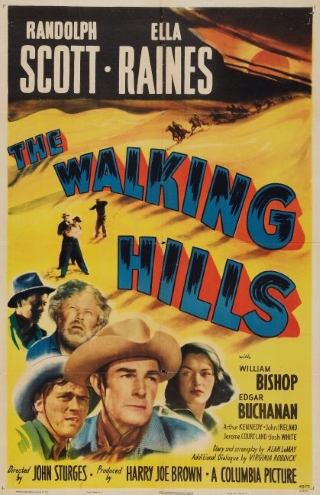
In 1948 John Huston had a small yet ill-assorted bunch of fortune hunters looking for gold and finding it paved the way to something far darker in The Treasure of the Sierra Madre. A year later, John Sturges took another disparate group from the back room of a cantina in Mexicali and had them cross the border into the US on a quest for the yellow metal. The Walking Hills (1949) is a less ambitious picture, smaller in scale but using that same lure of gold to trigger a range of reactions among his treasure seekers, and in so doing to offer a commentary on people and what makes them tick. Where Huston finished off with the dry desert winds blowing away the remnants of a tarnished dream to the accompaniment of a fatalistic laugh, Sturges uses his dust storm to scour away the mendacity and suspicion which has dogged his characters and to hold out the possibility of renewal.
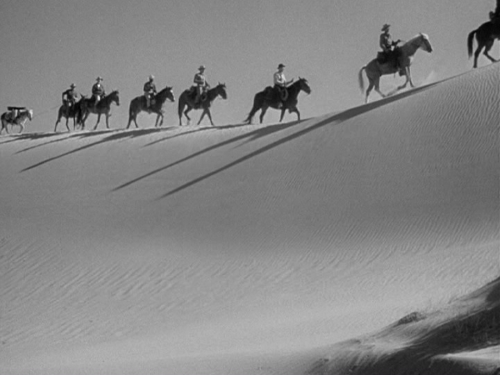
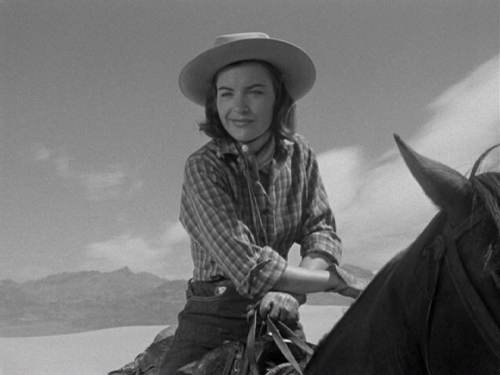
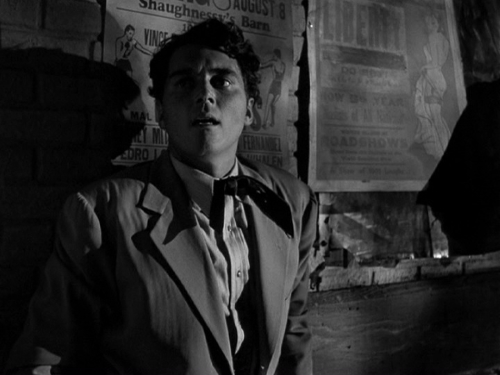
A chance remark during a card game in a cantina sets it all off. The men around the table had been musing and joking over the fate of a wagon train said to have been loaded with gold that had vanished in the wilderness almost a hundred years earlier. Then one of them mentions seeing what looked like an old wagon wheel sticking out of the ground on his last trip. Just as he says those words, a silence descends. A silence pregnant with meaning, as each person in that room thinks the same thought at the same moment, and then they realize that this shared knowledge binds them all together in an uneasy alliance of greed and distrust. They are an odd cross-section of humanity, dreamers and fugitives, drifters and grifters, the kind of people who have nothing much in common save a yearning for something better than the life they are currently leading. Most notable among them is Jim Carey (Randolph Scott), a horse breeder with a mare in foal to worry about – that foal acting as an overt symbol of rebirth and a new beginning and quite literally carried by Scott right to the end of the movie – and then there is Shep (William Bishop), who is a cowboy with a secret he is keen to keep, especially from the brash Frazee (John Ireland). So this diverse band sets out to cross the border back into the US and into the desert, where fates and loyalties shift as suddenly and unpredictably as the sands beneath them. No sooner have they left civilization behind than another rider appears on the horizon, having followed them from Mexicali. This is Chris (Ella Raines), a woman with past ties to both Jim and Shep.
With the sun beating down and the trappings of the modern world stripped away, something approaching truth is gradually revealed. Hasn’t the concept of entering the desert, the wilderness, represented the confrontation of temptation and the attainment of spiritual renewal from Biblical times on? The desert of this movie serves a similar purpose, bringing the secrets of the past out into the open and finally laying out the prospect of a new beginning for those whose resolve is strong enough to withstand the siren call of greed. Is it too convenient that there are so many potential suspects all brought together, and that all of them should be tormented by the prickly discomfort of a guilty conscience? Perhaps there is convenience too in the neat way the hunter proves himself to be little better, and in some senses arguably worse, than the hunted. Yes, all of this can be taken as contrivance, but it is a story after all, a parable with a lesson to impart, and not a factual entry in a diary. So long as it all leads to the resolution writer Alan Le May and director Sturges desire and the realization they wish to encourage, then it ought to be permissible to bend credibility a little.
Once again, we see a movie which underscores the steps Scott was taking towards the full flowering of his screen persona, one which would reach its apogee in the Ranown cycle. There’s the air of charm and civility cloaking a steely core that was so characteristic. Added to that is the wounded nobility that is his guiding principle. There is something heartfelt about the way his pride prevents him from correcting Chris when she misinterprets his motives and berates him – just the use of body language and the terseness of his tone is enough to convey how holding oneself to a high standard can be tough, and that expecting others to be capable of comprehending that is an even bigger ask. Then there is the climax, where his generosity of spirit is admirable. It is clear how much it costs him emotionally to grant Shep the facility to redeem himself. Still, he does so, that innate sense of nobility or propriety nudging him to sacrifice his shot at personal fulfillment in order to present others with that same prize.
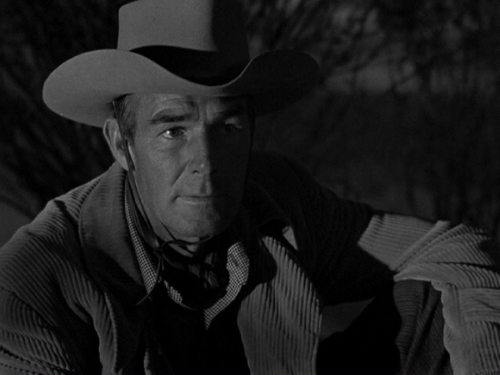
It has been said that The Walking Hills has noir overtones, but they are really only incidental, Charles Lawton casts some captivating shadows at times and the use of flashbacks to fill in the backstory for William Bishop and Ella Raines is suggestive, but nothing more. Bishop makes good use of the restlessness and ambiguity he brought to his better roles and keeps everyone guessing for a long time. Ella Raines is always a welcome sight and she offers some much needed empathy and selflessness to leaven the greed and antagonism that threatens to boil over in that raw and searing environment. In the small cast everyone gets to contribute something, Arthur Kennedy only really coming into his own as a delightfully sniveling ne’er-do-well towards the end. John Ireland displays his customary air of menace in a largely unsympathetic part, while Russell Collins, Edgar Buchanan, Jerome Courtland and Josh White all have their moments to shine, the latter via some terrific blues songs.

The Walking Hills got a DVD release as part of a Randolph Scott box from Sony years ago – I don’t know whether it has been upgraded to Blu-ray in the interim – and looks generally fine, highlighting Lawton’s cinematography and Sturges’ confidence shooting outdoors on location. Personally, I enjoy what could be termed contemporary westerns, especially something like The Walking Hills where it feels as though the classic west is within touching distance, easily accessible by simply riding beyond the city limits yet with a spectral, intangible quality too. It is one of those tight, compact pictures that Sturges excelled at and is well worth seeing.
 Riding the High Country
The Walking Hills is a picture I like a lot, and far more than its cousin, Treasure of the Sierra Madre, but with an exception. The exception, is an extended flashback detailing the romance between Ella Raines and Wiliam Bishop, as I don’t care much for the flashback concept generally but in this case, the players and the playing. Everything else, Scotts’ work, Ireland’s, and Josh White’s performance is subtle but brutal and compelling.
As for Treasure, a film I hate. overacted by Bogart and Huston to a lesser extent, it embraces failure and madness, although TimHolt, Bruce Bennett, and Alfonso Bedoya manage well, as does in his own brief bit, John Huston, but how I hate that picture.
LikeLiked by 1 person
Personally, I don’t hate Huston’s film. However, it’s not one of my favorites, probably as it’s not an “enjoyable” experience overall and there is that air of dry cynicism drifting around it, something that can be detected in a number of his films.
LikeLike
Surprisingly I have only seen THE WALKING HILLS once and that was when I got the Sony collection. TREASURE OF THE SIERRA MADRE is considered a classic generally, probably correctly, whereas Sturges’ film could not be considered thus. However THE WALKING HILLS is a film I personally like much more and I think Colin is right when he says SIERRA MADRE is not an especially enjoyable experience.
I have been meaning to rewatch this fine movie again for some time and this just might be the nudge I need.
I always enjoy an Ella Raines performance; a very ‘natural’ actress and she brings much to the film under discussion. I recently also found the same result when rewatching IMPACT (1949) where she really lifts the film by her character’s niceness and ordinaryness.
LikeLike
I haven’t watched Impact for a good many years. I liked it though, it’s well put together, tells quite an absorbing story and Ella Raines plays well alongside Donlevy. I agree, Jerry, that she brought something very attractive to her roles and certainly elevated every film I’ve seen her in.
LikeLiked by 1 person
It moves so slow but it’s a nice journey
LikeLike
Yes, it’s a journey I certainly enjoyed tagging along on, Scott and Raines make for admirable traveling companions and the destination appeals to me a lot.
LikeLiked by 1 person
A very descriptive writeup of one of the two obscure westerns from John Sturges, that I have not seen. The other being, The Capture.
LikeLike
I have yet to get around to The Capture, but it’s heartening that it has been restored and released.
The Sturges film that badly needs to be cleaned up and made available now is The Sign of the Ram.
LikeLike
There are no obscure Randolph Scott pictures.
LikeLike
From a fan’s (and especially a western fan’s) perspective, there probably aren’t. On the other hand, general movie watchers, and even those who are fond of classic era movies, won’t be familiar with many of his films outside of perhaps the Boetticher titles and maybe one of two others.
I mean I was a fan of Scott’s work since childhood, but even so I only managed to catch up with a fair number in the last two decades or so as they became more readily accessible.
LikeLike
Colin, what you have described is the passage of time, my comment is relative to being a top ten star, or near it, for years. The Walking Hills and the Ranown cycle exist only because Scott had an interest in doing them. This observation is not applicable prior to the mid-forties when he had a variety of employment contracts to fulfill. Abilene Town and beyond.
LikeLike
I see. I think that when people refer to films here on this site as obscure, it is in relation to how they are perceived now or how they have come to be perceived over the years.
LikeLiked by 1 person
Okay, but when I don’t know something, my lack of insight and information does not make anything obscure, it just means I need to fill in the pieces.
LikeLike
To general movie watchers today Casablanca is an obscure picture. Recently I was speaking to such a general movie watcher. I mentioned Bogart and got a blank look. I mentioned Hitchcock and got a blank look. She’d never heard of them. And this woman wasn’t a teenager. She was forty. And she likes movies.
To general movie watchers today classic movies means movies made in the 90s.
LikeLiked by 1 person
What you have described is someone to keep away from, a philistine.
LikeLiked by 2 people
But that’s now 99.9 percent of the population.
There’s been a major change. People growing up in the 60s, 70s and even 80s had exposure to the popular culture of the past. They got to hear their parents playing Bing Crosby and Sinatra records. They saw movies from the 1930s, 40s and 50s on TV because sometimes there was nothing else worth seeing. They saw TV shows of the 50s on reruns.
Today, if young people want to avoid any exposure to the pop culture of the past they can. And 99.9 percent of them choose to avoid that exposure. We live in a society with no cultural memory.
LikeLike
Sadly this is largely true. Mention classic films and peoples’ eyes glaze over, even older ones.
Luckily there are still a reasonable number of us who do treasure that era of film-making and a lot of them are not as old as me!
LikeLike
While it undoubtedly does play a role, age is not the only factor involved here. There is the gulf between availability and visibility to consider. We live in an age where almost everything is accessible in one former another, while visibility is restricted in the sense that one has to actively seek it out, and of course be aware of its existence in the first place in order to do so. The irony of this is comical if you stop to think about it.
LikeLike
Yes, good point about visibility. A lot of people today are totally unaware of pre-1990s pop culture and they have zero curiosity about it. If you mention movies made prior to the 90s they’ll say they’re not interested in exploring that field because those movies were boring (even though they haven’t seen any).
An added problem is that to people under 40 every single movie made before the 21st century is “problematic” and “dated” and offensive.
LikeLike
For those without curiosity, there is a word, and that is stupid. It does not only go to the movies but to life and history.
LikeLike
It is that odd paradox where a wider range of choices seems to lead to narrower exposure to material.
LikeLike
There is a certain logic to it. If you can subscribe to a streaming service that offers nothing but superhero movies then you can spend your entire life watching superhero movies. There is no need ever to leave your comfort zone.
LikeLike
The key word in your comment here is subscribe. If people are paying for something then they overwhelmingly tend to opt for what they know or think they will like, which is not an unreasonable position in all honesty. As more and more people participate in subscription services, this entrenchment in a comfort zone is only going to become more prevalent. Compartmentalization is on the increase in life and, certainly in cultural terms, I don’t feel this is a healthy development, particularly from a creative perspective. Still, it is what it is and perhaps it’s better to regard it as a challenge to be met rather than a fait accompli to be mourned.
LikeLiked by 2 people
If true, that is how we have evolved into a continuum of madness exemplified by hurt feelings, and nothign much more than that. In any case, who fundamentally cares about these morons?
LikeLike
Dee, Barry, Jerry, and Colin, I can see where you’re coming from concerning the cancelling of our movie cultural heritage and our Historical Culture overall. I live in the hinterlands of the USA, and I don’t find that 99.9% of the population hereabouts fit in that percentage of not caring about our past cultural heritage. I know lots of people under 40 years old, who know about happenings in the world before they were they born. They still know who John Wayne and Humphrey Bogart were and what they stood for. Better yet, they know about the local people where they live and how important they are to our way of life. These young folks care and they work hard at what they do. They just don’t sit in their rooms and view superhero movies on their phones. Sure, there are some young folks who don’t care, but there are also some old folks who don’t care either. Fortunately, they aren’t in the majority. I live in the part of our Nation where if you’re having automobile trouble alongside of the highway, people will stop and offer to help.
The mass media of the USA, which is owned by a handful of corporations, don’t care about the people of the hinterlands and certainly don’t portray them in a favorable light. The mass media only covers bad happenings, not the good. I still have faith in our young people. Recently we had to have a new water well electric pump replaced(yes, we don’t have city water, our water comes from a well). The twentysomething young man who installed the new pump, was very knowledgeable, because I could tell as we talked. He knew about what was happening in the world and he knew who John Wayne was.
LikeLiked by 1 person
Just to be clear, and I can obviously only speak for myself, I don’t make any judgement about people based on what they watch or their relative cultural awareness. I don’t consider myself qualified to do so, nor do I feel its my right or business. After all, I have plenty of gaps and blind spots of my own – I could be a lot better informed about current TV and movies, for example – so I’d never want to climb on a high horse over somebody else’s perceived lack of knowledge or interest. None of us can be interested in everything, so choices are made and, certainly when it comes to movies and TV, I don’t feel comfortable passing judgment on the validity of what others prioritize. Maybe it saddens me somewhat that the things I love are not more widely celebrated or recalled, but that’s just one of those regrets that relate to the passing of time as much as anything. It should not be taken as a criticism, either explicit or implicit, of people who do not share those likes.
LikeLike
Colin, I’m with you here. A lot of what we’re discussing has to do with the passing of time. Some years ago, and time is getting away from me, another individual and I were observing a youngster, who was considered quite a rounder. He was watching an episode of THE SIMPSONS(1989- ), and he was really getting into the Bart Simpson character. The other Individual said to me, “Look at him, he’s really enjoying Bart Simpson, just like we did the THREE STOOGES.” I replied, “Yes, and the BOWERY BOYS.” Each generation has their “Pop Culture.” Look at the POKEMON and ANIME sensations of the 2000’s. We had GODZILLA coming at us from the 1950’s through the 1980’s. Each generation has their likes and dislikes, but I think there will be enough people from each generation to carry on our culture, at least in my neck of the woods and up my lane here in the hinterlands of the USA.
LikeLiked by 1 person
Point taken, Walter, but….
LikeLike
Barry, I know, and I realize that we’re always going to have the “Philistines” among us. Personally, I think there is a backlash brewing out here concerning the “wonkiness” of thinking that movies made before 2001 are “problematic”, “dated”, and “offensive.”(Thanks Dee).
I’m not going any further, because I’m not going to get political, because there are other forums for that.
LikeLike
Sounds good, Colin. I’ve never seen this one and have now added to my to watch list.
LikeLike
The involvement of Sturges, Scott and Raines helps to make it attractive, it boasts a relatively brief running time, and it’s that type of hybrid movie that blends styles in a way that should appeal to a range of different movie fans.
LikeLike
I have become an Ella Raines fan after seeing her in THE WALKING HILLS, SINGING GUNS (sounds terrible but was actually very enjoyable) and RIDE THE MAN DOWN. Across these movies, she showed an excellent range and charmed the camera.
LikeLiked by 1 person
An Ella Raines movie that I’m keen on seeing is Time Out of Mind (1947). Seeing as it only appears to be available via a Blu-ray that is locked to Region A, that is not going to happen yet. The presence of Raines, Robert Siodmak’s direction and the premise makes it sound interesting.
LikeLike
Time Out of Mind sounds tempting. I’m a major Ella Raines fan and I’ve never seen a Robert Siodmak movie I didn’t like.
Another movie directed by Siodmak and starring Ella Raines that is worth a look is The Suspect, and you get Charles Laughton as a bonus. The Web is another Ella Raines movie worth seeing.
LikeLiked by 1 person
Recent times have allowed far easier access to ( and in the case of The Web, in greatly improved picture quality) many of the movies she appeared in, which has helped raise her profile a bit once again.
LikeLike
Yes, she does seem to have developed a fan base among classic movie fans.
LikeLike
Colin
Nice write-up as always. I have the dvd here somewhere in the apartment but have yet to watch it. As a Canadian, one of the Scott films I have seen numerous times is CORVETTE K-225 from 1943. When I was a kid it showed on Canadian television at least once every couple of months. It was also the first film Ella Raines made. When you consider that Miss Raines only made 22 films (not counting tv episodes)she is pretty well known. She was also married to famous flying ace, Robin Olds. Between WW2 and the Vietnam War, Olds collected 17 victories. Again, Colin, thanks for the reminder to dig THE WALKING HILLS up.
Gord
LikeLiked by 1 person
I think CORVETTE K-225 is a very fine war film and is, dare I say it, under-rated.
LikeLiked by 2 people
Jerry — your point about Corvette K-225 is fine up until you play games with that ridiculous word.
LikeLike
Not intentionally playing games with that term, Barry, but I do genuinely feel CORVETTE K-225 is under-rated as war films are viewed today. It rarely, if ever, gains a mention when war films are discussed. A great personal favourite, as is the great British war film THE CRUEL SEA (1952).
LikeLike
Jerry, I do not diagree with yo on any of that, but the term underrated disturbs e, because ntohign is.I watarted gettign antzy when Louis Hayward and Van Heflin were referred to that way. They were not anything other than extremely successful in their profession. That someone does not know, or care, who they are, does not make them underrated. It has no meaing.
A few years ago I tried to put together a film about Sheilah Graham and Scott Fitzgerald, not only did that not fly but in 1959 Gregory Peck Played Scott, and Deborah Kerr was Sheilah in Beloved Infidel. The people I spoke to had no idea who Peck was. They were enot underrated either, but the morons in charge were obviously overrated. One guy did know who Clark Gable was, not that he cared. I wanted to box their ears.
LikeLike
Corvette K-225 has been mentioned here a few times in the past, making it a film I become aware of, mean to watch, and then forget about again for some reason.
LikeLike
Jerry
Yes, I would fit CORVETTE K-225 into that under-rated area. A well made film with 5 time Oscar nominee and one time winner, Tony Gaudio handling the cinematography duties. The cast includes many up and comers in unbilled bits like, Peter Lawford, Charles McGraw, Frank Faylen, Cliff Robertson and Robert Mitchum. Even producer Howard Hawks stepped in to shoot several of the scenes.
Colin, I am quite sure you would enjoy the film.
Gordon
LikeLike
Charles Stevens was uncredited in his role as Cleve. Seems to me, with the amount of screen time and dialogue he should at the least been credited with Bit player if not Supporting player.
LikeLike
Yes, he is on screen quite a lot. Credit lists are quite different nowadays of course, where pretty much every contribution is listed.
LikeLike
Colin, good write-up of THE WALKING HILLS(filmed 1948, released 1949). I really like this movie and have viewed it several times in the past. This movie was shown a lot in my neck of the woods when I was a youngster. I saw it at least five times before I was twenty years old. I first viewed it on Memphis, Tennessee’s WREC Channel 3 EARLY MOVIE in 1966. It was still being aired a lot during the cable-tv explosion of the 1980’s. By the mid 1990’s the movie seemed to somewhat disappear. From 2002-07 the movie was airing on MOVIEPLEX and ENCORE WESTERNS cable channels. In 2013 Turner Classic Movies and Sony Home Entertainment Vault Collection released on DVD it’s Randolph Scott Westerns Collection, which consisted of CORONER CREEK(1948), THE WALKING HILLS(1949), THE DOOLINS OF OKLAHOMA(1949), and 7TH CAVALRY(1956). It was back on ENCORE WESTERNS in 2015-16, INSP-TV in 2020, and its airing on GRIT-TV in 2023. Hollywood Scrapheap has a single DVD for sale. Also, it’s been on YouTube for years, which is a tape made from ENCORE WESTERNS. THE WALKING HILLS isn’t that hard to find.
I think the movie is a gem and I’m not going to give away too much about it, but it’s not your usual Randolph Scott Western. The screenwriter Alan Le May wrote two of my favorite Western Novels, THE SEARCHERS(1954) and THE UNFORGIVEN(1957), which were the source material for two of my favorite Western Movies.
Colin, I really like the way you describe Randolph Scott’s screen persona, and I think that you have it down to a T. Randolph Scott has always been my favorite Western Star and I think he is a very good actor.
I also like contemporary Westerns and THE WALKING HILLS is contemporary for its time(1948). I agree that ” it feels as though the classic west is within touching distance”, which I think it still is, even today in 2023.
I can’t help but point out some neat touches in the movie. One fight scene is where they use, not your usual weapons. Also, there is a somewhat surprise at the end involving Old Willy(Edgar Buchanan). I’ll end with this, see if you can spot a young Marilyn Monroe in the movie. Johnny(Jeorme Courtland) is infatuated with her.
LikeLiked by 2 people
That’s the picture on the wall that Jerome Courtland can’t help admiring and wondering about. The fight is a well staged one, and I think the use of those tools adds to the sense of peril, even lends it an air of desperation.
LikeLike
Colin, yes, that’s Marilyn Monroe on the pin-up calendar sitting on a block of ice. No one knew who Marilyn Monroe was at the time of filming THE WALKING HILLS, which was May-June, 1948. Marilyn had just finished filming LADIES OF THE CHORUS(1948) at Columbia Pictures. Here is the pin-up photograph taken by studio photographer Robert Coburn.
https://movieposters.ha.com/itm/movie-posters/miscellaneous/marilyn-monroe-in-ladies-of-the-chorus-by-robert-coburn-columbia-1948-pinup-photo-1025-x-1325-/a/7055-83148.s
LikeLike
Here’s another quiz question. How many individuals were part of the search party and how many survived…….and name those who didn’t?
LikeLike
Scott S, please no spoilers. I agree that the wonderful character actor Charles Stevens should have been credited. His acting career goes all the way back to THE BIRTH OF A NATION(filmed 1914, released 1915). In one scene in THE WALKING HILLS Geronimo is referred to and Cleve(Charles Stevens) says, “Geronimo is dead.” In the early days of his acting career, it was publicized that he was the grandson of Geronimo, but he wasn’t. That was some typical studio publicity. Stevens did portray Geronimo in the tv series THE ADVENTURES OF RIN TIN TIN(1954-59).
LikeLike
Charles Stevens had a catalog of fine roles tangling with Randy in FRONTIER MARESHALL and as Kirk’s Father In Law in Struges’ masterpiece LAST TRAIN FROM GUN HILL.
LikeLike
Yes, and how about that masterful first reel of CORONER CREEK with Randy, Forrest Taylor (Indian Scout McCune) and Charles Stevens (Chiricahua Apache). That first reel brilliantly set the stage for what was about to come. This is one of my most memorable Scott movie sequences.
LikeLike
Scott, you got that right about the first reel of CORONER CREEK(filmed 1947, released 1948). A lot was packed into those first minutes of the movie. I think this movie is a humdinger of a Western. It’s really a good one.
LikeLiked by 1 person
Walter, your absolutely right about spoilers. Sorry to all.
Scott S
LikeLike
As far as early Sturges goes I too would love to see SIGN OF THE RAM get a decent quality release. I am also very keen on seeing one of his early B Pictures SHADOWED. It’s interesting to compare Sturges’ THE CAPTIVE with Mann’s BORDER INCIDENT to see two great Western directors go South Of The Border still early in their careers. Yes SINGING GUNS is a far better film than it’s title suggests and Ella is great fun as a gal who enjoys burning cowpokes with cigarettes. Kino Lorber played a real long shot releasing SINGING GUNS besides who remembers Vaughn Monroe these days? The other Republic- Monroe- R G Springsteen THE TOUGHEST MAN IN ARIZONA was superior but I doubt if it would have found many takers sales wise.
Nit picking certainly, but I consider Josh White’s soundtrack as “Folk Blues” and off hand can only think of another film with a Folk Blues soundtrack the superior British B THE PASSING STRANGER (1954) enhanced greatly by a soulful solo guitar soundtrack from Ken Skyora. Sadly the version shown on Talking Pictures TV seems to be the same ropey abridged version released by Sinister Cinema years back. I hope a complete version exists in Studio Canal’s vaults a little gem well worthy of rediscovery-certainly the best of Lee Patterson’s many Brit B Flicks
LikeLiked by 1 person
Lee Patterson made for a personable lead in B pictures and I like a lot of movies I’ve seen him in – I’ve never seen The Passing Stranger though.
LikeLiked by 1 person
A friend of mine and another person had the opportunity to interview Mr Patterson several years ago. They picked him up at Michael Winner’s Holland Park mansion. The pair considered Mr Patterson one heck of a nice guy.
LikeLiked by 1 person
I think you would really like SHADOWED (1946), John. I find it a very entertaining little picture with Lloyd Corrigan playing the central character. The film is way better than the rating Imdb gives it.
LikeLike
I don’t go by imdb or in fact Maltin for these little epics. I live in hope SHADOWED will turn up on a Noir set at some point. It’s the sort of film that may turn up on TPTV.
LikeLiked by 1 person
Maltin is inconsistent,adn IMDB is frequently and factually incorrect. We should all follow your lead.
LikeLike
Jerry
I agree with your take on SHADOWED. SHADOWED is a neatly done film that is well worth the time. Nice work by all involved including a 17 year old Terry Moore. Miss Moore is still working in films and television as of this year. I gave it a solid 7 out of 10 on IMDB on my review there.
Gord
LikeLike
Yes, the marks out of 10 on a Imdb review of a film are often a better guide to a film than the rating given at the outset.
LikeLike
Jerry, I know this is off the subject at hand, but you mentioned that you’ve been viewing a batch of early 1930’s Ken Maynard Westerns. What are some of the movie titles that you were watching?
LikeLike
Hi Walter,
I’ve been catching up on some of Ken Maynard’s westerns from when he really was at his peak. I have seen FARGO EXPRESS (1932) which has a strong role for a young Paul Fix. For the first time I spotted Ken being doubled in a brawl by his brother Kermit. I had been told Kermit doubled Ken in some instances but this was the first time I spotted him. THE LONE AVENGER (1933) was another enjoyable example. As one who enjoys spotting film locations (quite a bit of Lone Pine used) and stunt-riding and expert horsemanship, these films provide some of the best examples ever seen.
There are probably not too many fans of such films reading here but I’m most interested to hear your thoughts here, Walter.
LikeLike
Jerry, you know that I have a soft spot for the Western Movies from the silent days, 1930’s, and 1940’s. The so-called B’s. I grew up watching Republic Pictures’ Gene Autry, Roy Rogers, John Wayne, and William Elliott oaters. Ken Maynard and his Palamino stallion named Tarzan were really popular back in the 1930’s. The first Ken Maynard Western I ever saw was PHANTOM THUNDERBOLT(1933) back in the early 1980’s on a PBS(educational television) series titled SIX-GUN HEROES hosted by Sunset Carson. Maynard was known for his riding skills and stock footage from his movies were later used in John Wayne and Dick Foran Westerns of the 1930’s. Ken Maynard was the real deal, because he was a rodeo rider, trick rider, and roper in circuses, and wild west shows, including Buffalo Bill Cody’s Wild West Show. He was with Cody when they foreclosed his show in Denver, Colorado in July 1913. Maynard became not only a top box office Western Star, but a top ten box office star overall. His movies were the most action packed of the era, featuring displays of skilled horsemanship and he would actually get to kiss his leading lady.
I like these Western Movies of this time period(Pre-Code), because the characters were like they stepped right out of the “Old West.” The way they looked, dressed, spoke, and their manner. In actuality, this was the time period when the “Old West” was syncing into the “New West.”
I really like FARGO EXPRESS(1932), because it not only has skilled displays of horsemanship and action, but it has a good story. Credit should be given to screenwriters Earle Snell and Jack Natteford(uncredited), who were both old hands at writing. The story has some good twists and turns, and Ken Benton(Ken Maynard) has some close to the edge decisions to make concerning breaking the law to help his friend Mort Clark(Paul Fix). Also, Tarzan the “Wonder Horse” has an important acting role to play.
I like FARGO EXPRESS, and I think it’s well worth viewing.
LikeLike
Many thanks for sharing your thoughts (and knowledge), Walter. Yes, I knew we both liked these early westerns. As you say, the westerns of this era were only a stone’s throw from the time they depicted.
A personal favourite of Ken’s is COME ON TARZAN (1932) which I consider one of his very best films (some beautiful location shooting and a lot of skilled horsemanship).
LikeLike
Jerry, Ken Maynard and his wonder horse Tarzan. I like COME ON TARZAN(1932) also. It’s a neat role for Tarzan, where he is the leader of a herd of wild horses. I liked the scenes where he saves the life of Maynard. Tarzan is a good actor, and he had some doubles that were used, instead of him in some scenes. Maynard didn’t want to use Tarzan in what he thought were some of the more dangerous stunts. You can tell which was the real Tarzan, because he had a dark spot on his right haunch.
Talk about skilled horsemanship! The scene where Maynard is riding Roman style is terrific, and it’s him doing the stunt riding. Ken Maynard’s movies are so much fun and entertaining viewing.
LikeLike
Walter, I haven’t seen any silent westerns. Do you have any recommendations?
LikeLike
Dee, I’m not really an expert on silent movie Westerns, but I don’t think that you can really delve into them without viewing the movies of William Surrey Hart(1864-1946). Hart was a major star of the silent era. He was in the top ten at the box office from 1915-1921, coming in at number 1 in 1915 and 1916, ahead of Mary Pickford. A lot of people either like Hart’s movies or hate them. His movie image is of the stern faced “Good Bad Man.” His movies deal with the redemption of a “Bad Man” through the love of a good woman, although there are many temptations along the way from the “Baddies” both women and men. Hart stressed visual realism in his movies, and they are stunning visually. He wanted his Westerns to look real and they are of the gritty West. These are Hart’s movies, because he co-wrote and co-directed most of them, whether he is credited, or not. Anyway, I like William S. Hart movies, but I realize that not everyone does.
HELL’S HINGES(filmed 1915, released 1916) is a memorable one, to say the least, and some call it the first Western Movie masterpiece. The town of Placer Center, a.k.a. Hell’s Hinges just might be the baddest town depicted on screen until David Milch’s HBO series DEADWOOD (2004-06). HELL’S HINGES, is hands down, a melodrama, with some heavy symbolism with religious and sexual overtones. Well, I don’t want to give away too much, but I think it’s worth viewing. THE RETURN OF DRAW EGAN(1916) and THE TOLL GATE(1920) are good ones and Hart made many others.
Dee, there are other good silent Westerns that I like. The movies of Tom Mix, Harry Carey, Will Rogers, Hoot Gibson, Ken Maynard, and others. I think that William S. Hart will get you started.
LikeLike
I would recommend for silent Westerns two of John Ford’s: ‘The Iron Horse’ and ‘3 Bad Men’ both wonderfully presented on DVD and in the case of ‘3 Bad Men’ Blu ray with a fantastic commentary by Ford scholar Joseph McBride. Both are superior examples of the genre.
LikeLike
Walter, what I find remarkable about William S. Hart, it wasn’t until he was 50 years of age that he made his first feature, the masterpiece HELL’S HINGES (1916). His epic TUMBLEWEEDS (1925) followed 10-years later and he would have been a whopping 60. During this time period he never looked a day over 35. His early contribution to Western film making is legendary and forever cast in stone. Does anyone know if Randolph Scott had ever mentioned Hart? Lots of similarities.
LikeLike
Scott, you’re right – Randolph Scott’s western characterisations definitely had the feel at times of William S. Hart.
Hart had been the boyhood hero of Bill Elliott and Elliott set out in his later films to follow the course of ‘the good badman’ a la Hart. I believe Elliott had even hoped to make a movie about his hero though obviously it didn’t happen. That could have been interesting.
LikeLike
Ken Maynard, the guy with the thin voice and wide hips?
LikeLike
That’s the guy, Barry.
Walter’s advice on silent westerns is as helpful and knowledgeable as we expect from him. I recently acquired Hart’s THE TOLL GATE (1920) and enjoyed it. As a taster though, Dee, I would suggest Tom Mix’s “THE GREAT K &A TRAIN ROBBERY (1926) which is a terrific movie and in fact exemplifies the term ‘movie’!!
LikeLike
I like some silent Westerns too. A favorite, is the 1923 Virginian, with Kenneth Harlan, Florence Vidor, Russel Simpson, and Raymond Hatton. I am a fan of his.
LikeLike
Jerry, thank you for the kind words. You are very knowledgeable yourself. I agree with you about Tom Mix and THE GREAT K & A TRAIN ROBBERY(1926). It’s terrific!
Barry, Ken Maynard wasn’t known for his singing ability, but he was known as the first singing cowboy in the talking movies, because he sang in THE WAGON MASTER(1929).
LikeLiked by 1 person
Thanks to everybody for the silent western recommendations. I’ll grab some of those movies if I can find affordable copies.
LikeLike
John
Speaking of Vaughn Monroe, my father was a huge fan and I still have a huge pile of my dad’s Monroe recordings.
Gordon
LikeLiked by 2 people
Pleased that you also like SINGING GUNS, John. I never thought I’d like a singing Western but SG is a good drama and Ella Raines’ fun performance lifts it significantly.
LikeLiked by 1 person
It is a movie I have never seen, although I think I did see some impressive looking screen captures at one point. To be frank, the whole “singing cowboy” business is a major turn-off for me and I will admit I have avoided it for that reason.
LikeLike
That’s interesting, Colin, though not entirely surprising to me. And we come back to the discussion about age being a factor in what films different folks like. I was introduced to the western very early in my life – a combination of the fact that my family acquired a TV in 1953 and the first films I saw on it were Hopalong Cassidy westerns (loved ’em straight away, still do) and a few other B-westerns followed. These were followed by the earliest TV westerns like THE CISCO KID & THE RANGE RIDER. The other major factor was western comic books which I was into at the same time and top of the heap for years was ROY ROGERS. Now I appreciate that by the time you found an interest in western movies all this had moved on and was not, I presume, part of your childhood.
I saw KEN MAYNARD comic books long before I ever saw one of his films and that was true of many of the stars.
I DID though also find an early love of the bigger westerns starring Joel McCrea and Richard Dix and a little later, Randolph Scott, as their films were shown on TV during the 1950s.
The ‘singing cowboy’ films were not especially my favourites but they were phenomenally successful in their day.
By the way, Colin, I agree with Scott that you would possibly enjoy Bill Elliott’s THE SHOWDOWN, among others such as THE SAVAGE HORDE.
LikeLike
Age, and as a consequence the type of material or the personnel we are exposed to at an impressionable point, is certainly a factor in how our tastes evolve. I wouldn’t have been aware of watching anything until the early to mid 1970s on TV so yes, there would have been a different roster of movies, series and stars on view then. It was still classic/golden age material of course, but I guess produced a little later. I read western comics too of course, and war and Sci-Fi titles. I recall a lot of Fleetway comic books, such as the stuff discussed in this article: https://treasuryofbritishcomics.com/news/the-forgotten-world-of-the-picture-libraries/
I would still have a number of old western/war comic books boxed up somewhere in my parents’ house. I must dig around when I’m back on a visit over the summer.
LikeLike
I didn’t care much for The Showdown, but The Savage Horde is and was one of my favorite Bill Elliott films. The others, Wyoming, Hellfire, The Fabulous Texan, and all of his Red Ryder films taken as a single entry.
LikeLike
Colin- Way off topic but on previous threads we have discussed Imprint Australia and their Noir sets. In particular we recently discussed the Ida Lupino films BEWARE MY LOVELY and JENNIFER. I note from Imprint’s website that the latest films from their Noir set have been released as “stand Alone” releases. It’s alarming how quickly Imprint titles go OOP. The “stand alone” release that may interest you is the Ida double bill. I understand you are none too fond of BEWARE MY LOVELY I disagree-Ryan’s stunning performance is a masterclass in menace. No Spoilers-JENNIFER is probably not strong enough an entry to warrant a stand alone release. It’s the antithesis of the Gothic old dark house type mystery. Everything is shrouded in light (James Wong Howe) It’s the matter of fact treatment that makes the film so credible and believable I found it an engrossing mystery- Noir it is not.
The mystery of who directed it remains ‘though Glenn Erickson suggests Bernard Girard. Still with Lupino and Wong Howe on board who needs a director. The transfer from Imprint is flawless. I feel there may be Volume 5 of Imprint’s excellent Noir series
due in September perhaps.
LikeLike
John, thank you very much for passing that on about the individual releases. I would certainly be keen on the Lupino double. I don’t think I’d go so far as to say I was none too keen on Beware, My Lovely. I didn’t dislike it when I last saw it but, even if one shouldn’t compare, I couldn’t help but notice how it’s not in the same league as On Dangerous Ground. No, all told, I’d be happy to have a cleaned up copy of it along with Jennifer.
LikeLike
BEWARE MY LOVELY was also remade as a tv episode of FORD STARTIME 1960 with Audie Murphy and Thelma Ritter in the Ryan and Lupino roles. Saw it 6-7 years ago on a dvd copy taken off tv.
Gordon
LikeLike
Forgot to mention the remake title, THE MAN. A rather beat-up print is on You-Tube.
LikeLike
Here it is:
LikeLike
I’m glad to see this film covered — I discovered it a couple of years ago, as part of the Criterion Channel’s Western Noir collection. It was one of my many favorites of the group. I seldom hear this one discussed, and it’s so deserving. Good stuff.
— Karen
LikeLike
Thanks, Karen. It gets mentioned as a kind of western noir, which I’m OK with even if I’m not convinced the noir elements are all that strong – the flashbacks, some of the cinematography and so on give rise to this but I feel the overall tone and the aims of the picture lead it in a different direction. Of course anything that gets it noticed more and draws an audience to it is good.
LikeLike
I’ve seen a number of movies that get described as Noir Westerns and I don’t think such a thing exists. I think that label comes from a total misunderstanding of the western genre, and is also based on a dismissive attitude towards westerns.
There are people who see an intelligent grown-up western dealing with dark complex themes and their reaction is “This can’t be a western because westerns are just mindless shoot ’em up horse operas. This movie is so good it must be a film noir rather than a western.” But in fact dark complex themes treated intelligently are part and parcel of the western genre.
But yeah, if the Noir Western label is the only way to persuade people to see good westerns that they would not otherwise bother seeing I’m OK with that.
There are a number of westerns that I think are very underrated and if calling them Noir Westerns would get them some exposure then I’d be all for it. One such western is Hannie Caulder (1971), a fine revenge western about the price you pay for becoming a killer even when you feel the killings are justified.
LikeLike
I’m not convinced that it’s necessary to think of western noir being applied for negative reasons. For sure the genre does not appeal to all and seeing some titles referred to as noir vehicles might encourage some of that group to give them a look. However, I don’t believe people who coined and use the term western noir had that in mind. It seems to me that the visual style of certain westerns and the nature of the stories/protagonists indicated a connection with film noir. That’s not unnatural, as styles, moods and the like tend to seep from genre to genre and a similar feel can be detected in other genres from around that time.
Generally, the destination the western leads toward is what separates it from from classic film noir and makes it more difficult to fuse them satisfactorily – the western of that era is inextricably linked to themes of redemption, renewal and rebirth. These integral features are typically at odds with the (again more usually) bleak vision presented by true film noir. That said, some movies such as Pursued or Blood on the Moon, to give just a couple of examples, come very close indeed.
LikeLike
Since the western and the film noir are the two movie genres that have always resonated with me the most I find it quite interesting that a few films crossed into the territory of both and the two Mitchum westerns Colin mentions are perhaps the most obvious examples. But I do agree very much with your point, Colin, that the vision of the western and that of film noir are usually not the same.
LikeLike
Over the years, I’ve tried to cover as many westerns as possible where there is, to a greater or lesser extent, some discernible crossover with film noir. In all of those, I don’t think any, or I certainly don’t recall any at the moment, could be said to be 100% noir.
LikeLike
The sleeper THE SHOWDOWN (1950) has elements of a Noir Western throughout the movie…….especially the first reel having a strong Noir presence. One of Bill Elliott’s best, supported by Walter Brennan and Marie Windsor. IMDb rates with a much deserved 6.7.
LikeLike
This is a film that has been recommended more than a few times over the years. I have yet to see it, however, and I am going to have to go one further and admit that I still haven’t seen any Bill Elliott films all the way through. I do have a few of his later crime pictures to hand.
LikeLike
Scott S, I don’t know about the Noir elements of THE SHOWDOWN(filmed 1949, released 1950), but I think that it’s a good Western Movie. The beginning scene isn’t a usual one for a Western, but effective. William Elliott’s character’s name in the movie is Shadrach Jones, which is a good biblical name. This was Elliott’s last movie for Republic Pictures.
LikeLiked by 1 person
Hi Walter, I like D’s explanation of Noir “Flavouring”. In the case of THE SHOWDOWN, it may have been better stated if I had said the opening of the movie had strong Elements of Noir, but as the movie progressed it had a sprinkle of Noir “Flavouring”.
LikeLiked by 1 person
Yes, Elliott’s last movie for Republic was a more serious dramatic role than the Wild Bill Elliott “Peaceable Man” character we had become accustomed to. Maybe Republic was sending it’s longtime star of ‘B’ westerns off in good fashion.
LikeLike
Maybe the problem is that the western is a genre whereas film noir isn’t. Film noir is a flavour. A film noir is just a crime movie with a particular flavour, just as a giallo is a crime movie with a particular flavour. And a screwball comedy is just a comedy with a particular flavour.
LikeLike
Yes, I often refer to film noir as a genre, more for convenience than anything, but it’s not really accurate to do so. Is it always a crime film? While there is generally a crime involved in the story somewhere I’m not sure I’d be happy to view film noir simply in terms of a variant of the crime story. Maybe it’s not a full-on genre but it feels more discrete than simply a subset of a genre. Mind you, this is all purely academic and a matter of semantics – there might not be any definitive answer, and it probably doesn’t much matter anyway.
LikeLike
I should clarify that when I say film noir isn’t a genre it doesn’t mean I think film noir doesn’t exist. It does exist, just as screwball comedy exists and the giallo exists. I like to think of them as flavourings in the sense that a movie can have a lot of that flavour, or just a bit. There are movies that are very noirish, some that are moderately noirish and some that are slightly noirish.
LikeLike
That’s a fair enough way of looking at it. Sometimes people appear to get too hung up on defining these things, to the detriment of the actual movie watching experience. As with much of life and art, there are shadings and everybody will perceive it different ways.
LikeLike
Author Cormac McCarthy has died at age 89. Several of his works were turned into films . These include, ALL THE PRETTY HORSES, THE ROAD, CHILD OF THE GUN, THE COUNSELOR, THE SUNSET LIMITED and NO COUNTRY FOR OLD MEN.
Gord
LikeLike
Yes, I saw that. A significant literary figure.
LikeLike
I haven’t seen The Treasure of the Sierra Madre for years and years. I don’t even remember whether I liked it or not. I guess it’s another movie I need to rewatch.
LikeLike
There are worse ways to spend a couple of hours. Revisiting a classic generally brings some rewards, even one that is or was not a favorite.
LikeLiked by 1 person
As a big Randy fan I need to check out this pronto. About ‘Treasure’ I really like it and when Bogart goes off the deep end so memorable. I find it no more cynical than ‘The Maltese Falcon’ which most everybody loves.
LikeLike
Chris, it’s a good film for fans of Scott, but that could be said for so much of his post-war work.
Fair point regarding the cynicism in those Huston films, it is a feature in many of his movies. Maybe it just feels more palatable in The Maltese Falcon? I know it doesn’t hit me as hard in that anyway.
LikeLike
Colin, do you find ‘The Man who would be King’ a cynical Huston picture? I find it so magical and Connery and Caine so superb together that even playing the con as they do I don’t at it that way.
LikeLiked by 1 person
Good question. Perhaps not, I’m not sure, but I recall a girl I once knew insisting it took a cynical view of women.
I think the one of the least cynical of Huston’s films is Heaven Knows, Mr Allison.
LikeLiked by 1 person
And perhaps ‘Red Badge of Courage’.
LikeLike
The Maltese Falcon has a slightly odd tone (and it applies to Hammett’s novel as well). Not quite tongue-in-cheek but almost. All the characters (including Sam Spade) are such obvious and outrageous crooks right from the start. It’s so over-the-top that it softens the cynicism a bit. There’s a slight touch of the absurd to the story.
On a vaguely The Maltese Falcon-related note I was reading an interesting piece the other day on Sam Spade as an existentialist protagonist.
LikeLike
Glenda Jackson has passed away. The Queen is dead long live the Queen. She was an amazing Elizabeth R!
LikeLike
Yes, a fine actress who was able to handle dramatic and light comedic roles with equal skill.
RIP
LikeLike
I’ll remember her most for her roles for Ken Russell.
LikeLike
Blue Ray News……….. Laura’s fine blog has just announced that Classicflix are restoring THE PROUD REBEL. This is a very welcome release and even the “works in progress” clipon the link provided by Laura is far superior to the horrendous version shown on UK TV. Always wonderful to see a “lost” film rescued from p.d. hell; Classicflix do great work.
Further good news that the recent German Blu Ray of Boetticher’s CITY BENEATH THE SEA is also worthwhile. There ore now so many iffy Euro bootlegs around I am glad to announce that the Boetticher release is official licenced by Universal through Hollywood Classics. The transfer is excellent. The only extras are several trailers and a photo gallery-there are no subtitles. I found the film far more entertaining than Sturges similar UNDERWATER. I might add that Mala Powers smokes Jane Russell in the swimsuit stakes. Apologies to any J.R. fans reading.
LikeLike
That’s welcome news. I’ve only seen City Beneath the Sea once and thought it was kind of OK, but seeing a restored version might give it a boost. For early Boetticher adventure, I preferred East of Sumatra.
LikeLike
Never seen EAST OF SUMATRA but would like to. The German label are also prepping COLUMN SOUTH for Blu Ray
LikeLike
Now that’s another movie that could use an upgrade. The old UK DVD is a rather muddy affair.
LikeLike
Colin- SINGING GUNS is NOT a “Singing Cowboy” picture just a Western starring a singer who warbles a couple of tunes here and there-as much a singing cowboy picture as Siegel’s wonderful FLAMING STAR. Furthermore, how many Westerns have you seen that feature Ward Bond in drag!
Well recommended and as mentioned earlier Monroe’s other Western TOUGHEST MAN IN ARIZONA is even better. THE SHOWDOWN gets a strong recommendation from me and I hope to catch up with Allan Dwan’s SURRENDER which looks like another strong Republic Noir Western-another of the recent Scorsese MOMA Republic restorations.
Finally seen I, JANE DOE and STRANGERS IN THE NIGHT-loved ’em both. Preston Sturges told Mann “if they give you crap-or there’s no money in it just do it-it’s the only way to get a start in this business.” I guess I will avoid Mann’s early mini musicals but I’d still like to see DR BROADWAY and THE BAMBOO BLONDE and track down THE GREAT FLAMIRON which turns up on TPTV and I like a lot. At least with STRANGERS IN THE NIGHT you can see Mann’s heart is in it and here is a director that’s going to raise above being another Lew Landers, Leslie Goodwins or William Beaudine.
LikeLike
That’s refreshing to hear about Singing Guns, and I might just give it a go now on the basis of what you’ve said here.
LikeLike
The Great Flamarion is terrific. I have no idea why it’s so consistently ignored. Mary Beth Hughes gives one of the great femme fatale performances plus you get Dan Duryea in full-on Dan Duryea inadequate creep mode, and Erich von Stroheim as well. To top it off there’s all the theatrical trick-shooting stuff. Hugely entertaining and it’s closer to film noir than most of the movies that get released as film noir these days but when Mann gets discussed it usually doesn’t even rate a mention.
As much as I detest Blu-Ray as a format and as much as I detest most modern audio commentaries maybe a Blu-Ray release with an audio commentary would raise its profile.
LikeLike
My recollection of the film is that it doesn’t generate a great deal of suspense, nor did I feel sufficiently (for want of a better word) invested in any of the characters. Individually, these may not be essential elements, although they are frequently interdependent, yet their absence leads to a bit of a colder, more technical experience.
I wonder too if the title – and yes, I know such fairly trivial things ought not to count – appears slightly misleading.
LikeLike
THE GREAT FLAMIRON only seems to be available in a bad quality American DVD or a better French one. I like the film a lot and it would complete my essential early Mann collection-has anyone seen the French version. A Blu Ray release would be even better.
LikeLike
I don’t know about a French edition, but I know I bought this Italian DVD years ago and thought, at the time anyway, that it was OK, certainly watchable.
LikeLike
Jerry might remember this but there was a UK TV version of THE MAN with Robert Horton and Ruth Dunning. Horton was super hot in the UK at the time and even topped the bill at the Palladium. Wagon Train was very popular in the UK back then.
LikeLike
You’ve got me there, John, well and truly! Robert Horton with Ruth Dunning (what, Mrs Grove??). An odd mix to be sure.
LikeLike