Barbara Stanwyck – The Miracle Woman

There was a time when writing on the cinema was a bit thin on the ground. Then movie writing, criticism, and frankly anything related to the screen seemed to explode. Genres were hashed, rehashed and dissected, sometimes in celebration and sometimes in condemnation, theories were propounded and expounded, and reputations were analyzed, constructed and dismantled. That issue of reputations was and indeed is most noticeable in the writing of biographies. The movie biography, with its focus on those who have lived out their lives under the typically remorseless and unforgiving glare of publicity can prove problematic. Let’s face it, everyone writing a book wants people to read it and in the field of movie biographies the temptation to angle for readers using the promise of juicy personal revelations as bait must be a powerful one. Personally, I’m not all that interested in how well or badly individuals behaved in their personal lives – it is the public persona, or the screen work to be more accurate, which would have drawn my attention in the first place. As such, I often approach biographies with caution – too much gossip and too little appraisal of someone’s body of work doesn’t really appeal to this reader. Happily Dan Callahan’s book on Barbara Stanwyck, first published in hardback in 2011 and recently reissued in paperback by the University Press of Mississippi, does not go down that route , although there are some other issues present.

The book is not a standard bio, it’s an examination of the person via their screen, and to a lesser extent, their stage work. Callahan divides his study into seventeen chapters, each focusing on a different aspect of Stanwyck’s career. While it’s not a strictly chronological journey the chapters themselves do look at her performances and projects in that way. It begins with a short look at the star’s beginnings in life itself and her first steps as a performer. Callahan devotes separate chapters to the films she made for Frank Capra, Preston Sturges, Billy Wilder, Douglas Sirk, to her appearances in films noir, in westerns and in screwball comedies. There is also an in depth look at what the author sees as one of her defining roles in King Vidor’s Stella Dallas. This is an approach which I think makes sense as it attempts to unravel common threads running through movies that, either as a result of the genre or the filmmakers involved, tend to have a shared sensibility. All the major films receive attention and Callahan offers his own take on their strengths and weaknesses.

In terms of structure and organization, the book is very appealing. Added to that is the fluid style of writing, one which is largely engaging and never overburdened with jargon or the kind of impenetrable formality that tends to afflict more academic texts. These are all positive aspects. However, as was mentioned above, there are other points which I have a few reservations about. I think the easiest way to express this is to note that the book is the work of someone who is clearly a fan of the actress. People may be wondering why that’s used as a lead-in to some of the book’s weaknesses, so let me expand a little. I feel the author is a fan of the actress above all, to the extent where he is frequently dismissive, or at least ungenerous with regard to some of the films she appeared in and the people she collaborated with. Frank Capra and Peter Godfrey both come in for some strong criticism, the former for his approach or vision, and the latter for his filmmaking in general. Those are just a couple of examples, but the writer regularly praises the quality of Stanwyck’s work, occasionally drawing inferences from events in her personal life and how they may have affected her screen work. In itself, that’s fine, but, more often than I feel is necessary, I detect a strong tendency to denigrate films and some other performers and artists in order to highlight his subject’s talents. The films that are slated and those which earn praise seem to be selected on a puzzling basis too. I was pleased to see only one chapter dedicated to her personal life, and at least some effort made to tie that into her career development as well. Stanwyck’s first husband Frank Fay comes off quite badly; it has to be said I’ve never heard anyone have a good word to say about the man so that’s hardly surprising. I did find it odd though to see the author take such a virulent dislike to Robert Taylor, both as an actor and as a person.

So, I found Callahan’s book a bit of a mixed bag. It is informative and offers some detailed analysis of Stanwyck’s movies, is organized and presented in a satisfying way, comes with a complete filmography and an index, but I would have preferred if he could have reined in or disciplined his fandom and enthusiasm and allowed more fairness in certain assessments.

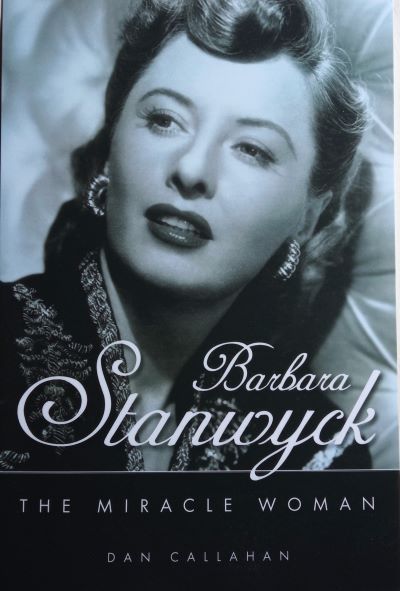
Barbara Stanwyck – The Miracle Woman by Dan Callahan

252 pages. Paperback edition published 2023 by University Press of Mississippi
Take One False Step

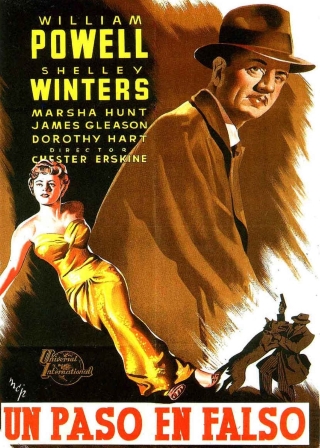
Any time I come across a mention of William Powell the name of Nick Charles springs to mind. The Thin Man and the series of sequels he made alongside co-star Myrna Loy represent only a fraction of his output, but it came to be something of a signature role for him. Those movies were enormously entertaining and Powell was perfectly cast in a part that allowed him to be smart, debonair and funny. Take One False Step (1949) came along much later, long after he had left Nick Charles behind, yet there is a hint of those light and stylish mysteries about it, easily as much as the film noir elements that its recent reissue might encourage one to believe to be dominant.

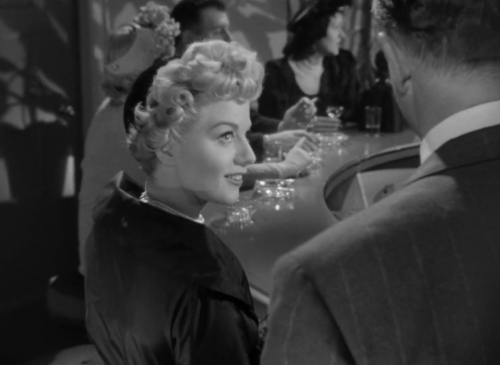
How much store should one set by the superficialities surrounding a film? I’m referring to the title, the credits, perhaps even the promotional material. The reason for posing that question is the fact that the opening credits for Take One False Step, and maybe the title itself, are strongly suggestive of some kind of late era screwball comedy. Of course all of this is emphasizing the need to remain vigilant, lest some major or minor catastrophe should befall one. The opening shot proper continues this theme, keeping the focus on a man’s feet as he enters a bar to order a drink before being addressed by some female counterparts. Well, it catches the attention. The man in question is Andrew Gentling (William Powell), a professor in the process of getting a new university off the ground. The woman who hails him from the bar is Catherine Sykes (Shelley Winters), an old flame he hasn’t seen in years, not since the war when both parties were unmarried and less burdened by life’s more mundane concerns. Should old acquaintances share a cup of kindness, or a couple of martinis at any rate? This pair do so and then part, as befits respectably married people. That ought to be the end of the matter, but Catherine is a restless type, pining for the immediacy of those dangerous wartime years, a woman prone to acting on her impulses. She calls Andrew up and invites him to a party, twisting his arm in a sense, but in a jokey, lighthearted way. Poor judgment, or momentary weakness, has been the undoing of many a noir protagonist and there is a whiff of that to Andrew’s acquiescence.

He soon discovers that he’s not only the guest of honor at this bash, but essentially the only guest. There’s nobody else present aside from another mutual friend Martha (Marsha Hunt) and she’s only there because her house happens to be the venue. Andrew is no longer the swashbuckler or adventurer Catherine remembers and perhaps he never really was, but he’s got a good heart and takes it upon himself to see the lady back home. She’s not so keen on this and he ends up taking a short stroll to let the fact sink in that there is to be no rekindling of lost romances on the agenda. Returning, he sees Catherine totter unsteadily back along the sidewalk towards her own place. However, that is only the beginning of the tale – the following morning brings news of Catherine’s disappearance, with only a bloody scarf, his scarf, left behind. Rather than go directly to the police, Andrew listens to some questionable advice and sets out to look into the business himself first. This leads to more trouble, with the cops, Catherine’s shady husband, a potentially rabid dog, and a race against time from Los Angeles to San Francisco.

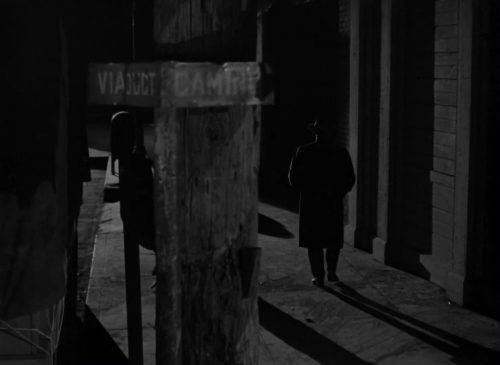
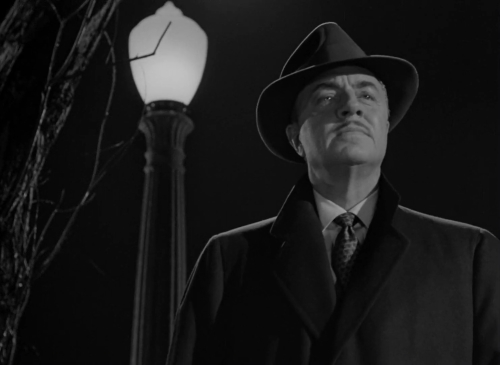
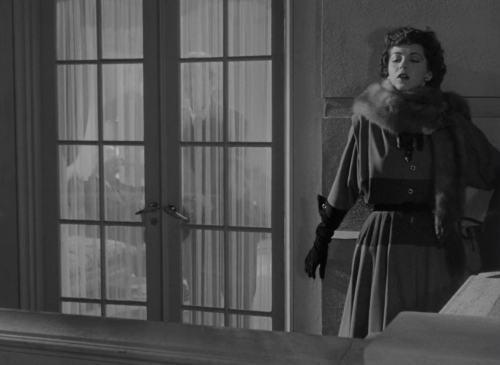
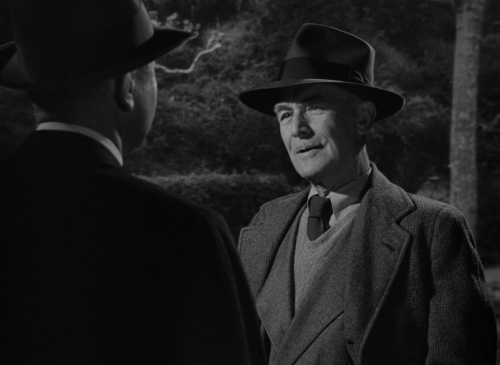
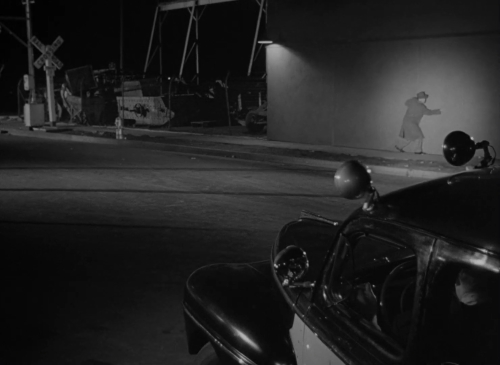
Is it reasonable to say Take One False Step is a film noir? I wouldn’t use the term myself, though I understand how parts of the movie could attract such a legend. The setup does point in that direction, with the innocent man finding himself in over his head very quickly, and his actions and their effects achieving a nightmarish quality. Franz Planer’s cinematography fits the bill too, getting some real value from the everyday and unremarkable. In truth though, this is a straight up mystery, not that far removed from the kind of material William Powell was headlining back in the 30s when he was playing Nick Charles or Philo Vance. There is a touch of humor in it too, as that credit sequence suggests. It’s not overwhelming, simply lightening the mood on occasion and I can’t say I found it unwelcome. Those going in looking for an uncompromising noir picture may find it grating, but as I said that’s not the way to approach this movie. Chester Erskine was the director and he does good work, conjuring up some attractive compositions and keeping a handle on the pacing. Nevertheless, I think it would be fair to say his credits as a writer (Angel Face, Split Second) and as a producer (The Wonderful Country) are more significant than his assignments as a director.

William Powell simply oozed sophistication, ever graceful and charming regardless of how difficult a situation might threaten to become. This was his stock-in-trade, the foundation of his screen persona and he made use of it in almost every genre he appeared in. Yet he carried along with it a kind of wry awareness of the fact this was a persona, enabling him to look at himself, his fellow characters and the circumstances in which they find themselves with a knowing air. This worked well in classy comedies and he was able to blend it into his mystery roles too. I mentioned the part of Nick Charles at the top of this piece as I have a hunch that characterization will be more familiar to many readers, which is not meant to suggest it was his only notable role. I also referred in passing to Philo Vance and I imagine those who have seen him play that part might agree he was an ideal fit. Personally, I find that any time I read Van Dine I have the image of Powell in mind. As the hapless professor he is less in control of events than he was in some of those mysteries, but this affords him the opportunity to exploit those characteristics that made him attractive to viewers – that smoothly polished exterior with a hint of panic stirring beneath, but with good manners and restraint holding it in check. There is one particularly effective scene, full of grim humor, around the mid-point, where the professor is seriously concerned about a bite he suffered and has sought medical assistance from a grouchy doctor (Houseley Stevenson) who tests his patience, and that of the viewer, to the limit.

Shelley Winters was in some excellent movies around this time, in what I think of as her dissatisfied vamp period, before A Place in the Sun saw her get nudged towards playing more needy types. She brings a lot of energy to the early scenes before Marsha Hunt steps into the spotlight. Hunt, who passed away last year at the ripe old age of 104 and who was one of those almost hounded out of the business during the shameful HUAC episode, is the faithful best friend, a classic Girl Friday part which she embraces and excels at. As the lawmen on the trail of Powell’s fugitive academic, Sheldon Leonard and James Gleason are responsible for most of the humor. Leonard is his usual loud self, forever on the brink of exasperation, while Gleason provides another variation on that hard-bitten but likeable cop that he brought to both the Miss Withers and The Falcon series. Another notable supporting part is filled by the instantly recognizable Felix Bressart, in his last role. He had appeared with William Powell years before in the rather good, if rarely mentioned, Crossroads and specialized in playing the kind of quirky middle European types he takes on here.

Kino has been instrumental in rescuing a whole raft of Universal crime, noir and mystery pictures, titles that were hitherto either impossible to see or only available in dreadful beat up prints. Take One False Step has been included in one of their film noir boxes and while I see how there are traces of noir to be found, it really is more of a straight mystery with a few comedic touches here and there. I have to say I thoroughly enjoyed this film, it’s of a type that I find most appealing and the cast are uniformly excellent. I strongly recommend checking it out.

Mister Cory

Another day, another movie that appears to defy categorization. Of course, there is no good reason why anyone ought to feel it is necessary to categorize a movie, but it is a pastime that we film fans like to indulge in.  Mister Cory (1957) does not comfortably wear any of the labels I’ve seen hung on it, not that there are many people who have actually commented on the film one way or another. It has been referred to variously as a crime picture, a drama, even as a film noir. I guess there are elements of all those genres and styles to be found there, but none of them are entirely satisfactory. Perhaps one could call it a Blake Edwards film. However, I’m not sure I would be able to define that either, certainly not for something coming at this early stage of his career as a director/writer. So what is it? There is a hint of The Great Gatsby about the setup, it maybe even casts a glance in the direction of Dreiser’s An American Tragedy (and Stevens’ adaptation A Place in the Sun), and there is too a touch of the humor that Edwards brought to so many of his films. If anyone can produce a convenient label out all that, I salute them. Frankly, I’m happy enough to just think of it as a good movie that is not as well known as it might be.

The first view of Cory (Tony Curtis) is of a young man making his way along a heaving sidewalk in Chicago, one of those tenement slums where all human life is to be found, the kind of place where hope can all too often wither or where the seeds of all-consuming ambition can take hold. Cory is a man with ambitions, and the first steps towards realizing them are going to see him keep right on walking out of the neighborhood he grew up in. They carry him out of the city to one of those exclusive lakeside resorts where only those with blue blood, deep pockets and an Ivy League education can afford to lunch and lounge with poise. Now Cory may not have any of the usual qualifications to hang out in such environs, but he does have poise, even if his is borne of audacity. He’s hired as a busboy, right down at the bottom of the pecking order. However, he has no intention of remaining in that lowly position and employs a combination of cunning and chutzpah to hobnob with the cream of society and keep an eye on the main chance. To be precise, he has set his sights on Abby Vollard (Martha Hyer), an ice cool society blonde, and for a time it looks as though he might just pull off the deception and bag the prize he so craves.

However, that would be too simple and dramatically, not to mention ethically, unsatisfying. No, a tale requires a twist if it’s not to become too predictable. So, with his imposture revealed and his scheme shattered, Cory is forced to move on. He does so, and moves far and wide, returning to his roots in a way as he falls back on the skills as a gambler he acquired early in life. All of which segues into the second part of the story, the rise of Cory as a slick and smooth front for Ruby Matrobe (Russ Morgan), a big man in the Chicago underworld. With money no longer an object, prestige and deference (even from those who once demanded the same of him) his constant companions, he would appear to have fulfilled his ambitions. Yet there is still the ever present itch that he yearns to scratch – Abby. That he is now in a position to woo her successfully is complicated by both the need to conduct the business and romantic equivalent of a high wire act. Her long time fiancé (William Reynolds) is the son of a man with significant political clout, capable of delivering a knockout blow to Cory’s backers and by extension to Cory himself. And then there is the sneaking suspicion he begins to have that maybe Abby’s now grown up sister Jen (Kathryn Grant) is the one he should have been pursuing.

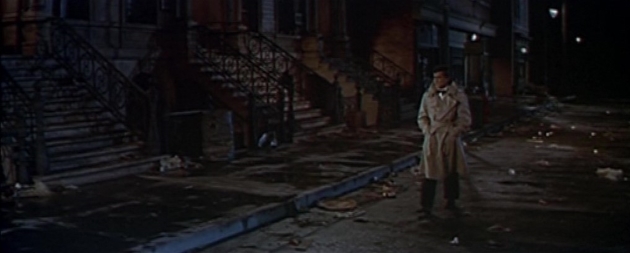
Mister Cory was adapted from a Leo Rosten novella, which Tony Curtis bought the rights to and had Blake Edwards adapt for the screen. It has a classic “rise and fall” structure that makes for good drama. There is a lot of emphasis placed on the nature of ambition, the old exhortation to be careful what one wishes for never being far from the surface, as well as other maxims regarding all that glitters and so on. This is all very well, but not that compelling at the same time. On the other hand, the movie is on much firmer ground when it posits the theory that human nature is immutable, rendering notions of grasping ambition, social climbing, and all the deceit and falseness that tend to accompany those wraiths redundant. At the heart of the story is the belief that running away from one’s true self, denial of one’s nature in essence, is a doomed enterprise. Sooner or later, this dawns on pretty much every character. It can be seen in Charles Bickford’s veteran gambler, a man who intuitively knows when the game has grown stale. Cory may be one of the last to fully grasp this, though it does grow on him gradually; there is a terrific scene where, with success won, he wanders back to the old neighborhood where he grew up, strolling down the middle of the empty nighttime street, gazing at the building he was born in, the locations that spelt loss and tragedy and the places he learnt his trade. Lost in the cool solitude of reminiscence, surrounded by the echoes of voices long gone and words drifting across time, his past and present knit together in a moment that marks the beginning of his acceptance of self.

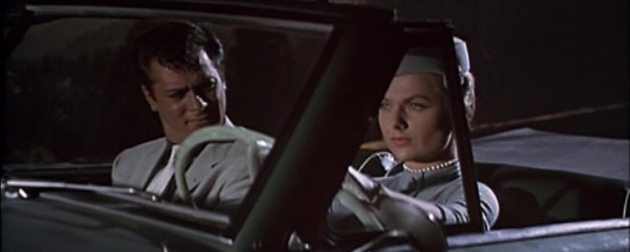
Curtis deftly captures the many facets of the character, the roguish charm that never really deserts him, the drive concealed behind this, and the awareness that all the polish and front is simply that, a veneer that does nothing to shrink the distance between the one-time street urchin and the elegantly clad dream merchant he has cast himself as. Again, I’m drawn back to that scene I mentioned above, so much of the character is encapsulated in it after all, with Russell Metty’s camera tracking the lone figure via a crane shot that shifts from cool objectivity to intimacy and serves to highlight the contrast between the slick facade Cory has adopted and the grimy background that produced him. With the lens focused on his troubled features, it’s clear to see that he hasn’t traveled so very far. Martha Hyer was an actress who flirted with true stardom yet never quite broke through. Around this time she had roles in some good movies – Battle Hymn for Douglas Sirk, and she earned an Oscar nomination for her work in Minnelli’s Some Came Running. The part of Abby called for someone who was able to convey chilly snobbery in tandem with a weakness for slumming  and hypocrisy, which Hyer gets across successfully.

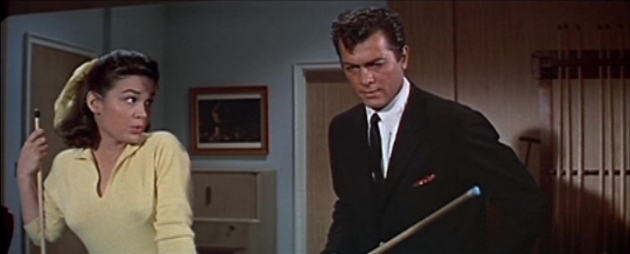
Kathryn Grant graced some fine films throughout the 1950s and she brings a liveliness that is quite infectious to the part of the younger Vollard sister. Playing the third arm of a romantic triangle frequently proves to be something of an unrewarding task, but William Reynolds takes it on manfully and achieves a degree of pathos as the flawed fiancé. The reliably crusty Charles Bickford brings dry humor coupled with down to earth wisdom to the table and acts as a stabilizing influence on his often hot-tempered protégé. Another interesting piece of casting is band leader Russ Morgan as the Chicago hood, something which sounds like an odd choice but which ends up working out just fine. Finally, a word for Henry Daniell, a man whose long career saw him regularly playing highly cultured villains. He brings great suavity to his work here, insisting on good manners and propriety at all times, the very personification of moral rectitude. And then he gets to deliver a genuinely killer punchline to wrap up the climactic confrontation in the casino.

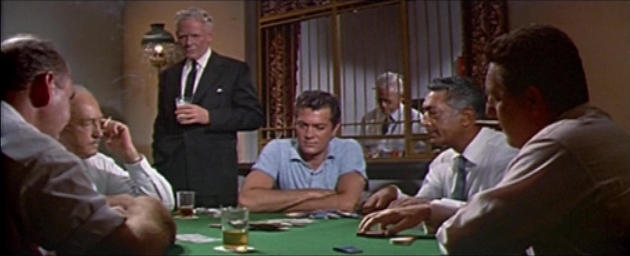
Mister Cory has had DVD releases in France, Spain and Italy, and I strongly suspect all of them will be using the same source. I have the Italian release, which presents the movie in the correct ‘Scope ratio. It’s a colorful if rather soft transfer though and the images I’ve added above should give some idea of how it looks. I would love to see this film get a brush up because it really deserves better treatment. I hadn’t seen it before and I’ve never heard anything much about it either. Every year brings a few new discoveries for me and I feel this movie rates as the most enjoyable and worthwhile of them so far in 2023.