
“I just want to be somebody… “
Why does film noir continue to resonate? Why does it continue to pull in viewers, beguiled by its shadow drenched nightmares? That is does exert a draw on audiences is beyond question and part of it is maybe down to the look, the attitude, the charm of something at once recognizable yet lost in time. Still, I feel there’s something else at play for film noir is a very human form of filmmaking; it is predicated on the frank acknowledgment of weakness and frailty, perhaps growing out of character flaws, ill fortune, poor choices, or even some unholy trinity of them all. In a way, there is something about the lack of definition regarding film noir that points to its core appeal. There has been decades worth of conversation and controversy over when noir began, when it ended, what it actually is and whether it can even be referred to as a genre. And at the end of it all, there remains no definitive answer, just schools of thought one might subscribe to. As such, is it possible that film noir is in essence a cinematic expression of uncertainty and confusion, mentally, morally and spiritually? Somehow it feels appropriate that the main character of Night and the City (1950) should say those words quoted at the head of this piece, struggling to articulate an ambition that he cannot fully visualize, much less define with clarity.

Movement and position matter. Anthony Mann frequently had his characters striving to rise, forging a path upward with mixed results, while Abraham Polonsky famously had John Garfield racing down from the heights. The characters in Jules Dassin’s Night and the City, on the other hand, start off at the bottom and remain resolutely anchored there. In a sense, nothing really changes throughout, at least not as far as Harry Fabian (Richard Widmark) is concerned. The opening and closing sequences see him racing through the streets of a broken post-war London, a grandiose chiseler with danger hot on his heels and the hope of sanctuary and salvation, even if it’s only temporary in nature, awaiting him in the form of Mary Bristol (Gene Tierney).

Harry Fabian is what can only be termed a dark dreamer, immature both emotionally and ethically. Mary loves him, that much is clear, not so much for what he is as what she imagines he could be, and Harry in a way is also in love with that projection of what he dreams he could be. The problem though is that neither Mary nor more importantly Harry himself is quite sure of who or what he might be. He is, as his neighbor observes, an artist without an art. We encounter him first as a strictly small time operator, a tout steering mugs to the clip joint where Mary sings, scratching around in the detritus of a city still partly bewildered in the wake of its wartime pummeling for any scheme that might turn a fast buck. Human nature being what it is, he’s not the first nor will he be the last person with his eye on the quickest way to reach easy street. The problem with this approach to life lies in the fact the route there is typically mined. Thus when Harry happens upon what seems like the perfect opportunity to muscle his way into the world of professional wrestling he fails to anticipate the the traps awaiting him. Blinded by his enthusiasm and unaware of how his smug efforts to play all of his rivals off against each other is actually weaving a Gordian knot of epic proportions, Harry is doomed by his own slickness.

It feels kind of appropriate that Jules Dassin would make Night and the City just as the appalling HUAC episode was reaching its peak. Zanuck had dispatched Dassin to London to shoot the movie where he would be beyond the reach of those congressional committees. By the time the movie was completed, the director was firmly on the blacklist and could no longer take any part in the editing process. Nevertheless, the result is portrait of bleak romanticism, where passion, ambition and duplicity all charge headlong towards an emotional intersection and the resulting collision leaves few survivors standing. I have seen assessments of the movie, both contemporary and subsequent, that lament the dearth of sympathetic characters, citing this aspect as a weakness. Such evaluations leave me wondering if I was watching the same movie. Perhaps it’s just me, but I’ve never seen the need to conflate admirable with sympathetic. I’ll concede that there are few truly admirable figures on show, but that does not mean there are none who are sympathetic. If anything, I would assert that almost all of the principals earn some sympathy.

Widmark’s role is almost as difficult to categorize as film noir itself. Fabian is neither hero nor villain in the proper sense of the words, nor would I be entirely comfortable referring to him as an anti-hero. Right up to the tragic moment which precipitates the climactic hunt, he does some contemptible things as he attempts to plug the leaks suddenly appearing in his plan, but the people he’s deceiving are no saints themselves so it’s hard to condemn him too much for that. As the various threads of his schemes become ever more entangled it’s a bit like watching an accident unfold in slow motion. Aside from his mounting desperation, a few moments such as the early scene in Tierney’s flat where the frustration of both is emphasized, as well as the later exchange with an implacable hotel manager serve to add layers to the character and knock off some of the corners. I don’t believe either Dassin or screenwriter Jo Eisinger had any intention of passing judgment on Fabian and certainly don’t encourage the viewer to do so – he is merely presented as he is. His maneuvering does bring about tragedy, but that occurs indirectly. By the end, when he lies spent and bereft the appearance of Tierney framed in a doorway like some angel of the dawn affords him the opportunity to seek a form of redemption through personal sacrifice. Whatever one may make of the gesture, it does indicate a man who is not merely self-absorbed. What’s more, even though he may be abandoned and betrayed by almost everyone, there’s no getting away from the fact this woman loves him in spite of all his flaws – that in itself places the character on a different level.

That said, Tierney’s part is a relatively small one. Her important scenes bookend the movie and she’s only on screen intermittently in between. It seems that Zanuck was keen to have her in the cast and her role is a pivotal one despite the lack of screen time overall. By humanizing Harry Fabian and adding another dimension to his character, Tierney helps to ground the movie and give it greater emotional depth. The other major female role is that of Googie Withers, the discontented nightclub hostess who is trapped in a relationship for purely financial reasons, something which would not have been uncommon for a woman at the time. Sure she is underhanded and motivated by selfishness, but it’s not so difficult to understand how circumstances have driven her in that direction, nor do I believe it should be so hard to empathize with her efforts to extricate herself from a wholly unsatisfactory marriage. Her husband, played by the oppressively bulky Francis L Sullivan, is another figure who is far from perfect. Insecure despite his clout and dominance in the way such large men often are, he pulls strings and manipulates Harry Fabian like some malign puppeteer out of a desire to see him brought low and in so doing maybe hold onto the woman he so badly needs. It’s a performance that manages to be simultaneously dangerous, vindictive and pitiful.
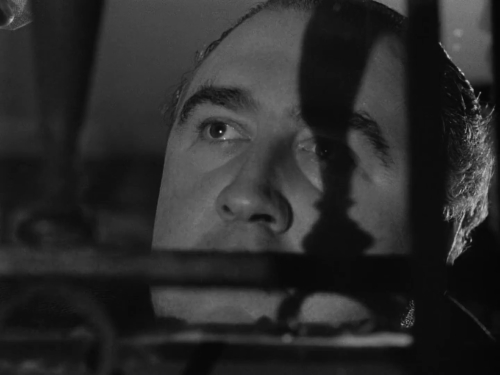
Many of the other supporting players are portraying characters who are associated in one way or another with the wrestling world. This milieu is appropriate even if it’s not an area that has been extensively featured in film noir – Ralph Nelson’s Requiem for a Heavyweight is the only other notable example that I can think of off hand. Boxing tends to be the go-to sport and I find the choice here a telling one. Boxing might be susceptible to certain abuses, it may attract corruption, but it still retains some inherent nobility, similar to the way Greco-Roman wrestling retains a link to the classicism of the ancient world and something finer. On the other hand, the crass vulgarity of professional wrestling exists on a much lower plane, a true moral wasteland. It’s that very cheapness, that sense of debasement which lies at the heart of Fabian’s flawed scheme and also forms the basis of the conflict between Herbert Lom’s shady underworld promoter and his scrupulously honest and dignified father. It’s highlighted too in the contrast between the easy superiority of that old athlete (Stanislaus Zbyszko) and the barely articulate coarseness of Mike Mazurki’s hulking and murderous pro.

Night and the City had two cuts, the shorter US version, which Dassin seems to have preferred, and a slightly longer British version. The UK Blu-ray from the Bfi, which now appears to be out of print and consequently is rather expensive, offered both cuts – I think the US Criterion also has both versions too though. I don’t know how popular a view this is, but I find I prefer the longer British cut of the film; perhaps the noir credentials are slightly weakened or some might say compromised yet I like the way it shades the character of Harry Fabian in another light. I find it provides another layer of tragedy and thus heightens the ambiguity of the experience. Nevertheless, this is prime film noir regardless of the version one favors and top filmmaking in anyone’s book. Widmark was only about a half dozen or so movies into his career at this point, already in the middle of a remarkable run of performances in very fine films while Dassin had just come off a short streak of excellent films noir. Under the circumstances, it’s hard to see how this one could miss. A first class movie all round.
 Riding the High Country
Such a fine film and you do it full justice here Colin. I really like your examination of the X and Y axis of movement – Fabian barely shift up or down, only able to move forward for as long as he can keep running. I may also prefer the UK cut, which is also notable for using a score by Benjamin Frankel instead of the one by Franz Waxman in the US release. The DVD from Criterion had an audiovisual essay on the differences between the two versions but only presented the US edition. The BFI release is certainly well worth getting for both cuts – shame they didn’t renew their licence. Have you read Kersh’s original novel, by the way? It is quite different (Fabian is truly irremediable there), darkly humorous and really superb.
LikeLiked by 1 person
Yes, it’s unfortunate the BFI either let this go, or were unable to renegotiate the license, as the had produced a really first rate edition.
As for the book, I have never read it, although I was aware that the portrayal of Fabian didn’t have any of the ambiguity the film adds. I’ll maybe try to get to it some time.
LikeLike
In the case of the book, it’s not so much that it less ambiguous it’s that his crimes are less forgivable. But the tone is pretty ambivalent. Kersh was a great writer, well worth trying.
LikeLike
I see. He appears to have led an interesting albeit relatively short life too.
LikeLike
Gerald Kersh is one of those writers that I’ve been intending to get around to reading for quite some time. So I’ve just ordered a copy of his Night and the City novel.
LikeLike
Really hope you like it. PRELUDE TO A CERTAIN MIDNIGHT and FOWLER’S END are also really worth tracking down.
LikeLiked by 1 person
Great review Colin 🙂 Director Jules Dassin truly understood film noir. The US Criterion edition has both cuts and I love them equally 🙂 Also, I just read your reply on Maddy’s post on Vertigo from last year and I too am a huge fan of the film, In fact, I just posted an essay on it on my site 🙂
Speaking of Dassin, do you remember Rififi? 🙂 I know that sounds silly cause you probably saw it already, but who can forget the heist setup sequence in that film 🙂
LikeLike
Thank you, John. Glad to hear you enjoyed it. I’m going to read through that post on Vertigo some time in the next few days, it looks like a long, detailed analysis which you clearly put a lot of effort into.
LikeLiked by 1 person
It’s probably a very unpopular view but I’m not much of a Jules Dassin fan. Yes Rififi is impressive but I dislike his forays into film noir. I was underwhelmed by The Naked City and I thought Brute Force and Thieves’ Highway were very heavy-handed and clumsy.
I think there’s a tendency to overrate directors who fell foul of HUAC. Joseph Losey being another prime example. Sometimes they’re admired mostly for political reasons.
LikeLike
Personally, I like Dassin’s work overall and would never have considered applying those adjectives, but each to his own.
As for the other point, I really cannot go along with that at all. I know I assess filmmakers on the basis of the work they produced and while acknowledging that other factors may have influenced how they approached subjects or the themes that are apparent in their films, this in no way colors my reaction or response to the quality of that work. And I don’t believe it has much effect on others either; we may, not unnaturally, sympathize with those victimized and bullied, with lives and careers damaged, by opportunists. However, that’s a separate issue and doesn’t make a poor film good or vice-versa.
LikeLike
“I’ve never seen the need to conflate admirable with sympathetic.”
Good point. In fact there are occasions when I find admirable characters unsympathetic.
LikeLiked by 1 person
Perhaps they are not so admirable, just conventional.
LikeLike
Personally, I reckon good characterization deserves to be taken on its own terms and any snap judgements about positive/negative, conventional/unconventional are best avoided. Any interestingly sketched character ought to be allowed to unfold as the writer wishes.
LikeLiked by 1 person
Yes, the main thing is to make a character interesting and complex. You can make a hero or a villain interesting, you can make a winner or a loser interesting, or a brave man or a coward.
What matters is that the viewer’s interest is sufficiently engaged that we want to find out what happens to that person. Which means that whatever we think of the character, we have to find him believable.
LikeLike
Just to clarify, I’m not suggesting that admirable characters should not be viewed in a sympathetic light, just that a figure who is clearly not admirable need not be regarded in an entirely negative way, without any redeeming features.
LikeLike
Characters who are a mix of good and bad are usually interesting. With a good writer and a good actor there’s so much potential for internal conflicts.
What really makes a movie engrossing is when the viewers are allowed to make up their own minds about a character.
I get the feeling that that is something that has been lost in recent years, with viewers not being trusted to make their own judgments.
LikeLike
Superb review Colin-background details much appreciated.
Dee’s comment on overrated HUAC directors-I wonder how much of Losey’s (best) work he has seen-the harrowing M still needs a proper restoration. For me the best Losey work is in black & white the exception being ACCIDENT. THE GO BETWEEN for me is overrated tosh-compare Losey’s treatment of the English landscape (rather like a cider commercial) to Peckinpah’s austere landscapes in STRAW DOGS.
Every dog has it’s day rather like film directors-Dee mentioned a fondness for J Lee Thompson;again his early black & white Brit flicks outstanding his later work drek of the highest order. The wretched McKENNA’S GOLD and THE WHITE BUFFALO showed this director should have never been let anywhere near a Western.
Losey’s early Brit flicks alone confirm him as a master film maker. THE SLEEPING TIGER-TIME WITHOUT PITY and THE CRIMINAL all wonderful. M is arguably Losey’s finest film and I guess why the HUAC goons got on his case. Losey wanted to make David Wayne’s insane child murderer more sympathetic than Lorre in Lang’s version admittedly the better film.
Another HUAC escapee was Cy Endfield and really only HELL DRIVERS showed the promise he had shown in TRY AND GET ME. (WOKE ALERT!!) I’ve never seen ZULU as Colonial adventures are not my thing but I’d still love to see Selander’s ROYAL AFRICAN RIFLES …..go figure. Barry now I’ve got you attention belated Happy Birthday for yesterday.
Dee you seem to favour directors by their political leanings which is all wrong-your opinion of Nicholas Ray was all off kilter a master film maker in anybody’s book, still you are entitled to your opinions as am I a woke lefty middle of the road Socialist.
Dee what’s your take on Robert Aldrich an early associate of Losey’s (Losey had hoped to get the rights to film APACHE) despite a card carrying Liberal many of his films are chock full of violence and sadism
LikeLiked by 1 person
Thanks, John. I concur with pretty much all you say there. The political or social positions of filmmakers shouldn’t sway us too much either way as regards how effective they were in making movies. Sure everybody will have their own reaction to the way some themes are handled, but the degree to which one sympathizes with that or disapproves is not relevant in my view. Some filmmakers whose films I enjoy had views that were very far from my own, but that doesn’t mean I’m going to dismiss their work on that basis. I like a lot of what Leo McCarey did, barring the dreadful My Son John, for example. I find the views Sam Wood professed quite repellent while still appreciating many of his movies, and there are other examples I could cite.
LikeLike
A filmmaker’s politics only bother me when the politics becomes intrusive. Cecil B. DeMille was a conservative Republican and I love his movies. Some of my favourite French and Italian directors were card-carrying communists and I still love their movies.
Politically I’m a far left right-winger and a far right left-winger and a centrist and I’m a radical moderate. If you ask me what I’m rebelling against politically I’ll answer in the immortal words of Marlon Brando – “What have you got?”
LikeLiked by 1 person
I really enjoy a lot of J. Lee Thompson’s less acclaimed work such as Eye of the Devil and St Ives.
And I know this is likely to be greeted with howls of derision but I loved his 1985 King Solomon’s Mines. I know, there’s no hope for me!
LikeLike
Thompson’s decline started somewhere in the mid to late 60s. The stuff he made from the 80s on for Cannon is the nadir for me.
LikeLike
Recently watched his ‘Return from the Ashes’ and liked it. Sad his decline was so marked because his best was so engrossing ‘Ice Cold in Alex’, ‘Guns of Navarone’, and ‘Cape Fear’. Such strong stuff.
LikeLike
Robert Aldrich certainly had an obsession with grotesque representations of women. Whatever Happened to Baby Jane?, Hush…Hush, Sweet Charlotte, The Killing of Sister George, even to some extent The Legend of Lylah Clare.
And to be clear, the women in The Killing of Sister George aren’t grotesque because they’re lesbians, they’re grotesque because they’re Robert Aldrich representations of women.
The female characters in The Big Knife are pretty grotesque as well, especially Shelley Winters.
LikeLike
Shelley grotesque? Isn’t she always…?
LikeLiked by 1 person
Well I have seen ‘Zulu’ only a couple dozen times. It is a favorite film and far more than just a colonial adventure film. It is one of the great war movies. Great acting, great direction by Endfield. Honor and courage of the opposing sides is depicted in such memorable ways. This film lingers long in the memory. I’ll have to get my Blu out and watch it again now!
LikeLike
My favourite Cy Endfield movie is Jet Storm (1959). It’s like a dry run for Airport, with a madman trying to blow up a jet airliner. Dickie Attenborough perfectly cast as the madman. Lots of fine suspense. Stanley Baker’s in it too. A neglected gem.
Interesting that they used a Russian jetliner – at the time the Russians had the only successful jet airliner (since the British Comets kept falling out of the sky even without bombs aboard).
LikeLike
I remember Diane Cilento being characteristically good in that, and Marty Wilde being pretty annoying.
LikeLike