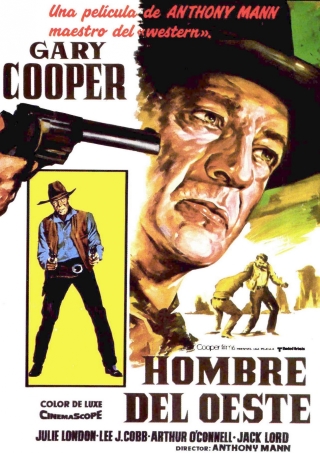
The western, when it hits the heights of its artistic potential, traces the route of its characters along a path that leads them to salvation, redemption, fulfillment or any combination thereof. When this is achieved then the audience gets to follow, to catch a glimpse of, and thus on some level share vicariously in those rewards – this is one of the riches of cinema and it’s to be found in abundance in the very best of the classic era of the western, not least as it approached the zenith of its power. And for directors who could be said to have had a clear view of what they wanted to do within the genre this same progression towards a destination marked fulfillment can also be discerned. Anthony Mann started making westerns at the beginning of the 1950s with Devil’s Doorway and Winchester ’73 and, particularly in that great cycle with James Stewart, dug deep into the heart of the genre. His work laid bare the tormented souls of his characters yet also applied a kind of spiritual healing balm that meant the harsh journeys he took them on finished up at a place that promised them peace. Man of the West (1958) follows this template and while it wasn’t the last of Mann’s westerns, it does represent the apogee of his work in the genre.
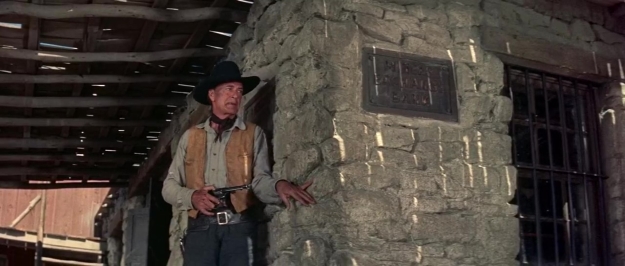
On the surface, the plot of Man of the West is a simple and straightforward one. Link Jones (Gary Cooper) is a man clearly out of his element, a true man of the west who is spooked by his first view of a train and bemused by civilization’s apparent determination to squeeze him into the smallest space manageable. Still, the west of his past is never far away and a neatly executed raid sees him relieved not only of his luggage (and the money he’s been carrying to hire a teacher for his town’s new school) but also the discomfort of his poorly designed seating. Stranded in the middle of nowhere in the company of garrulous card sharp Sam Beasley (Arthur O’Connell) and saloon singer Billie Ellis (Julie London), he has no option but to set out in search of shelter. The thing is though, Link is no helpless hick – he evidently knows where he’s headed as he soon comes upon an old homestead that he seems familiar with. In short, this is very definitely a man with a still unrevealed history, one who thought he had outrun that past only to find it catching up with him and drawing him back into its unwelcome embrace. There had been hints of that in his shifty avoidance of the law back at the train halt, but it’s here that the full extent of his involvement with criminality is dragged out into the light, or into the flickering shadows of a dank and dangerous cabin to be precise. The gang who robbed the train are taking orders from Dock Tobin (Lee J Cobb), the notorious uncle who brought up and shaped – or perhaps twisted – the character of the younger Link. His delight at having his protégé back is matched by Link’s carefully concealed disgust at being snared once again by the kind of people he thought he had escaped for good.
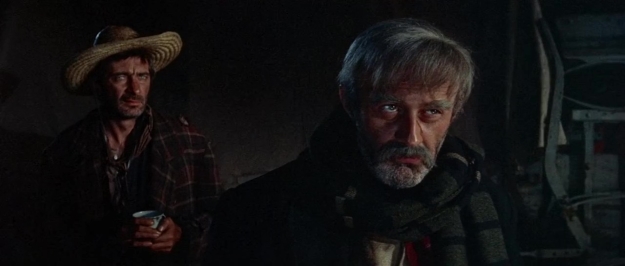
The tone of the movie shifts radically at this point. Link’s caginess grows and is clarified at the same time, and the worthlessness and utter inhumanity of Dock and his gang increases by the minute. The cabin itself is hugely oppressive, shot by Mann in the shadowy menace of guttering flames with a heavy and smoke darkened ceiling regularly in view, its narrow and tight dimensions seem to press from every side. As Dock raves and booms about a past steeped in blood and brutality, Link’s burgeoning despair is just about held in check. He had set out to recover the money entrusted to him by poor and trusting people and now finds himself responsible for both his own well-being (he has a dependent wife and children relying on his safe return) and that of two helpless people he has led into danger.
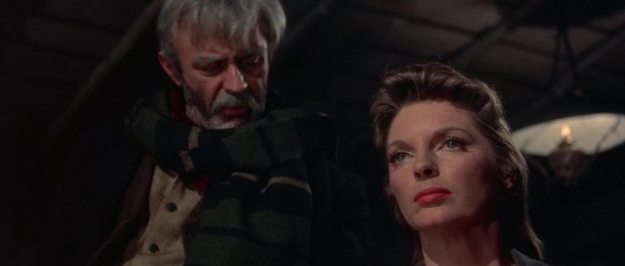
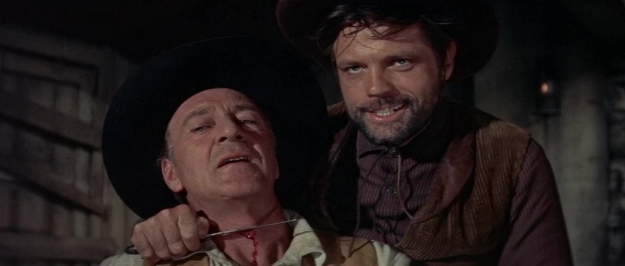
This long sequence in the cabin gradually takes on the feel of a visit to one of the deeper circles of Dante’s Inferno, where depravity is let loose and one starts to wonder if light will ever be permitted in again. Dock resides here, a malignancy at the center of a web he has spun around himself, goading his companions to ever greater excess. When the degenerate Coaley (Jack Lord) demands that Billie strip for their amusement and holds the outraged Link captive, a knife cutting into the flesh of his throat, there is a real sense of terror on show. This entire section is impossibly tense, dark and forbidding, so much so that there is a palpable sense of relief when events move the characters out, when a new dawn breaks and the possibility of getting into the open beckons.
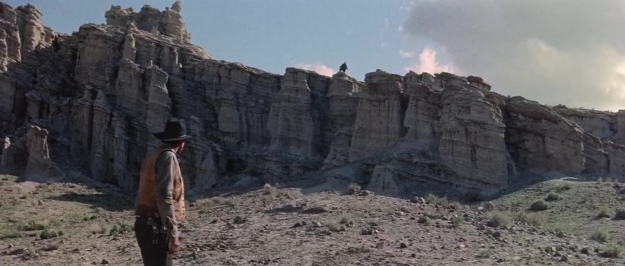
Here, in the closing act of Mann’s beautifully shot tragedy, those classic themes of revenge, redemption and renewal are played out against a dusty and sun-bleached backdrop that is as unforgiving as it is honest. Link is handed the opportunity to avenge the indignity and barbarity of Coaley, meting out a retribution that is chilling in its bleakness and also unsatisfying as a result of the further hurt it unwittingly inflicts on the innocent. The message of course is that revenge never achieves anything of value, a theme that Mann revisited time and again throughout his career. By the time it all draws to a conclusion with a sudden gunfight high up on one of the director’s characteristic elevated spots, more horror has been confronted and further pain endured. For all that harshness and violence and loss, Mann’s essential commitment to the durability and resilience of humanity, to the ultimate triumph of decency over malice never falters. When the damaged survivors come together briefly at the end before the inevitable parting, making their peace with themselves and the challenges posed by life itself, there is no doubt that catharsis and renewal have been earned and won. This holds true of the characters, maybe it can be said of the director, and it brushes off on the viewer too .
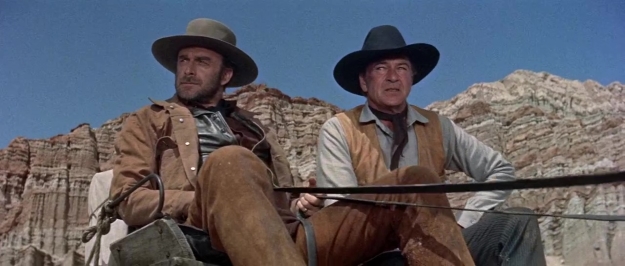
I know the casting of the movie has not met with universal approval, but I find it works fine for me. Sure Cooper was probably too old for the part as written but his work here allows me to ignore that. The fact he had such a natural affinity for western roles is a terrific boon in itself and then there is that minimalist approach to acting he had perfected over the years. Those eyes that dart like fugitives while the face remains taut, that guarded catch in the voice, the pauses and the silences all add up to wonderful screen acting and I find it hard to see how anyone else, regardless of their age, could more convincingly impart the mix of caution, fear and guts required. Does Lee J Cobb crank it up too high? Maybe so, but as I see it his character is a monstrous creation, deluded and demented by his own turpitude. Dock Tobin lives in an unreal cocoon and surrounds himself with lowlife sycophants so it’s arguably a valid interpretation on the part of the actor to play him with such studied bombast.
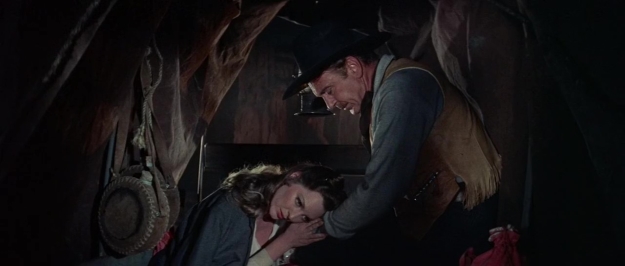
Julie London’s lonely saloon girl is well realized and she deftly captures the precarious position occupied by a woman in such circumstances. All her western roles were fine but this one presents her with a number of challenges – the natural toughness of the saloon singer is neatly juxtaposed with her innate vulnerability and she handles the scenes where she’s subjected to both physical and psychological assault with sensitivity and grace. She excels in her scenes in the cabin and barn, playing effectively off Cooper’s reticence and reserve, and then has two other memorable scenes with her leading man in the wagon, the first tender and bittersweet while the second exposes the full horror of Tobin’s bestial character. In support John Dehner plays it tightly coiled as Cooper’s cousin, coolly disgusted by the decline he sees in Tobin and never once deceived by Link’s maneuvering. Royal Dano is memorably manic as the mute Trout, Robert J Wilke sneers and threatens on cue while Arthur O’Connell is all blather and blarney till he stops a bullet at the end of one of the film’s most shocking scenes.
Man of the West saw Anthony Mann take the western to the place he wanted it to be. All the themes he’d touched on and explored throughout the preceding decade are on view and placed under the microscope. Having won acclaim as a director of film noir, his westerns hold onto some of that darkness – the visual aesthetic may have gradually become less pronounced as he moved to frontier tales but the fascination with the less savory aspects of humanity remained. What separates his westerns from his earlier noir work though is the focus on reaching for something finer, the scramble towards redemption and an escape from the darkness both within and around the characters. By the time he made Man of the West he had discovered how to set those characters firmly on that path.
 Riding the High Country
One of my favourites. So much going on and so many character layers. I love how Coop shows Link’s inner struggle to hold on to the good man he has become, instead of returning to the man he once was with Dock. I love the relationship between Link and Billie.
LikeLike
It’s such a classic theme driving the narrative., but very well executed. The disgust Link clearly feels at having to do things he thought he’d left behind in the life he’d abandoned is palpable and Cooper, regardless of his age at the time, communicates that aspect so well, as he does with that caution that is necessary in a character who is essentially making his way through a minefield. All very understated yet quite evident and with an authentic feel.
And yes, the relationship with Billie is touching in its simplicity and truth, never straying into the realm of some contrived romance which would have been at odds with the characters as presented.
LikeLiked by 1 person
Really enjoyed reading this post, Colin, not least of which because it’s one of my favorite westerns and one of the few that I’ve seen more than once. I never knew that there were those who questioned the casting — I thought it was spot-on. I especially like Gary Cooper in this part. I don’t usually think of him as one of my favorite actors, but I greatly appreciate him in this; it may just be my favorite Cooper performance. I noted your mention of Devil’s Doorway — I received it as a gift a couple of Christmases ago but still haven’t watched it. What do you think of it, especially in comparison to Mann’s other westerns?
Karen
LikeLike
Thanks, Karen – I just saw this comment as it strangely ended up in the spam folder and I had to recover it.
Anyway, I rate Devil’s Doorway highly. It’s visually closer to Mann’s noir work and there is a darkness and a genuine sadness to the story. However, the sober tone also adds to the moving quality of the film. I’d have no hesitation in urging you to check it out as soon as you can seeing as you have a copy readily available.
LikeLike
Thanks so much, Colin — I definitely will!
LikeLiked by 1 person
I think Coop’s late one-two of this and ‘The Hanging Tree’ are excellent, first rate work.
LikeLiked by 1 person
Quite. Two significant films towards the end of Cooper’s career and towards the end of the genre’s finest decade, both of which are mature works for important directors.
LikeLike
Same here Chris 🙂
LikeLike
Excellent review of a favorite. I really like late Cooper Westerns and I find this one of the best. Mann and Coop really do great work here. Now I need to get my DVD out (again!) and enjoy.
LikeLike
Like all good westerns of this era, it has plenty of rewatch value, always different things to look for. The DVD always looked good and the Blu-ray ( I have UK Eureka edition myself) certainly shows off the cinematography.
LikeLike
Yes I missed out on the Kino Blu and now it goes for a pretty penny. Ah well maybe next time!
LikeLike
I also meant to add Lee J. Cobb is a tremendous creep in this.
LikeLike
Cobb’s Dock is a full on villain with no redeeming features whatsoever. He starts out mean and dangerous and this just builds throughout the movie. The character has no moral compass at all and yet his actions when the others are off chasing his lunatic plan in the town of Lasso still shock.
LikeLike
One of my favorite Anthony Mann westerns that you did justice to in your fine review, Colin. Well done, my friend.
LikeLike
That’s all but one of Mann’s westerns that I’ve managed to feature on the site so far – I’m not sure why it’s taken me so long to get around to this one. Hopefully, I’ll add Cimarron at some point too just to round things out.
LikeLiked by 1 person
Caught this first run on the big screen. If I am not mistaken, it was shortly after the sad demise of Gary Cooper. The shootout at the climax was very impressive.
LikeLike
As far as I can see, the film should have been released in late 1958 in the US and then later on in other places – on into 1960 in some locations and even 1961 in Spain if IMDb is to be believed.
LikeLike
Well Colin; sorry pardner, but I’m going to have to rain on your parade.
As you know I have an intense dislike for this film and I’m certainly not alone.
I’m not so much a Mann completist but I do enjoy sifting through his early back catalog especially the early Noirs-THE GREAT FLAMARION is an early masterpiece and other incidental joys include STRANGERS IN THE NIGHT and STRANGE IMPERSINATION which I like very much. Even lightweight fluff like THE BAMBOO BLONDE has it’s delights,which I admit are pretty small, and DR BROADWAY an early indicator as to where Mann was heading.
I do admire Mann’s extremely modest assessment of his talent-I have only met two geniuses Preston Sturges and Erich Von Strolheim and they both ended up broke;that’s why I consider myself fortunate to be a mere worker.
I too endorse DEVIL’S DOORWAY a wonderful earlier work and SIDE STREET from the same brilliant period.
The point is I don’t adore everything Mann did and I cannot think of a director where it gets to the point that I love EVERYTHING they have done.
I have explained many time here my reasons for my dislike of Mann’s film-Cooper far too old (Coop & Jack Lord as cousins….REALLY) and Cobb’s OTT performance as Coop’s uncle. Gone is the visceral violence of RAW DEAL and THE NAKED SPUR-MAN OF THE WEST sees Mann exploring pure sadism which in some ways pre dates the Spaghetti’s.
As I’ve stated before just think how wonderful this picture would have been with Robert Taylor and Burl Ives-the latter who would have brought a sense of menace that Cobb’s vaudeville turn lacks.
No one likes a deconstructor of sacred cows but there you go.
LikeLiked by 2 people
John, I know that you’re no fan of the film and I fully respect your reasons for feeling that way even if I don’t share them myself. Personally, I see it as a natural destination for Mann based on the kind of themes he was digging into with his earlier westerns.
Just to pick up few points you made. I don’t necessarily adore all of Mann’s films either, although I think I do like most of them. A Dandy in Aspic – granting he passed before it was completed and it isn’t therefore all his work – is very weak in my opinion and something I don’t care if I never see again. The Great Flamarion has a strong reputation as far as I can see but it has always left me a little cold – I may try it again some day though. Strategic Air Command is another that does nothing for me. Then again, I feel The Fall of the Roman Empire remains criminally underrated, so I guess I too pick and choose my Mann films.
Regarding the relative ages of the stars, it really isn’t an issue for me and the discrepancy between Cooper and both Lord and Dehner isn’t something that I see as all that odd. Perhaps it’s down to having cousins of my own who are significantly older and younger than me (20+ years in some cases) is part of that – my father had brothers and sisters over 20 years older than him and my grandmother had siblings at least that many years younger than her so it naturally happens.
As for alternative casting, it’s fun to speculate on these things but that’s all it can be of course. I like Burl Ives a lot and he could take on villainous roles, but I think he generally exhibited too much warmth, or traces of humanity if you like, even on those occasions when he was playing a bad man.
LikeLike
I know everybody picks on the age of the characters in this film (Brian Garfield does in his negative review in his Western guide) and honestly I don’t care. We accept so much on faith in movies anyway. Two more Mann films I find interesting are ‘Men in War’ and ‘God’s Little Acre’. I always like to mention them.
LikeLike
Yes, I like, and agree with, that point about taking things on faith, it’s part and parcel of movie watching for me.
I’m glad to see you mentioned those films too, they don’t tend to get a lot of attention.
LikeLike
Like you, my father has nephews and nieces older than him so it puts my cousins age in the same area. My only issue with Cooper’s age is in the fight with Lord. Frankly, having been the age as Cooper was at the time the idea of beating someone half his age a bit of a stretch but experience can overcome a lot.
The relationship with London I find the attraction as much as them having a shared a painful experience (and survived) a compelling reason to be together as much as any physical attraction. Cooper’s protection alone might be a reason for her to stay with him.
Sometimes one’s age can be a benefit. Having turned around one’s life, and presumably, for some time, and hating being dragged back in makes reactions to the situation more deeply felt, I think.
LikeLiked by 1 person
All fair points, Chris. The connection between lived experiences and the intensity of reactions is worth noting.
LikeLike
The Great Flamarion is one of favourite Anthony Mann films. It just works for me.
Superb performances by all three leads. Von Stroheim gives perhaps his finest acting performance as a tragic and complex man. Dan Duryea is terrific, but then he always was. And Mary Beth Hughes totally nailing the femme fatale part!
It does help that I just love mysteries and thrillers with theatrical, circus or carnival settings and this movie ticks all my boxes in that respect.
I consider The Great Flamarion to be one of Mann’s two neglected masterpieces, the other being A Dandy in Aspic.
LikeLike
Points well made Colin.
THE GREAT FLAMARION is both cruel and mean spirited-but I love the beginning where the film really ends that almost demands a second viewing to make sense of it all. Von Strolheim brings a strong sense of tragedy to his character which contrasts nicely with the coldness of Mary Beth Hughes (sensational) and Duryea.
I’m not ashamed to have my real name printed-in fact that only happened by accident (WordPress again!) so I stuck with it as my comments were going through unlike our pal Jerry who is far more computer literate than me. A different form of sign has appeared today so I thought I’d go back to my old sign in with an addition inspired by Barry Lane-if that makes any sense.
I hope Jerry gives it another go and sadly our pal Walter had his e-mail hacked and has not been heard from since sadly. BTW any news from Gordon in Canada I always loved reading his comments.
LikeLiked by 1 person
The joys of WordPress, John. It is in many ways a law unto itself.
I haven’t heard a thing from or about Gordon in a long time. Technical issues may be the culprit again.
LikeLike
I’m having issues with WordPress at the moment as well, making it difficult to leave comments here. If you’ve noticed a falling-off of activity here then WordPress may be the culprit.
LikeLike
Same here.
LikeLiked by 1 person
WordPress has been problematic on a number of fronts for a while now, something I’ve come across both as a blog owner and as a visitor to other sites. Logins can be excessively fiddly and frankly forbidding at times and more than one comment has struggled to get through. It’s a long way from the smooth and intuitive experience the platform offered users and visitors way back when I first started using it.
LikeLike
It’s the story of the internet isn’t it? Start a really cool site. Set up an interface that is easy to use. Then keep “upgrading” the interface until it is completely unusable.
LikeLike
WordPress’s commenting system is truly atrocious. Long threads become a chaotic mess. Blogspot isn’t great in that respect either.
LikeLiked by 1 person
Great review Colin 🙂 I tell ya, the 1950’s was truly a golden age for them – Anthony Mann, Budd Boetticher and Delmer Daves among others 🙂 Man of the West is one of Mann’s many greatest films 🙂 His westerns were every bit as masterful as his film noirs and later on, his epics (yes I actually love his epics) 🙂 Mann’s westerns were unique in that they might have been the earliest to give the beloved genre a psychological spin. You see it in the Jimmy Stewart’s like Winchester ’73 (among others) and one sees it here in Man of the West 🙂
P.S. I just did a blog entry recently on my experience watching a 70 mm print of Vertigo on a big-screen 🙂
LikeLike
How about if we give all that disproportionate credit to Jimmy Stewart’s westerns to him? I know it is fashionable to salute the director, but there is an entire team, and each extremely expensive film has one person who calls the signals. That is the most important man or woman on the block, as in, run it by Clark, David Selznick, Claudetee, Duke. Many more, not least the unsung producers other than DOS.
LikeLiked by 1 person
Oh of course Barry, I am denying that 🙂 I think the reason we give lots of credit to the director is because he or she is often defined as the true auteur of the picture 🙂 Nevertheless, that is not always the case. Sometimes it is a producer like Selznick, who comes off as the true auteur or in the case of something like Tod Browning’s 1931 version of Dracula, it is lead actor Bela Lugosi and Karl Freund’s cinematography 🙂
LikeLiked by 1 person
Yes, I think this is the key. There’s no getting away from the collaborative nature of filmmaking and no reason why we should, but the better examples do tend to show the guiding hand of a director or producer,, someone with the combination of clout and vision to be able to influence the tone and theme of a movie. Not every filmmaker does so, at least not so recognizably, but some do and it is possible to see a focus on particular themes running through bodies of work as a consequence. This is noticeable in the films of Mann, whose work is under discussion here, and can be felt in all of his westerns spanning a decade and the factor common to them is the director. His sensibility permeates his films, which ought to be acknowledged yet in no way lessens the efforts or contributions made by others in the collaborative process.
LikeLiked by 1 person
Perhaps, but that sensibility begins with the story, followed by the producer. Even if your view turns out to be valid upon investigation, I still do not care at all for Mann. He is adequate as a storyteller but not more or better than that.
LikeLike
Liking or disliking Mann’s work and rating it accordingly is of course a matter of personal taste. When it comes to shaping the overall feel and theme of a movie the contributions of the writers and others clearly play their part and there’s no reason for anyone to try to minimize that but, excepting some of the more hands-on producers, the directors (particularly those afforded greater freedom for one reason or another) are uniquely placed to present their vision.
LikeLike
Correction: “I am not denying that :)”
LikeLike
I think of Ross Hunter as another producer who seemed to put something of a personal stamp on movies he produced.
LikeLiked by 1 person
I do agree with you on that dfordoom and I do not know If you knew this, but prior to directing melodramas, Douglas Sirk made some film noirs among other different genres 🙂
LikeLike
Do we count over the top melodrama?
LikeLike
Hey Barry, I was actually talking about Sirk’s career before his melodramas for producer Ross Hunter 🙂 But of course, melodrama counts 🙂 Today, melodrama would be characterized as over-the-top, but you have to remember that during the classical Hollywood era, melodramas were supposed to be over-the-top, whether one views that as a positive or a negative. Then again, you probably knew that already 🙂
LikeLike
The jane Wyman melodramas, as successful as they were, are there at the death of the classi c period, and probably responsible in part for their demise.
LikeLike
Actually Barry, the old studio system was on life support starting at the dawn of 1965 and officially died at the dawn of 1970. In the wake of the commercial success of anti-establishment films like 1967’s Bonnie and Clyde and 1969’s Easy Rider (a countercultural classic), the old studio system was considered (rightly or wrongly, fairly or unfairly) outdated considering that films like 1968’s Star and 1969’s Hello Dolly were either flops or they did not make the kind of money the studios behind them had hoped for.
LikeLike
Actually you are off by ten years. The studio system ws destroyed by the Supreme Court and by the early fifties most of the top stars, and all the minor ones were on their own. Stars made the movies not social workers.
LikeLike
Who do you mean by social workers?
LikeLike
The public.
LikeLike
Given that I said 1965, I am going to take it that this happened in 1955?
LikeLike
All of those Sirk and Ross Hunter constructs were fifties abortions, by the sixties those people were,i f lucky,working occasionally on television.
LikeLike
I am going to have to respectfully disagree with you on that 🙂
LikeLike
There is nothing to disagree with, what I have written is history.
LikeLike
Barry, I was saying that you wrong to call those melodramas fifties abortions, not what you said about their TV work in the 1960’s. Sorry If I was not more clear 🙂
LikeLiked by 2 people
As am I. Sirk’s melodramas are some of the most nuanced, not to mention visually arresting, films to come out of that decade.
LikeLiked by 2 people
I agree with you Colin. Melodrama is very poetic indeed 🙂
LikeLiked by 1 person
John, I an very fond of melodrama and have found myself appreciating it more as time goes on. Critics have tended to be sniffy about it and there is a tendency to treat it with less respect than some other genres.
What I like most about melodrama is that it is a very human form of storytelling, taking essentially mundane situations and holding the focus on the areas which provoke more passionate responses and reactions among the characters. By definition, it is a genre which operates on a level of heightened emotional response. Now that in itself can alienate some, and can even draw a dismissive or derogatory response from others depending on how sensitive one is to that style of drama.
Personally, that heightened style doesn’t put me off in the least and I find I like the way the intensity it prompts from the characters draws out some startling human truths and offers fine opportunities to directors and filmmakers who understood its potential and had the talent and ability to profit from it. Sirk and Minnelli brought their visual flair to the genre in the 50s, blending that with stories that picked away at the artifice and superficiality of life to drill into the kernel of the human condition. The result is a string of memorable films that are visually lush and deeply satisfying as narratives too. Sure they are critiques of society but there is something timeless about the way they place the spotlight on the foibles and failings that make the members of all societies what they are. Perhaps it might be fair to say that melodrama at its best is one of the most humanist of all cinematic genres?
LikeLiked by 2 people
I could not have stated what you said any better Colin 🙂
LikeLike
The last of the great Ross Hunter melodramas was Airport, and that was 1970. It was a huge hit because it was a heck of a lot more entertaining than the dreary sludge pumped out by the New American Cinema.
LikeLiked by 1 person
Fair enough, but it was not a Sirk melodrama. No Jane Wyman in a haircut that made this cute girl unattractive, which was in part the point of the melodramas.
LikeLike
I love Classical Hollywood Cinema dfordoom, but the New Hollywood era undoubtedly offered us many great films. Airport is entertaining and yes, the visual effects are spectacular, but it is no masterpiece. Nevertheless, I did champion a lot of the late 1960’s works of the Classical Hollywood directors like John Ford (though his last film was in 1966), Howard Hawks and Alfred Hitchcock 🙂
LikeLike
A few good movies did come out of the New American Cinema but overall it was very much like the French Nouvelle Vague, the British New Wave and the New German Cinema – lots of miserable movies totally lacking in style that critics loved mostly for political reasons. Critics also loved these movies because the public hated them.
The reason that Hollywood became obsessed with blockbusters (like The Poseidon Adventure, Jaws, Star Wars) in the mid-70s was that the movie-going public had been less than enthusiastic about the New American Cinema. Most movie-goers just stayed home and watched TV.
LikeLiked by 1 person
From about 1960 film critics and film academics started to take movies way too seriously. They wanted Serious Movies. That meant movies about politics. And Hollywood in the 50s was already developing an obsession with political movies.
There was also in general a trend through the 1960s towards an obsessive focus on violent action-oriented Guy Movies.
Both these developments led to a sneering attitude towards movies aimed at a female audience. These were Chick Flicks. They were seen as silly and trivial. Melodrama and romance were treated with contempt. Movies about human relationships and movies with emotional depth were seen as Chick Flicks.
LikeLiked by 1 person
It’s important to recognize that impressions of how and why changes occur can be just that though. When looking at the shifts that occurred in Hollywood filmmaking from the mid to late 1960s onward it should be remembered that 1966/1967 saw the saw the end of the motion picture production code. This had a profound effect on the style and content of movies.
LikeLiked by 1 person
Film criticism like any other kind is occasionally fun to read, but not always, or often.
LikeLike
There were all kinds of things happening during the 50s and early 60s that changed the nature of Hollywood movies. The collapse of the studio system. The rise of “socially aware” movies. The decay of the Production Code. The challenge of television. The emergence of a distinct youth market with the popularity of drive-ins. The slowly dawning awareness of the existence of niche markets. The gradual resurgence of European film industries.
And as movie audiences declined with the advent of television, it’s also likely that the nature of the movie-going audience started to change. It was not just a smaller audience, but a different audience.
LikeLiked by 1 person
As far as I am concerned, the socially aware films coupled with European imports are non-starters. The hell with the world, I will take the winning of the west by American men.
LikeLike
Barry Lane said
Film criticism like any other kind is occasionally fun to read, but not always, or often.
I find that I’m becoming less and less interested in reading the views of film critics and film scholars, and much much less interested in listening to audio commentaries. So many experts who seem to have no real understanding of movies, and zero ability to understand movies within their historical contexts.
LikeLiked by 2 people
I personally love over-the-top melodramas. Looking at the 50s, I’d choose the over-the-top melodramas in preference to the tedious Social Problem Movies.
LikeLike
They are both self righteous crap and terrible.
LikeLike
Yes, I’ve seen some of Sirk’s early films including his noir films. They’re good but they’re radically different from his 50s melodramas. So radically different that I’m inclined to see Ross Hunter as the real auteur behind those melodramas.
Or perhaps one could see Sirk and Hunter as joint auteurs, each making equally significant contributions. At the very least I think it’s safe to assume that working for Hunter changed Sirk’s style and approach very markedly.
This is of course how things should work. A fine producer and a fine director coming together as a creative team.
LikeLiked by 1 person
I actually love everything that Douglas Sirk has made dfordoom – melodrama or not 🙂 I do recall hearing in an interview (I wish I could remember where) that Sirk always wanted to do more than just melodrama, which is credible given that he did different before that. At the tail’s end of the 1950’s (after 1959’s Imitation of Life), he might either felt that he did everything he wanted or that it was getting too hard to work in Hollywood.
I have no problem seeing Sirk and Hunter as joint auteurs and yes and for t he most part, Hunter did change Sirk’s style and approach as you so eloquently state.
I personally believe that it works either way, but yes credit should be given to everybody involved. Though If were talking about Gone with The Wind and The Wizard of Oz, one could say that tons of directors were uncredited with the exception of Victor Fleming. One can endlessly debate that producers David O. Selznick and Louie B. Mayer were the true auteurs of those films. One can even say that Michael Balcon was the true auteur of Ealing’s 1945 anthology horror film Dead of NIght given that different directors directed each story 🙂
LikeLiked by 2 people
Right on about Selznick and Mayer, add Goldwyn but keep Jack Warner away.
LikeLike
Was Jack Warner involved with Gone with The Wind and The Wizard of Oz? I do apologize for not adding in Samuel Goldwyn.
LikeLike
I’d say it was the other way round – that Hunter learned from working with Sirk.
LikeLiked by 1 person
When you have a great producer and a great director working together, or a great director and a great screenwriter, or even a great director and a great cinematographer working together, I think they’ll learn from each other.
Or even a great director and a great star.
And then of course there’s the always controversial question about the extent to which Selznick should be seen as being at least to some extent the joint auteur of Rebecca.
And sometimes it’s not 50-50.
LikeLiked by 1 person
Hitchcock himself felt Rebecca wasn’t really his picture and he has a point. Selznick well documented micromanagement is to the fore and it’s probably fitting that the movie won the Best picture Oscar rather than Best Director. That said, I don’t think Hitchcock is what might be termed an anonymous figure in the finished film – his personality and sensibility was too strong to allow that to ever happen completely. His hand is still visible and his other collaborations with Selznick see him put more of himself into the movies. He just about sidesteps the overbearing reverence for psychoanalysis Selznick tired hard to force into Spellbound for instance and you can see much more of the director than the producer in that one as a consequence.
LikeLiked by 1 person
Yes, Rebecca has Hitchcock’s fingerprints all over it, and Selznick’s as well. Hitchcock may not have enjoyed the experience but I think it was a fruitful collaboration.
I don’t buy the argument that is sometimes advanced that Selznick’s involvement was harmful to Rebecca. Without Selznick’s involvement it would have been a different picture, but I like the movie as it stands. And I tend to like the movies that Selznick produced.
LikeLiked by 1 person
I like a number of Selznick pictures, but he must have been challenging to work with and it might have been better if he’d been prepared to give directors their head more often.
I am a great fan of Portrait of Jennie, such a touching and beautifully made film. His last effort A Farewell to Arms is not as good as I would like it to have been yet it still has positives. There are some breathtaking shots and I am inordinately fond of Nascimbene’s score.
LikeLiked by 1 person
I do have quite an admiration for Selznick but making a picture with him was probably quite an experience!
I must confess to being a major fan of both Portrait of Jennie and Duel in the Sun.
LikeLike
Of course I see a lot of William Dieterle’s romanticism and that affinity for the fey and fragile in Portrait of Jennie too. It makes a nice companion piece to the director’s other Cotten/Jones picture Love Letters.
LikeLiked by 2 people
Every time I saw this I knew it was in collaboration with whoever the Director …………..https://www.youtube.com/watch?v=ZGvh_V54hgc
LikeLike
I shall check your thoughts on that 70 mm viewing out over the weekend, John. That’s when I have the best opportunity to catch up on my reading.
LikeLiked by 1 person
Another point about MAN OF THE WEST I dislike and it’s a minor point, is the Puritanism at the end – ex-renegade Cooper returns with the loot to The Decent Folk and scarlet woman Julie London is more or less cast adrift. Furthermore can we believe Coop would ever have ridden with that scum?
Borden Chase would have had James Stewart ridden off into the sunset with Julie Adams or whoever, because Chase unlike Rose, knew the code of what it meant to be a Westener. Stewart had a darker side in his Mann Westerns – furthermore, he would have been far more credible as a renegade than Coop.
Not that I’m against Puritanism in the movies,far from it – Boetticher’s Scott Westerns are crammed full of it. We can go back to Lambert Hillyer, his greatest period of the sound era (pre-code) Puritianism reigns supreme. This contrasts with the values Hillyer learned in the silent era working with stalwart William S Hart to the early 30’s which saw a more decadent era upon us.
One of Hillyer’s best THE DEFENSE RESTS (1934) sees the usually stalwart square jawed Jack Holt playing a shady, lawyer the underworld’s go to guy when they need various scumbags to get an easy ride with the law. Holt has little respect for his clients, his profession and more to the point himself. This all comes to a head when he defends a child murderer; melodramatic Hillyer’s film may be at times,you cannot deny its sheer power.
With Boetticher, the Puritianism of Scott’s characters are all over the series. In DECISION AT SUNDOWN Scott’s Bart Allison (slyly named after two real life Western renegades) is not only Puritanical but also totally wrong. Things look up in COMANCHE STATION (for me the best of the series) where the more heroic named Jefferson Cody at the finish rides off in his possibly futile search for his missing wife,now probably dead. This not only touches on idealistic love but also the pure mythical code of the Western Movie at its most moving, indeed heartbreaking.,
A similar ending comes in Edward Dymtryk’s superior WARLOCK where the Puritanical Clay Blaisdell bonds with physically and emotional disabled Anthony Quinn; Fonda, if you will plays Yin to Quinn’s Yang. Both Fonda and Quinn have come to rely on each other to the point where their bond becomes almost metaphysical. Sadly, Fonda’s character almost but not quiet, finds true love with Delores Micheals. That’s no problem for ex renegade Richard Widmark who pairs with Angel Of Death figure Dorothy Malone who no doubt deserve each other. Fonda’s ending is as moving as Scott’s he departs throwing his prized gold plated Colts in the dust, indeed his symbol of power. What future can Fonda have unarmed? The ending of COMANCHE STATION and WARLOCK demonstrates the eternal etheral appeal of the cinematic Westerner.
LikeLiked by 1 person
An interesting and thoughtful comment there, John. Sorry for the late reply by the way – my schedule is extraordinarily heavy these days and I’ve only just got to it.
Is Link really a Puritan in this movie? Personally, I wouldn’t have thought of him in those terms – he doesn’t display the judgmental or intolerant side that I’d associate with that label. As I see it, and it is of course only my own view, he’s a man who has broken with a criminal past he had been drawn into (against his will?) as a youth and has built a new life for himself. He not only has no wish to part of that old life, but has an active repulsion to the violence and amorality of that time. I also see him as wanting to do the right thing by people who have trusted him and afforded him the opportunity to start afresh. That just seems like common decency on his part. And I’d say the same for his interactions with Billie. He never leads her on nor does he hold out any false hopes. He makes it very clear from the get go that he’s happily married and makes no move on Billie. She knows this too, even if she falls for his simple charm she knows that it can never amount to anything. So neither one of them is kidding the other and I don’t see the ending as a rejection of Billie as such. Link wanted no harm to come to her (or to Beasley for that matter) and he only partially succeeds in that he keeps Billie alive. She has suffered at the hands of Coaley and then Dock but I don’t Link ever regards her as a “scarlet woman”, he never sits in judgement of her as far as I can see. He does want to offer some kind of shield as he knows how low Dock and his crew can descend – that’s not what I would regard as puritanism though.
BTW John, this is the kind of chat and to and fro that I’ve always enjoyed, and which I think made running RTHC in its heyday such a rewarding experience for me. So thanks very much for rekindling that spirit here.
LikeLike
I agree with that excellent depiction of the ending. I always thought he showed intense respect for her in the end scenes.
LikeLike
Firstly,Colin thank you so much for the edit and deleting my pleas for the edit,reading my first draft I must have come across as a total moron. There are many comments I would like to “like” but I cannot seem to engage the “like” feature at the moment.
I must admit I forgot that Coop was happily married which makes nonsense of my Puritan comment. If anything MAN OF THE WEST does display the futility of violence.
I too like Dee love thrillers with a circus background without stating obvious examples;there are a couple of overlooked films I need to research further one from the 30’s with Anne Nagel (who I admire the more I see of her work) and another from 1953 called Girl On The Run or something, a 50’s exploitation movie which had a blink & you miss him appearance from Steve McQueen.
LikeLike
Regarding the “like” feature. I couldn’t engage it for years. Then recently, all of a sudden it worked. I think re-logging in may have had something to do with it.
LikeLike
I do wish WordPress would stop tinkering behind the scenes with features and functionality. The official line always seems to emphasize the effort to optimize the platform for various devices and so on yet the end result feels like a suboptimal one for the user.
LikeLiked by 1 person
Girl on the Run (1953) is seriously weird. Also quite sleazy in a fun 50s way. A really bad movie but I loved every minute of it. A must-see if you love carny movies.
Just don’t expect a slick polished mainstream movie.
LikeLiked by 1 person
I think Comanche Station may be my favourite of the Boetticher-Scott westerns as well.
LikeLike
Scott films I like a lot start with Last of The Mohicans then move on to Western Union,
The Spoilers, Abilene Town, Canadian Pacific, The Tall T, and the other Ranown films other than Buchanan Rides Alone, and the closer, Ride The High Country. It’s a way for all of us to go out.
LikeLike
I’m rather fond of Western Union as well. Ride The High Country is of course superb.
Scott did make a few clunkers. The Nevadan (1950) is a very mediocre western. A good cast (Randolph Scott, Dorothy Malone and George Macready) wasted.
LikeLike
I always kind of liked ‘The Nevadan’ I know not Ranown but Dorothy Malone! (swoon)
LikeLiked by 1 person
I’m fine with it as well. I find the fight with Tucker well done and the story works for me.
LikeLike
The only Scott clunkers I know of are Shootout at Medicine Bend and Ten Men From Now.
LikeLike
Err…..TEN WANTED MEN??
LikeLike
I did not like it, at all. feel free to believe otherwise. l
LikeLike
I’ll bite. Any underlying reason why a 10-count and not 7?
LikeLike
Sure, Ten Wanted Men bored me, but Seven Men From Now was a serious success.
LikeLike
Now…..that makes a lot more sense to me. Completely agree.
LikeLiked by 1 person
I was unaware of my typing ..Now after TenWanted Men. Glad you picked it up.
LikeLiked by 1 person
I think mine is ‘Ride Lonesome’ most days. Other days it might be ‘The Tall T’ or ‘Seven Men from Now’ or ‘Comanche Station’.
LikeLiked by 2 people
I feel about the same, Chris. Depending on my mood at any given time, I’d alternate between any or all of that group too.
LikeLiked by 2 people
Yes, such a wonderful series that way.
LikeLiked by 1 person
My wife liked Ride Lonesome, but she referred to i as Lonesome Cowboy.
LikeLike
The one I like the most is the last one I saw.
LikeLiked by 1 person
Very true. It is a wondrous cycle of films.
LikeLike
It’s always been my view that MAN OF THE WEST, an epic title, would be more aligned with the qualities of, quote johnk “the eternal ethereal appeal of the cinematic Westerner”. Western stars like William S. Hart, Harry Carey and Randolph Scott exemplify such qualities. Early Cooper, THE VIRGINIAN and a decade out, THE WESTERNER represent such a ‘man of the west’. But IMO, this film has none of those qualities and wasn’t intended to. The constant negativity of the narrative completely overwhelms the proceeding to the point of overshadowing anything that would be deemed as a positive. Even though I’ve seen this film many times and can appreciate the very good production values and onscreen performances I remain turned off by it.
LikeLike
Those films cited are fine movies, especially the Wyler with that script by Niven Busch and a host of other uncredited contributions – Lilian Hellman, W R Burnett et al. However, they are of their time and a film such as this coming in the last yeas of the 1950s was going to, and indeed ought to take a slightly different tack.
I know there is a good deal of negativity, pessimism and downright meanness on show but I’ve never viewed that as the predominant mood of the piece, or the taste it meant to leave the audience with. Personally, it’s always felt progressive and forward looking, not only in cinematic or genre terms but philosophically too. Surely the overwhelming message it conveys is the danger of sliding back into the past, or even of remaining static. Link is nothing if not a advertisement for leaving yesterdays behind us and building forward, and upwards to borrow Mann’s own visual motif.
On the other hand, Dock represents the peril of living in a fantasy past, he spends his time regaling his degenerate band with tales of his cruelty and violence, stifling any chance of development in them and finally becoming so deluded that he sends his men off to rob a non-existent bank in an abandoned town. Link is desperate to avoid this whole quagmire and strains against it from the beginning – his man of the west is one who has matured into a man of honor and common decency and he is determined to continue along that route. Billie too, even though she suffers dreadfully at the hands of Dock and his cohorts, is set on a forward looking path at the close.
LikeLike
That is most excellent way to put it. My feelings about the movie are articulated in your words.
LikeLike
I’m not sure what exactly people are meaning by the word Puritan in this context?
LikeLike
To tell the tuuth Dee,I don’t really know myself but it does encourage debate as it has done here before. I feel Scott’s character in most of the Boetticher films seems asexual compared to the “Lonesome Cowboys” forever lusting after the likes of Karen Steele and Nancy Gates-I always feel there is something of The Puritan regarding these complex driven cowboys be it town tamers in WARLOCK or MAN WITH THE GUN or Scott’s stoic loners especially in the Boettichers.
So glad BTW that you have actually seen GIRL ON THE RUN another good Carny Noir is an old Brit Flick DUAL ALIBI with Herbert Lom.
LikeLike
I can kind of get what you’re saying but I wouldn’t use the word Puritan. I think those heroes are more Tragic Loners. Puritan suggests people who want to tell other people how to live whereas I see the classic western Tragic Loner as being rather indifferent to what other people do.
LikeLike
Puritan is the right word, the film character is addressing the public.
LikeLike
One of my favorite type carnie movies is SINNERS’ HOLIDAY 1930. Features a boardwalk amusement park, an atmospheric backdrop with sideshows and arcades that are center to the theme. On display is James Cagney in his first co-starring film appearance exhibiting much of what we came to know. Also, co-starring Joan Blondell in her first pairing with Cagney and veteran actress Lucille La Verne having the female lead who delivers a powerful performance as the clan’s tough minded mother and owner of the penny arcade. I would characterize the movie as a pre-Code crime drama.
LikeLike
Not asexual, just older.
LikeLike
The more sexually provocative the film, the better I like it. Can never get enough of pre-Code.
If that’s what your getting at, Barry.
LikeLiked by 1 person
Sinners’ Holiday sounds like it might be right up my alley.
LikeLike
Definitely a Western Classic Colin.
The likes of which we miss so dearly in these times.
Cooper will be one of my Top Ten Western Stars of all time.
LikeLiked by 1 person
Cooper was without question one of the major western stars. A handful of his genre pieces were weaker, but that is true of all the greats and there are none of them that I can say I actively dislike.
And I agree, I too miss the kind of well-crafted and thought-provoking film this exemplifies. That said, we’re not short of material that can be revisited and enjoyed all over again.
LikeLiked by 1 person
One of my favorite quotes about Coop was Pauline Kael saying he had a look that made you want to give him power of attorney. That little cameo he has in ‘Wings’ (incredible Blu by the way) tells you this man is a star.
LikeLike
In response to Dee’s original comment regarding Circus films the Anne Nagel title is UNDER THE BIG TOP from 1938 (Monogram) and the other GIRL ON THE RUN (1953) from even more Poverty Row Astor Pictures. I think Dee will enjoy the 28 screenshots from the film on imdb. I also enjoy films set in penny arcades and the like even when the like of Sherlock Holmes and Charlie Chan visited and any film set around a waxwork;Chan’s visit to one resulted in one of his creepiest adventures.
LikeLike
All told, some of those B series made excellent and atmospheric use of a combination of theatrical, circus, spiritualist backdrops. There are some hugely entertaining movies with Chan in such settings.
LikeLiked by 1 person
While it’s not noir and it’s not a mystery (it’s more a romance) I think the best movie ever made with a carnival/circus setting is Carny (1980). With Jodie Foster giving her career-best performance.
LikeLike
I’m still a relatively recent convert to the cult of the western and I must confess that the only Gary Cooper western I’ve seen is High Noon. Which I disliked, but I saw it many many years ago.
What are the Gary Cooper westerns that I really need to see?
LikeLike
The Hanging Tree is splendid in almost every respect.
LikeLike
The Westerner.
LikeLike
I wrote a short piece on The Westerner here.
And a longer, more detailed piece on The Hanging Tree here.
LikeLiked by 1 person
Very nice piece, Colin. Thanks.
LikeLike
‘The Westerner’ is wonderful.
LikeLike
Recommend his version of ‘The Virginian’ best version of that classic Western story. Also ‘The Plainsman’ by Demille is historical hooey but fun where Coop plays Wild Bill Hickok and Jean Arthur as Calamity Jane. Aldrich’s ‘Vera Cruz’ can’t be missed where Coop and Burt Lancaster are often at odds. Stylish film. Three legendary directors direct Coop in these (Victor Fleming directed ‘The Virginian’).
LikeLike
Vera Cruz is most entertaining, Cooper and Lancaster work well in tandem and it all unfolds in a particularly satisfying way. It’s another I featured a good few years ago here.
LikeLike
Yes, I really enjoyed it more especially after viewing it on the good MGM Blu ray.
LikeLike
I also meant to add ‘The Plainsman’ is the very definition of a dime novel come to life.
LikeLike
I like the McCrea version better than any of the others, and television is a non-starter.
LikeLike
NORTH WEST MOUNTED POLICE (1940) produced and directed by Cecil B Demille doesn’t get the love it deserves, IMHO. The first Technicolor effort by Demille is eye-popping and visually stunning. There is quite a bit of fluff, Demille style, but very entertaining. Cooper is good as a Texas Ranger, but lit up, light blue eyed Mountie Preston Foster is even better. Recommended.
LikeLiked by 1 person
I’d forgotten North West Mounted Police. I really enjoyed that one.
I tend to enjoy DeMille’s movies. I’m very tempted now by The Plainsman, and it’s on Blu-Ray.
LikeLike
I second THE HANGING TREE with Coop perfectly cast. I’m also very fond of GARDEN OF EVIL.
LikeLike
Indeed, that one slipped my mind, John. I’ve grown more fond of it over the years and I love that Bernard Herrmann score.
LikeLike
Those two are definite favorites.
LikeLike
I must admit I’m very fond of Westerns that has the hero,or indeed anti hero riding off into an uncertain future-like for instance Fred MacMurrray in GUN FOR A COWARD or Audie Murphy (who has no future) in NO NAME ON THE BULLET. Murphy’s chess playing,coffee drinking gun for hire has something of a Puritan about him but with a sadistic streak.
LikeLiked by 1 person
I rather like westerns with a suggestion of existentialism.
And westerns that end not with justice being done or redemption being achieved but with more ambiguous endings.
Now I’m going to have to add Gun for a Coward to my shopping list.
LikeLike
This just in…………..
I see Australia’s Imprint Films in January are releasing one of the most little know Westerns ever.
Headlining Jack Lord (still on topic) WALK LIKE A DRAGON is from the prolific James Clavell. The Blu Ray will be from a new 4K scan and has a raft of extras including a commentary by our pal Toby Roan.
I recall WALK LIKE A DRAGON as a stark unusual anti racist Western and it’s another winner from Imprint.
UK’s Indicator are releasing Don Siegel’s superb Neo Western EDGE OF ETERNITY on Blu Ray-well worth the upgrade. I have the OOP USA edition and it’s a stunner.
LikeLike
I’ve never seen Walk Like a Dragon but I’m certainly curious to do so, not least since James Shigeta was very good indeed in Samuel Fuller’s excellent The Crimson Kimono.
LikeLiked by 2 people
I still cannot get the darn “like” feature to work-it sure has a mind of it’s own. Colin-Dee-Scott & Barry consider yourselves well “liked”
Dee & Scott as you are both Pre Code fans (off limits on RTHC? 🙂 I wonder if both of you have seen Roland Brown’s BLOOD MONEY (1933)
This film divides opinion especially with it’s very non p.c. aspects including Homophobic slurs and more to the point Frances Dee’s stunning turn as a bored socialite on the constant lookout for rough sex. The latter aspect will shock many today especially the final scene, sadly played for laughs,few modern day audiences will find it very funny.
For all it’s faults BLOOD MONEY is a sensational relic of it’s era and worthy of a restored Blu Ray. BLOOD MONEY is a vintage Fox picture-does anyone know what’s become of the Fox catalog now Disney have taken over?
LikeLiked by 1 person
Pre Code fans (off limits on RTHC?
Personally, I’ve never gotten that much out of Pre-Code movies by and large and consequently rarely feature or have a lot to say about many of them. I have a hunch a lot of them get more praise than they merit due to the fact they were made before the production code was adopted rather than on purely cinematic grounds. Of course I may be entirely wrong about that.
Anyway, while it may not be my favorite era, I certainly don’t consider it off limits.
LikeLike
john k……..Nope, never had seen Blood Money. But have now, thank you. They packed a lot in for a 65-minute film. I did enjoy the typical pre-Code dialogue and inner action between the characters. Judith Anderson was the stand-out player. Chick Chandler I’ve never cared for which didn’t help the enjoyment factor. Lead player George Bancroft was just okay playing a character that was trying to figure out who he was. Along with Anderson, Blossom Seeley was very good playing the ‘Mae West’ singing role. And finally, Frances Dee was beautiful as usual, but disappointing showing as little skin as possible which I guess is reserved only for Joel McCrea.
As far as Disney….the Fox pre-Code movie catalog is rotting away in their vault. My belief is for PC reasons…….if you can’t see it, it never happened.
LikeLike
Regarding the Disney/Fox material, I feel sure the issue with the catalogue in general relates to the Disney aversion to having its assets circulating widely on physical formats. The company traditionally kept a very tight control of its own in-house productions and that seems to have extended to a large extent to the catalogue titles it has acquired. Many Fox titles that had been licenses to third party boutique labels have vanished when their licensing agreement expired.
LikeLike
Makes perfect sense that Disney would want to maintain control of their own productions. On the other hand, Disney acquired the Fox pre-code catalogue and now it’s become their asset to do with as they want. The films surely have value. However, they don’t seem interested in marketing these films. So what is behind the motivation in acquiring these films? Personally, I feel they are purposely removing them from circulation because they want to eliminate this historical era that has become part of our American heritage. Disney has far removed itself from Traditional America. Of course, this is only my opinion.
LikeLiked by 1 person
Your view seems dead on to me.
LikeLike
My understanding of back catalogue acquisitions.is that they have value as corporate assets primarily and there are plenty of examples of various properties being left for years in vaults and simply held as part of the stock value of whatever company held them at the time. Plenty of Republic Pictures movies were hard to see for ages for just this reason, for example.
Disney have little interest in putting out physical product and the fact is they are sitting on much of the 20th Century Fox catalogue, certainly not just the precode stuff, and not renewing licenses when they expire. It’s just their business model, nothing more sinister than that.
LikeLiked by 1 person
johnk….another pre-Code carny has recently surfaced, CARNIVAL LADY (1933). Have you seen this one? Carnival life is very well depicted here. Boy meets girl carny drama with plenty of amusement attractions and sideshows featuring especially the ladies holds my attention. Fast paced with a lot of twists and turns along the way.
LikeLiked by 1 person
Scott…………….That’s a totally new one on me; I’ll check it out.
The title alone makes it a must see.
LikeLike
johnk……..as you mentioned above, I went ahead and took in Poverty Row GIRL ON THE RUN (1953). This one I really enjoyed. Although released in 1953, it could of very well been a pre-Code movie. The focus on a carnival burlesque sideshow centered around a crime drama was fun and held my attention throughout. The scene stealers were burlesque boss Edith King, carnival boss ‘Little Man’ Charles Bolender and star stripper Renee De Milo. Interesting how poverty row movies like this were able to push the boundaries’ of the Hays Code.
LikeLike
Scott
I believe GIRL ON THE RUN at the time would have been considered as an “Exploitation Picture” not shown in regular cinemas that’s how these Poverty Row film makers were able to ply their wares in the underground market-Drive In’s/Grindhouse Cinemas.
There are tons of these little epics that would have choked Hays but never got wide distribution.
LikeLiked by 1 person
Colin- Firstly I must apologise for dragging your blog down to the depths of depravity!
Scott another Exploitation gem is GIRL GANG (1954) You’ll love it!
GIRL GANG can be found on Film Masters site
http://www.filmmasters.com
Or on their you tube channel.
It’s a lovely print ENJOY!
LikeLiked by 1 person
Think nothing of it, John. If anything, you’re helping to keep the traffic ticking over as my crowded schedule and other pressures have seen me stepping back from things a bit.
LikeLike
Kino Lorber have just announced they are releasing on Blu Ray Edward L Cahn’s stark brutal Pre Code Western LAW AND ORDER (1932)
This will be from a 4K scan of the original nitrate negative supplied by Universal Pictures. Great news for Western fans and Pre Code fans alike.
Also in the rumour mill it’s announced Kino may release on Blu LADIES OF THE BIG HOUSE (1931) the grandma of all women’s prison pictures. If this trurns out to be true also, it’s wonderful news-to see these groundbreaking Pre Codes in sparkling HD. I guess this is on going work from Universal and The Film Foundation.
The growing interest in Pre Code is very good news especially with Sony’s recent spate of Pre Code releases. My attitude, whatever era, they are either good movies or not.
To keep the momentum going Kristina at Speakeasy has just done a wonderful piece on Pre Code Horror-well worth a look.
LikeLiked by 1 person
More westerns on Blu-ray, whatever the era, is indeed always welcome.
Anyone curious about that post by Kristina can find it by following this link – https://hqofk.wordpress.com/2024/10/27/looking-back-at-some-of-my-first-pre-code-horrors/
LikeLike
What’s been so nice about this diversion onto Carnival/Circus/Sideshow Movies is that the obvious examples have been ignored in favour of more obscure entries.
Another on my radar is THE SHADOW (aka The Circus Shadow) 1937
Directed by Charles C C Coleman a maker of excellent B Movies and later an in demand second unit/assistant director (VERTIGO) employed many times by Wilder.
Coleman’s THE SHADOW is about murder at the circus and as if that’s not scary enough Dwight Frye is on board as well.
More Western Blu Ray news Kit Parker Films have announced January 21 as release date for their first of restored double bills with APACHE RIFLES and PANHANDLE first out of the chute. These will be 4K scanned from master elements and our pal Toby Roan is involved. It’s also rumoured that this series will include a much needed restoration of a Western from a major director.
LikeLiked by 1 person
I’d like to think that rumor might be referring to Stranger on Horseback – Jacques Tourneur surely qualifies as a major director?
Or maybe Silver Lode? But I’m not sure how Allan Dwan’s stock stands these days.
LikeLike
A restoration of SILVER LODE would be wonderful and it certainly needs one but who actually owns the rights is another issue.
I would certainly class Dwan as a major director for the length of his career alone. True some of his later work one must take the rough with the smooth but overall a major talent I feel anyway.
I’m very impressed with your calculation from my teaser…let’s wait and see.
LikeLike
Back on topic…..well almost Warner Archive have announced a December release of Anthony Mann’s THE TALL TARGET.
Unbelievable but true I have never seen THE TALL TARGET
I ordered a Euro DVD years back with the film paired with SIDE STREET but was informed the film was OOP and instead they sent me an Italian copy of SIDE STREET which was very nice indeed so THE TALL TARGET has always evaded me despite a Warner MOD/DVD release.
Note for purists,nitpickers and people with money to burn.
I recently got one of those UK issue Warner Archive Blu Ray’s far cheaper than the USA imports. The difference the UK versions are smothered with ratings imprints 2 on the front and 2 on the reverse. The Blu Ray cases are the horrible cheap ones with cut outs and the stock for the insert is vastly inferior.
The thing is I have no idea what Warner are going to release in the UK and furthermore with the limited number of Archive Blu’s I buy I simply cannot wait.
LikeLike
It’s an interesting movie for sure, historical crime/espionage with a hint of noir.
I’ve been happy with the UK Archive releases I’ve got. The pricing is more to my liking and I have no interest in packaging/cases these days for space reasons – everything gets decanted into envelopes and the packaging is generally just binned.
LikeLike
“Decanted Into Envelopes” I do like that.
The problem is if ever you wanted to sell an item now fetching collector’s prices or wanting to upgrade and sell without the packaging NO SALE.
Yes space is an ever evolving problem for us collectors.
LikeLike
This is true and while this is something I’ve reconciled myself to I’m well aware the path I’ve taken is not going to work for everyone.
LikeLike
Yes, from my experience space was to become an unexpected and unfortunate problem. I had accumulated numerous boxes of hundreds of classic films (what would today be considered hard to get) recorded on cassettes, mostly on VHS and some Beta that were recorded myself or obtained from other collectors.
After the advent of the DVD recorder in 1999-2000, it was my intention to transfer the cassette recording to DVD. I knew it would be a monumental task to accomplish. Unfortunately, time constraints and unforeseen events prevented it from ever happening. Unexpectedly in 2007, I found myself having to downsize, thus unable to store the boxes of cassettes. I ended up donating them to a senior living facility thinking that’s where they would be the most appreciated. Six months later I ran into them being sold at a thrift store to benefit seniors.
Too bad those cassettes wouldn’t fit into an envelope!
LikeLike
VHS was a cumbersome medium, though of course it was marvelous at the time. Personally, I never acquired a huge number of cassettes, probably no more than 50 at most. I remember thinking about transferring some movies to DVD when that became possible but it never happened and ceased to be an issue for me when all of those movies gradually made their appearance on disc.
LikeLike