Sands of the Kalahari

poster2651

Desert wildernesses always provide an intriguing backdrop for movies. The vast emptiness of such settings, and their necessarily harsh conditions, has a minimalist quality that not only encourages but demands strong characterization. The barren, unforgiving landscape means that attention is easily focused on those who people it, and the various tribulations they must endure. As such, everything tends to appear heightened – dangers and relationships, strengths and weaknesses – and the potential exists for a rawer, more honest type of drama. Sands of the Kalahari (1965) is a survivalist epic, superficially an adventure story with a deceptively simple plot. As the tale unfolds both the group dynamic and human nature itself are explored, not always with palatable results, and the twists it takes are fascinating. It also benefits from an ending that is simultaneously bleak, shocking, and tantalizingly ambiguous.

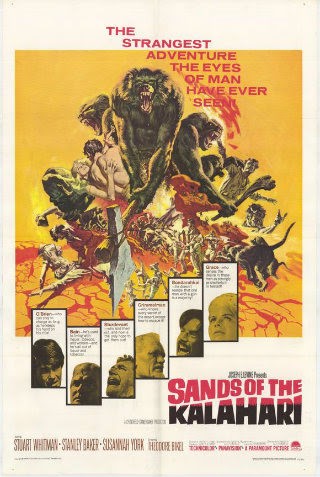
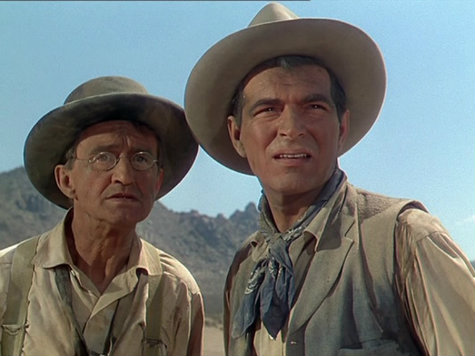
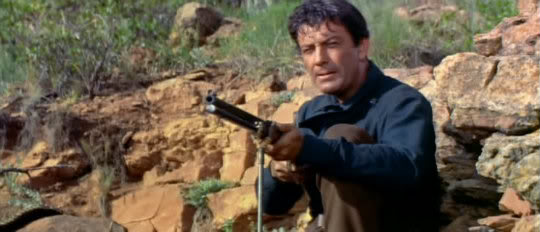
A charter plane has a freak encounter with a swarm of locusts, forcing a crash landing deep in the Kalahari desert of Namibia. Six disparate individuals stumble from the burning wreckage and must find a way to survive beneath the equally scorching African sun. This will be a test of their resolve, their character and their inventiveness. Ultimately though, the trials ahead of them will ask some very fundamental questions about the humanity of all these people. Initially, it’s the pilot, Sturdevan (Nigel Davenport), who takes charge and sets about organizing the rag-tag group. However, this film never follows a predictable course, and Sturdevan is gradually revealed to be too venal to serve as a leader. It gradually becomes apparent that particular mantle is to be passed on to O’Brien (Stuart Whitman), a hunter and, crucially, the man with the gun. When Sturdevan decides to set off alone in an attempt to reach some settlement and alert them to their plight, O’Brien has no serious rivals for dominance. Of the other men, Grimmelman (Harry Andrews) is elderly, Bondrachai (Theodore Bikel) is too soft, and Bain (Stanley Baker) is a recovering drunk with a leg wound. The sole female is Grace Munkton (Susannah York), an attractive society type and a fish out of water. While this little band are fortunate enough to come upon shelter (a cave) and a plentiful water supply, the problem of acquiring food remains an ever-present threat. Their temporary refuge is situated in an area with a large baboon population but, as Grimmelman points out, eating these fearsome creatures would be a little too similar to cannibalism for anyone’s taste. O’Brien points out that the apes represent competition for the limited food available, and so he takes it upon himself to wipe out as many as possible. However, even as group begin to settle into a familiar routine, it begins to dawn on Bain in particular that O’Brien is not the kind of man to tolerate competition of any kind, from any quarter. And so the internal tensions, and threats, rise in tandem with the need to survive. As the story develops, what becomes more and more obvious is that the danger from within is as great as, and perhaps even greater than, that posed by the forces of nature.

So, aside from being a first-rate adventure yarn, what is Sands of the Kalahari about? Well, the idea that adversity brings out both the best and worst in everybody for a start. All of the six people who find themselves stranded in the back of beyond are tested in various ways, physically, psychologically and morally. It’s how each one responds to the challenges, what they learn about themselves and we about them, that constitutes the core of the drama. Those who eventually find a way out, and I don’t think it’s a major spoiler to say that not everyone does, have been altered by their experiences. In addition, as viewers we are forced to reassess our first impressions of each of the characters: the quiet, passive ones become more proactive, the weak demonstrate reserves of strength, and the strong have their weaknesses revealed. This kind of plotting keeps us forever on our toes, never allowing any sense of complacency regarding the perception of characters to set in. Just when we think we’ve got someone figured out, either the circumstances or the sheer perversity of human nature throws us for a loop. Of course the movie also raises questions about how civilized we really are, and how far we’ve actually traveled from our primitive ancestors. Even those who started out disparaging supposedly lesser peoples, and Sturdevan is a good example of this, gradually come to rely on the techniques and skills they had previously thought beneath them in order to survive. That’s viewing things from a positive  perspective; but there’s a darker flip side to this too. If there is a lesson about using our basic abilities to overcome difficulties then there’s another one relating to the dangers of regressing to the point of savagery. The evolution of O’Brien’s character is a perfect illustration of this, where he ultimately fails as a human being but, conversely, rises to become master of his barbaric environment.

Sands of the Kalahari was produced by the team of Stanley Baker and Cy Endfield after the actor and director had been successful with Zulu. Endfield, along with cameraman Erwin Hillier, really made the most of the location shooting. There are some beautiful long shots of the desert, and the old western staple of positioning tiny figures against a background of massive rock formations is an ideal way of emphasizing the pettiness of the struggle these people engage in, their relative insignificance in the grand scheme of things, and of course their isolation. Additionally, the close-up work in the interior of the cave highlights the  tightness of the group, and makes the betrayals and treachery that occur all the more powerful. I think it’s worth noting too how well Endfield made use of the baboons surrounding the survivors. These apes are presented as a kind of noisy yet brooding menace lurking just beyond the limits of the camp. The animals are frequently photographed from above, perched high on rocky outcrops, which suggests their surveillance of the movements of the human interlopers has both a remoteness and a disdainful quality.

Stanley Baker was one of the biggest stars that British cinema produced, and was possessed of a magical and rare combination of talents that allowed him to convincingly play sensitive and tough parts with equal assurance. His role as Bain, the drunken engineer from the Congo, afforded him the opportunity to touch on both. As I said earlier, none of the characters in the movie follow the path that their initial appearances allude to; Bain seems at first to be a washed-up loser, a physical and emotional cripple, a largely ineffectual presence. However, his trials trigger something of a rebirth, and he is gradually and credibly transformed into the most heroic figure in the cast. Squared off against Baker is Stuart Whitman, radiating pure machismo and the ultimate survivor. I’ve often been less than impressed by Whitman’s performances, feeling not so much that he was poor but more that he could have been a whole lot better. Sands of the Kalahari provided him with probably his best part, playing to his strengths and exploiting his physicality to great effect. He has all the attributes of the hero, and starts off looking like the man who we’re going to root for, the guy most likely to save the day. However, this ruthless hunter, the group’s self-proclaimed provider, turns out to be a very different beast. It’s he who displays the lightest veneer of civilization, who adapts most readily and successfully to the primal surroundings. Whilst his character’s progression, or perhaps regression is a more apt description, is entirely logical and maybe even predictable, this does nothing to diminish the shock of his final actions. I really don’t want to go into details regarding the ending of the movie for to do so would rob it of much of its power for those who haven’t seen it. Suffice to say that Whitman’s character fulfills his ultimate destiny, and the last shot leaves everything open to each individual viewer’s interpretation. Susannah York’s displaced socialite stands between Baker and Whitman, her presence representing both an enticement and a provocation. Although she plays a pivotal part in the drama I felt she was, ironically, the least rounded character; by the end of the film she, and her motivations, remained something of an enigma for me. The rest of the cast – Davenport, Andrews and Bikel – all did sterling work and I can’t think of a moment when I wasn’t gripped by their performances. Davenport in particular turns in a marvelously manipulative piece of work, pulling the viewer’s sympathy every which way as his lecherous pilot rises, falls and rises yet again in our estimation.

Sands of the Kalahari is a movie that seemed to be out of circulation for an awful long time. I can vividly remember catching a late night television broadcast of this some time in the late 80s and I can safely say I was enthralled. The film, and that jaw-dropping finale, remained lodged in my memory, but it never appeared again. To say I was delighted when I saw the announcement that Olive Films in the US, having licensed the title from Paramount, was putting it out on DVD would be a huge understatement. The movie is also available on Blu-ray, but I believe it’s locked to Region A. Anyway, I purchased the DVD and I certainly have no regrets – it was high up on my wish list for so many years. The DVD from Olive is a basic bare bones effort but the transfer should give no cause for complaint. It’s anamorphic scope and looks great – sharp, clean and colourful. If you have any affinity at all for adventure movies, especially those with exotic locales and compact casts, then this should push your buttons. What’s more, this is no brainless action flick; it’s a literate and thoughtful piece of work that will stay with you long after the credits roll. I recommend it, unreservedly.


Red Sundown

poster276_zps6a227718

Low budget westerns seem to occupy a place on the filmography of just about every Hollywood star at one time or another. For some actors, the relationship with the genre was little more than a flirtation, something they dipped in and out of without leaving any real or lasting impression. On the other hand, there were others who discovered their niche in such movies. Rory Calhoun belongs in that category; sure he made other types of movie, but it’s with the western, and the programmers in particular, that his name tends to be most often associated. Red Sundown (1956), directed by Jack Arnold, offered him a pretty good role in a standard tale of a man trying to reform and make a fresh start.

Alec Longmire (Calhoun) is a man with a violent past, a drifter with no particular plans. However, his aimless existence is about to take a sharp turn, precipitated by his stumbling upon a lone figure in the wilderness. Bud Purvis (James Millican) is another wandering gunslinger, running from the law and on his last legs. He’s already walked the same path Longmire is currently taking, and all he has to show for it is regret. An altercation with a group of roughnecks in the saloon of some nameless backwater leads to the two men riding out of town in a hurry, with company not far behind. By nightfall they’re under siege in an abandoned shack with no way out. Gutshot and dying, with their shelter already on fire, Purvis comes up with a unique plan that will allow one of them to escape. But he has one condition; the doomed gunman has the younger man give his word that he’ll hang up his weapons if he should make it out alive. Well, Longmire’s not the kind to break a promise, least of all one given to a dying man, and so determines to leave his past behind him. However, reputations have a way of catching up with people and, besides that, wiping the slate clean generally demands more than a sense of remorse and good intentions. And so Longmire, somewhat reluctantly, finds himself sworn in as deputy to Sheriff Murphy (Dean Jagger) in the town of Durango. Murphy’s not getting any younger, and badly needs some backup as he’s caught right slap in the middle of an escalating range war. On one side is big time rancher Henshaw (Robert Middleton), while on the other is a collection of squatters and homesteaders. The greatest threat posed to Longmire and Murphy is the arrival on the scene of Chet Swann (Grant Williams), a reckless killer hired by Henshaw. Longmire has to tread a fine line, maintaining the objectivity of the law while an unwanted showdown with the dangerous Swann looms ever closer.

Red Sundown was Jack Arnold’s second western and showed a lot of promise. That’s not to say it’s above criticism though. Restricted budgets generally meant short running times and pacy storytelling, and that’s more or less the case with this movie. I say more or less because the film fairly springs out of the gate and grabs the attention, tends to coast along in the middle, and then puts in a strong sprint finish. The opening benefits from a bit of added exterior shooting and a great turn from James Millican – this was to be his last film and he looks quite ill at times. The siege of the abandoned hut where he and Calhoun hole up looks good, has a sense of real tension, and a pay off that’s sad and uplifting at the same time. The slightly problematic mid-section, in contrast, suffers from too much interior work and a romantic angle with Martha Hyer  that never sparks or truly convinces. In short, this passage has too much talk, not enough action and relatively flat visuals. Having said all that, the character of Swann is introduced in a way that highlights his creepy ruthlessness, and his presence does create a bit of much needed tension. The ending, while a touch abrupt, sees the pace pick up for the climactic duel and allows for a little more inventiveness as far as the camerawork is concerned.

Rory Calhoun gives what I’d term a comfortable, easy performance as the former bad man trying to cut his ties with a violent past and turn over a new leaf. This is far from an unfamiliar theme within westerns, and I think it’s fair to say that Calhoun doesn’t bring anything new or startling to the table. However, he’s never less than believable in the role and has enough natural charm to carry the lead. I think there’s a bit of a misconception that playing a tough western character doesn’t require a lot of effort. The thing is, pushing the boat out too far means you end up with a caricature, while reining it in too much results in a limp character lacking in credibility. Personally, I feel Calhoun strikes the right balance; the whole look, posture and attitude he adopts never leaves the viewer in any doubt that he’s capable of handling himself in a tight situation, yet he never tips over into comic book antics.

In contrast, Grant Williams, as the hired killer Swann, doesn’t quite hit the mark. His first appearance, all smiles and mock geniality, really taps into a sinister, chilling quality that bodes well. However, he fails to maintain this, and the scene where he confronts Calhoun in his room doesn’t work at all. It’s something almost indefinable, but the way Williams delivers his lines is all wrong – there’s no threat behind them, none of the menace that’s desperately needed. I already referred to the unsatisfactory romance between Calhoun’s character and Martha Hyer’s, but I’ll bring it up here again simply because it highlights what I feel was a missed opportunity. There was the possibility of adding an intriguing triangle to the mix with the introduction of Lita Baron as Henshaw’s housekeeper, and Calhoun’s old flame, but it’s never truly exploited. The actress was married to Calhoun at the time and there is a chemistry at work whenever the pair share the screen. When you consider the fact that Lita Baron eventually sued for divorce and cited her husband’s having committed adultery with seventy-nine different women (yes, that’s right 79) as the grounds, it’s clear this must have been a turbulent relationship. If there are some weaknesses in a few of the performances, it’s just about balanced out by solid playing from two old pros, Dean Jagger and Robert Middleton – the latter even gets to slug it out in a fine saloon punch-up with Calhoun.

Red Sundown has always been one of the more difficult Jack Arnold westerns to get hold of, previously only being available in a pricey box set from Koch in Germany (more so if, like myself, you already had the other titles) or a French release afflicted with the dreaded forced subtitles. However, Llamentol in Spain have recently put out a nice-looking edition on DVD that’s competitively priced. The film is presented in the correct 2:1 ratio and is anamorphic. The image is generally pleasing, with strong colour and a clean print. As usual, there’s no problem with subtitles – they can be disabled via the setup menu. The disc boasts no extra features, but I’m just glad to have a decent looking copy for a reasonable price. The movie is a solid programmer, and never aspires to anything loftier. I won’t claim the film is some lost classic or anything, but what I will say is that it does provide 80 minutes of attractive entertainment.


I Wake Up Screaming

“I’ll follow you into your grave. I’ll write my name on your tombstone.”

It’s hard to pin down exactly when film noir came into being, almost as hard as defining the term itself. Some argue that Stranger on the Third Floor kicked it all off, others point to John Huston’s version of The Maltese Falcon, and there are those who reckon it was even a year or two after that. So where does that leave I Wake Up Screaming (1941)? Well it came out around the time of The Maltese Falcon, so it falls into that early/proto-noir grouping. Unlike Huston’s film, there is a degree of unevenness to the tone; it veers between some broadly farcical moments and a darker, shadowy world of danger and complex psychology. In fairness though, the latter aspect does dominate and, even if one concedes that it’s not fully fledged noir, there is some wonderful photography and imagery on show.

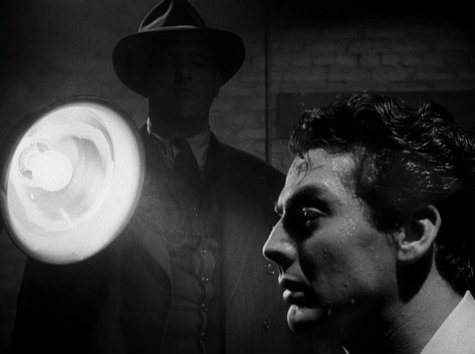
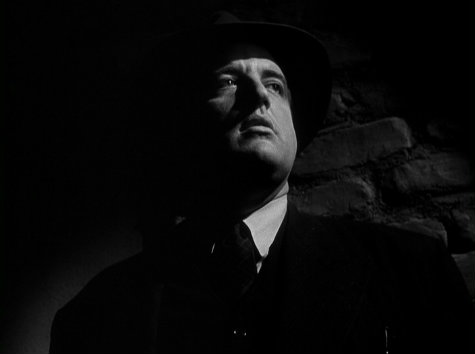
The opening is a dramatic one, with a newspaper seller announcing the murder of Vicky Lynn (Carole Landis) as the camera invites us into police headquarters. Inside, over the course of two interrogation sessions, we learn who this girl was and how she came to meet her end. Both Frankie Christopher (Victor Mature), a promoter, and Jill Lynn (Betty Grable), the victim’s sister, are under the spotlight and – via flashback –  filling in the background for the audience. It’s shown how Frankie and two friends (Alan Mowbray & Allyn Joslyn) make a Pygmalion style bet to turn waitress Vicky into a celebrity. Seeing as they have quality material to work with, things turn out fine. Maybe too fine though, since all three men have romantic designs on their muse, while she has plans to move to Hollywood. Anyway, Vicky winds up murdered and Frankie is sweating it out in the interrogation cell as suspect number one. The investigation is being headed up by an unusual cop, the soft-spoken and slow-moving Ed Cornell (Laird Cregar). Cornell seems sure Frankie’s the killer and is determined to break him. This immense and vaguely sinister figure becomes Frankie’s shadow, teasing and menacing him. On one memorable occasion, Frankie wakes suddenly from a bad dream only to find the Buddha-like figure of Cornell sitting in a chair in his room, just watching him. As Jill and Frankie join forces to trace Vicky’s killer, they draw closer together and it also starts to become apparent that the motives behind Cornell’s obsessive determination to nail his prey may not be quite as clear cut as they first seem.

I Wake Up Screaming, adapted from Steve Fisher’s novel, is as much a whodunit as a film noir. It’s the behaviour of a couple of the characters and the chiaroscuro lighting and imagery that earn it a place in the noir lineup. I mentioned the uneven tone, and that’s perhaps most evident in the opening segment, where the action alternates between the interrogations and the flashbacks. The latter tend to be bright and have a light, jokey feel about them as the three friends go about making Vicky over. This is where the transitional nature of the film is noticeable, as those scenes are reminiscent of the screwball style of the 30s. It also reflects something of the director’s background. H Bruce Humberstone is maybe best remembered for his handling of a few of the best Charlie Chan movies, and those flashback scenes recall that kind of mood. Cameraman Edward Cronjager had worked with Fritz Lang, and would do so again, and it’s tempting to wonder if this association may have had some influence over the look of the interrogation scenes. These are pure noir, full of harsh key lights, deep shadows and threatening, disorienting camera angles. In fact, this style dominates the remainder of the film and results in some strong visual imagery. I don’t often spend a lot of time discussing the musical scores in these pieces, but I’ll do so here as I feel there’s some added significance in this case. The movie’s main theme is Alfred Newman’s Street Scene, which would become something of a staple in Fox crime pictures. However, another very famous melody, Over the Rainbow, also features prominently throughout the film, and it’s that I particularly want to focus on. Initially, this might seem an odd choice for a noir/crime movie, being so closely associated with The Wizard of Oz. Nevertheless, it not only works but is also highly appropriate – that half-hopeful, half-melancholic song perfectly captures the nature of two important characters, both striving and straining to reach something that must forever remain unattainable.

In retrospect, there’s something incredibly sad about I Wake Up Screaming, and it’s not just the fate of some of the characters. Within a few short years, both Carole Landis and Laird Cregar would be dead. Landis would die by her own hand, and Cregar would bring on a fatal heart attack as a result of extreme dieting. Landis was pretty good in the role of the victim, seen only in flashback and in a clip of film her character made as a screen test. Although her screen time is limited, she still conveyed the ambition and single-mindedness of the character well enough. Cregar is phenomenally good, the best thing about the whole picture in my opinion. Despite the fact he may not have thought so himself, his bulk was one of his greatest assets as a performer. He dominates the frame whenever he appears, and his mock joviality comes across as nothing more than a veneer to cover up something much more sinister below. But there’s more than that, something about the eyes or voice had a soulful quality, a hint of regret maybe. By the end of the movie, Cornell (apparently Steve Fisher named the character after fellow writer Cornell Woolrich) develops into an extremely poignant figure. I always thought Cregar was great in anything I’ve seen him in, and his passing away at such an early age was a real tragedy. There’s also a small but pivotal role for cinema’s favourite runt, Elisha Cook Jr; the man was born to play losers and victims, and his plaintive, bewildered persona is put to good effect in this film. Which brings me to the two leads, Betty Grable and Victor Mature. Grable was essentially a musical star, not the kind of person you expect to see in a hard-boiled crime movie. Having said that, she does fine as the sister of the victim and is quite credible in a serious dramatic role – there was a short musical number shot for inclusion but this was, quite sensibly, cut and is presented as one of the extras on the DVD. If I have any quibbles about her it’s only that her relationship with Mature seems to grow too quickly to be realistic – still, that’s a scripting rather than an acting issue. Victor Mature featured in a fair number of noirs, and I have no problems with his work on this one. However, it has to be said, and again this really relates to the writing, that both Mature and Grable’s characters are a little too straight and square. Noir always works best when there’s a touch of ambiguity or doubt surrounding the protagonists, and that’s never convincingly achieved with either of these characters.

I Wake Up Screaming is on DVD from Fox in the US as part of their noir line, and looks great. The transfer is very clean and sharp, and the contrast is strong. The disc also offers a fair selection of extras, the commentary track by Eddie Muller and the aforementioned deleted scene being the most notable. As I’ve tried to make clear throughout, the film is not full-blown noir. Cinematic genres and styles are all about evolution, things don’t arrive fully formed out of the blue. As the world, and the US in particular, plunged further into crisis and war,  cinema would gradually reflect the darkness and disillusionment more. Even if films like I Wake Up Screaming don’t quite go the full distance, they’re still not too far off. Either way, it remains a classy movie that is recommended viewing.

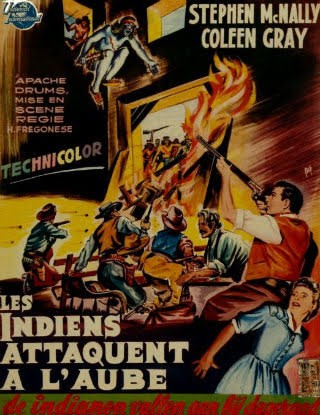
Apache Drums

Filmmakers assigned to B movie projects always faced an uphill struggle at the outset: inflexible and restrictive shooting schedules, budgets pared right down to the bone, and scripts that, as often as not, lacked any spark of originality. Still and all, there were a select few who seemed to thrive under such circumstances, who had the vision or the maybe even the guts to shape something worthwhile out of the modest resources before them. Fans of classic horror are familiar with, and hold in high regard, the name of Val Lewton. This was the man whose specialist unit at RKO managed to produce a series of classy, polished little nightmares that not only transcended their frugal budgets but actually succeeded because there was so little money available. Apache Drums (1951), made at Universal, was Lewton’s last feature as producer before his untimely death from a heart attack. The film is the only western he was involved in, and it’s such an effective and atmospheric little picture that I can’t help but wonder how he might have fared within the genre had his life not ended so prematurely.

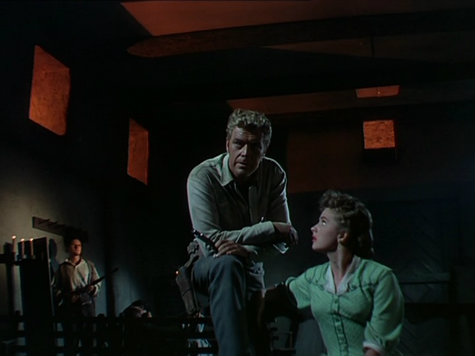
The story is derived from Harry Brown’s Stand at Spanish Boot, and it tells a fairly standard tale. Sam Leeds (Stephen McNally) is a gambler, a seemingly incorrigible ne’er-do-well (he’s even earned himself the unwelcome nickname “Slick”) who quite literally opens proceedings with a bang, shooting dead a rival card player in the stark saloon in the town of Spanish Boot. I found it a particularly nice touch that the shooting takes place off-screen as it immediately lends a sense of ambiguity to Sam’s character. He says it was self-defense and no-one seriously doubts that, still the seeds of suspicion are planted in our minds right from the off. The shooting comes at a bad time from Sam’s perspective: the mayor/blacksmith Joe Madden (Willard Parker) has been talked into a kind of moral crusade by the Welsh (the nationality has some significance later in the movie) parson Griffin (Arthur Shields) and Sam is given his marching orders. The fact that Madden is Sam’s rival for the affections of local girl Sally (Coleen Gray) rubs further salt into his wounds but he has no alternative. The dance hall girls have just been sent packing, and Sam is the next undesirable to be ejected. Thus we have the classic western staple of the outcast, shunned by the decent folk and driven out beyond the bounds of civilization. However, Sam’s exile is a short-lived one; he soon caches up with the wagon of girls, or rather their massacred remains. With his dying breath, the freshly scalped piano player who had been accompanying the spurned ladies tells of a formidable Apache raiding party appearing ghostlike and descending upon them. Sam gives his word to hightail it back to Spanish Boot and warn the solid citizens of the impending attack. The thing is he’s neither welcome nor trusted in his former home, the residents, with the tacit support of Madden, being on the point of riding him out of town on a rail before the arrival of a shot-up stagecoach bears out his words. It’s at this stage that the tension starts to build, as the Apache threat draws ever closer. Eventually, the net closes in to the point where all the survivors are holed up and under siege in the old church. Here, in the latter half of the movie, the camera never leaves the interior of the building and so heightens the feeling of helplessness and suspense, as the drums pound throughout the night and the defenders wait and watch for the Apache to leap howling through the high windows.

In writing about a lot of 50s westerns, one word crops up again and again – redemption. There’s no getting away from it; it quite literally pervades the genre throughout the decade, with even relatively humble and unpretentious efforts like Apache Drums having the concept at their core. All of the three main characters – Sam Leeds, Griffin and Madden – redeem themselves before the final fade out. Madden initially comes across as a vaguely priggish figure, allowing his preconceptions of Sam to colour his judgement and using his authority as means of furthering his own personal desires. But through enforced confinement with the man he regards as his opponent, he’s able to rise above his own inherent pettiness to attain a kind of nobility by the end. Griffin is a moral and religious absolutist, quick to judge and condemn all those who he considers to have strayed from the path of righteousness. Again, the circumstances he’s forced into lead to a reassessment of his former stance. There’s a marvelous little moment during the siege, where the preacher who had previously spoken in the most derogatory and disparaging terms about the Apache scout in their midst, Pedro-Peter (Armando Silvestre), moves across to kneel beside him. With the shadows of death creeping ever nearer, these two men pray to their respective deities side by side. And finally there’s Sam Leeds. He starts out expressing nothing but casual contempt for all those poor saps who slave away trying to earn an honest living and build a community. He’s of the opinion that he’s too smart for all that guff, that his only concern is his own welfare and comfort. Yet, he too (perhaps more than the others) finds that the threat from without carries a lesson for him. By putting aside his selfishness and obsession with self-preservation, he grows visibly as a human being. In their roles, Parker, Shields and McNally all manage to create rounded characters that are believable due to their respective weaknesses and prejudices. When you’re dealing with a low budget production such as this, good characterization, and the performers capable of achieving it, is a huge plus.

While the acting is important if you’re counting the pennies, it’s all likely to come to nothing if the technical expertise isn’t present behind the cameras. As I said in the introduction, producer Val Lewton was a past master at wringing the maximum out of limited resources. His RKO chillers all had a very distinctive look and feel, regarding shadow, darkness and the unseen and unknown as assets rather than obstacles. Such is the case with Apache Drums. Some of the most effective sequences follow on from events that the audience never get to see: both Sam’s deadly gunplay and the massacre of the saloon girls happen off-screen and the viewer only gets to witness the consequences of these events. The final section of the movie, which leaves the audience with no choice other than to view the action from the perspective of the terrified townsfolk means that we share in their sense of helplessness and dread. Of course Lewton was either clever or fortunate enough to work with talented directors on his projects. Between them the producer and director Hugo Fregonese work wonders in this section of the film: the image of garishly painted warriors springing through the high windows, backlit by the flames of the burning town, is like a vision out of hell, and retains a powerful shock value. I made brief mention earlier of the fact that Arthur Shields played a Welsh preacher. The reason for my drawing attention to his character’s nationality relates to a passage which takes place during the climactic siege. As the incessant beating of the war drums outside the walls begins to take its psychological toll on those inside, the decision is made to do something in an attempt to boost morale. Shields, playing a Welshman, leads the defenders in a chorus of Men of Harlech. In itself it’s a nice moment, but it’s also significant in that the scene would be mirrored in Cy Endfield’s Zulu over a decade later.

Apache Drums is a film that seemed quite difficult to see for many years. I caught a television broadcast back when I was a teenager and it stuck in my mind, probably because of the imagery as much as anything. At the moment, there are three DVD editions available: from France, Spain and Germany. From various comments I’ve seen, I get the impression they are all derived from the same source, though the French release will have forced subtitles. I have the Spanish DVD from Llamentol, which presents the film in the correct Academy ratio, and boasts a fine overall transfer – it’s sharp, colourful and well-defined. Subtitles are not an issue and can be turned off on the setup menu. The disc also offers the original theatrical trailer for the film, but that’s it in terms of extra features. I really like the film; it’s pacy, well structured and exciting. Aside from that, it looks good, with the kind of visual flair that’s typical of a Lewton production. A low budget sleeper that I happily recommend.

The Last Hunt

Westerns, especially the classics of the 50s, tackled just about every theme imaginable, often passing comment on universal concerns that transcend the genre itself. That of course is one of the western’s great strengths, it’s ability to resonate widely. However, the genre has also dealt with what might be termed more direct concerns too, actions and events that impacted  on the shaping of the frontier and the course of US history. Bearing in mind that the old west was essentially a wilderness, it’s no surprise that animals occupied such an important place in the minds of those who lived there. There are countless examples on film highlighting the importance to the native people and settlers alike of the horse. How many times have we witnessed the contempt and hatred directed towards horse thieves? In a primal landscape covering vast distances, the theft of a man’s sole means of transport was naturally one of the foulest crimes. However, the horse wasn’t the only animal which played a significant role in the development of the frontier. The buffalo, that great beast which sustained and dominated the lives of the plains Indians, was every bit as vital in its own way. As such, it’s perhaps surprising that The Last Hunt (1956) is one of the few westerns that concentrates on the fate of those creatures which once roamed in huge numbers across the continent.

The Last Hunt is the story of two quite different men, Sandy McKenzie (Stewart Granger) and Charlie Gilson (Robert Taylor), who enter into an uneasy partnership. Sandy is a famed buffalo hunter, but he’s also a man sickened by killing and has abandoned his old profession to turn his attention to the cattle business. However, fate has other ideas and, when a buffalo stampede wipes out his herd, a chance meeting with war veteran Charlie leads him reluctantly back to hunting. While Sandy has seen more than enough bloodshed, Charlie has something approaching an obsession with death. Charlie’s wartime experiences have clearly left a mark, and he seems to live to kill. The contrasting approaches of the two  men is highlighted during one of the hunt scenes. Having established a stand, the camera switches between this pair as they go about the slow, methodical business of picking off the buffalo herd. Charlie’s features are fixed in a mask of sadistic delight as one animal after another drops and breathes its last. Conversely, Sandy is stricken by conscience and is on the verge of breaking down and weeping at the thought of the devastation he’s participating in. If the radically different perspectives of the partners weren’t a great enough source of conflict, their rivalry is further complicated when Charlie captures a young Indian girl (Debra Paget) and takes her as his woman. Along with his wide sadistic streak, Charlie is also an unashamed racist with a deep suspicion and hatred of the Indian. He considers the girl to be his personal property, one of the spoils of war if you like, to be used or abused as he pleases. Not only does Sandy regard this kind of boorishness as an affront  to his sense of morality and civilized behaviour, but he also finds himself developing feelings for the girl himself. Charlie’s mounting paranoia and Sandy’s growing self-disgust, fueled both by their slaughter of the buffalo and the presence of the girl in their midst, see the tensions rise inexorably. Sooner or later, these two will have to face off and settle their scores, and the climax of the movie is a memorably chilling one in every sense as the final confrontation takes place during a freezing blizzard.

Richard Brooks started out as a writer, scripting films such as Brute Force, Crossfire and Key Largo before moving into directing with the Cary Grant suspenser Crisis in 1950. He didn’t work much within the western genre, making only Bite the Bullet, The Professionals and The Last Hunt. As a writer, he tended to tackle complex and controversial subjects and his first western as director (with a script credit too) saw him continue in a similar vein. The Last Hunt works in the theme of racism alongside its ecological message; the systematic elimination of the buffalo was essentially a government sponsored programme once the realization set in that the army wasn’t going to defeat the Indians through conventional military tactics. The buffalo had a special place within Indian culture, providing not only a source of food but also many of the essentials of life. The Indians used almost every part of the animals to make clothing, shelter, and tools. Therefore, it’s impossible to overestimate the status of these creatures as far as the native people were concerned. Brooks highlights the mysticism involved when he features a white buffalo, a sacred figure. This device also serves to draw attention again to the differences between Charlie and Sandy: Sandy is entranced by the sight of such a rarity, while Charlie sees only profit and immediately slays it. Although this is, superficially at least, a fairly simple tale, there’s a lot going on and Brooks blends it all together very successfully, ensuring that a brisk pace is maintained without sacrificing any of the necessary character development.

Robert Taylor is an actor whose work I’ve featured regularly on this site and The Last Hunt offered him one of his very best roles, maybe even the best. Generally, he played heroic figures but this film saw him take on the persona of an irredeemable rogue. I’ve read comments in the past which indicated Taylor had  doubts about his own abilities as a performer, but roles such as Charlie Gilson prove that there was no basis for such harsh self-criticism. I always feel the best and most effective movie villains have the knack of drawing a degree of sympathy or pity from the viewer, and that’s the case with Taylor’s portrayal here. There’s no question that Charlie is a bad lot, but Taylor brought a certain fragility to the part and that adds an interesting variation to what could have been a bland and routine character.

Stewart Granger might seem an odd choice for a western hero but here, in his second genre picture, he’s both comfortable and convincing. Apparently, Granger took to the whole western experience off-screen too and was well thought of by the crew. He’s very effective as the conscience-stricken counterbalance to Taylor’s killing machine and the two actors play well off each other. The Last Hunt is another of those movies with a small central cast; they’re usually quite successful at rounding out the characters and offering some more depth. In this case, the two protagonists benefit more from the increased focus though. Debra Paget as the captive Indian girl is never named and remains a slightly colourless presence throughout, albeit a strikingly attractive one. After appearing in Broken Arrow, this was Paget’s third outing as an Indian maiden and it must have looked like she was going to be permanently typecast at this point. Whatever you say about Paget, I don’t think anyone could mistake Russ Tamblyn for a native American. Nevertheless, he was cast as the half-breed hired by Sandy and Charlie, and his sympathetic presence is used to emphasize the blind bigotry of the latter and the relative enlightenment of the former. Best of all among the supporting players though is Lloyd Nolan, another initially questionable choice for a western. Nolan had a very  urban air about him and I tend to think of quick talking cops and the character of Michael Shayne whenever I see him. Still, he really embraced the part of the one-legged buffalo skinner and turned in a very  memorable performance.

For a long time The Last Hunt was only available on DVD in Europe. However, the film has recently made its US debut via the Warner Archive. I can’t comment on the quality of that particular transfer though as I don’t own a copy. I have the French release by WB, which looks reasonable although the scope image is letterboxed and non-anamorphic. In common with the majority of Warner titles released in Europe, it’s a bare bones affair with optional subtitles that can be deselected on the setup menu. The movie itself is a real keeper, a bit of a neglected gem that looks good, has fine performances, and makes a number of interesting points about man’s impact on the environment and race relations. The wider availability of this title on DVD may hopefully raise the profile of a film that’s well deserving of some renewed attention.

Gilda

Hate can be a very exciting emotion. Very exciting. Haven’t you noticed that?

I guess one of the defining characteristics of film noir is its subversive nature. It tends to take traditional scenarios and situations and casts its dark and cynical shadows over them, carrying the audience along on a journey into a murky and unfamiliar world. This subversion can apply to the legal system, social matters, or affairs of the heart. Gilda (1946) concentrates on the latter category, spinning its tale of three people locked into a romantic triangle, unable to decide if they love or hate each other and apparently unaware of the distinction between these powerful and conflicting emotions.

The story begins in Argentina at some unspecified point towards the end of WWII. But there’s a timeless, otherworldly quality to it all – the end of the war and the ensuing celebrations are mentioned in a throwaway fashion that’s surely meant to emphasize the detachment of the lead characters from the real world and the more mundane concerns of most people. These people seem to exist and operate within their own self-contained universe, a glamorous yet nightmarish demi-monde, where the bigger picture of world-changing events are relevant only as a kind of Hitchcockian MacGuffin. The opening shot of the movie introduces Johnny Farrell (Glenn Ford), a down on his luck grifter rolling dice on the waterfront and looking for easy marks. His strategy is a high risk one, not just because he’s a gambler but because his loaded dice are sure to attract the attention of disgruntled suckers sooner or later. When the inevitable happens, and Johnny finds himself the victim of a shakedown on a dark and forbidding wharf, his hide is saved by the intervention of a suave gentleman with a handy sword stick. This is Ballin Mundson (George Macready), a casino owner with an interest in shadier and even more profitable ventures. Johnny is nothing if not an opportunist and soon talks himself into employment, and a position of trust, with Ballin. For a time this mutually beneficial arrangement works and everything is sailing along smoothly on calm waters, until a woman appears and brews up a storm. Gilda (Rita Hayworth) is a sexual powerhouse, a woman whose passionate nature and provocative insolence seems to radiate from within. Her sudden and dramatic appearance as Ballin’s wife, after a whirlwind courtship, throws Johnny for a loop and irreversibly alters the dynamic of the relationship between the two men. Gilda’s arrival on the scene has an immediate and profound effect on Johnny – their introduction is a charged affair, and the confusion that Johnny’s barely able to disguise is shared by the audience. The rippling undercurrent of hostility gives rise to all sorts of questions about these people. I’m not giving away much here when I point out that it’s soon revealed that Gilda and Johnny were once lovers, before he walked out on her. And there we have our triangle: a cagey, duplicitous affair where the three protagonists circle each other warily and seem bent on mutual destruction. While it all develops nicely, I’ve always thought that the ending is weak – a little too abrupt and not all that convincing.

In my opinion, the reason Gilda is classified as a film noir is down to the theme more than the look. Cameraman Rudolph Maté does create some characteristically noir images – the waterfront opening, some of the nighttime casino scenes, and the way Ballin seems to blend and merge with the shadows – but much of the movie features bright, flat lighting. The edgy, darker tone stems largely from the setting and plot twists. A casino has a built-in sense of fatalism to it anyway, a place where fortune quite literally depends on the turn of a card or a throw of the dice. When this is combined with the South American setting, and the allusions to ex-Nazis involved in political and economic intrigue, it conjures up that sense of exotic danger that was very much in fashion in the mid to late 40s. Of course all this really only amounts to Casablanca style escapism; the key element that tips it over into the world of noir is the sadomasochistic relationship at the centre of the tale. The film is essentially a love story, but there’s a vicious, unpleasant side to the romance. Everything revolves around the title character, as she punishes both Johnny and Ballin, but in so doing she incurs arguably greater punishment at their hands in return.

The unquestionable star of the show is Rita Hayworth, the role becoming the one with which she would remain most closely identified for the rest of her life. Hayworth herself acknowledged this and it seems she had mixed feelings about it – her frank admission that the men in her life went to bed with Gilda and woke up with her is very telling. Whatever the personal legacy may have been, Hayworth certainly breathed life into what, in other hands, could have been a cardboard cutout character. She was excellent at getting across the contrast between the vivacious bravado that characterized Gilda’s public facade and the uncertainty and self-loathing she felt in more private moments. Her big scene, the one that is endlessly referenced in books and retrospectives, where she tries to provoke a reaction from Johnny with a knowing parody of a public striptease is justly famous. However, it also tends to overshadow the good work she did all through the movie.

While Rita Hayworth is the one most people will remember from the movie, Gilda worked wonders for the career of another of its stars. Glenn Ford, like a number of other actors, had seen service during the war, and Gilda was the film that gave him the boost he needed and raised his profile. Wartime experiences affected a lot of performers, it gave them a different air, a toughness and a touch of weariness too. Ford went on to work in some pretty good noir pictures, Lang’s The Big Heat being the best of them, and he did seem to belong in that world. As he did in his numerous western roles, Ford brought a kind of dissatisfaction with himself to his noir parts. Johnny Farrell has a veneer of cockiness and self-assurance to him, but Ford could always invest his characters with a nervy, slightly uncomfortable quality too. These may be little things yet they add up and make characters more believable and realistic. Although both Johnny and Gilda are flawed individuals, they’re not villainous. But a movie like this needs a bogeyman, and George Macready was a fine choice for the role of Ballin. Right from the beginning there’s a sinister air about him, and Macready’s innate charm and culture accentuates that. The repressed manner and wonderfully distinctive voice add to his calm menace – you honestly get the feeling that crossing this man would be an extremely foolish move. Of the supporting cast, I find Steven Geray the most memorable. This washroom attendant whose contempt for just about everyone, apart from Gilda, sees him making one flip comment after another seems to be given a lot of slack. I especially like the way we never find out exactly what leverage he has – the one time he’s about to reveal it he’s interrupted, and we’re left wondering.

I actually drafted this piece back in July, after I’d seen it one balmy Saturday night in an outdoor cinema in Athens – always a great way to enjoy a classic movie. However, I realized my holidays were fast approaching and so I decided to hold off publishing it. I though I might want to go back and tweak it some, but I’ve decided to leave it just as I’d written it a few days after watching the film. I’ve seen Gilda many times over the years and always enjoyed its dark romance. I wouldn’t say it’s one of those movies that reveals too many new things on repeated viewings yet it’s not the kind that grows stale either. It’s earned its classic status, and it’s well worth visiting or revisiting.

The Bounty Hunter

Obviously, perceptions of a lot of things change and evolve over time, and characters in movies are no exception. To modern viewers, it comes as no surprise to see a lead who makes a living pursuing criminals for the simple reason that it pays well. That attitude comes, of course, from familiarity with the concept, but it may also say something about the way opinions of certain occupations have shifted. The Bounty Hunter (1954) has a title which is pretty much self-explanatory. All told, it’s a fairly routine western, but one of its most interesting aspects is how it underlines the way audience expectations and judgements have altered in the half century since it was made. If this were a 2012 production viewers would simply take the lead’s profession at face value, not requiring justification of his choice in order to build up his heroism, whereas that wasn’t the case back in 1954. At that time, and especially in westerns, the idea of the anti-hero hadn’t been so firmly established; leads had to earn the sympathy of the audience, and doing an honorable job (as opposed to a merely profitable one) was one of the criteria.

Jim Kipp (Randolph Scott) is the bounty hunter of the title, with a fearsome reputation as a tracker and killer of men. Our first glimpse of him comes as he picks his way through the barren landscape, seeking out water for himself and his mount. This opening scene deftly establishes both the nature of the man and the risks his line of work entails. As Kipp prepares to drink, a figure lurking in the rocks takes aim and fires on him. Kipp’s lightning reflexes, his rapid outflanking and merciless disposal of the would-be assassin, all shot without dialogue, make it clear that we’re looking at a hardened professional killer. There are countless westerns of the classic era which feature such tough individuals hunting wanted men. The crucial difference though is that characters of that type usually had some personal motivation; those they pursued had wronged or injured them in some way and what they were generally seeking was revenge. Kipp is a different breed: in conversation with the sheriff, who’s partially in awe and partially contemptuous of him, Kipp makes no bones about the fact he does his job for money. This is a refreshingly honest admission but it’s also one that sits a little uneasily, and the various characters we’re introduced to throughout the movie react with a mixture of fear and suspicion to the presence of this ambiguous figure in their midst – although there is a dryly humorous moment when the only man sorry to see him leaving town is revealed to be the undertaker. While the plot of The Bounty Hunter does highlight the morally dubious actions of men like Kipp, the story is mainly concerned with a mystery. Kipp’s talents have earned him a strong reputation, strong enough to attract the interest of Pinkerton agents. When the famed detective agency draws a blank in its attempts to bring a gang of train robbers to justice, it turns to Kipp. He reluctantly (although there’s ample reward promised if he succeeds) agrees to set out in search of the criminals. The trail leads to the boom town of Twin Forks, where it seems likely the fugitives stopped off. The structure of the movie now resembles that of a classic detective story (although the disquiet among the townsfolk caused by Kipp’s presence also seems to foreshadow the anxiety generated by a similarly unwelcome visitor in No Name on the Bullet) as the hero tries to determine which of the many recent arrivals might fit the bill. There are plenty of red herrings, and a romantic subplot that’s blended fairly seamlessly into the tale, to keep the viewer guessing as the film rattles along towards a pretty satisfying conclusion.

Andre de Toth made a half a dozen westerns with Randolph Scott, starting in 1951 with Man in the Saddle and culminating with The Bounty Hunter. Generally, these are modest, B-grade movies that eschew pretension and aim to entertain first and foremost. The film does take a look at the frowned upon profession of bounty hunting and, as I said earlier, that’s probably what’s most noteworthy about it. Unlike later representations, particularly the Leone-inspired spaghetti westerns, there is a concession made to traditional genre expectations. As the story progresses, it’s revealed that Kipp does have a personal reason for choosing his career, although it’s not directly related to his investigation in Twin Forks. At this point, the western was still at the stage where complexity of characterization and motivation was acceptable, but an essentially amoral lead was still beyond the pale. As the credits roll, we see that Kipp has abandoned his solitary existence on the fringes of society and the law, and opted instead for convention and respectability. These days, de Toth is probably best known for shooting House of Wax in 3-D, and this movie was also produced with that format in mind. Even though I understand the film was never shown any other way than flat, there are a number of instances of shots that were clearly composed for 3-D projection: a rifle barrel pointed directly into the lens, champagne corks popped in our faces, and a hat which is shot off and then sails almost languidly in our direction. This is all gimmicky stuff that actually only distracts, and that’s one of my main gripes with 3-D in general. It’s also worth noting that the script for The Bounty Hunter was written by Winston Miller, who penned Ford’s My Darling Clementine nearly a decade earlier. Now I’m not going to try anything so foolish as comparing the two films, but it is worth mentioning that The Bounty Hunter features a couple of moments which certainly bring Ford’s great work to mind: there’s the scene of the community gathering at the church, and even more marked is the image of Kipp reclining on the boardwalk in the style of Henry Fonda.

I don’t think I’ve ever seen Randolph Scott give a poor performance in a western, even when the material he had to work with was nothing special, and he’s the best thing in The Bounty Hunter. It’s been discussed before on this site how Scott was gradually building and working towards the complex and often bitter characterizations he perfected in his later films. The role of Jim Kipp was another step along that road; there’s the kind of easy charm that was never far from the surface, but there’s a darker side too. Kipp is a man who’s living very much in the shadow of a wounded past, and Scott always had a wonderful way of delivering dialogue, modulating that distinctive drawl in such a way that half expressed feelings are easily understood. A very young Dolores Dorn was cast as his romantic interest, and she is quite capable in the role. However, perhaps unsurprisingly, she is overshadowed by Marie Windsor in another of her typically eye-catching parts. Windsor had a kind of knowing allure, an earthy attractiveness that’s hard to define yet mightily effective. There’s a strong supporting cast too, with Ernest Borgnine, Harry Antrim, Howard Petrie and Dub Taylor all turning in fine performances.

As far as I know, the only DVD release of The Bounty Hunter at present is the Spanish edition from Warner/Impulso. The film is presented in Academy ratio (1.33:1) but I’m not sure if that’s how it ought to be seen – IMDB suggests 1.75:1 for what it’s worth. The transfer is so-so, there is a bit of brief roughness visible in the opening few minutes – which also feature some sloppy editing – but it settles down after that. The film was shot using the WarnerColor process and it looks faded in places – in fact, there’s a definite greenish cast to the image most of the time. Despite that, there’s no serious damage to the print. The menu claims the English soundtrack comes with Spanish subtitles, but they don’t display as long as the subtitle option on the player is disabled. Anyway, the movie is a fast paced and entertaining programmer with pleasing performances and direction. The mystery elements of the plot are handled well and hold the interest – the fact that we get an early portrayal of a bounty hunter is an added bonus. I won’t claim this is a great western, and I don’t imagine it was ever envisioned as such, but it is a good example of the mid-50s variety.

Check out this fine piece on Kazan’s Boomerang! from Mike’s impressive site, Films on the Box.

Mike's avatarFilms on the Box

When it’s on: Monday, 2 July (11.40 am)
Channel: More4
IMDb Link

Louis De Rochemont, of March of Time and The House on 92nd Street fame, returned to his semi-documentary style of dramatic storytelling with his production of 1947’s Boomerang!, a courtroom drama based on the real life murder of a Connecticut priest.

First, some background. Homer Stille Cummings was the 55th US Attorney General, serving Franklin D Roosevelt for six years during the 1930s. A graduate of Yale University and Yale Law School, he practised law in Stamford, Connecticut, before spending much of the 1900s serving as Mayor of Stamford. Further steps up the political ladder seemed certain, but his nominations for Congress were each time narrowly defeated and he eventually became State Attorney. It was during this period in 1924 that Father Hubert Dahme, a much loved parish priest was shot and killed on a street corner…

View original post 1,037 more words

The Furies

fur1

You’ve found a new love in your life, haven’t you Vance? You’re in love with hate.

In some earlier pieces I wrote about the westerns of Anthony Mann, the matter of the order of production of his first few efforts came up. One of this site’s regular visitors, Blake Lucas, was kind enough to clear up what is often a confusing issue. Anyway, in connection with that, we also touched on the evolution of Mann’s style as he settled into his western period. The Furies (1950) was his second foray into the genre, and it seems to me at least that the film bears the hallmarks of a transitional picture. Mann started out making noir thrillers, and polished, highly regarded ones at that, before changing tack and moving west. His first three westerns, partially as a result of the use of black and white photography, retained some of film noir’s mood and sensibilities. The Furies is a very dark film, visually and thematically, yet suffers from a fault that shouldn’t be all that surprising when we consider its place within Mann’s filmography. I think it’s fair to say the director hadn’t fully found his feet in the genre, the upshot of which being a film that’s something of a mash-up of genres and styles, perhaps a reflection of a filmmaker who had not fully decided on the direction he wanted to follow.

The Furies is a ranch, a vast New Mexico spread presided over by the flamboyant T.C. Jeffords (Walter Huston). Jeffords is one of those self-made men so common to the western, a latter-day empire builder who has stamped his authority on the section of the frontier that he seized, tamed and held. Such men are frequently given to expansiveness in word and gesture, I guess we could say they earned the right, yet are also prone to all the petty weaknesses that afflict lowlier individuals: jealousy, vanity, loneliness and greed. Of these, perhaps vanity is the most treacherous, for powerful men have the means and ruthlessness to indulge it. Tellingly, Jeffords has a grand portrait of himself dominating the entrance hall of his home, and sits in his study flanked on one side by a bust of Napoleon and on the other by his own likeness. He’s lord of all he surveys, even going so far as to issue his personalized local currency. But a man like this can only extend his authority so far, and in Jeffords’ case the one person capable of challenging him is his daughter. Vance (Barbara Stanwyck) is a wilful and headstrong young woman, cast in the same reckless mold as her father. She is first seen, on the eve of her ineffectual brother’s wedding, brazenly trying on her late mother’s gown in the bedroom her father has forbidden all to enter. There, in a nutshell, we have a neat summation of the relationship between Vance and Jeffords; she has, to all intents and purposes, taken on the role of her departed mother. However, any such relationship is fundamentally flawed for the simple reason that the parties involved must naturally look outside for genuine fulfillment. In Vance’s case it appears that she is drawn to the roguish Mexican, Juan Herrera (Gilbert Roland), who has been a squatter on the Furies from way back. Still, this isn’t a tale where anything can be taken for granted, and it turns out that another man is vying for her affections. Rip Darrow (Wendell Corey) is a professional gambler with a grudge against Jeffords based on the dispossession of his family. If Jeffords feels some dissatisfaction at his daughter’s choice of suitors, it’s as nothing compared to the violent dislike she feels for the woman he brings into their home. Flo Burnett (Judith Anderson) is a self-confessed adventuress, trading her political influence for a share of Jeffords’ wealth. Such a charged situation is almost bound to tip over into violent confrontation, and does so in highly melodramatic fashion. A memorable and disfiguring assault with a pair of scissors leads to a hanging, and the die is cast. Father and daughter are pitted against one another in a struggle for ultimate control of the Furies.

£6

The Furies derives from a novel by Niven Busch and, like Pursued and Duel in the Sun, mixes in a lot of dark Freudian themes. Personally, I like this kind of stuff but I guess it can come across as a little too ripe for some tastes. The confused relationships that constitute the core of the story are all based on a warped blend of love and hate that reach near mythical proportions. Of course the title itself has its roots in the classical myths – the Furies being the three snake-haired goddesses charged with handing out punishment and retribution – and is highly appropriate given the personal trials all the main characters are destined to suffer at one another’s hands. I think Busch is probably the most melodramatic writer to work within the western genre, but this quality works well enough with films of the period. It also tended to attract directors who had experience of film noir and the kind of off-centre psychology that such pictures often dealt with. Anthony Mann’s noir roots are very much in evidence here, with an abundance of low angle shots picking out ceilings in the interiors to emphasise the tense and restrictive aspects of the story. There’s also an unremitting darkness about it all; much of the action takes place either at night or in the half-light of dusk or dawn, with figures frequently shot in shadow or silhouette. I see this film as a hybrid noir/melodrama/western, a halfway house for Mann if you like. Still, there are plenty of examples of the visual motifs he would later develop as he grew more comfortable with the genre. He draws attention to the stark, barren landscapes dominated by rocks. And then there’s the trademark focus on high places and the struggles that take place there. The film’s key scene, where Jeffords and Vance’s fates are sealed, occurs during the siege of the Herrera home high atop a forbidding rock formation.

The Furies really showcases the talents of both Walter Huston and Barbara Stanwyck. Huston had a distinguished career on both stage and screen and this was to be his last role – he passed away shortly after completing the film. As it happens, the part of T.C. Jeffords was a fitting one to sign off on. Huston drew on all his vast experience to give a well-rounded portrait of a complex man. Jeffords is neither hero nor villain; he’s capable of hanging a man out of pure spite, of blackmailing another to achieve his ends, yet he’s also charming, resourceful and philosophical enough to accept his own limitations. Even though we see him behave selfishly and ruthlessly towards those who cross him, it’s impossible not to admire him and feel sympathy too. In short, Huston presented the viewer with a flesh and blood man, a real person whom we ultimately judge on those terms.

£7

Stanwyck too got her teeth into the part of Vance, and transformed what initially seems something of a caricature into a woman the audience could respect. As someone who could move easily in both the noir and western worlds, Stanwyck was ideally cast. You never feel there’s anything affected about her toughness, and her rage, when provoked, is as raw and livid as the disfiguring wounds she leaves on her rival. Gilbert Roland didn’t have a huge part in the movie, but it is a significant one in relation to the plot. I’ve always enjoyed the swaggering, swashbuckling machismo that came naturally to him, and as Juan Herrera he had ample opportunity to show that off. He also brought a real sense of dignity to his character, especially as prepared to meet his fate. When I looked at Pursued, I commented on how well Judith Anderson handled herself. The Furies saw her taking on an entirely different character and she demonstrated just how versatile she could be. Flo Burnett starts out as someone whose obvious insincerity does grate, but the transformation she undergoes, as a result of her physical trauma, is well realized. By the end, she commands your sympathy. In the midst of all these strong performances, Wendell Corey suffers somewhat. He was never the kind of actor to grab the attention at the best of times, possessing a quiet, understated quality, and I’m not sure westerns were his ideal environment. Mind you, it doesn’t help that he had to play a pretty obnoxious character whose cocksure smarm feels a little misplaced. In addition to the leads, there were nice supporting turns from Albert Dekker, Thomas Gomez and Beulah Bondi.

The Furies is out on DVD in the US from Criterion, and it’s one of their usual, very professional packages. The image is in good shape, although I have seen more sparkling transfers from the company, but it does have one irritating issue. Criterion went through a stage of issuing Academy ratio movies in pictureboxed format (essentially, a black border running around all four sides) supposedly to compensate for overscan on CRT sets. I never liked this practice; the gain is minimal, the resolution is lessened, and the whole idea is increasingly redundant as HD and HD ready sets become more common. In terms of extras, this is a pretty stacked edition. Firstly, the movie comes in an attractive slipcase that also includes a copy of Niven Busch’s novel. Then there’s a 36 page booklet containing an article on Anthony Mann by Robin Wood, and a translation of an interview with the director carried out for Cahiers du Cinéma by Charles Bitsch and Claude Chabrol. On the disc itself, the highlights are a commentary by Jim Kitses, a 1967 interview with Mann, a 1931 interview with Huston, and a video interview with Nina Mann, the director’s daughter. As I said earlier, I regard The Furies as the work of a director in transition. I hope that doesn’t appear to be a negative assessment of the film as there’s a lot to admire in it. Still, I do feel I ought to point out that the blending of styles isn’t always as smooth as it could be. Overall, I think the performances and visuals carry the day and point towards even more accomplished work to come. Even if it’s not Mann’s best movie it makes for interesting and rewarding viewing.


The Big Combo

bc1

First is first and second is nobody.

As classic film noir moved into the 1950s, one noticeable change was the increased emphasis on stories involving mafiosi and various syndicates. If you consider that the movement was born out of changing moods and social circumstances in the US in the early 40s, then this shift is not altogether surprising. The whole issue of organized crime was back in the headlines and this concern seemed to have overtaken the more personal, individual angst that had dominated tales in the preceding decade. The Big Combo (1955) is based around such a premise, although it doesn’t really reveal any startling or particularly deep insights into the workings of the mob. But then that’s not the point of the movie, this being principally an examination of two obsessive men and the woman who stands between them; the fact that one is a cop and the other a mobster is mostly by the by.

Where more traditional crime sagas tend to chart the evolution of an investigation, The Big Combo eschews the slow build up and instead plunges right into the story at crisis point. The opening shot has a frantic Susan Lowell (Jean Wallace), long time companion of mob luminary Mr Brown (Richard Conte), running through the anonymous and shadowy corridors of a boxing venue. This woman is obviously in a highly emotional state, and it’s no real surprise to learn that she has tipped a bottle of pills down her throat in a desperate suicide bid. This draws in the third figure in the triangle at the heart of the movie, Lt Leonard Diamond (Cornel Wilde). Diamond’s a driven man, his expenditure of time and money in a quest to bring Brown to book has brought censure from his superiors. However, Diamond isn’t merely a crusader against crime in the conventional sense; his pursuit of Brown is closely linked to his interest in Susan. So, when news of her hospitalization filters through, Diamond naturally seeks her out. Matters are clearly coming to a head for all concerned, and the root lies in a name – Alicia – that Susan has realized carries some special meaning for Brown. Diamond’s appreciation of this fact affords him the leverage he needs to force the tiny crack in Brown’s armour into something more substantial and damaging. Even so, the path is by no means free of obstacles – after all, he’s got nothing more than a name to go on. Before Diamond can piece it all together he will have to see witnesses conveniently disappear, undergo torture himself and inadvertently allow his lover to be gunned down. All the while though, the focus remains firmly on the personal battle between Brown and Diamond, with the issue of the former’s crimes only acting as something of a blind. In reality, it’s a duel to the finish motivated by both men’s desire to possess Susan.


£46

The final fade out has become one of the most iconic images in film noir, stills derived from it appearing in just about every book dealing with the subject. The two figures frozen in silhouette against a background of glowing fog seems to perfectly capture the look and the essence of noir. This ought not to be any surprise due to the fact The Big Combo was lit and shot by the legendary John Alton. Of course it’s not the only memorable moment, the film is littered with shots that are beautifully composed and realized. Alton and director Joseph H Lewis managed to both disguise and turn to their advantage the small budget they had available. The movie boasts a significant number of basic, stripped down sets, yet the director and cameraman artfully cover these deficiencies through the use of clever lighting and framing. Backgrounds tend to dissolve into inky blackness as the key lights pick out and draw attention to the characters. Alton’s take on the dramatic potential of darkness and light is neatly summed up in this extract from Painting with Light (MacMillan, 1949):


To realize the power of light and what it can do to the mind of the audience, visualize the following little scene: The room is dark. A strong streak of light sneaks in from the hall under the door. The sound of steps is heard. The shadows of two feet divide the light streak. A brief silence follows. There is suspense in the air. Who is it? What is going to happen? Is he going to ring the bell? Or just insert a key and try to come in? Another heavier shadow appears and blocks the light entirely. A dim hissing sound is heard, and as the shadow leaves, we see in the dim light a paper slip onto the carpet. The steps are heard again…This time they leave. A strong light appears once more and illuminates the note on the floor. We read it as the steps fade out in the distance. “It is ten o’clock. Please turn off your radio. The Manager.”

I’ve mentioned the climax in the airport hangar, but there’s another wonderfully judged moment that takes place at the same sparse location earlier on. I guess what follows constitutes a mild spoiler, so anyone reading this who hasn’t seen the film might want to skip over this part. Just as it appears Brown’s empire is crumbling, his subordinate McClure (Brian Donlevy) decides to step in and take advantage of the situation by having his boss assassinated. However, he miscalculates badly and finds the guns of the hitmen turned on him instead. McClure backs up against the wall, stricken with terror, but Brown assures him he doesn’t need to worry, he won’t hear the shots. McClure’s little nervous smile of relief is short-lived though. Brown jerks the hearing aid from McClure’s ear and steps away. The camera cuts to the gunmen and the now silent muzzle flashes of their tommy guns. Very simple and very effective.

£47

Richard Conte was a fine villain in a number of noir pictures, and Mr Brown must surely rank as one of his best roles. He is the absolute epitome of cool arrogance and sadism, wearing a permanent smirk as he raps out Philip Yordan’s slick dialogue. The casual insolence he injects into the delivery is like a contemptuous slap in the face to whoever happens to be on the receiving end. It’s this overwhelming self-assurance and disdain for everyone that ultimately leads to his downfall, but it’s masterfully built up. His first encounter with Wilde in the hospital corridor sets the tone right away; not only does he insult and belittle his nemesis but he does so through an intermediary, not even deigning to address such an inconsequential figure directly. Wilde, on the other hand, plays a repressed and frustrated character. His frustration is twofold: his sense of professional impotence at failing to nail Brown despite investing so much time, money and effort, and his inability to compete on equal terms for the affections of Susan. I thought Wilde carried this off well, his emotions seething just below the surface and only held in check by his dubious morality. He covets Brown’s woman yet is simultaneously repulsed by his knowledge that her purity has been tarnished by her association with the mobster. On top of that, there’s his vaguely puritanical priggishness (note his comment about suicide breaking God’s laws) which is contradicted by his on-off relationship with a showgirl. As the object of Wilde and Conte’s obsession, Jean Wallace didn’t come across so successfully. There’s a blank quality to her performance although, in fairness, that may be intentional as she’s clearly supposed to be a character near the end of her tether psychologically. Wallace was married to Wilde at the time, and it seems he was less than pleased at the infamous scene where Conte starts kissing her neck and then continues working his way down as the camera zooms in on Wallace’s face. This also raised concerns as it was pushing the limits of the production code of the time. When questioned about where Conte went as he descended from view, Joseph H Lewis replied: “How the hell do I know? What does an actor do when you move in on a close-up of someone else? Go sit down somewhere, I guess.” In addition to that, the movie also features a couple of hitmen (Lee Van Cleef & Earl Holliman) who, while it’s never explicitly stated, are clearly involved in a homosexual relationship – strong stuff for a 1955 production.

The Big Combo is one of those films which has been poorly served on DVD. Although none of the available editions are truly awful, they aren’t especially satisfying either. I understand the US release by Image may offer the best transfer but I don’t have that one to comment for sure. I used to own a weak Geneon disc which displayed a fair bit of combing and motion blur but replaced it with a Spanish release by Sogemedia/Regia. This disc doesn’t have the combing issues but it’s still only a low-medium grade transfer. The biggest problem is a general haziness and softness that dilutes the work of Lewis and Alton. I continue to cling onto the hope that someone, somewhere will see fit to release this great film with a restored image and in the correct aspect ratio. Leaving aside the less than stellar DVD presentations, I can’t praise the movie itself highly enough. The dialogue, plotting and photography are all pure noir, and the two strong central performances ensure it’s a film worth revisiting.