Crime and Punishment

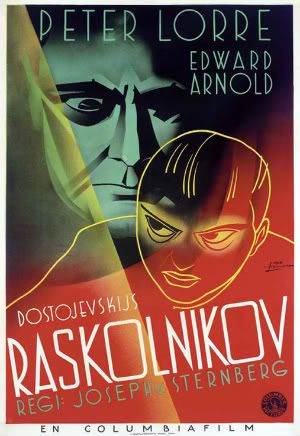
Poster

Dostoyevsky’s story has been filmed a number of times, but I have to confess I was not familiar with any of the versions until I viewed this 1935 film. It’s almost impossible to think of Josef von Sternberg without also thinking of Marlene Dietrich, so closely connected were their 30s careers in Hollywood. Crime and Punishment was only the second American picture von Sternberg made without his leading lady, and his best period was already behind him. This was a very low budget affair, made for Columbia, yet he still managed to turn out a film that remains visually interesting. Of course it didn’t hurt to have two up and coming talents involved, namely star Peter Lorre and cinematographer Lucien Ballard.

Basically, what we have is a tale of desperation. Raskolnikov (Lorre) is a brilliant young student of criminology, a man of great potential. Before long, however, we can see that this potential is not to be fulfilled. Both Raskolnikov and his family have fallen on hard times and he finds himself facing the threat of eviction. But Raskolnikov is a man of great pride, considering himself morally and intellectually superior to others. This pride, bordering on pomposity, is tested to the limit when he receives a visit from his mother and sister. The very real prospect of his sister allowing herself to be forced into a clearly unsuitable marriage purely out of financial necessity spurs him to act. A visit to a parasitic pawnbroker results in murder for profit, yet this great intellectual finds himself not much better off. Panicked into flight with only a fraction of the loot, his self-doubt and guilt quickly assail him. Having acted rashly due to desperation, he soon finds that a new variety of desperation awaits him. Inspector Porfiry (Edward Arnold) is the ever-smiling, unctuous figure that appears on the scene, apparently grateful for any assistance the brilliant young student of crime can offer. The truth is the policeman is never really taken in, and it’s only a question of whether he can wheedle a confession out of Raskolnikov or whether the young man’s mounting guilt and paranoia will do the job for him.

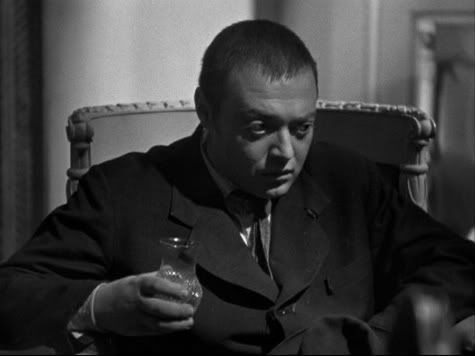
Peter Lorre ponders his fate.

Peter Lorre was in his pomp when this film was made, riding high on a wave of critical success following Lang’s M and Hitchcock’s Man Who Knew Too Much. He had the kind of face that was ideal for expressing fear, despair, self-loathing, anger and swaggering confidence, and all in quick succession. You can almost taste the terror as he shrinks back into the shadows when he’s on the point of being discovered at the scene of the crime, his round features bathed in cold sweat. Conversely, there’s real arrogance to the way he later struts into Porfiry’s office, casually putting his feet on the furniture, while he taunts the policeman. Edward Arnold was the perfect foil here (Sydney Greenstreet would fulfill a similar function a few years later) for Lorre’s emotional grandstanding. His ebullient Porfiry is like a great, fat spider spinning a web around, and toying with Lorre’s bug-eyed and hopelessly trapped fly. The scenes between these two, as they indulge in an intellectual duel, are the best parts of the film. The budget was obviously tight as the whole movie is studio bound and the cast is minimal, but von Sternberg never lets it look cheap. There are plenty of expressionistic shadows and the limited sets are all well photographed by a very young Lucien Ballard.

Crime and Punishment is a pretty rare film, but it has been given a DVD release in R2 in continental Europe. I picked it up purely on a whim when I noticed it on the shelf for a low price, and I’m very happy I did. Sony have provided a spiffy looking transfer that has clearly been cleaned up and really does justice to a film that’s almost 75 years old. There are a plethora of subtitles and dubs available but no other extras. There were rumours of a Peter Lorre box in R1 from Sony, and judging from the handsome look of this title I’d expect it to turn up there sooner rather than later. I don’t think Crime and Punishment is one of the lost greats, but with the high class talent involved both in front of and behind the camera it’s a movie I’m very happy to have in my collection.

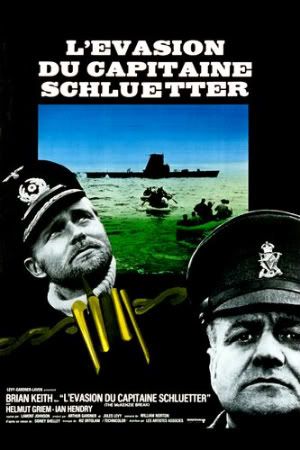
The McKenzie Break

Poster

Anyone who’s a fan of war movies will be familiar with the WWII POW/escape variety. One characteristic of such movies is that they rely (by necessity) far less on action than they do on character. The other aspect of note is that they are almost always told from the perspective of the American or British prisoners. I say almost because there are at least two exceptions that I can think of, The McKenzie Break (1970) being one of them. Having German POWs makes for an interesting approach to making a film since this premise automatically challenges the viewers sympathies. Normally, in any kind of prison movie, it’s hard not to find yourself rooting for those who are locked up – but this film turns everything on its head by portraying the leader of the inmates as an unrepentant, amoral and ruthless Nazi.

McKenzie is a POW camp situated in a desolate, sparsely populated area of Scotland. Its purpose is to hold captured German officers, principally submariners and flyers. However, right from the opening moments, it’s clear that all is not well. There is a war of wills going on between the camp commander, Major Perry (Ian Hendry), and the prisoners’ leader Schleutter (Helmut Griem). It’s suspected that there’s a reason for the organised disobedience, which goes beyond plain contrariness. In an effort to get to the bottom of it all,  Intelligence dispatches one Captain Connor (Brian Keith) with a brief to establish the cause of the ongoing trouble. Connor is a soft spoken maverick with a penchant for taking risks, and it’s no surprise  that the film soon develops into a duel between him and the charismatic Schleutter. Connor knows full well that Schleutter is planning an escape, he even has a fair idea how it’ll be done, but he hopes to bag bigger game and gambles on giving him enough rope to hang himself. Bar a few action scenes, the film plays out mostly as an espionage/detective story, with Connor doing the hunting and tracking and Schleutter, for the most part, managing to stay one step ahead. It’s  also worth pointing out the tension and rivalry within the camp, both on the German and British sides. Generally, POW flicks tend to portray the inmates as a united group of disparate characters banding together for the common good. Obviously there are  movies, such as Stalag 17, that feature a rotten apple, but off the top of my head I can’t think of another that presents a house so clearly divided. While there’s a mild abrasiveness and a degree of mistrust between Perry and Connor, it’s nothing compared to the sadistic hatred Schleutter displays towards his fellow prisoners from the Luftwaffe.

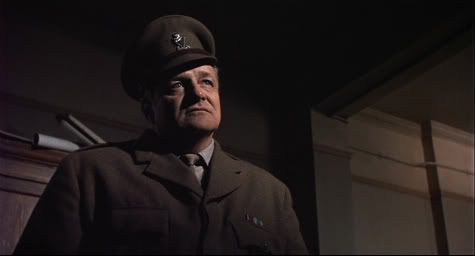
Brian Keith

Brian Keith was one of those amiable actors who always seemed to make things look very easy. Although he’s getting on a bit, and lays the Oirish accent on a bit thick at times, he still manages to put in a good and believable performance. The best parts of the movie for me were those where Connor and Schleutter faced off and traded blows verbally. There’s an especially good scene that takes place in the hospital in the aftermath of the murder of one of the German prisoners. In a grotesque parody of a wake, the two leads share a whiskey over the body of the dead man while each probes for weak spots in the armour of the other. Helmut Griem had the difficult task of playing a morally repugnant character while at the same time trying to imbue him with enough humanity and charisma to make him believable as someone capable of commanding the respect of all those under him. That he manages to do this and pull off the even neater trick of doing reprehensible things but still retaining a modicum of sympathy from the viewer is a credit to him. The McKenzie Break was directed by Lamont Johnson and it’s his one of his few forays outside of TV work. He handles the material competently but with no great style – the Irish locations, standing in for Scotland, are nicely used in the latter half of the film but the acting and storyline are what carry the film more than visuals.

MGM’s R2 DVD offers a pleasing enough image. The anamorphic 1.85:1 transfer has no damage to speak of and good detail. The colours are on the subdued side but that’s how they’re supposed to look as far as I can tell. The only extra on the disc is the theatrical trailer, but that’s par for the course for MGM catalogue titles. Overall, The McKenzie Break is a well-made suspenseful war movie that offers a different spin on the traditional POW tale.

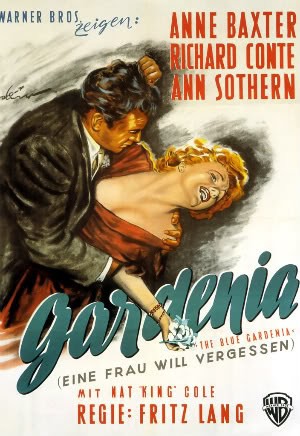
The Blue Gardenia

poster128

There are lots of sub-categories within film noir, and one of my favourites is what is sometimes termed nightmare noir. Fritz Lang’s The Blue Gardenia (1953) fits this description by presenting a protagonist whose world gets turned upside down after making one ill-judged decision. This kind of story offers all sorts of opportunities for some of the staple ingredients of noir – paranoia, suspicion, the idea that bad luck is waiting just around the corner, and the fact that the course of one’s life can hinge on something as simple and inocuous as a mix up over a phone call.

Norah Larkin (Anne Baxter) is a switchboard operator who leads a fairly humdrum life, sharing an apartment with two other single women and biding her time till her lover comes back from Korea. However, it doesn’t take long for things to start to unravel and for life to hand her the first in a series of unexpected kicks in the teeth. She’s just bought herself a new dress, cooked a special meal, and plans to sit down and share it with her absent G.I. boyfriend. So, with his photo propped in front of her, she opens his latest telegram and starts to read. It’s a brush off, he’s met a nurse, fallen in love and plans to marry her. Norah is naturally distraught and more than a little bitter, so when she takes a call meant for one of her flatmates she makes that one bad decision. On the rebound, she agrees to a date with the slightly sleazy ladies man Harry Prebble (Raymond Burr). During the course of dinner Prebble ensures that Norah gets well and truly tanked on cocktails before taking her back to his apartment. When he starts to get a little too friendly, Norah struggles with him but quickly blacks out. On awakening, she finds Prebble dead on the floor, his head smashed in with a poker. Panicking, and with only the haziest of memories of what went before, she flees the scene of the crime but leaves a few clues behind. The rest of the movie involves Norah’s attempts to evade the law, while playing a cat and mouse game with smooth newspaperman Casey Mayo (Richard Conte). The only real problem I had with the film was the fact that the element of doubt doesn’t really work for the viewer. While Norah and the characters around her cannot be sure of her guilt or innocence, it’s fairly clear to us. For this kind of story to work properly it’s preferable if the viewer experiences the same level of uncertainty the lead feels.

£14

Anne Baxter takes centre stage as the haunted and hunted Norah, and does a pretty good job of conveying her mounting sense of paranoia and isolation without resorting to histrionics. Richard Conte is reliable as usual in the role of the reporter who has his doubts. Raymond Burr was still at that stage of his career where he seemed to play nothing but heavies, but he did it well and his Harry Prebble has a nice touch of the sinister about him. However, while those three turned in fine performances, the picture really belongs to Ann Sothern. Her sassy turn as Norah’s seen-it-all-before flatmate is the highlight, and she walks away with just about every scene she appears in. Lang’s direction is as classy as one would expect, and the themes involved are right up his street. He seemed to have a thing for artists and reporters, and both play a prominent part here – although his most biting critique of the media, the ascerbic While the City Sleeps was still a few years down the road. There are strong noir credentials throughout the movie with Vera Caspary (Laura) providing the source material and Nicholas Musuraca working his magic behind the camera – the shadowy shots of the deserted newsroom at night being especially atmospheric.

The R1 DVD from Image is generally quite good, although there are a few damage marks here and there. It’s a totally barebones disc but should be available fairly cheap. The Blue Gardenia was originally distributed by Warner Brothers but is thankfully no longer controlled by them – I couldn’t imagine writing that just a few months ago, but this is the kind of film that might well be consigned to the appalling Archive programme now. All in all, it’s a fine noir that I’m happy to recommend.


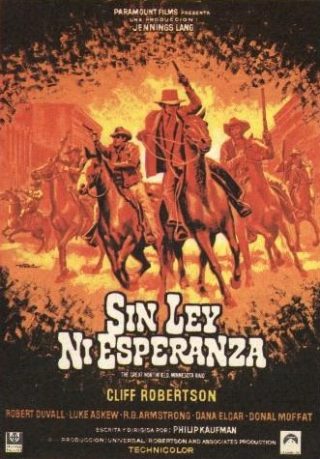
The Great Northfield Minnesota Raid

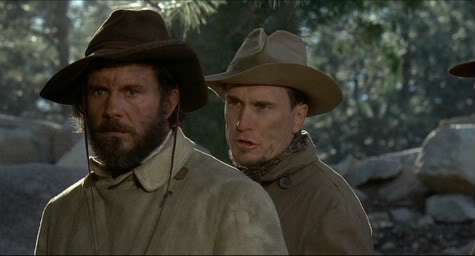
About a year ago I wrote a short series on the depiction of Jesse James in the movies. At the time, I skipped over The Great Northfield Minnesota Raid (1972) for the simple reason that I hadn’t seen the movie in years and didn’t have a copy to hand. Well I eventually got around to watching this a few days ago and thought I’d post my thoughts on it for the sake of completeness. I had recalled the film as being pretty good, but after my recent viewing I’m not so sure. I wouldn’t go so far as to call it bad – it has too many interesting things going for it – but it did leave me feeling disappointed. The performances, and some of the ideas, save it but the direction is the weak point for me. I suppose I really should come clean here and say that Philip Kaufman isn’t one of my favorite directors, so that may have affected my opinion somewhat.

The whole film takes place within a fairly short space of time, concentrating on the lead up to, execution and aftermath of the bank robbery of the title. Mainly it’s a character study of Jesse James (Robert Duvall) and Cole Younger (Cliff Robertson), with the latter getting more screen time and coming across the more sympathetic of the two. With the possibility of an amnesty for their past crimes being granted by the Missouri state legislature, Cole Younger (recuperating after a run in with Pinkerton agents) rides for Northfield with the aim of heading off Jesse before he can raid the bank. Along the way, he learns that the amnesty he was hoping for won’t be forthcoming, so a change of plan is in order. The scenes in Northfield, which make up the central part of the story, represent both the best and worst aspects of the picture. It’s here that the yokel outlaws get their first glimpse of the new technology and customs that will soon change their world forever. Some of these scenes work very well, such as the shock of being confronted by an early motorized vehicle. On the other hand, the almost interminable baseball game, replete with Keystone Kops style pratfalls, comes across as needlessly self-indulgent and slows the whole film down. The idea of including it was sound enough but Kaufman drags it out to the point where it becomes distracting. It’s worth comparing this sequence to the camel race at the start of Ride the High Country as they’re essentially making the same point; the difference, however, is that Peckinpah knew where to draw the line.

Robertson is excellent as the thoughtful and charismatic Cole. He plays him as a man of the world and a realist, a guy who sees change coming and who is smart enough to see that dwelling on the past does no good. Duvall’s Jesse is the complete opposite – an unbalanced psychotic who cannot let go of the past and who treats all who stand in his way with a ruthless contempt. He talks in grandiose terms of having visions and excuses his excesses by referring to the guerrilla action he’s involved in. Both men give strong, believable performances that help ground the film. The supporting cast is also noteworthy with R G Armstrong playing the ill-fated Clell Miller, and old-timers Elisha Cook Jr and Royal Dano getting small but important roles. One other point I’d like to make relates to the way Frank James was portrayed; in every other movie I’ve seen, this character was shown to be a tough, smart but very human figure. In this movie, however, John Pearce plays him as a vaguely simple-minded soul who lives only to carry out his brother’s wishes. I’ve no idea if this closer to reality or not, but it’s a marked contrast to all other portrayals. I said earlier that I wasn’t all that impressed by Kaufman’s direction and, apart from the aforementioned baseball sequence, he also handles the actual robbery poorly. The scenes in the bank are fine, but as soon as the action takes to the streets it falls down. It’s difficult not to compare this to Walter Hill’s superlative filming of the same events in The Long Riders, where I found myself riveted. Kaufman has the camera swooping all over the place, yet there’s none of the intensity or power of Hill’s version. There are some nice shots of landscape and forest but the whole thing has a slightly cheap look, which is odd since he almost perversely manages to evoke an authentic sense of time and place. I don’t know, I think if he could just have changed the emphasis here and there we could have had one of the best cinema versions of these events. As it stands, the movie seems like it’s trying too hard to be an art house representation of what is really a fairly straightforward story.

The R1 DVD from Universal is barebones, save for the inclusion of the trailer, but the picture quality is excellent. I certainly didn’t notice any significant damage and the colours, while subdued, are true. There’s a nice, tight 1.85:1 anamorphic transfer and the disc is available very cheaply. In general this movie has some good ideas and fine performances, but I feel it could have been so much better. Like all other versions it’s littered with inaccuracies (for example, Jim Younger’s facial wound was sustained in Northfield, and not earlier as the film states) but that’s no big deal for me. I’m still of the opinion that The Long Riders remains the best telling of the story of the James/Younger gang, and that Kaufman’s movie is an interesting but flawed addition to the mythology surrounding these men.

Rocky Mountain

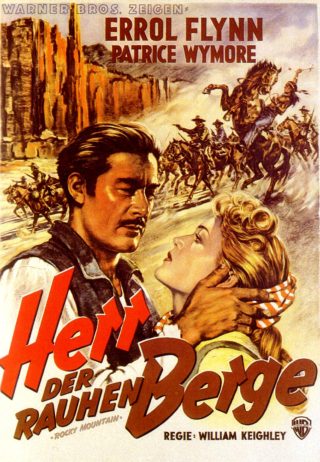
Having already made seven westerns, Errol Flynn got into the saddle one last time in 1950 to make Rocky Mountain. The whole tone of the film is different to what went before, and that makes it somewhat atypical. Both They Died with Their Boots On and Silver River had their darker moments but neither was as relentlessly grim as this. From the opening moments, when a weary, unshaven Flynn leads his bedraggled soldiers across a bleak landscape, an air of resigned fatalism hangs over the characters. This makes for a superior little picture, and one entirely in keeping with the era in which it was produced. By 1950 the western was on the cusp of one of its regular periods of transition, about to enter that Golden Age when heroes were less than perfect and endings weren’t always happy.

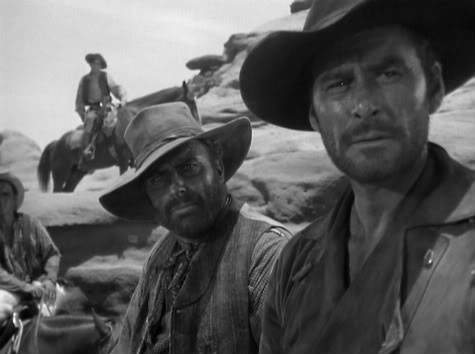
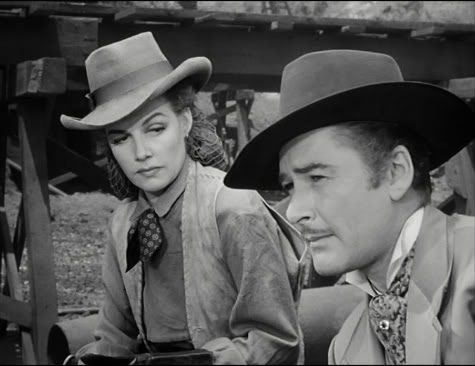
Lafe Barstow (Flynn) is a captain in the Confederate army who, in the dying days of the Civil War, has been sent west to California to raise a guerrilla force which his superiors hope will cause sufficient havoc to take the heat off their forces back east. We get our first sight of the small band of rebels as they near their rendezvous with the bandit warlord who has pledged his men to the cause. From there on the action is confined to the titular mountain and the barren valley below. Things go awry almost immediately when Barstow and his men take it upon themselves to rescue a stagecoach being pursued by a raiding party of hostile Shoshone. This act of gallantry is destined to backfire when it’s revealed that the sole surviving passenger is Johanna Carter (Patrice Wymore), the fiancee of a Union lieutenant stationed nearby. Not only has the secrecy of their mission been compromised but the rebels soon find themselves besieged by the vengeful Shoshone. A tense waiting game ensues and hard decisions will have to be made by all concerned. This is quite a downbeat story and, despite the misleading publicity blurb on the poster, the romantic aspects are largely ignored. There’s also a conspicuous lack of the kind of broad comedic moments that frequently characterize westerns starring Flynn.

I really enjoyed Flynn’s performance as the doomed soldier struggling to choose between duty and human decency. It’s sort of ironic that it should be his last western, and a low budget picture, where he finds a role that he could get his teeth into. Rocky Mountain was to be one of Flynn’s last good parts before he experienced a mini revival in his last years. It proves that the man could certainly act when the right material was offered to him – it’s just a shame that he chose, or had to accept, such poor vehicles thereafter. Patrice Wymore was soon to become the third Mrs. Flynn and she does fine as the reluctant hostage, appearing remarkably assured in what was only her second film. The support cast is generally good and there’s the bonus of seeing Slim Pickens making his screen debut as one of Flynn’s men. Long-standing sidekick Guinn Williams is also prominently featured (looking quite old and weathered, it has to be said) and he indulges in none of the comic pratfalls with which he’s often associated. Director William Keighley shot this sparse movie very professionally; both the action set pieces and the more thoughtful, talky passages work equally well, and he really gets the best out of the New Mexico locations. There’s not one interior in the whole film, and that’s always a good thing when the budget is restricted.

Warner’s R1 DVD of Rocky Mountain is another excellent transfer that shows off the crisp black and white photography to good effect. There’s the usual package of extras with three more of the very welcome western shorts that appeared on the disc for Montana. The film has also been granted a commentary track by Thomas McNulty, which I found both enjoyable and informative. All told, we get a classy presentation of a very fine movie which I’d recommend highly.

So, that brings me to the end of this little series on the westerns of Errol Flynn. I’m not sure how I’d rank them, but Rocky Mountain, They Died With Their Boots On and Silver River would have to be in the top three, with the first two probably sharing the top spot. I’d have no hesitation in placing San Antonio and Montana at the bottom of the pile, with the other three jockeying for position in the middle. Anyway, I’ve enjoyed viewing and writing down my thoughts on these films, and I hope others have taken some pleasure in reading them.

Montana

poster98

After watching Silver River, with it’s strong plot, good cast, and high production values, it’s a bit of a disappointment to view Montana (1950) next. What we have here is a B movie that uses technicolor in a vain attempt to disguise that fact. It’s a real struggle to find anything good to say about this film; the story is flat and unengaging, the cast largely anonymous, and the action (what little there is) is dull and devoid of tension. On the plus side, the colour photography adds a little sheen to a few scenes and it’s mercifully short, clocking in at just 76 minutes.

Montana falls into that small sub-genre of westerns that deals with the conflict between the cattlemen and the sheepmen. Now, there’s a very good reason why such stories never gained much popularity – it’s essentially a dull subject that doesn’t grab you. The plot deals with the efforts of Morgan Lane (Flynn) to drive his herd of little woolly guys into Montana and graze them on the open range. The cattle ranchers, who have already established themselves, are implacably opposed and are prepared to use whatever means are necessary to keep the sheepmen out. The ranchers, in the shape of Maria Singleton (Alexis Smith) and her betrothed Rod Ackroyd (Douglas Kennedy) have the range carved up between them and are preparing for war. Lane manages to trick Miss Singleton into signing over a lease, and the stage is set for a showdown. The problem is that there’s no real tension generated and the on-off romance between Flynn and Smith just feels contrived and serves only to pad out what is basically a lean tale. By the time you get to the appallingly poor climax it’s hard to care what the outcome will be.

This is one of Flynn’s poorest performances and it’s clear his heart just wasn’t in it. He looks tired for most of the running time and even his likability can’t lift this drivel. Worst of all there’s the unedifying spectacle of the star gritting his teeth and warbling along to a godawful ditty in a duet with Alexis Smith. Miss Smith wasn’t really served any better by this material and spends much of her time flouncing around playing a character whose behaviour perpetually alternates between the arch and the petulant. The  rest of the cast is filled up by a bunch of instantly forgettable nobodies giving one flat, one-note performance after another. Oh, S.Z. Sakall makes another of his unwelcome appearances but his character abruptly disappears and no explanation is offered – he’s just there, and then he’s not. This kind of continuity lapse, and the short run time, suggests that portions of this movie ended up on the cutting room floor. Ray Enright was one of those journeyman directors who could produce something passable given the right material, but his point-and-shoot handling of Montana is underwhelming and uninspiring. His filming of the big stampede at the climax is an object lesson in how not to shoot an action scene. We get pointless images of rampaging cattle interspersed with head and shoulder shots of Flynn and others bobbing up and down, pretending to be riding horses, against a painted backdrop!

For such a weak film Montana is presented handsomely on DVD in R1; the transfer is clean and the colours are strong. There’s a good selection of extras from Warners with trailers and shorts – best of all are three western shorts, which I actually found more entertaining than the main feature. Prior to this viewing I hadn’t seen Montana in over twenty years. I had forgotten most of the story and I have to say it really is a forgettable movie. If you’re a Flynn completist, like me, you’ll probably want it just to plug the gaps but I seriously doubt it’s the kind of movie anyone is likely to return to in a hurry. Next will be Flynn’s final western, and the last in this short series of reviews – Rocky Mountain.


Silver River

What a difference a director makes. One of my gripes with San Antonio was the fact that it was made by a man who didn’t seem to be in touch with the genre. The western is one kind of film where such a lack of association is especially damaging. Despite the fact that it encompasses so many themes and types of story, the western has its own look, rhythm and ethos – that’s what makes it unique, in my eyes anyway. Silver River (1948) is an odd mix of western and slightly soapy melodrama but, at heart, it’s really an old-fashioned morality play. Raoul Walsh was very much at home making oaters and his steady hand on the tiller ensures that this movie holds true to its course.

Silver River is a tale of one man’s rise, fall and ultimate redemption. It opens towards the end of the Civil War, when Mike McComb (Errol Flynn) deliberately disobeys an order, for the best of reasons, and is subsequently court martialled and cashiered. This has the effect of hardening his resolve to succeed at all costs in civilian life, and look out solely for number one. The first half of the movie charts his seemingly unstoppable rise both socially and financially, as he acquires capital, transport, a gambling house, interests in the mining business, and another man’s wife in rapid succession. As we follow each step of McComb’s progress, the script throws in one reference to the classical world after another (ranging from Julius Caesar to King David) to draw parallels with the character’s actions. McComb’s ruthless pursuit of power and glory drives him right to the brink of moral bankruptcy, but results in the financial bankruptcy that is necessary if he is to avoid slipping into the abyss. The aptly named Plato Beck (Thomas Mitchell) is on hand all the while to act as the voice of conscience. The drunken lawyer first assists McComb in his meteoric rise and then presides over his downfall, knowing that he must destroy his friend in order to save him.

Silver River is one of those movies that was almost perfectly cast. Flynn, nearing forty and with a few rough years behind him, is fine as the man still young enough for grandiose dreams but tinged with the kind of realism that comes from having lost a few rounds. His own personal troubles and the knowledge of what he was doing to himself at this point must surely have coloured his performance. Some of the scenes in the latter half of the film, where he is confronted with the ugliness of his actions and the prospect of abandonment, really ring true and one can read the resignation and despair in his eyes. Ann Sheridan is wholly believable playing the tough as nails frontier woman who first rails against Flynn before finally succumbing. Sheridan was one of those actresses who brought a lot of honesty to her playing and I thought she was especially convincing in the early scenes where she eschewed all of the usual Hollywood glamour to portray a woman who was the equal of any of the men around her. I always enjoy seeing Thomas Mitchell in anything and, although some may have a problem with his admittedly hammy style, find he brings an enormous amount of pathos and humanity to every part. His role in Silver River is a pivotal one and it’s entirely to his credit that it would be hard to imagine anyone else playing it. As I said earlier, Raoul Walsh holds everything together expertly and succeeds in preventing the melodrama from becoming too suffocating. The outdoor scenes and the action are everything you would expect from a director of Walsh’s calibre, and the more dramatic indoor confrontations are well shot with plenty of emphasis on the actors’ faces – something of a characteristic with this director.

Silver River was a surprise omission from Warners Errol Flynn western package, but it is freely available on DVD from them in France. The image quality looked pretty good to my eyes, save for a little softness in the first ten minutes or so. Thereafter the picture remains clean, sharp and quite consistent. The disc has removable French subs and is completely barebones but, on the positive side, it’s not all that expensive. I think this is a bit of an undervalued film that deserves to be rediscovered, so I’d recommend it. I’ll be looking at Montana next.

San Antonio


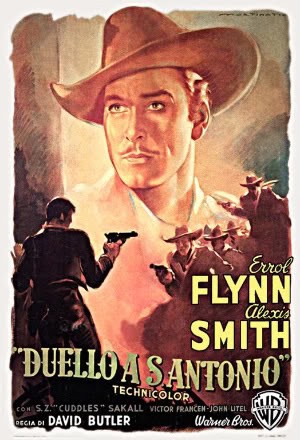
poster103It’s often difficult to put your finger on exactly why a film doesn’t work for you. I’ve frequently found that such films suffer from two basic flaws; they can’t seem to make up their minds what style to adopt, and/or the director is someone who has no real affinity or feel for the genre in which he’s working. The existence of one of these factors can easily hamstring a production – when they appear in tandem it’s never good news. I feel that San Antonio (1945) is one of those films that falls into this unfortunate category. There’s actually the makings of a fine film in there, and indeed it contains some well executed sequences, but it ultimately loses its way and winds up as a pretty unsatisfactory experience.

San Antonio is basically revenge western. The prologue places the action in Texas in the 1870s at a time when a struggle is taking place between ranchers and rustlers. Clay Hardin (Flynn) was once a big time rancher who’s been run off his property and left for dead. The early part of the movie finds him holed up in a Mexican pueblo, recovering from his wounds and preparing to return across the border with the hard evidence that will finally doom the rustlers. The plot follows a fairly straightforward line as Hardin tries to bring his enemies to book and they in turn try to find and dispose of his proof. The high point of the movie is the duel that takes place in the ruins of the Alamo between Hardin and the two principal villains (Paul Kelly & Victor Francen). This is a nicely shot sequence that generates a bit of tension but loses much of it’s impact due to the fact the story is allowed to dribble on when it should have ended there at its natural climax. Along the way there’s also time for a romance to develop between Hardin and visiting actress Jeanne Starr (Alexis Smith) – an attempt is made to turn this into a love triangle involving Paul Kelly’s character, but it quickly fizzles out as there’s never any doubt as how the chips are going to fall in this situation. The irritating thing is that all this forms the basis of what could have been a pretty good western. Unfortunately, there are far too many instances of jarringly inappropriate comedy and overblown musical numbers that stop the movie in its tracks. Any dramatic tension that had been building just gets killed stone dead in these moments.

Flynn played his part fairly straight throughout, and gives a generally sound performance. His features  were just starting to show a bit of wear at this point, but I thought that was fitting for a character who has taken a bit of a beating. Alexis Smith made a number of films as Flynn’s co-star and they work well enough together; her character remains believable and she certainly photographed nicely in technicolor. As the villains, Messrs Kelly and Francen are passable if fairly generic – their performances being of the snarling and moustache-twirling variety. One of my biggest problems was the casting of S.Z. Sakall, one of those acquired tastes I’ve never managed to develop. In my opinion, his presence is unnatural and unwelcome, adding nothing of worth to the picture and, most damningly of all, draining the dramatic clout out of a number of scenes. In his defence, he does manage to raise a smile when, early on, upon observing a riderless horse, he slips in a sly dig at fellow English language-mangler Michael Curtiz by announcing: “There goes an empty horse!” Unfortunately, the exact same gag is repeated at the end, just in case the audience were too dumb to catch it first time round. Generally, I’m not one to grouse about the injection of humour in a western, Ford, Walsh, Hawks and others managed to do it effortlessly and successfully. The problem with the jokes in San Antonio is that they come at the wrong time and verge on the surreal – a lime green parrot with a southern drawl and a whisky-drinking cat being conspicuous examples. When you get a script from Alan Le May and W.R. Burnett, it’s not unreasonable to expect something better, so I’d lay the blame at the feet of director David Butler. His western credentials are nearly non-existent and I have to say it shows up in the final result here.

San Antonio was clearly an expensive production and that’s apparent in the technicolor renditions of the lavish sets. Warner’s DVD shows these production values off to good effect, but the clean, sharp picture also highlights a few dodgy painted backdrops for exteriors. Nevertheless, the colours are strong and really pop off the screen, especially some of Alexis Smith’s costumes. All in all, this is an excellent looking DVD that I couldn’t fault – it’s just a pity that the movie itself doesn’t measure up. It’s part of the Flynn western collection but if it were available separately I couldn’t, in all good faith, recommend it. Coming up – Silver River.


They Died with Their Boots On

“What do you Yankees think you are? The only real Americans in this merry old parish are on the other side of that hill with feathers in their hair”

If most old movie fans were asked to name their favorite Errol Flynn picture I think that a significant majority would probably plump for The Adventures of Robin Hood. I couldn’t really fault that choice as it comes in near the top with me too, but it’s still not my favorite. That honor would have to be reserved for They Died with Their Boots On (1941). I don’t know if it’s Flynn’s best film but it is up there and must surely be seen as one of the high points of his career. The character of George Armstrong Custer is one that Tasmania’s most famous son must have seemed ideally suited to playing. When the film was made Custer’s reputation as one of America’s greatest military heroes was only beginning to be reassessed, so there’s no axe-grinding revisionism to be found. Judged as a faithful biopic or character study, the movie is open to all sorts of criticism; but that’s not really what They Died with Their Boots On is all about, and it would be doing it a great disservice to treat it too harshly on those grounds. No, this is a Boys’ Own adventure of romance and daring, of guts and glory – and taken as such, it works perfectly.

There have been numerous portrayals of Custer on screen, dating back to Francis Ford in 1912, but I doubt if any have imbued the man with the glamour that Flynn brought to the part. The film traces his life and career from his entry into West Point up to his final moments at the Little Big Horn. Custer’s arrival at the US military academy, in all his gold-braided glory with a pack of hunting dogs in tow, is largely played for laughs, although it does set up a simmering rivalry with fellow cadet Ned Sharp (Arthur Kennedy) that’s crucial to the plot’s development. In fact, this is a film of two distinct parts; the first hour or so is mostly lighthearted knockabout stuff with only the occasional foray into more serious matters, while the second half takes on a decidedly darker and moodier tone. Therefore, we get to see Cadet Custer as a kind of fun-loving prankster who liked to ride his luck and chance his arm with authority, which, by all accounts, wasn’t too far from the truth. When the Civil War intervenes and necessitates his early graduation, Custer finds himself torn between pursuing his interest in the love of his life, Libby (Olivia De Havilland), and his enthusiasm to get into the thick of the action. Naturally, the pursuit of glory and honor wins out, and this leads to a nice little scene in Washington with General Winfield Scott (Sydney Greenstreet). Interestingly, Custer did have a fortuitous meeting with the Union commander on arrival at the Adjutant General’s office which led to his first active posting – albeit without the business with the creamed onions. The war, which ironically brought enormous fame to Custer, is given only minimal attention but it does show his rapid rise through the ranks. While all this is presented in a highly entertaining fashion, you still get the sense that we’re only marking time until we get to the real meaty stuff – the move west and the Indian Wars.

With the action shifting to Dakota, the whole feel of the film changes and raises it up to a different level. There’s still time for the odd lighter moment but it’s quickly apparent that this new war is no gentleman’s affair. Custer almost immediately clashes with his old foe Sharp who’s running a saloon and trading rifles with friendly Indians from within the fort. The first order of business is to end the drinking and whip the drunken recruits into some sort of fighting force. This is achieved via a wonderful sequence whereby Custer adopts the old Irish drinking song Garryowen and uses it as a means of instilling a sense of pride and unity into his ragtag 7th Cavalry. There’s also the first view of the red men, and in particular their chief Crazy Horse (Anthony Quinn). One notable aspect of this movie is the respect afforded to the Sioux; at no point are they portrayed as anything less than a disciplined fighting force with legitimate grievances. The real villains of the piece are the corrupt officials and their businessmen backers from the east. The point is made very clear that the Sioux are left with no choice but to rise against the whites when treaties are broken and their shrinking homeland is further encroached upon. When Custer leads out his last fateful expedition he does so in the hope of earning more personal glory of course, but it’s also obvious that his political masters and their moneyed allies have left him with no other option. So, he leads his 7th to the Little Big Horn – to hell…or to glory, depending on one’s point of view.

Flynn gave one of his better performances in They Died with Their Boots On, particularly in the second half. You can see the character gradually mature as the story moves along, his youthful optimism giving way first to disillusionment and then, finally, to a perversely jaunty death wish. If you wanted to stretch a point, it’s possible to see parallels in the course of Flynn’s own life. There’s also much more maturity in the relationship between the characters of Flynn an Olivia De Havilland; this would be their last film together and that fact adds considerable poignancy to their farewell scene, which is pitch perfect in its playing. However, even though the film marked the end of one partnership, it would signal the beginning of another – this was the first movie that Flynn made with director Raoul Walsh. If the star’s relationship with Michael Curtiz was a less than happy one, his collaboration with Walsh was much more congenial. These were two men who were much closer in temperament and Flynn seems to have felt a lot more comfortable in the company of the buccaneering old director. Walsh was one of those directors who was always in his element shooting outdoors on location. I’ve already made the point that when the film switches to the west it moves up a gear, and I think that’s due, in part, to Walsh’s affinity with the outdoors. The last half hour or so has a dreamy, poetic quality that’s the equal of some of John Ford’s best work – and that’s no mean feat. It should also be pointed out that the movie benefits enormously from one of Max Steiner’s finest and most memorable scores, which is built around the rousing yet vaguely melancholy Garryowen.

Warner’s R1 DVD (I believe the R2 is the same transfer) of They Died with Their Boots On is quite fabulous, clean and sharp with barely a damage mark in sight. It has a good selection of extras though it lacks a commentary, which I feel this movie deserves. OK, maybe this isn’t the best western you’ll ever see but it’s right up there among my all time favorites – one of those films that unfailingly pushes all the right buttons on every viewing. Next up, San Antonio.

Santa Fe Trail

poster100

If you’re the kind of person who gets hot under the collar when movies play fast and loose with historical facts, or if you find the political undertones of times gone by to be unbearably offensive then Santa Fe Trail (1940) is most assuredly not the film for you. This is the kind of movie that’s awfully easy to criticise and denigrate, and it’s probably a simple task to find lots of sites on the web that have done just that. Well, I’m not going to indulge in that kind of shot-taking. I can live with a movie twisting history for dramatic effect as it seems foolish to expect what is essentially an entertainment medium to stick only to the facts. As for politics, there are always going to be positions that we either agree or disagree with. If I were to limit myself to those movies that conform to my personal views I would in all likelihood be looking at a very small pool of titles. So, while I can acknowledge that Santa Fe Trail has some shortcomings, I’d still say it ranks as an enjoyable movie experience.

The story is a fairly straightforward good guys versus bad guys tale, with the role of the heroes being assumed by the army, and the new West Point graduates in particular. So, we are presented with the fanciful notion of Jeb Stuart, George Custer, Phil Sheridan and other famous military figures all graduating the same year. That’s all nonsense of course, but it does allow the point to be made that the Civil War was an event that was to set former friends and allies at one another’s throats. The focus remains firmly on Stuart (Errol Flynn) and, to a lesser extent, Custer (Ronald Reagan) as they strive to run to ground the abolitionists in Kansas led by John Brown (Raymond Massey). This is the point that most people object to; namely the fact that the film seems to demonise the anti-slavery activists. Now, while there can be no doubt that these characters are portrayed as the villains of the piece, it’s not that simple. The movie actually takes pains to keep to a middle line and actually shows the pro-slavery crowd (albeit in far fewer scenes) to be no better. As I said, the viewers perspective is that of the army in the middle. There are numerous occasions where the characters all voice sympathy for the ultimate aims of, if not the tactics employed by, the abolitionists. If anything, this is the source of the issues many have with the film – it fails to come right out and condemn the southern states advocacy of slavery. Personally, I’m not sure if this should be seen as a weakness. The fact that it doesn’t take the easy route gives it a unique quality. There’s always a certain satisfaction and reassurance that a viewer feels when a movie follows the line that he himself believes to be right. However, there’s also a different satisfaction to be derived from those rare movies whose message remains more ambiguous. Santa Fe Trail is such a film, it never really takes sides clearly and saves its condemnation for the kind of murderous zeal that that can tarnish even the noblest of causes.

Flynn again gives another variation of his laughing cavalier character. He must surely rank as the most swashbuckling cowboy ever to ride the frontier, and the script offers him ample opportunity to do so here. He was still in his athletic prime at this point, and is in his element whether chasing gun-runners on horseback at breakneck speed across the prairie or storming Harper’s Ferry with sabre drawn. After his unconvincing pairing with Miriam Hopkins in Virginia City, it’s good to see Olivia De Havilland cast opposite him once more – the obligatory love story seems much smoother and more comfortable with these two. Ronald Reagan seems an odd choice for the role of Custer for he possessed neither a physical resemblance to the man nor any of that driving ambition that characterized him. Instead, we get a slightly  comedic figure who’s relegated to playing second fiddle to Flynn’s more Custer-like lead. Raymond Massey’s John Brown is all fiery passion and outrage. His wild-eyed reformer borders on parody but, despite chewing up the scenery, stops just short of that. He still invests his role with a sense of credibility and even manages to bring some humanity to what could easily have become a caricature. A word also for Van Heflin who gives solid support as the mercenary Rader who finds redemption at the end.

This would be the last western collaboration for Flynn and Michael Curtiz, and their penultimate film. By all accounts there was no love lost between them despite the fact they made a dozen movies together. Curtiz again makes good use of both locations and studio, and his handling of the action scenes is exemplary. There’s also a memorable little interlude before the climax, when the group of soon to be famous soldiers all gather round an old indian squaw and have their collective fortunes told. As the old woman sits drawing pictures in the dirt, she tells them that they will all achieve honours and rank but in the process become bitter enemies. This is pure Hollywood fantasy but it’s beautifully filmed and quite poignant in view of the historical context.

Santa Fe Trail has long been a staple of various PD companies on DVD. There has yet to be an official release in either the UK or the US, but there is a Warners DVD of the movie out in France. The disc is a barebones affair but it does present the film better than I’ve seen before. The print used is a little soft in places and a little too bright in others but it is remarkably clean and free of damage. The audio is generally strong although I did notice a momentary dropout on two occasions. If anyone’s looking to get their hands on the best extant version of this interesting and frequently overlooked film I would suggest seeking out this French copy, which has the Warners logo intact at the beginning, and mercifully removable subs. Next time – They Died with Their Boots On.