Red Sun

bronson1

Charles Bronson and Toshiro Mifune take on a gang of desperadoes led by Alain Delon. Add the decorative charms of Ursula Andress and Capucine to the mix, stir it all up under the watchful eye of original Bond director Terence Young, and the result is the 1971 samurai western Red Sun. How can you not love such a movie? While you can find a number of films, from The Magnificent Seven on, that took their cue from and remade Japanese stories, the mixing of genres is not so common (I could mention a recent movie that borrows the basic premise but I don’t want to dirty up this piece by referencing it).

The  plot  goes like  this: the Japanese ambassador to the USA is travelling cross country to Washington when the train he’s using is held up by an outlaw gang. The robbery is masterminded by Link (Bronson) and Gauche (Delon), and their objective is a safe full of money. It’s just bad luck that the Asian diplomat happens to have chosen this train and gets himself robbed too. Having already murdered a few innocent people, Gauche shows just how ruthless he really is by knocking off one of the ambassador’s samurai guards, stealing a priceless sword, double-crossing Link, and leaving him for dead. So our two heroes, Mifune and Bronson, must set out in pursuit of the duplicitous Frenchman; one seeking to recover the sword and uphold his honour, and the other just seeking the stolen money that has been stolen from him. For Mifune there is the added complication that he has been given just seven days to accomplish his mission; should he fail to do so he will be forced to take his own life.

Red Sun came along towards the end of Spaghetti/Euro western cycle and it manages to add a new twist to it with the inclusion of the samurai angle. Now if someone were to offer you a meal consisting of a Spanish omelet, sushi and good old bacon & beans all mixed up together you’d probably feel a little queasy at the prospect. However, from a cinematic point of view, it doesn’t turn out so bad – in fact it manages to remain quite appetising. This is not a film that is trying to make any serious points and, as long as you keep that in mind, it provides some marvellous entertainment. Nevertheless it is nice to see the relationship between Bronson and Mifune’s characters blossom as each comes to acquire a respect for the other. Mifune is fine as the taciturn, honour bound warrior and Bronson (on the verge of international action stardom) is very likable as the wisecracking bandit. Alain Delon is a very one-dimensional villain, but the movie isn’t about character studies anyway. Capucine and Ursula Andress were really just along as eye candy, and that was alright by me. So, the film has copious amounts of gun and swordplay, the Cavalry, Mexican bandits, a marauding Comanche raiding party, and a catchy score by Maurice Jarre. It’s hard to imagine what else the producers could have thrown in.

Red Sun comes on DVD in R2 from Cinema Club in a fairly decent print, except it’s not OAR. The film should be shown 1.85:1 but the R2 is full frame. It looks like an open matte transfer, rather than pan & scan, since there is far too much headroom on view. I believe there is a widescreen version available somewhere, but I can’t recall where – Japan maybe? All in all, I found the movie undemanding and fun. Bon Appetit!


The Killers

I did something wrong…once.

So says the Swede (Burt Lancaster) as he lies in bed bereft of all hope, and calmly awaits his end. I love that scene near the beginning of the 1946 version of The Killers. It is one of the great moments of film noir and says so much about the genre – if you can even call it a genre. A good deal of its bleak power comes from the fact that it seems to run contrary to all normal human instincts. If someone were to burst into your room and breathlessly inform you that a couple of mean-looking hitmen had just rolled into town with the express aim of rubbing you out, most people would take the opportunity to make tracks fast. But Lancaster just remains prone in the shadows and delivers that line in the detached tone of a man already dead; when fate pays that last call there’s no ducking out.

Robert Siodmak’s film takes Ernest Hemingway’s short story (and it’s a very short story) and uses it merely as the jumping off point. The rest of the movie follows insurance investigator Reardon (Edmond O’Brien) as he tries to find out why the Swede ended up in a small New Jersey town waiting passively to greet a hail of bullets. The story is revealed by a succession of characters who had known the Swede, and a number of flashbacks gradually piece together all the events that brought about his demise. The Swede starts off as a medium grade fighter who, after breaking his hand and ending his career, begins the slow descent into the criminal underworld. This culminates in a payroll heist, the aftermath of which leads to the eventual downfall of just about everybody involved. The character of the Swede is basically a good-natured oaf whose desire for easy money allows him to be dazzled and duped by the grasping and predatory Kitty Collins (Ava Gardner). In a sense the whole film is as much about Kitty as anyone else; as we see her manipulations provide the catalyst for the betrayals that litter the story.

The Killers marked the screen debut of Burt Lancaster and his tough vulnerability is shown to good effect in the movie. There’s enough innocence in the Swede for you to genuinely sympathise with him and despair at the big lug’s stupidity as Kitty plays him for the ultimate sucker. Ava Gardner’s Kitty gets the classic femme fatale intro; we first see her as the Swede does – seductively clad in black satin and vamping for all she’s worth in a night club. Her character is rotten all the way through – effortlessly hooking the smitten Swede, playing the gang off against each other, and finally, tearfully begging a dying man to save her neck by damning himself. The role of Edmond O’Brien is to offer perspective and lead the viewer through the labyrinth of deceit; he’s really the linking device between all the small episodes that make up the whole. O’Brien’s own guide along the way is police lieutenant Lubinsky (Sam Levene from the Thin Man movies) and there is good support from gang members Albert Dekker, Jack Lambert and Jeff Corey. However, two of the most memorable turns come from William Conrad and Charles McGraw as Max and Al, the killers of the title. Their roles don’t extend much beyond the first ten minutes of the film, but those are ten truly magical minutes. They get some of the choicest dialogue (and deliver it perfectly) as they simultaneously mock and menace the occupants of the Brentwood lunch counter.

Robert Siodmak made some of the best noirs of the forties and I feel The Killers is his standout work. This is one of those films where plot, direction, characterization and photography all seem to come together harmoniously. Deep, dark shadows are everywhere and only the policeman’s terrace, where the ideal wife serves lemonade on a hot day, seems to rise above the murkiness. I should also say a word about the powerful score by Miklos Rozsa which is especially effective whenever Messrs Conrad and McGraw make an appearance.

The Killers is out on DVD from Criterion in R1 and from Universal in R2. I can’t comment on the presentation on the R2 disc as I haven’t seen it but bitter experience has taught that Universal’s UK releases are a hit and miss affair, with a high proportion of misses. The Criterion is everything you would expect from them with a beautiful, clean transfer to show off those deep, black shadows. As you would expect, the film comes packed with useful and informative extras – and, best of all, it is paired with Don Siegel’s 1964 remake (and Andrei Tarkovsky’s student film version). All in all, this represents the definitive presentation of what is probably my favorite film noir.

The Long Riders

I’ve been working my way chronologically through as many films dealing with the James/Younger gang as possible. The last one I’m going to look at for now is Walter Hill’s The Long Riders from 1980. I feel sure that this is Hill’s best western, quite possibly it’s his best film period. All the other films that I have gone through in this little series have basically concentrated on one character, either Jesse James, Frank James or Bob Ford. The Long Riders differs in this respect since the focus is on the gang members collectively – the unique casting decisions playing a significant role here.

The movie charts the last years of the gang and provides little of the background found in other versions. There are, of course, numerous references throughout to the post-war hostility that is usually cited as the reason for the gang’s activities. But there are no images here of innocent farm boys driven, in spite of themselves, towards criminality. Instead, the opening of the film shows the gang as a bunch of seasoned pros coolly holding up a bank. That’s not to say that the characters are portrayed in an unsympathetic light – the script encourages the viewer to root for these men while also hissing at the bungling, murderous Pinkerton agents hunting them. The needless killing of a bank cashier by Ed Miller (Dennis Quaid), and his consequent expulsion from the gang, is meant to show us that these men are not just mindless sociopaths. It is also made clear that the killings of a number of Pinkerton men are forced on them only after those agents have murdered innocent members of their families. There’s also attention paid to the personal relationships of all the gang members, the most memorable being that between Cole Younger (David Carradine) and the tough and sexy Belle Starr (Pamela Reed). This affords Carradine the opportunity to deliver one of the best lines in the movie: “You’ll never be respectable Belle. You’re a whore… You’ll always be a whore…That’s why I like you.” 


The film is beautifully shot and paced all the way through and this is most evident in the memorable Northfield sequence. The filming of the raid and the shootout has often been compared to the style of Sam Peckinpah, and I won’t argue with that. This brutal gun battle is the real highlight of the movie with lots of slow motion to emphasise the agonising impact of each and every bullet wound. Sure this a bloody scene but not in the pointless, voyeuristic sense that seems to plague so many modern action movies.

I don’t think the unusual casting method employed here has been attempted anywhere else – all the brothers’ roles are taken by real life brothers. James and Stacy Keach are the James brothers, the Youngers are played by David, Keith and Robert Carradine (would any Jesse James film be complete without the presence of a Carradine?), Randy and Dennis Quaid are the Millers, and Nicholas and Christopher Guest are Bob and Charlie Ford. If I were to analyse each performance I might never finish this piece, so I’ll keep it brief. I feel the acting honours are shared equally between Stacy Keach’s Frank James and David Carradine’s Cole Younger. Carradine’s swaggering and tough Cole, and Keach’s thoughtful and mature Frank are the roles that anchor the film. For the others, they’re mostly as good as their parts allow them – with one exception. James Keach’s portrayal of Jesse is about the worst that I have seen. For a man’s name to have become so deeply embedded in popular mythology Jesse James must surely have been possessed of some charisma. However, the acting of James Keach makes him so wooden and blank that you have to wonder how all those vital characters around him could have acknowledged him as their leader.

So, having gone through a number of similarly themed movies, what conclusions can I come to? Firstly, I would have to say that The Long Riders is my personal favorite of all the depictions of these colorful characters. It also happens to be the one that sticks closest to the historical facts, but I can’t say that this seriously affects my opinion of their cinematic merits. The other thing that I noticed was that the character of Frank James consistently fares best of all. I was never in any doubt that this was one tough, mean hombre but I couldn’t help feeling that he was the most recognisably human figure of the bunch – of course, this may well be a result of the quality of the actors who have played the part down through the years. For myself, I found it interesting to watch the various versions almost back to back and see how they evolved; I plan to do something similar with the Wyatt Earp movies, but not right away.

The Long Riders is available on DVD from MGM in R1 and R2 in a mediocre edition. The transfer, while it is anamorphic, is badly in need of a clean-up. It is also shameful that a film which I regard as a bona fide classic of the genre comes with no extras save for a theatrical trailer. I sincerely hope that MGM sees fit to revisit this title and show it some of the respect it most certainly deserves.


The True Story of Jesse James


Almost twenty years after scoring a hit with Jesse James Fox tried to repeat their success in 1957. With a screenplay based on and crediting Nunnally Johnson’s 1939 effort, the studio tagged ‘The True Story’ onto the title and director Nicholas Ray was handed the task of trying to offer a fresh perspective on this oft-told tale. So, does this one actually tell the true story? Well, not exactly since the time-line is more than a bit suspect, although it does get quite a few things right which the earlier version didn’t.

The film pitches the viewer straight into the action as it opens during the raid on the Northfield bank. After the dramatic escape of Jesse (Robert Wagner) and brother Frank (Jeffrey Hunter) the film proceeds to narrate events via a series of flashbacks which lead up to the climactic and doomed heist. The True Story of Jesse James, as I said, manages to correct a few of the errors of the earlier version. In this film the James gang are, more accurately, shown to be driven towards a life of crime as a result of the conditions that prevailed after the Civil War. The treatment of the other characters is also a good deal closer to reality. The 1939 film had the James home being bombed by railroad agents, resulting in the death of Jesse’s mother. Nicholas Ray’s movie has the attack being carried out by Pinkerton men (referred to here as Remington agents) and causing not the death of the old woman but the loss of her arm – again this is pretty much as it happened. It is no bad thing either that the Younger brothers are actually portrayed here, although the emphasis on them is slight.


The biggest weakness of the movie lies in the casting, and particularly that of the lead. While earlier incarnations showed Jesse James as a lovable rogue (Tyrone Power) or a saintly, avuncular type (Reed Hadley), here he has evolved into more of a trigger-happy glory seeker. The trouble is that Robert Wagner just doesn’t have the necessary edge or grit to carry this off successfully. Although he does give a pleasant enough performance he is simply too lightweight. Jeffrey Hunter, on the other hand, is excellent as Frank; so much so that it seems a pity he wasn’t given the lead. Agnes Moorehead adds some class as the mother but her scenes are few. Even though Alan Hale’s Cole Younger is played mostly for comic relief it lends a touch of realism to see the character appear and be shown as a figure of some influence within the gang. John Carradine turns up again (how many  movies did this man make?), not as Bob Ford but as the preacher who baptises Jesse.

While I generally enjoyed this movie there were a few things that did get up my nose. These mostly involved the inclusion of footage from the 1939 Henry King film. The train robbery sequence blends in fairly seamlessly but another example proved especially distracting to me. During the well filmed Northfield raid, as the lead flies and men are falling all around, Frank and Jesse take the time to ride into an alley and divest themselves of their long dusters. Why, you might well ask, would two men caught in a firefight pause to do this? Well, the answer is that we’re about to see recycled footage of Power and Fonda riding through a plate glass window and later jumping their horses off a cliff – and our heroes hadn’t been wearing dusters in the ’39 film! Now those scenes were great the first time round but it smacks of a certain cheapness to wheel them out here again. Another problem I had was at the end of the film. You know that Bob Ford is going to shoot Jesse as he stands on a chair to straighten that picture. Well, here Ford gives it to him in the back of the head at point blank range – and instead of dropping to the floor like a sack of potatoes, Jesse swivels around to glare reproachfully at his assassin before succumbing to his wound. Bah!

The True Story of Jesse James is available on DVD from Fox in R1 and Optimum in R2. I watched the R1 and the presentation of this scope film is excellent with no major faults worth mentioning. I can’t comment on the quality of the R2 disc but I would imagine that it has been cut by the BBFC for the aforementioned scene of the jump off the cliff – I understand one of the animals was killed during the filming of that stunt. So, despite some quibbles, I would say this is not a bad movie – just not a great one.

I Shot Jesse James

jesse_james0

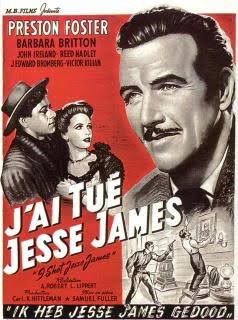
Sam Fuller made his directorial debut in 1949 with this take on the old story. I Shot Jesse James, as the title suggests, keeps the focus squarely on Bob Ford (John Ireland) and shows him in a more sympathetic light than usual. Like most film representations of these characters, there are some elements of the truth woven into the story. This film comes a little closer to reality in depicting the demise of Bob Ford than was the case with The Return of Frank James; here the name of the killer, the location and the means are broadly correct. Where the story drifts off into total fiction is the inclusion of the romantic triangle as the centrepiece of the drama.

The story opens with a botched bank robbery that leaves Bob Ford wounded and forced to lay up at the James home in Missouri. As he recuperates, he has the opportunity to visit the love of his life Cynthy Waters (Barbara Britton) who is an actress in a travelling theatre company. This meeting lays the groundwork for all that is to follow. When Ford arrives to see his woman he also meets a man called Kelley (Preston Foster) – a prospector who is clearly smitten with Cynthy. And thus the aforementioned triangle is set up. Cynthy begs Ford to abandon his outlaw ways and settle down to a decent life, thereby providing the motive for the subsequent murder of his friend. The rest of the movie is a portrait of guilt and a man trying to make good on his promise to go straight, yet foiled at every turn by his past and a love destined to remain unfulfilled.

In many ways I Shot Jesse James is a slight film, no more than a B movie really. What makes it notable is the way it tries to show Ford as a real person and not the greed driven caricature of earlier versions. I can’t say I was bothered by the playing around with historical facts since the reason for this was clearly the need to provide the character of Ford with a motive that might be understood. John Ireland does a pretty good job in showing us a man who is left bewildered when his actions draw not only the scorn of strangers but drive away the very woman whose heart he’d hoped to capture. Barbara Britton is good enough too as her character goes from love for Ford, through disgust at his actions, and finally to fear of what he has become. Preston Foster, as Kelley, isn’t called on to do much more than be the strong, dependable, moral anchor but he does it capably enough.

Sam Fuller would go on to make more famous, and better films than this but there are some memorable scenes. The climactic shootout has Ford framed in inky blackness – maybe signifying the moral void he now inhabits. There’s also a great scene in a saloon where Ford listens to a travelling minstrel sing about the murder of Jesse James. This was mirrored in the recent film by Andrew Dominik, but I prefer the way it was done here. After introducing himself, Ford insists that the singer complete his ballad as he stares implacably at him. You can almost taste the man’s fear as he chokes his way through the song, and struggles to utter the words ‘the dirty, little coward’ to Bob Ford’s face.

Criterion put this out on DVD in the ‘First Films of Samuel Fuller’ set, and it’s not available separately. This is part of the Eclipse line, and hasn’t had the careful restoration commonly associated with Criterion releases. However, it still looks good enough and I didn’t find the damage marks present to be particularly distracting. All in all, I Shot Jesse James is an interesting, if minor film.


Ministry of Fear

poster60

The ‘entertainments’ of Graham Greene have provided a rich source of material for makers of Film Noir. The Third Man, This Gun for Hire and Brighton Rock have all been derived from his works and, if you want to stretch the point, a case could also be made for the inclusion of The Fallen Idol and Confidential Agent. This all goes to prove that there is enough darkness and pessimism in Greene’s writings for them to lend themselves to the shadowy world of noir. And so we come to Fritz Lang’s 1944 adaptation of Ministry of Fear, where a frightened Ray Milland blunders through the bombed out streets of wartime London in pursuit of fifth columnists.

Stephen Neale (Milland) has just been released from an asylum after having been confined for the mercy killing of his wife and, naturally, is anxious to avoid any further entanglements with the law. As he waits to catch a train to London, he wanders into a charity fete where a palmist helps him to guess the weight of a cake and win it. With this seemingly innocuous incident Neale finds himself drawn into a nightmare world of murder and espionage. It turns out that the fake spiritualist had mistaken Neale for a Nazi agent (Dan Duryea) and that the cake contained something worth killing for. Neale’s curiosity leads him to follow up the matter in London where he attends a seance in the company of, among others, the aforementioned agent. When the spy is murdered Neale is falsely accused.  He believes that due to his past conviction no one will believe him innocent of the murder and so he goes on the run. His only assistance comes from an Austrian refugee (Marjorie Reynolds), and while the pair try to seek out the truth they are all the time dogged by a shadowy figure in a bowler hat.

Ray Milland’s star was in the ascendancy at this point and he would win an Oscar for his performance in The Lost Weekend the following year. His role here allows him to get in a bit of practice in psychological anguish and the natural affability of the man means that it’s easy to sympathize with the plight of his character. Marjorie Reynolds is fine as his Girl Friday but the forced Austrian accent does begin to grate a little at times. Dan Duryea is always good value as a villain and the only complaint that could be made is that his character is not given nearly enough screen time. Indeed the same could be said for much of the support cast who seem to breeze in and out of the picture, but all leave lasting impressions. A notable feature of so many films of this period is the marvellous gallery of eccentrics that cropped up time and again. These people, whose faces are immediately recognizable yet whose names escape us, were character specialists who usually played similar parts in every movie and their presence added enormously to the enjoyment.

Fritz Lang’s background in expressionist film-making serves him well here and is most notable in the early scenes of the picture. The charity fete provides that slightly surreal quality that continues throughout the film. The parts with the fake blind man on the train and the ensuing chase over the fogbound moor are also beautifully photographed. Everything seems to have been shot on studio sets but this is no criticism as it helps heighten the unreal, otherworldly feel of the movie.

Optimum released Ministry of Fear on DVD in R2 last year. The transfer is not bad but it could use a clean up. All in all, this is a highly enjoyable mix of noir and espionage and it’s always good to see more of Fritz Lang’s movies making it out onto the market.

The Return of Frank James

 Titles

It is, and always has been, common for a highly successful film to spawn a sequel. In 1939 Fox produced Jesse James and, riding on the wave of the reinvigorated western genre, found themselves with a hit on their hands. Of course, it’s a little difficult to continue a story when you have just killed off your main character. However, Hollywood rarely finds itself at a loss for long and the solution was to pick up the story where the first film left off and concentrate on the surviving brother, Frank James (Henry Fonda). The only problem was that, after Jesse’s death, Frank’s life wasn’t the stuff of dramatic, action-packed blockbusters. Therefore, the truth needed to be manipulated to present audiences with a story of revenge and redemption.

In the aftermath of the ill-fated raid on the Northfield bank Frank James had gone to ground. We find him living under an assumed name and it would seem that he has renounced his outlaw ways. On receiving news of the death of his brother he is content to let the law run its course, believing that Bob and Charlie Ford will be tried and duly hanged for the murder. It is only when he learns that, despite their conviction, the Fords have been granted a full pardon that he decides to take matters into his own hands and straps on his guns again. There follows a pursuit across the country to Colorado as Frank attempts to track down the Fords and mete out the justice he feels the courts have denied him. By the end of the film all the loose ends have been tied up and we get a traditionally happy ending. The problem with this is that the production code of the time dictated that a killer should not be presented as the hero – or at the very least that he should be punished for his deeds. The way around that issue was to present Frank James as an essentially honorable man hounded into infamy by circumstances and big business. So while the Fords get their comeuppance it is not Frank who is shown to kill them (which is historically true at least). In fact, the film is at pains to point out the innocence and decency of our hero throughout – even having one of the characters declare indignantly that Frank James never killed anyone. All of this is vaguely unsatisfactory since a man setting out on a mission of vengeance should, to my mind, be allowed to achieve some measure of it directly.

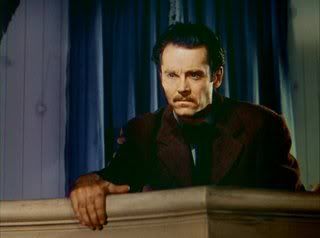
A grim Frank James (Henry Fonda) watches Bob Ford re-enact the murder of his brother.

As I said, Henry Fonda plays the lead very much in the style of the classic romantic hero. Throughout his long career Fonda was most frequently cast as the everyman who was the very epitome of human virtue. Almost thirty years later Sergio Leone would give Fonda the opportunity to finally play a character (also named Frank, as it happens) of pure evil in Once Upon A Time In The West. Gene Tierney (in her debut role) provides some eye-candy and romantic interest as a newspaper reporter, but not much else. Much of the rest of the cast is filled out with actors from the previous film, with John Carradine reprising his part as Bob Ford. Once again, Donald Meek is the conniving railroad boss and Henry Hull chews up every piece of scenery in sight as the editor of the local paper and friend of the family. Hull’s best scenes come towards the end of the film in a flamboyant courtroom defence of Frank on a charge of murder. This scene mirrors reality, where Frank James stood trial for robbery and murder and whose character was attested to by an old Confederate officer. In truth, the film spends a good deal of time on the lingering animosity between north and south in the years following the Civil War. All in all, director Fritz Lang’s first foray into the western genre is a pleasant and entertaining one.

Fox’s DVD release of The Return of Frank James is an improvement on the transfer of Jesse James, but not by much. The image is a good deal more consistent here but darker scenes are still quite murky and washed out. Generally, the outdoor scenes fare the best with stronger colour and sharpness. 

Jesse James

zjdoxsb

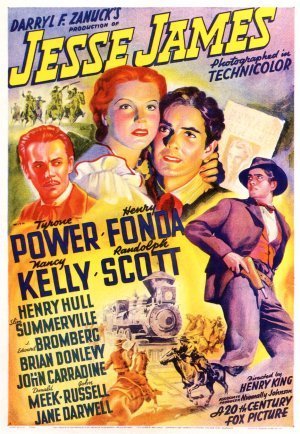
Having recently seen The Assassination of Jesse James, and having enjoyed it immensely, it occurred to me to go back and revisit some of the other movies based on the legendary outlaw. Along with William Bonney the name Jesse James has become an integral part of the myth of the west. For both of these men, questions of who and what they were and why they acted as they did have been endlessly explored and no truly satisfactory answers have emerged. But does that really matter? To me it doesn’t since the movies are and were, at heart, an entertainment and storytelling medium. It seems naive in the extreme to seek the whole truth in a dramatic form – if you want the real facts you need to look elsewhere. Henry King’s 1939 version of Jesse James certainly bends the truth more than a little, but that doesn’t mean the film is a poor one.

This movie opens in the years following the Civil War and portrays Jesse (Tyrone Power) and brother Frank (Henry Fonda) as peace loving farmers in Missouri. That’s the first of many inaccuracies, for the truth is that the brothers had already strayed into lawlessness during the war – Frank riding with Quantrill and Jesse with another group of guerrilla raiders. There is no doubt, right from the beginning, that the true villain here is the railroad and more specifically it’s representatives. The railroad, as in many westerns, is shown to be the product of the greedy and corrupt east. It is the actions of one of the railroad agents (Brian Donlevy) that causes the James bothers to turn their backs on the law. From this point on their fates are mapped out for them and further dissembling on the part of the big businessmen serves only to provide more justification for the brother’s criminal activities.

The movie is full of some fine set pieces such as the early train robbery with Jesse riding up to the rear, hauling himself aboard, and then proceeding along the roof for the whole length of the locomotive until he reaches the engine. The famous raid on the bank in Northfield could have been given more time but it does contain some great action shots – Jesse and Frank riding their horses through a store window to escape and then following that up with a dive off a cliff into a river below.

Power and Fonda play the brothers as essentially romantic and heroic figures, but the film is not above pointing out the less honorable aspects of Jesse’s character. At one point Randolph Scott’s sympathetic lawman makes it clear that Jesse’s initial justification has been superceded by simple, inexcusable criminality. Another scene, on the eve of the Northfield raid, shows Jesse to be a man on the verge of losing control and only the efforts of his more rational brother haul him back. Scott’s supporting role doesn’t offer much and I get the feeling that it was only included to show that all authority figures are not scheming back-stabbers. The notorious Bob Ford is played by John Carradine as a craven scoundrel with whom the viewer can feel no sympathy whatsoever. As a portrait of cowardly betrayal it’s well done but, as with all the villainous parts, remains one dimensional.

Fox issued the movie on DVD last year and the presentation is a good deal less than might have been hoped for. Frankly, the print is in poor condition and this is particularly evident for the first half hour or so where the age of the film becomes painfully obvious. Things do improve as it goes on but issues with the colour occasionally arise. The film clearly needs restoration work but, despite it’s shortcomings, I’m still very happy to at least have it in my collection.


The Blue Dahlia

poster4 

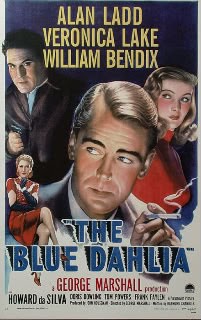
The Blue Dahlia (1946) was the third film that Alan Ladd and Veronica Lake had made together. While their two previous collaborations had been based on novels (This Gun for Hire by Graham Greene and The Glass Key by Dashiell Hammett) this one was from an original screenplay by Raymond Chandler. Anyone who has read anything by Chandler will know that plot always took second place to dialogue in his writing, and that’s certainly the case with this film. For me, the holes in the plot make this a less satisfactory affair than the earlier Ladd/Lake movies – I can’t comment on their last one Saigon since I have yet to see it.

The story concerns Johnny Morrison (Ladd), a navy veteran, returning from the war in the Pacific theatre. Arriving back in L.A. in the company of two of his former crew (William Bendix and Hugh Beaumont) he goes to meet his wife. Their reunion is not a happy one as his unannounced arrival finds her in the middle of throwing a party. Not only that, but he finds her to be having an affair with the shady owner of a night club, the titular Blue Dahlia. Unsurprisingly, he packs up and leaves. Later, the wife will be discovered shot dead with Johnny’s automatic and the suspicion naturally falls on him. The rest of the movie deals with his efforts to evade capture while trying to run down the real killer. The list of suspects is a long one, with just about every major character having either the motive or opportunity to have done the deed.

The performances are generally good and Ladd is convincing enough as the tough hero. Lake is not so good playing the estranged wife of the night club owner, although that may have something to do with the allegedly sour relationship between her and Chandler. Still, her screen chemistry with Ladd remains and they share some good scenes. The real standout turn, though, comes from William Bendix as the shell-shocked buddy with a steel plate in his head and a violent aversion to what he refers to as ‘monkey music’. The movie fits nicely into the noir category due largely to the trappings – clubs, cheap hotels and cheaper people, a neon lit L.A. and so on. As I said above, the dialogue was Chandler’s strong suit and helps to paper over the cracks and outrageous coincidences in the plot. The biggest problem of all is the ending. Chandler had originally written a different climax to that seen on screen but was forced to change it as a result of outside pressures. What we are left with doesn’t really work at all, for it makes a nonsense of much of what went before – it just comes across as weak and contrived.

The Blue Dahlia, whatever it’s weaknesses, was a title long desired on DVD by fans of noir, and Universal duly obliged with a release in R2 last year. However, the fact that it has been made available is about the only good thing I can say. The movie has not had any restoration work done and looks quite soft, worse than that is the ghosting which plagues the last half. So, I don’t think this is the best of the Ladd/Lake vehicles but it is stylish and fun – just not all that logical.

Attack

attack_zps7cxft2gs

Robert Aldrich made one of many people’s favorite war movies in The Dirty Dozen. In fact he made all kinds of great movies encompassing almost every genre. By 1956 he had turned out a handful of fine pictures, including Kiss Me Deadly and Vera Cruz. That year he turned his hand to the war movie and came up with the superior and intense Attack. This came at a time when the war film was transitioning from the flag-waving efforts of the forties to more bitter and realistic portrayals of combat.

The story focuses on the strains within a WWII company of US soldiers during the Battle of the Bulge. The company is under the command of Capt. Cooney (Eddie Albert), a privileged man who joined the army to satisfy the wishes of his father. However, Cooney is an undisguised coward whose position only remains tenable due to his friendship with Col. Bartlett (Lee Marvin), the battalion commander. The situation in the company has reached crisis point after Cooney’s inaction has caused the death of a squad of Lt. Costa’s (Jack Palance) men. When orders come through that a small town must be taken and held, Costa delivers an ultimatum to his superior – if he fouls up again then Costa will kill him.

Jack Palance reaches the breaking point

The film was adapted from a stage play and, as is often the case, is a real actor’s movie. Both Palance and Albert hold centre stage and the focus is on the duel between these two. Palance’s performance is raw and painful to watch as his endurance is fully tested. The latter part of the movie, when betrayal and the pointless slaughter drive him to the edge of reason, is something to behold. Eddie Albert gives him a good run for his money, forcing the viewer to both pity and despise Capt. Cooney. Lee Marvin’s colonel is at once cunning, ambitious, cynical, and the absolute epitome of cool machismo. Of the support cast, Buddy Ebson, Robert Strauss and Richard Jaeckel all give entertaining turns.

This is one of the finest war movies of the fifties and bears comparison to the best of Sam Fuller. It is probably one of Aldrich’s least known films but deserves a much wider recognition. It is on DVD in R1 and R2 from MGM and the full screen image looks very good. Being an MGM release the only supplement is a trailer. However, a movie as good as this should have a place in any self-respecting war collection.