Phantom Lady

jxoodds

Most people are aware that revisiting a movie can be either a rewarding or a disappointing experience. For myself, subsequent viewings have more often than not proved to be positive. That may say something about me, or it may be a result of the kind of movies I tend to gravitate towards. Phantom Lady (1944) was a film I’d seen a good few years ago and one which, at the time, I thought was OK but nothing special. Anyway, having recently bought the DVD I decided to give it another go. I thought it was fantastic, like watching a completely different film – everything just seemed to click into place. I have a hunch that a large part of the reason behind this reappraisal is due to the use of one major plot device which bugged me on my first viewing. Naturally, I knew what was coming this time around, so it didn’t bother me in the least – in fact, I found it to be one of the film’s better ideas and, lo and behold, the whole thing worked for me.

The film begins much like a standard murder mystery. Scott Henderson (Alan Curtis) is an engineer with marital problems. After an argument with his wife he heads to a bar to drown his sorrows, and finds himself seated next to a woman with a big hat and her own troubles. Since he’s got a couple of theatre tickets and nothing better to do, he takes her along to the show. The lady in question sets just one condition – no names and no details. At the end of the night the two of them bid each other farewell, and that ought to be the end of that. However, on returning home Henderson finds his wife murdered and the police anxious to learn how he’s spent his evening. The woman who could furnish him with an alibi would seem to be an easy one to trace, after all she had drawn the attention of a number of people. But no, no-one remembers her, or if they do they’re not saying. So Henderson is tried and convicted of murder. Just when all seems lost, however, Henderson gets a lifeline. His loyal secretary (Ella Raines), his best friend (Franchot Tone) and a sympathetic cop (Thomas Gomez) take it upon themselves to try and find the mysterious Phantom Lady.

The idea of an innocent man pitched into a nightmare world where no-one believes him is a staple of noir, and Phantom Lady has an excellent pedigree as it originates from the pen of Cornell Woolrich (although this novel was written under his William Irish pseudonym). The plot device which I alluded to above is the revelation of the killer’s identity about halfway into the film. This has the effect of transforming the story from a straightforward mystery into a taut suspense picture, and it’s all the better for it. Since the viewer now knows more than the characters do, he is free to concentrate on other aspects of the film – and there’s much to admire here. The lengthy sequence where Kansas (Raines) mercilessly stalks a tight-lipped bartender is masterfully shot. From the long shot of her mask-like countenance staring at him down the length of the bar, along the slick and rainy sidewalks, on a deserted platform, to his final demise under the wheels of a truck, you can feel the tension rise and the man’s fear become palpable. This neatly reverses the roles one expects to see in a movie of this vintage, and has the effect of putting a fresh spin on a potentially trite situation. In fact, Phantom Lady is ahead of its time in a number of ways, not least the atmosphere of sexual tension it creates. Another memorable scene takes place in a back street jazz club, where a bunch of stoned and liquored up musicians do a little after hours improvisation. The edge here comes from the sight of Kansas, looking cheap and provocative, driving an ill-fated drummer (professional squirt Elisha Cook Jr) half crazy with lust. The close-up of the expression on his face as his drumming grows more and more frenzied is pure gold, and must have raised a few eyebrows at the Hays Office.

£8

Despite being billed second, the real star of the show is Ella Raines. Her part as Kansas (at the time it was a kind of fashion to hand nicknames to female leads in movies: Lauren Bacall becoming Slim in To Have and Have Not and Lizabeth Scott in Dead Reckoning getting saddled with Mike!) is the most substantial one in the movie and offered her ample opportunity to show what she could do. I’ve already mentioned a couple of scenes above but she holds the attention throughout, displaying a tough, almost masculine, determination without ever being anything less than a woman. Franchot Tone, who received star billing, does well enough even though the nature of his role was one that encouraged a touch of overacting. Alan Curtis generally gets overlooked or dismissed by critics of the film, but I feel that’s a little unfair as he doesn’t get the opportunity to do much in the second half. When he is on screen he performs capably and believably enough – he’s no standout but he is acceptable. Thomas Gomez and Elisha Cook Jr were fine character players in many films and their presence adds some more class to proceedings. Phantom Lady was Robert Siodmak’s first in a series of excellent noir pictures throughout the 40s. All of his films made fine use of atmosphere, imagery and lighting, and this was no exception. There are countless examples I could cite, including the weird, tortured sculptures dotted around the killer’s apartment. However, aside from those already mentioned, there’s a marvellously shot scene where the killer lectures one of his victims on the ways a man can use his hands for both good and evil. As he talks the camera concentrates on his own hands, picked out stark white by a spot, while the man himself blends into the background shadows.

For some reason Phantom Lady has yet to be given a DVD release in R1 by Universal. However, it is readily available in R2 (France & Spain) and R4 and, although I can’t be sure of this, I have a feeling all these versions are sourced from the same print. I watched the R4 from Aztec (licensed from Universal) and the transfer is a good one. There hasn’t been any work done on it, evidenced by the presence of some scratches and speckles and a fine vertical line that appears on the right of the screen at one point for six minutes or so, but it is very sharp and has strong contrast. The R4 comes on a barebones, single layered disc but the relatively short running time means it doesn’t appear to be over-compressed. I don’t believe I’ve seen a poor film noir from Robert Siodmak yet and my repeat viewing of Phantom Lady has elevated its value in my opinion. This is a movie I can see myself returning to fairly often and I would certainly recommend any noir fans pick up a copy.

Silver River

What a difference a director makes. One of my gripes with San Antonio was the fact that it was made by a man who didn’t seem to be in touch with the genre. The western is one kind of film where such a lack of association is especially damaging. Despite the fact that it encompasses so many themes and types of story, the western has its own look, rhythm and ethos – that’s what makes it unique, in my eyes anyway. Silver River (1948) is an odd mix of western and slightly soapy melodrama but, at heart, it’s really an old-fashioned morality play. Raoul Walsh was very much at home making oaters and his steady hand on the tiller ensures that this movie holds true to its course.

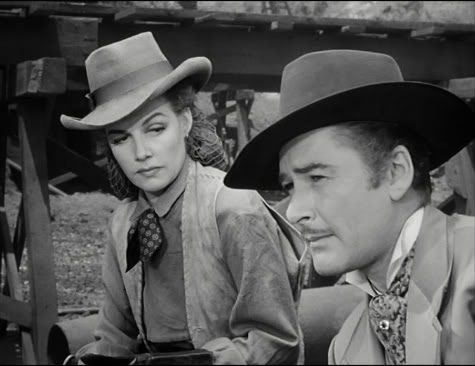
Silver River is a tale of one man’s rise, fall and ultimate redemption. It opens towards the end of the Civil War, when Mike McComb (Errol Flynn) deliberately disobeys an order, for the best of reasons, and is subsequently court martialled and cashiered. This has the effect of hardening his resolve to succeed at all costs in civilian life, and look out solely for number one. The first half of the movie charts his seemingly unstoppable rise both socially and financially, as he acquires capital, transport, a gambling house, interests in the mining business, and another man’s wife in rapid succession. As we follow each step of McComb’s progress, the script throws in one reference to the classical world after another (ranging from Julius Caesar to King David) to draw parallels with the character’s actions. McComb’s ruthless pursuit of power and glory drives him right to the brink of moral bankruptcy, but results in the financial bankruptcy that is necessary if he is to avoid slipping into the abyss. The aptly named Plato Beck (Thomas Mitchell) is on hand all the while to act as the voice of conscience. The drunken lawyer first assists McComb in his meteoric rise and then presides over his downfall, knowing that he must destroy his friend in order to save him.

Silver River is one of those movies that was almost perfectly cast. Flynn, nearing forty and with a few rough years behind him, is fine as the man still young enough for grandiose dreams but tinged with the kind of realism that comes from having lost a few rounds. His own personal troubles and the knowledge of what he was doing to himself at this point must surely have coloured his performance. Some of the scenes in the latter half of the film, where he is confronted with the ugliness of his actions and the prospect of abandonment, really ring true and one can read the resignation and despair in his eyes. Ann Sheridan is wholly believable playing the tough as nails frontier woman who first rails against Flynn before finally succumbing. Sheridan was one of those actresses who brought a lot of honesty to her playing and I thought she was especially convincing in the early scenes where she eschewed all of the usual Hollywood glamour to portray a woman who was the equal of any of the men around her. I always enjoy seeing Thomas Mitchell in anything and, although some may have a problem with his admittedly hammy style, find he brings an enormous amount of pathos and humanity to every part. His role in Silver River is a pivotal one and it’s entirely to his credit that it would be hard to imagine anyone else playing it. As I said earlier, Raoul Walsh holds everything together expertly and succeeds in preventing the melodrama from becoming too suffocating. The outdoor scenes and the action are everything you would expect from a director of Walsh’s calibre, and the more dramatic indoor confrontations are well shot with plenty of emphasis on the actors’ faces – something of a characteristic with this director.

Silver River was a surprise omission from Warners Errol Flynn western package, but it is freely available on DVD from them in France. The image quality looked pretty good to my eyes, save for a little softness in the first ten minutes or so. Thereafter the picture remains clean, sharp and quite consistent. The disc has removable French subs and is completely barebones but, on the positive side, it’s not all that expensive. I think this is a bit of an undervalued film that deserves to be rediscovered, so I’d recommend it. I’ll be looking at Montana next.

San Antonio


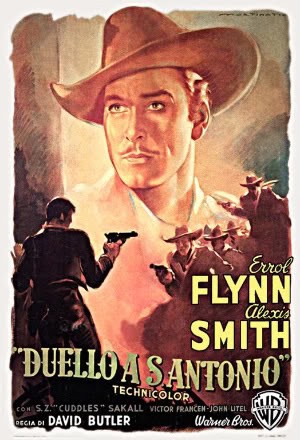
poster103It’s often difficult to put your finger on exactly why a film doesn’t work for you. I’ve frequently found that such films suffer from two basic flaws; they can’t seem to make up their minds what style to adopt, and/or the director is someone who has no real affinity or feel for the genre in which he’s working. The existence of one of these factors can easily hamstring a production – when they appear in tandem it’s never good news. I feel that San Antonio (1945) is one of those films that falls into this unfortunate category. There’s actually the makings of a fine film in there, and indeed it contains some well executed sequences, but it ultimately loses its way and winds up as a pretty unsatisfactory experience.

San Antonio is basically revenge western. The prologue places the action in Texas in the 1870s at a time when a struggle is taking place between ranchers and rustlers. Clay Hardin (Flynn) was once a big time rancher who’s been run off his property and left for dead. The early part of the movie finds him holed up in a Mexican pueblo, recovering from his wounds and preparing to return across the border with the hard evidence that will finally doom the rustlers. The plot follows a fairly straightforward line as Hardin tries to bring his enemies to book and they in turn try to find and dispose of his proof. The high point of the movie is the duel that takes place in the ruins of the Alamo between Hardin and the two principal villains (Paul Kelly & Victor Francen). This is a nicely shot sequence that generates a bit of tension but loses much of it’s impact due to the fact the story is allowed to dribble on when it should have ended there at its natural climax. Along the way there’s also time for a romance to develop between Hardin and visiting actress Jeanne Starr (Alexis Smith) – an attempt is made to turn this into a love triangle involving Paul Kelly’s character, but it quickly fizzles out as there’s never any doubt as how the chips are going to fall in this situation. The irritating thing is that all this forms the basis of what could have been a pretty good western. Unfortunately, there are far too many instances of jarringly inappropriate comedy and overblown musical numbers that stop the movie in its tracks. Any dramatic tension that had been building just gets killed stone dead in these moments.

Flynn played his part fairly straight throughout, and gives a generally sound performance. His features  were just starting to show a bit of wear at this point, but I thought that was fitting for a character who has taken a bit of a beating. Alexis Smith made a number of films as Flynn’s co-star and they work well enough together; her character remains believable and she certainly photographed nicely in technicolor. As the villains, Messrs Kelly and Francen are passable if fairly generic – their performances being of the snarling and moustache-twirling variety. One of my biggest problems was the casting of S.Z. Sakall, one of those acquired tastes I’ve never managed to develop. In my opinion, his presence is unnatural and unwelcome, adding nothing of worth to the picture and, most damningly of all, draining the dramatic clout out of a number of scenes. In his defence, he does manage to raise a smile when, early on, upon observing a riderless horse, he slips in a sly dig at fellow English language-mangler Michael Curtiz by announcing: “There goes an empty horse!” Unfortunately, the exact same gag is repeated at the end, just in case the audience were too dumb to catch it first time round. Generally, I’m not one to grouse about the injection of humour in a western, Ford, Walsh, Hawks and others managed to do it effortlessly and successfully. The problem with the jokes in San Antonio is that they come at the wrong time and verge on the surreal – a lime green parrot with a southern drawl and a whisky-drinking cat being conspicuous examples. When you get a script from Alan Le May and W.R. Burnett, it’s not unreasonable to expect something better, so I’d lay the blame at the feet of director David Butler. His western credentials are nearly non-existent and I have to say it shows up in the final result here.

San Antonio was clearly an expensive production and that’s apparent in the technicolor renditions of the lavish sets. Warner’s DVD shows these production values off to good effect, but the clean, sharp picture also highlights a few dodgy painted backdrops for exteriors. Nevertheless, the colours are strong and really pop off the screen, especially some of Alexis Smith’s costumes. All in all, this is an excellent looking DVD that I couldn’t fault – it’s just a pity that the movie itself doesn’t measure up. It’s part of the Flynn western collection but if it were available separately I couldn’t, in all good faith, recommend it. Coming up – Silver River.


They Died with Their Boots On

“What do you Yankees think you are? The only real Americans in this merry old parish are on the other side of that hill with feathers in their hair”

If most old movie fans were asked to name their favorite Errol Flynn picture I think that a significant majority would probably plump for The Adventures of Robin Hood. I couldn’t really fault that choice as it comes in near the top with me too, but it’s still not my favorite. That honor would have to be reserved for They Died with Their Boots On (1941). I don’t know if it’s Flynn’s best film but it is up there and must surely be seen as one of the high points of his career. The character of George Armstrong Custer is one that Tasmania’s most famous son must have seemed ideally suited to playing. When the film was made Custer’s reputation as one of America’s greatest military heroes was only beginning to be reassessed, so there’s no axe-grinding revisionism to be found. Judged as a faithful biopic or character study, the movie is open to all sorts of criticism; but that’s not really what They Died with Their Boots On is all about, and it would be doing it a great disservice to treat it too harshly on those grounds. No, this is a Boys’ Own adventure of romance and daring, of guts and glory – and taken as such, it works perfectly.

There have been numerous portrayals of Custer on screen, dating back to Francis Ford in 1912, but I doubt if any have imbued the man with the glamour that Flynn brought to the part. The film traces his life and career from his entry into West Point up to his final moments at the Little Big Horn. Custer’s arrival at the US military academy, in all his gold-braided glory with a pack of hunting dogs in tow, is largely played for laughs, although it does set up a simmering rivalry with fellow cadet Ned Sharp (Arthur Kennedy) that’s crucial to the plot’s development. In fact, this is a film of two distinct parts; the first hour or so is mostly lighthearted knockabout stuff with only the occasional foray into more serious matters, while the second half takes on a decidedly darker and moodier tone. Therefore, we get to see Cadet Custer as a kind of fun-loving prankster who liked to ride his luck and chance his arm with authority, which, by all accounts, wasn’t too far from the truth. When the Civil War intervenes and necessitates his early graduation, Custer finds himself torn between pursuing his interest in the love of his life, Libby (Olivia De Havilland), and his enthusiasm to get into the thick of the action. Naturally, the pursuit of glory and honor wins out, and this leads to a nice little scene in Washington with General Winfield Scott (Sydney Greenstreet). Interestingly, Custer did have a fortuitous meeting with the Union commander on arrival at the Adjutant General’s office which led to his first active posting – albeit without the business with the creamed onions. The war, which ironically brought enormous fame to Custer, is given only minimal attention but it does show his rapid rise through the ranks. While all this is presented in a highly entertaining fashion, you still get the sense that we’re only marking time until we get to the real meaty stuff – the move west and the Indian Wars.

With the action shifting to Dakota, the whole feel of the film changes and raises it up to a different level. There’s still time for the odd lighter moment but it’s quickly apparent that this new war is no gentleman’s affair. Custer almost immediately clashes with his old foe Sharp who’s running a saloon and trading rifles with friendly Indians from within the fort. The first order of business is to end the drinking and whip the drunken recruits into some sort of fighting force. This is achieved via a wonderful sequence whereby Custer adopts the old Irish drinking song Garryowen and uses it as a means of instilling a sense of pride and unity into his ragtag 7th Cavalry. There’s also the first view of the red men, and in particular their chief Crazy Horse (Anthony Quinn). One notable aspect of this movie is the respect afforded to the Sioux; at no point are they portrayed as anything less than a disciplined fighting force with legitimate grievances. The real villains of the piece are the corrupt officials and their businessmen backers from the east. The point is made very clear that the Sioux are left with no choice but to rise against the whites when treaties are broken and their shrinking homeland is further encroached upon. When Custer leads out his last fateful expedition he does so in the hope of earning more personal glory of course, but it’s also obvious that his political masters and their moneyed allies have left him with no other option. So, he leads his 7th to the Little Big Horn – to hell…or to glory, depending on one’s point of view.

Flynn gave one of his better performances in They Died with Their Boots On, particularly in the second half. You can see the character gradually mature as the story moves along, his youthful optimism giving way first to disillusionment and then, finally, to a perversely jaunty death wish. If you wanted to stretch a point, it’s possible to see parallels in the course of Flynn’s own life. There’s also much more maturity in the relationship between the characters of Flynn an Olivia De Havilland; this would be their last film together and that fact adds considerable poignancy to their farewell scene, which is pitch perfect in its playing. However, even though the film marked the end of one partnership, it would signal the beginning of another – this was the first movie that Flynn made with director Raoul Walsh. If the star’s relationship with Michael Curtiz was a less than happy one, his collaboration with Walsh was much more congenial. These were two men who were much closer in temperament and Flynn seems to have felt a lot more comfortable in the company of the buccaneering old director. Walsh was one of those directors who was always in his element shooting outdoors on location. I’ve already made the point that when the film switches to the west it moves up a gear, and I think that’s due, in part, to Walsh’s affinity with the outdoors. The last half hour or so has a dreamy, poetic quality that’s the equal of some of John Ford’s best work – and that’s no mean feat. It should also be pointed out that the movie benefits enormously from one of Max Steiner’s finest and most memorable scores, which is built around the rousing yet vaguely melancholy Garryowen.

Warner’s R1 DVD (I believe the R2 is the same transfer) of They Died with Their Boots On is quite fabulous, clean and sharp with barely a damage mark in sight. It has a good selection of extras though it lacks a commentary, which I feel this movie deserves. OK, maybe this isn’t the best western you’ll ever see but it’s right up there among my all time favorites – one of those films that unfailingly pushes all the right buttons on every viewing. Next up, San Antonio.

Santa Fe Trail

poster100

If you’re the kind of person who gets hot under the collar when movies play fast and loose with historical facts, or if you find the political undertones of times gone by to be unbearably offensive then Santa Fe Trail (1940) is most assuredly not the film for you. This is the kind of movie that’s awfully easy to criticise and denigrate, and it’s probably a simple task to find lots of sites on the web that have done just that. Well, I’m not going to indulge in that kind of shot-taking. I can live with a movie twisting history for dramatic effect as it seems foolish to expect what is essentially an entertainment medium to stick only to the facts. As for politics, there are always going to be positions that we either agree or disagree with. If I were to limit myself to those movies that conform to my personal views I would in all likelihood be looking at a very small pool of titles. So, while I can acknowledge that Santa Fe Trail has some shortcomings, I’d still say it ranks as an enjoyable movie experience.

The story is a fairly straightforward good guys versus bad guys tale, with the role of the heroes being assumed by the army, and the new West Point graduates in particular. So, we are presented with the fanciful notion of Jeb Stuart, George Custer, Phil Sheridan and other famous military figures all graduating the same year. That’s all nonsense of course, but it does allow the point to be made that the Civil War was an event that was to set former friends and allies at one another’s throats. The focus remains firmly on Stuart (Errol Flynn) and, to a lesser extent, Custer (Ronald Reagan) as they strive to run to ground the abolitionists in Kansas led by John Brown (Raymond Massey). This is the point that most people object to; namely the fact that the film seems to demonise the anti-slavery activists. Now, while there can be no doubt that these characters are portrayed as the villains of the piece, it’s not that simple. The movie actually takes pains to keep to a middle line and actually shows the pro-slavery crowd (albeit in far fewer scenes) to be no better. As I said, the viewers perspective is that of the army in the middle. There are numerous occasions where the characters all voice sympathy for the ultimate aims of, if not the tactics employed by, the abolitionists. If anything, this is the source of the issues many have with the film – it fails to come right out and condemn the southern states advocacy of slavery. Personally, I’m not sure if this should be seen as a weakness. The fact that it doesn’t take the easy route gives it a unique quality. There’s always a certain satisfaction and reassurance that a viewer feels when a movie follows the line that he himself believes to be right. However, there’s also a different satisfaction to be derived from those rare movies whose message remains more ambiguous. Santa Fe Trail is such a film, it never really takes sides clearly and saves its condemnation for the kind of murderous zeal that that can tarnish even the noblest of causes.

Flynn again gives another variation of his laughing cavalier character. He must surely rank as the most swashbuckling cowboy ever to ride the frontier, and the script offers him ample opportunity to do so here. He was still in his athletic prime at this point, and is in his element whether chasing gun-runners on horseback at breakneck speed across the prairie or storming Harper’s Ferry with sabre drawn. After his unconvincing pairing with Miriam Hopkins in Virginia City, it’s good to see Olivia De Havilland cast opposite him once more – the obligatory love story seems much smoother and more comfortable with these two. Ronald Reagan seems an odd choice for the role of Custer for he possessed neither a physical resemblance to the man nor any of that driving ambition that characterized him. Instead, we get a slightly  comedic figure who’s relegated to playing second fiddle to Flynn’s more Custer-like lead. Raymond Massey’s John Brown is all fiery passion and outrage. His wild-eyed reformer borders on parody but, despite chewing up the scenery, stops just short of that. He still invests his role with a sense of credibility and even manages to bring some humanity to what could easily have become a caricature. A word also for Van Heflin who gives solid support as the mercenary Rader who finds redemption at the end.

This would be the last western collaboration for Flynn and Michael Curtiz, and their penultimate film. By all accounts there was no love lost between them despite the fact they made a dozen movies together. Curtiz again makes good use of both locations and studio, and his handling of the action scenes is exemplary. There’s also a memorable little interlude before the climax, when the group of soon to be famous soldiers all gather round an old indian squaw and have their collective fortunes told. As the old woman sits drawing pictures in the dirt, she tells them that they will all achieve honours and rank but in the process become bitter enemies. This is pure Hollywood fantasy but it’s beautifully filmed and quite poignant in view of the historical context.

Santa Fe Trail has long been a staple of various PD companies on DVD. There has yet to be an official release in either the UK or the US, but there is a Warners DVD of the movie out in France. The disc is a barebones affair but it does present the film better than I’ve seen before. The print used is a little soft in places and a little too bright in others but it is remarkably clean and free of damage. The audio is generally strong although I did notice a momentary dropout on two occasions. If anyone’s looking to get their hands on the best extant version of this interesting and frequently overlooked film I would suggest seeking out this French copy, which has the Warners logo intact at the beginning, and mercifully removable subs. Next time – They Died with Their Boots On.


Virginia City

£18

When Errol Flynn’s first stab at a western, Dodge City, proved to be a financial hit Warners wasted no time in casting him in another. They reassembled as many of the cast and crew from the previous movie as possible and threw in a few more stars for good measure. The result was Virginia City (1940), and although this one wasn’t in technicolor the sweep of the narrative was every bit as epic as its predecessor. It’s not quite the movie of Dodge City but it does come close, only let down by a couple of questionable casting decisions which I’ll look at later.

The story of Virginia City takes place towards the end of the Civil War, and deals primarily with a last ditch attempt by the Confederacy to secure a bullion shipment which would allow them to fight on. Four years of warfare, and the accompanying blockade, have left the South on the verge of bankruptcy and staring defeat in the face. Their one chance of survival hangs on obtaining the necessary funds to keep them afloat. Virginia City was the site of some of the richest mines in the country and provided the Union with untold wealth. Of course some of those same mines were owned by Confederate sympathisers who had managed to raise $5 million to aid the cause. The difficulty for the South was to get that money out of Nevada and safely into their own territory. Enter Vance Irby (Randolph Scott), a Confederate officer who has the requisite knowledge of the territory to head up an expedition to bring the contraband through. In the film’s opening scenes Irby is in charge of a military prison which counts a certain Captain Kerry Bradford (Errol Flynn) among its inmates. When Irby foils Bradford’s attempt to escape it sets up a personal rivalry between the two men that is added to later on when they meet again in Nevada and find themselves competing for the attentions of saloon singer Julia Hayne (Miriam Hopkins). Although both Bradford and Irby find themselves on opposing sides in the war they have a good deal in common, and indeed end up fighting shoulder to shoulder against a mutual threat in the closing stages. Since both of the leads were cast in essentially heroic roles it meant that another, more obvious, villain was needed. That’s where Humphrey Bogart comes in, playing the mustachioed Mexican bandit John Murrell.

£3

Flynn and Scott both play their parts well and it’s hard not to find yourself rooting for both. However, it has to be said that Scott comes off the best. He was the better actor but that’s not the only reason; his mission was also more romantic, and the fact you know it’s doomed from the outset lends more pathos to his character. In fact, the northerners of the film (with the exception of Flynn and perennial sidekicks Hale and Williams) are generally an unpleasant bunch who are difficult to sympathise with. Douglass Dumbrille’s Major is a straight-backed martinet and other pro-Union characters are shown in a highly unfavorable light. It’s notable that many films of this period tended to side with the Confederacy and painted the Yankees as the villains. Only in the closing moments, when Lincoln (appearing as no more than a shadow cast on a document) makes an appeal for national reconciliation, does the film show the Union in a positive way. If Flynn and Scott give a good account of themselves the same cannot be said for Bogart and Miss Hopkins. Bogie just didn’t belong in westerns; he was too eastern and urban, and he gives a stiff and unconvincing performance that borders on pantomime. Miriam Hopkins also looks all at sea belting out old standards in a can-can dress in a rough saloon. There is a bit of back-story for her character to show that she came from an altogether higher class of family, but it still fails to hide the fact that she was a poor choice for the part. Most of the time she appears uncomfortable and too old for her role. It’s a pity Olivia De Havilland couldn’t have been given the part for, although she wasn’t exactly the saloon girl type either, she at least had chemistry on the screen with Flynn.

Michael Curtiz did another fine job of directing and every shot is professional and well framed. The movie benefits a lot from the extended use of locations that are especially important for westerns. He created plenty of excitement in the action scenes, in particular the sequence where Bogart escapes from the runaway stagecoach. That scene also features a repeat of master stuntman Yakima Canutt’s patented under-a-moving-vehicle manouevre that he first used in John Ford’s Stagecoach. It’s also worth mentioning that Max Steiner provided another thundering score to match the on-screen action, and it adds a great deal to the film’s atmosphere.

Virginia City is available on DVD from Warners in R1 in their set of Flynn westerns. The transfer is excellent and Sol Polito’s black & white photography positively glows. There’s the usual array of extra features, including a commentary track by Frank Thompson that provides plenty of detail on the film’s production. Warners have also released a set of Flynn’s westerns in the UK, but omitted this title. I’m not sure why this happened but I have to wonder if it may not have something to do with some of the horsefalls; there’s one particularly brutal shot that would surely cause a problem with the BBFC. I would rate this film at just a notch below Dodge City, but it’s still pretty good. The plot is strong and Flynn and Scott’s characters have enough depth to keep you watching, but the miscasting of Hopkins and Bogart does damage the picture. Coming next, Santa Fe Trail.


Cry of the City

$1

He’s out there somewhere…in an alley, on a roof…looking for a way out.

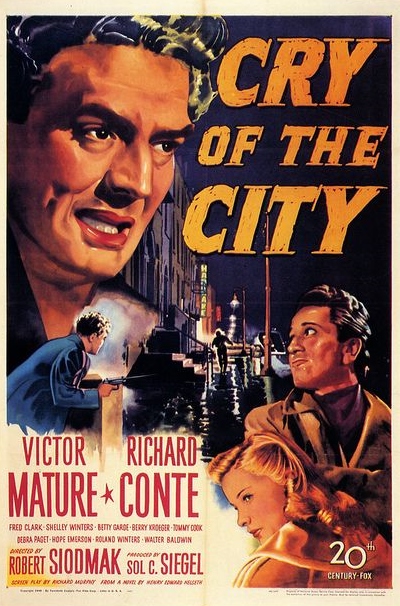
One of the most interesting, and the most enjoyable, aspects of the best noir pictures is the blurring of the lines between the hero and the villain. In a way, the noir world doesn’t have any real heroes, just people forced to make the best of whatever circumstances life pitches at them. Characters may be stylised, situations may be exaggerated, but the dilemmas and bad breaks that have to be faced are issues that most people can identify with on some level. I think it’s this ambiguity that ensures the enduring popularity of these films. While fashions, speech patterns and social attitudes are obviously changing all the time, human nature remains constant. Robert Siodmak’s Cry of the City (1948) is a classic manhunt thriller that toys with the viewer’s sympathy by presenting both hunter and hunted as two sides of the same coin.

Martin Rome (Richard Conte) is an Italian American hood who’s just taken one chance too many. A botched hold-up has left a policeman dead and Rome badly wounded and clinging to life. As his family and priest gather at his bedside to pray for him, the law in the shape of Lt. Candella (Victor Mature) hovers in the wings, waiting to hand down retribution. Rome is a doomed man, his killing of a cop can have only one outcome. But doomed men can be of value to desperate men, and so the vultures circle. With the knowledge that Rome has no future, crooked lawyer Niles (Berry Kroeger) tries to coax him into confessing to a murder that would let his client off the hook. When this approach doesn’t meet with any success, Niles makes the mistake of threatening Rome’s girl, Teena Riconti (Debra Paget). Now, he has a reason to live; both the police and Niles want to get their hands on Teena for their own ends. Rome needs to get out of the prison hospital, track down Niles and his accomplices, protect Teena, and try to make good his escape. All the while he’s dogged by his nemesis, the tenacious Candella, a man who seems to be on a personal crusade to run him to ground. As Rome runs and Candella pursues him, we get to see the contrasts and similarities between the two men. Both come from essentially the same background, namely poor immigrant families, but both have chosen different paths out of the urban squalor. Candella walks with the righteous, but the face of the law he presents is a rigid and largely inflexible one. He shows no mercy in his dealings with all the little people who offered assistance to the fugitive, promising instead only prosecution and punishment. As such, it is notable that Candella never receives any willing help whereas Rome has no shortage of people prepared to go the extra mile for him, albeit for their own reasons. Also, when Rome lay wounded in hospital he was surrounded by family and friends, but when Candella later suffers a similar fate his only visitor is his partner.

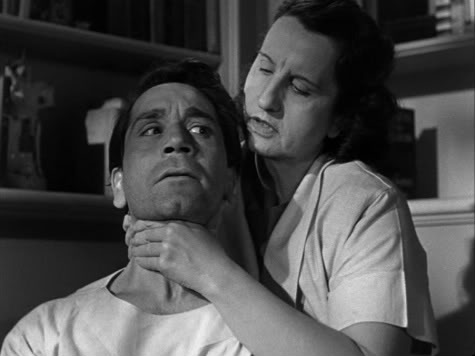
Richard Conte’s smooth talking gangster is a fine performance. You know he’s no good but can’t help rooting for him. The fact that he gets to deliver the best lines of the script and enjoys the lion’s share of screen time is helpful of course. It’s also significant that the killing for which he’s originally wanted is never shown and is only referred to briefly. When he does off someone on screen, that character is such an unpleasant slimeball that you feel he’s justified in doing so. Victor Mature’s persistent detective, on the other hand, is hard to like. He plays a cold, judgmental man with only a trace of humanity; the scenes where he visits Rome’s family are where he comes off best, yet even there his sincerity is open to question. It’s not really any surprise that his character has doors slammed in his face where Conte has them opened invitingly to him. The supporting cast is excellent, although the real stand out is Hope Emerson. This imposing figure of a woman is a genuinely unnerving presence, and you feel she could crush Conte’s ailing Rome just for the sadistic pleasure of it.

£2

Robert Siodmak made a lot of noir pictures, and I don’t believe any of them were poor. Cry of the City may not be his very best but it’s not far off. There are some beautifully framed shots on view, not the least of which is the final showdown between the two protagonists. He also handles the more suspenseful passages, such as Rome’s brazen escape from the hospital with a deft touch and excellent camera placement. The whole film exudes the noir atmosphere with plenty of wet sidewalks, flashing neon and wailing police sirens. I think what helps the film succeed the most is the inclusion of all the incidental characters and situations, from the Rome’s apartment with the Amercan and Italian flags hanging side by side above the mantle to the frightened immigrant doctor who’s willing to risk imprisonment to find the cash to care for his sick wife. I can’t help seeing some parallels between this film and Carol Reed’s Odd Man Out in terms of theme and narrative structure, although Conte never achieves the level of pathos seen in James Mason’s dead man walking. I’d also like to mention the great score by Alfred Newman; this music was used on a number of occasions in Fox movies but its melancholy notes are the ideal accompaniment to this fatalistic production.

Cry of the City is available on DVD in a number of editions in R2. I have the German release, and I understand it’s the pick of the bunch. It was previously only possible to buy this in combination with Sam Fuller’s House of Bamboo but it is now available in a stand alone edition. I couldn’t see anything wrong with the transfer which has very good contrast, is sharp, and displays next to nothing in the way of damage. There have been rumours for some time of this title getting the Criterion treatment but, at the time of writing, it still remains absent in R1. I’m not sure why Fox never went ahead and released this as part of their own noir line and, given recent reports of personnel changes taking place in their home video division, it remains to be seen what will be forthcoming from them in the future. Anyway, I give Cry of the City a big thumbs up, it’s an excellent film noir from a director at the top of his form.

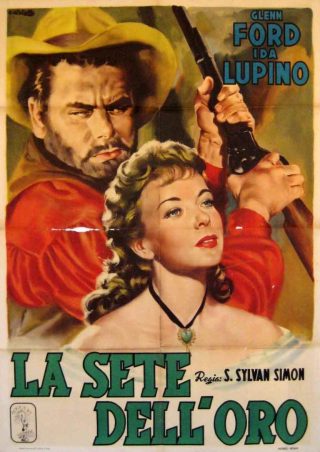
Lust for Gold

Based on the legend of the Lost Dutchman mine, Lust for Gold (1949) is a hybrid western noir. However, it differs from the handful of other movies in that category on account of its narrative structure. The western part is actually a flashback which takes place within a contemporary mystery story. As far as I’m aware this is a unique approach; I’m fairly sure I’ve never seen the technique used to combine these two styles of film anywhere else.

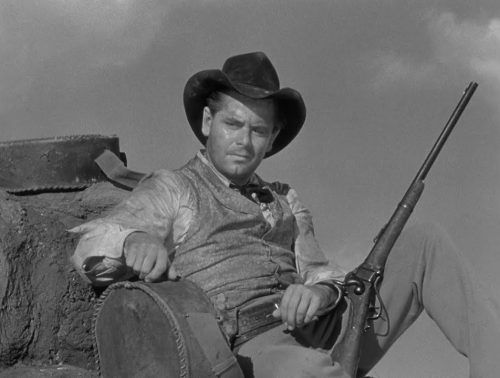
The film’s opening pitches you right into the action – the snappy voice-over narration gives some brief background information before the latest treasure seeker comes to an untimely end, shot dead by an unseen sniper. There’s a breathless, urgent quality to the narrator’s voice which sets the tone and the pace of the picture. Barry Storm (William Prince) has come to Arizona to try his hand at finding the fabled lost mine that his grandfather, Jacob Walz (Glenn Ford), is reputed to have discovered back in the 1880s. When the explorer he was following perishes at the hands of the unknown assassin, Storm finds himself with two mysteries to solve; one in the half remembered past, and the other much closer in time. While the shadow of death hangs over the present, his research reveals some unpleasant facts about his Grandpa. Walz is shown to be a ruthless and greedy man who has no qualms about murdering three men (including his own partner) to secure possession of an old mine with a blood-soaked history.

Such stories are usually morality plays, and Lust for Gold is no exception; Walz’s fortune is a source of little comfort to him. He starts out as an opportunistic outsider and, though his sudden riches bring the semblance of popularity, he finds himself more alone than ever. The superficial bonhomie of those around him who wish him well masks the envy and disdain they truly feel. This petty begrudgery pales into insignificance though when compared to the scheming and deceit practised by Julia Thomas (Ida Lupino). When this grasping, amoral female sniffs a chance of a fast and easy buck she doesn’t hesitate to dismiss her weak failure of a husband. The only questions are how long she can string Walz along, and how he will react when the truth finally dawns upon him.

Glenn Ford managed well in a role that called for him to be both reprehensible and sympathetic. There’s no doubt that Walz is a cold-blooded killer, but Ford was able to invest a certain childlike innocence in the character. This works especially well in his scenes with Lupino, where buys into her deception because it’s what he wants to believe. However, like any emotionally immature character, his vengeance is terrible to behold. The pleasure he takes in watching his tormentors destroying each other, as they die of thirst among the barren, sun-baked rocks, is akin to that of a small boy pulling the wings off a fly. If Ford is good, Lupino may even be better. Her self-obsessed manipulation of the men around her is the equal of any of the great femme fatales of the noir canon. Her character has not one redeeming feature, and there’s a certain grim satisfaction to be had from seeing her get her comeuppance.

Sony have given Lust for Gold an excellent transfer to DVD. The image is sharp and crisp with barely any damage. The film is out in R1 and is widely available in R2 in continental Europe, though not in the UK; I have the R2 and I believe the R1 is identical. The disc is totally barebones but the quality of the image and the movie itself kind of compensate for that. This is a fine, neglected film that should have crossover appeal for fans of westerns and film noir alike. Both the contemporary and historical parts of the story complement each other, though I feel the western flashback works best. That’s largely due to the aforementioned performances of Ford and Lupino, and the dark, bitter tone. The modern mystery does have a satisfying resolution but it suffers in comparison to the bleakness of what went before. All in all, I recommend it.

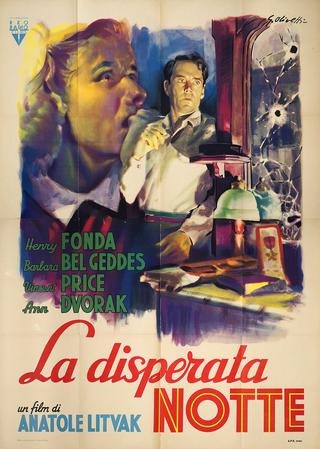
The Long Night

Hollywood has always been in love with the remake, not only of its own domestic product but those originating in other territories too. In the ’40s and ’50s a number of French movies were revisited, Lang’s Scarlet Street and Human Desire being prime examples, with a fair degree of success. Frequently these re-imaginings were (as in the previous examples) the work of directors and crews who had learned their craft in the French and other European cinema industries. Such was the case with The Long Night (1947); a remake of Le Jour Se Leve carried out by emigre director Anatole Litvak. Now I’ve never seen  the original, but a quick scan of the comments at the IMDb tell me that a number of people regard the Hollywood film as inferior. I’ve always been of the opinion that there are both good and bad remakes, and that there are those who display a knee-jerk reaction whenever the term is used. You pretty much have to judge any movie on its own merits and, as such, I think The Long Night stands up well enough.

It’s late in the day in a nameless town and a blind man taps his way up the stairs to his room in a boarding house. His ascent is interrupted as a shot rings out. On the top floor a door bursts open, and a mortally wounded man stumbles out before pitching headlong down the staircase. This was The Great Maximilian (Vincent Price), a second rate conjurer plying his trade in a succession of low rent night clubs across the country. Now he lies dead on a seedy landing in a tenement, gutshot by factory worker Joe Adams (Henry Fonda). That’s how The Long Night opens, and before the end we will learn just how these two men came to this point. For the most part the story is told in flashback from the point of view of Adams, although at one stage there is what you might call a double flashback. Sound confusing? Well, it’s not really, since the story recounted is a fairly simple one. Naturally, there’s a woman involved who acts as the catalyst. She is Jo Ann (Barbara Bel Geddes), a virginal young innocent for whom both Adams and Maximilian fall – figuratively and literally. With Maximilian persisting in his attempts to seduce the girl and Adams simmering resentment growing, events slowly build towards the only possible outcome. Along the way, other characters flit in and out of the story, most notably Maximilian’s former assistant and lover Charlene (Ann Dvorak). Her streetwise presence serves both to provide a contrast to the gullibility of Jo Ann and to highlight just what a piece of work Maximilian is. His deceitful pursuit of Adams’ girl is one thing, but it’s a rare kind of S.O.B. who shaves the paws of puppies and burns the skin red raw in order to train them to perform.

Made at a time when noir pictures were beginning to move towards a wider use of locations and a more documentary approach, The Long Night is something of a throwback. Shot entirely in the studio and making extensive use of miniatures and forced perspective, the film takes on a dreamlike, otherworldly quality. This works pretty well since Joe Adams spends the film holed up in a bullet-riddled room living within his own mind and memories. Fonda does well in a role that demanded he be breezy and cheerful in the flashbacks, all the while growing more uneasy until he finally starts to lose his grip on reality. He always excelled in his portrayals of average guys who are put upon, and he manages to work in some post-war angst which must have struck a chord with the recently returned WWII vets. In contrast, Vincent Price hams it up in a bombastic performance as the villain who is sly, snide and sneering while retaining a certain pathos. Barbara Bel Geddes, in her debut role, was well cast as the youthful Jo Ann. Superficially, she doesn’t seem to fit the stereotypical image of the femme fatale, but her character certainly has a fatal effect on the men in the picture. Ann Dvorak’s wisecracking dame who’s seen it all is is a joy to behold as she picks away at Maximilian’s carefully arranged image, and seems to be having a ball casually humiliating him whenever and wherever the opportunity arises.

The Long Night was an RKO picture but it has been released on R1 DVD by Kino. While the film clearly hasn’t had any significant clean-up done it remains in pretty good shape. There are a variety of damage marks present but, with a few exceptions, the print is clear and very watchable. As is often the case with films like this, the audio can be a bit inconsistent but I can’t see anyone forking out for a full blown restoration so this is probably as good as it’s going to look and sound. The disc does boast some nice extras in the form of a text based feature detailing the meticulous work that went into the production design which gives the film its unique atmosphere. Alongside that, there are  a  couple of clips which compare scenes in the movie with virtually identical ones in the French original. All told this is a fine movie that should please anyone with a taste for noir.

Five Graves to Cairo

poster90

I suppose it goes without saying that war movies made while WWII was still in progress are inevitably going to be propaganda pieces. The more routine ones can lay the flag waving and speech making on so thick as to appear more than a little stodgy when viewed from a distance of over sixty years. The more memorable examples, at least from a present day perspective, are those that manage to tell a story that goes beyond merely depicting heroic resistance, a story that remains absorbing and exciting in its own right. Such is the case with Billy Wilder’s Five Graves to Cairo (1943). Naturally, the film was conceived and produced with the aim of assisting the war effort, but it avoids beating the viewer over the head with its message – at least until the final minutes. What we get instead is a tight, suspenseful yarn where the propaganda is served up sparingly and, for the most part, with subtlety.

Corporal Bramble (Franchot Tone), the sole survivor of a tank crew after the fall of Tobruk, stumbles out of the desert and into a battered, run down hotel. With the British in full retreat the only occupants are the owner (Akim Tamiroff) and a French maid by the name of Mouche (Anne Baxter). While the owner panics, Mouche is openly hostile to the new guest due to her bitterness over what she regards as Britain’s desertion of France at Dunkirk. However, the arrival of the Afrika Korps, and their illustrious chief Rommel (Erich von Stroheim), signals a softening of her attitude; not by much mind, but she can’t bring herself to betray Bramble. Therefore, Bramble assumes the identity of the recently deceased waiter Davos who, it turns out, was actually a Nazi agent sent on in advance. As such, Bramble finds himself in the dangerous yet privileged position of having Rommel’s confidence as the Field Marshal prepares for his assault on Cairo. That task would seem an impossible one given the demands made on his lines of supply. Yet Rommel’s ebullient self-assurance suggests he holds a trump card, which is hinted at via references to five graves and a mysterious professor. Bramble/Davos now faces the challenge of discovering the identity of the professor and the significance of the five graves before his cover is blown. None of this is made any easier by the continued ambivalence of Mouche, who is determined to “do business” with either Rommel or his aide (Peter van Eyck) in order to secure the release of her brother from a Nazi concentration camp.

Directing only his second feature in Hollywood, Billy Wilder was already showing signs of his trademark style. Bleak is a word that has been used to characterize Wilder’s world view, and that’s certainly in evidence in the opening shots which show a tank trundling remorselessly across the vast desert, manned by its crew of dead men. There are lots of inventive little touches throughout the movie, such as the point of view shot seen through the intricate lattice work of the hotel desk, or the zoom cut to the transom as it snaps shut and knocks a concealed weapon into plain view. Alongside this is the sharp dialogue and strong characterization one typically associates with a Wilder picture. There’s a nice contrast of acting styles on show from both von Stroheim and Tone; von Stroheim is all swaggering Germanic confidence while Tone underplays his role as the ingratiating and obsequious waiter/spy. Anne Baxter does well enough as the conflicted maid, but it’s a tough slog with all the showmanship going on around her, not to mention the scene stealing comedic turn of Akim Tamiroff. The other supporting roles are well filled out by a young Peter van Eyck, Fortunio Bonanova, and Miles Mander’s British colonel, who bears more than a passing resemblance to Field Marshal Montgomery.

Five Graves to Cairo was a Paramount picture so the rights now reside with Universal who, in association with Madman, have released this on DVD in R4, at least both of their logos appear on the cover and on the disc itself. The transfer is a particularly fine one and is crisp and sharp throughout. There are some occasional damage marks but I can’t say I found them to be very distracting. The disc also has a 25 minute documentary on Anne Baxter, and there’s a nice 15 page booklet on the movie by Adrian Danks inside the case. This was one of the few Billy Wilder films I hadn’t seen before and I enjoyed it immensely. There’s so much going on that the 90 minutes seemed to fly by yet the pace never feels forced, save the ending which is a bit rushed. If you count yourself a fan of Wilder, or you just like war/spy movies, then Five Graves to Cairo is well worth seeking out.