The Return of Frank James

 Titles

It is, and always has been, common for a highly successful film to spawn a sequel. In 1939 Fox produced Jesse James and, riding on the wave of the reinvigorated western genre, found themselves with a hit on their hands. Of course, it’s a little difficult to continue a story when you have just killed off your main character. However, Hollywood rarely finds itself at a loss for long and the solution was to pick up the story where the first film left off and concentrate on the surviving brother, Frank James (Henry Fonda). The only problem was that, after Jesse’s death, Frank’s life wasn’t the stuff of dramatic, action-packed blockbusters. Therefore, the truth needed to be manipulated to present audiences with a story of revenge and redemption.

In the aftermath of the ill-fated raid on the Northfield bank Frank James had gone to ground. We find him living under an assumed name and it would seem that he has renounced his outlaw ways. On receiving news of the death of his brother he is content to let the law run its course, believing that Bob and Charlie Ford will be tried and duly hanged for the murder. It is only when he learns that, despite their conviction, the Fords have been granted a full pardon that he decides to take matters into his own hands and straps on his guns again. There follows a pursuit across the country to Colorado as Frank attempts to track down the Fords and mete out the justice he feels the courts have denied him. By the end of the film all the loose ends have been tied up and we get a traditionally happy ending. The problem with this is that the production code of the time dictated that a killer should not be presented as the hero – or at the very least that he should be punished for his deeds. The way around that issue was to present Frank James as an essentially honorable man hounded into infamy by circumstances and big business. So while the Fords get their comeuppance it is not Frank who is shown to kill them (which is historically true at least). In fact, the film is at pains to point out the innocence and decency of our hero throughout – even having one of the characters declare indignantly that Frank James never killed anyone. All of this is vaguely unsatisfactory since a man setting out on a mission of vengeance should, to my mind, be allowed to achieve some measure of it directly.
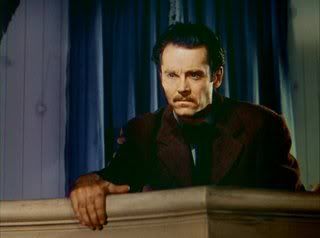
A grim Frank James (Henry Fonda) watches Bob Ford re-enact the murder of his brother.

As I said, Henry Fonda plays the lead very much in the style of the classic romantic hero. Throughout his long career Fonda was most frequently cast as the everyman who was the very epitome of human virtue. Almost thirty years later Sergio Leone would give Fonda the opportunity to finally play a character (also named Frank, as it happens) of pure evil in Once Upon A Time In The West. Gene Tierney (in her debut role) provides some eye-candy and romantic interest as a newspaper reporter, but not much else. Much of the rest of the cast is filled out with actors from the previous film, with John Carradine reprising his part as Bob Ford. Once again, Donald Meek is the conniving railroad boss and Henry Hull chews up every piece of scenery in sight as the editor of the local paper and friend of the family. Hull’s best scenes come towards the end of the film in a flamboyant courtroom defence of Frank on a charge of murder. This scene mirrors reality, where Frank James stood trial for robbery and murder and whose character was attested to by an old Confederate officer. In truth, the film spends a good deal of time on the lingering animosity between north and south in the years following the Civil War. All in all, director Fritz Lang’s first foray into the western genre is a pleasant and entertaining one.

Fox’s DVD release of The Return of Frank James is an improvement on the transfer of Jesse James, but not by much. The image is a good deal more consistent here but darker scenes are still quite murky and washed out. Generally, the outdoor scenes fare the best with stronger colour and sharpness. 
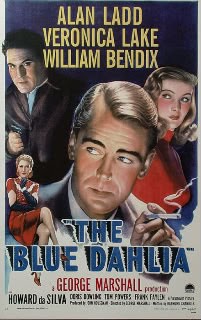
The Blue Dahlia

poster4 

The Blue Dahlia (1946) was the third film that Alan Ladd and Veronica Lake had made together. While their two previous collaborations had been based on novels (This Gun for Hire by Graham Greene and The Glass Key by Dashiell Hammett) this one was from an original screenplay by Raymond Chandler. Anyone who has read anything by Chandler will know that plot always took second place to dialogue in his writing, and that’s certainly the case with this film. For me, the holes in the plot make this a less satisfactory affair than the earlier Ladd/Lake movies – I can’t comment on their last one Saigon since I have yet to see it.

The story concerns Johnny Morrison (Ladd), a navy veteran, returning from the war in the Pacific theatre. Arriving back in L.A. in the company of two of his former crew (William Bendix and Hugh Beaumont) he goes to meet his wife. Their reunion is not a happy one as his unannounced arrival finds her in the middle of throwing a party. Not only that, but he finds her to be having an affair with the shady owner of a night club, the titular Blue Dahlia. Unsurprisingly, he packs up and leaves. Later, the wife will be discovered shot dead with Johnny’s automatic and the suspicion naturally falls on him. The rest of the movie deals with his efforts to evade capture while trying to run down the real killer. The list of suspects is a long one, with just about every major character having either the motive or opportunity to have done the deed.

The performances are generally good and Ladd is convincing enough as the tough hero. Lake is not so good playing the estranged wife of the night club owner, although that may have something to do with the allegedly sour relationship between her and Chandler. Still, her screen chemistry with Ladd remains and they share some good scenes. The real standout turn, though, comes from William Bendix as the shell-shocked buddy with a steel plate in his head and a violent aversion to what he refers to as ‘monkey music’. The movie fits nicely into the noir category due largely to the trappings – clubs, cheap hotels and cheaper people, a neon lit L.A. and so on. As I said above, the dialogue was Chandler’s strong suit and helps to paper over the cracks and outrageous coincidences in the plot. The biggest problem of all is the ending. Chandler had originally written a different climax to that seen on screen but was forced to change it as a result of outside pressures. What we are left with doesn’t really work at all, for it makes a nonsense of much of what went before – it just comes across as weak and contrived.

The Blue Dahlia, whatever it’s weaknesses, was a title long desired on DVD by fans of noir, and Universal duly obliged with a release in R2 last year. However, the fact that it has been made available is about the only good thing I can say. The movie has not had any restoration work done and looks quite soft, worse than that is the ghosting which plagues the last half. So, I don’t think this is the best of the Ladd/Lake vehicles but it is stylish and fun – just not all that logical.

The Reckless Moment

iawu5gw

You live in a small close-knit community where everyone knows you and yours. Your family is all around, both depending on you and making endless demands on your time. You are also the victim of a blackmailer. What do you do and who do you turn to? That’s the problem at the centre of the 1949 film noir thriller from Max Ophuls, The Reckless Moment.

Lucia Harper (Joan Bennett) lives in a small California town. She is married with two teenage children, has a housekeeper and a large comfortable home. On the surface everything appears idyllic, but chaos is looming. The film opens with Lucia driving to Los Angeles to meet a man called Ted Darby. Darby (Sheppard Strudwick) has been dating the daughter of the family and Lucia means to put an end to it. She fails to do so and Darby comes secretly to the house later that night. The daughter (Geraldine Brooks) meets him in the adjacent boathouse and, after a quarrel, Darby stumbles off the landing to skewer himself on an anchor below. Lucia discovers the body the next morning and, with her husband traveling on business in Europe and she wanting to protect her daughter, decides to dump the corpse and cover everything up. It looks like she might pull it off until Martin Donnelly (James Mason) turns up with some compromising letters and proposes blackmail.

ewdhlrj

Joan Bennett will be familiar to any fan of noir due to her work with Fritz Lang on a number of pictures, most notably Scarlet Street and The Woman in the Window. There’s no femme fatale style vamping here though, instead she’s the competent, protective mother driven to near despair as the situation spins out of her control. Her measured underplaying is one of the factors which keeps the movie rooted in noir territory and saves it from straying into melodrama. The other factor is James Mason. Two years earlier Mason had given a blinding performance in Carol Reed’s beautiful and masterful Odd Man Out. Here he’s playing another doomed Irishman, albeit one with more dubious motives. He’s very believable in the role and there’s nothing that seems phony as we witness his self-doubts transform him.

The film is well directed by Ophuls and excellently photographed by Burnett Guffey. The location work adds to the realism and the interiors of the big open-plan house seem, paradoxically, to heighten the sense of domestic claustrophobia. It’s almost impossible to hold a private conversation anywhere as family members bustle in and out, cheerfully oblivious to the treachery that threatens them all.

The movie is available in R2 from Second Sight and it’s a great looking, clean transfer. The disc also has decent enough extras with a commentary, a good introduction and a stills gallery. Definitely recommended.

Western Union

pxsblta

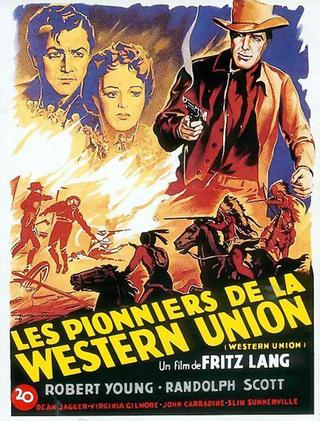
If you mention Fritz Lang’s name to most film fans they are most likely to think of expressionism, thrillers, and films such as M and Metropolis. It is not so typical to associate the German director’s name with classic Hollywood westerns but he did make a handful of these. To be exact, he made three westerns: The Return of Frank James (1940), Western Union (1941) and Rancho Notorious (1952). I think it would be fair to say that Western Union is the least known of them, but perhaps it deserves better. It is quite representative of 1940s westerns in that it tries to avoid some of the more juvenile aspects of the previous decade’s output but lacks the psychological depth that would come in the 50s. Although it may not bear the hallmarks of classic Lang, it does contain those of the classic western.

It’s not for nothing that the building of the railroad has figured so prominently in so many great westerns, from Ford’s The Iron Horse through to Leone’s Once Upon A Time In The West. It was this massive undertaking that at once opened up the west and also signalled the closing of the frontier way of life. For some film-makers it represented the advance of law, order and civil society; for others it stood only for the gradual encroachment of the corrupt influences of the east. Western Union deals not with the railroad but that other piece of progress that would drag America into the modern world and relegate the Old West to the realm of mythology – the laying of the transcontinental telegraph wire.

The film opens with outlaw Vance Shaw (Randolph Scott) attempting to outrun a posse and happening upon telegraph boss Edward Creighton (Dean Jagger). Creighton has been injured and is barely able to move with a busted ribcage. Shaw is desperate to evade capture and is on the point of taking Creighton’s horse and leaving the stricken man to his fate. However, his conscience pricks at him and he decides to take a risk and bring the helpless man along. That proves to be the turning point for Shaw, for when he later finds employment with the telegraph company as a scout it is Creighton who offers him the chance to go respectable. The other main character is the dandified easterner, Blake (Robert Young). Blake has come west to work for the telegraph, and soon enters into a rivalry with Shaw over Creighton’s sister. The movie, like the characters themselves, has a lot of ground to cover and is played out against the back-story of the Civil War. It includes a well-staged battle with some drunken Indians and a confrontation with a gang of renegade confederate raiders led by Shaw’s own brother.

£2

Randolph Scott is excellent as a man torn between a lingering loyalty to his brother and the old ways, and a desire to turn over a new leaf. If you’re under the impression that Scott would not come into his own until a decade later in the films of Budd Boetticher then think again – this is definitely one of his better performances. Dean Jagger’s part doesn’t call for much more than stoic determination and he does that just fine. As for Robert Young, he’s never been an actor that I’ve cared much for and this showing did little to change my opinion. The support cast features some great and familiar faces, not least Barton MacLane (who seemed to appear everywhere in the thirties and forties) as Scott’s thoroughly good-for-nothing brother. Add in an impossibly young looking Chill Wills as a tobacco-chewing (and spitting) telegraph man, and John Carradine as the company doctor and there’s not much to complain about. As I said above, there isn’t much to distinguish this as a Fritz Lang film, but he still delivers a polished, professional picture and does include a few typically dark moments – particularly the ‘shock’ climax.

The film is out on DVD in R2 from Optimum in their Western Classics line. The transfer is mediocre at best and has clearly undergone no restoration, with the colours looking quite washed out. Having said that, the movie is worth seeking out, but I can’t help wishing that Fox would see their way to releasing it in R1 with an improved transfer.


The Big Clock

bpnijge

The Big Clock is a 1948 thriller about a race against time; a manhunt where the protagonist is essentially hunting himself. Does that sound complicated? Well, the plot is complex but it never becomes incomprehensible.

George Stroud (Ray Milland) is the overworked editor of a crime magazine who yearns for a holiday with his family. Just when this seems in sight his boss, time-obsessed media tycoon Earl Janoth (Charles Laughton), insists that he postpone his vacation and follow up on a breaking news story. In a fit of pique, he tenders his resignation and ends up spending a drunken evening with Janoth’s mistress. While exiting the girl’s apartment Stroud sees his boss arriving, while the boss sees only a silhouette. Goaded into a rage by the mistress, Janoth clubs her to death. On the advice of his reptilian chief executive (George Macready) he now plans to pin the deed on the shadowy stranger he glimpsed in the corridor. To this end, Stroud is recalled to co-ordinate the manhunt.

This is a great suspenseful picture, and you really sense Milland’s mounting horror as he is forced to use his own investigative team and techniques to gradually build up a profile of the mystery man; a man who he knows better than anyone. The two principal female roles are taken by Maureen O’Sullivan (who was married to director John Farrow) as Stroud’s wife, and Rita Johnson as the ill-fated mistress. I always enjoy anything with that inveterate scene stealer Charles Laughton, and he gives one of his more restrained performances here. There are lots of familiar faces in the support cast, not least Laughton’s real life spouse Elsa Lanchester as an eccentric artist and her turn damn near steals the whole show. Harry Morgan also shows up as a darkly menacing gunman on Janoth’s payroll, made all the more sinister by the fact that his character utters not a word on screen. Seasoned noir watchers may also recognise Harold Vermilyea who remains forever memorable, for me at least, as the doomed Waldo Evans from Sorry, Wrong Number.

If the plot to this movie seems slightly familiar that may be due to the fact that it was remade in the 80’s as No Way Out, with Kevin Costner and Gene Hackman in the Milland and Laughton roles respectively. That film was not bad but, to my mind at least, not a patch on the original – isn’t that usually the case?

The Big Clock is available in R1 as part of the now, apparently, defunct Universal Noir line. If any fans of classic noir/suspense don’t already own this, I can only ask – Why?


The Dark Corner

cfe6bdn 

I feel all dead inside. I’m backed up in a dark corner….and I don’t know who’s hitting me.

Those words are uttered by desperate private eye Brad Galt (Mark Stevens). He’s talking about the one lead that he’d hoped would get him out of a frame-up for murder; the one lead that’s just turned out to be another dead end. But those same words also go a long way towards defining the essence of Film Noir.

Contrary to popular belief, there weren’t all that many Noirs of the classic period that featured a private detective as the hero, however, Henry Hathaway’s 1946 movie does. Galt is a New York P.I. who was double-crossed by his ex-partner. When the partner turns up in town and the police call around to warn Galt not to cause any trouble, you can be sure just what’s coming. Or can you?

The slightly convoluted plot introduces us to a cast of characters who are rarely what they first appear to be. Clifton Webb is a wealthy gallery owner, reminiscent of his earlier Waldo Lydecker in Laura. Cathy Downs is his trophy wife. William Bendix (one of the screen’s most memorable heavies) is…a heavy. Kurt Kreuger is Galt’s ex-partner and Lucille Ball is his ever faithful secretary. By the end of the movie we get to see all these characters for what they really are, and the ride there is never a displeasing one. Hathaway directs tightly on location and keeps everything moving along like an old pro. The interiors are all well shot by Joe MacDonald – lots of inky black shadows, silhouettes, figures framed in windows and so on.

hxhsdyj

So, have I any criticisms to make? Well, there’s Lucy! I have to confess that I have never been a fan of Miss Ball. Even as a youngster her TV shows irritated the hell out of me, now that I’m all grown up I find her even less appealing. While I watched this film, I found myself thinking that almost any other actress would have preferable in the role of the resourceful girl friday.

Nevertheless, I consider this to be a highly entertaining entry in the Fox Noir line. The R1 transfer is very good (it’s also available in R2 and I assume the image should be the same) and well worth picking up if you’re a fan of vintage noir/crime/mystery movies.

The October Man

92ekbeh

British attempts at producing film noir have traditionally been regarded as a notch down from their Hollywood counterparts. There is, sometimes, that sense of the genteel that the harder-edged Hollywood movies don’t suffer from. However, when BritNoir is at its best it’s more than capable of competing with productions from across the pond. The Third Man, The Fallen Idol, It Always Rains on Sunday, Brighton Rock, for example, are all films that belong in the front rank of noir. The October Man (1947) may not be quite in the same league as those other titles but it’s not far off.

When you see a film boasting a script by Eric Ambler, you know you’re on fairly safe ground. Ambler was, first and foremost, a novelist and gave us some of the best espionage/mystery fiction of the last century. I would strongly urge anyone unfamiliar with his writing to seek it out, although I believe a good deal of it has shamefully fallen out of print. His script here contains those staples of any good noir, namely murder, guilt and psychological imbalance.

The story concerns Jim Ackalnd (John Mills) who we see in the opening scenes riding a bus and knotting his handkerchief into the shape of a rabbit for the amusement of the small girl seated next to him. The child – played by Mills’ own daughter Juliet – is the daughter of some friends, and Jim is accompanying her back home. As the bus makes its way along a  country road in torrential rain, a brake failure causes a fatal accident at a level crossing. This results in the death of the child and Mills spends a year in hospital with a fractured skull and brain damage. As Jim is released from hospital we learn that he remains racked with guilt and has already attempted suicide. He moves into a rundown boarding house peopled by an assortment of fine British character actors including a poisonous Joyce Carey, Catherine Lacey as the put upon manageress, and Edward Chapman (who should be recognizable as Mr Grimsdale from numerous Norman Wisdom movies). He also makes the acquaintance of model Kay Walsh, of which more later.

Jim’s life seems to be getting back on track and a romance with Joan Greenwood helps give him some renewed hope for the future. However, things are about to go pear-shaped – this is the world of noir after all. The model turns up dead in a park and a cheque from Jim is found close to the body; worse still he was out walking alone when the crime took place. This, combined with some malicious gossip from the other residents, leads the police to suspect Jim – and Jim to query his own sanity. With the psychological pressure mounting and distrust surrounding him, it falls to Jim to try to find the real killer before the net closes around him.

John Mills

Roy Ward Baker provides his usual solid, unfussy direction but the real star is the cinematography. Erwin Hillier lays the noir atmosphere on thick, with lots of smoke, fog, deep shadows and harsh white lighting to pin the focus on the hapless Jim. John Mills plays the role perfectly as the quiet and essentially decent man driven to the very limit. Mills was ideal casting for this kind of part and would reprise it a few years later in the similarily themed The Long Memory. In fact, the acting is uniformly strong throughout and the scenes in the boarding house are memorable.

So, where does the weakness lie? Perhaps surprisingly, the fault is with Amblers script. I always feel that this kind of movie benefits enormously from creating suspicions in the viewers mind about the hero. In this case, we are never really in any doubt that Mills is innocent, moreover, the identity of the real killer is fairly obvious right from the off. Personally, I also found the repeated use of the knotted handkerchief motif – used to point up the mental strain of Jim – a little tiresome towards the end.

Generally though, this is one of the better examples of BritNoir and I would certainly recommend it to any fan of suspense/noir. The film is currently unavailable on DVD anywhere, save grey market copies, as far as I know. I believe the rights may currently reside with Optimum/Network/ITV in R2, all of whom have released some little known gems in the past. I very much hope they get around to this one soon.

Station West

220px-station_west_poster_small

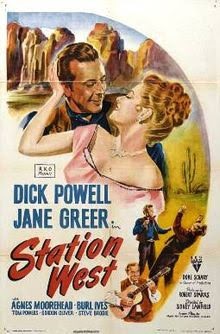
What an oddball little western this is. It opens with Dick Powell’s stranger riding into town and checking into a hotel run by a guitar strumming (and uncredited) Burl Ives who just happens to be singing about a stranger riding into town. At this point we’re not seeing any western conventions being stretched. However, as soon as this slight figure crosses the street, enters the saloon and starts to throw out the kind of wise cracks and casual insults that would surely earn anyone the ass-kicking of a lifetime, we can be sure this is no average oater.

Powell is not really your average western hero, and here this is explained by his being an undercover army intelligence officer. Mind you, I’m not suggesting that Powell isn’t tough enough to be a westerner (a brutal and well photographed brawl with Guinn “Big Boy” Williams leaves that in no doubt) but he doesn’t sound like a cowboy. In truth, this is a lot of what makes the picture so entertaining. If you are familiar with Powell’s role in Murder, My Sweet then this film will conjure images of Marlowe riding the range.

Another thing the movie has going for it is the cast. In addition to Powell we have Jane Greer, playing another dangerous vamp, who seems to own the whole town. Agnes Moorehead is Powell’s contact with the army, and Raymond Burr is the town lawyer with a gambling problem – all wide-eyed weakness and far removed from Perry Mason. The aforementioned Williams doesn’t have much to do here except look mean, but (as with Ward Bond) I find something reassuring about the presence of his familiar mug in a film. Burl Ives’ small role as “either the town poet or the village idiot” is also most welcome.


The plot revolves around hijacked gold shipments but, in a Chandleresque way, it doesn’t seem so important. The real joy here is the fusion of hard-boiled noir dialogue with western locales. If you are seeking an authentic and gritty representation of the Old West, then look elsewhere. On the other hand, if you are a fan of westerns and noir and want to see the best elements of both working in tandem, then Station West is worth a look.

The film is available on DVD from France in a transfer that is just adequate. It’s an RKO picture so it may get a R1 release from Warner one day, although the company seems to show little appetite for westerns right now.