The Last Wagon

There she lies…as far into the west as your eyes can see, and then some – The Canyon of Death. The Indians say you can hear cries in the night down there that you’ll hear all your life…usually it’s only the wind.

The more I watch Delmer Daves’ westerns, the higher they rise in my estimation. As a body of work, they work on so many levels and manage to weave a variety of themes into their plots. In terms of basic structure, The Last Wagon (1956) has a simple and straightforward plot – a tough outsider uses his knowledge of the frontier to lead a group of greenhorns to safety. Yet within this fairly standard framework, there are a number of interesting elements vying for the viewer’s attention. The film can be enjoyed as a kind of outdoor survivalist epic; however, it’s also a critique of race and prejudice, a celebration of the positive influence of women, a revenge tale, and ultimately a journey towards redemption. Above all though, and this is the case with most of Daves’ pictures, there is an overriding sense of optimism that pervades the movie. In short, and characteristic of the best westerns of the 50s, it’s an affirmation of the essentially positive aspects of human nature, making it a very American film.

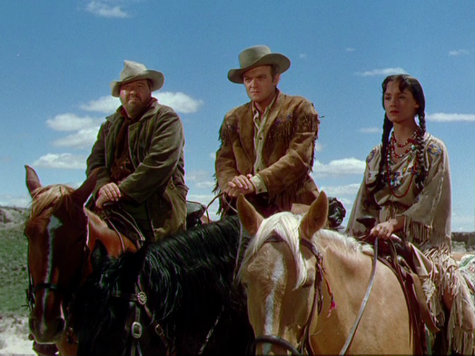
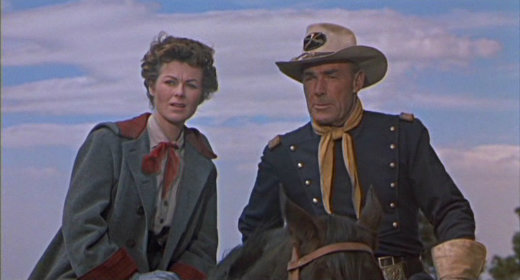
It’s Arizona in 1873, and a rider makes his way down towards a river. The camera pulls back to reveal another figure, a rifleman clad in buckskins concealed on the near bank. He calmly takes aim and drops the rider before wading across to confirm his kill. This dramatic pre-credits sequence introduces Comanche Todd (Richard Widmark) in ambiguous terms – is this silent, ruthless killer the hunter or the hunted? It’s soon established that he falls into the latter category, a fugitive being pursued by a relentless posse. Still, Todd is no hapless or helpless victim – he’s an accomplished survivor, having been raised by and lived among the Comanche for twenty years. Nevertheless, he’s not some invulnerable superhuman either, and soon finds himself the bound captive of a brutal sheriff (George Mathews), the last of the posse members. Now all this is just a build-up to the main events of the story, which kick in when the two men cross paths with a wagon train of settlers. In one of the most memorable images from the movie, Todd finds himself shackled to the spokes of a wagon wheel as the settlers reluctantly agree to allow the sheriff and his prisoner to accompany them. Todd’s presence stirs a mixed reaction; the hero-worship of a young boy (Tommy Rettig), a vague attraction in the kid’s elder sister and guardian (Felicia Farr), and bitter resentment among two half sisters – one of whom is part Indian (Susan Kohner) and the other (Stephanie Griffin) a spoiled and overt racist. All of these elements are explored and probed more deeply after disaster befalls the camp. While the young people sneak off for a midnight swim, an Apache raiding party descends on the settlers and kills everyone. Everyone except Todd, whose wagon they roll over a cliff with him still attached. Miraculously, the plunge doesn’t kill him and leaves him in a position to take charge of the frightened and confused group of young people. It’s now down to this wanted killer to lead his raw companions through the Canyon of Death, and on to safety. Aside from the ever-present danger, Todd’s progress is made more difficult by the suspicion of the group and their internal wrangling. What’s more, every step closer to salvation for the youngsters brings Todd nearer a date with the hangman.

As I said back at the beginning, one of the notable features of much of Delmer Daves’ work is its optimism. I’ve mentioned before a tendency in Daves’ films towards endings that can appear weak in relation to what has preceded. However, as a result of some discussions we’ve had on this site, I’ve been reassessing this position. If Daves’ films are viewed as pieces whose aim is to project a positive take on humanity, then the relatively upbeat endings make a lot more sense and actually fit the narrative thrust better. Additionally, and I’m referring particularly to the westerns here, Daves’ best films are all from the 50s, and this progression towards a positive resolution for his anti-heroic protagonists mirrors the general trend in the genre during that decade. In The Last Wagon, Todd starts out as a man driven on by his thirst for revenge against those who destroyed his family. Although he’s never fully drawn back to white society, he is offered a new perspective on life. It’s the combination of a boy’s devotion and loyalty, and the burgeoning love of a girl that maps out a more hopeful future for him. It’s only through his acknowledgment of these two factors that Todd is able to seek out and achieve the personal redemption that gives meaning to the story. From a purely technical point of view, Daves’ work on The Last Wagon is as good as anything he did. The director, along with cameraman Wilfrid Cline, shot the film almost exclusively on location in Arizona, and the use of landscape is spectacular at times. There are many instances of wide, long shots looking down on and across the vast expanses dotted with canyons and buttes. These shots emphasize both the freedom of the country, and also the isolation and relative insignificance of the characters. It all makes for a wonderful contrast with the tight, intimate feeling conveyed by the scenes showing the group interacting whenever they stop to make camp.

As far as performances are concerned, the film really belongs to both Widmark and Felicia Farr. What is most remarkable about Widmark’s playing in The Last Wagon is his physicality. For an actor whose distinctive voice and looks are such a large part of his repertoire, Widmark made less use of them here  than in his other movies. Instead, it’s his cat-like grace and spatial awareness that are to the fore. One would expect a man who has lived his adult life in harmony with the wilderness to appear comfortable and almost at one with his natural surroundings. Such is the case with Widmark as he pads round soundlessly and deftly skips across the rocks and sand. Widmark brought a genuine physical confidence to this role, and his fight scenes – especially his duel, using knife and manacle, with two Apache warriors – have a ring of authenticity to them. On top of that, there’s a raw frankness that Widmark achieves in his scenes together with Felicia Farr. The actress made three films for Delmer Daves, and the quality of the work she did makes me regret they hadn’t collaborated more. In westerns, femininity is seen as a civilizing force, balancing masculine individualism and aggression, and Daves was very good at highlighting this vital aspect. As in her other two films for the director, Farr plays a pivotal role in drawing out the hero and humanizing him. Daves seemed to have a knack for tapping into Farr’s strengths and mining her attractive vulnerability. Just like in Jubal and 3:10 to Yuma, Farr’s intimate scenes with the hero are poignant and beautifully memorable.

While the central character of Comanche Todd, and his deep respect for native ways, plays a large part in getting the anti-racist message of the movie across, it’s by no means the only one. Perhaps equally important are the roles of Susan Kohner and Stephanie Griffin. The latter’s open hostility towards her half-sister, based purely on her disdain for her Indian blood, exposes the ugliness that is only disguised by her superficial beauty. Again, the redemptive nature of the western story is emphasized through the gradual transformation of this hate fueled character into a more human and understanding figure by the end. In contrast to Griffin’s naked bigotry, Kohner is the very epitome of dignity and self-deprecation. If Griffin’s character develops in an interesting way, then Kohner’s goes on an equally fascinating journey. It’s through her character, more so even than Widmark’s, that the whole question of identity is addressed. The point being made in the movie is the importance of pride in oneself, and the crucial fact that one can be proud without allowing apparently conflicting social identities to displace each other.

The Last Wagon has been widely available on DVD in most territories for some time now. I have the US release from Fox, and it features a fine anamorphic scope transfer. The disc is one of those odd, from my perspective at least, ones which has the widescreen version on one side and a pan & scan copy on the other. Personally, I see 4:3 versions of scope movies as redundant and can’t really understand the need to include them. Extra features amount to a series of galleries and a selection of trailers for other Fox westerns. The movie comes from Delmer Daves’ strongest period, when he could hardly put a foot wrong, and has to rate among his best work. Like all the best films, The Last Wagon works fine if viewed simply as a piece of entertainment. However, its real strength is the way, as all great westerns do, it turns the focus on other issues and themes, and so encourages the viewer to think. The fact that both Jubal and 3:10 to Yuma are about to get released on Blu-ray by Criterion brought this film back to my attention –  I’d love to think those releases might lead to a critical and popular reappraisal of the strengths of Delmer Daves in particular and the western in general.
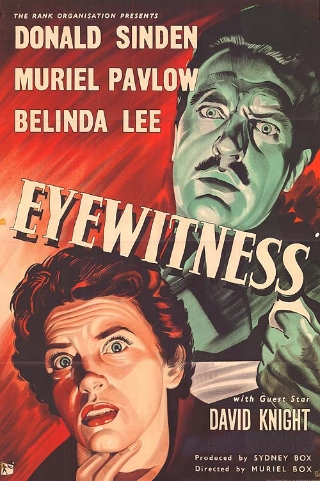
Eyewitness

poster71_zps72hqlekp

British attempts at producing noir thrillers have tended to be a hit and miss affair, the greatest stumbling block generally being an inability to strike the right tone. The nuts and bolts are easy enough to put in place: the city setting, the night, the shadows and key lights, some criminal enterprise to provide a framework. However, British movies of the classic noir period (the 40s and 50s) struggle to escape the rigid class structures that remained firmly in place at the time. American films benefited enormously from the more flexible social structure of the country, which allowed filmmakers to blend in characters from a variety of backgrounds. Despite its best efforts, British noir tends to be forever trapped in a middle-class world and, consequently, loses something of the edge of danger that helped elevate pictures from across the Atlantic.

Eyewitness (1956) opens in these typically middle-class surroundings, with a minor domestic spat involving a young couple.  Jay (Michael Craig) and Lucy (Muriel Pavlow) are two young suburbanites who have run into a bit of a crisis in their marriage. Jay is a guy who wants to live better than his income allows and has been accumulating a bit of debt buying stuff on credit. His latest acquisition, a brand new TV set, proves to be the straw that breaks the camels back though. Lucy is not at all impressed, such apparent profligacy failure to think of tomorrow going against the grain with her. In a foul temper, and threatening to leave for good, Lucy stalks out of the house to try to cool off.

While Jay sits home, toying with his new purchase and reflecting on the injustices of married life, Lucy’s wanderings take her to a movie theater. And it’s at this point the story starts to take shape. Jay’s feelings of frustration drive him out in search of a drink and some sympathetic male company, just at the moment Lucy’s conscience pricks at her and she decides to call him up. Getting no answer on the phone, Lucy is making her way through the theater when she chances upon a robbery in progress.

It’s Lucy’s misfortune to witness two men, Wade (Donald Sinden) & Barney (Nigel Stock), in the process of cracking the safe and roughing up the manager. Barney sets off in pursuit of the panic-stricken woman as Wade goes about settling matters with the ill-fated manager. Lucy’s terrified flight takes her out of the cinema, onto the street, and straight into the path of an oncoming bus. The situation leaves Wade and Barney in a quandary; is the unexpected witness going to live? And if she does, how much will she recall?

Wade reveals himself to be not only a cool customer, but a nasty piece of work to boot. His primary concern is his own self-preservation, and he coerces the meek Barney into falling in with his schemes. Wade has no intention of leaving any loose strands that may, in time, weave themselves into a noose to hang him. Following the ambulance that carries the comatose Lucy to a local hospital, Wade has in mind to dispose of this potential threat. Despite Barney’s protests, Wade takes it upon himself to stalk the now helpless Lucy and ensure nothing can be traced back to him. And so the bulk of the movie involves Wade’s attempts to gain entry to the communal ward where Lucy is taken. The suspense of the film derives from Wade’s determination, and increasing frustration, to silence this inconvenient witness. All the while, the net draws closer, time is running short and the opportunities grow fewer. Everything builds relentlessly towards a dramatic finale in a deserted and vaguely sinister operating theater.

Muriel Box was one of those rarities in classic era cinema, a female director. After writing some strong British movies – The Seventh Veil (1945) and The Brothers (1947) – she began directing in 1949. However, her career was closely linked to her husband, producer Sydney Box, and the break up of their marriage also signaled an end to her time behind the camera. Eyewitness sees Box making good use of the inherent suspense generated by the setting. A hospital at night is full of dramatic potential, the random comings and goings, the relative anonymity, that sense of disquiet aroused by the sight of mask-wearing professionals silently padding along starkly lit corridors. As the story progresses, Box ensures the tension grows in increments and the visuals reflect the increasing darkness of what we’re watching.

I think the biggest weakness stems from a basic flaw in the script. The success of pretty much any film, and especially a thriller, depends on having if not a hero then a recognizable figure that the viewer can identify with or root for. Eyewitness suffers in this respect; since it’s clearly intended that we should side with Lucy. However, she spends the bulk of the running time either unconscious or semi-conscious, effectively taking her out of the equation. There’s a similar problem with Barney, another whose presence ought to draw sympathy, but who ends up sidelined much of the time. In the end, we see things predominantly from Wade’s point of view, and he’s such a thoroughly bad lot, without a single redeeming feature, that it’s impossible to view him even in an anti-heroic light When it comes to the performances, Donald Sinden is pretty good as the twitchy killer with a slightly manic air. Still, the best work is probably done by Nigel Stock as the deaf safe-cracker whose dream of moving to New Zealand has seen him roped into a scheme that’s a whole lot more than he bargained for. Pavlow and Craig are so-so as the young couple whose marital tiff pitches them into a perilous situation, but there’s no great depth to their characterization.

In the final analysis, Eyewitness is a mid-range British crime thriller. The story is gripping enough but the lack of a sympathetic central character does damage it somewhat. The movie is available on DVD in the UK as part of a Donald Sinden box set from ITV. It’s a reasonably good transfer, presented in the correct 1.66:1 aspect ratio, though without anamorphic enhancement for widescreen TVs.

Note: I originally published an edited version of this piece as a Noir of the Week for The Blackboard.

Tomahawk

poster209-1

Over the years I’ve tried to turn the spotlight where possible on those films which I reckon have either been unfairly maligned or, more commonly, just fallen between the cracks and slipped off the radar of movie fans. As a lover of westerns, I’ve found that the genre provides an especially rich vein to mine with respect to neglected gems. This is partly down to the sheer volume of pictures made during the western’s heyday, and also the gradual decline in interest in the genre, not least from a critical perspective. In my own small way, I’ve looked to draw a little attention back towards westerns and maybe encourage others to explore a little deeper. I particularly like the more socially aware pictures of the early 50s, those movies which did their best to offer entertainment and simultaneously encourage thought on the part of their audience. George Sherman’s Tomahawk (1951) is one such film – it’s a handsome looking, well paced work that not only contains a potted history lesson but also approaches the Indian Wars in a mature and intelligent way.

The film is bookended by one of those strident, self-important and frankly grating narrations that became fashionable in the documentary-style noir pictures of the post-war years. In many ways this is an inauspicious opening and one that doesn’t really blend in with the rest of the film. The time and context are established but I feel that this could have been achieved just as well, and with a good deal less piety, via the more traditional method of using rolling captions. Anyway, it’s Wyoming in 1866, at the time the Bozeman Trail is drawing in settlers and prospectors. The fact that this route west passes through Sioux hunting grounds, and violates previous treaty pledges, has the potential to spark off a major conflict with Red Cloud’s warriors. The problem is exacerbated by the government’s decision to build Fort Phil Kearny as a garrison to house an army detachment and offer protection to travelers. The construction proved a sore point with the Sioux, and the film concentrates on a compressed version of the bloody events that ensued, namely the Fetterman Massacre and the Wagon Box Fight. It includes all the major players in those battles and gives the story a new twist by adding in a revenge aspect. Everything unfolds from the perspective of Jim Bridger (Van Heflin), a trapper and former scout who allows himself to be coaxed back into service for personal reasons. Bridger is disparagingly referred to by some as a “Squaw Man” – a man who has taken an Indian girl as his wife – and it’s this status that forms the basis for his decision to return to scouting duties. The Sand Creek Massacre of 1864 is one of the most notorious atrocities to take place on the frontier, when Colonel Chivington led his irregular cavalry in a raid on a Cheyenne village, butchering and mutilating in the region of 150 of the inhabitants, the majority of whom were women and children. Bridger, who suffered a grievous loss in this massacre, has spent the intervening years hunting those responsible. When the young Cheyenne girl, Monahseetah (Susan Cabot), with whom he’s traveling believes she has recognized one of Chivington’s men among the troops detailed to the new fort, Bridger takes up the offer to scout for the army once again. At first, there exists an uneasy truce between the Sioux and the soldiers, Red Cloud being shown as a man willing to compromise so long as his people aren’t faced with aggression. However, the hotheaded hatred of the Indians by a young officer, Lieutenant Dancy (Alex Nicol), leads to an inevitable killing and matters start to spiral ever downward. The new fort soon finds itself under effective siege, with Dancy and Captain Fetterman (Arthur Space) seeking to discredit Bridger in the eyes of the garrison commander and downplay his estimate of the strength of Red Cloud’s forces. The movie covers the essentials concerning the build up to and aftermath of the Fetterman Massacre but alters some details for the purposes of storytelling – most notably by compressing the timeline and shifting some of the responsibility away from Fetterman himself.

£11

George Sherman has never really got his due as a director; he worked in a variety of genres but his westerns for Universal in the 1950s in particular constitutes a strong body of work. His movies tend to be well paced and, more often than not, play around with interesting themes. Tomahawk packs a lot of story into its 80 minutes yet, despite moving at a fair clip, never sacrifices coherence. Aside from the standard cavalry versus Indians stand-off at the heart of the tale, there’s a revenge story and a commentary on the dubious treatment of the Indians blended in too. I think it’s a credit to Sherman’s skill that all these elements are handled well, and that the finished film is never less than entertaining. The majority of the action takes place outdoors, with Sherman and cameraman Charles P Boyle making the most of the Dakota locations. Sherman manages to convey the beauty and expansiveness of the landscape, leaving the viewer in no doubt why men like Red Cloud were prepared to fight and die if necessary to safeguard their ancestral lands. The film makes no bones about where its sympathies lie; the character of Bridger is as much of a guide for the viewer as he is for the army. It’s through his eyes that we’re invited to see things, and this allows us to experience the personal conflict of a man torn by his love for and understanding of the Indian way of life, and his sense of duty to the country of his birth. As such, the film never shies away from depicting the duplicity and inherent racism of Indian policy at the time, yet does its best to address the complexity of the situation too. I feel it slots nicely into that cycle of early 50s westerns that tried to come to terms with a particularly tumultuous period of US history.

Van Heflin’s stoic presence is the glue that holds the picture together. He had that lived in look that was just right for playing a toughened frontier scout, and the necessary physicality to make the action scenes seem authentic. I think one of his strengths as an actor was the thoughtful, introspective quality that he was able to bring to his roles, and the character of Bridger allowed him to explore that. You could argue that the revenge motif that runs throughout the movie was a tacked on extra, but it’s very important in helping to flesh out the character of Bridger and explain his motivation. Without the whole Sand Creek back story, Bridger would be just another westerner with a fondness for Indians. The scene where he explains his background to Yvonne De Carlo not only provides something for Van Heflin to get his teeth into, but it also makes it clear to the viewer where his passionate advocacy of the Indian stems from. Heflin rarely gave a poor performance in any movie, and Tomahawk saw him touch on grief, compassion, love and fury convincingly – a real three-dimensional figure rather than a caricature or stereotype. Yvonne De Carlo always brought a kind of tough glamour to whatever part she played, and some of the technicolor movies she made in the late 40s and 50s really highlighted her beauty. Although she was essentially playing the love interest in this film, her character’s real purpose was to draw out Heflin. Therefore, the romantic aspects never actually overwhelm the main focus of the story, serving to complement it instead. The chief villain of the piece was Alex Nicol as the sneering racist. He always seemed at his best playing the bad guy (check out The Man from Laramie for another performance that’s certainly interesting), and Tomahawk gave him the chance to indulge in some great rodent-like nastiness. The film boasts an extremely strong supporting cast, including a small part as a trooper for a young Rock Hudson. Susan Cabot met a very tragic end in real life but she was a very attractive screen presence in her time. I thought she brought a really sweet allure to the role of Monahseetah. In addition, there are well-judged turns from Jack Oakie, Preston Foster and Tom Tully.

£10

Tomahawk is available on DVD in a number of territories, including the US (as part of Universal’s MOD programme) and the UK. Before those editions were released Mondo Entertainment in Germany put the title out as part of a licensing arrangement with Universal, and that’s the copy I have. I have to say that the transfer on that disc is fantastic – it’s sharp, clean and has the kind of eye-watering colours that show the cinematography off to great effect. The film is offered with a choice of the original audio or a German dub, and no subtitles of any kind are present. Extras are confined to text biographies of Yvonne De Carlo and Rock Hudson (Hudson’s name gets prominent billing on the cover too despite his minor role – no mention of Heflin at all) and advertisements for other titles in the range. All told, I feel Tomahawk is an excellent little film that rarely seems to get a mention. Sherman paints some lovely images, packs in the action, tackles tough themes, coaxes solid performances from his cast and entertains all the way. Frankly, this really ought to be better known and more widely seen. It’s definitely a movie to check out if you get the opportunity – I don’t think it will disappoint.


7th Cavalry

poster200-1

On June 25 1876 Lt Col George Armstrong Custer led his famed 7th Cavalry into the valley of the Little Bighorn, and into the pages of history. Exactly how subsequent events unfolded have remained the subject of debate and conjecture to this day. What is certain is the result of that fateful engagement between Custer’s 7th and the enormous force of Indian warriors, largely Sioux and Cheyenne, ranged against them. Custer and his entire command were massacred, wiped out to a man. Over the years, that event has come to symbolize different things to different people: heroism, folly, retribution, or flawed judgement. A number of films have offered various interpretations of what transpired in the heat of battle, and a few have also turned their attention to the aftermath. 7th Cavalry (1956) is one of those movies that looks at what followed and, for a time at least, toys with the notion of saying something definitive about the actions of Custer. Ultimately though, it backs away from this – it’s essentially a film of two parts, with the potentially interesting beginning gradually giving way to a more familiar and standard outdoor adventure that’s nowhere near as satisfying as it could or should have been.

The story is told from the perspective of Captain Benson (Randolph Scott), apparently one of Custer’s favourites, who is first seen returning to Fort Lincoln in the company of his bride-to-be, Martha Kellogg (Barbara Hale), shortly after the ill-fated Little Bighorn expedition. At this stage Benson is unaware of what has befallen his regiment, but the uneasy silence hanging over the fort as he approaches it alerts him to the fact that something is badly wrong. These opening scenes are eerily atmospheric, as we follow Benson through the deserted fort, and share in his confusion and sense of foreboding. And then the full, horrific truth is revealed – the overwrought widow (Jeanette Nolan) of one of the slain soldiers confronts Benson and tells him of the massacre and the ugly fate of those who fell, practically accusing him of cowardice and deception in the process. What follows is the return of the surviving units, the establishment of a board of inquiry and the airing of various recriminations. The inquest into this military disaster is to be conducted by the father of Benson’s betrothed, a stiff and uncompromising army man of the old school (Russell Hicks) who has always regarded his potential son-in-law with suspicion at best. This section is where the film is at its strongest, holding out the possibility that a range of themes, ranging from the classic one of redemption through notions of honour and class prejudice, will be  delved into. Yet few of these, barring the former, are ever fully explored as the movie progresses. The second half sees the tone, emphasis and setting shift completely as the investigation winds up rapidly and Benson sets out on a suicidal mission to recover the remains of Custer and the other officers of his command. Here we retreat towards more standard fare as Benson picks a troop of “volunteers” made up of drunks and shirkers (Jay C Flippen, Denver Pyle, Leo Gordon, Frank Faylen et al) who also avoided the initial battle to undertake the perilous mission. Despite being weaker, this portion of the movie is not without its own points of interest, not least the introduction of the idea of spirituality. Sadly though, here’s another potentially fascinating avenue that’s left undeveloped and actually treated in a hokey fashion in order to facilitate a convenient climax.

£25

Over on his site on 50s westerns yesterday, Toby made a very good point when he mentioned Night Passage. If you follow that link you will see exactly what he was saying, and the essence of it is that the way we approach a film, or the weight of expectation that we bring along, can unfairly colour our assessment of it. It’s an idea that I’ve had buzzing around in my own head for a while too, and Toby’s reference to it made me wonder if it didn’t have some application to the movie in question here. What I mean is this: how far does one’s preconceptions based on cast, crew and subject matter impact on the evaluation of a movie? In this case, we have a mid-50s western starring Randolph Scott, directed by Joseph H Lewis, and dealing with one of the most controversial figures in western lore. I think all of these factors are bound to raise expectations in the minds of viewers, expectations on which the finished product doesn’t really deliver. Is that position fair though? On consideration, I think it is, or partially so at least. Lewis has a reputation for making tight and economical little B pictures that frequently transcend their modest production values and offer visual and thematic riches. I don’t think his direction is especially weak in 7th Cavalry, but the script, and its execution, tries to pack too much into a pretty brisk running time. There’s simply too much going on and too little time to expand upon any of it. Ultimately, we’re left with a first half that flatters to deceive, and a visually attractive follow-up (beautifully shot by Ray Rennahan) which leaves us short-changed. The specter of Custer hovers over proceedings throughout, and indeed helps effect a resolution which is far too pat for my liking. I do wonder if the film had had a director and star of lesser standing whether my overall reaction would have been different – I don’t know, but it is something to ponder.

And back again to expectations. Randolph Scott made 7th Cavalry just as his collaboration with Budd Boetticher was about to see his iconic status within the western genre fixed permanently. It’s difficult to put that thought to one side while watching the movie but, in all fairness, Scott acquits himself well enough despite the shortcomings elsewhere in the production. Anyone familiar with this site will be well aware of my admiration for Scott, and the roles he took on in the latter stages of his career are easily my favorites. No one ever played pride on screen quite so effectively as Scott, and that aspect forms the cornerstone of his portrayal of Benson. His quiet dignity and innate self-confidence are to the fore as he plays a man whose motives and character are called into question by almost everyone – it’s not quite the conflicted loner that he and Boetticher would so successfully explore but it’s not a million miles away either. As the principal female lead, Barbara Hale is fine, yet the role is limited in scope and offers her few opportunities. The supporting cast in the film is particularly strong – Jay C Flippen, Frank Faylen, Leo Gordon, Denver Pyle and Jeanette Nolan all have their chances to shine and deliver telling little performances, with Faylen and Flippen getting the more interesting and rounded roles. I also want to take this opportunity to mention the small (yet pivotal in terms of the plot) part played by the recently deceased Harry Carey Jr. Over the years, his presence contributed a lot to so many films, especially westerns, and his passing sees yet another link to the golden age of cinema severed. In 7th Cavalry, as in so many movies, Carey displayed an honesty and simplicity that always helped ground a picture and added a certain warmth.

£28

7th Cavalry is one of those films that has been hard to get hold of in an acceptable edition on DVD. There are a number of options available, but most are problematic in one way or another. There’s a French release by Sidonis that reportedly sports a fine transfer but forces subtitles on the original soundtrack, there’s a UK disc that I understand is of appalling quality, and there are no fewer than three editions in Spain. Of those Spanish releases, two are either full frame or non-anamorphic letterbox transfers. The one to go for is this edition by Regia Films, which sees the movie paired up on separate discs with another Lewis title Terror in a Texas Town. The disc has a good anamorphic widescreen transfer, with subtitles which can be deselected via the setup menu. The print used is in pretty good condition, without any noticeable damage, although the colours can appear slightly muted on occasion. In the final analysis, I’d have to say 7th Cavalry is a middling western; there is the promise of something different that’s never fulfilled, and that’s what I find most disappointing.


Across the Wide Missouri

poster196-1

I’ve already featured a number of films that highlighted the trend in 1950s westerns towards a more sympathetic and mature view of the various native peoples and their relationships with the westward moving settlers. William Wellman’s contribution to this phenomenon can be seen in Across the Wide Missouri (1951), where his setting of the story in the 1820s and its focus on trappers and mountain men, as opposed to the later arrival of large groups of settlers, allows him to sidestep political issues and tell a more human tale. Wellman’s movie suffered from some overzealous editing that frankly hacked his work to pieces and leaves the version available to us today an imperfect one. The director was greatly displeased by this, virtually disowning the film, yet what remains is still a beautifully shot work that has some emotional punch, in spite of what was left on the cutting room floor.

The story is centered around Flint Mitchell (Clark Gable), a rough and ready mountain man and trapper, whose adventures we follow in the form of the narrated reminiscences of his grown-up son – voiced by an uncredited Howard Keel. Mitchell is in the process of putting together an expedition to head into Blackfoot country in search of lucrative beaver pelts. With most of the arrangements in place, Mitchell catches the attention of a young Blackfoot girl, Kamiah (Maria Elena Marques), who has been brought up by the Nez Perce. Despite being amused by her advances, he initially brushes her off. It’s only when he learns of the plans of Brecan (John Hodiak), a Scot who has become so enamored of the Blackfoot way of life that he’s literally “gone native” and been integrated into their tribe, to bring her back to her own people that he changes his tune. Kamiah is the granddaughter of Bear Ghost (Jack Holt), the tribe’s elder, and Mitchell sees an opportunity to gain favour. Of course the only way to take the girl from the Nez Perce is to marry her and bring her back as his wife. While Mitchell isn’t averse to the idea, he still regards Kamiah primarily as a bargaining chip at this stage. In the course of the long trek though he finds himself genuinely falling for her charms. Mitchell doesn’t speak a word of her language, nor she his, and all but the most basic communication has to be conducted through the medium of an interpreter, an old French trapper by the name of Pierre (Adolphe Menjou). One of the interesting aspects of the film is the fact that the Indian characters, and the many of the French too, speak exclusively in their own tongue, lending a touch of authenticity to it all. With much of the focus of the middle section of the movie on the arduous journey undertaken by Mitchell and his fellow hunters, it’s basically an outdoor adventure yarn with a romance woven into it. Although the adventurous elements occupy a lot of the running time, the real heart of the film comes from the interracial romance and the gradual development of cultural understanding that accompanies it. However, few tales succeed without the introduction of some kind of conflict, and that’s provided here by the appearance of a rising Blackfoot warrior, Ironshirt (Ricardo Montalban), whose enmity with Mitchell leads to the film taking a tragic turn at the end.


My father told me that for the first time, he saw these Indians as he had never seen them before – as people with homes and traditions and ways of their own. Suddenly they were no longer savages. They were people who laughed and loved and dreamed.

The above words, spoken by the narrator after Mitchell has come upon the Blackfoot settlement, might seem to be stating the obvious these days. However, they are quite potent when viewed in historical perspective. When Across the Wide Missouri was produced it was by no means a given to see some respect granted to Native American customs and ways of life. While it’s disingenuous to say that westerns before the 50s were uniformly dismissive of Indian culture, those that tended towards the kind of sympathetic treatment that grew in popularity as the decade went on were certainly thin on the ground. One could of course argue that the inclusion of the villainous character of Ironshirt shows the movie reverting to timeworn genre stereotypes, but that’s both lazy and a bit of a cheap shot. In the first place, the responsibility for the bad blood that arises can be traced back to both sides. Furthermore, it would be a misrepresentation of the times to suggest that everything was harmonious and that the thought of expelling perceived intruders from their territory never crossed the minds of the Indians. Finally, from a storytelling perspective, the presence of this character and his actions are a large part of what gives the film its emotional impact at the climax.

£10

Across the Wide Missouri must rate as a huge missed opportunity for William Wellman, though the director cannot be held responsible for the failings. The film had the makings of being one of the great frontier epics, a sweeping and intelligent analysis of cultural symbiosis. However, it appears that MGM bosses allowed themselves to be swayed by negative pre-release feedback and cut the movie down (allegedly from over two hours originally) to its current sub-80 minute running time. As such, we’re left with a slightly disjointed effort that nevertheless hints at what might have been. Despite the choppy rhythm, the development of the relationship between Mitchell and his Blackfoot maiden is a touch abrupt, there’s still a lot to admire. Wellman kept his cameras mainly outdoors to capture the splendor of the Colorado locations and, as a result of both the broadly comedic interludes and the incorporation of the landscape into the narrative, produced a film that’s reminiscent of the work of John Ford. Leaving aside the plot, the picture is a visual delight – William Mellor’s cinematography is frequently breathtaking and never less than beautiful.

Clark Gable had what could be termed a fairly lean run in westerns, with Raoul Walsh’s The Tall Men probably being his best showing in the genre. Across the Wide Missouri offered him a strong role though, one that played to his strengths and exploited his trademark roguish charm. In spite of his frequent casting in romantic parts, he had a certain goofball quality which, along with his inherent machismo, made him the ideal choice for a socially clumsy trapper. In addition, he performed very well in the handful of tender and reflective moments; no doubt he drew on his own sense of personal loss for the climactic scenes, and there’s a real dignity in the way he consoles his grief-stricken bride after the murder of her grandfather. As Kamiah, Mexican actress Maria Elena Marques is cute, spirited and gutsy. She barely utters a word of English throughout the film, save a few efforts in heavily accented pidgin, yet her feelings at any given point are abundantly clear. Her presence really drives the picture and gives it its purpose, and it’s refreshing to see the matter of fact acceptance of her relationship with Gable. After a promising start, John Hodiak’s career dipped swiftly and he died a very young man; this film was arguably his last memorable role before the decline set in fully. He had a dour thoughtfulness about him, a withdrawn sense that seems to match the character he plays ideally. There’s no real explanation given as to why Brecan left his own society to become assimilated into the Blackfoot tribe, and the actor’s own distance and remoteness adds to the air of mystery surrounding the character. Ricardo Montalban’s Ironshirt is a completely undeveloped part, although that may be due to the heavy cuts imposed by the studio, and he serves basically as a bogeyman figure. As for the supporting cast, the best work is done by Adolphe Menjou and Alan Napier.

£11

Across the Wide Missouri is now available in the US via the Warner Archive, and also on pressed disc in Europe from Warner Brothers in France. I have the French release of the film and I have to say the transfer is a very good one. The Technicolor hues come out very strongly, which is vital in a movie so heavily dependent on its outdoor photography and imagery, and the print is in pretty good condition. There are no extra features offered, and the French subtitles can be disabled from the language menu. In the final analysis, I’d have to say Across the Wide Missouri is a disappointing film. In doing so, I’m not saying it’s a poor movie, nor am I implying any criticism of the cast and crew. I feel there was a work of greater significance and cohesion here had the scissors not been applied so drastically. As it stands, this picture has fallen by the wayside somewhat when 50s westerns are discussed. Wellman was capable of producing work of considerable depth when the material was right, and the ingredients for something special were in place here. And that’s what disappoints me; we’re only seeing a fraction of the director’s vision. Even so, the movie is not without interest and is worth viewing for its visuals and its progressive storyline.

Just as an aside, it’s five years to the day since I first started blogging back on the old FilmJournal site. Time certainly flies.


Smoke Signal

poster254

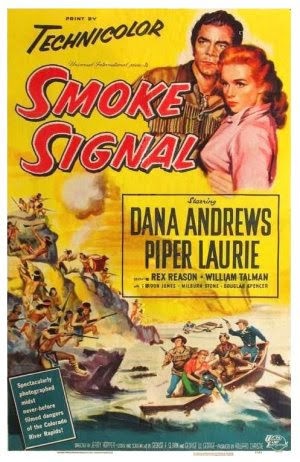
Films that adopted a pro-Indian stance can be found throughout the 50s, some more explicit in their sympathies than others. Smoke Signal (1955) offers an interesting variation on this trend; it would be inaccurate to refer to it as directly pro-Indian, rather it provides a critique of anti-Indian thinking. By casting a traditionally heroic actor in the central role and keeping his motivation slightly ambiguous for much of the running time – personally, I feel that greater ambiguity would have made the tale even more fascinating, but more on that later – it challenges our conventional genre perceptions. Add in an unusual setting, with the characters running the rapids of the Colorado River through the Grand Canyon, and the ingredients are in place for a compelling western.

The story is built around Brett Halliday (Dana Andrews), a former captain in the US Cavalry who deserted, joined the Utes and turned renegade. However, Halliday has been captured by the army and is being held prisoner at a remote fort until he can be transported for court-martial. The opening sees Captain Harper (William Talman) and his patrol coming upon the fort that’s currently under siege. Harper’s arrival puts him in command of the tiny garrison which has been whittled down by relentless attacks. He has a special interest in seeing the captive called to account since his brother was killed in a battle with a band of Utes led by Halliday. Apparently, these Utes have been massing and forming alliances with other tribes to stage a spectacular uprising. Harper is initially skeptical about this but when proof is provided it becomes evident that holding out in the fort is not going to be an option. Although reluctant to do so, he takes Halliday’s advice and decides to evacuate the fort, bringing some abandoned boats and making a break for it down the uncharted river. The majority of the running time is spent on this perilous journey, where the small band of survivors must fend off the harassing Utes and struggle to overcome the dangers posed by nature. While Halliday protests his innocence of the charges against him at the beginning, he avoids mention of this for most of the journey. Instead, we’re left to wonder and, like the desperate group around him, have our doubts raised only by his seemingly selfless actions and determination to see his captors to safety. Gradually, as Halliday’s knowledge of the Indians and their tactics proves more effective, he gains the trust of a few of his companions. His strongest allies are the late garrison commander’s daughter (Piper Laurie) and a grizzled old campaigner, Sergeant Miles (Milburn Stone), he once led. The turning point comes when the inflexible Harper, seemingly motivated by spite, orders Miles to undertake a suicidal mission. From here on, sympathy shifts to Halliday, the sole exception being the callous and brutal Lieutenant Ford (Rex Reason). The emphasis of the film is on the group dynamic as much as anything, and the shifting loyalties is an important part of what keeps the viewer’s interest alive. Who, if anyone, will make it to journey’s end is always uppermost in our thoughts and the battle for hearts and minds, ours as much as the characters on screen, ensure the tension is maintained right to the last scene.

Director Jerry Hopper made a series of good if fairly unremarkable movies in the 50s (Secret of the Incas perhaps being the most notable) before embarking on a long and successful career in a string of well-known TV shows. Hopper, and cameraman Clifford Stine, get good value from the Grand Canyon locations, the towering rock face being both visually impressive and also hammering home the bottled up, claustrophobic atmosphere. However, it has to be said that while the location work is extremely attractive, there’s far too much reliance on obvious and distracting back projection. Hopper’s handling of the action scenes is just fine, the sporadic battles and skirmishes blend well with the ever-present threat of the raging river and keep the story moving along. I think my biggest complaint relates to the script, and the ending in particular. For me, this was altogether too pat and slightly unsatisfactory – I feel that not only does Harper behave out of character but he gets off a bit lightly too.

Smoke Signal is really Dana Andrews’ picture all the way. Writing of this actor before, I commented on his tendency to internalize his feelings and play things down. That understated quality is highly appropriate for the character of Brett Halliday, a man to whom being true to his own inner convictions has brought only the distrust and enmity of others. I think Andrews was capable of hiding things so well that it’s a pity the scrip didn’t capitalize on this talent and keep the viewers guessing a little longer about the true nature of his character – it would have added more depth and uncertainty. There’s an excellent example of Andrews’ carefully modulated playing in one of the early scenes, when Halliday and Harper first meet. Harper, full of scorn and bitterness, reaches out to snatch away the native amulet Halliday wears round his neck. The flash of anger and resentment that briefly flits across Andrews’ momentarily clouded features, not much more than a twitch of muscle and a hardness of eye, tells us that this charm is special to him and that Harper’s action has gravely insulted him. When it comes to screen acting it’s the little things, those fleeting gestures and tics, that often speak loudest. William Talman tended to get cast in villainous, or at least unsympathetic, parts. He’ll always be remembered as Hamilton Burger, Perry Mason’s eternal foe, but he was exceptional as the psychotic bad guy in Ida Lupino’s The Hitch-Hiker. In this film though he portrayed a man bound by his own rigid code, a by the book disciplinarian with a narrow and inflexible perspective. Talman’s performance, alongside Rex Reason’s thuggish characterization, is what lends Smoke Signal its pro-Indian status. As such, it earns its credentials almost by default; the film paints the Utes’ opponents as deeply prejudiced rather than showing the Indians themselves in an especially positive light. As the only woman in the movie Piper Laurie spends much of her time torn between Andrews and Reason, but does well providing a non-partisan viewpoint. In supporting roles, there’s strong work from Milburn Stone, Robert J Wilke and Douglas Spencer.

Pegasus in the UK licensed Smoke Signal from Universal for their DVD release. The disc presents the film in a nicely framed 2:1 anamorphic transfer. The image looks a little soft in some places but there’s no real damage on show and the colours are bright and strong. There are no extra features whatsoever offered, just the main menu and scene selection. Anyway, the Pegasus release is the only one, so far as I’m aware, that presents the movie in the correct aspect ratio and with anamorphic enhancement. Universal westerns from the 50s are always worth seeking out – they’re generally attractive to look at and often feature plots that throw out something a little different. Smoke Signal is a solid, medium grade western that works pretty well. Andrews is dependable and credible, Hopper’s professional direction keeps it all moving along ensuring the pace never flags, and the location work is very welcome. Generally, this is a tight and entertaining mid 50s western that I’m happy to have in my collection.~

Wichita

poster2741

Some years ago I ran a short series of pieces on the various representations of Wyatt Earp in the movies*. I covered almost all the major productions, but one – Wichita (1955) – was omitted for the simple reason that I won’t ever write about a film which I haven’t had the opportunity to view recently. Well, now’s the time to fill in a notable gap in the aforementioned series. For a character whose name has become such an iconic part of the history and mythology of the old west, there is a good deal of variation when it comes to assessment of his motives. While some writers have sought to build up the man’s legend, others have dedicated their efforts to chipping away at it, and then there’s always the stories that Earp himself chose to spin. Despite the diversity of opinion on Earp in literature, I think it’s safe to say that cinema has, for the most part, chosen to cast him in a heroic mold. The historical veracity of those pictures where his character played a prominent part may be open to question, but there can be no doubt that Earp provided filmmakers with a rock solid basis for their portrayals of tough, unflinching lawmen.

Wyatt Earp (Joel McCrea) is introduced a man hoping to start up business in the burgeoning cow town/railhead of Wichita, Kansas. Two early scenes, one involving a couple of light-fingered cowboys and another depicting a foiled bank raid (where Sam Peckinpah appears uncredited as the teller), make it abundantly clear that Earp is a man skilled in the use of firearms. However, for all his adept gunplay, he has no interest in wearing a badge and using his talents to enforce the law. Wichita is shown to be a town facing something of a dilemma; the railroad is attracting the big cattle outfits and the money that they bring with them, but the town’s also faced with the challenge of lawlessness. Hard men who have spent long weeks riding dusty trails, deprived of liquor and female company, are only too eager to spend their earnings and blow off steam. Everyone of influence in Wichita knows what’s going to happen as soon as the first big cattle drive arrives. These town elders are anxious to fully exploit the financial gains, but they also need someone strong and reliable to ensure that some semblance of law and order is maintained too. Earp would appear to be the natural choice but, as the newspaper editor (Wallace Ford) points out, he hasn’t yet come to terms with his calling in life. It’s only after a child is killed by a stray bullet that Earp bows to the inevitable and pins on a badge.

The script doesn’t concern itself too much with the documented facts – having Earp team up with a fresh young reporter by the name of Bat Masterson (Keith Larsen) for example – but it does give at least a grudging nod in their direction. In reality, Earp finally left Wichita after political disagreements and headed for Dodge City to make money in some questionable ventures. The film ends with our hero setting off for Dodge in order to continue along what’s claimed to be his destined path as a dedicated peace officer. And the political disputes, albeit of an entirely different nature, do form a significant part of the plot. The script sees Earp come into conflict with the business interests in Wichita, men who are prepared to turn a blind eye to violence as long as the dollars keep rolling in. While some people may try to tell you that Hollywood productions of the 50s were generally right-wing in perspective, I’ve never seen too much evidence of that. Wichita is yet another film that champions basic morality above any narrow political consideration.

Wichita is very fine film, where both visuals and theme vie for the viewer’s attention. All of the great directors had the ability to move with ease between genres, and Jacques Tourneur was no exception. Having made what I have no hesitation in referring to as masterpieces in the horror and noir fields, he went on to prove that he was equally at home with westerns. Wichita was shot in scope and Tourneur handles the wide lens beautifully throughout. The opening, which highlights the vast open spaces of the frontier, quickly draws the eye to a tiny speck, a lone figure off on the horizon. This is the first view of Wyatt Earp, a fine visual introduction for a character who remains resolutely apart from the milieu throughout the film. Now that’s a considerable feat in my book, encapsulating the essence and core of a character through the use of one long shot. A good deal of the action in Wichita takes place in interiors, and again Tourneur employs the scope camera to great effect, altering angles to highlight the dominance and physicality of McCrea, to create a sense of chaos or remoteness as required, and generally positioning his actors within the frame in such a way as to focus on the emotional relationships between them. All of this, along with a strong sense of pacing, marks out the work of a top flight director.

With regard to theme, I’ve already mentioned the political sensibilities, but there’s more going on than that. The best classic westerns dealt with the internal struggles of their heroes, men trying to come to an understanding with themselves and to decide on the right path to follow. The Wyatt Earp of Wichita faces this eternal dilemma too, but with the added complication of unavoidable destiny thrown into the mix. Time and again the script makes reference to men being unable sidestep or ignore the responsibilities that fate has laid before them. If one bears in mind that Earp ultimately chooses to pursue what’s morally right then the picture has an uplifting quality. However, it’s not quite so simplistic; in order to fulfill his destiny the hero must do things that offend him personally. I think the minimalist artwork used for the poster sums up that aspect very well – a hunched, regretful figure, full of remorse in his moment of triumph, surveying the body of his slain opponent.

Joel McCrea was an excellent piece of casting as Earp. He may not bear any physical resemblance to the man but both his size and commanding presence ensure he dominates the picture. McCrea was one of the top half-dozen western stars, a man who simply belonged in the genre. He often brought a good deal of warmth to his characterizations, though his role in Wichita sacrifices that to an extent in order to play up other qualities. His Earp is a man who’s not quite satisfied with himself, a reluctant hero whose awareness of his deadly skills pains him. He communicates the dour, steely nature of his character well, and leaves no doubt in our minds as to why this man held such a fearsome reputation. Vera Miles was cast as the romantic interest, and she’s fine given the limitations of her role. The film isn’t a romance so Miles has few dramatic opportunities. Under the right circumstances, she was a very good actress – something like Hitchcock’s The Wrong Man should offer ample evidence – but she’s never stretched here. Lloyd Bridges and Edgar Buchanan played the main villains, the former as a vengeful cowhand and the latter as a conniving, duplicitous businessman, and provide solid opposition to McCrea. The supporting cast is filled with plenty of familiar faces: Peter Graves, Carl Benton Reid, Robert J Wilke, Wallace Ford, and the ever dependable Jack Elam.

Wichita is available as part of the Warner Archive in the US, but I recently picked up a release from La Casa del Cine in Spain that pairs the film with The Oklahoman. Both movies come on their own discs and Wichita looks very good. The film is presented in anamorphic scope and the print seems to be in excellent shape, without significant damage and boasting solid colours. There are no extra features offered but the two movies can be had for less than 5 Euro. Spanish subtitles are removable via the setup menu, however, I did notice that they seem to be burnt in during the opening credits for Tex Ritter’s theme song, and there’s a brief instance of a sign being similarly translated. I think this is an exceptionally good movie, intelligently scripted, beautifully directed by Tourneur and featuring a strong central performance by McCrea. Check this one out.


*Other films featuring the character of Wyatt Earp:

Frontier Marshal

My Darling Clementine

Winchester 73

Gunfight at the O.K. Corral

Cheyenne Autumn

Hour of the Gun

Tombstone

Wyatt Earp

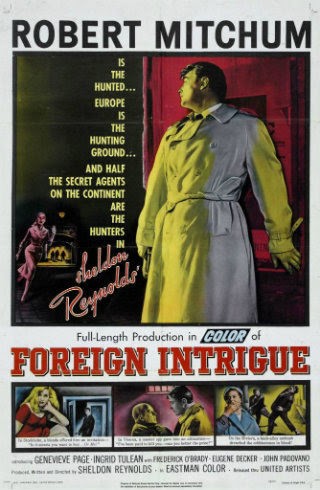
Foreign Intrigue

poster292-1

When television was still in its infancy, and for quite some time afterwards, it was quite common to see the appearance of small screen shows inspired by their big screen cousins. Today it seems like a reversal of that trend has taken place with a fair number of big budget productions hitting the cinema that have spun off from TV series. This phenomenon was noticeable in the 1970s when British TV shows frequently found themselves becoming movie features. However, even as far back as the 50s this was not unheard of, though it tended to be less pronounced in Hollywood. One early example of the US studios raiding their rival medium to produce a feature film is Foreign Intrigue (1956). I’ve never seen the TV show but I understand the movie isn’t really an adaptation in the strict sense of the word – it borrows the title and general concept, but that’s about it.

The movie opens on the French Riviera, with a man sauntering round the beautiful grounds of his equally beautiful villa. As he passes into his library and begins to browse the bookshelves, he’s struck down by a massive heart attack. The man is Victor Danemore and the first person to come upon him as he draws his dying breath is Dave Bishop (Robert Mitchum), his publicist. It’s soon revealed that Danemore was a genuine mystery man, one of those characters that could really only be a product of the 50s. Bishop was hired to fabricate an identity for his enigmatic employer and he knows no more about him than the inventions he’s been feeding the outside world. One would think the dead man’s young widow, Dominique (Genevieve Page), could fill in a few gaps but no, she knows nothing of the years before her marriage. So Bishop takes it upon himself to delve into Danemore’s past, to find out who this man was and why a Viennese lawyer is seeking confirmation of the circumstances surrounding his death. The quest moves from France to Austria and then on to Sweden, with Bishop encountering a variety of shady characters and dangerous situations as he tries to piece together Danemore’s fractured history. As he chases the shadows of the past down the murky, cobbled alleys of post-war Europe, a picture begins to emerge. The tale involves murder, blackmail, Nazis and collaborators, and how a legacy of treachery can poison the futures of the unsuspecting. Foreign Intrigue is a film that is very much of its time, sharing some of the characteristics of The Third Man and Mr Arkadin, yet never attaining the levels of suspense or artistry of either. There are some nicely crafted set pieces and atmospheric moments but the end result isn’t entirely satisfying. In short, the build-up promises much more than the pay-off can hope to deliver.

Foreign Intrigue was brought to the screen by Sheldon Reynolds – he wrote, directed and produced the movie – after Robert Mitchum expressed an interest in working with him. Reynolds had had some success with his TV show of the same name, and hastily knocked out a script. As I understand it, a good deal of the appeal of the show was its use of authentic European locations, and the movie employs the same tactics. This aspect is probably the greatest strength of the film, lending it an air of glamour and reality that even the most lavish studio mock-ups couldn’t hope to achieve. Leafing through Lee Server’s biography of Mitchum certainly gives the impression that the movie was an enjoyable one to make, and the star seems to have had a good time hopping around Europe. Reynolds and cameraman Bertil Palmgren compose some very attractive images and create atmosphere and suspense here and there, but the script fails to provide adequate backup. There’s too much shallow characterization to generate real interest in the people involved, and there are too many plot holes and unresolved questions. Even the finish is weak, its open-ended quality betraying Reynolds’ television background – it actually comes off like a pilot where the groundwork is being laid for the forthcoming episode.

Mitchum was the biggest name in the film and the whole thing revolves around his star power. While this could never be counted among his better roles, he’s good enough in the part. His trademark nonchalance is used well and he handles the thick-ear moments with the kind of toughness that makes it feel believable. Amid all the shadowy cloak and dagger stuff, he gets involved in two romantic sub-plots, but I didn’t feel either of these worked especially well. The two females in question, Genevieve Page and Ingrid Thulin (here billed as Ingrid Tulean), certainly look attractive yet the performances are just passable. Page is poorly served by a role that’s seriously underwritten and underdeveloped, while Thulin simply appears uncomfortable and unsure – disappointing when you consider her later success with Ingmar Bergman. However, there’s some fine support offered by Frédéric O’Brady as the double-dealing foil to Mitchum. A quick look at O’Brady’s IMDB entry reveals the man led a life that could comfortably be described as quirky, fascinating and off-beat. A good deal of this unpredictable quality shines through in his performance and some of the film’s best moments occur when Mitchum and he share the screen.

Foreign Intrigue is a film that I’d never had the opportunity to view until recently. It was one of those titles that you see included in filmographies and wonder what it’s like. Being a United Artists production, it’s part of the MGM library and recent arrangement with TGG Direct has seen it making its DVD debut. The movie is presented in anamorphic widescreen I’d describe it as typical of many MGM releases we’ve seen down the years. I mean that the transfer is about medium, some dirt and speckles, fair enough colour and no visible restoration. There are no extra features whatsoever and the movie shares disc space with an non-anamorphic version of The Quiet American. However, the fact that the title has been made available at last, and the very attractive price, should be taken into consideration. All in all, I found Foreign Intrigue to be a reasonably pleasant, if unremarkable, way of passing the time. The movie isn’t anything special and, realistically, will probably appeal mainly to Mitchum completists like myself. Still, bearing in mind how cheap the DVD is, it’s worth a look at least.


Red Sundown

poster276_zps6a227718

Low budget westerns seem to occupy a place on the filmography of just about every Hollywood star at one time or another. For some actors, the relationship with the genre was little more than a flirtation, something they dipped in and out of without leaving any real or lasting impression. On the other hand, there were others who discovered their niche in such movies. Rory Calhoun belongs in that category; sure he made other types of movie, but it’s with the western, and the programmers in particular, that his name tends to be most often associated. Red Sundown (1956), directed by Jack Arnold, offered him a pretty good role in a standard tale of a man trying to reform and make a fresh start.

Alec Longmire (Calhoun) is a man with a violent past, a drifter with no particular plans. However, his aimless existence is about to take a sharp turn, precipitated by his stumbling upon a lone figure in the wilderness. Bud Purvis (James Millican) is another wandering gunslinger, running from the law and on his last legs. He’s already walked the same path Longmire is currently taking, and all he has to show for it is regret. An altercation with a group of roughnecks in the saloon of some nameless backwater leads to the two men riding out of town in a hurry, with company not far behind. By nightfall they’re under siege in an abandoned shack with no way out. Gutshot and dying, with their shelter already on fire, Purvis comes up with a unique plan that will allow one of them to escape. But he has one condition; the doomed gunman has the younger man give his word that he’ll hang up his weapons if he should make it out alive. Well, Longmire’s not the kind to break a promise, least of all one given to a dying man, and so determines to leave his past behind him. However, reputations have a way of catching up with people and, besides that, wiping the slate clean generally demands more than a sense of remorse and good intentions. And so Longmire, somewhat reluctantly, finds himself sworn in as deputy to Sheriff Murphy (Dean Jagger) in the town of Durango. Murphy’s not getting any younger, and badly needs some backup as he’s caught right slap in the middle of an escalating range war. On one side is big time rancher Henshaw (Robert Middleton), while on the other is a collection of squatters and homesteaders. The greatest threat posed to Longmire and Murphy is the arrival on the scene of Chet Swann (Grant Williams), a reckless killer hired by Henshaw. Longmire has to tread a fine line, maintaining the objectivity of the law while an unwanted showdown with the dangerous Swann looms ever closer.

Red Sundown was Jack Arnold’s second western and showed a lot of promise. That’s not to say it’s above criticism though. Restricted budgets generally meant short running times and pacy storytelling, and that’s more or less the case with this movie. I say more or less because the film fairly springs out of the gate and grabs the attention, tends to coast along in the middle, and then puts in a strong sprint finish. The opening benefits from a bit of added exterior shooting and a great turn from James Millican – this was to be his last film and he looks quite ill at times. The siege of the abandoned hut where he and Calhoun hole up looks good, has a sense of real tension, and a pay off that’s sad and uplifting at the same time. The slightly problematic mid-section, in contrast, suffers from too much interior work and a romantic angle with Martha Hyer  that never sparks or truly convinces. In short, this passage has too much talk, not enough action and relatively flat visuals. Having said all that, the character of Swann is introduced in a way that highlights his creepy ruthlessness, and his presence does create a bit of much needed tension. The ending, while a touch abrupt, sees the pace pick up for the climactic duel and allows for a little more inventiveness as far as the camerawork is concerned.

Rory Calhoun gives what I’d term a comfortable, easy performance as the former bad man trying to cut his ties with a violent past and turn over a new leaf. This is far from an unfamiliar theme within westerns, and I think it’s fair to say that Calhoun doesn’t bring anything new or startling to the table. However, he’s never less than believable in the role and has enough natural charm to carry the lead. I think there’s a bit of a misconception that playing a tough western character doesn’t require a lot of effort. The thing is, pushing the boat out too far means you end up with a caricature, while reining it in too much results in a limp character lacking in credibility. Personally, I feel Calhoun strikes the right balance; the whole look, posture and attitude he adopts never leaves the viewer in any doubt that he’s capable of handling himself in a tight situation, yet he never tips over into comic book antics.

In contrast, Grant Williams, as the hired killer Swann, doesn’t quite hit the mark. His first appearance, all smiles and mock geniality, really taps into a sinister, chilling quality that bodes well. However, he fails to maintain this, and the scene where he confronts Calhoun in his room doesn’t work at all. It’s something almost indefinable, but the way Williams delivers his lines is all wrong – there’s no threat behind them, none of the menace that’s desperately needed. I already referred to the unsatisfactory romance between Calhoun’s character and Martha Hyer’s, but I’ll bring it up here again simply because it highlights what I feel was a missed opportunity. There was the possibility of adding an intriguing triangle to the mix with the introduction of Lita Baron as Henshaw’s housekeeper, and Calhoun’s old flame, but it’s never truly exploited. The actress was married to Calhoun at the time and there is a chemistry at work whenever the pair share the screen. When you consider the fact that Lita Baron eventually sued for divorce and cited her husband’s having committed adultery with seventy-nine different women (yes, that’s right 79) as the grounds, it’s clear this must have been a turbulent relationship. If there are some weaknesses in a few of the performances, it’s just about balanced out by solid playing from two old pros, Dean Jagger and Robert Middleton – the latter even gets to slug it out in a fine saloon punch-up with Calhoun.

Red Sundown has always been one of the more difficult Jack Arnold westerns to get hold of, previously only being available in a pricey box set from Koch in Germany (more so if, like myself, you already had the other titles) or a French release afflicted with the dreaded forced subtitles. However, Llamentol in Spain have recently put out a nice-looking edition on DVD that’s competitively priced. The film is presented in the correct 2:1 ratio and is anamorphic. The image is generally pleasing, with strong colour and a clean print. As usual, there’s no problem with subtitles – they can be disabled via the setup menu. The disc boasts no extra features, but I’m just glad to have a decent looking copy for a reasonable price. The movie is a solid programmer, and never aspires to anything loftier. I won’t claim the film is some lost classic or anything, but what I will say is that it does provide 80 minutes of attractive entertainment.


Apache Drums

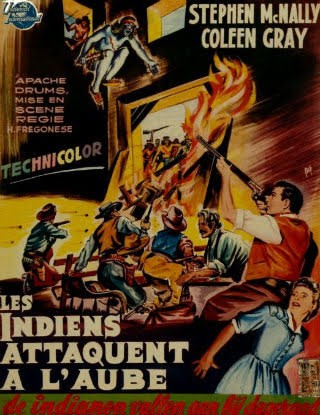
Filmmakers assigned to B movie projects always faced an uphill struggle at the outset: inflexible and restrictive shooting schedules, budgets pared right down to the bone, and scripts that, as often as not, lacked any spark of originality. Still and all, there were a select few who seemed to thrive under such circumstances, who had the vision or the maybe even the guts to shape something worthwhile out of the modest resources before them. Fans of classic horror are familiar with, and hold in high regard, the name of Val Lewton. This was the man whose specialist unit at RKO managed to produce a series of classy, polished little nightmares that not only transcended their frugal budgets but actually succeeded because there was so little money available. Apache Drums (1951), made at Universal, was Lewton’s last feature as producer before his untimely death from a heart attack. The film is the only western he was involved in, and it’s such an effective and atmospheric little picture that I can’t help but wonder how he might have fared within the genre had his life not ended so prematurely.

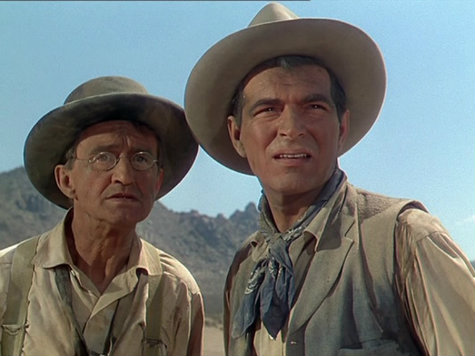
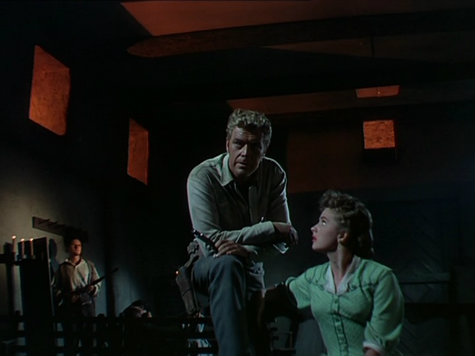
The story is derived from Harry Brown’s Stand at Spanish Boot, and it tells a fairly standard tale. Sam Leeds (Stephen McNally) is a gambler, a seemingly incorrigible ne’er-do-well (he’s even earned himself the unwelcome nickname “Slick”) who quite literally opens proceedings with a bang, shooting dead a rival card player in the stark saloon in the town of Spanish Boot. I found it a particularly nice touch that the shooting takes place off-screen as it immediately lends a sense of ambiguity to Sam’s character. He says it was self-defense and no-one seriously doubts that, still the seeds of suspicion are planted in our minds right from the off. The shooting comes at a bad time from Sam’s perspective: the mayor/blacksmith Joe Madden (Willard Parker) has been talked into a kind of moral crusade by the Welsh (the nationality has some significance later in the movie) parson Griffin (Arthur Shields) and Sam is given his marching orders. The fact that Madden is Sam’s rival for the affections of local girl Sally (Coleen Gray) rubs further salt into his wounds but he has no alternative. The dance hall girls have just been sent packing, and Sam is the next undesirable to be ejected. Thus we have the classic western staple of the outcast, shunned by the decent folk and driven out beyond the bounds of civilization. However, Sam’s exile is a short-lived one; he soon caches up with the wagon of girls, or rather their massacred remains. With his dying breath, the freshly scalped piano player who had been accompanying the spurned ladies tells of a formidable Apache raiding party appearing ghostlike and descending upon them. Sam gives his word to hightail it back to Spanish Boot and warn the solid citizens of the impending attack. The thing is he’s neither welcome nor trusted in his former home, the residents, with the tacit support of Madden, being on the point of riding him out of town on a rail before the arrival of a shot-up stagecoach bears out his words. It’s at this stage that the tension starts to build, as the Apache threat draws ever closer. Eventually, the net closes in to the point where all the survivors are holed up and under siege in the old church. Here, in the latter half of the movie, the camera never leaves the interior of the building and so heightens the feeling of helplessness and suspense, as the drums pound throughout the night and the defenders wait and watch for the Apache to leap howling through the high windows.

In writing about a lot of 50s westerns, one word crops up again and again – redemption. There’s no getting away from it; it quite literally pervades the genre throughout the decade, with even relatively humble and unpretentious efforts like Apache Drums having the concept at their core. All of the three main characters – Sam Leeds, Griffin and Madden – redeem themselves before the final fade out. Madden initially comes across as a vaguely priggish figure, allowing his preconceptions of Sam to colour his judgement and using his authority as means of furthering his own personal desires. But through enforced confinement with the man he regards as his opponent, he’s able to rise above his own inherent pettiness to attain a kind of nobility by the end. Griffin is a moral and religious absolutist, quick to judge and condemn all those who he considers to have strayed from the path of righteousness. Again, the circumstances he’s forced into lead to a reassessment of his former stance. There’s a marvelous little moment during the siege, where the preacher who had previously spoken in the most derogatory and disparaging terms about the Apache scout in their midst, Pedro-Peter (Armando Silvestre), moves across to kneel beside him. With the shadows of death creeping ever nearer, these two men pray to their respective deities side by side. And finally there’s Sam Leeds. He starts out expressing nothing but casual contempt for all those poor saps who slave away trying to earn an honest living and build a community. He’s of the opinion that he’s too smart for all that guff, that his only concern is his own welfare and comfort. Yet, he too (perhaps more than the others) finds that the threat from without carries a lesson for him. By putting aside his selfishness and obsession with self-preservation, he grows visibly as a human being. In their roles, Parker, Shields and McNally all manage to create rounded characters that are believable due to their respective weaknesses and prejudices. When you’re dealing with a low budget production such as this, good characterization, and the performers capable of achieving it, is a huge plus.

While the acting is important if you’re counting the pennies, it’s all likely to come to nothing if the technical expertise isn’t present behind the cameras. As I said in the introduction, producer Val Lewton was a past master at wringing the maximum out of limited resources. His RKO chillers all had a very distinctive look and feel, regarding shadow, darkness and the unseen and unknown as assets rather than obstacles. Such is the case with Apache Drums. Some of the most effective sequences follow on from events that the audience never get to see: both Sam’s deadly gunplay and the massacre of the saloon girls happen off-screen and the viewer only gets to witness the consequences of these events. The final section of the movie, which leaves the audience with no choice other than to view the action from the perspective of the terrified townsfolk means that we share in their sense of helplessness and dread. Of course Lewton was either clever or fortunate enough to work with talented directors on his projects. Between them the producer and director Hugo Fregonese work wonders in this section of the film: the image of garishly painted warriors springing through the high windows, backlit by the flames of the burning town, is like a vision out of hell, and retains a powerful shock value. I made brief mention earlier of the fact that Arthur Shields played a Welsh preacher. The reason for my drawing attention to his character’s nationality relates to a passage which takes place during the climactic siege. As the incessant beating of the war drums outside the walls begins to take its psychological toll on those inside, the decision is made to do something in an attempt to boost morale. Shields, playing a Welshman, leads the defenders in a chorus of Men of Harlech. In itself it’s a nice moment, but it’s also significant in that the scene would be mirrored in Cy Endfield’s Zulu over a decade later.

Apache Drums is a film that seemed quite difficult to see for many years. I caught a television broadcast back when I was a teenager and it stuck in my mind, probably because of the imagery as much as anything. At the moment, there are three DVD editions available: from France, Spain and Germany. From various comments I’ve seen, I get the impression they are all derived from the same source, though the French release will have forced subtitles. I have the Spanish DVD from Llamentol, which presents the film in the correct Academy ratio, and boasts a fine overall transfer – it’s sharp, colourful and well-defined. Subtitles are not an issue and can be turned off on the setup menu. The disc also offers the original theatrical trailer for the film, but that’s it in terms of extra features. I really like the film; it’s pacy, well structured and exciting. Aside from that, it looks good, with the kind of visual flair that’s typical of a Lewton production. A low budget sleeper that I happily recommend.