A Dandy in Aspic

poster19

Anthony Mann’s career as a director could be divided into three broad phases; his noirs of the forties, his westerns of the fifties, and his epics of the sixties. I think it’s fair to say that he mastered all of these and brought something new to each. A Dandy in Aspic (1968) would be his first Cold War spy thriller, although ironically it would also be his last film and he died before it was completed. Had he lived, I think it’s unlikely that he would have embraced the genre if this film is anything to go by. All told, it’s a tired, glum effort which offers nothing fresh; it falls back on endless cliches and tries to be too clever for its own good.

It opens brightly enough with a nice credits sequence featuring a puppet dancing on a string to the accompaniment of a cool Quincy Jones score. Alex Eberlin is a British spy who we are informed is a remote, sexless snob. Personally, I found this tidbit of information superfluous as the part was being played by Laurence Harvey, and those are the very words that spring to mind when I think of him. It turns out that Eberlin is really a double agent and a KGB assassin who has been living in Britain for twenty years but longs to return home. However, his controllers don’t want him to return just yet since he’s been performing well enough for them. A bigger problem for him, though, is the fact that his superiors in British Intelligence want him to take on a new task. They have grown weary of their operatives being knocked off and Eberlin is handed the job of eliminating the assassin, in other words eliminating himself. To this end, he is packed off to Berlin in the company of another agent, the openly hostile Gatiss (Tom Courtenay). There follows a series of confusing double-crosses, shot against a drab looking Berlin cityscape, until everything winds down to a vaguely unsatisfying twist ending. Along the way, there is time for a romance with an English photographer, Mia Farrow. I’m not quite sure what purpose this relationship is supposed to serve other than to add some swinging sixties atmosphere – if it’s supposed to help the viewer to connect with these characters in some way, then it fails.

The movie is essentially hamstrung with the casting Harvey and Farrow. Harvey’s role is hardly a sympathetic one to begin with as he shows no remorse for his betrayals, and he kills and uses people simply to preserve his own hide. On top of this, he was the kind of actor who could make the furniture around him seem interesting, those pinched facial reactions conveying all the intensity of a mild case of indigestion. Farrow is just vacant, although, in all fairness, she’s handed such a non-role that there’s no real opportunity to do anything with it. Tom Courtenay’s embittered, and belligerent Gatiss is better but it’s still pretty much a one note performance. He gets to stump around on his cane (which doubles as a rifle – shades of Bond amid all the dourness) and spit out his lines with a perpetual scowl on his face but there’s never any explanation for his anger. Lionel Stander has a clownish part as the cigar chomping KGB man in Berlin, and John Bird does his patented mugging act that will be familiar to anyone who’s ever seen a Rory Bremner show. Oh, and Peter Cook (who always seemed to find himself funnier than I ever thought he was) pops up for a small yet irritating role. One of my biggest regrets was that Harry Andrews wasn’t given more to do than chair a claustrophobic briefing session.

There are some interesting shots in the film which illustrate Anthony Mann’s good eye for strong composition, and there’s a nice set piece climax at a motor circuit, but they’re not enough. The plot is close to incomprehensible with all the twists and turns it takes and, in the end, it falls between two stools by trying to marry the grim aspects with too much contrived buffoonery. I think one’s fondness or lack of it for this film may come down to one’s level of tolerance for the performers involved, and I think I’ve made it clear enough where I stand. Basically, I feel I’ve seen all this done before and better but, if you’re a fan of this type of story or any of the actors, it is worth a look. For myself, I only wish Anthony Mann had signed off on a better note.

A Dandy in Aspic is available on DVD in R2 from Sony in a barebones edition, but it does have a pretty good anamorphic scope transfer.


Hour of the Gun

Ten years after making Gunfight at the O.K. Corral director John Sturges paid a return visit to Tombstone. Where his earlier film drew to a close with the shootout of the title, Hour of the Gun takes it as the starting point and proceeds from there. Although the 1967 movie is more or less a direct sequel, it is a very different production. Those intervening ten years had seen the western evolve away from a brighter optimism to become something much darker. The Wyatt Earp of Hour of the Gun is far removed from the upstanding representative of justice and honor that had previously been the standard. This is a driven, vengeful man who manipulates the law more than he upholds it.

The first half of the film sticks pretty close to the known facts and it is only towards the end that it drifts off into the realm of fantasy. It opens at the O.K. Corral and is quite accurate in depicting what actually happened; all those involved in the real incident are shown to be there and, for the first time, behave in the way that history has recorded. The story continues with the trial of the Earps and what would come to be known as the Earp vendetta. It is only the ending, where Wyatt and Doc Holliday track down Ike Clanton in Mexico for a final confrontation, that departs radically from the truth. However, aside from greater veracity, the most distinctive feature of this film is the way Wyatt Earp is portrayed. In all the previous versions he was a man whose primary motivation was the service of justice and the badge of office that symbolized it. In Hour of the Gun he starts off in much the same mode, but the attacks on his family bring about a rapid and drastic change. This Wyatt Earp is an anti-heroic figure paying only lip service to the law as he takes advantage of his position to exact a cold and bloody revenge on those he holds responsible for the shootings of his brothers. Although he carries arrest warrants, it becomes increasingly clear to his companions on the posse, and to the viewer, that he has no intention of ever serving them. One by one, the hired gunmen are shot down in what amount to legal executions.

If you’re only familiar with James Garner as the easy-going Jim Rockford, then his work here is a revelation. His Wyatt Earp doesn’t indulge in shy romances or offer fatherly advice to wayward teens – he is instead the angel of death. For the most part he comes across as aloof and unemotional, yet there is a maniacal, almost psychopathic, gleam in his eyes in those scenes where he blasts away his enemies. Jason Robards was frankly too old to play Doc Holliday although he brings a world-weary cynicism to the part that is attractive. The script makes a number of references to his deadly reputation but his main function in the film is to act as the conscience to Earps dark avenger, taking him to task for using the law to his own ends. Robert Ryan was always good value in any film which he graced with his presence, and his Ike Clanton is more of a politically savvy string-puller than an out and out gunslinger. There’s also a small role for Jon Voight (his big screen debut) as Curly Bill Brocius. The direction from Sturges is a solid, professional job and the story moves along at a nice pace. I’ve become very fond of Sturges as a director; he was no groundbreaker or innovator like Ford, Peckinpah or Leone but he almost always turned out strong, quality product. The film also benefits from a fine Jerry Goldsmith score, downbeat and relentless like the story itself.

Hour of the Gun seems to be the Wyatt Earp film that no one remembers, and that’s a pity. I think it’s a little hidden gem of a movie that deserves much more recognition. MGM have had this out on DVD in R1 for a few years now in a mediocre interlaced transfer. It’s recently had a R2 outing in what looks like the same print but this time it seems progressive – at least it runs a lot smoother on my system. All things considered, I’d say this is a worthy addition to the Earp canon and a film that I’m more than happy to have in my collection.

Cheyenne Autumn

poster11-1

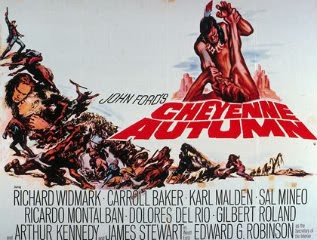
John Ford made Cheyenne Autumn in 1964 and with it he bade farewell to the western, the genre with which he was and is most frequently associated. By his own admission, Ford wanted this to be his attempt at setting the record straight with regard to the injustices visited upon the American Indians. Taken as such, it is fairly successful in depicting a people hounded almost to the point of extinction, without indulging in the politically correct schmaltz that more recent Indian centered epics have fallen prey to. Yet it is not a perfect film and does have its faults, not the least of which are the uneven tone and, to a lesser extent, some of the casting decisions.

The story concerns the Cheyenne who, having been moved to a reservation in Oklahoma, were dying a slow death as a result of disease, starvation and neglect. When a promised meeting with a Congressional committee fails to materialise, they take the bold and, in their minds the only viable, decision to strike out on a march back to their tribal homeland in Montana, 1500 miles to the north. Their journey is seen from the perspective of both the Cheyenne chiefs (Gilbert Roland & Ricardo Montalban) and the soldiers (under the command of Richard Widmark) charged with running them to ground. While the film’s sympathy lies with the hunted, the main focus is on the the various soldiers and civilians who pursue or encounter them. This is both a strength and a weakness of the film; a weakness because the characters of the Cheyenne are never explored in any great depth. The strength comes from the way the white characters are represented as holding a whole variety of, often conflicting, views on the fugitives.

The roles of the principal Cheyenne characters are filled by Mexicans (Montalban, Roland & Dolores Del Rio) and an Italian (Sal Mineo). In truth, this doesn’t work out too badly (I’ve never felt that a part can/should only be played by an actor of the same ethnic origin as the character – it’s called ‘acting’ fer chrissakes!) although Sal Mineo is far too much of a wuss to be taken seriously as a fiery Cheyenne warrior. Richard Widmark is good, as always, as the reluctant cavalryman who knows he has a job to do but also knows he doesn’t have to enjoy it. Pat Wayne is quite wooden as a young Lieutenant who experiences a “road to Damascus” type conversion, going from rabid bloodlust to outraged empathy over the course of the story. Karl Malden is a caricature of a Prussian officer whose blind devotion to duty and orders ultimately leads to tragedy. There are also small roles for George O’Brien (a ‘the-only-good-Indian-is-a-dead-Indian’ Major) and Sean McClory (a professional Irishman). Ben Johnson and Harry Carey Jnr appear as cavalrymen and get to show off some mighty impressive horse-riding skills – and there’s a nice running joke where Widmark can never remember that Carey is playing a character called Smith, referring to him variously as Jones, Murphy etc.

£36

Now a word about the Wyatt Earp scene in the movie. To be blunt, I hated it when I first saw it and I still hate it. The whole thing feels wrong, like it was grafted in from another picture. It’s the kind of sequence that wouldn’t be out of place in a ‘Carry On’ film – that bad! We get twenty minutes of Earp (James Stewart) and Doc Holliday (Arthur Kennedy) playing poker in Dodge City and having their game interrupted by the news of the Cheyenne being sighted nearby. There follows a Wacky Races type chase through the desert, culminating in a saloon girl losing her dress and winding up with her legs around Stewarts neck. Laugh, I thought I’d never start. In his biography of Ford, Joe McBride claims that the director used this sequence as a means of highlighting (through satire) the casual racism of the civilian population, but I don’t buy it. That bigotry had already been shown when a trail hand (Ken Curtis) callously murdered and scalped an Indian begging for food. In fact, the power of the aforementioned scene is effectively ruined by the subsequent clowning of Curtis in Dodge. I can’t think what came over Ford but this part of the movie definitely didn’t need to be shot.

Warners put Cheyenne Autumn out on DVD as part of their ‘John Ford Film Collection’. As far as I know it is still only available as part of that set. The transfer is probably the best of all the films in the collection. It’s anamorphic scope with no damage of any consequence and strong true colors. The disc carries a commentary from Joe McBride and a featurette on the film and the historical events that inspired it. Maybe it’s not Ford’s best film but it works well enough for the most part, offering a different perspective from the director yet retaining his trademark visual and narrative touches.

Where Eagles Dare

Poster

There are some films that seem to have the ability to transport us back in time, and Where Eagles Dare is one of those; I only have to watch the first few minutes for it to work its magic. The alpine landscape appears, the blood red credits roll, Ron Goodwin’s pounding score swells up, and I’m once again that wide-eyed little boy sitting on my parents’ rug – spellbound. Back then, I felt sure that this was the greatest war film ever made – and I was becoming something of a connoisseur of the genre at the time. Now, as the years wear on, I know that Where Eagles Dare is not the greatest war film ever, but its ability to carry me back thirty years or more is a priceless quality that no amount of critical snobbery can ever diminish. 

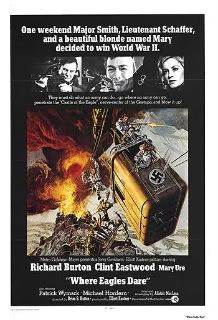
Following on the success of The Guns of Navarone, the books of Alistair MacLean were seen as a source of cinematic gold just waiting to be mined. There wasn’t a lot of character development in these stories, but the twisty plots and non-stop action made up for that. Where Eagles Dare is about an Allied mission (headed up by Richard Burton and Clint Eastwood) behind enemy lines to rescue a captured American general from the Nazis before they can force him to reveal the details of the D-Day invasion. The difficulty for our heroes lies in the fact that the general is being held in the Schloss Adler, an almost impenetrable castle perched on a mountain top, and accessible only by cable car. As if this were not enough, it looks as though there is a traitor lurking among our intrepid group. To go deeper into the plot would require some massive spoilers, and I don’t want to do that here. Suffice to say that the film treats us to double cross piled onto double cross, lots of big spectacular explosions, huge numbers of Nazis mowed down by Burton and Eastwood, and a fantastic fight with an ice pick atop a moving cable car. By the end everything has been resolved satisfactorily and two and a half hours of escapist bliss have whizzed by.  

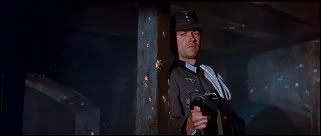
Clint Eastwood asking the whole German army if they feel lucky. 

There’s a great cast for this movie, even if they’re all playing roles which are basically caricatures. Richard Burton’s Major Smith seems capable of planning and talking his way out of even the most hopeless situations. Clint’s Lieutenant Schaffer is cool, ruthless and laconic; a WWII version of The Man With No Name. Mary Ure and Ingrid Pitt look good while helping out the heroes and, crucially, they do not indulge in any girly histrionics – something which should never happen in a proper Boy’s Own adventure anyway. The support cast is also well stocked with Ferdy Mayne and Anton Diffring playing German officers (what else?). Derren Nesbitt is ideal as the suspicious Gestapo major, although his German accent wouldn’t stand up to too much analysis.

Where Eagles Dare has been out on DVD from Warner for ages. The anamorphic scope transfer is good enough and there’s a ‘Making of’ featurette on the disc. I don’t see this getting an upgrade any time soon since it’s probably seen as too lowbrow for the SE treatment. For me, it will always remain one of those links to an increasingly distant past – an innocent and adventurous world where Richard Burton will forever intone “Broadsword calling Danny Boy…..Broadsword calling Danny Boy” 

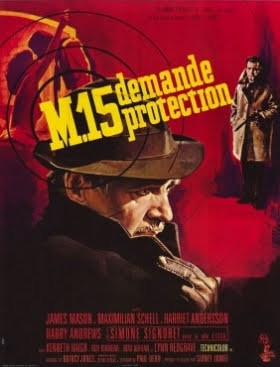
The Deadly Affair

poster18_zps6df1ef13

The 1960s were the heyday of the spy thriller with the market flooded in the wake of the success of Bond. Now most of these films fall into two broad categories – the glossy, gadget-laden Helm/Flint kind and the more pessimistic, downbeat Le Carre/Deighton kind. For one reason or another my own preferences lean towards the latter. The Deadly Affair is an adaptation of an early John Le Carre novel, and in no way attempts to glamorize the world of espionage. Instead, it focuses on petty betrayals and the slightly dingy suburban surroundings of the protagonists.

The story, as with many of this type, deals with the investigation of a possible mole in British Intelligence. James Mason plays Charles Dobbs (in the novel it’s George Smiley – I suppose the change of name is understandable enough given how little the character has to smile about here) who is charged with the task of investigating a civil servant. MI5 has received an anonymous letter concerning said civil servant and questions must, therefore, be answered. Dobbs appears satisfied that the letter is nothing more than a hoax, but the apparent suicide of the suspect seems inconsistent. It is the questions raised by this death that drive the rest of the  story along. There is also the secondary plot concerning Dobbs’ tortured domestic life with his nymphomaniac wife (played by Swedish actress Harriet Andersson) and the two strands are woven together successfully enough.

The film was directed by Sidney Lumet and has some nice location work around the vaguely depressing urban and suburban settings. Lumet’s style has never been the most exciting but that fits well enough with the mood – lots of grey skies and rain. Quincy Jones scored the picture and it’s one of the best things about it. The langourous, wistful jazzy music both evokes the mid-60s and reflects the emotional longings of the central characters.

The acting is a mixed bag, with the male characters coming off the best by far. James Mason is excellent and manages to convey the combination of determination, weariness, hopeless romanticism and pathos that the role requires – no mean feat that. To be honest, I don’t think I’ve ever seen Mason give a bad performance on screen and he ranks right up there as one of my favorite actors. There’s good support from Harry Andrews as a tough old retired policeman, and Roy Kinnear excels in a small role as a seedy, bigamous used car dealer. Maximilian Schell is adequate enough playing Dobbs’ old friend and former colleague, but nothing more. The female characters, however, are where the film falls down somewhat. Simone Signoret’s widow is too detached, although that may well be what the part of a concentration camp survivor demanded. The biggest problem, though, is Harriet Andersson. She gives one of the weakest performances I’ve seen in a long time. Given her role, you would have thought that some passion should be on display; but no, she’s ice-cold and blank throughout.

Overall, The Deadly Affair is a satisfying, if unspectacular movie. Currently, it’s available in R2 from Sony in a reasonable 1.85:1 transfer. The disc is a totally bare-bones one – literally. There isn’t even a real menu screen. While I’m grateful that the film is available, it has to be said that the cheap presentation of the disc is quite insulting.


Ride the High Country

poster19_zpsa03d6774

Generally, when I’ve knocked out my thoughts on a film, I’ve tried to avoid those productions which have already been analyzed to death. Such is the case with the work of Sam Peckinpah, which has had more than its fair share of examination and re-examination. However, I have decided that I’m not going to ignore the movie that both provides the title of my own blog and also happens to be my favorite among Sam’s films. Made in 1962, Ride the High Country was the director’s second feature – although this piece by John Hodson helps to explain why the previous year’s The Deadly Companions isn’t a real Peckinpah picture. This film contains the elements that have come to be typically associated with Sam, namely the passing of the Old West, the nature of friendship and loyalty, and a reflection on one’s past deeds.

The whole thing revolves around the two leads, Randolph Scott and Joel McCrea. These two men are old friends and former partners who have come together one last time,  for one last job. McCrea is the very epitome of honour and personal integrity, whose only wish in life is to enter his house justified. His idealism hasn’t brought him any material rewards, his shabby suit in the early scenes being proof enough of that. Scott, on the other hand, has come to question the value of holding on to principles that lead only to poverty and a poorly attended funeral. And so it’s a question of whether McCrea’s quiet nobility or Scott’s cynical pragmatism will ultimately triumph. The guarding of a gold shipment will test the strength of their friendship to the full, but it is the climactic showdown with a family of degenerate rednecks that brings closure to all the moral issues that precede it.

Both Scott and McCrea play off each other beautifully and it’s a genuine pleasure to watch these two old hands clearly relishing what they must surely have recognised as the roles of a lifetime. Both men had spent the previous decade acting almost exclusively in westerns and that experience adds immeasurably to the authenticity of the film. For Scott and McCrea, Ride the High Country was to be the last hurrah; McCrea would make a few more movies and Scott, wisely I think, called it a day and bowed out with what is arguably his best role. Maybe it’s just my sentimentality, but I always get goosebumps when Scott speaks his final lines in cinema and tells McCrea “I’ll see you later..” – it’s a lovely understated way to bid farewell to a long and distinguished career. Randolph Scott is one of the reasons why I enjoy the western genre so much (I suspect I’m not alone, if that gag in Blazing Saddles is anything to go by) – when I was a child it seemed as though no Saturday afternoon was complete without a television showing of one of his films, so he was and is the personification of the western hero for me.

Ride the High Country is a marvelous looking picture due to Peckinpah’s direction and Lucien Ballard’s wonderful cinematography. The movie is full of memorable scenes, not the least of which being the climax, as Scott and McCrea stand shoulder to shoulder and walk out to confront the murderous Hammond clan and fate itself. Peckinpah would offer up a more elaborately staged and celebrated ‘walk’ in The Wild Bunch, but this one packs just as much punch for its simplicity.

Ride the High Country may have become overshadowed by the films that would follow from Peckinpah, but I don’t feel that that should be the case. Is it his best movie? Many would argue that it’s not and point instead to The Wild Bunch or Pat Garrett and Billy the Kid, but it is the one that I have a special affection for, and the one that I find myself returning to most often.

100 Rifles

100Rifles_Poster

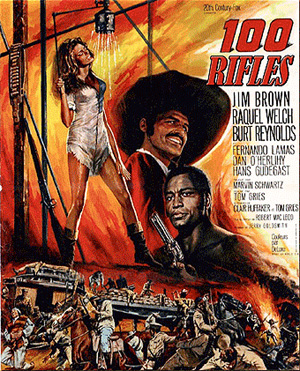
1969 saw the release of two westerns that featured Americans dabbling in the Mexican revolution. Both pictures involved hijacked arms shipments, trains, advancing technology, European military advisers and elaborately staged shootouts with the Federales. One, of course, was Sam Peckinpah’s seminal, genre-defining masterpiece  The Wild Bunch – the other was Tom Gries’ popcorn entertainment 100 Rifles. Since copious amounts of scholarly writing has already been devoted to the former, I’m going to look at the latter.

A year before, Tom Gries had directed the thoughtful and elegiac Will Penny – his next project was a distinct departure. 100 Rifles tells of Lyedecker, an American lawman (Jim Brown), who ventures south of the border in pursuit of Yaqui Joe (Burt Reynolds) who has stolen a consignment of weapons – the hundred rifles of the title. The guns are to be presented to the Yaqui Indians to assist them in their struggle against the Mexican authorities. Naturally, the Federales – led by a thoroughly sadistic Fernando Lamas – are keen to acquire these rifles for themselves. And there you have it. Will Lyedecker carry out his sworn duty and bring Joe back for trial? Will he be seduced by the plight of the Yaqui? Will the Federales beat them all to the chase? By the time the movie hurtles along to its grandstand climax all those questions have been resolved.

All the main players give amiable performances here with likable heroes and hissable villains. Burt Reynolds may not be the greatest actor in the world, but it’s hard not to like him on screen. Jim Brown is merely passable and Fernando Lamas is suitably vile. Dan O’Herlihy is always watchable as the railroad boss with shifting allegiances. But the real standout here is Raquel Welch as the revolutionary, Sarita. The scene where she stops a whole trainload of Federales as she takes a shower under a water tower is reason enough to see this film on its own!

OK, so this isn’t the best western you’ll ever see but its heart is in the right place, there’s more than enough action to satisfy, and Jerry Goldsmith’s score suits the mood of the piece perfectly. Available in a great looking anamorphic transfer from Fox in R1.