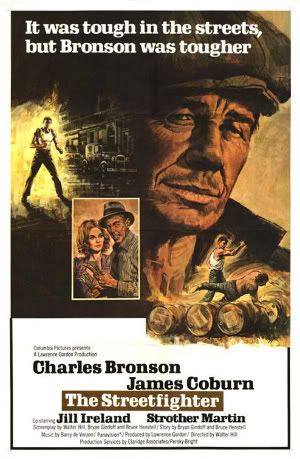
Hard Times

Poster

There’s something marvellously reassuring about sitting down to watch a Charles Bronson movie. You pretty much know what you’re going to get, and during his early-mid 70s peak that usually translated into an uncomplicated and entertaining film. Most of his work falls into the action category but the best of it managed to be a cut above the standard thick ear fare. Hard Times (1975) has long been a favourite of mine due to the simple yet engrossing story, the powerful fight scenes, the star pairing of Bronson and Coburn, and the presence of Walter Hill behind the camera. This is very much a man’s film, something that we rarely see nowadays – it’s tough, gritty and violent without ever becoming gratuitous or allowing the characters to lose touch with their humanity.

The story takes place in 1930s New Orleans and perfectly captures the spirit of the depression era. Chaney (Bronson) is a professional bare-knuckle streetfighter who roams the US, moving from one drab city to another making his living the hard way. Speed (James Coburn) is a chiseling promoter with a big mouth and a gambling habit, always on the make and always on the lookout for a likely prospect. There’s no backstory provided for these men, no clue offered as to how they arrived at this place in life – they just are. When Speed first sees Chaney in action, felling a much younger opponent with one devastating punch, he knows he’s found the fighter he’s been looking for. The taciturn hitter and the garrulous wide boy form a partnership and set about making some real money. However, to make money you have to have money so Speed borrows enough from a local loan shark to set up the first of a series of fights. The first half of the movie deals with the development of the releationship between Chaney and Speed as they seek out the funds necessary to permit a showdown with a local champ and his shady boss. There’s also the diversion of a romance for Chaney with a woman (Jill Ireland) he picks up in a low rent diner. One might imagine the aforementioned showdown would form the climax of the story, but it doesn’t. When Speed squanders the winnings, and thus places his life in danger with the mobsters he borrowed from, Chaney has to decide if he will risk all he has fought for to save the skin of a man who doesn’t deserve it.
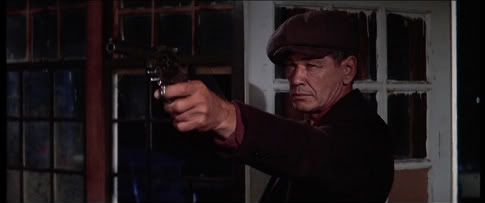
Charles Bronson - would you want to argue with this man?

Bronson was in his mid 50s when he made Hard Times but, aside from his weathered facial features, you’d never guess it. He moves through the brutal fights with a kind of graceful, measured confidence. Unlike many more modern films where the hero appears to be an unbreakable superman, Bronson looks like a man who can and has been physically hurt. Those weary, hard-bitten features and his economy with words are perfect for the role – I’d say this may well be his finest hour. In contrast, Coburn’s Speed is a boastful, grinning wastrel who thinks nothing of using everyone around him. His performance here is a broad one and can grate a little at times. He’s an actor that I have a lot of time for and who I’ve admired in many roles, but he did have a tendency to overcook it on occasion and I think he does so here. Strother Martin is great, as always, in a supporting role as the medic with an opium habit. The only really false note comes from Jill Ireland, an actress who never fails to disappoint. Mercifully, her part is not a major one so her wooden performance doesn’t detract from an otherwise excellent film. Hard Times was Walter Hill’s debut as a director and it’s a classy start to a career. He has a real feel for the period and the characters and creates a very believable sense of time and place. He chose to shoot much of the film in old warehouses and dingy nightspots which positively drip atmosphere. The staging of the fights is especially noteworthy and I’d rank them among the most realistic and exciting examples ever put on film.

The transfer on the R2 DVD is a fine one from Sony. The image is anamorphic scope and is strong and true, good colours and sharpness with no noticeable damage. Extras consist of a trailer and brief text biographies for Bronson, Coburn and Hill. Hard Times is a great film with a great cast and a director who’s one of my personal favourites. It’s a movie that tells a simple, straightforward story without resort to sentimentality or sensationalism. Highly recommended.
Breakout

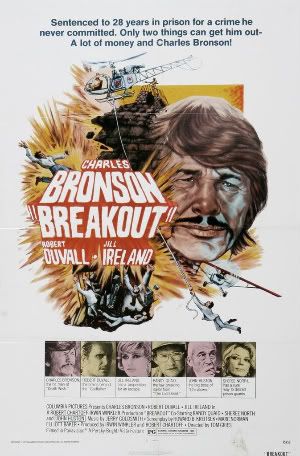
Poster

Some movies just can’t seem to decide what they want to be, and that’s pretty much the case with Breakout (1975). Charles Bronson made a string of pretty good and entertaining movies through the 70s, none of which were ever going to draw too much critical acclaim. Breakout boasts an embarrassment of talent both in front of and behind the camera, but never manages to make the best use of it. The main problem lies with the script, which lurches from near farcical comedy, to drama, then on to action, and back again without ever really succeeding at any of them. In the end, the movie tries to be too many things and just loses its way.

Jay Wagner (Robert Duvall) is a wealthy American who finds himself kidnapped in Chile, hauled off to Mexico to face trumped up charges in a rigged trial, and sentenced to 28 years in a prison run by Emilio Fernandez (General Mapache of The Wild Bunch). It’s never made clear exactly why Wagner needs to be subjected to this treatment; all we know is that both his powerful grandfather (John Huston) and a rogue CIA agent wish to see him safely out of the way. Only Wagner’s wife Ann (Jill Ireland) seems intent on proving his innocence or, failing that, breaking him out of jail. It is to this end that she comes to hire Nick Colton (Bronson), a less than successful charter pilot. As Wagner begins to decay physically and psychologically, a number of attempts are hatched to spring him from his incarceration. A combination of poor planning and betrayal ensures that they fail, until Colton decides to take the bull by the horns and do what no-one expects. This is another problem with the film; after the total incompetence of the first couple of botched jailbreaks, we are suddenly presented with an operation that’s planned and executed with military precision.

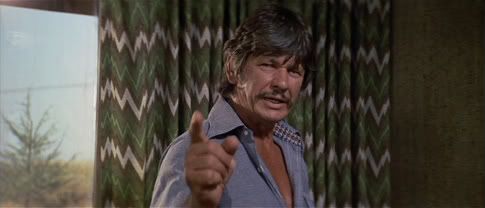
Charles Bronson - clearly not happy with the choice of curtains in this scene

Bronson is about the best thing in the film and obviously enjoyed the opportunity to indulge in some lighter moments. However, those moments of clowning around with Randy Quaid and Sheree North sit a little uncomfortably with the sombre tone of the prison scenes where Duvall is slowly disintegrating. Director Tom Gries and the writers didn’t seem to know whether they wanted to make a serious prison movie or a spoof caper, and ended up falling between two stools. Thus we get the startling sight of Quaid dragged up as a Mexican whore juxtaposed with scenes of Duvall breaking down and assaulting his own wife. I don’t think I’ve seen Duvall give too many bad performances and I couldn’t fault his playing here. He’s pretty convincing as a man who goes from being strong and self-confident to a character whose health and will are gradually broken. As for Jill Ireland, the less said the better. She was a fairly limited actress whose blank countenance was ill-suited to playing the kind of emotional role this film called for. John Huston has a small cameo role that’s really wasted as it goes nowhere. In fact, his character simply disappears about half way into the story and is never mentioned again. Emilio Fernandez is similarly underused, and doesn’t have much more to do than leer sadistically in his bogeyman part.

Breakout has been given a nice anamorphic transfer to DVD by Columbia. The disc in R2 is a barebones affair, but it can be picked up for next to nothing. When you get a movie with a cast like this, a score by Jerry Goldsmith and cinematography by Lucien Ballard, it’s not unreasonable to expect something more satisfying. On top of all the other issues there are some exceedingly poor effects shots; notably a man falling to his death through a tiled roof that looks suspiciously like it’s made of canvas, and the appalling demise of another guy who’s supposed to get minced by a plane propeller. I wouldn’t call Breakout a total failure, it does have a few entertaining turns and Bronson is always watchable, but it could have been a whole lot better. This one’s pretty much for Bronson completists – I guess I’m guilty on that score.

Red Sun

bronson1

Charles Bronson and Toshiro Mifune take on a gang of desperadoes led by Alain Delon. Add the decorative charms of Ursula Andress and Capucine to the mix, stir it all up under the watchful eye of original Bond director Terence Young, and the result is the 1971 samurai western Red Sun. How can you not love such a movie? While you can find a number of films, from The Magnificent Seven on, that took their cue from and remade Japanese stories, the mixing of genres is not so common (I could mention a recent movie that borrows the basic premise but I don’t want to dirty up this piece by referencing it).

The  plot  goes like  this: the Japanese ambassador to the USA is travelling cross country to Washington when the train he’s using is held up by an outlaw gang. The robbery is masterminded by Link (Bronson) and Gauche (Delon), and their objective is a safe full of money. It’s just bad luck that the Asian diplomat happens to have chosen this train and gets himself robbed too. Having already murdered a few innocent people, Gauche shows just how ruthless he really is by knocking off one of the ambassador’s samurai guards, stealing a priceless sword, double-crossing Link, and leaving him for dead. So our two heroes, Mifune and Bronson, must set out in pursuit of the duplicitous Frenchman; one seeking to recover the sword and uphold his honour, and the other just seeking the stolen money that has been stolen from him. For Mifune there is the added complication that he has been given just seven days to accomplish his mission; should he fail to do so he will be forced to take his own life.

Red Sun came along towards the end of Spaghetti/Euro western cycle and it manages to add a new twist to it with the inclusion of the samurai angle. Now if someone were to offer you a meal consisting of a Spanish omelet, sushi and good old bacon & beans all mixed up together you’d probably feel a little queasy at the prospect. However, from a cinematic point of view, it doesn’t turn out so bad – in fact it manages to remain quite appetising. This is not a film that is trying to make any serious points and, as long as you keep that in mind, it provides some marvellous entertainment. Nevertheless it is nice to see the relationship between Bronson and Mifune’s characters blossom as each comes to acquire a respect for the other. Mifune is fine as the taciturn, honour bound warrior and Bronson (on the verge of international action stardom) is very likable as the wisecracking bandit. Alain Delon is a very one-dimensional villain, but the movie isn’t about character studies anyway. Capucine and Ursula Andress were really just along as eye candy, and that was alright by me. So, the film has copious amounts of gun and swordplay, the Cavalry, Mexican bandits, a marauding Comanche raiding party, and a catchy score by Maurice Jarre. It’s hard to imagine what else the producers could have thrown in.

Red Sun comes on DVD in R2 from Cinema Club in a fairly decent print, except it’s not OAR. The film should be shown 1.85:1 but the R2 is full frame. It looks like an open matte transfer, rather than pan & scan, since there is far too much headroom on view. I believe there is a widescreen version available somewhere, but I can’t recall where – Japan maybe? All in all, I found the movie undemanding and fun. Bon Appetit!