Night and the City

“I just want to be somebody… “

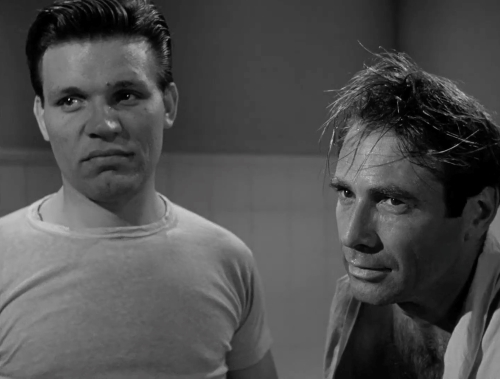
Why does film noir continue to resonate? Why does it continue to pull in viewers, beguiled by its shadow drenched nightmares? That is does exert a draw on audiences is beyond question and part of it is maybe down to the look, the attitude, the charm of something at once recognizable yet lost in time. Still, I feel there’s something else at play for film noir is a very human form of filmmaking; it is predicated on the frank acknowledgment of weakness and frailty, perhaps growing out of character flaws, ill fortune, poor choices, or even some unholy trinity of them all. In a way, there is something about the lack of definition regarding film noir that points to its core appeal. There has been decades worth of conversation and controversy over when noir began, when it ended, what it actually is and whether it can even be referred to as  a genre. And at the end of it all, there remains no definitive answer, just schools of thought one might subscribe to. As such, is it possible that film noir is in essence a cinematic expression of uncertainty and confusion, mentally, morally and spiritually? Somehow it feels appropriate that the main character of Night and the City (1950) should say those words quoted at the head of this piece, struggling to articulate an ambition that he cannot fully visualize, much less define with clarity.

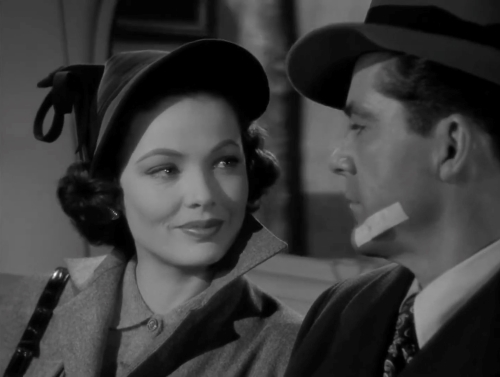
Movement and position matter. Anthony Mann frequently had his characters striving to rise, forging a path upward with mixed results, while Abraham Polonsky famously had John Garfield racing down from the heights. The characters in Jules Dassin’s Night and the City, on the other hand, start off at the bottom and remain resolutely anchored there. In a sense, nothing really changes throughout, at least not as far as Harry Fabian (Richard Widmark) is concerned. The opening and closing sequences see him racing through the streets of a broken post-war London, a grandiose chiseler with danger hot on his heels and the hope of sanctuary and salvation, even if it’s only temporary in nature, awaiting him in the form of Mary Bristol (Gene Tierney).

Harry Fabian is what can only be termed a dark dreamer, immature both emotionally and ethically. Mary loves him, that much is clear, not so much for what he is as what she imagines he could be, and Harry in a way is also in love with that projection of what he dreams he could be. The problem though is that neither Mary nor more importantly Harry himself is quite sure of who or what he might be. He is, as his neighbor observes, an artist without an art. We encounter him first as a strictly small time operator, a tout steering mugs to the clip joint where Mary sings, scratching around in the detritus of a city still partly bewildered in the wake of its wartime pummeling for any scheme that might turn a fast buck. Human nature being what it is, he’s not the first nor will he be the last person with his eye on the quickest way to reach easy street. The problem with this approach to life lies in the fact the route there is typically mined. Thus when Harry happens upon what seems like the perfect opportunity to muscle his way into the world of professional wrestling he fails to anticipate the the traps awaiting him. Blinded by his enthusiasm and unaware of how his smug efforts to play all of his rivals off against each other is actually weaving a Gordian knot of epic proportions, Harry is doomed by his own slickness.

It feels kind of appropriate that Jules Dassin would make Night and the City just as the appalling HUAC episode was reaching its peak. Zanuck had dispatched Dassin to London to shoot the movie where he would be beyond the reach of those congressional committees. By the time the movie was completed, the director was firmly on the blacklist and could no longer take any part in the editing process. Nevertheless, the result is portrait of bleak romanticism, where passion, ambition and duplicity all charge headlong towards an emotional intersection and the resulting collision leaves few survivors standing. I have seen assessments of the movie, both contemporary and subsequent, that lament the dearth of sympathetic characters, citing this aspect as a weakness. Such evaluations leave me wondering if I was watching the same movie. Perhaps it’s just me, but I’ve never seen the need to conflate admirable with sympathetic. I’ll concede that there are few truly admirable figures on show, but that does not mean there are none who are sympathetic. If anything, I would assert that almost all of the principals earn some sympathy.

Widmark’s role is almost as difficult to categorize as film noir itself. Fabian is neither hero nor villain in the proper sense of the words, nor would I be entirely comfortable referring to him as an anti-hero. Right up to the tragic moment which precipitates the climactic hunt, he does some contemptible things as he attempts to plug the leaks suddenly appearing in his plan, but the people he’s deceiving are no saints themselves so it’s hard to condemn him too much for that. As the various threads of his schemes become ever more entangled it’s a bit like watching an accident unfold in slow motion. Aside from his mounting desperation, a few moments such as the early scene in Tierney’s flat where the frustration of both  is emphasized, as well as the later exchange with an implacable hotel manager serve to add layers to the character and knock off some of the corners. I don’t believe either Dassin or screenwriter Jo Eisinger had any intention of passing judgment on Fabian and certainly don’t encourage the viewer to do so – he is merely presented as he is. His maneuvering does bring about tragedy, but that occurs indirectly. By the end, when he lies spent and bereft the appearance of Tierney framed in a doorway like some angel of the dawn affords him the opportunity to seek a form of redemption through personal sacrifice. Whatever one may make of the gesture, it does indicate a man who is not merely self-absorbed. What’s more, even though he may be abandoned and betrayed by almost everyone, there’s no getting away from the fact this woman loves him in spite of all his flaws – that in itself places the character on a different level.

That said, Tierney’s part is a relatively small one. Her important scenes bookend the movie and she’s only on screen intermittently in between. It seems that Zanuck was keen to have her in the cast and her role is a pivotal one despite the lack of screen time overall. By humanizing Harry Fabian and adding another dimension to his character, Tierney helps to ground the movie and give it greater emotional depth. The other major female role is that of Googie Withers, the discontented nightclub hostess who is trapped in a relationship for purely financial reasons, something which would not have been uncommon for a woman at the time. Sure she is underhanded and motivated by selfishness, but it’s not so difficult to understand how circumstances have driven her in that direction, nor do I believe it should be so hard to empathize with her efforts to extricate herself from a wholly unsatisfactory marriage. Her husband, played by the oppressively bulky Francis L Sullivan, is another figure who is far from perfect. Insecure despite his clout and dominance in the way such large men often are, he pulls strings and manipulates Harry Fabian like some malign puppeteer out of a desire to see him brought low and in so doing maybe hold onto the woman he so badly needs. It’s a performance that manages to be simultaneously dangerous, vindictive and pitiful.
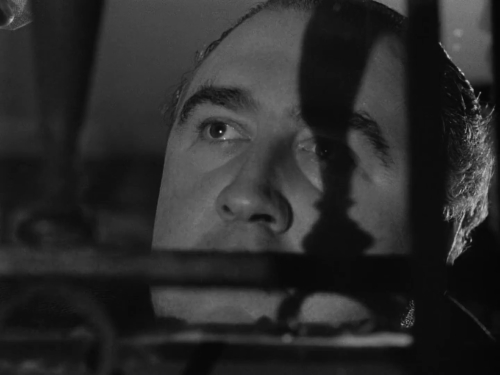
Many of the other supporting players are portraying characters who are associated in one way or another with the wrestling world. This milieu is appropriate even if it’s not an area that has been extensively featured in film noir – Ralph Nelson’s Requiem for a Heavyweight is the only other notable example that I can think of off hand. Boxing tends to be the go-to sport and I find the choice here a telling one. Boxing might be susceptible to certain abuses,  it may attract corruption, but it still retains some inherent nobility, similar to the way Greco-Roman wrestling retains a link to the classicism of the ancient world and something finer. On the other hand, the crass vulgarity of professional wrestling exists on a much lower plane, a true moral wasteland. It’s that very cheapness, that sense of debasement which lies at the heart of Fabian’s flawed scheme and also forms the basis of the conflict between Herbert Lom’s shady underworld promoter and his scrupulously honest and dignified father. It’s highlighted too in the contrast between the easy superiority of that old athlete (Stanislaus Zbyszko) and the barely articulate coarseness of Mike Mazurki’s hulking and murderous pro.

Night and the City had two cuts, the shorter US version, which Dassin seems to have preferred, and a slightly longer British version. The UK Blu-ray from the Bfi, which now appears to be out of print and consequently is rather expensive, offered both cuts – I think the US Criterion also has both versions too though. I don’t know how popular a view this is, but I find I prefer the longer British cut of the film; perhaps the noir credentials are slightly weakened or some might say compromised yet I like the way it shades the character of Harry Fabian in another light. I find it provides another layer of tragedy and thus heightens the ambiguity of the experience. Nevertheless, this is prime film noir regardless of the version one favors and top filmmaking in anyone’s book. Widmark was only about a half dozen or so movies into his career at this point, already in the middle of a remarkable run of performances in very fine films while Dassin had just come off a short streak of excellent films noir. Under the circumstances, it’s hard to see how this one could miss. A first class movie all round.

Where the Sidewalk Ends

Otto Preminger’s Where the Sidewalk Ends (1950) has the feel of something that might have been cooked up had Cornell Woolrich and William P McGivern ever decided to collaborate on a story. There is that quality of the inescapable nightmare, a fatalistic vortex relentlessly dragging the protagonist down, while he is one of those big city cops who appears to be as uncomfortable in his own skin as he is in the department he works for. The end result is a form of psychological trial by ordeal, where the moral fiber of a man is measured by his ability to meet the challenge laid down by his own past.

Right from the beginning it is clear that Mark Dixon (Dana Andrews) is a man in trouble. The patience of his superiors in the police department with his brutal, two-fisted approach to the job is wearing perilously thin. What is perhaps more dangerous though is his appraisal of himself. It’s not voiced yet the truculence that pervades features, manner and posture clearly announces a deep-rooted dissatisfaction. With a final warning still ringing in his ears, he sets out to investigate the death of a rich out of town businessman. The victim ought to have been the mark in a rigged game of dice, but a bit of bad luck on the part of the mobsters running the racket leads to a misunderstanding, which leads to a scuffle, which leads to a murder. So Dixon is one of the bulls sent to investigate and is soon on the trail of the man being lined up as fall guy for the killing. Seeing as this is a story that is full to the brim with ill fortune and bad judgement calls, it is somehow inevitable that a man with a hair trigger temper such as Dixon is going to get into deeper strife when he finds himself alone with an antagonistic suspect. That’s exactly what happens, blows are traded and the suspect, a war veteran with a metal plate in his head, winds up dead on the floor. And it’s here that everything begins to spiral completely out of control. Shocked and panicked, Dixon attempts to cover up the accidental killing, but once he sets the ball rolling the momentum generated threatens to crush everything and everyone in its path, not least the dead man’s father-in-law.

The entire business is further complicated by the fact Dixon finds himself falling in love with the estranged wife (Gene Tierney) of the man he’s just killed. What follows is a variation on that noir trope of a man investigating a killing he is responsible for, the hunter essentially hunting himself. The personal angle and the need to see that blame is not wrongly placed on an innocent man adds some spice, as does the fact Dixon is all the time fighting an internal battle borne of the fact his own father was a career criminal. It sets up an intriguing study of the concept of justice and how it may be best achieved, as well as looking at the potential for attaining personal and professional redemption.

Where the Sidewalk Ends feels like something of a watershed movie. That whistling intro with the opening bars of Alfred Newman’s Street Scene playing over credits chalked on the sidewalk, suggestive of the casual impermanence of a crime scene and the expedience of the methods used to mark it out, as anonymous citizens stroll past seems apt given the way film noir – that genre that wasn’t even aware of its own name at the time – was moving along into other areas. As the new decade went on noir would move gradually away from those tales of personal misfortune and shift its focus onto wider societal ills, organized crime and institutional corruption. The director too would soon be on his way, leaving behind the restraints imposed by being under contract to a major studio.

Recently, after revisiting Preminger’s Anatomy of a Murder I was watching one of the supplements on the Criterion Blu-ray where Foster Hirsch was commenting on the directors insistence on shooting that movie on authentic Michigan locations. Some of that fondness for using real locations comes through in Where the Sidewalk Ends too with much of the film shot on familiar Fox studio sets, but also taking the cameras out onto the streets of New York where possible to give it an air of genuine urban grit. The whole picture has a strong noir aesthetic, canted angles, telling close-ups, characters clustered in tight, claustrophobic spaces framed by doorways and windows, and plenty of shadows carefully lit and photographed by Joseph LaShelle.

Where the Sidewalk Ends was the fourth of five films Dana Andrews would make with Preminger. All of their collaborations are interesting and there’s not a bad movie among them. Andrews has always been a favorite of mine whatever genre he happened to be working in and I’m sure I’ve spoken before of that marvelous internalized style he used so effectively on so many occasions. The part of Mark Dixon allowed him to tap into that: his rage and hunger for violence barely contained every time he encounters Gary Merrill’s conceited gangster, the appalled horror at what he has done when he realizes the murder suspect is lying dead before him, and then the sickening, sliding sensation as he witnesses the net cast by the law drawing tighter around those who least deserve it. These are all different emotions and reactions yet all of them are perfectly conveyed with great subtlety and quietness by Andrews – superb screen acting. Gene Tierney was another veteran of Preminger’s movies, making four in total for the director over the years. One might say her character isn’t as directly involved in the story yet her presence is one of the primary drivers of the plot – the initial killing stemmed partially from her attendance at the dice game, her father called on her abusive ex and placed himself at the scene of the crime as a result of what happened to her, and Dixon’s journey back from the brink towards redemption could not take place without her.

Gary Merrill is good enough in the role of the villain, although he is off screen quite a bit. In a sense though, one could argue that Merrill is not the main villain, that honor belonging to Dixon’s father, the ghost of a long dead hoodlum haunting his son’s conscience and putting a hex on his character. An uncredited Neville Brand makes for a memorable sidekick, superficially tough but easy to crack under pressure. That pressure is applied not only by Andrews but also by Karl Malden as the newly appointed lieutenant who is keen to make a quick arrest. As Tierney’s cab driver father, and Malden’s prime suspect, Tom Tully is hugely endearing. Both Tully’s playing and Tierney’s devotion to him lend credibility to the conflict which assails Andrews as the plot unfolds. All of the supporting actors turn in good work, including Bert Freed, Craig Stevens and Ruth Donnelly. I want to add a brief word too for Grayce Mills, who only appears in one scene. Many of these studio productions contained seemingly throwaway moments, little vignettes that are easily overlooked yet frequently stick in the memory. Such is the case with the old widow living the basement below the apartment where Andrews runs into trouble – there is something touching and memorable about this old lady’s few telling lines about the insignificance of time to the aged, and how she sleeps in the parlor with the radio softly playing to assuage her loneliness.

Some years ago the Bfi released a Blu-ray set of three Otto Preminger films noir comprising Where the Sidewalk Ends, Whirlpool and Fallen Angel, but it now seems to have gone out of print. Anyone fortunate enough to have picked that set up will know that this movie (and the other two titles) looks exceptionally good so it’s worth keeping an eye out should it be reissued, or if a competitively priced used copy pops up.

So, this year ends with Where the Sidewalk Ends. My thanks to all of you who came along for the ride, and I hope I’ll be seeing you again in 2023.

Whirlpool

Whirlpool (1950) is another borderline film noir. It is  a stylishly shot crime movie with a cast whose credentials speak of a strong pedigree in the school of dark cinema, directed by Otto Preminger, who was certainly no stranger to noir. I suppose it might be seen as more of a whodunit (or should that actually be a “how did he do it”, given the seemingly unbreakable alibi involved) and it might not feature all the classic ingredients, but the strong emphasis on the psychological aspects of the story as well as its examination of matters relating to trust and manipulation nudge it in the direction of film noir.

It takes a thief. Well, the story opens with a thief taken, even if it looks as though psychoanalyst’s wife Ann Sutton (Gene Tierney) is too classy and polished to fit that particular bill. Nevertheless, that’s what she is, having been spotted, trailed and then approached by a store detective after walking out of a shop with an expensive piece of jewellery stashed away in her purse. Since she is not short of money, it becomes evident that she is a kleptomaniac, acting under the influence of some private compulsion. This fact is pointed out by a convenient witness to the embarrassing episode, one David Korvo (Jose Ferrer). While he may not be clad in shining armor he does have a smooth line in persuasive patter, more than enough to allow him to ride to the rescue of this felon in distress. One might have thought that a woman married to an eminent psychiatrist (Richard Conte) would be ideally placed to obtain the finest treatment, but no film noir would be complete without the presence of secrets someone wants to keep buried. Such is the case with Ann Sutton, whose success in suppressing traumas suffered in the past has left her with little appetite for shattering the illusion of the perfect wife she has carefully constructed around herself.  So what is Korvo’s motivation in all this? Despite his protestations that he’s no blackmailer, and his very public determination to display his innocence, his money is made via fortune telling and hypnosis. What becomes increasingly apparent is that this man is a master manipulator, and that Ann Sutton is about to become just one more cog in a devious and murderous scheme.

Otto Preminger had memorably worked with Gene Tierney on Laura and they would collaborate again on Where the Sidewalk Ends and, somewhat later, on Advise & Consent. Preminger was good at tales of damaged people and as he moved into the 1950s he was drawn to scripts that featured ever more complex individuals and circumstances. Ben Hecht’s adaptation of a Guy Endore novel is characteristically slick and the plot, while twisty, always moves smoothly. In noir terms, Preminger would do much more interesting things with the idea of the troubled and criminally inclined female in the superlative Angel Face a few years down the line. In a sense, Whirlpool feels like something of a throwback; as much a puzzle plot murder mystery as regular film noir, it combines a critique of quackery and charlatanism, which had waxed and waned in popularity from the early years of the twentieth century on, with that kind of slightly reverential take on Freudian psychoanalysis that was in fashion in the post-war period. The focus is on the well-heeled and leisured classes, people with good jobs, nice clothes and the time and money to indulge in some lightweight self-analysis. If the idea of admitting that all may not be as idyllic as the shiny new decade promised to a psychiatrist (even if that person happens to be one’s spouse) was something to be reserved for a different type of person,  consulting some flimflam artist like Korvo was acceptable. Perhaps it was a way of acknowledging the existence of post-war angst without having to take it too seriously.

Knowing how hard Gene Tierney had to struggle with mental health issues in real life gives the movie a bit of an edge. It adds poignancy to those moments where she is expressing dismay at her instability, a feeling that this is not merely a woman playing a part but someone who is in fact living it out. Richard Conte comes across rather stiff at times, which is probably the way his part was written – too much empathy too readily expressed at too early a stage would not have made sense given the reluctance of Tierney’s character to confide in him. Nevertheless, he does seem a little too controlled and reined in, particularly in the scenes where he’s confronting Ferrer’s smugness. On the other hand, it could be said that this contributes to an air of tension. The meeting between a recuperating Ferrer, taunting and needling even as he sweats in pain, and a deeply wounded Conte does have a palpable undercurrent of menace. Ferrer is well cast, unctuous and dissembling, adept at the kind of emotional larceny that easily outstrips Tierney’s petty pilfering.

The main supporting part is filled by Charles Bickford, someone whose name pops up here from time to time and whose presence in a movie I generally welcome. The weathered features and gruff manner suited a range of roles and his dogged but fair-minded police lieutenant in Whirlpool represents one of those times when he made the most of a relatively small part. The script has him cast as a recent widower, which is a nice touch that serves to round out and humanize what might otherwise have felt like a purely generic character. That moment when he wakes at night, stung by his conscience, and then glances briefly at the small framed photo of his late wife on the bedside table before making up his mind to go along with Conte’s hunch is true and simple, and it helps to ground the movie beautifully.

Whirlpool is an interesting movie, fanciful in its telling (is the kind of hypnosis depicted even possible?) yet authentic in its presentation. I guess almost everyone involved has done better work elsewhere, but none of them could be said to have been below par either. The Bfi Blu-ray from some years ago looks excellent to me and the film can be accessed easily on DVD or even online depending on one’s preference.


Leave Her to Heaven

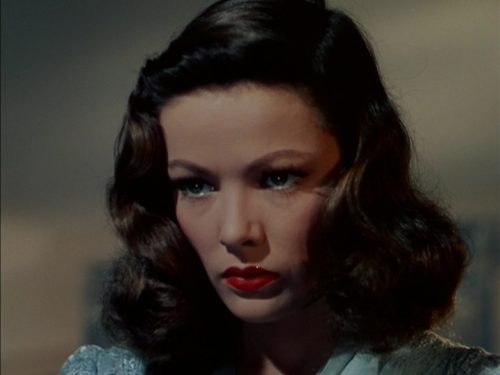
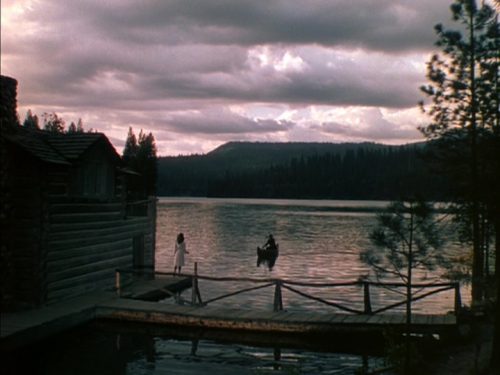
Leave Her to Heaven (1945) is a visually and emotionally arresting piece of cinema. Shot in lush, vibrant Technicolor, with an unashamedly melodramatic plot which unfolds in a succession of rustic settings, this is the kind of movie which is guaranteed to root out that perennial bone of contention relating to color and film noir. While I am happy to consider it noir, I certainly respect the views of those who are reluctant to do so. Ultimately though, the labels or categories applied are immaterial, fading to insignificance next to a startling central performance which manages to simultaneously compel and repel, and that is no mean feat.

Alfred Newman’s ominous score sets a sombre tone for the opening on the water in Maine. The arrival of novelist Richard Harland (Cornel Wide) is the cue for stolen glances and mumbled words of sympathy. He’s fresh out of prison, having served a two year term and as he sets off across the lake to keep a date with destiny his lawyer (Ray Collins) fills in the background for a mystified companion, and leads the audience into the long flashback that occupies the bulk of the running time. On the way to New Mexico, two strangers on a train exchange some flirtatious banter, the kind that feels light and amusing due to its ephemeral nature. These people are Richard Harland and the intense, and intensely beautiful, Ellen Berent (Gene Tierney). She’s been reading his latest novel and, because she hasn’t recognized him as the author, offers a frank and less than flattering critique of the writing. Coincidences wrapped up in misunderstandings are the staple ingredients of many a story and frequently offer a good jumping off point. Here they form the basis for a whirlwind romance which sees Harland bewitched by Ellen, while she casually discards both her old engagement ring and the man who gave it to her (Vincent Price). Make no mistake, this is a love story. However, it is a story of a twisted, all-consuming and all-destructive love, one where insecurity and possessiveness trample generosity and trust, where the heights of joy are abruptly flipped to become the depths of evil. Without going into spoiler territory for those who haven’t seen the movie, the first hour charts Ellen’s gradual succumbing to the persistent whispering of her inner demons, culminating in a scene that is shocking in its coldness. What follows is a rapid downward spiral, leading Ellen ever deeper into a state of moral decay and trapping those nearest to her in the web of deceit and selfishness she has spun.

I have only a passing acquaintance with the work of John M Stahl. I’m aware that he was responsible for the original versions of Magnificent Obsession and Imitation of Life (both of which would be famously and successfully remade by Douglas Sirk) and I have seen The Walls of Jericho, again with Cornel Wilde. He brings a striking visual aesthetic to Leave Her to Heaven, ably assisted by Leon Shamroy’s sumptuous cinematography, and makes particularly effective use of nature. I have read of the film’s blending of references to Greek myths into the story and while I can see where the connections are being made, I’m not convinced they are all entirely apposite. What does strike me, however, is the significance not just of water, as others have suggested, but of the lake, and its positioning within the narrative at the beginning, in the middle, and again right at the end.

This symbol of life and death, indeed of the journey of life itself, is always present, from a vague and undefined early hope, through bitter tragedy, and finally on to a hard won reward of sorts. One thinks of the lake and its calmness, but it is a superficial calm masking something stirring softly beneath, perhaps something darker and more dangerous. Is there a reflection, as the water reflects and as the sunglasses donned for that darkest of all scenes also reflect, in the beautiful perfection and composure of Gene Tierney’s features?

Tierney could convey a powerful stillness at times that, again like the symbolism and imagery of the lake, is of a deceptive type. There is too that sense of a hidden thing lurking and submerged, revealed or betrayed by the suggestions of hurt, fear, love and on occasion downright malice which flash momentarily from the eyes. She forms the emotional heart of the tale, remaining a slightly mysterious and unknowable figure. The reasons for her murderous possessiveness are never fully explained – there is the obvious attachment to (or obsession with) her late father, yet this only partially explains her behavior, and it would seem reasonable to assume some sense of displacement was prompted by the adoption of her cousin (Jeanne Crain). What matters though is not so much why these impulses exist as the fact that they do. Especially in the first act, she comes across as something of a force of nature, that scene where she scatters her father’s ashes in the New Mexico wilderness, on horseback and with Newman’s soaring music carrying her over the ridges is notable. It serves to point up the contrast with Wilde, who watches it all from afar, meek and passive. In fact, the traditional roles are subverted on a number of occasions: Tierney’s bold and prolonged staring at Wilde at their first meeting is remarkable for its provocative unconventionality, and of course it is she who later proposes marriage, again in contravention of what would have been regarded as the norm.

Crain is fine in her supporting part, but it is a fairly one-dimensional role. Cornel Wilde makes for a personable lead, moving smoothly from love to dismay and on to horror and despair. However, I do wonder how a character who is so clearly unperceptive could make a living as a successful writer. Vincent Price, who appeared in a number of films alongside Tierney around this time including Laura, only has two scenes in the movie. His big moment occurs in the climactic trial where his vengeful and driven prosecutor takes center stage. His remorseless lashing of the witnesses on the stand veers dangerously close to histrionics but also highlights the raw wounds inflicted on his pride and dignity.

Leave Her to Heaven is film I felt was due a revisit for some time now and I was motivated to move it up to near the head of the queue when I read this post last month. That piece expresses some doubt as the whether Tierney’s character can be properly referred to as a femme fatale, and I tend to feel the same. Surely someone ruled by their own destructive impulses belongs in a different category. And so, just as the movie comes full circle, so we finish where we started, pondering the worth of labels. I’ll let others decide what they wish to call the film, I’m satisfied to think of it as simply a great example of the filmmaker’s art.

The Iron Curtain

The 50s saw the red scare, fanned by McCarthyite rhetoric, blaze into life in Hollywood. With the HUAC inspired blacklists casting a dark pall over the movie capital, there was a kind of desperation in the air, a need to prove one’s patriotism and simultaneous rejection of the evils of communism. This meant the decade saw the production of a number of films directly addressing the issue and sending out a message to the witch-hunters that the industry was aware and prepared to play ball. Whatever contemporary reactions may have been, these films, by and large, not only seem lousy when viewed today but they also remind us of all those careers and lives left in tatters by the taint of the blacklist. From a purely artistic standpoint, the ham-fisted presentation of political dogma and the judgemental tone adopted both bog down the narrative and, in the worst cases, leave a very sour taste. However, there are always exceptions, and William Wellman’s The Iron Curtain (1948) is one of the more polished and less hysterical pieces of work from a generally unsavoury interlude in cinema history. I think this is partly due to the skills of Wellman as a filmmaker, and partly as a result of the production taking place right at the beginning of HUAC’s reign of terror, before it’s raging paranoia had fully matured.

In keeping with a lot of Fox movies of the time, the film opens with a declaration that what we’re about to see is a true story, shot on real locations. The cool, authoritative tone of the narrator further enhances the sense that this is something more than mere Hollywood fantasy. I’ve often found that there’s a tiresome quality to some of these earnest eulogies to the dedication and responsibility of various government agencies remaining ever vigilant in the face of multiple threats from without and within. What sets the introduction of The Iron Curtain apart is its location if nothing else. The entire film takes place in Ottawa, Canada, so we are spared yet another hymn to the efficacy of the FBI, Treasury agents or other assorted G Men. Instead, the plot follows the establishment of a Soviet fifth column in Canada during the war and its subsequent dismantling as the big freeze of the Cold War set in. As I said, the movie doesn’t takes us behind the scenes of one of those complex government sting operations that were much favoured by contemporary filmmakers, but concentrates on telling the tale of how one man brought a spy ring to its knees off his own bat. The man in question is Igor Gouzenko (Dana Andrews), a cipher clerk freshly assigned to the Soviet embassy in Canada. The first third of the film goes to great pains to establish how loyal Gouzenko was to his own country and political system, one of those resolute, unthinking servants of the state with clear and direct convictions. As we observe the steadfast Gouzenko going manfully about his duties, we’re also afforded a view into the closed world of the Soviet diplomatic mission. And it’s a drab, forbidding world at that, peopled with stony-faced officials and dripping an atmosphere of suspicion and secrecy. There’s also a glimpse at the careful construction of the spy network, whose eventual unravelling provides the dramatic backdrop for the latter stages of the story. It’s Gouzenko who brings the whole thing crashing down, and his motivation for doing so is a slow realization that he’s serving a flawed master. The catalyst for his decision is the arrival in Canada of his wife Anna (Gene Tierney), and the birth of a son. The presence of this human element greatly strengthens the story and adds to the dramatic tension of the final third. By doing so, the political aspects necessarily take a back seat to the unfolding drama of a family suddenly cast into a perilous situation.

Even if it’s viewed purely as a propaganda piece, then I think The Iron Curtain is remarkably successful. The reason for that is the script and Wellman’s ability to sidestep the trap of sensationalism and instead adopt a more matter of fact tone, letting the events and their inherent drama speak for themselves. Of course, the air of quiet dread that seems to hang over the scenes in the embassy emphasises the stifling lack of personal and intellectual freedom, but this is quite subtly achieved. The ever-present music from Soviet composers, the inclusion of which in the score apparently caused something of a minor international incident at the time, has the effect of building up the brooding, sinister feel. The only time we take a detour into the realm of direct political preaching is when one of the Soviet residents (Eduard Franz) seals his own fate by getting drunk and lamenting the betrayal of the ideals of the revolution by the apparatchiks who have risen to prominence in Moscow. As a thriller, the film really comes into its own in the final third, as Gouzenko decides to take that leap of faith and defect. Wellman, and cameraman Charles G Clarke, employ classic film noir techniques of lighting and shooting angles to ratchet up the tension during Gouzenko’s theft of incriminating documents from the embassy, and then again in the climactic standoff in his apartment. Another notable aspect of the film is how the government agencies – I’m guessing the Canadian setting facilitated this slight subversion – are conspicuous by their lack of involvement. In fact, there’s initially a downright refusal on the part of the authorities to become involved in what they take to be the ravings of a lunatic.

Dana Andrews was never one of the most emotive or demonstrative of actors, the kind of guy who tended to keep it all inside and bottled up. Such characteristics can unfairly lead to accusations of woodenness when the truth is it’s simply another, and no less effective, style of performing. As it happens, that tight-lipped anxiety that he had a talent for fits the character of Gouzenko to a tee. After all, this is a man who’s been trained to exert self-control in the first place and who then finds himself in a situation where both his own and his family’s survival depends on the maintenance of a facade. Still, Andrews conveyed more than a blank countenance when he had to, the eyes in particular registering the mounting pressure Gouzenko was subjected to. Gene Tierney was making her fourth film alongside Andrews, the most successful being their partnership in Laura a few years earlier, and was good enough in a fairly undemanding role. Her main purpose was to act as a softening and humanizing influence on her previously stiff and determined husband, and that’s how she comes across. However, arguably the most memorable work is produced by the supporting cast. Berry Kroeger was making his screen debut as the shadowy head of Canada’s communists and carries off the part of the principal villain with aplomb. Playing such a Machiavellian puppet master required a good deal of restraint combined with implicit menace. Kroeger was blessed with the features and voice that were ideally suited to this kind of role and he makes a very strong impression. Stefan Schnabel also shines as the head of the NKVD, masking a dangerous ruthlessness with an outwardly reasonable persona. And finally, June Havoc appears as the embassy secretary with a wandering eye and a special brief to vet the reliability of all new staff.

I think the only DVD edition of The Iron Curtain to date is the one issued in Spain by Fox/Impulso. In terms of picture quality, it’s one of their mid-range efforts. There hasn’t been any restoration work done, as can be seen from the cue blips and so on, but the print used is in generally good condition and doesn’t display noticeable wear. Extras are limited to the usual gallery and text data on the cast and crew. The disc offers English and Spanish soundtracks – the Spanish subtitles are optional and can be deselected via the setup menu. While I certainly don’t think this film represents Wellman at his best, it is an interesting addition to his body of work. The main attraction of The Iron Curtain though lies in its historical significance, coming as it does near the beginning of the red scare. It’s interesting to observe the comparatively restrained approach it takes to its emotive subject matter in contrast to some of the more hyperbolic and offensive offerings that the following decade would eventually produce. Generally, this is worthwhile viewing for fans of Wellman and for providing a snapshot of early Hollywood reactions to the HUAC assault.

The Secret of Convict Lake

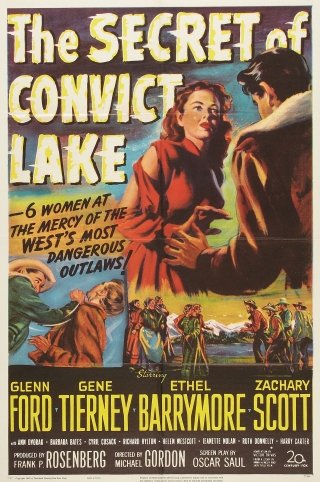
One of the joys of collecting and watching movies is that, from time to time, you chance upon a little neglected gem. Sure, there are the disappointments too but that’s more than balanced out by the buzz of seeing something previously unknown for the first time and liking it. The Secret of Convict Lake (1951) was a movie I’d never heard of before I acquired it. Anyway, I thought I’d give it a go for a number of reasons: the cast was great, the title was evocative, and the cover looked quite cool. Having seen it now, I have no regrets about this particular purchase and it’s a film I can see myself revisiting. It’s a compact little western with noirish undertones and good performances all round.

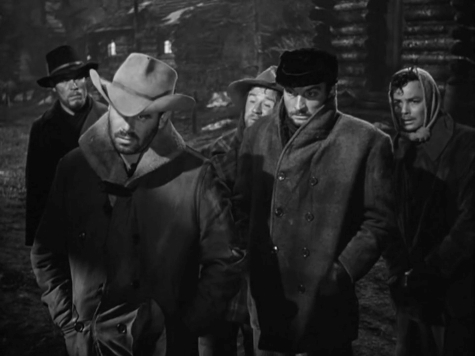
Any western involving snow inevitably gets the thumbs up from me, and this one opens with a group of men fighting their way through a white, mountainous landscape. The voiceover informs us that we’re looking at six convicts (soon to be five as one freezes to death) who have broken out of prison and are trying to keep ahead of the pursuing posse. When a blizzard forces the hunters to abandon the chase, the remaining fugitives find themselves on a ridge overlooking a small settlement. After the hellish trek the collection of small dwellings with soft lights spilling from them look very inviting. A quick reconnaissance reveals that the only inhabitants are women, their men having yet to return from prospecting. Right away the conflict at the centre of the picture is before us: a bunch of frozen and half-starved criminals fresh out of prison are confronted with a community of frontier-hardened females who aren’t shy of guns but nor are they without compassion. An uneasy compromise is struck whereby the convicts are to be fed and lodged long enough to allow them to regain enough strength to continue on their way, but they must keep to their assigned quarters. The women are dominated by a trio of well-defined stock characters: Granny (Ethel Barrymore) is the tough old matriarch, Rachel (Ann Dvorak) a spinster who hears the clock ticking louder every day, and Marcia (Gene Tierney) an outsider with a questionable past who’s engaged to Rachel’s brother. The balance of power among the fugitives rests uneasily between Canfield (Glenn Ford) and Greer (Zachary Scott), with the latter counting on the greed of the others to bolster his position. The thing is that Canfield was convicted of robbery and murder, and the $40,000 he is said to have stolen has never been recovered. Greer wants that money badly but Canfield wants something else, the man whose perjury delivered him to the hangman. The rest of the convicts comprise a thug, a bragging Englishman and a mentally unstable young man with a penchant for killing women. Factor in the added complication that the man Canfield’s seeking happens to be Marcia’s betrothed and the situation bristles with explosive potential. The film’s hour and twenty minute running time packs in a powerful mix of sexual tension and the looming threat of violence before coming to a satisfying conclusion.

£8

The Secret of Convict Lake comes near the mid-point of director Michael Gordon’s career, one derailed by the blacklist. Until then he’d been making B programmers and a few noir pictures, the enforced break would be followed by a move to glossy Ross Hunter/Robert Arthur productions. While this isn’t a straight film noir Gordon’s direction, Leo Tover’s moody photography and Sol Kaplan’s doom laden score all combine to create a darkly atmospheric western. The casting of Ford, Tierney, Scott and perennial heavy Jack Lambert add to the noir feel of proceedings. Glenn Ford was able to play these kinds of uncomfortable outsiders with his eyes closed and Canfield is another in a long line of basically right guys who’ve been screwed over by circumstances. He’s a man who’s been brought face to face with death and has only his quest for justice or vengeance to keep him going. Zachary Scott, on the other hand, is all slime and self interest, prepared to use everyone to get what he wants. His calculating seduction of Ann Dvorak’s frustrated old maid is both creepy and (from her point of view) tragic. Gene Tierney’s natural beauty could never quite mask the demons struggling inside her, but that often worked in her favour on screen. Her Marcia is a similarly troubled soul, a woman with a past she desperately wants to leave behind and who is on the point of marrying a worthless man in order to try to make a fresh start. Canfield’s arrival and his subsequent revelations offer hope and despair in equal measure. Ethel Barrymore gives another variation on her wise old owl turn with a hint of that mischievous eccentricity peeping through – I always appreciate her presence in a movie. A word too for Cyril Cusack, not an actor you expect to see in a western, whose talkative cockney provides Canfield’s ruthless comrades with their most human and sympathetic face.

As far as I’m aware the only release of The Secret of Convict Lake on DVD at the time of writing is the Spanish disc from Fox/Impulso. The film hasn’t had any work done on it but, fortunately, for the most part the image is very strong. There are cue blips and some very minor damage but the elements are generally in good shape leading to a sharp picture with contrast levels that looked fine to me. The downside is that it appears to be interlaced, although I didn’t find that a huge problem to be honest. The mono soundtrack is clear and the Spanish subs are removable by deselecting them via the main menu. Extras are limited to text bios and a gallery. I found the film to be a very entertaining and tightly paced production. There are fine performances all round and, as I mentioned before, a welcome hint of film noir in the script, casting and direction. It’s a strong movie that really ought to be better known, and it gets my approval.

The Return of Frank James

 Titles

It is, and always has been, common for a highly successful film to spawn a sequel. In 1939 Fox produced Jesse James and, riding on the wave of the reinvigorated western genre, found themselves with a hit on their hands. Of course, it’s a little difficult to continue a story when you have just killed off your main character. However, Hollywood rarely finds itself at a loss for long and the solution was to pick up the story where the first film left off and concentrate on the surviving brother, Frank James (Henry Fonda). The only problem was that, after Jesse’s death, Frank’s life wasn’t the stuff of dramatic, action-packed blockbusters. Therefore, the truth needed to be manipulated to present audiences with a story of revenge and redemption.

In the aftermath of the ill-fated raid on the Northfield bank Frank James had gone to ground. We find him living under an assumed name and it would seem that he has renounced his outlaw ways. On receiving news of the death of his brother he is content to let the law run its course, believing that Bob and Charlie Ford will be tried and duly hanged for the murder. It is only when he learns that, despite their conviction, the Fords have been granted a full pardon that he decides to take matters into his own hands and straps on his guns again. There follows a pursuit across the country to Colorado as Frank attempts to track down the Fords and mete out the justice he feels the courts have denied him. By the end of the film all the loose ends have been tied up and we get a traditionally happy ending. The problem with this is that the production code of the time dictated that a killer should not be presented as the hero – or at the very least that he should be punished for his deeds. The way around that issue was to present Frank James as an essentially honorable man hounded into infamy by circumstances and big business. So while the Fords get their comeuppance it is not Frank who is shown to kill them (which is historically true at least). In fact, the film is at pains to point out the innocence and decency of our hero throughout – even having one of the characters declare indignantly that Frank James never killed anyone. All of this is vaguely unsatisfactory since a man setting out on a mission of vengeance should, to my mind, be allowed to achieve some measure of it directly.

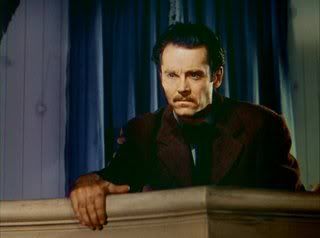
A grim Frank James (Henry Fonda) watches Bob Ford re-enact the murder of his brother.

As I said, Henry Fonda plays the lead very much in the style of the classic romantic hero. Throughout his long career Fonda was most frequently cast as the everyman who was the very epitome of human virtue. Almost thirty years later Sergio Leone would give Fonda the opportunity to finally play a character (also named Frank, as it happens) of pure evil in Once Upon A Time In The West. Gene Tierney (in her debut role) provides some eye-candy and romantic interest as a newspaper reporter, but not much else. Much of the rest of the cast is filled out with actors from the previous film, with John Carradine reprising his part as Bob Ford. Once again, Donald Meek is the conniving railroad boss and Henry Hull chews up every piece of scenery in sight as the editor of the local paper and friend of the family. Hull’s best scenes come towards the end of the film in a flamboyant courtroom defence of Frank on a charge of murder. This scene mirrors reality, where Frank James stood trial for robbery and murder and whose character was attested to by an old Confederate officer. In truth, the film spends a good deal of time on the lingering animosity between north and south in the years following the Civil War. All in all, director Fritz Lang’s first foray into the western genre is a pleasant and entertaining one.

Fox’s DVD release of The Return of Frank James is an improvement on the transfer of Jesse James, but not by much. The image is a good deal more consistent here but darker scenes are still quite murky and washed out. Generally, the outdoor scenes fare the best with stronger colour and sharpness.