The Western Range

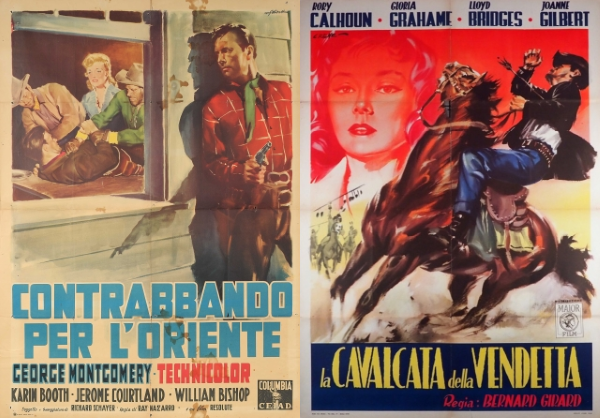
If one is to accept that the second string western, or the programmer or B movie depending on the terminology preferred, represented the bread and butter of the genre during its heyday in the 1950s (and I strongly believe that the assertion should be accepted) then it’s not unreasonable to assume those films would have much in common. Yet, leaving aside the personnel who turn up time again both in front of and behind the camera, there was in fact quite a wide variety on show. I recently watched Cripple Creek (1952) and Ride Out for Revenge (1957) back to back and was struck by how very different these two “lesser” westerns were. Both featured stars (George Montgomery and Rory Calhoun respectively) who are closely associated with such westerns and both work pretty well when taken on their own terms. Nevertheless, tonally, visually and with regard to aims, one might just as easily compare movies from two entirely different genres.

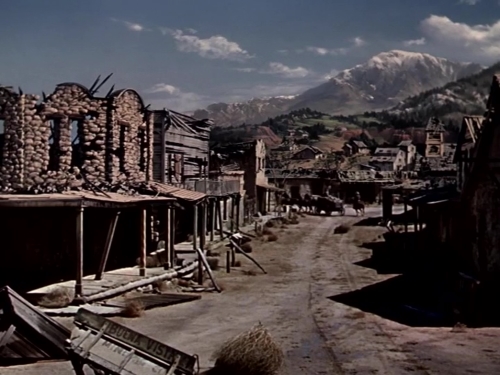
So what have these two pictures got in common? Well the 19th century setting and the locations (Colorado and the Black Hills) are fine for westerns, and both movies have the hunt for gold worked into their scripts. But that’s about as far as it goes. Cripple Creek is in essence a crime movie taking place against  western backdrop, all about gold robberies, smuggling and intrepid Secret Service agents working undercover. And despite a few harder edged scenes, it has a lighter feel to it overall – I’d hesitate to say juvenile, but it does have the kind of cut and dried ethical simplicity about it that means it can be enjoyed by just about anybody regardless of age. I can’t say for sure if I saw the movie myself when I was a youngster but it is the kind of Saturday matinee fare that I tended to lap up at an impressionable age. George Montgomery is heroically square-jawed as the gutsy G-man while William Bishop and John Dehner never leave the viewer in the slightest doubt that they are up to no good. Only Richard Egan, gradually working his way up the billing towards stardom, shows a bit of shading in his characterization. Ray Nazarro serves up a colorful and broadly frothy concoction, a frank piece of lightweight entertainment that never tries to  cajole the viewer into believing it’s anything more than that.

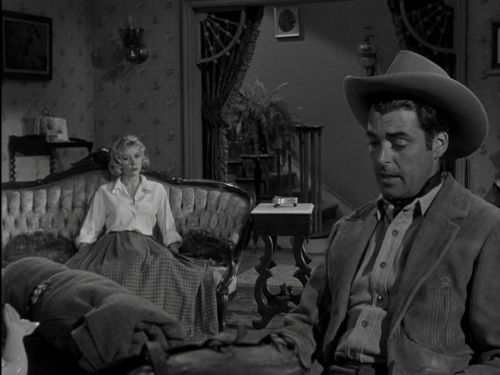
Conversely, Ride Out for Revenge is a much more serious affair. Bernard Girard is clearly shooting on a tight budget but making fine use of Floyd Crosby’s stark black and white cinematography. This is weightier stuff with conflicted marshal Rory Calhoun butting heads with a drunken and incompetent soldier played by Lloyd Bridges. The story explores greed, intolerance and the corrosive effects of unfettered hate on individuals and whole communities. There’s not much to smile about in this movie and there’s a hardness to it befits an exploration of the themes mentioned. There is an interracial romance which is central to the plot – sidelining Gloria Grahame, who appears so completely detached that hers is practically a non-performance – and has the guts to end on a far more hopeful note than is often the case with such storylines in westerns of the time. An early outing for Kirk Douglas’ Bryna Productions, Ride Out for Revenge challenges all types of prejudice and even the whole idea of manifest destiny.

So, there you have it: two westerns made just five years apart, both a step below the A list yet both radically different in look, theme and mood. The sheer malleability of the western in the classic era has always struck me and I guess I could have chosen plenty of other examples from this general time period to illustrate this.


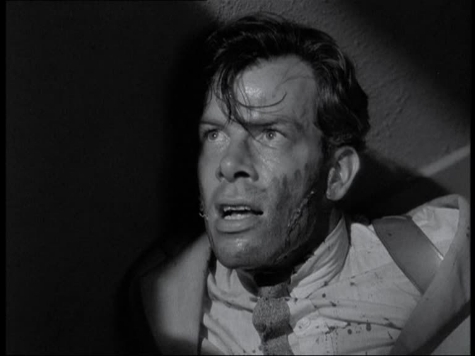
Human Desire

Fate and free will, two philosophical concepts that go to the heart of the human condition and form the basis of a good deal of religious thinking and debate. They loom large in the world of film noir too, though that shouldn’t come as any great surprise since art and our perception of our place in the scheme of things are inseparably linked. Fritz Lang’s Human Desire (1954), made as he was approaching the end of his time in Hollywood, posits both fate and free will as drivers of his characters and invites viewers to make up their own minds on which exerts the more powerful influence. I’m of the opinion that Lang himself regards both of these concepts as being in play simultaneously and that there are certain points at which individuals have the opportunity to exercise their free will in order to determine which path of fate they will lock themselves into.

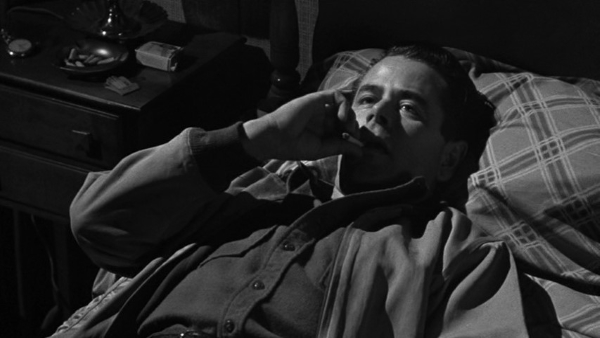
If one were to seek a visual metaphor for fate as a fixed and predetermined path, then a railway line is as good a one as any. Sleek and clean, indicative of precision and order, the lines forge the way ahead, carrying their passengers to a destination that lies at the end of the track as sure as a compass needle points to north. Yet the lines run in more than one direction and points do exist where it’s possible to shunt from one to the other. Human Desire opens with those railroad lines and the locomotives that carry all kinds of people to all kinds of places, starting and ending with absolute certainty at predefined locations that can no more be avoided or cheated than birth and death themselves. In between though, the choices are available, laid before the driver as he advances and by extension before those he brings along with him on the journey. Jeff Warren (Glenn Ford) is an engineer on the railroad, back home and back in his old job after serving in the Korean War. He is very much a regular guy doing a regular job, following those clearly defined lines in life in many ways. There’s nothing particularly special about him, he’s no medal adorned hero nor does he profess to have any ambitions beyond the desire for an uneventful life. However, a movie with this title must necessarily focus on desires affecting all kinds of people and even changing according to circumstances. Carl Buckley (Broderick Crawford) is an old acquaintance, a man who has risen to assistant yard master while Warren was off at war. He’s a blunt, brutish character, loud of mouth and quick of temper who manages to get himself fired for quarreling with his supervisor.

Desperate to get his job back – he’s only got a few more years to do before he qualifies for a pension after all – he badgers his wife into interceding on his behalf with a big city businessman who he figures has sufficient clout to see him reinstated. His wife Vicki (Gloria Grahame) is much younger and it’s immediately clear from her reaction that there is some history involving herself and the corporate bigwig that goes beyond the fact her mother was once his housekeeper. This is the catalyst for the snarl up in the lives of all concerned that follows. It’s made clear that Vicki gets Carl his job back by offering sexual favors. Even though he brought about this situation and essentially forced his wife into a compromising position, Carl is affronted, savagely beating her and making her an unwilling accessory to murder. A sordid business all round and one whose spreading ripples draw in Jeff Warren, who just happens to be riding the same train when the killing takes place and subsequently finds himself fatally attracted to Vicki.

Does one slaying inevitably lead to another? Do abusive, dehumanizing relationships become habit forming and addictive? Are the patterns woven by rotten choices and poor judgement indelible? Or can a virtual lever be pulled at the crucial point and send a life back onto a track that hauls it away from destruction? All of these questions are posed during the course of Human Desire and are answered at least in part by the close. While I’ve no wish to take any credit away from scriptwriter Alfred Hayes, adapting Jean Renoir’s own adaptation of an Émile Zola novel, it seems clear enough that these are themes Lang addressed on multiple occasions and thus carry the director’s imprint too.

Glenn Ford’s everyman qualities are to the fore in Human Desire. He plays Jeff Warren with a directness and simplicity that befits an uncomplicated working man who is unexpectedly snared in a web of temptation and desire. He is faced with the dilemma of succumbing to the vagaries of fate or using his free will to chart an alternative course. Ford’s ability to present frankness alongside a hint of personal dissatisfaction and discomfort works well under the circumstances. I see a touch of resentment early on in his realization that men like Buckley have prospered while he was doing his duty in Korea, it’s just barely there but I think it helps color some of his subsequent actions and decisions. In contrast, Gloria Grahame’s mistreated femme fatale is anything but straightforward, veering from victim to manipulator, cowering one moment and goading the next, and effortlessly alluring throughout. Her work alongside Ford here makes for an interesting companion piece to their previous collaboration with Lang in The Big Heat. Crawford too is neatly cast, by turns shambling and violent he’s a doomed figure haunted by his inadequacy and too ineffectual to challenge his own fate. On the other hand, Edgar Buchanan and Diane DeLaire as Ford’s landlord/colleague and his wife provide an alternative take on marriage. Their affectionate devotion in effect represents the other route available to Ford, in stark contrast to the dysfunctional dynamic of the Grahame-Crawford mismatch.

Human Desire ought to be easy enough to view these days. I have the UK Blu-ray from Eureka, a dual format release that looks terrific, and there is a Kino version available in the US as well. The main supplemental feature on the Eureka Blu-ray consists of an interview with Tony Rayns which fills in some background information on the making of the movie as well as comments on scriptwriter Hayes. I’m not sure the contributor fully gets the film though and he raises a number of points I found myself taking issue with, not least that tiresome critical gambit of looking at movies in terms of what they are not rather than what they are. Anyway, his is an interesting perspective, even if I don’t share all his conclusions. Personally, I’ve always been fond of Human Desire for its thoughtful exploration of themes and motifs that frequently grace Fritz Lang’s movies. Well worth checking out.

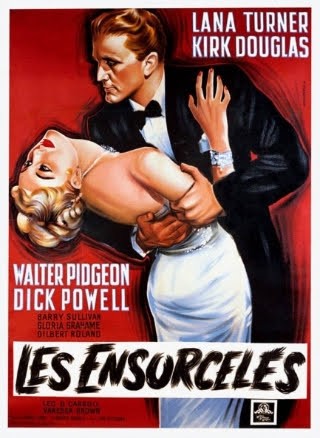
The Bad and the Beautiful

Don’t worry. Some of the best movies are made by people working together who hate each other’s guts.

Seeing as Kirk Douglas celebrates his 100th birthday today I wanted to make a point of featuring one of his movies to mark the occasion. With one of the great movie stars I figured it would be appropriate to choose a movie about movie-making, not only one of the best of that little sub-genre but one of the best Hollywood has produced. The Bad and the Beautiful (1952) is a carefully crafted piece of work, episodic in structure but with an organic, flowing quality that ensures scenes and sequences segue naturally to provide us with a portrait of a man both shaping and simultaneously being shaped by the cinema. Sounds like a perfect role for Douglas, doesn’t it?

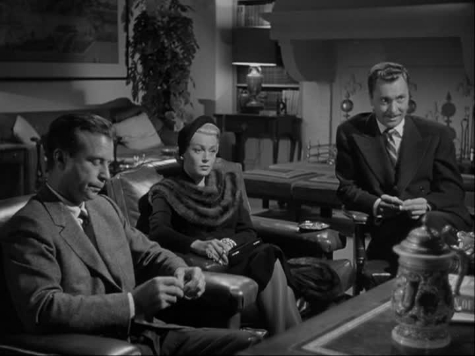
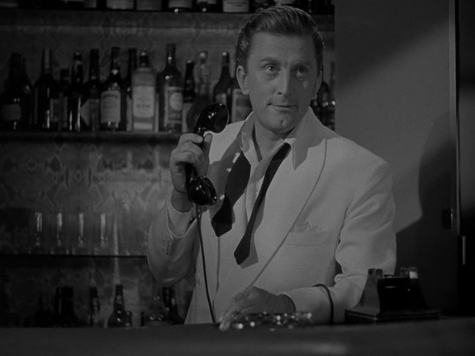
If one wanted to be glib, it could be said the film is the story of a phone call. In fact, it  starts with  a series of telephone calls, three to be exact and each one is rejected with something approaching relish. Three calls to three Hollywood figures, all of whom take pleasure in telling the party at the other end of the line to take a running jump. That guy at the other end of the line is Jonathan Shields (Kirk Douglas), once a big-time producer but now reduced to hearing casual brush-offs across a long distance line. So we’ve got a good hook right here, you do tend to wonder why a man should be summarily dismissed in this fashion. Curiosity is such that we want to know what a man like this has to say, and by the end of the picture those on the screen clearly share this feeling too. In the meantime, we have the build-up, where studio executive Harry Pebbel (Walter Pidgeon) tries to persuade the director (Barry Sullivan), the leading lady (Lana Turner) & the writer (Dick Powell) to at least take Shields’ call and give their collective answer on whether or not they are prepared to work with him one more time.  So, this trio gathers in Pebbel’s office while he, through flashbacks, recalls the way their lives and careers became entwined with that of Shields, and why they feel the way they do about him.
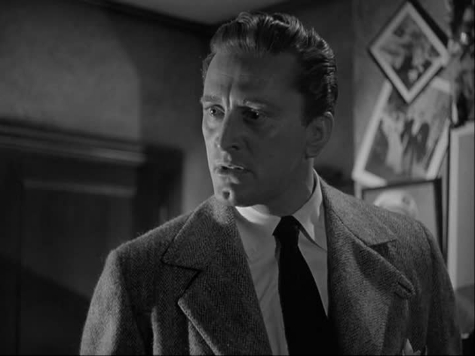
Hollywood thrives on narcissism, it loves to look at itself and can’t resist encouraging us to look at it while it indulges in this introspection. You could say that’s indicative of the all-consuming vanity of the movies, the conviction that audiences will be fascinated by the chance to peek behind the cameras and glimpse the artists and technicians at work and play, that there’s no drama as compelling as the everyday lives of the filmmakers themselves. And I guess they’re right, there’s always been a market for celebrity watching and this has shown no sign of abating any time soon, if anything it’s more intense than ever these days. We sometimes hear about stripping away the glamor but the classic Hollywood exposés didn’t really do that, sure they showed the less savory side of the business and those involved in it but even so they couldn’t help making it look good. As the title of this film suggests, there are some rotten people on screen but they and the world they inhabit remain beautiful and captivating. The Oscar-winning Charles Schnee screenplay focuses on the ruthlessness, the lack of scruples of Shields, the way he’s consistently used and manipulated his colleagues to attain success. Yet, for all that, despite the duplicity and the betrayals, the milieu holds our attention and we’re never allowed to forget that Shields brought success even to those he hurt.

Director Vincente Minnelli clearly enjoyed turning the cameras around since he, and Douglas, would return to the theme 10 years later when they made Two Weeks in Another Town, again scripted by Schnee and produced by John Houseman. He’s always going to be best remembered for his musicals but it has to be said he had a marvelous talent for well-judged melodrama – this movie, the aforementioned Two Weeks in Another Town, Home from the Hill and the dazzling Some Came Running are significant artistic achievements and add up to a highly impressive mini-filmography by themselves.

Kirk Douglas was second billed in The Bad and the Beautiful behind Lana Turner and earned himself his second Oscar nomination. He didn’t win (losing out to Gary Cooper in High Noon that year) and claims in his autobiography to have been surprised by the nomination, believing his roles in Wyler’s Detective Story or Wilder’s Ace in the Hole were more worthy of such an honor. I think this says something about the way Douglas views his own work, seeming to prefer the more driven and less sympathetic parts. While there is much to dislike about Jonathan Shields, it’s said that Minnelli worked on Douglas to bring out the nicer side of the character and tone down the more explosive and less likeable aspects. Which is not to say he doesn’t explode at any point – he does have two fairly intense, in-your-face scenes opposite Lana Turner, but it probably wouldn’t feel like a proper Kirk Douglas film if they weren’t there.

Lana Turner wasn’t an actress who ever impressed me all that much, meaning she was always someone you noticed in a movie (her looks kind of demand that) but whose roles were frequently less memorable, with a few notable exceptions. I think The Bad and the Beautiful ranks as one such exception. The fact she was playing an insecure, alcohol dependent star was an advantage as it required a degree of fragility and vulnerability that Turner was able to convey successfully. In terms of awards though, the big winner among the actresses was Gloria Grahame, who scooped the Oscar for best supporting actress. Grahame was a terrific screen presence, sexy and credible in just about everything I’ve seen her in. Her part in this film is a small one, confined to the section with Dick Powell, yet she doesn’t waste a moment of the time she has. Powell was fine too as her cynical husband, adding an intellectual spin to the kind of insolence he had down pat by this stage. I generally like Barry Sullivan, he was one of those guys who could be a hero or villain (or even something in between) quite effortlessly. He was good enough as the director who sees his idea stolen but it’s an undemanding and perhaps a bit of a thankless part under the circumstances. And there’s plenty of depth in the cast – Walter Pidgeon, Leo G Carroll, Gilbert Roland and Paul Stewart all make contributions.

This is a movie where some people like to see if they can pick which cinema personality each of the main characters was based on – Douglas’ lead appears to be a composite of sorts with the characteristics of at least two producers (one of whom is a cult favorite) on view. Of the others, some are pretty obvious (Lana Turner’s part, for example) while others (like Barry Sullivan) are less so. I won’t go naming any names here – it might spoil a little bit of the fun for some and anyway the curious can easily search online for clues/opinions. That’s just trivial stuff though, the movie provides a masterclass in professionalism and polish where there’s next to nothing to fault in the direction, writing, photography (another Oscar there for Robert Surtees) and acting. The Bad and the Beautiful is an extremely smooth and classy piece of filmmaking, Hollywood writing its own lore and having a good time doing it. The film is easy to find and looks good too, at least my old Warner Brothers DVD does. Viewed for the first or the fiftieth time, it still satisfies.

It’s a rare thing to be able to post something on the occasion of the 100th birthday of a living screen legend, a bona fide star of the Golden Age of cinema, and it gives me a real kick to be able to do so on the day Kirk Douglas hits three figures – congratulations to him and may he see many more.
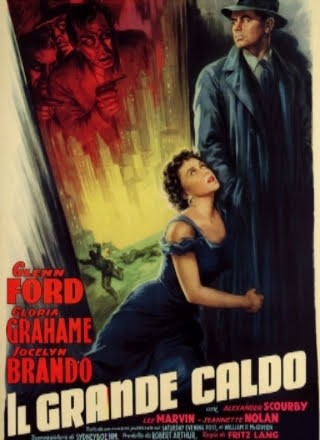
The Big Heat

poster52_zpsuu5u64gu

Over the years I’ve spent a fair bit of time talking about film noir, musing over what it is or isn’t and, perhaps inevitably, looking at quite a few borderline cases. I’m still not sure I could articulate exactly what constitutes film noir – although not being able to do so is hardly a big deal – but I do recognize a clear-cut example when I see it. Fritz Lang’s The Big Heat (1953) comfortably fits the bill with its harsh portrayal of a cruel and corrupt world and the merciless way it treats those who would resist it.

The first thing we see is a man reaching for a revolver and then calmly blowing his brains out as he sits at the desk in his front room. His wife (Jeanette Nolan) is alerted by the gunshot and appears shocked, but not too much and certainly not overcome by grief. If anything, she’s drawn more to the document her late husband left behind. The recently deceased was a cop, a dirty one who had been bought and paid for by the mob, and also smart enough to have retained some insurance. As the investigating officer, Bannion (Glenn Ford), remarks, when a cop takes his own life the department is always interested to find out the reason. Initially, there’s no reason to doubt the widow’s claims that her husband was suffering from ill-health and the case looks to be an open and shut one. Even when a girl in a clip joint makes allegations about a less than satisfactory private life, there’s nothing to prove it’s anything other than talk. It’s only after Bannion starts to get gently warned off that he grows more suspicious. As the underworld flexes its muscles and reveals the violence that has been lurking behind the thinnest of veils the full extent of official corruption becomes apparent. Had Bannion been prepared to play the game, matters would have ended there. However, his persistence, and perhaps recklessness or naivety, brings tragedy right into his own parlor. With the whole fabric of his being torn down around him, Bannion moves himself out to the fringes of society where he allows himself to become consumed with hatred, frustration and an unquenchable desire for vengeance.

£2

I’ve never made any secret of the fact I’m a big fan of Fritz Lang, and I’m especially fond of his Hollywood movies. Towards the end of his time in the US the budgets he operated under seemed to shrink but he always had a talent for economy in his storytelling anyway. The Big Heat exemplifies this neatly in the no-nonsense way it plunges headlong into the tale from the very first shot. The whole movie is a lean affair, pared down to its essentials visually, thematically and in terms of dialogue too. There’s no waste – not a word nor a gesture appears which doesn’t serve to drive the narrative on. Even the central idea (that of institutional corruption, an increasing staple of 50s film noir) is addressed in direct, matter-of-fact terms.

One of the most interesting aspects, for me at least, was the contrasting portrayal of family life on view. We’re introduced to Bannion’s domestic setup early on and it’s an attractive one, defined by the affection and banter between the detective and his wife (Jocelyn Brando) and the simple yet wholesome way they’re living. Later, when we’re introduced to the chief mobster, Lagana (Alexander Scourby), it’s a very different world which is presented. Where Bannion’s home is a relaxed place filled with informal conversation, Lagana’s mansion feels like a mausoleum of respectability, a soulless place where no hint of “dirty” talk is tolerated.

The other notable point to be made about The Big Heat is the frank way that violence is depicted. There’s real brutality in the actions of the mob and its principal enforcer (Lee Marvin), a sadistic pleasure derived from the infliction of pain and suffering. The film came along quite early in Marvin’s career and gave him the kind of role that was something of a gift for a young actor. In another of those instances of mirroring Ford’s honest cop is driven right to the brink of sanity and morality – he comes to embrace violence with almost the same gusto as Marvin’s sociopath. The crucial difference here though is that Ford draws himself back before he fully succumbs to his basest instincts. Actually, it’s a very solid part for him, requiring him to exercise a fair bit of range as his character travels along the painful arc from contented family man, through heartbreak and loss, to cold avenger. He’s partially saved or redeemed by his own innate decency, but an even more significant influence is provided by Gloria Grahame’s unfortunate moll. It’s her actions and what happens to her that breaks everything wide open, giving Ford his first real leads and also reawakening his ability to identify and empathize with people again. Ultimately, while The Big Heat is a film which sees very bad things happen to people, its message is a positive one about human nature. Sure society has its share of rottenness and violence may be lurking just round the corner, but decent people remain so at heart and there are always those willing to lay it on the line to help others.

£3

There was a time when it was difficult to see all of Fritz Lang’s films, although that’s no longer the case. Even back in the days when one had to search around for his stuff The Big Heat was one of the more accessible titles – I think it may actually have been one of the first films by the director I ever saw, at a time when his name wouldn’t have registered with me. Now there are a variety of DVDs and Blu-rays available from different territories so there should be no problem finding a suitable copy of the movie to view. I would imagine that most people with even a passing acquaintance with Lang will be aware of this film – it’s generally well regarded and the casting probably helps. Needless to say, it’s highly recommended for anyone who has yet to view it.