The Big Country

poster204

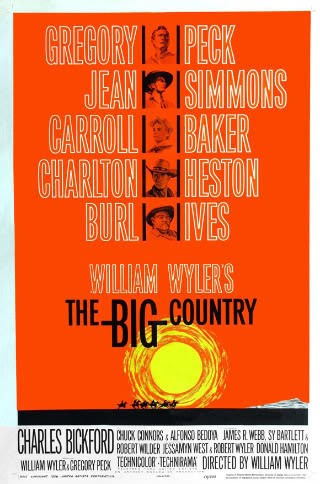
The Big Country (1958) has been described as a Cold War allegory, and I guess the reasons for that are fairly clear for anyone who wants to see them. It’s also been referred to as a traditional “stranger in a strange land” style tale, which is once again obvious enough. Whilst the latter is a theme that’s been visited too many times to mention, the former tends to date movies badly if that’s all there is on offer; one has only to compare a one-note diatribe like Ralph Nelson’s Soldier Blue to multi-layered works such as Peckinpah’s The Wild Bunch, Richard Brooks’ The Professionals, or Aldrich’s Ulzana’s Raid to see the difference. What raises The Big Country above a trite critique of contemporary politics and lends it a timeless relevance is the fact that it’s also an examination of man (or should I say men) and what he’s made of. The hero continuously has his masculinity questioned and challenged, and it’s his refusal to play others’ games and conform to preconceived ideas of how he should or should not act that builds up his stature in the viewer’s eyes while, conversely, it is diminished in the eyes of his fellow characters.

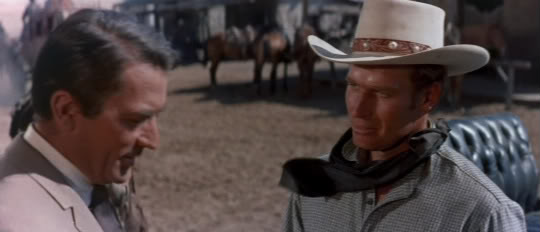
Jim McKay (Gregory Peck) is the archetypal easterner come west. His arrival is enough to literally stop the locals in their tracks, gazing in wonder at this alien figure with his trim suit and odd hat. McKay is a seaman who’s come to this new land to wed Pat Terrill (Carroll Baker), daughter of a wealthy rancher. Within a very short time McKay has a run in with Buck Hannassey (Chuck Connors) and his brothers, and so gets his first taste of the situation he’s landed himself in. The Hannassey’s are a rough and ready clan of ranchers engaged in an off and on vendetta with McKay’s future father-in-law Major Terrill (Charles Bickford). The cause of the feud is a piece of land that both families covet due to its providing that most valuable of commodities in the parched prairies of the old west, water. Having said that, the bitterness and venom that both Pat and the Major express when speaking of their not so welcome neighbours hints at some deeper source for the rivalry. Right away you can sense McKay’s unease at the raw hatred he’s exposed to, and the fact that he refuses to share in it and even backs off confronting the Hannassey’s shocks his bride-to-be. In fact, McKay seems to do nothing but disappoint his betrothed; he avoids taking a ride on the unbroken horse that’s traditionally wheeled out to give all newcomers a rough welcome, and worst of all turns his back on a fight that the Major’s foreman Steve Leech (Charlton Heston) goads him into. As far as Pat is concerned, these all amount to calculated insults and his shunning of such public displays of machismo cast doubts on his manhood and, by extension, on her pride and judgement. However, the viewer gets to see what Pat and her father don’t: that McKay is no coward, he’s merely a man with a deep sense of personal honour who’s offended by the act of showing off to others and proving to them that which he’s very sure of himself. When Pat rides off in a huff, and the Major and Steve go hunting vengeance, McKay quietly takes out that unbroken horse and sets about taming it. Time and again the animal hurls him into the dust of the corral, and time and again McKay gets back in the saddle until he finally bends it to his will.

The thing about McKay is he’s spent years sailing the oceans of the world and knows full well what hardships he’s capable of enduring. He feels no obligation to show the Major what a big man he is for the simple reason that he’s already proven that to himself. To McKay, that’s all that matters: that a man should know his own abilities and that his woman should believe in him just because she is his woman. For Pat, however, that’s not the case and she comes to feel shame for having chosen a man who regards acts of bravado as beneath him. If further evidence were needed of McKay’s physical courage then it comes in a remarkable night time scene. Having begged off a public brawl with Steve, McKay pays him a nocturnal visit to “say goodbye”. The two men walk out onto the moonlit prairie and engage in a brutal fist fight that was marvellously filmed and choreographed. Director William Wyler shot the whole scene without music and the only sounds heard throughout are the grunts and gasps of the two men punctuated by the thud of bone striking flesh. Wyler also made excellent use of the camera in that scene, alternating between close-up, medium and ever widening long shots that point up not only the isolation of McKay and Steve but also their insect-like insignificance (and indeed the insignificance of their struggle) in that vast landscape. By the end of their bout, as both men stand bruised and bleeding, McKay asks Steve what he thinks that has proved. In addition, there’s also the standoff with Buck late on, when he rides into the Hannassey’s place to try and rescue Julie Maragon (Jean Simmons) and head off a bloodbath in the making. As Rufus (Burl Ives), the patriarch of the Hannassey’s, does the honours the two men take the requisite number of paces and turn to face each other down the barrels of McKay’s antique duelling pistols.
£3

I’ve already mentioned William Wyler’s masterful use of the wide lens, but it’s to be seen all the way through the film. The whole thing is a visual delight that takes in both the sprawling prairie vistas and the blanched rocks of the canyon between Terrill’s ranch and the Hannassey’s place. Blanco Canyon is the setting for the scene that, for me at least, is just about the finest in the picture. The Major has decided that a showdown with the Hannassey’s is unavoidable and sets off to finish things for good. When it becomes apparent that he and his men will be riding into an ambush, the Major turns to Steve for support. However, this man has had his bellyful of mindless violence and says so. The Major rides off alone to meet whatever fate awaits him. Steve has looked on this man as a surrogate father all his life and you can see the anguish etched into his features as he watches him depart. He mounts up, and the camera moves to the mouth of the canyon and the lone figure of the Major. As Jerome Moross’ spine-tingling score slowly builds the angle shifts slightly and Steve gallops into view, drawing level with the Major he looks back to see the rest of the ranch hands come one by one round the rim of the canyon. There’s not a word exchanged between Heston or Bickford but the flickering glances and quickly concealed smiles speak volumes. To me this is cinema at its purest, where visuals, score and subtle expression tell the viewers all they need to know about the nature of a relationship, and in this case what masculinity is about – the importance of loyalty, affection and sheer guts even when good sense should dictate otherwise.

I honestly couldn’t criticise any of the performances and just about every major character felt fully rounded. Peck’s hero is maybe too straight down the line but that’s a minor complaint when you consider that such a role was necessary amid all the complexity elsewhere. Charles Bickford should be the guy to hiss at, but the raw courage and determination he invests in the Major tempers the less savoury aspects. There aren’t really any absolute villains in The Big Country, Chuck Connors comes the closest but even he is more to be pitied than anything. He shows himself to be only a step or two above an animal towards the end but it’s hard not to see him as something of a victim of circumstance in some respects too. I thought Charlton Heston gave one of his best performances in a role that ensured he got to act in a restrained and measured way, his lower billing probably contributing to that. Burl Ives picked up a Best Supporting Actor Oscar for his part and I’d say he deserved it on the basis of a couple of memorable scenes alone – his gatecrashing of Major Terrill’s party and the climax, where he is forced to do the unthinkable, immediately spring to mind. Both Jean Simmons and Carroll Baker did well portraying two opposite sides of the female character and made the most of their screen time.

MGM’s R2 DVD of The Big Country is slightly disappointing. The anamorphic scope image is generally clean and sharp with good colours but there are some really irritating instances of shimmer, especially when any of the wooden buildings are on view. What’s maybe more annoying is the fact that the disc is practically barebones. This is an important film, and not simply because it’s an epic production; it’s a movie that’s both visually and thematically rich and deserves better. Anyway, despite some reservations about the DVD the film itself is a genuine classic that ought to have a place on the shelf of those who consider themselves western fans, or even just fans of quality cinema.

The Stalking Moon

£20

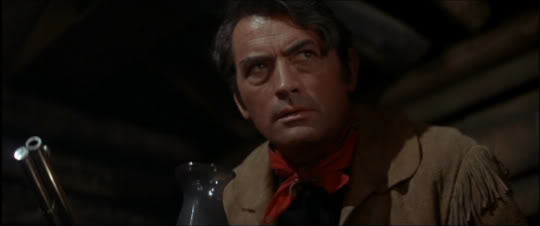
Thanks to the suggestion of a fellow blogger, le0pard13, I decided to dig out and rewatch Robert Mulligan’s 1968 suspense western The Stalking Moon. Although the film contains its fair share of action, it is essentially a slow burning mood picture which builds tension almost imperceptibly yet inexorably towards a conclusion that is both nerve-wracking and satisfying. A good part of its strength comes from the fact that it can be approached from a variety of angles; as the standard chase picture, an examination of race relations, a love story, a tale of friendship, and it even has a suggestion of the supernatural.

Sam Varner (Gregory Peck) is an army scout on the verge of retirement, having already bought a ranch in New Mexico. His last job for the army, helping bring a band of Apaches in to the reservation, leads to the rescue of a white woman who has been held captive for ten years. This woman, Sarah Carver (Eva Marie Saint), has a young half- breed son in tow and manages to persuade Varner to escort her to the nearest coach stop and help her on her way. At first, her eagerness to distance herself from her rescuers might appear to be rooted in some sense of shame at having given herself to the Apache – an idea reinforced by an uncomfortable stopover at a remote swing station. However, it soon becomes apparent that her desire to be on the move is based on an altogether more serious threat. It turns out that her boy is the son of Salvaje, a renegade Apache with a fearsome reputation. So begins a relentless pursuit that leads to Varner’s ranch and, eventually, a one man siege of the log cabin that seems to grow smaller by the second. All the while, the spectral presence of Salvaje lurks in the shadows or flits from rock to rock and the viewer starts to wonder if this man is indeed human. The film’s masterstroke is keeping Salvaje off the screen for so long; he remains a cipher, a kind of bogeyman who is spoken of in hushed tones but never seen. Even when he does appear, we are only given a fleeting glimpse of him before he vanishes again like some terrible force of nature leaving death and chaos in his wake.

£21

Gregory Peck plays another of his stoical, straight down the line characters in The Stalking Moon. In truth, it’s one of those classic western roles wherein the hero knows that the right thing to do is the unhealthy option but goes ahead with it all the same. In this case Varner has the chance to put Sarah on a train and let someone else deal with the whole mess, but his own sense of honour rules that out. As he toys with his food and gazes repeatedly at the lonely, forlorn figure sitting on the train platform it’s obvious what he’s going to do. Peck was always fine in those parts where his character had to draw on that inner steel to tough out the most hopeless of situations, and the role of Sam Varner might have been tailor made for him. Eva Marie Saint is also good in a difficult part, a woman who has become something of a stranger among her own people and little more than a misplaced possession to the mysterious Salvaje. In a movie that’s short on dialogue she has few lines to speak yet manages to convey the vulnerability of her character without diluting any of the resolve that would have been required to live the way she did. Robert Forster makes an early appearance as Peck’s half breed friend and fellow scout who proves his loyalty right to the end. The Stalking Moon was the only western made by director Robert Mulligan, and that’s something of a shame since he did an excellent job and seemed at home in the genre. He made excellent use of the locations (Nevada standing in for New Mexico) and the widescreen photography to emphasise the isolation of his characters. The open spaces of the first half of the film highlight not only the vastness of the country but also the relentless nature of Salvaje who will follow Sarah to the ends of the earth if necessary. In contrast, the second half becomes claustrophobic with Varner’s cabin, and the encroaching mountains and trees, becoming the focal point.

Warner put The Stalking Moon out on DVD last year in R1 as part of their Western Classics box and it’s also available in much of R2, though not the UK yet, as a stand alone title. It’s been given a fine anamorphic scope transfer with good colour and detail. The disc is as basic as they come without even a scene selection menu, but that seems to be par for the course with WB at the moment. Having said that, it’s a movie that does manage to sell itself on its own merits. There are those who have put forward the theory that Once Upon A Time In The West has a hint of the supernatural about it, with the possibility of Harmonica being an avenging ghost. Eastwood’s High Plains Drifter and Pale Rider also play around with a similar idea and I don’t think it’s too much of a stretch to view Salvaje in The Stalking Moon in that company. Anyway, it’s a damn fine film and one that’s well worth seeing.

The Bravados

There’s something so deeply satisfying about watching 1950s westerns that I sometimes feel I could dedicate an entire blog to them and still only scratch the surface. Just about every star and director of note managed to produce, at the very least, one quality western during those few short years. While the cinematography ran from monochrome and Academy ratio to technicolor drenched scope, one feature remained constant: maturity of theme.

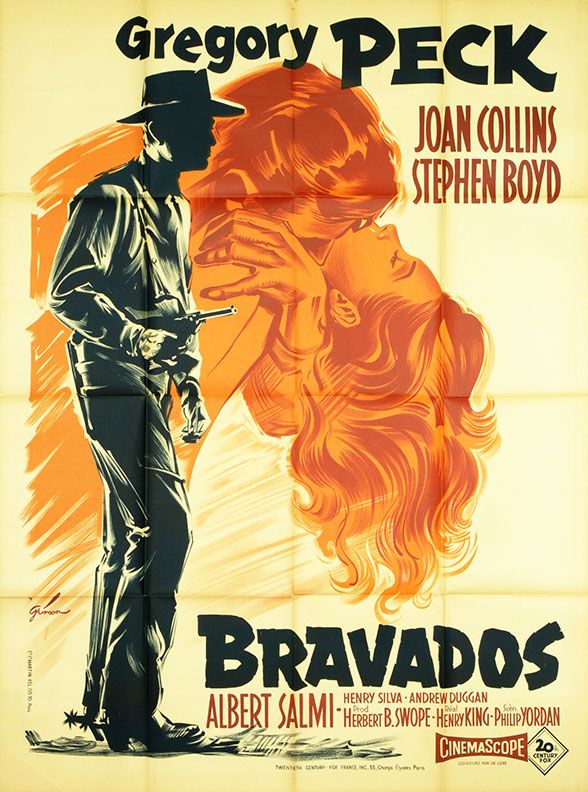
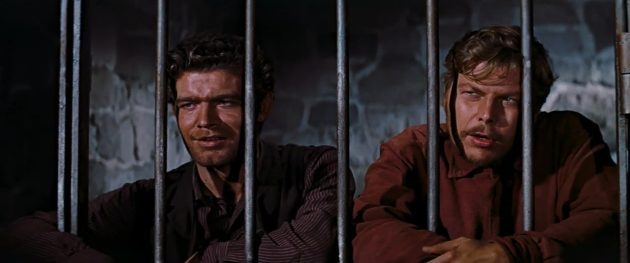
The Bravados (1958) opens in dramatic fashion with a silhouetted rider driving himself on through the night to the accompaniment of Lionel Newman’s pounding score while the blood red titles flash onto the screen. The rider is revealed to be Jim Douglass (Gregory Peck), a man obsessed enough to ride a hundred miles just to witness the execution of four men he’s never seen before (Stephen Boyd, Henry Silva, Lee Van Cleef and Albert Salmi). Initially there’s no explanation offered for Douglass’ desire to see these men keep their date with the hangman. The only thing that’s clear is that he’s nursing a deep and bitter hatred – perfectly realized in a wordless scene in the jail as Douglass walks along outside the bars and rakes each man in turn with a look of such malice that they flinch as though a lash had been applied. It’s only after the four have escaped, taking the storekeepers daughter hostage, that the reason for Douglass’ personal vendetta is revealed. It transpires that his wife has been raped and murdered and he believes that these men are the ones responsible. What follows is a tale of pursuit, revenge, realization, and finally a kind of sour redemption. The only false note in the picture is the introduction of an unnecessary and less than believable romance between Douglass and a Mexican rancher (a woefully miscast Joan Collins). This really adds nothing whatsoever to the film and actually serves to weaken it – the final ten minutes pack a powerful emotional punch but the last shot takes a good deal of the sting out of it. I think it’s also worth mentioning that I was left wondering if The Bravados had any influence on Sergio Leone. Maybe it’s just me but I couldn’t help but notice parallels with For a Few Dollars More: the taciturn anti-hero, the watch with his dead wife’s photo that Douglass carries and shows to his victims before killing them, the grimy and sadistic villains, and the ride along the deserted street of a Mexican pueblo before a showdown.

Gregory Peck gave a remarkably intense performance in a complex role that’s basically a study of bitterness, obsession and false conviction. His playing of a man who has cast aside his soul in the pursuit of vengeance is pitch perfect. As the story progresses the viewer understands that Douglass has become no better than the criminals he is ruthlessly hunting down, but it’s his own final realization of that fact that raises the movie to a higher class. Peck does a fine job of showing the psychological disintegration of a man who has his illusions stripped away and must henceforth look at himself in a new and disturbing light. Stephen Boyd clearly had a ball portraying the chief badman and slipped from smirking charm to menacing brutishness with ease. I’ve always been a big fan of Boyd and have enjoyed his performances in everything I’ve seen him in. His best work was as the villain and when the big lead parts came along he was a touch unlucky – a poorly written role and no chemistry with Sophia Loren in Fall of the Roman Empire, almost becoming James Bond, and having production delays force him to relinquish the role of Mark Antony to Richard Burton in Cleopatra. I was prepared to write some scathing comments about the wooden acting of Joan Collins in this movie but I can’t seem to work up the enthusiasm – although how anyone ever thought it was a good idea to cast her as a Mexican cattlewoman just beggars belief.

Henry King was one of those directors that the studio system seemed to have in abundance, the skilled craftsman who could effortlessly churn out quality pictures in just about every genre. His name is hardly a familiar one today but a glance at his filmography makes for impressive reading and contains far more hits than misses. King’s work on The Bravados is aided immeasurably by Leon Shamroy’s cinematography, which mixes stunning landscape views with moody day for night shooting to great effect.

The Bravados is available on DVD from Fox and their R2 Studio Classics version (I imagine the R1 is broadly similar) is a perfectly fine anamorphic scope transfer with nice colours. There’s not an extra feature in sight (I think the R1 has a trailer) but it is cheap. This is a movie that often gets overlooked and is rarely mentioned, but if you’re a fan of westerns from this era you need to see it. Highly recommended.

Mackenna’s Gold

£2

Well, time to roll out one of my guilty pleasures. Mackenna’s Gold (1969) is one of those movies I saw as a youngster and which has entertained me ever since. Everyone knows that the age at which you first see a film is a major factor influencing how much you appreciate it. When I was a little boy this film seemed like the best western I’d ever seen. It had everything you could ask for: a strong hero, a roguish villain, cavalry, Mexican bandits, menacing Apaches, and lots of action. I’m a good deal older and more jaded now and I no longer think it’s a great western, but it is a great fun western. Sure, I can see all it’s shortcomings now and, if I wanted to be coldly objective, I could probably savage it. But I  don’t feel like being objective; this movie was a genuine childhood pleasure and I intend to hang on to the memory.

There’s a great opening sequence with Joe MacDonald’s camera swooping and soaring over a primal western landscape to the accompaniment of Victor Jory’s narration and Jose Feliciano’s theme song. Ancient buttes and mesas rise up from the parched desert floor before the circling camera locks onto a lone figure and zooms in on an equally ancient Indian on horseback. This old man, Prairie Dog (Eduardo Ciannelli), is carrying a map that reveals the location of a mythical canyon of gold. Before dying he passes on the map to Marshal MacKenna (Gregory Peck), but the marshal has little faith in such tall tales and promptly burns the document. When he is subsequently captured by an outlaw band led by Omar Sharif, he is forced to lead them to the canyon whose whereabouts he has memorized. As the treasure hunt progresses more people are drawn in, notably a number of the leading citizens of the nearest town. There are ambushes, Indian attacks, betrayals and more before the whole thing wraps up with a psychedelic sunrise and a massive earthquake. And let’s not forget there’s the very welcome sight of Julie (Catwoman) Newmar stripping off for a swim in among all that.

dlcvhmz

The acting tends to come second in a piece of fluff like this, and that’s pretty much the case here. Gregory Peck is as stoic (those who wish to be unkind might say wooden) as usual in a part that doesn’t call for much more than that. Leaving aside the Egyptian cowboy and the Italian Indian, the best bits come from the starry citizenry of the town (Lee J. Cobb, Edward G. Robinson, Anthony Quayle, Burgess Meredith, Raymond Massey and Eli Wallach) although they have little more than cameo roles and don’t last too long before being massacred. Telly Savalas was generally worth watching when he got to play a villainous part and he’s not bad as a greed fuelled cavalry sergeant.

The direction of J. Lee Thompson, and Carl Foreman’s script keep things moving along fast enough to paper over many of the plot holes and gaps in logic. The action scenes are well filmed, but then you would expect that from Thompson. There’s also some fantastic location photography from veteran cinematographer Joe MacDonald but, despite that, there’s too much reliance on obvious back projection. The only real complaint I have is one shockingly bad effects shot which involves a rope bridge and what looks like an Action Man tied to a toy horse.

OK, this is no masterpiece of cinema but, as I said, it is a movie that I have fond memories of and I’m willing to overlook or forgive many of its faults. Perhaps others who came to it later in life would not be so generous. Sony’s DVD of Mackenna’s Gold is a reasonable transfer. I have the R2 which is anamorphic scope (I have heard that the R1 may be a pan and scan effort – if I’m wrong, feel free to correct me) and it is generally clear but the process shots do stick out like a sore thumb.