Young Guns

Poster

Such is the nature of this series of reviews that we go from the sublime to…well, Young Guns (1988). To be honest, it’s hard for me to find very many positive things to say about this one. It seems to be touted as the most historically accurate movie dealing with the life and times of Mr Bonney, but that’s really only in a superficial sense – events take place out of order, characters are missing or misrepresented, and people are shown to die in ways and at times they never did. But OK, it’s a film and you have to expect some of that. For me, the biggest problem is the poor acting of the “Brat Pack” stars. There’s nothing the least bit convincing about any of the central performances nor is there any real feel for time and place.

The plot deals with the events leading up to and during the Lincoln County War. It starts off with Billy (Emilio Estevez) being taken in by Tunstall (Terence Stamp) and his integration into the group of Regulators (of course they weren’t actually known as Regulators until after Tunstall’s death) that act as hired muscle. Now, there’s a problem here right away; the Regulators were, by all accounts, a bunch of tough gunmen who were ruthless by nature. What the movie presents us with, however, is a collection of soft looking post-adolescents being tutored by the kindly Tunstall. Mind you, this set up does allow the chief villain, Murphy (Jack Palance), to toss out a loaded line about Tunstall’s interest in “educating” young boys. There’s also an allusion made to the Old World grudges fuelling the rivalry – Murphy being an Irish immigrant and Tunstall a wealthy Englishman – but nothing further comes of that. Such bad feelings weren’t the source of the conflict, but it might have made for an interesting plot device if it had been explored in more depth – after all, the script doesn’t shy away from other departures from the truth. With the assassination of Tunstall, the story gets down to the serious business of depicting as many tit-for-tat killings as can be squeezed into the running time. This gives rise to another scripting issue; the action tears headlong from one manic and confused gunfight to the next, with characters popping up and being dispatched before you get a chance to even realise who they are. There’s never a sense that you’re getting to know anything of substance about the leads, except maybe Chavez (Lou Diamond Phillips) and Doc Scurlock (Kiefer Sutherland). And even then the results are nothing to write home about; the former plays out an embarrassingly bad scene where he explains his motivation, and the latter is handed a horribly tacked on romance in between his poetry writing sessions. So the plot charges its way towards the climactic Battle of Lincoln – one of the better staged sequences – before coming to a pretty dumb conclusion.

All guns blazing - Emilio Estevez as the Kid.

Essentially, this film is trying to pack too many events and people into its running time, leading to clutter and an unsatisfactory lack of development. As the Kid, Emilio Estevez comes across as a kind of giggling fool with no character progression whatsoever from the opening until the ending. I already mentioned the low point of Lou Diamond Phillips getting in touch with his angst, but his “mystic Indian” schtick all through the movie is both dull and cliched. I think Kiefer Sutherland probably fares better than any of the other young stars, though it has to be said that the attempts to portray Doc Scurlock as some kind of sensitive and bookish intellectual feel too much like an affectation. Also the romantic subplot involving the Asian girl really serves no purpose other than to show what a bad man Murphy is. In truth, that’s not even necessary as Jack Palance’s presence should be enough in itself. Sure the old-timer leers and hams it up, but even so he still blows the so-called stars away every time he appears. Which brings me to the only positive aspect of the picture, the older generation of actors who make appearances. Terence Stamp brings a touch of class to Tunstall and it’s a pity he wasn’t given more to do. Brian Keith, as Buckshot Roberts, only has one scene but it says something for the man that it’s so memorable. Even Pat Wayne’s little cameo as Pat Garrett stands out and helps illustrate the gulf in class between the nominal leads and their elders.

The R2 DVD from Lionsgate is acceptable but not particularly notable. The film is given an anamorphic transfer that looks a little soft to me. The only extras are the trailer and some filmographies. I saw Young Guns when it was first released, and I wasn’t very impressed at the time. If I hadn’t been doing this series then I don’t think I would have bothered to watch it again. It represents the kind of western that doesn’t appeal to me at all, telling you more about the time it was made than the time in which the action takes place. I’m afraid it’s not a film that I could recommend.

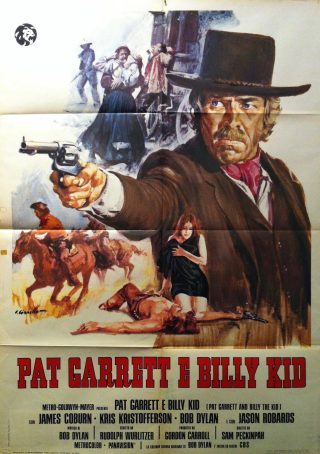
Pat Garrett and Billy the Kid

When I started this series of reviews about a month ago I mentioned that one of the reasons why I’d avoided doing it for a time was the variable quality of the films involved. Being aware that you’re going to have to sit through and then try to express your thoughts on movies that you already know are mediocre can be a little discouraging. What I didn’t mention, however, was the fact that the opposite is also true. When a film has a particularly strong critical reputation it’s equally daunting, though for different reasons of course. You instinctively wonder whether it’s possible to say anything that hasn’t been said before, and probably been said better. In the case of Pat Garrett and Billy the Kid (1973), Sam Peckinpah’s last western, I don’t promise to offer any startling insights but I do hope that I manage to at least express my own personal appreciation of this flawed masterpiece.

The film can, and I think should, be viewed as the death dream of Pat Garrett as he relives the defining events of his life, even as that life is slipping away. I ought to say right now that this view is dependent on the version of the film that’s watched – I’ll explain what I mean later, but for now I will simply say that it does have an impact on the way viewers approach the story. It’s 1909 and an aging and testy Garrett (James Coburn) is riding a wagon through New Mexico. His terse, snappish conversation with his companions is violently interrupted by the crack of a rifle shot. No sooner has the first bullet struck home than Garrett’s escort proceed to empty their own weapons into his mortally wounded body. As the old lawman tumbles towards the earth for the last time the scene is intercut with events of almost 30 years before, in 1881, when we see Billy the Kid (Kris Kristofferson) getting in a bit of target practice by shooting the heads off live chickens. What follows sets up the mood of the rest of the film and explains the motives for the characters subsequent actions. Garrett has sensed that the wind has changed and is pragmatic enough to know that he must go with it or be swept away. He’s thrown in his lot with a shadowy collection of big cattle men and business interests, and has been appointed sheriff. The Kid, on the other hand, resolutely refuses to bow to the march of progress and is bent on continuing as he’s always done. Garrett points out that part of his remit is to ensure the removal, by whatever means are deemed necessary, of the Kid from the territory. This is one of the few times both men share the screen until their final fateful meeting in Fort Sumner, but the movie charts the movements of both as circumstances inexorably draw them to their predetermined positions. That early scene in the cantina where Garrett and the Kid lay their cards on the table and both are aware that they will have to face off sooner or later is full of the melancholy that dominates the picture, and it’s pure Peckinpah. From this point the hunt is on. Garrett brings the Kid in after a bloody shootout at an isolated shack and has him locked up in Lincoln to await execution. This leads to a wonderfully realized sequence in the stark jail room where the Kid’s flippant disregard for authority (both earthly and divine) goads his manic, evangelical guard Ollinger (R G Armstrong) into taunting and threatening him – again depending on which version you watch there’s a killer line that may be missed. When the Kid effects his escape after blasting Ollinger apart with his own shotgun there’s a very human side of him revealed. He swaggers along the main street and orders up a horse to take him out of town. What he’s presented with is a wild animal that promptly bucks him clear and lands him square on his ass. Instead of avenging his bruised dignity on the old Mexican who embarrassed him by offering a horse he couldn’t ride, he simply smiles ruefully, steals another and rides coolly off as befits a legend.
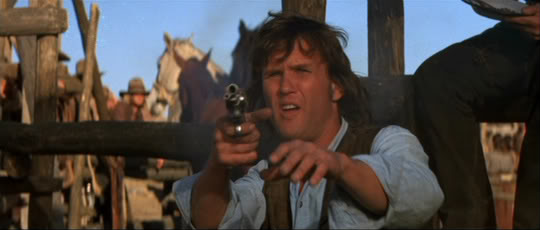
In truth, the whole film could be viewed as a series of memorable scenes. That’s not to say, of course, that there’s a lack of narrative structure; the story follows a very definite line and draws to a completely natural conclusion. What I’m trying to say is that there are certain characteristics that mark it out as a western that transcends the run-of-the-mill and elevate it to something grander. A prime example is the segment with Slim Pickens and Katy Jurado – it moves things forward by showing how Garrett’s pursuit is progressing but that’s not really the point. If anything, like one of Ford’s grace notes, the scene exists for the sake of its own beauty and and poignancy. I’m not going to spoil things for anyone who has yet to see the movie but I will say that it’s gut wrenching stuff and I’ve still never been able to watch it without a lump in my throat. The characters grow and develop as we move along too, especially Garrett. His cynicism and self-loathing increase the closer he comes to his quarry and the further he moves from the man he once was. By the end of the movie he has sold himself completely and his disgust at what he has become is a painful thing to witness. It’s also interesting to compare the portrayal of Garrett’s principal backer, Chisum (Barry Sullivan), to the one John Wayne offered a few years before. This is no heroic defender of the common man, instead he’s a coldly dedicated businessman who feels no sentimental attachment to those who worked for him in the past. This Chisum regards Billy as nothing more than a liability, both financially and politically, who needs to be exterminated. Those hands in his employ are shown to be similarly heartless, and it’s surely clear to Garrett that he’s only being tolerated so long as he has a role to play in Chisum’s schemes. In contrast to Garrett, the character of the Kid undergoes less of a change, perhaps because he’s the one who clings more firmly to the old ways. He starts out grinning, nonchalant and oozing self-confidence, and meets his fate with that attitude virtually intact. However, for all his free spirited charm there’s a hard edge there too. The first time I saw the film I was slightly shocked at the outcome of the duel that the Kid and Alamosa Bill (Jack Elam) are unable to avoid. Having said that, I’ve grown to appreciate that little scene more and more for showing that shootouts in the old west were rarely the kind of honourable and noble standoffs that they’re traditionally portrayed as.

As I stated earlier, this was to be Peckinpah’s last western and it’s another of his ruminations on the passing of the old west and the dawn of the modern era. It was a troubled production, not least because of the director’s increasingly wayward behaviour, and the end product reflects that in the multiple cuts of the movie down the years. For all that though, it remains very much a Peckinpah film. It’s tempting to think that Sam saw something of himself in both the title characters: the Kid as the wild, anti-establishment figure that he encouraged others to see him as, and Garrett as the disillusioned independent trying to strike some kind of working balance between corporate interests and a free soul that was probably closer to the truth. As such, I think it’s Coburn’s performance as Garrett that drives the film and gives it much of its power. In terms of realism or accuracy he was too old for the part, but in terms of characterization he was perfect. He was of an age where you can easily understand a man’s need to seek out some form of security, that point when you realize that the recklessness of the past is no longer a viable option yet a part of you still yearns for it and rails against the advance of time and the compromises that are involved. Coburn’s lived-in features and grey hair help to get the point across, and the expressive eyes that could flash cold steel one minute and sardonic humour the next see that it strikes home. In contrast, Kristofferson plays the Kid as a devil may care adventurer, but one with a deep sense of fatalism. Even in that early scene in the cantina the twinkle in the eyes cannot disguise the fact that the Kid knows there and then, as surely as the grim faced Garrett does, that there can only be one outcome. Awareness is one thing of course, but the real fatalism is evident in the way the Kid only half-heartedly tries to elude his old friend. He heads for Mexico and safety but it’s clear enough that in so doing he’s hoping to find some excuse to return and play that one last card whatever the consequences. The supporting cast is something like a wish list of western character players and it’s another of the film’s great strengths. I don’t know how this works for those who come to the film without a familiarity with the genre, but for someone like myself it’s akin to meeting up again with a group of old acquaintances and simply revelling in their company. It would be impossible to go through all the people who drift in and out of the story and enrich it with their presence but, as I noted earlier, a special mention must be given to Slim Pickens and Katy Jurado who contribute to one of the finest moments in this picture, or any other for that matter. The only casting decision that doesn’t really work for me is the inclusion of Bob Dylan. I love the way his music blends in and complements the images on screen but his appearance as a character in the story is unnecessary in my opinion and is just too conspicuous.
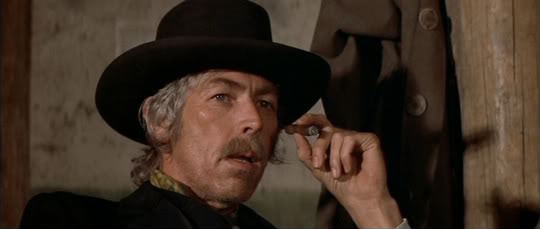
The DVD release of Pat Garrett and Billy the Kid, not unlike the production itself, has become a source of controversy. Ever since Peckinpah’s clashes with MGM boss James Aubrey led to the movie being taken away from him and hacked down into a theatrical version that he hated there has been no real director’s cut available. The closest thing is the Turner Preview version, derived from Peckinpah’s workprint. The 2-disc DVD from Warners includes both the Turner version and a new 2005 Special Edition that claims to come closer to the director’s wishes. Now the problem is that the 2005 cut adds some material but, most damagingly, removes or alters key scenes and lines of dialogue from the Turner version – the exact changes can easily be found by running an internet search or just sitting down and watching the two cuts to compare for yourself. The fact that both versions are available is good of course, but it should be mentioned that the Turner cut has not undergone restoration whereas the 2005 one has. My own preference is for the Turner version for a variety of reasons, but the strongest one is the fact that the bookending of the story remains intact. Others will have to decide for themselves. Aside from the restoration, or lack of it, the DVD set contains a plethora of supplementary material that’s most welcome. As for the movie, I hope it’s clear that I hold it in high regard. It’s not only a compelling story, but it’s also a study of fading dreams, vanished innocence and bitter regrets. It’s one of Peckinpah’s best and should rate high in any list of top westerns. Very highly recommended.

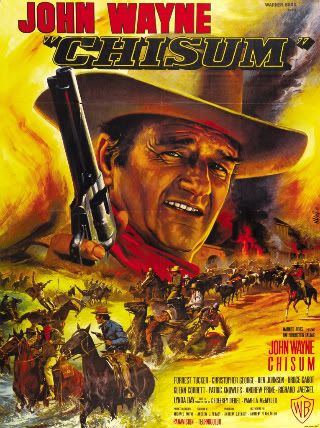
Chisum

Poster

Of the movies I’ve been looking at so far, and those I’ll feature next, Chisum (1970) is the only one where the Kid is not one of the main characters. That’s not to say he doesn’t play a significant role in the story, just that he’s not the one viewers are asked to focus on. First and foremost, this is a John Wayne film – he plays the title character, one of the prime movers in the Lincoln County War, and the plot revolves around him. I’ve always enjoyed this picture even though I’m aware it’s no classic – it’s solid, entertaining and, for the most part, well made.

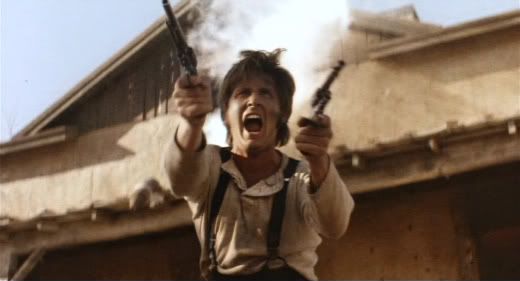
The film tells its version of the Lincoln County War and, in particular, the role played by John S Chisum (John Wayne). The title character is presented here as a heroic pioneer whose patriarchal position sees him drawn into conflict with Murphy (Forrest Tucker) over not only the latter’s expansionist plans but also his casual disregard for the livelihoods of Lincoln’s less influential citizens. As the stirring opening credits fade there’s the image of Chisum sitting magisterially astride his mount and surveying all the vast territory he has conquered. All would seem well with the world, despite the dark mutterings of his old friend Pepper (Ben Johnson), as long as this weathered cattle baron holds sway over the territory. However, Murphy’s men are already stoking the fires by masterminding raids on Chisum’s herd. An early confrontation with a group of hired rustlers leads to a shootout and the first contact between Chisum and the Kid (Geoffrey Deuel). Billy’s reputation precedes him and Chisum regards him with wariness in spite of the hearty recommendation of fellow rancher Tunstall (Patric Knowles). Whatever reservations he may have are driven to the sidelines by the continued sniping attacks of Murphy and the corrupt lawmen and hired guns he’s got working for him. More men and guns are drifting into Lincoln and the scene seems set for all out war between the two factions. As the situation deteriorates the Tunstall/Chisum ranks are bolstered by the arrival of an ex-buffalo hunter named Pat Garrett (Glenn Corbett). The movie doesn’t really lay out any specific rivalry between Garrett and the Kid – save for an insipid and wholly unnecessary romantic triangle involving Chisum’s neice – except to show that Garrett’s older and more experienced man has chosen a path that’s governed by caution as opposed to the Kid’s impulsiveness. When Tunstall is murdered by Murphy’s hirelings the fat is very definitely in the fire; Billy embarks on a killing spree to avenge his boss, and Chisum (who’s still shielding the Kid discreetly) sees himself pushed to the limit too. The climax comes with a potted and compressed version of the Battle of Lincoln that’s only brought to an end by the intervention of Chisum and a spectacular cattle stampede that he orchestrates.

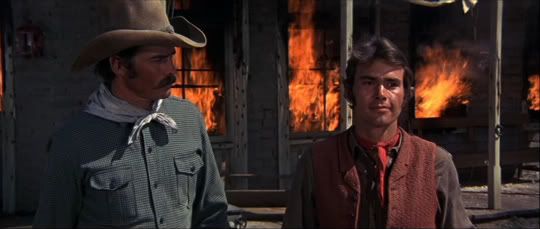
Nearing the end of friendship - Garrett (Glenn Corbett) & the Kid (Geoffrey Deuel)

Both the strengths and weaknesses of Chisum can be seen in the casting. Both Wayne and Forrest Tucker butt heads impressively as the two hard men at the centre of the storm. I remember hearing or reading a comment once that Tucker was one of the most graceful riders ever to mount a horse, but he does none of that here. He’s the manipulative businessman quietly pulling the strings and calling in favours, but he does so with a craftiness and cunning that’s a lot of fun to watch. Wayne, in contrast, is the typical outdoors individualist with a simple philosophy and a straightforward approach to dealing with problems. It’s one of Wayne’s most enjoyable late career roles; it may not be his best but his massive screen presence is used to great effect and he does bring real warmth to his character. On the other hand, the younger stars – Glenn Corbett and Geoffrey Deuel – are just about adequate as Garrett and the Kid. Corbett probably comes off better by being on the “right” side and getting the more sympathetic handling whereas Deuel’s Kid is little more than a cypher who flits in and out of the action to knock off whoever’s next in line. Once again the support cast, consisting of a virtual who’s who of western players, comes to the rescue. Ben Johnson’s part is not a huge one but his long acquaintance with the Duke means that the scenes they share have a kind of easy going charm and are full of good-natured humour. For the others, just reading through the list of names – Patric Knowles, Bruce Cabot, Richard Jaeckel, Ray Teal, Hank Worden et al – should give an indication of the depth of talent involved. Like many of Andrew V McLaglen’s pictures, Chisum is a mix of the good and the not so good. The action scenes are generally well handled but the tacked on romance is both poorly conceived and badly executed. There’s also an unwelcome tendency to indulge in cheap looking, TV movie style zooms at inappropriate moments. Having said that, William Clothier’s photography and Dominic Frontiere’s score help offset some of the other technical shortcomings.

The UK DVD of Chisum from Warners offers a nice, sharp anamorphic scope transfer that boasts strong colour and a clean image. The disc has a short feature on the making of the film and a commentary track with the director. The movie itself isn’t one of the great westerns and it has plenty of historical goofs – for example, Chisum’s fictitious stampede to halt the Battle of Lincoln, and the violent deaths of Murphy and Jesse Evans – yet it’s one with a high rewatch value. In fact, it’s one of those pictures that I used to test drive movie guides in the past. Reviews are, by necessity, subjective and it’s hard to lay your hands on those volumes that are likely to suit one’s own tastes. I once hit upon the method of browsing guides to see what they had to say about a selection of films that I knew were no classics but still pleased me. Chisum was almost always among the choices. If the reviewer trashed the movie then it wasn’t for me; if, on the other hand, it got a generally positive but guarded write up then it was probably one I could depend on. As such, that’s still more or less the way I view this picture – an enjoyable and competent mid-range western that’s worth seeing.

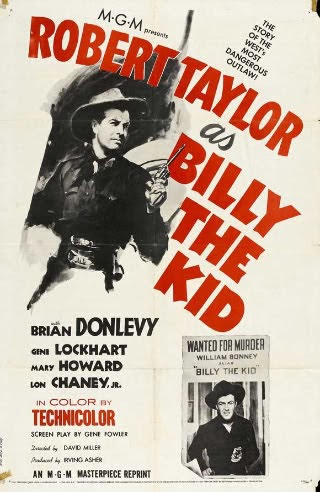
Billy the Kid

poster217-1

It’s been a long time since I committed myself to doing a themed series. Having done a few of them in the past I kept putting this particular one off. Why? Well firstly, this kind of thing requires watching a number of predetermined films more or less back to back, and I normally baulk at that kind of discipline as I prefer to go with whatever strikes my fancy at a given time. Moreover, I knew that running a series on Billy the Kid means sitting through a few poor movies. Anyway, I finally got myself into the right mood and I’ve decided to delve into it. As with other series I’ve done I’m not claiming that this will be an exhaustive analysis of each and every cinematic representation of this figure – there are just too many movies that feature Mr Bonney. In the coming weeks, I’ll be covering what I think are all the major portrayals. I’ll obviously touch on the historical accuracy of the various films, but I don’t want to dwell too much on that side of things as I’m no expert and, besides, good history and good cinema don’t necessarily go hand in hand. So, let’s kick things off with Billy the Kid (1941), a film that dances around the facts, changes the names of just about every major character, but remains an entertaining piece all the same.

The opening sees Billy (Robert Taylor) breaking an old pal Pedro (Frank Puglia) out of jail, and subsequently finding himself drawn unwittingly into what would become this movie’s version of the Lincoln County War. In short, there’s a conflict brewing between two rival ranchers, Hickey (Gene Lockhart) and Keating (Ian Hunter) – read Murphy and Tunstall respectively – and Billy is hired as a troubleshooter by the former. One of his first tasks for his new master is to participate in a stampede of Keating’s herd. This excitingly shot sequence leads to a fateful reunion between Billy and an old friend from his childhood, Jim Sherwood (Brian Donlevy playing what’s really the Pat Garrett role), who’s now foreman for Keating. As the two men sit around the campfire it’s clear that a bond still exists, but circumstances have placed them at loggerheads. Gradually though, Billy comes to see that Hickey’s methods are unjustifiable and, after being impressed by the dignity of Keating, it’s not long before a switch in allegiances takes place. So, the two friends become allies under the moderating influence of Keating. Even after Pedro is callously murdered and Billy is itching for revenge, Keating counsels restraint. His way is to work within the law to topple Hickey. Such noble sentiments are cast aside though when Keating himself falls victim to the Hickey faction. The result is the outbreak of open warfare, and Billy and Sherwood, while united in their goal, stand divided over the methods to be used. Inevitably, these two will have to confront each other in combat. It’s surely no secret how the showdown ends, although this film depicts events in a much more heroic way. Leaving historical airbrushing aside, the face-off between Sherwood and Billy is effectively done, as is the earlier retribution that’s meted out to Keating’s murderers.

Robert Taylor was 30 years old when he made this picture and looked far too mature to play the callow youth of the title. Still, he turns in a good performance as a man who cannot escape the mistakes of his past. The script explains his descent into lawlessness as a consequence of his father’s being murdered and his resulting thirst for revenge. The upshot is that Taylor gives the audience an early take on the “angry young man” persona that cinema would explore in later decades. He starts out scowling and clad in black leather, easing into more relaxed and typical cowboy garb for the mid section when Keating’s got him cooled down a little, and finishes the same as the plot turns full circle to bring him back into confrontation with the law. Brian Donlevy frequently played the villain in westerns so it’s kind of refreshing to see him on the right side of the law for a change. The scenes where he and Taylor get to act as pals have a certain charm and affability that form a nice contrast to the later ones when they must lock horns and face each other down. The other characters are all painted with broad strokes though, Lockhart’s conniving runt and Hunter’s fair-minded crusader leaving us in no doubt who the heroes and villains are. Having said that, both men handle their material well and if complaints of black and white characterisation are to be made then the fault lies with the writing and not the acting. One of the really positive points of the movie is the wonderful location shooting in Monument Valley; director David Miller may not have been in John Ford’s league but he created some memorable images of tiny human figures dwarfed by those familiar rock formations. The climactic ride to marshal forces and take on Hickey is a great sequence that’s only marred by the puzzling decision to intercut sumptuous long shots with close-ups and poor back projection.

To my knowledge, there are currently two options for acquiring this film – one is from Warner/Impulso in Spain and the other is a DVD-R through the Warner Archive in the US. The Spanish disc is a weak effort that has a kind of hazy softness throughout – I thought it improved marginally as it went on but that may have just been me getting used to it. The print has had no work whatsoever done to it and there are numerous instances of scratches, damage, cue blips and the like. On the plus side, the colours seem to have held up well enough and make the location work look very attractive. As with all the Spanish Warner discs I’ve seen the subs on the English track are fully removable regardless of what the main menu seems to suggest. I’ve seen some screen captures from the US disc and they certainly appeared to be of better quality – crisper, sharper and better defined. The film itself is a fairly typical early 40s effort that combines solid drama with lighter moments. If close adherence to the facts is a prerequisite then this is not the film for you. If, on the other hand, you’re looking for a reasonably entertaining western with professional performances and good location work it should check most of the boxes. Robert Taylor westerns are always good value and I’d rate this as one of his medium efforts.


Born to Be Bad

£2

Strange how a title can prove misleading, isn’t it? Then again, it’s not always just the title. Take Born to Be Bad (1950) – directed by Nicholas Ray, photographed by Nicholas Musuraca, starring Robert Ryan and appearing in a few noir lists. When you bear all that in mind it’s not unreasonable, I think, to expect to see a good solid noir picture, maybe even a neglected gem. However, appearances are all too often deceptive and that’s certainly the case with this one. I’ll grant that the plot follows a noirish theme and strays towards that elusive dark style at times, but it never quite gets there and remains rooted firmly in melodramatic territory – and soapy melodramatics at that.

The story concerns Christabel (Joan Fontaine) and her determined climb to the top of the social ladder. We first see her after her arrival at the apartment of Donna (Joan Leslie), one of her wealthy uncle’s employees, who’s about to throw a party. Christabel is to attend business school with a view to later working in the uncle’s publishing firm. The first impression we get is of a shy, socially naive woman who’s slightly overwhelmed by the sophisticated and opulent world she’s suddenly arrived in. This feeling is further heightened when she encounters the cocksure and worldly Nick Bradley (Robert Ryan), an author who’s recently returned from China. This initial meeting sets the tone for the subsequent relationship between those two characters; Bradley all wisecracks and confidence and Christabel holding him off, but not too far off. The apparent innocence of Christabel is nothing but a sham to facilitate her own scheming though. From the moment she comes across her new flatmate’s wealthy and patrician fiance Curtis Carey (Zachary Scott) she gradually reveals her true nature (to the audience at least) as she sets her sights on displacing Donna and ensuring her own comfortable future. There are no surprises in the way the plot develops and it’s this predictability that weakens the movie most. While the story has an inherently noir theme it can’t escape being a study of social manners and hypocrisy, and all the cliches that involves. It’s also not helped by the light tone that seems to pervade it, with the jokey, mocking ending doing nothing to dispel that.

£3

Nicholas Ray’s directing career was highly unpredictable and could veer wildly from the brilliant to the mediocre. It’s hard to believe that this sudsy concoction came from the same man who produced dark masterpieces like In a Lonely Place and On Dangerous Ground. Of course, Howard Hughes’ notorious tampering may have had something to do with the flat and apathetic feel that Ray’s work here inspires. When the plot is a humdrum affair then you look to the visuals to add some life but neither Ray nor Musuraca manage to create anything especially memorable and I caught myself checking out the counter a couple of times while watching, never a good sign. The casting is generally good, although I have to admit I’ve never been a particular fan of Ms Fontaine’s work outside of Rebecca and Suspicion, her two collaborations with Hitchcock. I wouldn’t say I dislike her performances as such, but I’d rarely seek out a film due to her presence – that innocent vulnerability she projected could be used to good effect but it’s also a characteristic that tends to be restrictive. In Born to Be Bad the kind of duality the role calls for isn’t altogether successful as Fontaine’s “bad girl” moments are never entirely convincing. Joan Leslie, on the other hand, is much better as the spurned Donna. She brings a far more believable quality to her playing, and her growing suspicion of Christabel’s motives progresses naturally. Robert Ryan and Zachary Scott were both handed fairly typical parts for them, and they do all that’s asked satisfactorily. Ryan has that familiar swagger that suggests something hidden deeper inside, but his character doesn’t get the chance to develop much and kind of tails off as the picture goes on. Scott got the better written role and thus his Curtis Carey comes across as more rounded, although Ryan delivers the best of some fairly ripe dialogue.

The French DVD from Montparnasse is quite typical of their RKO titles, a little soft and thick in places but generally clean and I wasn’t aware of any damage to the print. As with all their releases the subs aren’t forced on the English track and extras are non-existent, apart from the usual introduction. I can’t say I got much pleasure from this movie; there are some nice performances but that’s about it as far as I’m concerned. Maybe I went in expecting something different – correction, I did go in expecting something different – and the film I got fell short. If you’re after an undiscovered noir then this isn’t the place to look, but if you want some social melodrama with a touch of darkness it may just fit the bill.

Breakheart Pass

poster233

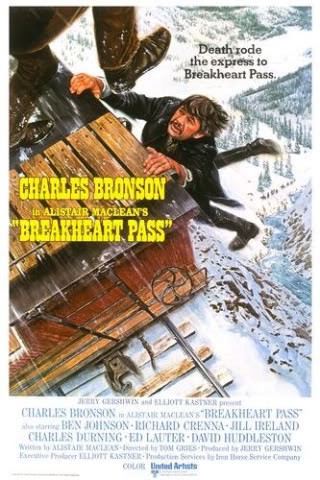
A Charles Bronson western written by a Scotsman and combining elements of a whodunnit and an espionage thriller sounds very much like a recipe for disaster. Despite that, Breakheart Pass (1975) actually works quite well; it’s never going to be considered a classic but it is wonderfully entertaining and looks great. A fine cast and some first class talent behind the camera have a lot to do with this of course. For me, the fact that a significant part of the action takes place aboard a train adds to the pleasure, as I’m a huge fan of anything that exploits the dramatic possibilities of having a group of suspicious characters all cooped up together and denied the opportunity to escape.

A military train carrying reinforcements, and medicines is bound for Fort Humboldt, where a diptheria epidemic is raging out of control. Aside from soldiers, there’s a number of civilian passengers aboard, all with official reasons for being there. Their numbers are swollen right at the beginning though when Marshal Pearce (Ben Johnson) muscles his way through the protocol in order to get both himself and his newly acquired prisoner, a wanted murderer and arsonist, John Deakin (Charles Bronson) a couple of berths. Before the train has even pulled away from the halt two army officers have mysteriously vanished, and it’s clear from the shifty behaviour of practically every passenger that nothing is quite as it seems. While the locomotive chugs its way towards the stricken fort the unexplained incidents, and the bodies, start to pile up ominously. The senior army officer, Major Claremont (Ed Lauter), is growing uneasy while the Marshal and the most prominent passenger, Governor Fairchild (Richard Crenna), seem reluctant to treat matters as anything more than ill fortune and coincidence. All the while, Deakin moves surreptitiously from carriage to carriage pursuing some undefined agenda of his own. It’s only when the troop cars are sheared off and sent careening away into mid-air and subsequent carnage that it becomes clear to everyone how grave the danger is, and that a ruthless killer is in their midst. The movie trades heavily on the fact that all the passengers are potential suspects; it’s a constant guessing game for the viewer to try to figure out who’s behind the ever increasing mayhem. Just about everyone appears to have something to hide yet it’s difficult to see how any individual could wreak such havoc. Of course all is eventually revealed before a slam bang finish draws the curtain on an hour and a half of solid entertainment.

Most of Alistair MacLean’s books which were adapted for the big screen have something to keep you interested. While his writing was fairly formulaic, it’s not hard to see why so many of his stories ended up being filmed; they tend to have a cinematic quality in that the plots are definitely to the fore and the characters usually have a shadowy aspect that’s only gradually revealed. The biggest failing tends to be in the dialogue, his later work suffering especially. Breakheart Pass has a few such instances, when characters come out with lines that just don’t ring true in any way. Director Tom Gries had already directed a couple of very enjoyable westerns, the one of particular note being Will Penny with Charlton Heston. His shooting of the action scenes is hard to fault and, apart from the free-for-all finale, the fight atop the moving train is one of the best parts of the movie. Bronson and former light-heavyweight champion Archie Moore get to slug it out in an excellently choreographed scene that’s tense, exciting and real looking – no doubt the presence of the great Yakima Canutt, as stunt coordinator had something to do with it too. Of course, the aforementioned crash of the runaway troop cars is another of the big set pieces that’s both mesmerizing and horrifying. Furthermore, Lucien Ballard was on lens duty and, as you would expect, the photography of the outdoor scenes is quite spectacular. And rounding out the crew is Jerry Goldsmith, who provided another of his memorably upbeat scores that draws you in from the moment the title credits roll.

As far as the acting’s concerned, Bronson is his usual laconic self, speaking only when there’s a need to but holding off on the physical stuff for long stretches. His character is no brainless lug and he plays him with restraint and enough thoughtfulness to make him believable. Although the wife was also in the cast there’s, mercifully in my opinion, no contrived romance to take the attention away from the twisty plot. Ben Johnson is always a pleasure to watch and just got better and better with age. His character isn’t the best defined one that he played but he still manages to make his mark on the movie – all his little gestures and his characteristic delivery keep reminding you that you’re watching a genuine westerner in action. Richard Crenna and Ed Lauter, as the Governor and the Major, have just enough oily charm and nervy anxiety respectively to keep the viewer guessing about their motives too.

MGM’s UK DVD of Breakheart Pass is a reasonably good effort. The anamorphic transfer is the kind that’s not especially remarkable but doesn’t have any major issues either. The colour looks true enough to my eyes and there’s no notable damage to the print – the image doesn’t pop off the screen but nor does it disappoint. The only extra included is the trailer, along with a variety of subtitle options. So, we’re talking here about a movie that’s best described as good, competent entertainment. It doesn’t offer anything groundbreaking but there are far worse ways to spend an hour and a half. It’s the kind of film that will obviously grip the viewer more the first time it’s seen, however, there’s enough in the action scenes, acting and visuals to ensure it’s worth revisiting.


Ramrod

Range wars have always been a favorite backdrop for westerns, men struggling over a piece of land upon which they have built their dreams being an ideal source of conflict. It’s not so common though to see a woman as one of the aggressors, and certainly not one as petite and vulnerable looking as Veronica Lake. However, if there’s a lesson to be learned from Ramrod (1947) it’s surely that one should never be taken in by appearances.

This is a lean, brisk movie where things happen fast and no time is wasted. Within minutes of the opening the main protagonists of the story are introduced and their motivations laid out. Everything revolves around Connie Dickason (Veronica Lake), a headstrong young woman hell bent on establishing herself in her own right and independent of her rancher father. We’re pitched immediately into the middle of a potentially explosive situation where Connie’s betrothed, a sheepman, is about to confront her father and his enforcer, Frank Ivey (Preston Foster). Ivey is the man Connie’s father would like to see her paired off with and he’s not averse to the idea himself. When the the sheepman decides that he values his hide more and thus backs down Connie turns her attention to a drifting cowboy and former drunk, Dave Nash (Joel McCrea). Nash has no interest in involving himself in the Dickason’s affairs at first, but a run-in with the bullying Ivey leads to a change of heart. He decides to sign on with her as her foreman, or ramrod, and face down her father and Ivey. Nash wants to use the law to secure Connie’s rights but she has other ideas on how to go about things. At the heart of the picture are Connie’s machinations, seductively playing the men off against each other to achieve her own ends. All of this deceit inevitably leads to tragedy and the loss of many innocent lives, although Connie blithely dismisses the bloodshed as a necessary if distasteful step on the road to fulfilling her ambitions. It’s only at the end, when her dreams are almost within her grasp, that this scheming puppeteer realises that her self-absorbed ruthlessness has driven away the very thing she desired most.

Joel McCrea’s portrayal of Nash is spot on, his calm and inner strength fitting for a man who has come face to face with personal tragedy and dragged himself back from despair. His honest, straight shooting persona is also ideal for a man who finds himself duped and manipulated by Connie. In fact, every man in the film falls prey to her deceptions at one point or another. Lake was clearly trading on her film noir credentials as she plays what is essentially a femme fatale out west. Her diminutive stature obviously rules out the possibility of her involving herself directly in any of the violence but her awareness of and confidence in her own femininity, and its attendant power, ensures that she calls the shots at almost every point. Director Andre de Toth was married to Lake at this time and he handles not only her scenes but the whole film very well. While he couldn’t be classed as one of the great directors, de Toth was certainly competent and made enough good films to be worthy of more attention. Aside from a number of very enjoyable collaborations with Randolph Scott, he also made the superior Day of the Outlaw and a handful of quality noirs. He was especially good at shooting action and the stalking by night of McCrea’s friend is particularly well done. It’s also worth noting the tough edge he brought to proceedings with a cigar ground into a man’s hand to provoke a gunfight and a savagely brutal beating being some of the highlights.

While there are plenty of good things to say about Ramrod the film, unfortunately, that not the case with the DVD. The only edition that I’m aware of is the Suevia release from Spain, and it’s pretty poor stuff. The master looks to be taken from an old VHS cassette and all the expected faults are present in the transfer. The image is scratchy, dirty and lacking in definition, and the audio is weak too. Despite that, it remains quite watchable, although there is an especially bad section beginning on the hour mark and continuing for about two minutes. In terms of quality it’s reminiscent of a mid-range PD title. However, as things stand, it’s the only version available – I’m not sure where the rights for this reside but I have a hunch it could be with MGM. On the plus side it can be had for very little money and there are no forced subs on the English track. I think this is a neglected little western with noir undertones that is well worth a look; anything starring McCrea and directed by de Toth deserves that at least. I’d imagine a decent release would go some way towards elevating its status.

Kiss of Death

poster230

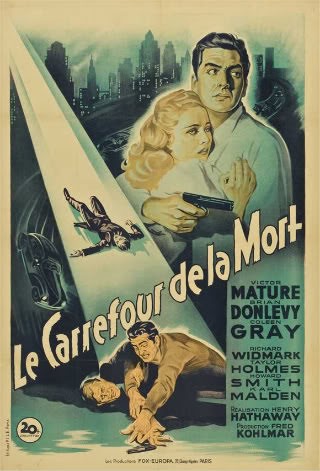
Stool pigeon, squealer, informer – these words all evoke images of weak, low-life types who are willing to spill it all and damn their friends for personal gain. It’s not easy to portray such people without resorting to stereotypes like the tragic, pitiful dupe, or maybe the moral/political crusader. Kiss of Death (1947) is the tale of a man who happily shops his partners in crime, but he comes across as the hero mainly because his actions are guided by his devotion to his family and not greed or some trite ethical principle.

Nick Bianco (Victor Mature) is a career hood who’s spent his life on the wrong side of the law. The opening voiceover narration establishes the fact that Bianco’s record now precludes him from holding down any meaningful job, and thus limits his choices. When a pre-Christmas jewel robbery goes wrong he finds himself on a downward spiral where his already restricted options will be narrowed even more. Initially, Bianco holds firm to the doctrine of honour among thieves and spurns the approaches of Assistant DA D’Angelo (Brian Donlevy). So he takes the jail time and the criminal kudos that comes with it, choosing to leave things up to his crooked lawyer. It’s only when he hears of the suicide of his wife (who’s never seen incidentally) and the subsequent packing off of his two daughters to an orphanage that he undergoes a change of heart. Both his lawyer’s ineffectiveness and the news of the inappropriate behaviour of his former comrades cause him to reassess his position. Striking a deal with D’Angelo gets Bianco out on parole but that’s not the end of it. The law demands more from him and Bianco finds himself drawn deeper into the DA’s plans. The ultimate goal is to secure the conviction of one Tommy Udo (Richard Widmark), a ruthless hoodlum with a psychopathic streak. Although Bianco secures the evidence the trial is a failure and Udo walks. It’s now that the real nightmare begins; Bianco has a new wife and a new identity, and all that will surely be swept away when (not if) Udo tracks him down and exacts his revenge. It’s in this second half of the story that the film shows its true noir credentials and moves away from the early melodramatic gangster movie feel. Bianco’s world shrinks to the point where he is eventually left with only one viable course of action.

£22

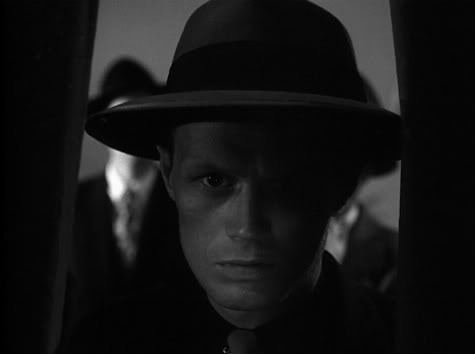
Kiss of Death is a good movie for many reasons, but over the years it’s come to be remembered mainly for the debut of Richard Widmark. The performance is so intense and memorable that it’s hard to believe Widmark had never been on screen before. The fact that this giggling maniac who delights in shoving a crippled woman to her death down a staircase has featured in so many clips through time has maybe drained some of the shock value away. However, there’s no denying the chilling quality that Widmark brings to every scene he’s in – whether it all came down to the actor’s own nervousness or not he has a kind of electric menace that demands you give him your full attention. In contrast, Victor Mature is like a rabbit caught in the headlights when confronted with this raw aggression. That’s not meant as a criticism of Mature’s performance; his role is that of man trapped by his own past and some poor decisions, and he brings off the mounting sense of isolation, desperation and fear that any man in Bianco’s position must surely experience.

In the supporting parts, Donlevy is his usual strutting and brusque self as the Assistant DA who’s not averse to bending the law his way in order to achieve his ends. Coleen Gray, who also provides the voiceover, is the new wife who finds herself thrust into a perilous situation – although she must surely have expected that her life with Bianco would be less than smooth given her knowledge of his past – and she’s sweet and sympathetic in the role. Henry Hathaway’s no nonsense direction makes sure that the action moves along, and neatly avoids the kind of sermonising that could easily derail things. He also blends the extensive location work into proceedings and this does lend a touch of realism.

The US release of Kiss of Death on DVD (although it’s out in the UK too) via Fox’s noir line is a typically strong one, the transfer being crisp and clean throughout. There are some nice extras too: a commentary by James Ursini and Alain Silver, a gallery and the trailer. The movie has points to make about the inadequacy (and possibly the corrupt nature) of law enforcement, and the failings of the penal system. However, this stuff has all been done before and it’s therefore refreshing that the abiding memory one takes away from a viewing is that of Widmark’s sniggering nutjob. I think it’s fair to say that it’s this powerhouse performance that elevates the movie above other noir pictures.


3 Godfathers


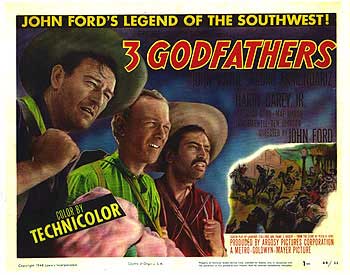
MPW-9143There haven’t been too many westerns that are set around Christmas, in fact I’m struggling to think of any others apart from 3 Godfathers (1948) and the earlier versions of the same story. While it starts out as a fairly standard western it soon turns into a play on the nativity story and the journey of the three wise men. It’s one of John Ford’s more sentimental pieces and the symbolism is laid on a little thick at times, but the cast and visuals carry it through the sticky patches. I’ll grant that the whole thing can seem a bit contrived yet the story, and its message of redemption and the good that lurks within all of us, remains affecting.
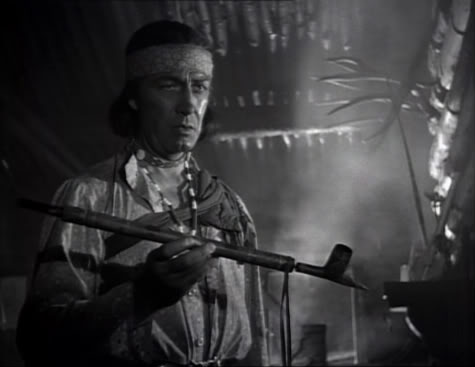
The movie opens in fairly conventional fashion, with the three main protagonists Robert Hightower (John Wayne), Pedro (Pedro Amendariz) and The Abilene Kid (Harry Carey Jr) surveying a town they’re about to enter and rob. Before they can get down to business, however, they get chatting to a local resident (Ward Bond) who turns out to be the local lawman. Thus far much of the action is played for laughs, and broad Fordian laughs at that, and the light heartedness even extends to the raid on the bank. The first really serious note is struck when The Abilene Kid takes a bullet to the shoulder as they attempt their getaway. As the three men race out into the desert with the law hot on their heels, one shot finds its target and punctures the vitally important water bag. Safe in the knowledge that no one is going to travel far in the parched wilderness with only a limited supply of water the lawman eases back and sets about laying a trap. That singe shot has essentially sealed the fate of the three outlaws, as they discover that the law (with the help of the railroad) is one jump ahead of them and bent on keeping them away from any source of water. In an effort to outsmart the authorities, the men double back but in so doing stumble upon a situation that will bring about profound changes within them all. They come across an abandoned wagon containing a pregnant woman who’s about to give birth. Their most basic human instincts are aroused by this pitiful scene and, after seeing that the baby is delivered, find themselves giving their oath to the now dying mother to protect her infant son. From this point on a gradual transformation takes place wherein each man suppresses his own selfish needs in order to ensure the fulfillment of their promise. As they trudge across the gruelling desert, shedding their possessions along the way, they come to view the protection of their new godson as the only purpose in their lives. As such, their trek turns into a kind of pilgrimage to cleanse themselves of the evil that had motivated them until that time. As I said the symbolism can be a little heavy handed (following a star to the town of New Jerusalem etc.) but the hardship of the journey and the fact that these hardened criminals are willing to sacrifice themselves for the sake of an innocent and a promise prevents the film from becoming a parody.

John Ford opened the film with an onscreen tribute to his departed friend Harry Carey Sr and then took the further step of casting the latter’s son in the pivotal role of The Abilene Kid, the conscience of the three bad men. However, that’s about as far as the old man’s sentimentality went for it’s well documented that he drove his cast mercilessly in the searing heat of Death Valley. Despite, or maybe because, of this the performances of the three leads are first rate. Carey in particular is touching as the callow youth who’s simultaneously running from and striving to retain some of his boyish innocence. The way he calmly accepts his fate before such thoughts enter his companions’ heads is a fine piece of acting. In fact, Ford granted the young man some of the best scenes in the movie: singing over the grave of the baby’s mother and then his own death scene. Both Armendariz and Wayne were handed more straightforward roles as the older and more experienced men and they don’t disappoint either. The part of Robert Hightower has none of the complexity of Wayne’s more famous and prestigious performances yet he does all the script and director ask of him, and carries the picture alone for a significant time. The bulk of the action takes place outdoors on location in Death Valley and Ford creates some beautiful and bleak images – the dust storm (with all its attendant symbolism) being a particular highlight. The support cast is filled up with all the familiar faces from the “Stock Company”, Ward Bond and Mae Marsh getting the lion’s share of the screen time.

3 Godfathers is widely available on DVD from Warner. I have the R2 disc, but I’ve heard that the US version is the same, and the transfer is a good one. Print damage is minimal and the colour is strong, the outdoor scenes faring best to my eyes. The only extra included is the theatrical trailer, and a variety of subtitle options. While this is not one of Ford’s very best, it remains a top film by anyone’s standards. In a way, it’s what you might call a typical Ford movie in that it contains most of his trademark visual and thematic motifs. All in all, it’s a satisfying and uplifting production that works well both as a seasonal film and as a traditional western.

Finally, as this will be my last post before the holidays I want to take the time to wish all those who have followed, commented or just stopped by a very happy and peaceful Christmas. Be seeing you again in the New Year.


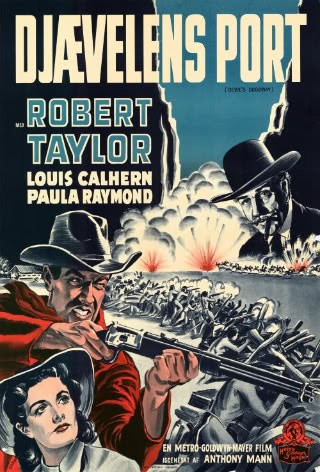
Devil’s Doorway

poster229

Before 1950 the injustices visited upon the Native American people were essentially ignored, or at the very least only touched on, in the cinema. However, in the space of a year two major Hollywood productions would use the plight of the Indian as their central theme. Delmer Daves’ Broken Arrow was notable for its sympathetic portrayal of the Apache, but Anthony Mann’s Devil’s Doorway (1950) went even further by concentrating on the naked and ugly racism confronting those Indians who had done their best to embrace the ways and laws of the white man. It’s a much more tragic film than Broken Arrow and consequently more powerful; the fact that this power remains undiminished even for a modern audience demonstrates just how radical a picture this must have been sixty years ago.

Lance Poole (Robert Taylor) is a Shoshone who has decided to adopt the classic American mindset i.e. looking to the future rather than dwelling on the past. Not only has he anglicized his name but he has also taken a huge leap of faith by enlisting in the white man’s army and fighting in the Civil War. Returning home to Wyoming as a highly decorated veteran (having won the Congressional Medal of Honor no less), he is full of optimism and hopes for a bright future. He’s confident that the recent horrors of the battlefield will have purged the nation of its desire for further bloodshed. However, soon after his triumphant return he has to face the fact that not everything or everyone has changed as much as he might have hoped. The old grudges and prejudices still live on in the hearts of some, notably an eastern lawyer, Verne Coolan (Louis Calhern), who’s moved to Wyoming for his health. Coolan’s snide comments are only a foretaste of what’s to come though, as the local doctor’s refusal to attend to Poole’s ailing father until it’s too late proves. While Poole busies himself building up his cattle ranch and his fortune, Coolan is angling for a chance to seize the ancestral land and teach the red man a lesson on climbing above his station in life. Coolan’s opportunity comes with the Homestead Act, which allowed for the breaking up of former tribal land into individual claims, and he encourages a mass migration of sheepmen in the hopes of forcing Poole off his land. Although Poole is  initially persuaded to hold his fire and try for a compromise by female lawyer, Orrie Masters (Paula Raymond), the scene is set for violent confrontation between the Shoshone and the sheepmen that Coolan is ruthlessly manipulating. As tensions rise, and the viewer’s outrage at the double standards and open bigotry on display similarly escalate, Poole must finally concede that his dreams of peaceful co-existence are nothing more than the foolish longings of a man too eager to buy into the glib promises of pragmatic politicians. When he dons his old uniform, with his medal proudly pinned in place, to face the same army that he once served with distinction there is a poignancy and irony that drives the message of the film home most eloquently.

£20

Anthony Mann had spent the 40s building up his reputation with a series of tight little noirs frequently lensed by master cameraman John Alton. Both men brought their style and sensibility to a western setting in Devil’s Doorway. Given Mann and Alton’s background it’s not altogether surprising that the movie has both the look and feel of a film noir; there are plenty of dark, shadowy scenes and an abundance of low angle shots. One scene that highlights this perfectly is the fist fight that Poole is goaded into in the saloon by Coolan and one of his cohorts. Everything is shot in the cramped confines of the bar with smoke and shadow blending together as the two men hammer each other savagely – there’s no musical accompaniment to distract from the sound of the punches landing, and the quick cutting alternates between the increasingly battered faces of the fighters and the even more grotesque visages of the rubbernecking customers. Having said that, there’s no shortage of more traditional genre imagery either, and Mann demonstrates a breadth of vision and skill with large-scale action scenes that would be further developed in both his later westerns and epics. For me, Robert Taylor was convincing as the Shoshone warrior caught between two camps. He injected a huge amount of humanity into the role of Lance Poole and produced a fully rounded character that transcended the “noble savage” caricature. I guess the black and white photography helps, but I never caught myself thinking that this was just a guy in dark make-up playacting. Louis Calhern also did sterling work as the slimy lawyer who uses convenient statutes as a means of disguising his own prejudices. Paula Raymond was good enough as the woman caught in the middle, but the script shies away from depicting an all-out romance with Poole – the movie was in all honesty already pushing the envelope as far as could be expected for the era. I might also mention the strong support particularly from Spring Byington and Edgar Buchanan.

Currently, there are only two editions of Devil’s Doorway available on DVD. There is an MOD disc from the Warner Archive in the US and a Region 2 pressed disc from Warner/Impulso in Spain. From the perspective of international customers neither one is ideal – the US disc being both expensive to acquire and on potentially suspect media, while the Spanish release is exclusive to El Corte Ingles for who knows how long with the attendant shipping costs. I viewed the Spanish disc, and the transfer is generally a strong one with good contrast and detail. However, it is unrestored and there are the usual scratches, nicks and blemishes – though never to the point of distraction. There is English and Spanish audio with removable Spanish subs. The disc comes in a slip case with a 34 page booklet, in Spanish naturally, that contains a very nice selection of still photographs and original advertising material. When one considers the development of the western, and the career of Anthony Mann too, this is an important title. As such, it’s disappointing that it should be marketed so restrictively on both sides of the Atlantic. However, the Spanish disc does at least afford the film a degree of respect that’s lacking in the US release. Devil’s Doorway seems to have got lost between Mann’s earlier noir pictures and his subsequent psychological westerns, but it actually acts as something of a bridge. It’s a film that’s intellectually and emotionally satisfying while it also provides solid western entertainment. Recommended.