The Bravados

There’s something so deeply satisfying about watching 1950s westerns that I sometimes feel I could dedicate an entire blog to them and still only scratch the surface. Just about every star and director of note managed to produce, at the very least, one quality western during those few short years. While the cinematography ran from monochrome and Academy ratio to technicolor drenched scope, one feature remained constant: maturity of theme.

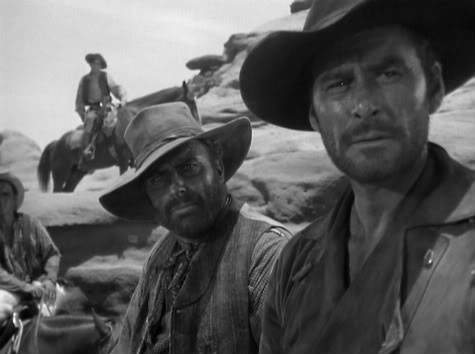
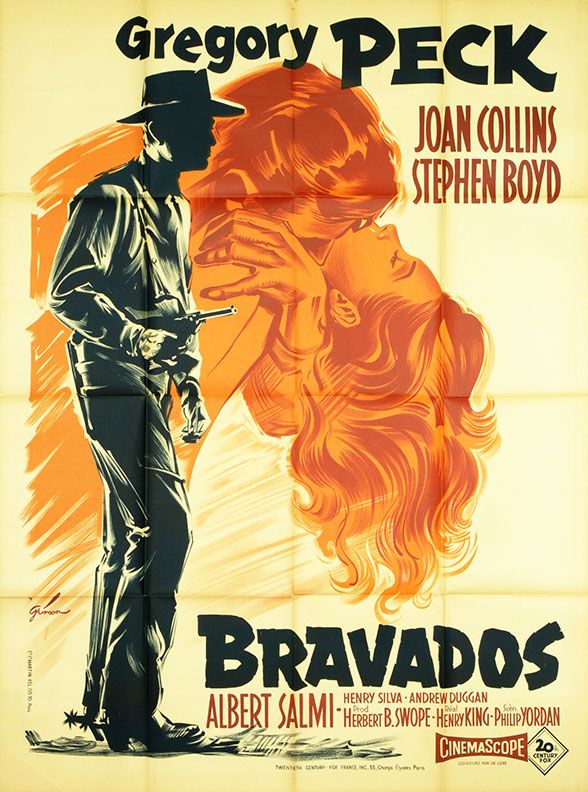
The Bravados (1958) opens in dramatic fashion with a silhouetted rider driving himself on through the night to the accompaniment of Lionel Newman’s pounding score while the blood red titles flash onto the screen. The rider is revealed to be Jim Douglass (Gregory Peck), a man obsessed enough to ride a hundred miles just to witness the execution of four men he’s never seen before (Stephen Boyd, Henry Silva, Lee Van Cleef and Albert Salmi). Initially there’s no explanation offered for Douglass’ desire to see these men keep their date with the hangman. The only thing that’s clear is that he’s nursing a deep and bitter hatred – perfectly realized in a wordless scene in the jail as Douglass walks along outside the bars and rakes each man in turn with a look of such malice that they flinch as though a lash had been applied. It’s only after the four have escaped, taking the storekeepers daughter hostage, that the reason for Douglass’ personal vendetta is revealed. It transpires that his wife has been raped and murdered and he believes that these men are the ones responsible. What follows is a tale of pursuit, revenge, realization, and finally a kind of sour redemption. The only false note in the picture is the introduction of an unnecessary and less than believable romance between Douglass and a Mexican rancher (a woefully miscast Joan Collins). This really adds nothing whatsoever to the film and actually serves to weaken it – the final ten minutes pack a powerful emotional punch but the last shot takes a good deal of the sting out of it. I think it’s also worth mentioning that I was left wondering if The Bravados had any influence on Sergio Leone. Maybe it’s just me but I couldn’t help but notice parallels with For a Few Dollars More: the taciturn anti-hero, the watch with his dead wife’s photo that Douglass carries and shows to his victims before killing them, the grimy and sadistic villains, and the ride along the deserted street of a Mexican pueblo before a showdown.
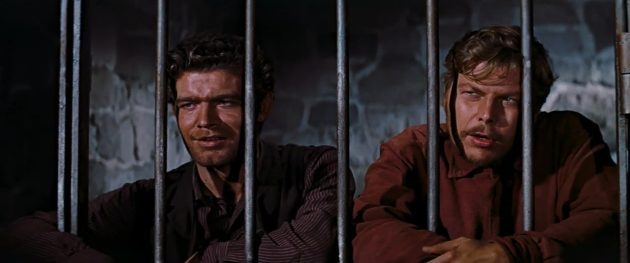
Gregory Peck gave a remarkably intense performance in a complex role that’s basically a study of bitterness, obsession and false conviction. His playing of a man who has cast aside his soul in the pursuit of vengeance is pitch perfect. As the story progresses the viewer understands that Douglass has become no better than the criminals he is ruthlessly hunting down, but it’s his own final realization of that fact that raises the movie to a higher class. Peck does a fine job of showing the psychological disintegration of a man who has his illusions stripped away and must henceforth look at himself in a new and disturbing light. Stephen Boyd clearly had a ball portraying the chief badman and slipped from smirking charm to menacing brutishness with ease. I’ve always been a big fan of Boyd and have enjoyed his performances in everything I’ve seen him in. His best work was as the villain and when the big lead parts came along he was a touch unlucky – a poorly written role and no chemistry with Sophia Loren in Fall of the Roman Empire, almost becoming James Bond, and having production delays force him to relinquish the role of Mark Antony to Richard Burton in Cleopatra. I was prepared to write some scathing comments about the wooden acting of Joan Collins in this movie but I can’t seem to work up the enthusiasm – although how anyone ever thought it was a good idea to cast her as a Mexican cattlewoman just beggars belief.

Henry King was one of those directors that the studio system seemed to have in abundance, the skilled craftsman who could effortlessly churn out quality pictures in just about every genre. His name is hardly a familiar one today but a glance at his filmography makes for impressive reading and contains far more hits than misses. King’s work on The Bravados is aided immeasurably by Leon Shamroy’s cinematography, which mixes stunning landscape views with moody day for night shooting to great effect.

The Bravados is available on DVD from Fox and their R2 Studio Classics version (I imagine the R1 is broadly similar) is a perfectly fine anamorphic scope transfer with nice colours. There’s not an extra feature in sight (I think the R1 has a trailer) but it is cheap. This is a movie that often gets overlooked and is rarely mentioned, but if you’re a fan of westerns from this era you need to see it. Highly recommended.
5 Fingers

£9

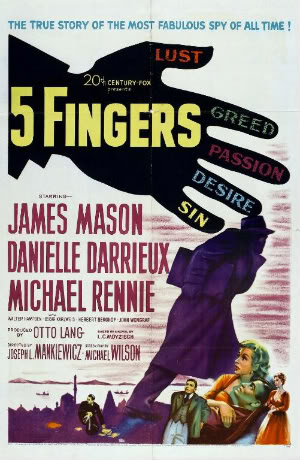
Much as I enjoy all the gadgetry and technology that seems to have become part and parcel of the espionage film over the years it’s refreshing nevertheless to watch something where the spy uses nothing more advanced than a pocket camera to accomplish his goal. 5 Fingers (1952) is just such a film, a slow burning suspense yarn that concentrates on character and the gradual building of tension. The fact that it’s supposedly based on a true story makes the whole, seemingly unlikely, series of events even more intriguing.

The story takes place in Ankara, Turkey during WWII and tells the story of an amazing scam carried out under the noses of the British embassy staff. Diello (James Mason) is an Albanian employed as a valet to the British ambassador, and is a man of intelligence, culture and ambition who realises the unique opportunity afforded him by his current employment. Not only is he the trusted companion of the senior diplomat, but he also has easy access to countless documents of the highest classification that routinely cross his master’s desk. To a patriotic man, or even a man of integrity, this might be regarded as a privilege but nothing more. However, Diello is neither; he is a pragmatist with two aims in life – a) to win the heart of the aristocratic widow of a former employer, and b) to have sufficient funds to emulate the life of a South American gentleman he once caught sight of in Rio. With this in mind, he approaches a German diplomat and makes an offer that’s hard to believe and even harder to turn down. He promises to ensure the delivery of a continual stream of top secret documents, but at his price and on his terms. He thus becomes a privately employed agent of the Nazis, under the code name Cicero, and the money starts to roll in. But, as I said, Diello is a very clever man, clever enough to know that he cannot keep popping around to the German embassy and hope to remain unnoticed. Needing both a partner and a safe meeting place, he strikes a bargain with an impoverished Polish countess (Danielle Darrieux) for whom he’s been carrying a torch. In return for funding her lifestyle Diello gets to use her home as a cover for meeting and carrying out transactions with a variety of high ranking Nazis. Of course such a scheme can’t last indefinitely and Diello eventually finds out that betrayal can be a double-edged sword.

£10

5 Fingers came out a mere seven years after the end of WWII and when you bear that fact in mind it’s quite surprising that the character of Diello is one the viewer actively roots for. Although it’s made clear that Diello is spying out of a desire for money and cares nothing for political ideology, the truth is that it’s Mason who makes the character such an appealing one. Both the British and German authorities are treated with a kind of suave condescension by the man. He always appears the master of his own destiny and, even with the earth falling away beneath him, you never really doubt that he’s the one in control of the situation. I never tire of watching James Mason, and there’s real pleasure to be found here in seeing him toss out casual insults to the Nazis in a marvellously supercilious tone. Danielle Darrieux is an actress I haven’t seen much of, but her fallen Polish aristocrat is a fine mix of allure, earthy sensuality and duplicity. Her scenes with Mason carry a sense of conviction and there’s certainly some chemistry between them. Michael Rennie has a somewhat thankless role as the secret service man hunting Cicero but he does well enough in the circumstances. Joseph L Mankiewicz wasn’t the most prolific director but I’ve always enjoyed his work and he handles this material very stylishly. The use of genuine Turkish exteriors helps lend some authenticity to the film but it’s the interior sequences that have the most power. The scene that leads up to the discovery of Cicero’s identity is a masterclass in the building of suspense – the way the camera follows a cleaner round an embassy corridor, while she tries to work out the source of a power failure and we know what the consequences of her actions will be, is a piece of film-making worthy of Hitchcock himself. And that neatly allows me to point out that the movie also benefits from a score by the great Bernard Herrmann.

5 Fingers is available on DVD in R2 from Optimum in the UK. Unfortunately, it’s one of their weaker efforts with a soft transfer that also suffers from being interlaced. It’s one of the usual barebones discs from this company with no extras whatsoever and no subtitle options. However, the one thing in its favour is that it’s cheap and it’s about the only option if you want to see this title – being a Fox property the chances of a R1 release are not good at present. Anyway, it’s a very classy film that won’t disappoint, and the final scene that fades out to the accompaniment of the kind of hollow, cynical laughter that recalls John Huston is almost worth the price on its own. The Optimum disc is definitely watchable despite its shortcomings and, since the movie itself is just so entertaining, I’d have no hesitation in recommending it.

Man Hunt

poster58

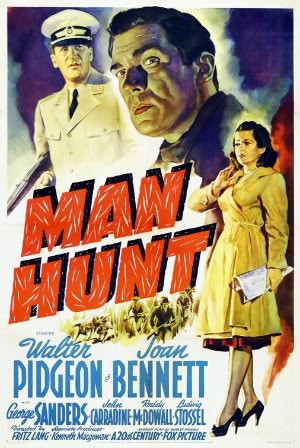
Popular wisdom holds that when a film is adapted from a novel the original source material is inevitably superior. I’m not sure how true that really is though. I suspect that this maxim has come to be as a result of the disappointment felt by a loyal readership when filmmakers have had to alter the material to make it work on the screen. We all naturally form a mental picture of characters and places when we read about them, but when others place their interpretation in front of us it can be an underwhelming and perplexing experience. Man Hunt (1941) is Fritz Lang’s interpretation of Geoffrey Household’s novel Rogue Male. Since I saw the movie first, many moons ago, and only later read the novel, my own preference is for the film version. In truth, I found the book to be a bit of a letdown – not that it’s actually bad or anything, but just because it lacks Lang’s little stylistic touches and the character interaction that helps the film pack a greater emotional punch.

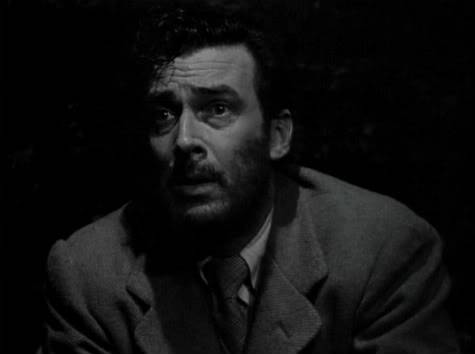
The movie is basically a chase story which utilises that old chestnut of the hunter becoming the hunted. Alan Thorndike (Walter Pidgeon) is a big game hunter of some renown who has grown weary of the traditional prey. In Germany, on the eve of WWII, he finds himself closing in on the “most dangerous game” – man. And not just any man at that. Perched high on a hilltop, he focuses the cross-hairs of his hunting rifle on one Adolf Hitler. With a live round in the chamber, he has only to touch the trigger to forever alter the course of world history. However, for Thorndike this is merely a sporting stalk – an attempt to get close enough to the prey to make the kill itself a purely technical issue, for he has lost his taste for the taking of lives. But fate has other plans for Thorndike; such a simple and unexpected thing as a leaf falling across his telescopic sight causes him to twitch at the wrong moment and thus be discovered by a passing sentry. He is hauled away to be interrogated, tortured and presented with an ultimatum – his life in exchange for a signed confession that he was acting under orders from the British government to effect the assassination of Hitler. Realising the consequences of any such confession, Thorndike refuses and finds himself sentenced to death. Chance, and the natural world, once again comes into play when the faked accident that is supposed to claim his life doesn’t quite come off. From here on Thorndike must run for his life, first to a freighter and then to an England that is positively hiving with Nazi agents and fifth columnists all directed by the suave and sinister Quive-Smith (George Sanders).

hbthrd7

Fritz Lang brought a very noirish atmosphere to what is a fairly standard adventure thriller. The sets that represent London are bathed in deep, dark shadows that promise danger and death for the unwary. He has his hero ruthlessly driven further and further underground, his world shrinking by the minute, until he finally finds himself walled up within the very bowels of the earth. Walter Pidgeon performs well as Thorndike and effortlessly handles the character shift from a man who has achieved a degree of mastery over nature itself to one who becomes desperate, friendless and riddled with guilt. George Sanders made a career out of playing sophisticated and detached villains so the part of Quive-Smith was one he could manage with his eyes closed, but that’s not to take anything away from his performance. Joan Bennett would eventually make three films with Lang, of which Man Hunt was the first. Her role as the prostitute (never explicitly stated but clear enough all the same) who helps Thorndike and falls for him is a large part of what makes the film work, adding much needed humanity and a genuinely touching quality to a very dark tale. John Carradine also deserves a mention for his turn as the cadaverous assassin hounding Thorndike and leading to an excellently filmed confrontation within the London Underground system.

Man Hunt was long absent on DVD until Fox finally released it in R1 last month. The disc is up to the usual high standard from that company, sporting a sharp, clear image with wonderful contrast. There’s a commentary included by Patrick McGilligan along with a short featurette and advertising galleries. The only bad thing to say is that this title looks like it may well be the last classic release we’re going to see from Fox for some time, and that’s all the more galling given the high quality of their product. All told, Man Hunt is a fine film, first rate Lang, and a title that I’m just glad was able to make it out before Fox decided to shut up shop.

The Gentle Gunman

poster51_zpswesskv80

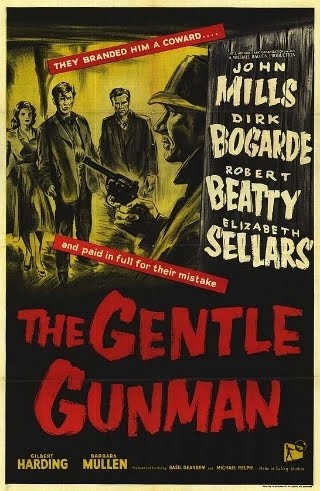
The Irish “Troubles” have gone through many stages of development, and most of those stages have been represented on film down the years. That little island on the periphery of Europe which, despite long absences, I still call home seems to exist in a permanent state of conflict. Although there are sporadic outbreaks of peace, one always feels that it’s only a matter of time before we retreat behind our respective barricades once again. The Gentle Gunman (1952) is set in the border country during WWII, a period of relative calm when compared to the frenzied blood-lust that overtook us in the 70s and 80s, and deals with those themes that go to the very heart of the Irish character – loyalty, betrayal and identity. I suppose it could be said that the film simplifies things a little, but that’s a criticism that can be levelled at a lot of movies. In fact, I always think it’s a bit unfair to fault filmmakers too much in that regard since trying to explain or understand the complexity of the conflict in Ireland, even for those of us who lived through the worst of the horrors, is an almost impossible task. The Gentle Gunman, by boiling the politics down to its essentials and focusing on two brothers, does a fair enough job.

Terry Sullivan (John Mills) is an IRA man who has been living in London for some time. When rumours start to drift back to the old country that Terry may have turned, his younger brother Matt (Dirk Bogarde) decides to pay him a visit and see if such slights on the family honour are justified. To his horror, Matt discovers that what he’s been hearing may well be true – Terry is no longer trusted and, in the aftermath of a botched bombing, seems to have become (that lowest of words in the Irish vocabulary) an informer. The arrest of two gang members is too much for Matt, and he warns his brother that if he values his life he’ll not set foot across the Irish Sea. However, Terry wouldn’t be much of an Irishman if weren’t stubborn and contrary, so he comes back to the land of his birth and the not so welcoming arms of former friends and relations. The roads and lanes along the Irish border have seen more than their fair share of death. The usual outcome of a charge of informing was a brief inquiry and a sentence handed down by a kangaroo court, before a man was taken for his last walk down a lonely road at dawn to get a bullet in the head and be dumped in a ditch. Why, therefore, would anyone take such a risk? The answer in this case is the bond of kinship. Terry sees that his younger brother is being groomed for a life on the run by local commander Shinto (Robert Beatty) and his own former fiancee, the fanatically patriotic Maureen (Elizabeth Sellars). The question is whether Terry can haul his brother back from the brink and prove his own innocence before his comrades in arms decide to dispose of him.

John Mills was at his peak when this film was made and it seemed he couldn’t put a foot wrong. He’d reached the age where he was perfect for the kind of roles that called for an idealism that had been tempered by bitter experience. The ability to convey much while seeming to do very little has always been the mark of the best actors and Mills had it in spades. At his best he was wonderful to watch, the cast of his eye or the fleeting shadow of a smile or a grimace saying so much more than pages of dialogue ever could. His Terry Sullivan is a first class combination of bravado and nervy unease that’s entirely appropriate for a man walking the tightrope of self doubt and political duplicity. Dirk Bogarde, here at the height of his matinee idol period, is less satisfactory as the young man torn between loyalty to his brother and the idealism that has always formed the cornerstone of his existence. In short, he’s a bit wet but that’s as much a criticism of the script as Bogarde’s performance. That same year, Elizabeth Sellars appeared with Mills (again as a former lover as it happens) in The Long Memory, and I was less than complimentary about her. I think her limitations work in her favour here though, her immobile features fitting the character of a woman more in love with an idea than with any man. When Maureen (who’s clearly spent far too much time poring over the writings of Padraig Pearce) speaks with passion of the near sacred act of bloodletting, the only truly apt word to describe her is terrible. As usual in films of this period, the supporting cast does a sterling job. Robert Beatty is very believable as the tough OC with an unshakable self-belief. Joseph Tomelty is just great as the rural doctor dispensing wisdom while he carries on an amicable war of words with his old friend Gilbert Harding. These two add a touch of light humour and get to deliver a great last line that’s pure blarney.

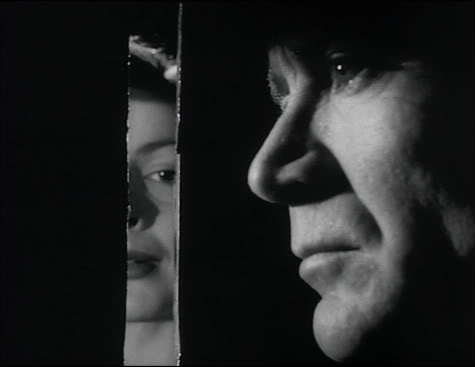
Basil Dearden does fine work as director, moving the camera around enough to help disguise the fact that this is an adaptation of a stage play. The opening scenes in London have a noirish quality with lots of deep shadow and uncomfortable angles. He also handles the attempted Tube bombing well and cranks up the suspense by having a group of kids dart innocently around Dirk Bogarde’s lethal, explosive-laden suitcase – although he does use essentially the same device again during the later ambush in Belfast. For the most part though, the action is confined to the lonely border garage which doubles as the IRA HQ. Instead of letting this be an encumbrance, Dearden turns it to his advantage by using the limited space and some clever lighting to focus on the claustrophobic atmosphere and ratchet up the tension.

The Gentle Gunman has been released on DVD in the UK by Optimum only as part of the John Mills – Screen Icons set. Optimum can be variable in the quality of their transfers, but this is one of their better ones. It’s presented in its correct academy ratio and, despite some speckles and light damage, is mostly clear and crisp with excellent blacks and contrast levels. I’m not sure how much resonance this film would have with viewers unfamiliar with the subject matter. I think it does a good job of telling a very human story and the performances and visuals are hard to fault. Given my own Northern Irish background, I’m probably a little biased in my judgement – but I loved it. There’s a lot of honesty in this little film, and a lot of themes that still hold true over fifty years later. As such, I give it a big thumbs up and recommend it wholeheartedly.


Hard Times

Poster

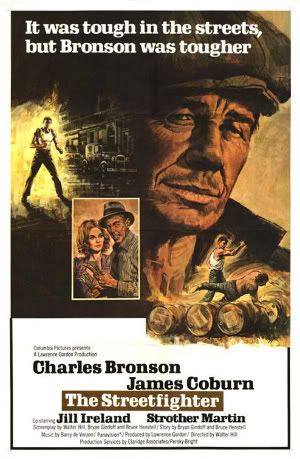
There’s something marvellously reassuring about sitting down to watch a Charles Bronson movie. You pretty much know what you’re going to get, and during his early-mid 70s peak that usually translated into an uncomplicated and entertaining film. Most of his work falls into the action category but the best of it managed to be a cut above the standard thick ear fare. Hard Times (1975) has long been a favourite of mine due to the simple yet engrossing story, the powerful fight scenes, the star pairing of Bronson and Coburn, and the presence of Walter Hill behind the camera. This is very much a man’s film, something that we rarely see nowadays – it’s tough, gritty and violent without ever becoming gratuitous or allowing the characters to lose touch with their humanity.

The story takes place in 1930s New Orleans and perfectly captures the spirit of the depression era. Chaney (Bronson) is a professional bare-knuckle streetfighter who roams the US, moving from one drab city to another making his living the hard way. Speed (James Coburn) is a chiseling promoter with a big mouth and a gambling habit, always on the make and always on the lookout for a likely prospect. There’s no backstory provided for these men, no clue offered as to how they arrived at this place in life – they just are. When Speed first sees Chaney in action, felling a much younger opponent with one devastating punch, he knows he’s found the fighter he’s been looking for. The taciturn hitter and the garrulous wide boy form a partnership and set about making some real money. However, to make money you have to have money so Speed borrows enough from a local loan shark to set up the first of a series of fights. The first half of the movie deals with the development of the releationship between Chaney and Speed as they seek out the funds necessary to permit a showdown with a local champ and his shady boss. There’s also the diversion of a romance for Chaney with a woman (Jill Ireland) he picks up in a low rent diner. One might imagine the aforementioned showdown would form the climax of the story, but it doesn’t. When Speed squanders the winnings, and thus places his life in danger with the mobsters he borrowed from, Chaney has to decide if he will risk all he has fought for to save the skin of a man who doesn’t deserve it.

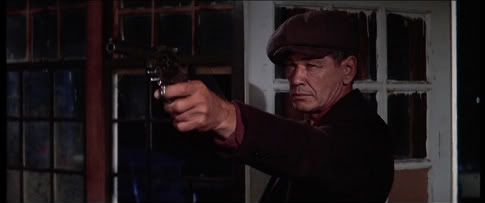
Charles Bronson - would you want to argue with this man?

Bronson was in his mid 50s when he made Hard Times but, aside from his weathered facial features, you’d never guess it. He moves through the brutal fights with a kind of graceful, measured confidence. Unlike many more modern films where the hero appears to be an unbreakable superman, Bronson looks like a man who can and has been physically hurt. Those weary, hard-bitten features and his economy with words are perfect for the role – I’d say this may well be his finest hour. In contrast, Coburn’s Speed is a boastful, grinning wastrel who thinks nothing of using everyone around him. His performance here is a broad one and can grate a little at times. He’s an actor that I have a lot of time for and who I’ve admired in many roles, but he did have a tendency to overcook it on occasion and I think he does so here. Strother Martin is great, as always, in a supporting role as the medic with an opium habit. The only really false note comes from Jill Ireland, an actress who never fails to disappoint. Mercifully, her part is not a major one so her wooden performance doesn’t detract from an otherwise excellent film. Hard Times was Walter Hill’s debut as a director and it’s a classy start to a career. He has a real feel for the period and the characters and creates a very believable sense of time and place. He chose to shoot much of the film in old warehouses and dingy nightspots which positively drip atmosphere. The staging of the fights is especially noteworthy and I’d rank them among the most realistic and exciting examples ever put on film.

The transfer on the R2 DVD is a fine one from Sony. The image is anamorphic scope and is strong and true, good colours and sharpness with no noticeable damage. Extras consist of a trailer and brief text biographies for Bronson, Coburn and Hill. Hard Times is a great film with a great cast and a director who’s one of my personal favourites. It’s a movie that tells a simple, straightforward story without resort to sentimentality or sensationalism. Highly recommended.

Crime and Punishment

Poster

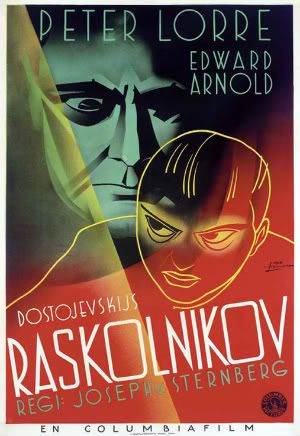
Dostoyevsky’s story has been filmed a number of times, but I have to confess I was not familiar with any of the versions until I viewed this 1935 film. It’s almost impossible to think of Josef von Sternberg without also thinking of Marlene Dietrich, so closely connected were their 30s careers in Hollywood. Crime and Punishment was only the second American picture von Sternberg made without his leading lady, and his best period was already behind him. This was a very low budget affair, made for Columbia, yet he still managed to turn out a film that remains visually interesting. Of course it didn’t hurt to have two up and coming talents involved, namely star Peter Lorre and cinematographer Lucien Ballard.

Basically, what we have is a tale of desperation. Raskolnikov (Lorre) is a brilliant young student of criminology, a man of great potential. Before long, however, we can see that this potential is not to be fulfilled. Both Raskolnikov and his family have fallen on hard times and he finds himself facing the threat of eviction. But Raskolnikov is a man of great pride, considering himself morally and intellectually superior to others. This pride, bordering on pomposity, is tested to the limit when he receives a visit from his mother and sister. The very real prospect of his sister allowing herself to be forced into a clearly unsuitable marriage purely out of financial necessity spurs him to act. A visit to a parasitic pawnbroker results in murder for profit, yet this great intellectual finds himself not much better off. Panicked into flight with only a fraction of the loot, his self-doubt and guilt quickly assail him. Having acted rashly due to desperation, he soon finds that a new variety of desperation awaits him. Inspector Porfiry (Edward Arnold) is the ever-smiling, unctuous figure that appears on the scene, apparently grateful for any assistance the brilliant young student of crime can offer. The truth is the policeman is never really taken in, and it’s only a question of whether he can wheedle a confession out of Raskolnikov or whether the young man’s mounting guilt and paranoia will do the job for him.

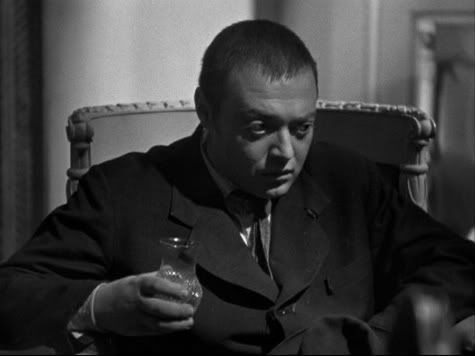
Peter Lorre ponders his fate.

Peter Lorre was in his pomp when this film was made, riding high on a wave of critical success following Lang’s M and Hitchcock’s Man Who Knew Too Much. He had the kind of face that was ideal for expressing fear, despair, self-loathing, anger and swaggering confidence, and all in quick succession. You can almost taste the terror as he shrinks back into the shadows when he’s on the point of being discovered at the scene of the crime, his round features bathed in cold sweat. Conversely, there’s real arrogance to the way he later struts into Porfiry’s office, casually putting his feet on the furniture, while he taunts the policeman. Edward Arnold was the perfect foil here (Sydney Greenstreet would fulfill a similar function a few years later) for Lorre’s emotional grandstanding. His ebullient Porfiry is like a great, fat spider spinning a web around, and toying with Lorre’s bug-eyed and hopelessly trapped fly. The scenes between these two, as they indulge in an intellectual duel, are the best parts of the film. The budget was obviously tight as the whole movie is studio bound and the cast is minimal, but von Sternberg never lets it look cheap. There are plenty of expressionistic shadows and the limited sets are all well photographed by a very young Lucien Ballard.

Crime and Punishment is a pretty rare film, but it has been given a DVD release in R2 in continental Europe. I picked it up purely on a whim when I noticed it on the shelf for a low price, and I’m very happy I did. Sony have provided a spiffy looking transfer that has clearly been cleaned up and really does justice to a film that’s almost 75 years old. There are a plethora of subtitles and dubs available but no other extras. There were rumours of a Peter Lorre box in R1 from Sony, and judging from the handsome look of this title I’d expect it to turn up there sooner rather than later. I don’t think Crime and Punishment is one of the lost greats, but with the high class talent involved both in front of and behind the camera it’s a movie I’m very happy to have in my collection.

The Blue Gardenia

poster128

There are lots of sub-categories within film noir, and one of my favourites is what is sometimes termed nightmare noir. Fritz Lang’s The Blue Gardenia (1953) fits this description by presenting a protagonist whose world gets turned upside down after making one ill-judged decision. This kind of story offers all sorts of opportunities for some of the staple ingredients of noir – paranoia, suspicion, the idea that bad luck is waiting just around the corner, and the fact that the course of one’s life can hinge on something as simple and inocuous as a mix up over a phone call.

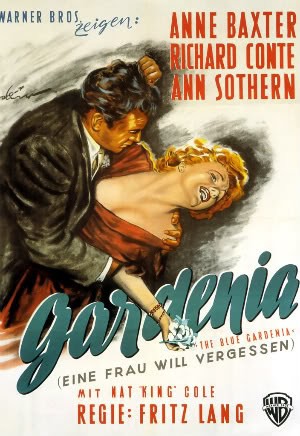
Norah Larkin (Anne Baxter) is a switchboard operator who leads a fairly humdrum life, sharing an apartment with two other single women and biding her time till her lover comes back from Korea. However, it doesn’t take long for things to start to unravel and for life to hand her the first in a series of unexpected kicks in the teeth. She’s just bought herself a new dress, cooked a special meal, and plans to sit down and share it with her absent G.I. boyfriend. So, with his photo propped in front of her, she opens his latest telegram and starts to read. It’s a brush off, he’s met a nurse, fallen in love and plans to marry her. Norah is naturally distraught and more than a little bitter, so when she takes a call meant for one of her flatmates she makes that one bad decision. On the rebound, she agrees to a date with the slightly sleazy ladies man Harry Prebble (Raymond Burr). During the course of dinner Prebble ensures that Norah gets well and truly tanked on cocktails before taking her back to his apartment. When he starts to get a little too friendly, Norah struggles with him but quickly blacks out. On awakening, she finds Prebble dead on the floor, his head smashed in with a poker. Panicking, and with only the haziest of memories of what went before, she flees the scene of the crime but leaves a few clues behind. The rest of the movie involves Norah’s attempts to evade the law, while playing a cat and mouse game with smooth newspaperman Casey Mayo (Richard Conte). The only real problem I had with the film was the fact that the element of doubt doesn’t really work for the viewer. While Norah and the characters around her cannot be sure of her guilt or innocence, it’s fairly clear to us. For this kind of story to work properly it’s preferable if the viewer experiences the same level of uncertainty the lead feels.

£14

Anne Baxter takes centre stage as the haunted and hunted Norah, and does a pretty good job of conveying her mounting sense of paranoia and isolation without resorting to histrionics. Richard Conte is reliable as usual in the role of the reporter who has his doubts. Raymond Burr was still at that stage of his career where he seemed to play nothing but heavies, but he did it well and his Harry Prebble has a nice touch of the sinister about him. However, while those three turned in fine performances, the picture really belongs to Ann Sothern. Her sassy turn as Norah’s seen-it-all-before flatmate is the highlight, and she walks away with just about every scene she appears in. Lang’s direction is as classy as one would expect, and the themes involved are right up his street. He seemed to have a thing for artists and reporters, and both play a prominent part here – although his most biting critique of the media, the ascerbic While the City Sleeps was still a few years down the road. There are strong noir credentials throughout the movie with Vera Caspary (Laura) providing the source material and Nicholas Musuraca working his magic behind the camera – the shadowy shots of the deserted newsroom at night being especially atmospheric.

The R1 DVD from Image is generally quite good, although there are a few damage marks here and there. It’s a totally barebones disc but should be available fairly cheap. The Blue Gardenia was originally distributed by Warner Brothers but is thankfully no longer controlled by them – I couldn’t imagine writing that just a few months ago, but this is the kind of film that might well be consigned to the appalling Archive programme now. All in all, it’s a fine noir that I’m happy to recommend.


The Great Northfield Minnesota Raid

About a year ago I wrote a short series on the depiction of Jesse James in the movies. At the time, I skipped over The Great Northfield Minnesota Raid (1972) for the simple reason that I hadn’t seen the movie in years and didn’t have a copy to hand. Well I eventually got around to watching this a few days ago and thought I’d post my thoughts on it for the sake of completeness. I had recalled the film as being pretty good, but after my recent viewing I’m not so sure. I wouldn’t go so far as to call it bad – it has too many interesting things going for it – but it did leave me feeling disappointed. The performances, and some of the ideas, save it but the direction is the weak point for me. I suppose I really should come clean here and say that Philip Kaufman isn’t one of my favorite directors, so that may have affected my opinion somewhat.

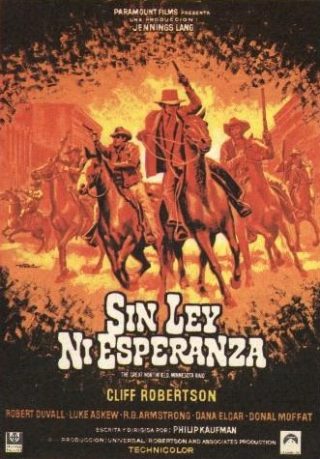
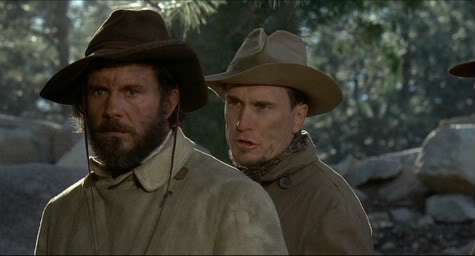
The whole film takes place within a fairly short space of time, concentrating on the lead up to, execution and aftermath of the bank robbery of the title. Mainly it’s a character study of Jesse James (Robert Duvall) and Cole Younger (Cliff Robertson), with the latter getting more screen time and coming across the more sympathetic of the two. With the possibility of an amnesty for their past crimes being granted by the Missouri state legislature, Cole Younger (recuperating after a run in with Pinkerton agents) rides for Northfield with the aim of heading off Jesse before he can raid the bank. Along the way, he learns that the amnesty he was hoping for won’t be forthcoming, so a change of plan is in order. The scenes in Northfield, which make up the central part of the story, represent both the best and worst aspects of the picture. It’s here that the yokel outlaws get their first glimpse of the new technology and customs that will soon change their world forever. Some of these scenes work very well, such as the shock of being confronted by an early motorized vehicle. On the other hand, the almost interminable baseball game, replete with Keystone Kops style pratfalls, comes across as needlessly self-indulgent and slows the whole film down. The idea of including it was sound enough but Kaufman drags it out to the point where it becomes distracting. It’s worth comparing this sequence to the camel race at the start of Ride the High Country as they’re essentially making the same point; the difference, however, is that Peckinpah knew where to draw the line.

Robertson is excellent as the thoughtful and charismatic Cole. He plays him as a man of the world and a realist, a guy who sees change coming and who is smart enough to see that dwelling on the past does no good. Duvall’s Jesse is the complete opposite – an unbalanced psychotic who cannot let go of the past and who treats all who stand in his way with a ruthless contempt. He talks in grandiose terms of having visions and excuses his excesses by referring to the guerrilla action he’s involved in. Both men give strong, believable performances that help ground the film. The supporting cast is also noteworthy with R G Armstrong playing the ill-fated Clell Miller, and old-timers Elisha Cook Jr and Royal Dano getting small but important roles. One other point I’d like to make relates to the way Frank James was portrayed; in every other movie I’ve seen, this character was shown to be a tough, smart but very human figure. In this movie, however, John Pearce plays him as a vaguely simple-minded soul who lives only to carry out his brother’s wishes. I’ve no idea if this closer to reality or not, but it’s a marked contrast to all other portrayals. I said earlier that I wasn’t all that impressed by Kaufman’s direction and, apart from the aforementioned baseball sequence, he also handles the actual robbery poorly. The scenes in the bank are fine, but as soon as the action takes to the streets it falls down. It’s difficult not to compare this to Walter Hill’s superlative filming of the same events in The Long Riders, where I found myself riveted. Kaufman has the camera swooping all over the place, yet there’s none of the intensity or power of Hill’s version. There are some nice shots of landscape and forest but the whole thing has a slightly cheap look, which is odd since he almost perversely manages to evoke an authentic sense of time and place. I don’t know, I think if he could just have changed the emphasis here and there we could have had one of the best cinema versions of these events. As it stands, the movie seems like it’s trying too hard to be an art house representation of what is really a fairly straightforward story.

The R1 DVD from Universal is barebones, save for the inclusion of the trailer, but the picture quality is excellent. I certainly didn’t notice any significant damage and the colours, while subdued, are true. There’s a nice, tight 1.85:1 anamorphic transfer and the disc is available very cheaply. In general this movie has some good ideas and fine performances, but I feel it could have been so much better. Like all other versions it’s littered with inaccuracies (for example, Jim Younger’s facial wound was sustained in Northfield, and not earlier as the film states) but that’s no big deal for me. I’m still of the opinion that The Long Riders remains the best telling of the story of the James/Younger gang, and that Kaufman’s movie is an interesting but flawed addition to the mythology surrounding these men.

Rocky Mountain

Having already made seven westerns, Errol Flynn got into the saddle one last time in 1950 to make Rocky Mountain. The whole tone of the film is different to what went before, and that makes it somewhat atypical. Both They Died with Their Boots On and Silver River had their darker moments but neither was as relentlessly grim as this. From the opening moments, when a weary, unshaven Flynn leads his bedraggled soldiers across a bleak landscape, an air of resigned fatalism hangs over the characters. This makes for a superior little picture, and one entirely in keeping with the era in which it was produced. By 1950 the western was on the cusp of one of its regular periods of transition, about to enter that Golden Age when heroes were less than perfect and endings weren’t always happy.

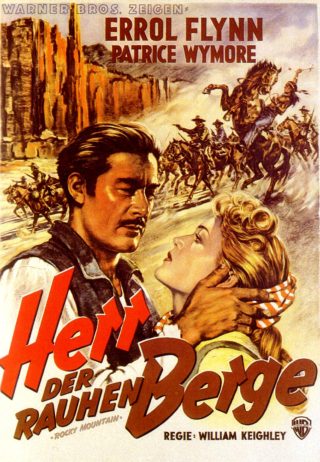
Lafe Barstow (Flynn) is a captain in the Confederate army who, in the dying days of the Civil War, has been sent west to California to raise a guerrilla force which his superiors hope will cause sufficient havoc to take the heat off their forces back east. We get our first sight of the small band of rebels as they near their rendezvous with the bandit warlord who has pledged his men to the cause. From there on the action is confined to the titular mountain and the barren valley below. Things go awry almost immediately when Barstow and his men take it upon themselves to rescue a stagecoach being pursued by a raiding party of hostile Shoshone. This act of gallantry is destined to backfire when it’s revealed that the sole surviving passenger is Johanna Carter (Patrice Wymore), the fiancee of a Union lieutenant stationed nearby. Not only has the secrecy of their mission been compromised but the rebels soon find themselves besieged by the vengeful Shoshone. A tense waiting game ensues and hard decisions will have to be made by all concerned. This is quite a downbeat story and, despite the misleading publicity blurb on the poster, the romantic aspects are largely ignored. There’s also a conspicuous lack of the kind of broad comedic moments that frequently characterize westerns starring Flynn.

I really enjoyed Flynn’s performance as the doomed soldier struggling to choose between duty and human decency. It’s sort of ironic that it should be his last western, and a low budget picture, where he finds a role that he could get his teeth into. Rocky Mountain was to be one of Flynn’s last good parts before he experienced a mini revival in his last years. It proves that the man could certainly act when the right material was offered to him – it’s just a shame that he chose, or had to accept, such poor vehicles thereafter. Patrice Wymore was soon to become the third Mrs. Flynn and she does fine as the reluctant hostage, appearing remarkably assured in what was only her second film. The support cast is generally good and there’s the bonus of seeing Slim Pickens making his screen debut as one of Flynn’s men. Long-standing sidekick Guinn Williams is also prominently featured (looking quite old and weathered, it has to be said) and he indulges in none of the comic pratfalls with which he’s often associated. Director William Keighley shot this sparse movie very professionally; both the action set pieces and the more thoughtful, talky passages work equally well, and he really gets the best out of the New Mexico locations. There’s not one interior in the whole film, and that’s always a good thing when the budget is restricted.

Warner’s R1 DVD of Rocky Mountain is another excellent transfer that shows off the crisp black and white photography to good effect. There’s the usual package of extras with three more of the very welcome western shorts that appeared on the disc for Montana. The film has also been granted a commentary track by Thomas McNulty, which I found both enjoyable and informative. All told, we get a classy presentation of a very fine movie which I’d recommend highly.

So, that brings me to the end of this little series on the westerns of Errol Flynn. I’m not sure how I’d rank them, but Rocky Mountain, They Died With Their Boots On and Silver River would have to be in the top three, with the first two probably sharing the top spot. I’d have no hesitation in placing San Antonio and Montana at the bottom of the pile, with the other three jockeying for position in the middle. Anyway, I’ve enjoyed viewing and writing down my thoughts on these films, and I hope others have taken some pleasure in reading them.

Montana

poster98

After watching Silver River, with it’s strong plot, good cast, and high production values, it’s a bit of a disappointment to view Montana (1950) next. What we have here is a B movie that uses technicolor in a vain attempt to disguise that fact. It’s a real struggle to find anything good to say about this film; the story is flat and unengaging, the cast largely anonymous, and the action (what little there is) is dull and devoid of tension. On the plus side, the colour photography adds a little sheen to a few scenes and it’s mercifully short, clocking in at just 76 minutes.

Montana falls into that small sub-genre of westerns that deals with the conflict between the cattlemen and the sheepmen. Now, there’s a very good reason why such stories never gained much popularity – it’s essentially a dull subject that doesn’t grab you. The plot deals with the efforts of Morgan Lane (Flynn) to drive his herd of little woolly guys into Montana and graze them on the open range. The cattle ranchers, who have already established themselves, are implacably opposed and are prepared to use whatever means are necessary to keep the sheepmen out. The ranchers, in the shape of Maria Singleton (Alexis Smith) and her betrothed Rod Ackroyd (Douglas Kennedy) have the range carved up between them and are preparing for war. Lane manages to trick Miss Singleton into signing over a lease, and the stage is set for a showdown. The problem is that there’s no real tension generated and the on-off romance between Flynn and Smith just feels contrived and serves only to pad out what is basically a lean tale. By the time you get to the appallingly poor climax it’s hard to care what the outcome will be.

This is one of Flynn’s poorest performances and it’s clear his heart just wasn’t in it. He looks tired for most of the running time and even his likability can’t lift this drivel. Worst of all there’s the unedifying spectacle of the star gritting his teeth and warbling along to a godawful ditty in a duet with Alexis Smith. Miss Smith wasn’t really served any better by this material and spends much of her time flouncing around playing a character whose behaviour perpetually alternates between the arch and the petulant. The  rest of the cast is filled up by a bunch of instantly forgettable nobodies giving one flat, one-note performance after another. Oh, S.Z. Sakall makes another of his unwelcome appearances but his character abruptly disappears and no explanation is offered – he’s just there, and then he’s not. This kind of continuity lapse, and the short run time, suggests that portions of this movie ended up on the cutting room floor. Ray Enright was one of those journeyman directors who could produce something passable given the right material, but his point-and-shoot handling of Montana is underwhelming and uninspiring. His filming of the big stampede at the climax is an object lesson in how not to shoot an action scene. We get pointless images of rampaging cattle interspersed with head and shoulder shots of Flynn and others bobbing up and down, pretending to be riding horses, against a painted backdrop!

For such a weak film Montana is presented handsomely on DVD in R1; the transfer is clean and the colours are strong. There’s a good selection of extras from Warners with trailers and shorts – best of all are three western shorts, which I actually found more entertaining than the main feature. Prior to this viewing I hadn’t seen Montana in over twenty years. I had forgotten most of the story and I have to say it really is a forgettable movie. If you’re a Flynn completist, like me, you’ll probably want it just to plug the gaps but I seriously doubt it’s the kind of movie anyone is likely to return to in a hurry. Next will be Flynn’s final western, and the last in this short series of reviews – Rocky Mountain.