Dark Command

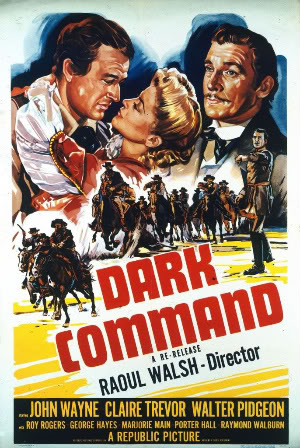
William Clarke Quantrill was one of those controversial figures who gained fame or noteriety, depending on where one’s sympathies lay, as a result of his activities during the Civil War. The nature of those activities has ensured that his character and associates have continued to appear on screen on a fairly regular basis, right up to Ang Lee’s much maligned Ride with the Devil. Raoul Walsh’s Dark Command (1940) takes Quantrill, changes his name to Cantrell, and adds a written caveat at the beginning to explain that certain liberties have been taken with the truth. As such it’s not a biopic of the man in the traditional sense; it merely uses the character and a few events from his life to tell a standard western story. Taken on this level it works very well, but then I don’t think I’ve ever seen a film by Walsh that didn’t work on some level.

Dark Command opens in Lawrence, Kansas on the eve of the Civil War, with Bob Seton (John Wayne) arriving in town in the company of perennial sidekick ‘Gabby’ Hayes. Seton is an uncomplicated Texan who’s in the process of working his way across the country. In making the acquaintance of banker’s daughter Mary McCloud (Claire Trevor), he also meets local schoolteacher Cantrell (Walter Pidgeon). Both men clearly have romantic designs on Miss McCloud, and their rivalry later extends to the political arena when they run for the newly instituted position of town marshal. It is Seton’s victory in this election that proves the catalyst for Cantrell’s abandonment of civic duty in favour of a much more lucrative career as a guerilla raider. Actually this brings about a change in the two lead characters; Seton becoming tougher and more assured once the weight of responsibility falls on his shoulders, and Cantrell revealing his venal nature in his quest to attain “greatness”. This personal animosity is played out while, all around, the town divides itself along pro-Union and pro-Confederacy lines. The wider national conflict is referred to only through dialogue and one of those, now cliched, burning map shots.

As I said before the film isn’t a straight biopic and never claims to be giving all the historical facts. Having said that Quantrill did work as a teacher in Lawrence in the years preceding the Civil War, although I’m not aware of his running for marshal or other elected office. It has been said of Raoul Walsh that his idea of humour was burning down a whorehouse; in Dark Command he goes one step further by burning down a whole town, although not for comedic value. The sacking of Lawrence by Quantrill is a known historical event and the film duly acknowledges this. However, this set piece, which forms the climax of the story, doesn’t dwell on the gory excesses of Quantrill’s men. Instead it uses it as a means of neatly wrapping up the personal battle between Seton and Cantrell. One could pick out all kinds inaccuracies relating to timelines, weaponry, the ultimate fate of Quantrill and so on, but I’ve never felt that this serves much of a purpose. Movies are a means of telling stories, and if this requires the makers to play a little fast and loose with the facts, well, so be it.

John Wayne made Dark Command one year after Stagecoach, the film which offered him a way out of the cycle of B westerns he’d been doing since the failure of Walsh’s The Big Trail. It’s a little ironic that the man who first introduced Wayne to the cinema-going public should again feature at the rebirth of his career. The Duke is still not the finished product here, although he’s not far away; audiences wouldn’t really see his fully formed western character until Tall in the Saddle, a few years later. There’s a bit too much mugging in the first half of the picture, although the easy, confident Wayne we’re all familiar with starts to emerge as the story moves along. Walter Pidgoen was an actor I’ve never really warmed to, but he was capable of turning in good performances as men carrying around a lot of internal baggage – How Green Was My Valley would be a good example of this. His Cantrell is never all that convincing as an out-and-out villain but maybe that’s just the way the part was written. Where he’s at his best are those private moments when he gives vent to all the pent up frustration that comes from thwarted ambition. Claire Trevor, who received top billing here, was a fine actress and does well as the conflicted woman at the centre of events. In Stagecoach she showed good chemistry with Wayne and that spark continues to be evident in this film. Romantic interludes were never Wayne’s strong suit but the tough Miss Trevor manages to draw out her co-star quite successfully.

I’ve already alluded to the fact that Raoul Walsh’s sense of humour tended towards the broad, and that’s certainly the case in the scenes with ‘Gabby’ Hayes. In much the same way as with Walsh’s contemporary and fellow Irish-American John Ford, audiences either get this kind of humour or they don’t. Superficially, one could see similarities in the styles of these two directors, but Ford remains the better known filmmaker. That’s not to say that Walsh should be regarded as a lesser figure, mind; he was every inch the professional and turned out some of the finest films of classic era Hollywood. It should also be mentioned that Dark Command contains some top class second unit work from the great Yakima Canutt. There’s a spectacular wagon jump from atop a cliff, and another outing for his patented under-a-moving-wagon escape ala Indiana Jones. Today’s climate of clumsy editing and overused CGI makes this viewer yearn for the era when there was genuine creativity and artistry in the second unit.

The movie is available on DVD in both R1 and R2. I have the old R1 from Artisan and the picture quality is quite good. Like all those Republic pictures released by Artisan there hasn’t been any restoration done, so there are instances of speckling and the odd cigarette burn. However, the print remains in pretty good shape and is always watchable. The R2 comes from Universal UK, and while I don’t have it to compare I would be wary of its quality considering its source. Dark Command is a fine western with an epic feel that comes partly from the bigger budget that Republic granted it. I’d recommend it to the general western fan and anyone with an interest in the Civil War era, or the development of the Duke’s career.

Where Danger Lives

poster71

The films produced at RKO under the stewardship of Howard Hughes were a mixed bag to say the least; the billionaire’s’s involvement lending a crass, juvenile quality to more than one movie. While he led the once great studio along the path to bankruptcy and oblivion, he also introduced the cinema-going public to number of new starlets such as Jane Russell and Faith Domergue. Miss Domergue never made that many memorable pictures, save for Where Danger Lives, This Island Earth and It Came from Beneath the Sea. Of those three, Where Danger Lives (1950) has the slightly odd distinction of presenting her with her best role while also being the least known. In fact, this is a fine movie all round with stylish direction by noir stalwart John Farrow, a powerful lead performance by Robert Mitchum, moody cinematography by Nicholas Musuraca, and a Charles Bennett script.

At first glance the film may seem like a standard lovers-on-the-run yarn, but that’s merely the framing device for a tale of obsessive love, deception and madness. Jeff Cameron (Robert Mitchum) is introduced as an overworked but dedicated doctor who, at the end of his shift, is called upon to treat an attempted suicide. He is immediately attracted to the patient, Margo (Faith Domergue), and soon embarks on an affair. The immediate effect of this is that Cameron develops a callous disregard for both his job and his devoted sweetheart, played by director’s wife Maureen O’Sullivan. The whole point of the story is how lust can blind a man to reality and allow him to be deceived and manipulated. The film is packed with lies and liars and it seems that just about everyone is prepared to bend the truth to suit their own agenda, right down to ambulance drivers and small town doctors. When Cameron receives a blow on the head in a struggle, the resulting concussion gradually impairs his judgement and allows him to be more easily duped. In a marvellously surreal passage, the fleeing couple arrive in a town where everyone is bearded and dressed in western apparel. For a moment it looks as though the action has taken a detour into the Twilight Zone, until it is revealed that Mitchum and Domergue have stumbled into a local festival. The idea of nobody being quite what they appear is nicely highlighted when a local boy draws facial hair onto a photograph of Domergue, while muttering that everyone has to have a beard. From first to last, the movie concentrates on shifting identities and false perceptions.

Robert Mitchum was an old hand at playing noir anti-heroes and the role of Jeff Cameron offers him the opportunity to flex his acting muscles. He goes from being an upstanding professional at the beginning of the film to a shambling brain damaged wreck of a man by the climax. In the hands of a lesser actor the part could easily have descended into eye-rolling histrionics, but Mitchum’s deceptively lazy style ensures that credibility is maintained as his character’s mental state deteriorates and he floats between clarity and confusion. Faith Domergue’s Margo is a fine femme fatale in the classic mould. Her performance isn’t as controlled as Mitchum’s but she still manages to be convincing. It’s obvious from the start that there’s something not quite right about Margo, but you can’t really put your finger on what. Claude Rains appears in a small but significant part, and adds some real class to proceedings; in his few minutes of screen time he shows us another psychologically twisted character, and his playing is every bit the equal of that of his co-stars. John Farrow always seemed comfortable in noir territory, and does a good job of holding together a story that could have easily spun out of control. Farrow is ably assisted by his director of photography Nicholas Musuraca, whose camera does good things with the bleak desert backdrops and shadowy small towns that dominate the film.

Where Danger Lives comes to DVD, paired on disc with Tension, from Warners in R1 via their fourth noir set. It’s a fine, clean transfer which shows Musuraca’s excellent black and white photography at its best. The film comes with a trailer and a short featurette on the movie. This is a  film that I wasn’t at all familiar with until I picked up the box set. I can’t think why it has been such an obscure and hard to see movie since I’d rate it as an excellent example of classic era noir. Highly recommended.

The Long Memory

hhrbybb

I seem to be on a bit of a Robert Hamer kick at the moment. Having recently enjoyed Pink String and Sealing Wax, I decided to give The Long Memory (1952) a spin. While the former is a Gothic/Victorian noir which may stretch the definition for purists, the latter is the real deal. It has the contemporary setting, stark photography and relentlessly downbeat moodiness that should satisfy all who have a penchant for dark cinema. The story is classic noir wherein an innocent man is persecuted for a crime he has not committed and subsequently finds himself consumed by his thirst for revenge on those responsible for his plight.

Phillip Davidson (John Mills) has just been released from prison, having served twelve years for murder. An early flashback establishes that he had been wrongfully convicted, and that the false testimony of his then fiancee (Elizabeth Sellars) played a significant part in securing that conviction. In a neat twist, it also transpires that the treacherous fiancee has, in the intervening years, married the policeman originally in charge of Davidson’s case (John McCallum). Aware of the fact that Davidson still bears a grudge, the authorities track him Kent where he takes up residence in an abandoned barge along the desolate Thames estuary. As Davidson grimly sets about the task of seeking out his former tormentors the action alternates between his search and the slow unravelling of the idyllic domesticity of the policeman’s life. Running parallel to this is the development of a relationship between Davidson and a refugee girl (Eva Bergh) working as a waitress in a dingy cafe. This plot thread is not mere romantic padding but an essential element that clearly demonstrates just how deep Davidson’s scars run. By the end of the movie the quest for revenge has transformed into more of a journey towards spiritual redemption.

£6

The acting is out of the top drawer all round with the only weak link in the chain being Elizabeth Sellars. Her performance comes across as even more wooden given the emotional depth shown by almost everyone else around her. John Mills does a fine understated turn in the lead role. The scenes he plays in the old barge with Eva Bergh have such a touching and heartrending quality. These are two people who have spent so long living within themselves that the effort of reaching out to another is close to physically painful. John McCallum is also fine as the decent cop who gradually comes to realise that the woman he married is not all she seems, and who must resign himself to the fact that his career cannot continue if he’s to come out of it all with any sense of honour intact. There’s plenty of good support from a selection of familiar British character actors; special mention going to Michael Martin Harvey as Mills’ slightly kooky neighbour.

Where Pink String and Sealing Wax suffered from an undisciplined and unfocused script, The Long Memory can boast tighter writing and pacing. Hamer moves his camera around effectively and makes maximum use of the barren Kent coastline. He also controls the flow of the story very well, and cuts tellingly between the gradual flowering of the Mills/Bergh relationship and the simultaneous disintegration of Sellars and McCallum’s. All of this is backed up by the excellent cinematography of Harry Waxman who manages to throw in some welcome deep focus shots.

The Long Memory is currently only available on DVD as part of the John Mills Centenary Collection II from ITV DVD in R2. The set is a bit pricey but it does offer a good selection of Mills films and is worth checking out. This movie comes on its own disc and, while not perfect, gets a pretty good transfer. There’s optional subs, production notes and a gallery included. I hadn’t seen this film for a number of years and had forgotten what an underrated little gem it is. I give it a big thumbs up and recommend it wholeheartedly.


Desert Fury

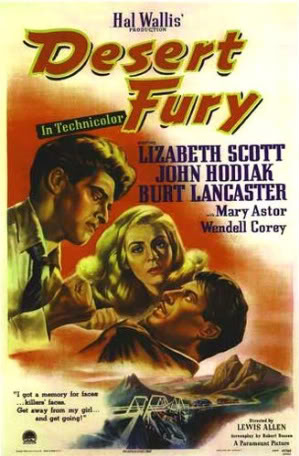
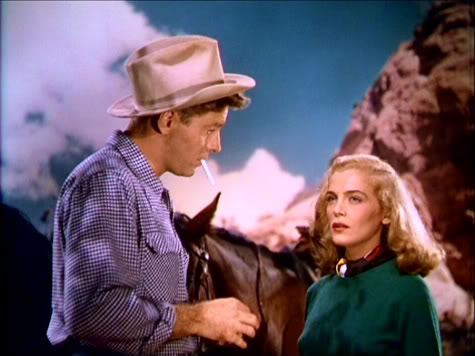
Can a technicolor movie be considered a film noir? I think so. Sure, the form lends itself better to the harshness of black and white photography where the light and shadows can be more skilfully manipulated. Having said that, film noir is more than just a photographic style – it’s a style of film making. To me, noir is a combination of many elements (theme, character, time, location, photography etc.) and the more boxes we can check, the closer we come to defining it. Photography is, undoubtedly, one of the major elements that needs to be present – I just feel that photographic style rather than color vs B&W is the clincher. As such, I feel Desert Fury (1947) is most definitely noir. Although the movie is shot in blinding technicolor, the themes and characterization place it firmly in the realm of dark cinema.

Paula Haller (Lizabeth Scott) returns to Chuckawalla, the small desert town where she was raised by her widowed mother Fritzi (Mary Astor). Paula is shown to be an outsider right from the off, snubbed by the locals due to her mother’s ownership of the town’s gambling joint. The only friend she has is Tom Hanson (Burt Lancaster), a former cowboy now working as town deputy after an accident put an end to his former career. Paula’s arrival back home coincides with the reappearance of a shady character called Eddie Bendix (John Hodiak), whose wife died years earlier in a mysterious road accident. When Paula falls for Bendix a whole hornet’s nest of passion is stirred up as Fritzi, Hanson, and Bendix’s partner Johnny (Wendell Corey) all, for their own reasons, try to keep them apart. What tilts this into noir, rather than straight melodrama, is the twisted nature of the relationships involved. Paula is said to bear a strong resemblance to Bendix’s late wife; Fritzi and Bendix were formerly lovers; there’s more than a hint of jealous competition between the two female leads; and there are strong suggestions that the relationship of Bendix and Johnny might involve some sexual undercurrents – heady stuff indeed for 1947. There’s also a nice cyclical form to the movie, which both opens and closes with characters staring over the rails of a bridge at the site of a fatal crash.

This is a picture that’s dominated by the performances of the women. Mary Astor is near perfect casting as the worldly and tough dame who rules the roost in a man’s world, yet struggles to tame the impulses of her headstrong daughter. Lizabeth Scott was born to star in films noir, and she does the business here as the troubled heroine with the whiskey voice who has to learn a few hard lessons. Burt Lancaster’s role is a bit of a thankless one; he seems to do little more than cruise up and down the desert highway, hoping to run into Scott on her return from Hodiak’s rented pad. Hodiak himself gives an interesting performance as man who’s clearly not all he seems. His initial detachment and suppressed aggression hint at some dark secret, and he gradually descends further into a kind of manic vindictiveness until his flaws and weakness are finally exposed by the sly and knowing Corey. Director Lewis Allen makes sure everything moves along smoothly and makes excellent use of the harshly beautiful locations. A word also for cinematographer Charles Lang, who makes those same desolate landscapes positively pop off the screen.

Desert Fury is available on DVD in R4 from a company called DV1. Their disc looks fantastic with strong color and detail, although there are some speckles and damage marks here and there. It is, however, totally barebones with not even subs offered. On the plus side there are some interesting liner notes  printed on the reverse of the cover – and it should be available cheaply. For me, this was pretty much a blind buy and I ended up enjoying it a lot. Recommended.

Ride, Vaquero

poster52

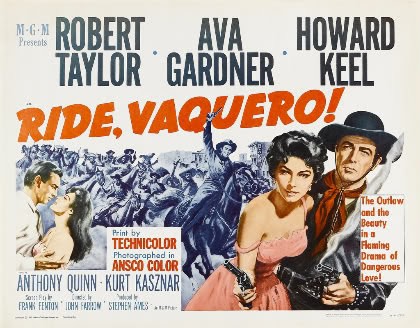
Ride, Vaquero (1953) was one of those films that always seemed to elude me. I’d read about it and heard about it often but, somehow, could never manage to see it. Well, I’ve finally got around to it. Robert Taylor may not be the first actor some would think of as a western character but the fact is he made a good number of oaters in his time. I’ve been watching quite a few of his westerns recently (the ones in the R1 westerns set, and a TV broadcast of The Hangman) and I quite enjoyed this.

Rio (Taylor) is the right hand man for bandit chief Jose Esqueda (Anthony Quinn), operating along the Texas/Mexico border in the aftermath of the Civil War. The end of the war has thrown up new challenges for these men, namely the arrival of new settlers and the renewed interest of the army and the federal government. Esqueda understands that such developments will spell the end of his reign as the undisputed master of his territory. His preferred course of action is a simple one; drive out the settlers before they have had a chance to put down permanent roots. The toughest proposition Esqueda has yet to face comes in the form of King Cameron (Howard Keel), who has come west with his wife (Ava Gardner) to build a new life. An abortive raid on the Cameron ranch leads to the capture of Rio. Instead of handing him over to the law, Cameron offers Rio the opportunity to switch allegiances and become his partner. He accepts, but the question remains whether his decision is based on a desire to embrace a more lawful lifestyle, or just a desire to embrace Camerons wife.

Director John Farrow manages to throw a number of big themes into the mix – the old ways vs progress, loyalty and betrayal, and a man’s need to hold onto what he has won. Taylor gives a good performance as a man who’s in search of his place in the world. He may seem cold and aloof, but that’s surely an essential part of the character. His precise relationship with Esqueda is not fully revealed until the end, and it goes a long way towards explaining the alienation his character feels. Anthony Quinn gives the lusty, larger-than-life treatment to his role of the bandit king, and it’s very enjoyable. Ava Gardner naturally looks great and brings a credibility to her part as the rancher’s wife with the wandering eye. Howard Keel is just about adequate but, since I believe this was his first non-musical role, I won’t be too harsh on him. There are also small yet memorable parts for Jack Elam and Ted De Corsia.

Ride, Vaquero has recently been released on DVD by Warners in France. The disc is a barebones affair with removable French subs and, unfortunately, boasts a weak transfer. The image doesn’t seem to have undergone any restoration and looks soft throughout. The biggest problem though is the colour, which has faded badly. The film was shot using the cheap Anscocolor process and if you’ve seen the recent R1 of Escape form Fort Bravo you’ll have some idea of what to expect. That said, the film is well worth 90 minutes of anybody’s time and I’d recommend it, if you can get past the deficiencies in the DVD transfer.

Seminole

seminole

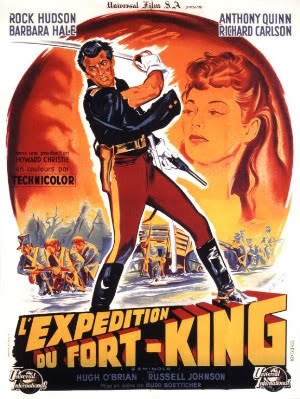
Budd Boetticher is celebrated, and rightly so, for the seven westerns he made with Randolph Scott in the late 50s. Seminole was produced just a few years before those collaborations and, while it’s a satisfying enough picture, it’s not quite up there with his best. One could, I suppose, quibble about its credentials as a western due to the setting (Florida) and the time period (1835) but I feel it’s as near as makes no difference.

The story, most of which is recounted in a long flashback sequence, follows the newly appointed Lt. Caldwell (Rock Hudson) who is travelling back to his birthplace in Florida to take up a position at Fort King. His arrival coincides with the beginnings of an uprising among the Seminole, provoked by a government plan to uproot the tribe and move them west to prevent their presence slowing down the nation’s expansion. Within this framing story there’s further conflict due to the revelation that Caldwell’s boyhood friend, the half breed Osceola (Anthony Quinn), is not only the chief of the Seminole but is also vying for the affections of his sweetheart Revere Muldoon (Barbara Hale). While Revere shuttles back and forth in the role of intermediary between the Seminole and the army, a plan is set in motion by the fort’s commander, Major Degan (Richard Carlson), to strike at the enemy in their Everglades homeland and thus preempt any further threat.

The film raises a number of issues, only a few of which are fully explored. The main conflict is the internal struggle which Caldwell experiences between his loyalty to the army and his inherent sympathy for the Seminole he has known all his life. This leads to his being suspected of treachery by his superiors and his eventual court martial. The film tries hard to show the Seminloe in a positive light (mostly due to the performance of Anthony Quinn) but generally takes the middle way, since the army is portrayed as being reasonably even-handed with the exception of the uptight martinet Major Degan. This leads to a bit of a pat, upbeat ending. Much stronger is the middle section where Degan leads his troop on a disastrous march through the steamy swamps with a huge cannon in tow, all the while insisting they keep their tunics buttoned to the collar as per the regulations. One of the more interesting themes, and the film really only touches on it, is that of miscegenation. It is quite clear that Revere has been involved in a long-term relationship with Osceola but, after a brief mention by the chief of how white society would frown on this, she quite happily drops him and contents herself with a future by Caldwell’s side.

Rock Hudson is just about adequate in his role as the new officer forced to make war on his one time friend but his acting is a little too wooden to do justice to a part which requires him to experience a good deal of inner turmoil. Anthony Quinn fares better as the reluctant war chief whose living in both the white and Seminole cultures has afforded him an understanding of both. However, the role, as written, calls for a little too much nobility on his part and so weakens the chracter. Richard Carlson’s Degan is a very one dimensional portrayal which consists of much manic ranting and petty spitefulness, still he makes for a good hissable villain. As for Barbara Hale, she hasn’t a lot to do except act as a plot device and provide  some decoration. Lee Marvin shows up in one of his small early parts as Sergeant Magruder and adds a touch of class to the proceedings, as he always did. Boetticher directs the whole thing at his trademark brisk pace, and does his best work when he moves out from the confines of the fort into the swamp scenes and the ensuing battle at the Seminole camp. As I said earlier, his finest work would come a few years later but Seminole remains an entertaining little piece.

Now for the DVD. Seminole is available in R2 in the UK from Optimum and the transfer can best be described as weak. The picture is very soft and muddy throughout, and the colours are extremely faded – a real shame since this is a movie that would benefit enormously from strong, vibrant colours. The only bonus included is the theatrical trailer. There are editions of the film available from France and Germany but I have no idea if they look any better. All told, I would recommend the film – pity about the DVD.


3:10 to Yuma

I guess, like everything else, the circumstances in which you view a movie will affect your perception of it. I just rewatched the 2007 3:10 to Yuma the other day having already reacquainted myself with the 1957 version the previous night. Now, I’ve seen the original many times and always held it in high regard although it’s not without its faults. So when I went to see the remake, during its theatrical run, I knew that the central story was a strong one and I was curious to see what it would turn out like. At the time I came away thinking that I had just seen a moderately entertaining but imperfect film. In short, I wasn’t overly displeased. The thing is though, I hadn’t seen the original for a few years at that point. Viewing the two versions so close together has forced me to alter my appraisal of the remake somewhat.

The plot of both films is derived from a short story by Elmore Leonard, and tells of a struggling Arizona rancher Dan Evans (Van Heflin in the original, Christian Bale in the remake) who witnesses a stage robbery carried out by notorious outlaw Ben Wade (Glenn Ford in the original, Russell Crowe in the remake). When Wade is later captured Evans volunteers to escort him to the town of Contention and put him on the titular 3:10 to Yuma state prison. Evans hopes that the money he earns from this will be enough to see him and his family through the drought that’s crippling his ranch. There follows a battle for Evans’ soul as Wade tries to buy, persuade and cajole the desperate rancher into letting him go while the clock counts down and the threat of attack by the outlaw gang draws ever nearer.

Those are the necessarily common elements, but if a remake is to have any purpose it must add to or change certain aspects of the original. Firstly, the 2007 version expands the story and runs about a half hour longer, most of this extra time being used to depict the journey to Contention and introduce more characters. This doesn’t really come off successfully for, despite being crammed with incident, it simply serves to slow down the central thrust of the story: the conflict and relationship between Evans and Wade. Where the original cut straight to the chase, the remake forces the viewer to sit through a lot of implausible action which seems to exist merely to dispose of a few superfluous characters. By the time Evans and Wade reach Contention and hole up in the hotel the momentum has been lost and the tension levels have dropped. The DVD of the 2007 movie contains an extra feature which carries the title An Epic Explored, and that tells a tale. This is essentially a small, intimate story based around two men and covering a short period of time. The 1957 version succeeds admirably in telling this story, whereas the remake has ambitions to be something altogether grander yet falls short of fulfilling them.

The other major difference in the two films is a change in emphasis and tone. The first movie presented Dan Evans as a man in a bad spot and dogged by ill fortune, but there was nothing pathetic or defeatist about him and the viewer can feel for him without ever being asked to. The new Dan Evans is, we are told over and over, a cringing loser who manages to elicit only pity from his captive rather than respect. In fact, even his family are contemptuous of him – Van Heflin’s distraught wife turned up in Contention to beg him to drop the matter and return home while Christian Bale’s other half disappears from the story early on like she just doesn’t give a damn what happens to him, and I’m not sure if I blame her. The ’57 movie showed Evans’ two boys to be a couple of nice respectful kids, while the ’07 one gives us a surly brat who never misses an opportunity to bad-mouth his father, regardless of the company they’re in, and left this viewer yearning to see him on the receiving end of a good hiding. All told, there are far too many jarringly modern touches to the remake; when Bale’s wife upbraids him for not making decisions together and his son throws another insult his way I was taken out of the film completely. Such moments defy all logic in terms of time and place – it’s akin to seeing a bunch of brawling cavemen interrupted by one of their number saying “Wait a minute fellas, surely we can talk this through like civilized men.”

Delmer Daves is a director who I feel has been severely underrated and a comparison of his work with that of James Mangold during two key sequences points this up. Take the scene with Glenn Ford and Felicia Farr first. When they stand on the porch and talk about their former lives there’s a very poignant sense of two lonely people and their sense of loss. As the camera follows Ford back into the saloon there’s a kind of innocent charm about his seduction of Farr, and then the camera zoom and music cue hit the mark perfectly when he asks the colour of her eyes. In contrast, Mangold just has Crowe sidle up behind Vinessa Shaw, grunt in her ear and off they go. The other sequence that highlights Daves’ superior handling of the material is during the lengthy wait in the hotel. While Ford stretches out on the bed he tries to tempt his captor into letting him walk with offers of a bribe. During this exchange the camera cuts back and forth between the faces of the two men, each time the focus zooms marginally closer on Van Heflin and ratchets up the tension. Mangold shoots the same scene mostly static and the result is that the tension doesn’t build and it simply falls flat.  Another problem is the ending of the remake. One criticism of Delmer Daves’ work was that his endings were often a bit of a cop out after what had gone before. The climax of the ’57 3:10 to Yuma was always its weakness but it feels deeply satisfying when compared to the absolute travesty that the remake offers as a conclusion. This is not to say that Mangold doesn’t do anything well. His handling of the action sequences is noteworthy, from the opening stage hold-up (complete with exploding horse) to the climactic gun battle/chase through the streets of Contention. The problem is that these have a comic book, Spaghetti western feel that sits a little uncomfortably with the dour tone of the rest of the picture.

I know Russell Crowe is a fine actor but when I compare his Ben Wade to that of Glenn Ford’s he comes off second best; there’s just not enough charm and too much of his natural oafishness showing through. I also prefer Van Heflin’s Dan Evans to that of Christian Bale but I don’t mean that as a criticism of the latter’s acting skill, rather I would put it down to the writing of the part. Ben Foster certainly outscores Richard Jaeckel as Wade’s henchman Charlie Prince; the role is greatly expanded in the remake and Foster really sinks his teeth into it. I also want to mention Peter Fonda, whose grizzled bounty hunter was one of the best things about the 2007 movie. How can you not admire a man who’s back in the saddle mere hours after being gut-shot and then operated on by a vet – what a guy!

So, I think I can safely say that my preference is for the 1957 3:10 to Yuma. However, people who come upon the remake with no knowledge of or exposure to the original may find it entertaining enough. Sure it’s chock full of implausibilities and boasts an outrageous ending but even I was willing to take these in my stride at first. Watching them consecutively as I did will only throw all those negatives into even sharper relief.

Hondo

There’s a small, isolated western homestead looking out over the harsh wilderness. A lone figure appears in the distance, and slowly makes his weary way towards the house. As he does so, the inhabitants watch his advance warily; does this figure represent hope or danger? While that may sound a whole lot like the opening of 1953’s Shane, it is actually from the same year’s Hondo.

The stranger who appears from the desert turns out to be Hondo Lane (John Wayne), part Indian and a former scout for General Crook’s cavalry. He tells the homesteaders, Mrs. Lowe (Geraldine Page) and her boy Johnny (Lee Aaker), that he  lost his horse a few days before while running from Apaches. He plans to buy a replacement and be on his way, but when he sees that the man of the house is absent, and Mrs. Lowe’s story about his being away in the hills for the day is patently a lie, he tries to make himself useful chopping wood and shoeing horses. He also happens to be carrying dispatches to the effect that the Apache under Vittorio (Michael Pate) are gearing up for war, and tries to impress upon the woman the dangers ahead and the necessity to move out. However, his appeals fall on deaf ears and, being a man who believes in letting people follow their own judgement, he takes his leave the following day. But something about the courage and character of the woman has impressed this fiercely independent man and you know that it’ll only be a matter of time before he returns. Soon after, the farm is visited by Vittorio’s war party, and the Apache chief is so impressed by the grit of little Johnny that he takes a special interest in him. Like Hondo, he feels the woman has no business raising the boy on her own and hands her an ultimatum that unless her man returns by the next rains she must become the squaw of one of his warriors.

By the early 50s, westerns had begun to portray Indians as more than just faceless bogeymen. Broken Arrow and Devil’s Doorway (both 1950) are generally credited with starting this trend, though you could argue that John Ford had already made moves in that direction a few years earlier with Fort Apache. Although Hondo is certainly no revisionist western it does show the Apache as two dimensional people. The film doesn’t shy away from their brutality with plenty of references to massacres and scalpings, and a scene where the captured Wayne is tortured with burning coals. Nevertheless, Vittorio is shown to be a man of honour who respects guts and, above all, honesty. This essential honesty of the Apache is juxtaposed with the whites’ tendency to be less than truthful in their dealings with friend and foe alike. In fact the issue of truth and lies runs all through the picture, with Wayne’s Hondo emphasising its importance again and again. Of course by the end of the film Vittorio is dead, and the last scene brings home how futile the Apache’s struggle would ultimately be as Wayne laments the passing of their way of life.

Hondo Lane is one of Duke’s better roles; he starts out as a man alone who values integrity and self reliance more than anything. Little by little we learn bits and pieces about him and how he came to this point in his life. There’s a nice scene where he talks about his dead wife, an Apache woman, and tries to express in English exactly what her name meant. It’s a simple little scene but Wayne manages to get across not so much the loss his character felt at her passing, but the wonderful memories that he was left with – memories that might be evoked just by the act of saying her name. Although it’s never directly stated, the inference is that his aloof manner is the result of his grief, and it’s only when he sees something of his late wife in Mrs. Lowe that the cracks begin to appear in his armour. There’s no schmaltz in the scenes with Gerladine Page and Lee Aaken, instead there seems to be a real chemistry. Page was nominated for a best supporting actress Oscar for her role as the abandoned wife and her performance justifies that; there’s nothing whiny or hysterical about her, just a kind of quiet acceptance. She wasn’t the most striking woman you’ll ever see but I think that’s as it should be for a character who has been dealt a fairly lousy hand of cards by fate and must play them as best she can. The other notable performance is that of Michael Pate. His Vittorio, as I said above, is more complex than many of the stereotypical Indian characters of the time. This is a man who boasts proudly of the number of white men he’s killed yet is human enough to feel protective towards a boy without a father. Hondo was shot in 3D and this obviously influenced the way John Farrow directed the picture. Action and fight scenes in particular are used to highlight the process, with guns fired directly at the screen and arrows and knives thrust dramatically in your face. (I suppose it should be mentioned that a few bits and pieces during the climax were actually shot by John Ford.)

The DVD from Paramount is presented flat in full screen, although I understand it was intended to be projected in 1.85:1 widescreen. It looks then like the transfer is an open matte one as I couldn’t detect any noticeable cropping at the sides. Generally, the image is a very strong and colorful one with only a few shots, especially near the end, looking a bit ragged. The disc is packed with extras: a commentary, a number of featurettes etc. This was one of the Batjac titles which the Wayne estate had kept out of circulation for years, and so the reputation of the film may have suffered a bit. I think it’s a great movie and would rank it as one of Wayne’s best, right alongside his work with Ford and Hawks.

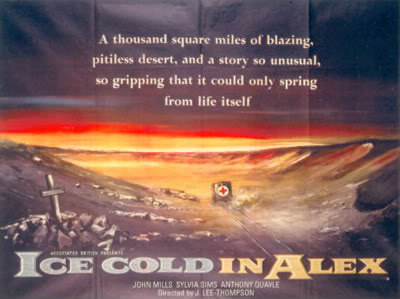
Ice Cold in Alex

What makes a good war film? At its best, the war movie goes beyond mere action, heroism and patriotism. It provides the opportunity to show real human drama and real human frailty under the most extreme circumstances. The small, everyday, mundane struggles between individuals, and within individuals, play against the backdrop of the larger conflict. There is also the matter of character and how its strength or weakness can shape the course of events and the direction of men’s lives. The British film industry has succeeded in producing some fine war movies, and Ice Cold in Alex (1958) is no exception. This is no epic production; it really only deals with the experiences of four people yet it touches on some very big themes, not the least of which are honour and decency.

It’s 1942, Rommel’s Afrika Korps are racing across North Africa, and Tobruk is about to be besieged. Captain Anson (John Mills) is a man nearing the end of his tether, both physically and mentally. The unrelenting hardship of the desert war has driven him to drink, and his dependency on the bottle, while superficially steadying his nerves, threatens to undermine his judgment. Having been ordered to take his ambulance out of Tobruk before the siege begins, he finds himself faced with an overland trek to Alexandria accompanied by the phlegmatic Sergeant Major Pugh (Harry Andrews) and two nurses (Sylvia Sims & Diane Clare). Along the way they pick up an Afrikaaner, Van Der Poel (Anthony Quayle) who proves to be an asset in a number of situations. It’s Van Der Poel’s ability to speak German which gets them out of a tricky spot when Anson panics and tries to outrun an enemy patrol. However, the incident leads to the death of one of the nurses and Anson’s subsequent pledge to lay off the liquor until they reach Alex, where he’ll buy them all an ice cold beer.

Reaching their destination will be no easy task though. Rommel’s troops are advancing faster than expected and, as town after town falls, they must race to keep one step ahead. From this point on Anson’s war is no longer against an army; he must instead battle the hostile environment, suspicion and his own weakness. With the ambulance damaged, the water supply diminishing and the temperatures rising, he is forced into taking a route across The Depression, a vast desert quagmire, where one false step would spell disaster. Even as the little group pulls together to overcome each challenge nature throws at them, the seeds of suspicion are growing. Is Van Der Poel all that he claims to be?

Although the fate of the group ultimately depends on the calm resourcefulness of Pugh and the brute strength of Van Der Poel, it is Anson that you find yourself rooting for. It is a tribute to the skill of John Mills that the viewer feels such sympathy for what should be an unsympathetic character. After all, the man’s a drunk and his early recklessness causes the death of one of his charges. Yet, for all that, Mills manages to bring out the finer points of the man. There is a sense of real pain when he sees how his actions have led to tragedy for the unfortunate nurse. Throughout the film he’s all twitches and nerves and doubts and regrets and hopes – in short, a human being. Harry Andrews is all square-jawed grit and resolve; if you found yourself in a tight spot you’d love to have this guy by your side. Anthony Quayle also fits his role perfectly as the ebullient Afrikaaner who relishes every opportunity to show off his physical powers. Yet, all the while, those piggy little eyes dart around and you wonder what’s going on behind them. Sylvia Sims is the epitome of sweetness and practicality as she falls for Mills and, more importantly, believes in him and encourages him to believe in himself. J. Lee Thompson does his usual professional job in the director’s chair and makes good use of the North African locations. He manages to generate real suspense in some set piece scenes such as the navigation of the minefield and the nightmarish struggle in the quicksand. He also gets across the sense of dry, dusty heat and you feel the same relief as the characters do when John Mills sits on the bar stool in Alexandria and eyes that famous glass of Carlsberg.

Ice Cold in Alex is available on DVD in R2 from Optimum as part of their War Collection line. It’s a very nice anamorphic transfer in the correct 1.66:1 ratio. It’s a barebones affair as usual from Optimum but the quality of the film itself is enough to sell it, and it can normally be picked up cheaply. This is no action packed affair, it’s more of a character study and an excellent example of the British war film at its best. It succeeds in delivering a deeply satisfying ending and one that serves to reinforce the basic decency of man. And who better to portray that decency than John Mills.

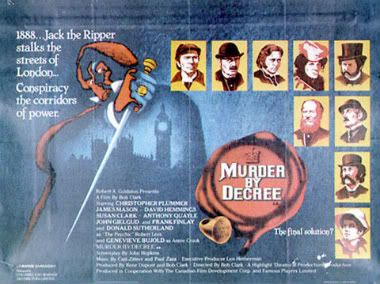
Murder By Decree

Poster

I’ve always been a fan of Sherlock Holmes films. However, strange though it may seem, the stories and novels which inspired them never grabbed me in the same way. This may be due in part to the fact that I was first exposed to the screen Holmes rather than the literary Holmes, or it may be that my subsequent reading of Doyle’s stories left me a little underwhelmed. My earliest memories of the great detective and Dr. Watson were the films with Basil Rathbone and Nigel Bruce. Over the years I’ve seen many more actors take on the role, from Peter Cushing and Andre Morell through to Jeremy Brett and Edward Hardwicke. However, Rathbone and Bruce have remained the definitive screen incarnations – seems to bear out the old saying about first impressions. Murder By Decree (1978) offers Christopher Plummer in the role of Holmes and James Mason as Watson. I found them to be probably my second favorite pairing although the Cushing/Morell combination would run them pretty close.

This film has nothing to do with the Doyle stories (not always a bad thing) but simply takes his characters and transplants them into the Jack the Ripper mystery. This wasn’t the first time Holmes had been called upon to attempt to crack the famous unsolved murders on screen; that distinction belongs to A Study in Terror, made a decade before. While the earlier film was made on a more modest budget, Murder By Decree was an expensive production filled with big names. The plot has Holmes called into the case in its latter stages as a result of an anonymous tip-off. He is met with open hostility from the authorities in the form of Sir Charles Warren (Anthony Quayle). The mysterious informants later turn out to be members of a citizens’ committee (in reality anarchist agitators) who have taken a special interest in the murders. Holmes investigation takes him through the seedy and foggy backstreets of Victorian Whitechapel, where his and Watson’s conversations with the friends of the murdered women draw him closer to an unpalatable conclusion. When he finally visits an asylum to meet an inmate called Annie Crook (Genevieve Bujold), the talk he has not only confirms his suspicion but also leads that monument to logical reasoning to break down and weep. I won’t spoil the ending for anyone who hasn’t seen the film, but I will say that it will scarcely come as a surprise as it involves a fanciful theory that has been frequently expounded.

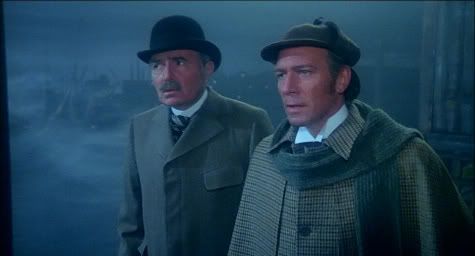
James Mason & Christopher Plummer - The game's afoot!

Christopher Plummer gives a performance as Holmes which brings out the humanity of the man better than anyone else I’ve seen. I’m not going to claim that this is Holmes as Doyle wrote him; by all accounts, Jeremy Brett managed to nail that one. Instead of the aloof character of literature we get a more rounded man and it is genuinely affecting to see him display honest emotion in the scene with Genevieve Bujold. He also gives a fine speech at the end when rails against Lord Salisbury (John Gielgud) and the hypocrisy of the powers that be. James Mason’s Watson is closer to the spirit of Doyle and not the bumbling, yet engaging, buffoon that Nigel Bruce made famous. Having said that, he does have his moments – the “You squashed my pea!” business never fails to raise a smile with me. The film is a very starry one with many good character turns: Anthony Quayle gives a wonderfully distasteful portrait of upper-class arrogance, David Hemmings is a policeman with his own private agenda, Donald Sutherland’s frightened psychic haunted by his own visions, and no Holmes film would be complete without Lestrade (Frank Finlay).

Murder By Decree is out on DVD in both R1 and R2. I have the R2 from Momentum and it has a pretty good anamorphic transfer and includes the theatrical trailer. I’m not sure if the R1 from Anchor Bay tops it but I’m happy enough with what I have. All in all, I think this is a very entertaining Holmes film which positively drips atmosphere. It features some great photography and excellent acting, and successfully blends the characters into a set of real historical circumstances. The resolution doesn’t particularly convince but, given the nature of the events, that’s always going to be the case. Unless you’re expecting a movie that sticks rigidly to Doyle’s characters you shouldn’t be disappointed.