Blood on the Moon

Pa8uCNs

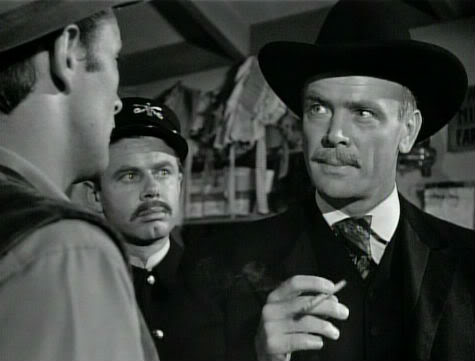
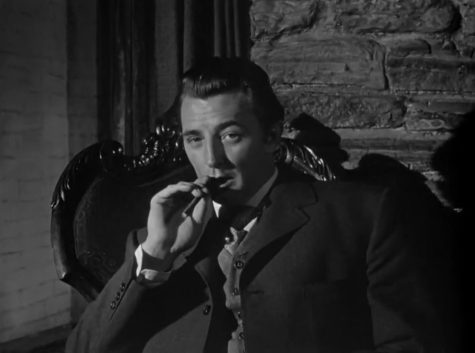
Having already covered a number of westerns which have crossed over into noir territory, it’s time to turn the spotlight on one more. If we regard the mid-late 1940s as the heyday of film noir proper, then it’s only reasonable to find one of the strongest western variants within that time period. Blood on the Moon (1948) follows all the typical western conventions but uses a recognizably noir figure as its protagonist and employs the dark cinema’s trademark shadowy photography to emphasize both the sense of danger and moral ambiguity implicit in the story. As is always the case with these genre straddling examples, the film stops just short of being noir at its purest – the essential pessimism of that form rarely blending naturally or completely into a western story.

Jim Garry (Robert Mitchum) is one of those guys who’s no stranger to bad luck, a drifter with an ill-defined past first seen traversing a bleak and rocky ridge in the middle of a driving rain storm. When you see a guy strike a frugal camp and bed down to rest his weary bones, gaining some respite from the harsh elements, only to have his outfit smashed to pulp by a wildly stampeding herd of cattle, it’s easy to tell fortune isn’t exactly smiling on him. The herd belongs to Lufton (Tom Tully), and when Garry is taken back to the cattleman’s campsite he receives a kind of backhanded welcome. The west of Blood on the Moon isn’t an open or warm place, rather it’s a world of shadows, suspicion and wariness. Garry has ridden into a developing range war, the classic stand-off between the ranchers and the homesteaders. On one side we have Lufton, a rancher with a herd of beef that the Indian agent has refused to buy and which is about to be seized by the army unless it’s removed from the reservation post-haste. The opposition is a ragtag bunch of settlers, organized and dominated by Tate Riling (Robert Preston), and bolstered in strength by a handful of hired gunmen. Riling is denying Lufton access to old grazing land, ostensibly on the pretext that he’s defending the rights of the settlers. However, his real motivation is the opportunity to force Lufton into selling to him on the cheap, thus allowing him to make a financial killing through his dealings with the crooked Indian agent (Frank Faylen). Garry and Riling are old friends, the former having arrived due to the promise of a job with Riling. Initially, Garry isn’t particularly thrilled with the role he’s been cast in but a job’s a job. Although he doesn’t put it into words, it clear enough that Garry is uneasy about the double-dealing of Riling. What’s more, he’s clearly more impressed by the apparent straightforwardness of Lufton, and then there’s the attraction he feels towards the rancher’s younger daughter, Amy (Barbara Bel Geddes). For Garry, the turning point arrives in the aftermath of a violent raid on Lufton’s encampment that leads to the tragic death of the son of a widowed settler (Walter Brennan). With his realization of the depth of Riling’s ruthlessness, Garry experiences a crisis of conscience and finds his allegiance shifting.

Apart from the strong cast, Blood on the Moon featured a wealth of talent behind the cameras too. The story was adapted from Luke Short’s novel Gunman’s Chance, and has a scripting credit for the author himself. It appears that story caught the attention of the up and coming Robert Wise and he persuaded Dore Schary to let him run with the project. Wise had served a long and telling apprenticeship at RKO, editing Citizen Kane for Orson Welles and directing a couple of pictures for Val Lewton. In learning his trade, Wise had been keeping some esteemed company, and the experience showed up in this his first stab at directing a western. With cameraman Nicholas Musuraca achieving beautiful effects with light and shadow, Wise produced a western that’s dark, moody and heavy on atmosphere. There’s some good use of Arizona locations for the exteriors, but the most memorable aspect of the film is the gloomy and claustrophobic interior work. The low ceilings of the buildings, illuminated by guttering oil lamps, seem to press down on the characters, squeezing them and restricting their options as much as their movements. Although there are a number of noteworthy scenes, the highlight is arguably the brawl between Mitchum and Preston in a deserted cantina. This isn’t the typical cartoon scrap that we find in countless westerns; instead it’s a vicious and visceral affair that sees the two combatants slugging it out realistically. There’s no music to distract from the thudding, crunching landing of blows, and the naturalistic half-light makes the bruised and bloody faces and hands all the more convincing.


The first scene we shot after Mitch got outfitted was in the barroom. Walter Brennan was sitting at a table with a couple of pals and Brennan was very interested in the Old West, it was a hobby of his. And I’ll never forget when Bob came on the set, just standing there, with the costume and the whole attitude that he gave to it, and Brennan got a look at him and was terribly impressed. He pointed at Mitchum and said, “That is the goddamndest realest cowboy I’ve ever seen!”  – Robert Mitchum – Baby, I Don’t Care by Lee Server, Faber & Faber 2001, p180

The above quote comes from Robert Wise and is as good an illustration as any of the degree of authenticity that Robert Mitchum brought to his western roles. Brennan’s observation was spot on for Mitchum does indeed look the real deal here and gives another of his deceptively easy performances. While he seemed to relish the physical stuff that I mentioned above the quieter scenes are played out with great subtlety and, throughout it all, he moved around the landscape and sets with tremendous grace. Robert Preston was good casting as Riling, turning on the false charm and grins when it suited and really bringing out the slippery side of the character. I thought Barbara Bel Geddes was impressive too, even though the western wasn’t a genre she did a lot of work in. Her role called for a fair bit of shooting and riding and she made for a game, independent heroine. The supporting cast is a long and starry one: Walter Brennan, Tom Tully, the wonderfully gritty Charles McGraw, Phyllis Thaxter, Frank Faylen and Clifton Young all doing good work and helping to flesh out the story.

Blood on the Moon is available on DVD from both Montparnasse in France and Odeon in the UK. Seeing as I have the two discs, I’m of the opinion that the transfers are identical – both sport the same significant print damage during the raid/stampede scene at around the half hour mark. In terms of extras, the French disc (with optional subs) has the usual disposable introduction, and the UK release has a gallery. Overall, I suppose the Odeon disc is marginally more attractive, at least in relation to its packaging which features a reproduction of the original poster art on the reverse of the sleeve. The aforementioned damage, along with various other nicks and scratches, show that no restoration work has been done and the transfer does tend to look a little soft. However, the feature is quite watchable and there are no better alternatives that I’m aware of anyway. The movie is an entertaining and striking one, a strong entry in the filmographies of both Mitchum and Wise. The development and resolution of the plot do dilute the noir credentials to an extent yet the strong visual style means it never strays too far either. Personally, I feel it hits the mark as a western and comes pretty close as a film noir too; as such, it’s recommended to fans of both types of movie.
 

Foreign Intrigue

poster292-1

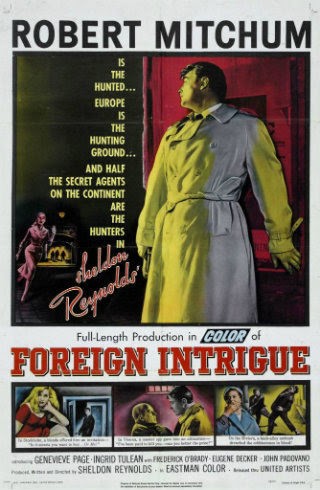
When television was still in its infancy, and for quite some time afterwards, it was quite common to see the appearance of small screen shows inspired by their big screen cousins. Today it seems like a reversal of that trend has taken place with a fair number of big budget productions hitting the cinema that have spun off from TV series. This phenomenon was noticeable in the 1970s when British TV shows frequently found themselves becoming movie features. However, even as far back as the 50s this was not unheard of, though it tended to be less pronounced in Hollywood. One early example of the US studios raiding their rival medium to produce a feature film is Foreign Intrigue (1956). I’ve never seen the TV show but I understand the movie isn’t really an adaptation in the strict sense of the word – it borrows the title and general concept, but that’s about it.

The movie opens on the French Riviera, with a man sauntering round the beautiful grounds of his equally beautiful villa. As he passes into his library and begins to browse the bookshelves, he’s struck down by a massive heart attack. The man is Victor Danemore and the first person to come upon him as he draws his dying breath is Dave Bishop (Robert Mitchum), his publicist. It’s soon revealed that Danemore was a genuine mystery man, one of those characters that could really only be a product of the 50s. Bishop was hired to fabricate an identity for his enigmatic employer and he knows no more about him than the inventions he’s been feeding the outside world. One would think the dead man’s young widow, Dominique (Genevieve Page), could fill in a few gaps but no, she knows nothing of the years before her marriage. So Bishop takes it upon himself to delve into Danemore’s past, to find out who this man was and why a Viennese lawyer is seeking confirmation of the circumstances surrounding his death. The quest moves from France to Austria and then on to Sweden, with Bishop encountering a variety of shady characters and dangerous situations as he tries to piece together Danemore’s fractured history. As he chases the shadows of the past down the murky, cobbled alleys of post-war Europe, a picture begins to emerge. The tale involves murder, blackmail, Nazis and collaborators, and how a legacy of treachery can poison the futures of the unsuspecting. Foreign Intrigue is a film that is very much of its time, sharing some of the characteristics of The Third Man and Mr Arkadin, yet never attaining the levels of suspense or artistry of either. There are some nicely crafted set pieces and atmospheric moments but the end result isn’t entirely satisfying. In short, the build-up promises much more than the pay-off can hope to deliver.

Foreign Intrigue was brought to the screen by Sheldon Reynolds – he wrote, directed and produced the movie – after Robert Mitchum expressed an interest in working with him. Reynolds had had some success with his TV show of the same name, and hastily knocked out a script. As I understand it, a good deal of the appeal of the show was its use of authentic European locations, and the movie employs the same tactics. This aspect is probably the greatest strength of the film, lending it an air of glamour and reality that even the most lavish studio mock-ups couldn’t hope to achieve. Leafing through Lee Server’s biography of Mitchum certainly gives the impression that the movie was an enjoyable one to make, and the star seems to have had a good time hopping around Europe. Reynolds and cameraman Bertil Palmgren compose some very attractive images and create atmosphere and suspense here and there, but the script fails to provide adequate backup. There’s too much shallow characterization to generate real interest in the people involved, and there are too many plot holes and unresolved questions. Even the finish is weak, its open-ended quality betraying Reynolds’ television background – it actually comes off like a pilot where the groundwork is being laid for the forthcoming episode.

Mitchum was the biggest name in the film and the whole thing revolves around his star power. While this could never be counted among his better roles, he’s good enough in the part. His trademark nonchalance is used well and he handles the thick-ear moments with the kind of toughness that makes it feel believable. Amid all the shadowy cloak and dagger stuff, he gets involved in two romantic sub-plots, but I didn’t feel either of these worked especially well. The two females in question, Genevieve Page and Ingrid Thulin (here billed as Ingrid Tulean), certainly look attractive yet the performances are just passable. Page is poorly served by a role that’s seriously underwritten and underdeveloped, while Thulin simply appears uncomfortable and unsure – disappointing when you consider her later success with Ingmar Bergman. However, there’s some fine support offered by Frédéric O’Brady as the double-dealing foil to Mitchum. A quick look at O’Brady’s IMDB entry reveals the man led a life that could comfortably be described as quirky, fascinating and off-beat. A good deal of this unpredictable quality shines through in his performance and some of the film’s best moments occur when Mitchum and he share the screen.

Foreign Intrigue is a film that I’d never had the opportunity to view until recently. It was one of those titles that you see included in filmographies and wonder what it’s like. Being a United Artists production, it’s part of the MGM library and recent arrangement with TGG Direct has seen it making its DVD debut. The movie is presented in anamorphic widescreen I’d describe it as typical of many MGM releases we’ve seen down the years. I mean that the transfer is about medium, some dirt and speckles, fair enough colour and no visible restoration. There are no extra features whatsoever and the movie shares disc space with an non-anamorphic version of The Quiet American. However, the fact that the title has been made available at last, and the very attractive price, should be taken into consideration. All in all, I found Foreign Intrigue to be a reasonably pleasant, if unremarkable, way of passing the time. The movie isn’t anything special and, realistically, will probably appeal mainly to Mitchum completists like myself. Still, bearing in mind how cheap the DVD is, it’s worth a look at least.


Pursued

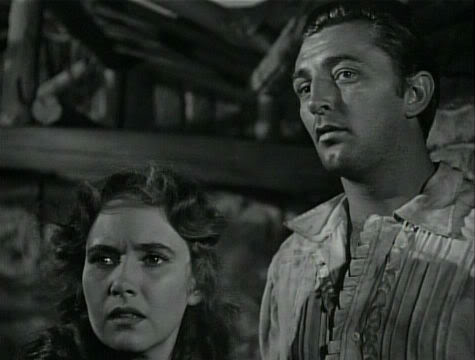
Anyone who has visited this site a few times must be aware of my fondness for both film noir and westerns, and it shouldn’t therefore come as any surprise to learn that I find myself drawn to what we might call crossover movies. The noir influence that can be detected in so many 40s films is especially noticeable in a number of westerns, and Raoul Walsh’s Pursued (1947) is one example where this is very evident. Now this is by no means a perfect movie; I’m not convinced that the basic premise of the story, which isn’t fully revealed until the end, is all that logical or capable of bearing too much close scrutiny. However, film noir, regardless of its setting, was never heavily dependent on wholly logical motivation or reactions. In terms of appearance, tone and mood, Pursued is a very stylish piece of western noir that emphasises and revels in its more melodramatic aspects.

The opening has an edgy, breathless quality with Jeb Rand (Robert Mitchum) holed up in the ruins of a New Mexico homestead, waiting for some inevitable showdown. With the arrival of his girl, Thor (Teresa Wright), Jeb begins delving into their shared past in order to try to make sense of their current predicament. It’s abundantly clear that Jeb is in a heightened emotional state, and the lengthy flashback which occupies the bulk of the running time seems to take on the dizzying, disorienting characteristics of a fever dream at some points. The story traces Jeb’s life from childhood, from the point where he was found cowering and confused by Ma Callum (Judith Anderson) in his deserted home. She adopts the youngster and raises him as her own along with her two natural children, Thor and Adam (John Rodney). Young Jeb has no memory of his life before the night Ma Callum discovered him, and it’s clear that this is the result of some deeply traumatic events that occurred. The practice of employing Freudian theories about the roots of psychological issues and the whole process of memory recovery was woven into the plot strands of many a regular film noir, but it’s something of a departure to see it play such a prominent role in a western. Right from the beginning Jeb is seen to be a victim; not only does he feel a gnawing sense of self-doubt over his failure to fully recall his past, but his life is threatened on numerous occasions. Early on we learn that the principal danger is posed by Ma Callum’s brother-in-law, Grant (Dean Jagger), but the reasons for his apparent determination to see Jeb in his grave are only vaguely hinted at. Grant’s animosity stems from the existence of a vendetta between the Rand’s and the Callum’s and, like Jeb, the viewer has to wait and discover the meaning as the story unfolds. This element of mystery serves the twin purpose of maintaining our interest and also of emphasising the fatalistic nature of Jeb’s life – a man continually stalked by phantoms lurking in the shadows of his childhood.

The movie’s title is highly appropriate, in both a literal and figurative sense, as Jeb spends almost all of his screen time on the run from a variety of perils. Raoul Walsh’s direction, helped enormously by the masterly photography of the great James Wong Howe, hammers the point home by reducing the wide open spaces of the frontier to a series of dark, claustrophobic compositions. Even the exteriors have a tight, constricted quality to them – the ruins of the Rand homestead with broken and burnt rafters clawing despairingly at the lowering sky, and the huge, featureless rock formations that seem to dwarf the tiny riders scampering across their face. In addition, the cramped interiors are often filmed from low angles and bathed in expressionistic shadows, thus enhancing the mood of doom and paranoia. The action scenes, for which Walsh earned a lot of praise throughout his long career, are infrequent but well-shot and jarringly effective. All told, Pursued is arguably one of Walsh’s most artistic and stylized pieces of work. I think the director’s own macho dismissal of pretentious theorizing about subtexts or the artistic value of his vision goes some way towards explaining why he remains an underrated figure, although his reputation has seen some steady growth and reappraisal. The only major weakness I can detect lies in the script, or the resolution to be more precise. Niven Busch’s writing holds out the possibility of a big reveal that ought to shock, although close observers should more or less work things out for themselves anyway, yet fails to deliver on that promise. As I mentioned above, there’s a certain lack of logic to the climactic revelations that I found mildly disappointing.

Pursued is probably the movie that saw Robert Mitchum really hit his stride as an actor, and his star was in the ascendancy from this point. His tough, laconic persona had already been put to use in westerns, and the underlying hint of vulnerability meant that he could move comfortably within the shadowy and uncertain world of film noir. This movie’s artful blending of the two filmmaking styles was therefore an ideal showcase for Mitchum’s talents. The sleepy-eyed passivity that he was able to project fits in with the fatalistic character who appears to have grown to accept the fact that life has and will continue to kick dirt in his face. As the architect of the ill-fortune that has dogged Mitchum’s footsteps, Dean Jagger makes for a formidable rival. He gives an electrifying performance as the driven man, consumed with hate for the Rand’s, who thought nothing of losing an arm to even up a score. There’s something chilling about the manic gleam that comes onto his eyes whenever the opportunity arises to compromise Mitchum further. Judith Anderson ought to be a cinematic legend if only for her turn as Mrs Danvers in Hitchcock’s Rebecca, and she’s very good here too. She didn’t feature in too many westerns – this and Anthony Mann’s The Furies being the most notable – but her role as Ma Callum represents another memorable characterization. She’s a pivotal figure in the development of the story and brings a strong sense of believability to her part. I have to say I was less impressed by Teresa Wright, whose evolution from Girl Friday to femme fatale and back again lacked both consistency and plausibility. Again, this may be more the fault of the leaps in logic demanded by the script than any particular deficiency on the part of the actress.

The R1 DVD of Pursued from Artisan is a middling effort at best. The disc carries a note that the film was restored by the UCLA but there’s inconsistency in the presentation. Early on, there’s a short section that’s noticeably weaker than the rest of the movie, and the sharpness and clarity varies throughout. There are no extra features offered. The film belongs in the Republic library, the recent acquisition of which by Olive in the US has seen the announcement of a number of titles on Blu-ray. I don’t know if this movie is seen as a candidate for a future release in the HD format but it would need to undergo some additional work for that to be a viable option. All in all, I see Pursued as an interesting attempt to fuse the western with film noir and throw some Freudian psychoanalysis into the mix. Personally, I like it and I reckon it should offer something to fans of both types of movie.

Track of the Cat

poster310

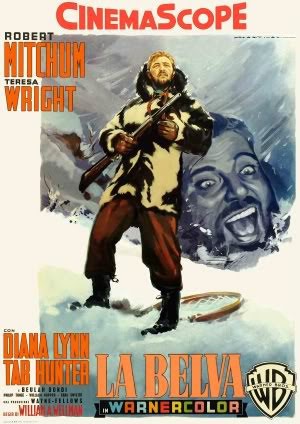
The terms art house or experimental film don’t often get used when westerns are being discussed. While there are of course countless examples of highly artistic westerns, it’s rarely the kind of self-conscious artistry that those labels suggest. There’s also the matter of audience expectation to take into account; when the genre was at its peak the fans were largely thought to want the kind of movie that didn’t veer too far from the traditional. In order to produce an art piece, particularly within a genre widely regarded as being bound by convention, you need a filmmaker who has confidence, clout, skill and vision. Although a combination of such qualities may be rare it is not unknown, and William Wellman was a director who fulfilled the criteria. His production of Track of the Cat (1954) was a daring attempt to fuse the western and the art house movie. Back when it was made, the film was not considered a success yet looked at now, over half a century later, it can perhaps be appreciated better.

Generally, mainstream audiences like to be clear about what they’re watching, and part of the problem with Track of the Cat is the difficulty in categorizing it. Sure it’s a western, but it can also be approached as an allegorical morality tale, a psychological dissection of a dysfunctional family, or even a horror story. At various points the movie is all of the above and this diversity can have a disconcerting effect on the viewer who comes at it unprepared. The plot itself is straightforward, simple and springs no major surprises. It concerns the Bridges, a ranching family living an isolated, insular existence with a seething mix of conflicting emotions buried beneath the apparent domesticity. The arrival of a guest, the fiancée of the youngest son Harold (Tab Hunter), coincides with the early snows and the appearance of a panther that threatens to devastate the herd. However, it’s suggested that this cat may be no normal beast, the superstitious bent of an ancient Indian (Carl Switzer) has planted the seed in everyone’s mind that this animal is the representation of a greater evil – all the evil in the world in fact. And so the two older sons, Arthur (William Hopper) and Curt (Robert Mitchum), take it upon themselves to weather the elements and head off to track down the cat and slay it once and for all. From this point on the film cuts between scenes of this near classical doomed quest and those back at the Bridges’ ranch, where the heightening emotional tension mirrors the increasing physical dangers out on the mountain. Whether one views it as a masterstroke or a failing – personally, I tend towards the former – the titular cat is never seen on-screen. Instead, it exists as a kind of psychological bogeyman, a malign presence stalking the dark corners of the characters’ awareness. Peeling back the layers, I think it’s possible to draw a parallel between the panther and Harold’s fiancée, Gwen (Diana Lynn), as both appear on the scene simultaneously and both represent a threat to the status quo. The Bridges’ world, like the snowbound landscape they occupy, is a barren one: the relationship between Ma and Pa Bridges is a loveless one where each merely tolerates the others foibles, those of Arthur and his spinster sister (Teresa Wright) are only superficially better – a telling comment early on informs us that both will remain childless – and the family likely to decline, and Curt is nothing but a domineering bully. This leaves only Harold, the repressed and half-forgotten son who has yet to become jaded and bitter. The arrival of Gwen and the cat has the potential to tear asunder the entrenched negativity of the Bridges. Both embody a kind of primal energy that, in their contrasting ways, will violently transform this stale and moribund family.

£7

Track of the Cat was the second time William Wellman filmed one of Walt Van Tilburg Clark’s books (the first being The Ox-Bow Incident a decade before) and he once again produced a notable and memorable piece of work. According to Lee Server’s biography of Mitchum, when Jack Warner learned that the colour movie he was backing had next to no colour in it he was not best pleased. Wellman’s response was simple and to the point:  ” If he doesn’t like it he can go shit in his hat.” It could of course be argued that Wellman’s radical decision to shoot a colour movie using almost exclusively black and white imagery was not much more than a stylistic affectation, an exercise in aesthetics if you like.  However, I believe there’s more to it than that; the colour, or lack of it, used by Wellman, and cameraman William H Clothier, goes a long way towards defining the nature of the characters and their relationships. Black and white infers absolutes, clearly defined parameters. Bearing in mind that the domestic setup is traditionally the province of females, the fact that the decor of the homestead consists of just these two colours reflects the inflexible and puritanical outlook of Ma Bridges (Beulah Bondi). The Bridges inhabit a world where any kind of personal manoeuvrability is severely limited. There are only two notable exceptions to this stark, spartan colour scheme: the red jacket worn by Curt and the yellow blouse of Gwen. Both these colours are indicative of energy, but while Curt’s red conveys the notion of power and aggression, Gwen’s yellow implies warmth and happiness. I think it’s also worth pointing out that when Curt exchanges his jacket for that of his dead brother after the cat’s attack he undergoes a kind of transformation. Now shorn of the symbol of strength and vitality, he dons the cow hide tunic and gradually assumes the characteristics of the prey rather than the predator.

Mitchum managed to capture this character shift very subtly in his performance. There’s a world of difference between the brash, swaggering bully of the first half of the picture and the paranoid, haunted shell of a man he becomes, yet he achieves this switch in a wholly natural and seamless fashion. The role of Curt is very unsympathetic (foreshadowing his work on Night of the Hunter and Cape Fear) but he pulls it off and, in the process, provides evidence of just how versatile and talented he really was. I couldn’t say that any member of the cast struck a false note and everyone involved performed more than competently. However, I do want to single out Beulah Bondi’s turn as the forbidding matriarch. This self-righteous and moralizing figure is the linchpin of the family, binding them all together either in spite of or because of her intolerance. Although there is a terrible quality to this woman, it’s hard not to feel some twinge of pity as she sits in that cold room, waking one dead son, fearing for the life of another and watching the slow disintegration of all she holds dear.

Despite being released theatrically by Warner Brothers, Track of the Cat was made by John Wayne’s production company Batjac and so was put out on DVD a few years back by Paramount in the US, and subsequently elsewhere. The anamorphic scope transfer is good enough, though not perfect. The movie really could use a clean up, but there isn’t anything that acts as a distraction or spoils the enjoyment of the movie. Apart from the main feature itself, where the disc really scores is in the extras department. There’s a commentary track with Tab Hunter, William Wellman Jr and Frank Thompson, a gallery and trailers. Additionally, there’s also a feature on the making of the film which has been divided up into four self-contained featurettes. The film won’t be to everyone’s taste, but it is a remarkable and unique work that deserves to be seen. Aside from the visuals, and they are quite spectacular, it’s one of those multi-layered pictures that rewards repeated viewings. I’ve seen the movie a few times now and there are still things that I’m only just noticing. Whether or not one warms to the film is ultimately down to personal preference, but it certainly refutes the notion that westerns and art house pictures don’t mix. I recommend giving it a chance at least.


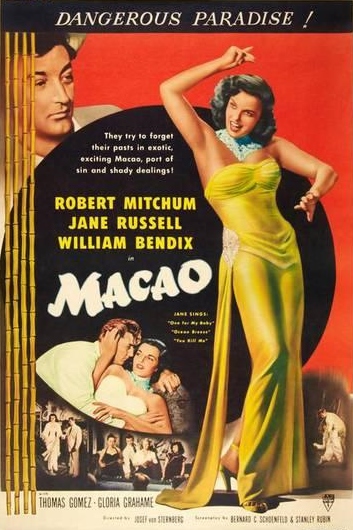
Macao

If there were such a term as noir-lite then Macao (1952) would have to feature as a prominent example. Taking its lead from the likes of The Big Steal and, more especially, His Kind of Woman, the movie uses some standard characters and situations but drops the harder-edged cynicism and fatalism that one normally expects to find. As a result, we wind up getting a moderately entertaining picture that passes the time but never delivers the kind of sickening gut punch a film noir ought to. The chaotic nature of the production probably contributed significantly to the less than satisfactory final product. However, there are casting issues involved too, but more on that later.

Exotic settings have long been a favourite of Hollywood movies, and the Orient has a special flavour and mystique of its own. Macao, the Portuguese colony, had the kind of murky reputation that suits the world of noir down to the ground. The story revolves around the arrival of three strangers – Nick Cochran (Robert Mitchum), Julie Benson (Jane Russell) and Lawrence C Trumble (William Bendix) – in this corrupt and largely lawless locale. What’s not clear is the reason for these individuals turning up; Julie says she’s looking for a job as a singer, Trumble says he’s a salesman, and Cochran says he’s just hoping to turn a buck whatever way he can. Regardless of what they say, it’s soon apparent that one or more of this ill-matched trio is out to bring down local underworld and gambling kingpin Vince Halloran (Brad Dexter). He’s wanted by Interpol but can’t be touched as long as he remains within Macao’s three mile limit; so a plot involving stolen diamonds is cooked up to appeal to his avaricious nature and lure him far enough out for the authorities to nab him. At the heart of the story is the dynamic between Cochran and Julie – he helps her out of a tight spot and she repays him by lifting his wallet, he gets threatened with deportation and she bails him out, and so on. This cagey romance runs parallel to the business with Halloran, and it seems at times like there are two different movies fighting for dominance. In the end it’s the lighter elements that prevail and the more sinister aspects are only dealt with during the climax. Generally, it’s a schizophrenic kind of picture that fails to deliver adequately through its lack of decisiveness. There are a number of effective scenes that, taken individually, prove satisfying either for their smart-ass comedic dialogue or their tense stylishness. However, they sit uncomfortably side by side and the shift of emphasis is a clumsy affair.

It’s rarely good news when a film experiences a change of director during production, and the further along it is when the switch takes place the greater the damage is likely to be. Josef von Sternberg had already shot a significant amount of the script when on set disagreements led to his departure and replacement by Nicholas Ray. The credits show von Sternberg as the director but it’s hard to be sure how much of the finished movie is down to him; Cochran’s escape from Halloran’s clutches and subsequent pursuit through the docks at night do seem to carry his stamp though. That’s easily the most visually impressive sequence in the whole movie, as Cochran stumbles and slips through a set draped with trawler nets that resemble some massive spider web that’s been spun across the waterfront to ensnare him. Additionally, the scenes in Halloran’s gambling house hark back to von Sternberg’s The Shanghai Gesture, but never achieve anything like the intoxicating decadence of the earlier film. On top of all the other turmoil, the script was undergoing constant revision and being written on the fly, with Mitchum apparently contributing. Mitchum and Russell were essentially playing to type and their chemistry is a large part of what ensures Macao remains watchable. I enjoy seeing William Bendix in anything but he overdoes the mugging in this one and his part suffers as a result. A bigger problem with the casting though concerns Brad Dexter and Gloria Grahame: Dexter is simply too wooden and passive to convince as the threatening figure he’s supposed to be, and Grahame is criminally wasted in an underwritten role that she reportedly didn’t want to play in the first place.

The R1 DVD of Macao from Warners is a good one that is sharp and has strong contrast in the crucial night scenes. If the film itself is a weak one then the disc extras go some way towards making up for that. There’s a nice commentary track with Eddie Muller, Jane Russell and Stanley Rubin. Also, we get a half hour of TCM Private Screenings with Russell and a very ill Mitchum chatting to Robert Osborne. I couldn’t recommend the movie to anyone just getting into film noir as it’s too watered down to be in any way representative. While it’s passably entertaining, it’s realistically more likely to appeal to Mitchum/Russell/von Sternberg (delete as appropriate) completists.

The Wonderful Country

I often find myself at a loss to understand why certain films get shunted aside and miss out on the attention that others seem to attract effortlessly. And I’m not talking about trite, derivative time wasters here, I mean quality movies that just get passed over and forgotten. One such case is The Wonderful Country (1959) which quite possibly contains some of Robert Mitchum’s best work. Actually, maybe I’ve answered my own question there; the 50s positively overflow with so many classy westerns it’s hard to keep count of them, and Mitchum was the kind of actor for whom the phrase “undervalued performer” might have been specially coined.

Martin Brady (Mitchum) is a gunman, an enforcer, in the employ of the Castros, a powerful Mexican family. On a rare sojourn across the border to purchase arms for his masters he meets with an accident and finds himself laid up with a broken leg. It’s during this convalescence that we learn a little about Brady’s past, and how he came to be a hired gun south of the border. This is his first time back in the US since his youth, having gone on the run following the killing of his father’s murderer. By this time Brady has become Mexican in all but name, dressing, speaking and acting like those with whom he has chosen to live. The kindness shown him (by the local doctor, a German immigrant, the local commander of the Texas Rangers, and most especially the wife of the garrison commander) causes Brady to reflect on his life thus far. Two things in particular colour his perceptions – the first being the fact that the Ranger captain informs him that he’s no longer considered a wanted man; the second, and more influential, is the attention he draws from Mrs Colton (Julie London), a woman trapped in an unsatisfactory marriage to a stiff-necked soldier. However, life’s never that simple, is it? When an argument with a local roughneck leads to a fatal shooting, Brady finds himself back at square one. There’s a nice piece of filming at this point as the camera zooms in on Brady’s face to catch the moment when he realizes he’s thrown it all away again – great naturalism and reaction from Mitchum. So, he’s left with no choice but to hightail it back to Mexico, the wonderful country, again. But if he thinks he’s left his troubles behind he’s mistaken. His return plunges him into a deadly power struggle between the two Castro brothers that will finally force this former drifter to decide where true allegiance lies. This, the question of where a man really belongs, constitutes the core of the film, and I’m not sure it’s completely resolved by the end. Throughout the movie, those from both sides of the border lay claim to Brady and try to entice him back. Brady himself professes to have no home, and at one point his enraged patron screams at him that he belongs nowhere. Surely that’s not true though – doesn’t every man have the right to find some place that he might reasonably call home? In the end, Brady makes his choice but, as he sets off on foot towards his new life, there’s still a lingering doubt as to whether he’s taken the right path.

The Wonderful Country is a real slow burner, beautifully directed by Robert Parrish. The contrast between the US and Mexico is highlighted by the filming styles adopted for the respective locales. While the scenes based in the US are framed tighter and more cramped, as soon as the action moves to Mexico the aspect opens out and thus gives a sense of freedom and space. The location work around Durango not only looks good but also adds to the feeling of realism and grit. Mitchum (who also served as executive producer) found in Martin Brady a role that fitted him like a glove. The character of Brady is a quiet, introspective one – an essentially lonely man (as I think all the great western heroes are) trying to find his place in the world. Mitchum was often, and to an extent still is, unfairly criticized for his apparent non-acting, but he was a master of underplaying and everything is there in the eyes and face. Brady isn’t a character given to showing off or expansiveness, and Mitchum subtly conveys all of his melancholy and uncertainty. I never thought Julie London was anything exceptional as an actress and she doesn’t really have much to do here beyond looking sultry and hungry, but she carries that off satisfactorily. Gary Merrill, as her husband, has a pretty one dimensional part as the cold fish army commander. Pedro Armendariz, on the other hand, gets one of the choice roles as Cipriano Castro, the initially sympathetic brother. In his few scenes he brings a marvelous urbanity to his part that seems at odds with his true ruthless nature. It’s also worth mentioning that Charles McGraw appears in what amounts to little more than a cameo role – a pity since it’s always a pleasure to see him rasping and swaggering his way through any film.

To the best of my knowledge, The Wonderful Country has only had two releases on DVD, one in Spain and one in Australia. I once owned the Australian disc but binned it, from memory it was a drained and blurry P&S mess. The Spanish disc from Suevia, however, presents the film quite nicely. The transfer is widescreen 1.66:1, though unfortunately not anamorphic. There isn’t any noticeable damage, colours are generally very good, and the image is sharp except for a very few shots. Oh, and subtitles are not forced on the English track. All in all, this release is acceptable and, bearing in mind this is a MGM/UA property, probably as good as the film is going to look on DVD in the foreseeable future. I’d rate this movie very highly as one of the top westerns of the 50s – in other words, we’re looking at a top-flight production here.

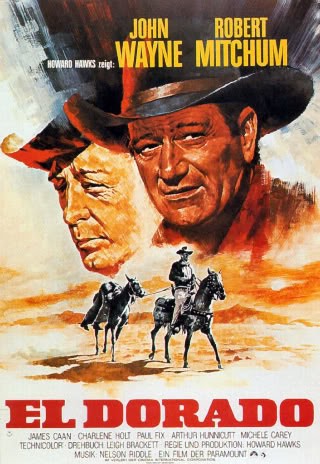
El Dorado

poster208

A while back I mentioned directors remaking their own movies, citing Hitchcock and Walsh at the time. However, they’re not the only ones; Howard Hawks reworked the same material that he originally used for Rio Bravo no less than three times. In this case, I think the law of gradually diminishing returns applies – although I’m aware that there are those who might disagree. Hawks’ second trip to the well resulted in El Dorado (1966), a film that improved on its predecessor in one or two ways but ultimately remains a less satisfying work. Ok, it’s not a straight remake of Rio Bravo since it opens the story up a little more in terms of people and locations but it does use the same core situation and characters. There’s the tough professional, the drunk, the old coot and the green kid all holed up in a dingy jailhouse and under siege.

Cole Thornton (John Wayne) is a professional gunman who hires his skills out to the highest bidder. After accepting an invitation from one of the parties involved in a range war he discovers that the job would mean facing off against an old friend. Sheriff J.P. Harrah (Robert Mitchum) is the lawman caught between the feuding factions, and it’s his presence that dissuades Thornton from signing any contract. However, before Thornton can take his leave an accidental shooting leads to an ambush that results in his getting a bullet lodged perilously close to his spine. When he returns some months later he finds that Harrah has taken to the bottle in the wake of an ill-judged love affair. To make matters worse, the nearly incapacitated sheriff is in no position to cope with the ongoing range war that’s about to come to a head. Therefore, it’s left to Thornton to take charge of a rapidly deteriorating situation provoked by an attempted murder and the subsequent arrest of one of the feud’s main players. Up to this point the plot has its own reasonably unique slant. However, once Thornton, Harrah et al find themselves barricaded in the jail it’s Rio Bravo all over again. Where the original had a gentle humour, a gradually built sense of camaraderie and a frisson of sexual tension (thanks to Angie Dickinson), El Dorado rushes things a bit and lays the humour on too thick. Actually, it’s the comedic elements that do the most damage in my opinion. Much of this is based around the character of Mississippi (James Caan) – in particular, his incompetence around firearms and his questionable taste in hats. What’s worse, though, is a cartoonish fight between Thornton and a drunken Harrah that wouldn’t have looked out of place in a Three Stooges short. The climax is also disappointing, the pyrotechnics of Rio Bravo being replaced with a contrived showdown that’s not much more than a damp squib.

In a sense, if you’ve seen one Howard Hawks picture you’ve seen them all. The same themes crop up again and again, namely professionalism and loyalty to one’s comrades. El Dorado is no exception in this respect, we have the tight knit group defying the odds and getting moral support from no-nonsense women. However, there’s a certain flatness to El Dorado, both in the visuals and the reworking of a tried and tested story. The areas where it does score over Rio Bravo are a few of the performances. I can’t honestly fault Dean Martin’s Dude, but Mitchum does bring more weight to his take on the broken down drunk if only because he’s Robert Mitchum. The biggest improvement is the casting of James Caan as the young man taking his first steps in the presence of the big boys. Although the forced jokiness of his character does tend to grate a little after a while he is certainly an actor, something that couldn’t be said for Ricky Nelson. Wayne, of course, is Wayne and it matters not a jot whether he’s playing the sheriff or the hired hand, his star quality ensures that he dominates proceedings. It is interesting to note though that the plot device concerning the bullet in his back was a convenient way to make allowances for the effects of the passage of time and the major health problems he had endured. As for the others, let’s just say that Arthur Hunnicutt, Charlene Holt and Ed Asner were no match for Walter Brennan, Angie Dickinson and Claude Akins. While I’m drawing comparisons, I might just add that Nelson Riddle’s score isn’t a patch on Tiomkin’s – although the title song played over Olaf Wieghorst’s paintings is very memorable.

El Dorado got a 2-disc release not long ago in the US as part of Paramount’s Centennial Collection. I never bothered to pick that one up so I can’t comment on the picture quality, but I do know it offered a variety of extras. The old UK R2 that I have presents the film 1.78:1 anamorphic and it’s not a bad transfer. The image could, I suppose, be a little sharper but there’s really not much to complain about. Image quality aside, the big difference between the old and new releases relates to bonus features, with the earlier disc boasting nothing but a theatrical trailer. Reading back through this, I might seem a little hard on El Dorado. The truth is it’s not at all a bad western and makes for entertaining viewing – the problem is that it’s damned near impossible not to compare it to Rio Bravo, and that’s where it comes up short.

Where Danger Lives

poster71

The films produced at RKO under the stewardship of Howard Hughes were a mixed bag to say the least; the billionaire’s’s involvement lending a crass, juvenile quality to more than one movie. While he led the once great studio along the path to bankruptcy and oblivion, he also introduced the cinema-going public to number of new starlets such as Jane Russell and Faith Domergue. Miss Domergue never made that many memorable pictures, save for Where Danger Lives, This Island Earth and It Came from Beneath the Sea. Of those three, Where Danger Lives (1950) has the slightly odd distinction of presenting her with her best role while also being the least known. In fact, this is a fine movie all round with stylish direction by noir stalwart John Farrow, a powerful lead performance by Robert Mitchum, moody cinematography by Nicholas Musuraca, and a Charles Bennett script.

At first glance the film may seem like a standard lovers-on-the-run yarn, but that’s merely the framing device for a tale of obsessive love, deception and madness. Jeff Cameron (Robert Mitchum) is introduced as an overworked but dedicated doctor who, at the end of his shift, is called upon to treat an attempted suicide. He is immediately attracted to the patient, Margo (Faith Domergue), and soon embarks on an affair. The immediate effect of this is that Cameron develops a callous disregard for both his job and his devoted sweetheart, played by director’s wife Maureen O’Sullivan. The whole point of the story is how lust can blind a man to reality and allow him to be deceived and manipulated. The film is packed with lies and liars and it seems that just about everyone is prepared to bend the truth to suit their own agenda, right down to ambulance drivers and small town doctors. When Cameron receives a blow on the head in a struggle, the resulting concussion gradually impairs his judgement and allows him to be more easily duped. In a marvellously surreal passage, the fleeing couple arrive in a town where everyone is bearded and dressed in western apparel. For a moment it looks as though the action has taken a detour into the Twilight Zone, until it is revealed that Mitchum and Domergue have stumbled into a local festival. The idea of nobody being quite what they appear is nicely highlighted when a local boy draws facial hair onto a photograph of Domergue, while muttering that everyone has to have a beard. From first to last, the movie concentrates on shifting identities and false perceptions.

Robert Mitchum was an old hand at playing noir anti-heroes and the role of Jeff Cameron offers him the opportunity to flex his acting muscles. He goes from being an upstanding professional at the beginning of the film to a shambling brain damaged wreck of a man by the climax. In the hands of a lesser actor the part could easily have descended into eye-rolling histrionics, but Mitchum’s deceptively lazy style ensures that credibility is maintained as his character’s mental state deteriorates and he floats between clarity and confusion. Faith Domergue’s Margo is a fine femme fatale in the classic mould. Her performance isn’t as controlled as Mitchum’s but she still manages to be convincing. It’s obvious from the start that there’s something not quite right about Margo, but you can’t really put your finger on what. Claude Rains appears in a small but significant part, and adds some real class to proceedings; in his few minutes of screen time he shows us another psychologically twisted character, and his playing is every bit the equal of that of his co-stars. John Farrow always seemed comfortable in noir territory, and does a good job of holding together a story that could have easily spun out of control. Farrow is ably assisted by his director of photography Nicholas Musuraca, whose camera does good things with the bleak desert backdrops and shadowy small towns that dominate the film.

Where Danger Lives comes to DVD, paired on disc with Tension, from Warners in R1 via their fourth noir set. It’s a fine, clean transfer which shows Musuraca’s excellent black and white photography at its best. The film comes with a trailer and a short featurette on the movie. This is a  film that I wasn’t at all familiar with until I picked up the box set. I can’t think why it has been such an obscure and hard to see movie since I’d rate it as an excellent example of classic era noir. Highly recommended.

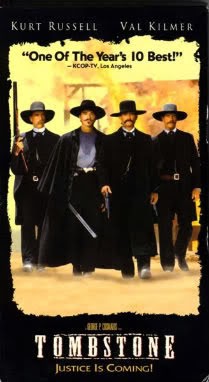
Tombstone

poster9

No. Make no mistake; it’s not revenge he’s after…it’s a reckoning.

Is Tombstone the best western of recent years? Perhaps not, but it must surely rank as one of the most entertaining. Eastwood’s Unforgiven may have more things to say, it’s themes may run deeper, but despite its undeniable quality it is nowhere near as much fun as Tombstone. When one sets about telling a story that has already been committed to celluloid as many times as this one has, it’s no mean feat to produce something which avoids staleness. The trick was to make a film that stayed closer to the historical facts than any previous effort, yet compress it and ensure that the pacing didn’t suffer. Tombstone manages to maintain this fine balance: the facts are mostly adhered to, but some are altered for dramatic effect and, crucially, the script never allows itself to getbogged down in tedious minutiae.

The title of the film makes it plain that it’s going to deal with the portion of Wyatt Earp’s life spent in the town of Tombstone, and the events surrounding it. Of course references are made to the lives and exploits of the Earps in the years preceding the story but they’re never labored, serving only to clarify the reputation of Wyatt. The opening of the film is a short montage of black and white shots with a voiceover by Robert Mitchum to establish time and place. This little sequence ends with the famous shot from The Great Train Robbery (1903), where a gun is fired straight at the audience. In truth, this is only one of many homages paid to the classic westerns of years gone by, the film is littered with them. From there on, it’s pure blood and thunder stuff as we get our first glimpse of the villains of the piece, the Cowboys, riding into a Mexican pueblo to massacre a wedding party as an act of vengence. The real Cowboys were a band of outlaws who came together from time to time to engage in various criminal acts. The movie, in order to heighten the drama, gives the impression that they were a closely knit group – a sort of western prototype for the mafia. The Earps, on the other hand, are shown to be former lawmen (except the younger Morgan) who have no interest in a confrontation, preferring to spend their time building up their finances via gambling. Some of their less savoury activities, such as their alleged involvement in prostitution, are glossed over, although Ike Clanton (Stephen Lang) frequently refers to them as pimps. They only find themselves drawn into conflict with the Cowboys after the killing of town marshal Fred White (Harry Carey Jnr) forces their hand. As a result, the situation soon deteriorates rapidly, culminating in the gunfight at the O.K. Corral, the Cowboys’ retribution, and Wyatt’s subsequent vendetta.

The centrepiece is undoubtedly the shootout at the O.K. Corral, and this is filmed with much more attention to the real details than ever before. The movie takes pains to show who shot who, when, where and how. Even the dialogue sticks close to what has been recorded, with Wyatt (Kurt Russell) telling Ike to either get to fighting or go (he went) and Doc Holliday (Val Kilmer) delivering the memorable “You’re a daisy if you do” before dispatching Frank McLaury. It’s a well filmed scene which captures not only the spontaneous excitement but also the nervy disorganisation of the event. The aftermath of this was a lot of legal shenanigans before the Cowboys took bloody revenge on the Earps. The movie skips over the legal wrangling completely and condenses the Cowboys’ attack into one night of violence. While this may be taking liberties with the facts, it helps the film immeasurably by ensuring the narrative keeps moving. The greatest divergence from the truth takes place during the depiction of the vendetta. There were nowhere near as many people killed as the movie suggests, although the entertainment value would have been greatly reduced if this had been insisted on. Even so, the film still manages to include some genuine happenings here, such as Wyatt’s shotgun duel with Curly Bill (Powers Boothe) and the stopover at the ranch of Arizona cattleman Henry Hooker (Charlton Heston).

The acting is dominated by Kurt Russell as Wyatt, Val Kilmer as Doc, and Michael Biehn as Johnny Ringo. These three performances are central to the success of the movie and they’re so good it’s hard to imagine anyone else filling the roles. Russell plays Earp as a cold pragmatist driven to action only by family loyalty, and an emotional icicle who’s gradually thawed out by Dana Delany’s slightly goofy but attractive actress. Michael Biehn’s Ringo is a study in madness and evil, alternately killing priests, quoting in latin, and screaming at the Earps that he wants their blood and souls. The real standout, though, is Val Kilmer as the screen’s definitive Doc Holliday. It is unlikely that Kilmer will ever play a better part (he’s certainly done nothing approaching it since) than the doomed lunger. He gets all the best lines and delivers them with such fatalistic charm that you can’t help liking him. The script also offers him a great exit; if that deathbed scene doesn’t bring a tear to your eye then you’ve obviously mislaid your heart somewhere. It’s nice to see a nod to the classic westerns with the casting of Harry Carey Jnr and Charlton Heston, and Robert Mitchum’s narration – Mitchum was to have played Old Man Clanton but a back injury on the first day of filming put paid to that. A few other references to the movies of the past come with Dana Delany singing Red River Valley (one of John Ford’s favorites) and Russell channelling the spirit of Henry Fonda as he reclines on the boardwalk with his heels on the hitching post before marching off to the O.K. Corral and immortality.

The only DVD of this film worth owning is the R1 Director’s Cut. The anamorphic scope transfer is generally good, though there is visible edge enhancement. The 2-disc set has a number of extras including a commentary from director George P. Cosmatos and, most importantly, it is the only complete version of the film. The added scenes, while not of huge significance, do help fill in a few gaps in the narrative. Although Tombstone will probably never attain the status of one of the great westerns I still get an enormous kick out of it every time I see it.