Criss Cross

poster319

“From the start, it all went one way. It was in the cards, or it was fate or a jinx, or whatever you want to call it.”

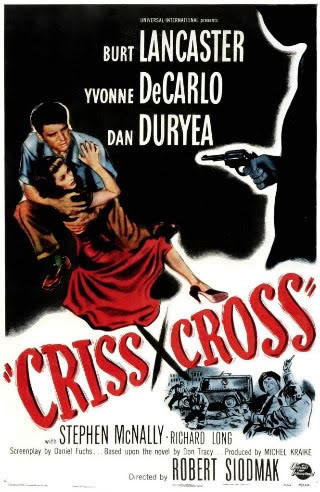
Burt Lancaster, Robert Siodmak, a heist, a hero doomed by fate and his own stupidity, and a rotten to the core femme fatale – all of this sounds a little like a brief synopsis of The Killers. In fact, it refers to Criss Cross (1949), a near relative of that earlier work and a film that vies with it for the honor of being hailed Siodmak’s best movie. Apart from the pairing of director and star, both these films share a similar theme and structure, and I find it almost impossible to decide which is the better one. Ultimately, it doesn’t matter – I like them both and they are two of the strongest noir pictures to come out of the 1940s.

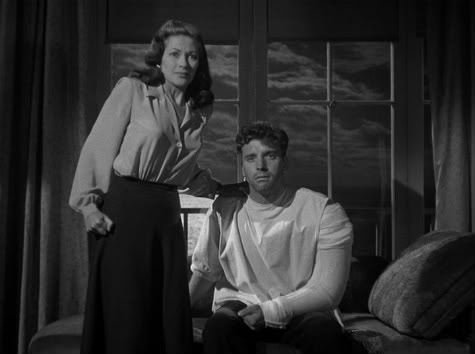
The title of this movie is a highly appropriate one for a tale where the paths of all the main characters are continually intersecting in a web of deceit and betrayal, each crossing up the other at the first opportunity. At the centre of it all are three people – Steve Thompson (Burt Lancaster), Anna (Yvonne De Carlo) and Slim Dundee (Dan Duryea) – bound together by an unholy combination of love, lust and greed. The opening shot, with the camera swooping ominously down from the night skies of LA, sees Anna and Steve caught in a clinch in the parking lot of a nightclub. As the lights suddenly pick them out, their startled and guilty reaction indicates that this is an illicit rendezvous. The fact is further underlined by the terse, tense dialogue – this couple is planning something dangerous, and the possibility of discovery holds a terrifying threat for them. Anna is married to local hood Slim Dundee, but she and Steve were once wed too. Their passionate embrace makes it clear that they have rekindled their old relationship, with the flame burning brightest for Steve in particular. And it’s from the point of view of Steve that the story is primarily seen, with the others moving in and out of the picture at various intervals. He’s a classic noir protagonist, a fairly ordinary guy with limited prospects and a blind spot where no-good females are concerned. A lengthy flashback sequence, accompanied by a suitably weary and resigned voiceover by Steve, spells out exactly how the lives of these three characters converged and the complex ties that continue to bind them together. In short, Steve’s job as a guard for an armored car company has led to his conspiring with Dundee to raid one of the secure vehicles. However, in the noir universe there’s no such thing as honor among thieves and everyone has his own hidden agenda. Steve is the only one of the trio whose motives have some semblance of decency – he’s driven by a kind of desperate love for Anna – and the aftermath of the heist shows just how deep the fault lines of treachery run in this uneasy alliance.

£5

Apparently the untimely death of Mark Hellinger meant that the original script was revised and certain aspects of the story were changed. Be that as it may, the movie that we ended up with is almost impossible to fault and Daniel Fuchs’ script successfully blends the heist and Steve’s obsessive love to powerful effect. Flashback structures can sometimes be confusing or upset the mood of a film but in this case it works perfectly, coming at precisely the right point and filling in the background details that are vital to understanding the nature of Steve and Anna’s relationship. With a tight script, and Franz Planer’s photographic talents, in place, director Robert Siodmak was free to put it all together with his customary visual flair. The opening, which I referred to earlier, pitches the viewer headlong into this complex tale of dishonor and betrayal in incredibly stylish fashion. And it never really lets up from that moment, with one memorable and superbly shot scene following hard on the heels of another. Siodmak uses every trick up his sleeve to manipulate the mood and perspective, from coldly objective overheads to disconcerting low angles and close-ups, interspersed with fast cuts and dissolves. For me, the real stand out scenes, although there’s hardly a poor moment throughout, are the ones in Union Station and in the hospital. The former not only gives a fascinating glimpse of contemporary LA bustle, but also shows the director’s skill in composing a complex series of shots in a crowded environment while retaining control of the geography. In the latter, he uses the reflection from the mirror in Steve’s room to break up the static nature of the setup and extract the maximum amount of tension at the same time.

If the technical aspects of the film are straight out of the top drawer, then the same can also be said for the acting. Burt Lancaster kicked off his career with some finely judged playing as the doomed Swede in The Killers, and Siodmak got him to tap into that same vibe to coax another wonderfully nuanced and sensitive performance from him. Once again he hits all the right notes as the big palooka whose dark romanticism sees him suckered by the machinations of a conniving woman. Every emotional state the script calls on him to display is carried off convincingly, from fear and disenchantment right through to the calm acceptance of his fate at the end – from the dumbfounded look of a guy who’s just had his guts kicked out by the woman he loves to the cloying sense of panic of a man under sentence of death and trapped in an anonymous hospital ward.
£4

Yvonne De Carlo didn’t have to go through quite as many stages, yet she’s still excellent alternating between the sassy, sensual broad that forms her public persona and the nervy, desperate woman she becomes in private. When she drops all pretense in the climax and reveals her true character to Steve and the audience there’s a tangible shock to be felt. Dan Duryea was an old hand at taking on the role of the slimy villain, and to that he adds a layer of menace as Slim Dundee. He manages this so well that it’s easy to understand the level of fear and trepidation he provokes in Steve when he contemplates the consequences of crossing him. While these three actors carry the movie, there’s real depth in the  supporting cast too. Stephen McNally is solid and sympathetic as the cop whose friendship for Steve leads him to inadvertently push him into crime. In fact, there are lovely little cameos all through the movie: Percy Helton’s chipmunk featured barman, Joan Miller’s garrulous barfly, Griff Barnett’s kindly and lonely father figure.

Criss Cross has been out on DVD for many years now, and the US disc from Universal is an especially strong effort. It offers a near perfect transfer of the film with clarity, sharpness and contrast all at the high end of the scale. My only disappointment comes from the absence of any extra features, bar the theatrical trailer, for such a quality movie. One shouldn’t really complain, in these days of bare bones burn on demand discs, but this film does deserve a commentary track at the very least. Still, we have got an excellent piece of the filmmaker’s art looking great. Criss Cross is a highly rated production that occupies a prominent position in the noir canon, and it has earned that honour. It’s one of those rare films that checks all the boxes and never puts a foot wrong from its dramatic opening until it’s darkly cynical final fade out. Those who are familiar with the picture will know exactly what I’m talking about, and those who are not owe it to themselves to discover this little treasure. This is unquestionably one of the real jewels of film noir.


Violent Saturday

poster297

Stories about heists that invariably go wrong somewhere along the line have a kind of evergreen quality about them. I don’t think it’s anything as simple as the need to see the moral balance restored that’s the attraction, instead it’s more a kind of perverse wish fulfillment for all of us living in an imperfect world to witness even the most meticulous plans of smart guys turn pear shaped. Violent Saturday (1955) is one such movie, detailing the build-up, execution and aftermath of a bank robbery in a small town. It’s also a film which takes its time creating expectations about certain characters, only to show that those assumptions can frequently be misleading.

Essentially this is a film of two halves. The opening section is something of a darkly soapy melodrama, wherein the principal characters, and their roles in the community, are all established. The two people that are focused on most are Boyd Fairchild (Richard Egan), the heir to the local copper mining facility, and the mine foreman Shelley Martin (Victor Mature). These men are living in the brave new world of a booming 50’s America, all shining, chrome-laden automobiles and homes filled with the latest modern conveniences. Yet, despite the trappings of material success that surround them neither man is particularly at ease with himself. Fairchild is drinking too much in an attempt to blot out the inferiority complex that comes with being the son of a self-made millionaire, and keep his mind off the numerous affairs his wife has indulged in. Martin, on the other hand, is carrying round an entirely different set of baggage; his marriage is a happy one and his success is all of his own making but he’s burdened by a sense of guilt for not having seen active service in the war, a feeling of inadequacy compounded by his failure to appear heroic in the eyes of his young son. Additionally, we’re afforded glimpses into the lives of a few of the town’s other citizens – a financially pressed librarian driven to petty larceny, and the outwardly prim but repressed and voyeuristic bank manager. While these various strands of small town life are being laid before us, three strangers weave their way among them. These men (Stephen McNally, Lee Marvin and J Carrol Naish) are career criminals, come to a town they see as a soft touch to raid the bank. As the citizens go about their daily lives and try to cope with their personal issues, the three newcomers calmly and deliberately plan their heist. The second part of the movie, and the most gripping, sees the paths of all the disparate characters converge on a Saturday afternoon in an explosion of physical and emotional violence.

£29

Director Richard Fleischer’s career was on an upward curve at the time Violent Saturday was made; he’d come off making a number of interesting noir movies, two of which (Armored Car Robbery & The Narrow Margin) are especially noteworthy. While I don’t believe Violent Saturday is film noir, it does display some of the style/genre’s sensibilities – the doomed robbers and the facade of respectability concealing a darker reality. The structure of the film is clearly designed to provide a back story for the characters and flesh them out, thus heightening the impact of the abrupt intrusion of violence into their lives. As far as that goes it’s only partially successful; the introduction of the librarian and the bank manager has a dramatic potential that’s never fully explored, and in the former’s case the the plot leaves her fate dangling and neglected. The banker (Tommy Noonan) does at least play a pivotal role, albeit in a negative way. His creepy passivity undergoes a transformation in the course of the heist and he finally resolves to take some positive action in his life. It’s unfortunate, however, that his new found steel acts as the catalyst for the bloodletting that follows. Victor Mature was well cast in the role of the family man dogged by the shadow of cowardice. There was always an undercurrent of melancholy and sensitivity about him, and the film puts that to good use. He too experiences a reversal of fortune, where adversity reveals an inner strength and toughness whose existence he doubted. Having said that, the message that’s ultimately conveyed by his actions, and the reactions of others to them, isn’t one that sits entirely comfortably with me. Of the three criminals, both McNally and Naish perform competently without ever being particularly memorable. The real star is Lee Marvin. Dapper in appearance and ruthless in behaviour, he gets the better lines and makes the most of them. It says a lot for Marvin’s talents that he could take what was basically a minor supporting role and deliver the most telling performance in the whole movie. It’s also worth mentioning that Ernest Borgnine has a small, and incongruous, part as an Amish farmer who finds himself and his family drawn into the turbulent events.

To date, Violent Saturday has had three releases on DVD (in Spain, the US and Australia), none of which appear ideal. All of these discs offer the film a non-anamorphic scope transfer. The Spanish release is via Fox/Impulso and, the letterboxing aside, sees the movie looking quite nice. The lack of anamorphic enhancement does take away from the overall sharpness of the image but, on the plus side, the colours look strong and true, and the print doesn’t suffer from any significant damage. Extras, as on the majority of Fox/Impulso titles, consist of some text-based material on cast and crew along with a gallery. Subtitles on the English track can of course be disabled via the menu. The movie itself is a solid crime drama that builds nicely to a suspenseful and action-filled conclusion. It’s not quite top flight material, but it’s not too far off either. I’d rate it as a smoothly directed piece of entertainment that could have used a little extra polish on the script.


Diplomatic Courier

poster236

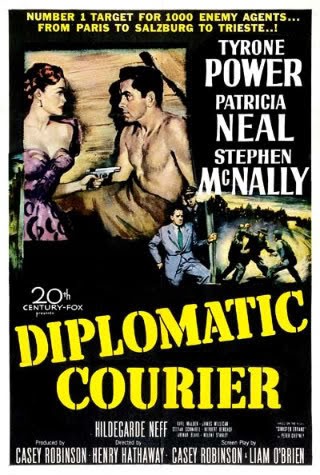
In the past I’ve done a few write-ups on those thrillers that take advantage of the devastated world of post-war Europe. The uncertainty evoked by time and place, the dreams of a better future coupled with the knowledge that the dangers of the past are no further away than a glance over the shoulder, is a strong foundation on which to build tales of intrigue and deception. In the late 40s and early 50s, as the chill of the Cold War was spreading, there was an abundance of such movies. I think the appeal of these pictures, despite the patriotic trappings required by the contemporary political climate and the inevitable loss of immediacy with the passage of time, lies in their ability to tune into the despair and disillusionment of those displaced and damaged by war and the subsequent carving up of a continent. Diplomatic Courier (1952) is one of the lesser known examples of this sub-genre, despite its boasting a strong cast. This film is not without its flaws but, taken as a whole, it remains a slick and atmospheric espionage thriller.

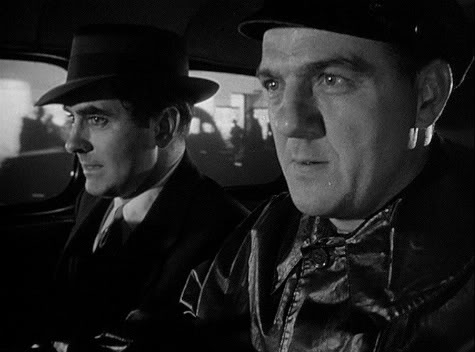
It starts off with one of those voice-of-God narrations, extolling the virtues of dedicated government agencies, which I tend to find irritating but quickly settles down to telling the story in a more traditional way. In short, a coded document originating in Romania needs to be passed to a courier in Salzburg for transportation back to the US. Sounds simple enough in itself, and thus our courier, Mike Kells (Tyrone Power), is promptly dispatched to do the business. Of course, things don’t quite run according to plan and Kells’ contact winds up dead on the railway line outside the city, without having completed the exchange. The circumstances leading to the murder aren’t clear as they were preceded by a series of cat and mouse shenanigans aboard the train involving a couple of heavies (one of whom is Charles Bronson in a blink and you miss him role) and an unidentified blonde. Kells now finds himself high and dry, and his only lead is the blonde, a Czech refugee called Janine Betki (Hildegard Knef), on her way to Trieste. His only option is to travel to the Italian city, track down Janine, and hope that she can lead him to the missing document. Again, the errand seems uncomplicated yet Trieste is a nest of spies and assassins, with danger lurking and ready to pounce within its ruins and darkened courtyards. Trying to run down one female in an unfamiliar and hostile locale ought to be problem enough, but Kells faces the added complication dealing with the attentions of an amorous American pleasure seeker, Joan Ross (Patricia Neal), who he met after falling asleep on her mink clad shoulder en route to Salzburg. What emerges is that both these women have a central role to play in the mystery, the question though is which one, if either, can be trusted.

£11

The whole thing moves along at a brisk pace under Henry Hathaway’s direction, but I do feel the script could have used some tightening to cut down on the kind of disposable dialogue that just serves to slow the momentum. Also, there are a few too many convenient arrivals at crucial moments. Having said that, Hathaway, aided by cameraman Lucien Ballard, creates some nice images and takes full advantage of the European locations. The best scenes are those with Kells blundering around Trieste following up clues that frequently leave him even more confused than ever. By this time, Tyrone Power had left his swashbuckling days behind him and was exploring more varied roles. I thought he was pretty good as the messenger boy thrown in at the deep end and unsure of who’s really on his side, apart from a faithful but hyperactive Karl Malden. Both Patricia Neal and Hildegard Knef gave strong but very different performances – the former oozing a kind of feline sexuality, while the latter tapped into a credible blend of vulnerability and grit. Of the two, I’d say Knef produced the the better work, probably due to her character benefiting form greater depth. I mentioned earlier a fleeting appearance by Charles Bronson, and it’s also worth pointing out that’s there’s a small part for Lee Marvin in there too.

Diplomatic Courier is available on DVD from Fox in Spain – the only release of the movie anywhere that I know of – in a pretty good edition. The print is quite clean and crisp, but there is a fair bit of grain in evidence early on. Actually, I can’t work out if it’s genuine film grain or some kind of digital noise; I have a hunch it’s the latter but I’m not expert enough to call it for sure one way or the other. Whatever, it fades after the first ten minutes or so. The Spanish subs are removable via the set up menu, and the extras are limited to a gallery and some text based cast and crew info. This was my first viewing of the film, a total blind buy, and I enjoyed it a lot. I did have some issues with the script, but the acting is good overall and the direction and location photography are very stylish. Yet another picture that deserves a wider audience.


Winchester 73

Down through the years there have been a number of significant collaborations between directors and actors, such as Ford and Fonda, Ford and Wayne, and Huston and Bogart. In 1950 another such partnership was born, that of Anthony Mann and James Stewart. Their work together was to change the direction of both their careers, and produce some of the best cinema of the decade. Anthony Mann had made his reputation with a series of fine noirs in the last half of the 40s, but he had never done a western. James Stewart’s name had been built on the light leading man roles he excelled in before the war; with the exception of the comedic Destry Rides Again he was another relative stranger to the Old West. However, as a result of the success of Winchester 73 the names of both men would be forever linked to the oldest genre of them all. They went on to make eight films together, five of them westerns.

The story concerns Lin McAdam (Stewart) who arrives in Dodge City on July 4th 1876 and enters a sharpshooting contest presided over by none other than Wyatt Earp (Will Geer), Virgil Earp and Bat Masterson. The contest’s first prize is the famous rifle of the title, and it soon comes down to a run-off between McAdam and Dutch Henry Brown (Stephen McNally). There’s clearly a history of bad blood between the two men, and when McAdam wins it’s not long before Dutch Henry robs him and makes off with the gun. The film then chronicles McAdam’s search for his stolen rifle, and his pursuit of the man who took it. But that’s really only a plot device, a kind of Hitchcockian McGuffin – something of greater significance to the characters than it is to the audience. While the gun is admired, valued and coveted by everyone who comes across it, it is not the sole, nor even the most important reason for McAdam’s dogged quest. This is a dark tale of revenge and the settling of old scores and, despite the dropping of a number of hints, the cause is not stated explicitly until the end.

James Stewart’s pre-war career consisted mainly of Mr Nice Guy roles, while the years following his return found him floundering around in search of a niche. Although It’s a Wonderful Life and Rope offered him roles with a greater complexity, Lin McAdam was a complete departure for him. This part, and subsequent ones with Mann, allowed him to display a cold ruthlessness that the public hadn’t seen before. In addition, he seems so completely at home in the saddle that it’s hard to believe this was his first serious western character. The film boasts a marvellous cast of character actors and up and coming talent: Stephen McNally and Dan Duryea (playing Waco Johnny Dean – lots of exotic character names in this movie) as villains, Shelley Winters as a luckless saloon girl, Millard Mitchell, John McIntire, Jay C. Flippen, and early parts for Tony Curtis and Rock Hudson.

The character of Wyatt Earp is really only incidental to the story here. His appearance is limited to the first twenty minutes or so and doesn’t add much to the narrative. Earp was an assistant marshal in Dodge at around the time the story takes place but the film suggests he was the principal lawman in the city. Will Geer portrays him as a folksy, down home type which seems at odds with the popular conception of the man. When McAdam challenges his authority early on, he fumbles around in his vest pocket for his tin star before almost sheepishly revealing his identity. One would have expected the real Earp to have kicked the upstart’s butt up and down the street.

Winchester 73 is a Universal release on DVD in R1 and R2, and it’s a fine looking disc. Not only is the transfer clean and tight, but there’s one fantastic extra. The film comes with a feature length scene specific commentary by James Stewart. I’m not usually one who gets too excited by extras in general, especially commentaries – but this kind of stuff is cinematic gold dust. Most of the stars of this period were long gone by the time the idea of recording commentaries occurred to anyone, so this is one to be treasured.