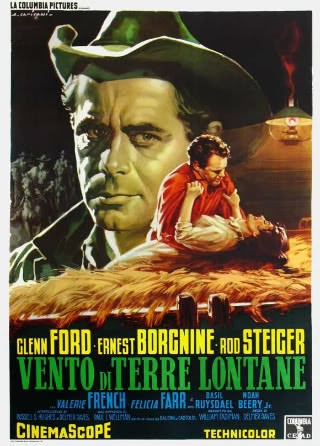
Jubal

Shakespeare and westerns really don’t sound like they go together. However, in the case of the former, the universality of his themes means that the location and period in which the drama takes place is largely irrelevant. And as for the latter, the genre is so flexible that pretty much anything can be tackled within its framework. William Wellman’s Yellow Sky has been described as a reworking of The Tempest, while Jubal (1956) sees the ideas central to Othello transported to a ranch in Wyoming. In a way, the isolated simplicity of the west provides an ideal backdrop for the presentation of such timeless concepts. Like an uncluttered stage, the absence of the trappings of civilization helps to better focus attention on the more important aspects of the story.

Jubal Troop (Glenn Ford) is a wanderer, a man who has spent his life running; he claims that he’s been trying to escape the bad luck that’s always dogged his steps. In reality though, he’s been running away from himself, or rather his own perceived inadequacies that stem from traumatic childhood experiences. When ranch boss Shep Horgan (Ernest Borgnine) takes him in and offers him a job and a chance to make a fresh start, it looks as though his streak of ill-fortune may be coming to an end. In spite of Jubal’s initial optimism, he soon realizes that he’s actually walked into a highly volatile situation. Shep is one of those salt of the earth types, brimming with hospitality and geniality yet lacking certain social graces. It’s this cheerful disdain for (or ignorance of) the niceties of polite society that has apparently pushed his young Canadian wife, Mae (Valerie French), away from him. I say apparently, because Mae merely uses this as an excuse – it’s clear enough that the remote ranch life and lack of social contact play an equally significant role in shaping her dissatisfaction. Almost as soon as Jubal arrives on the scene Mae begins to show an interest in the newcomer. On top of all this, there’s the problem of Pinky (Rod Steiger), Shep’s current top man and the previous recipient of Mae’s attention. Where Jubal resists Mae’s advances on the grounds that it would be a betrayal of the one man who ever handed him a break, Pinky never displayed such qualms. Now that he’s been sidelined by the new arrival, his resentment and natural antagonism bubble closer to the surface. Due as much to his own petty and spiteful nature as Jubal’s dedication to his job and his boss, Pinky finds himself falling out of favour both as a lover and an employee. It’s this displacement that triggers Pinky’s pent-up jealousy and latent misanthropy. When the opportunity arises, he slyly plants the seeds of doubt in Shep’s mind. And it’s from this point that the classical tragedy at the heart of the story starts to develop fully.

Delmer Daves had a real affinity for the western, his films within the genre all displaying an extremely fitting sense of time and place. In addition, he also had a great eye for telling composition and the use of landscape. His best movies look beautiful, and Jubal takes advantage of the breathtaking vistas that the location shooting in Wyoming offered. The exteriors have a kind of clean, bracing quality to them reminiscent of the mountain air their backgrounds suggest. These wide open spaces are representative both of the freshness of Jubal’s new life and also the remoteness of Shep’s ranch. However, Daves was no slouch when it came to interiors either; he, and cameraman Charles Lawton, create some extremely moody and tense imagery when the action moves indoors. It’s not always easy to achieve effective depth of focus and shadow density when filming in colour, yet Daves and Lawton manage to pull it off time and time again. When you’re telling a story as thematically dark as this it’s vital to keep the mood of the visuals in tune with the plot – Jubal always looks and feels just right at all the critical moments. What’s more, although Daves’ endings had a tendency to be a letdown in comparison to what went before, this movie maintains the correct tone right up to the rolling of the credits.
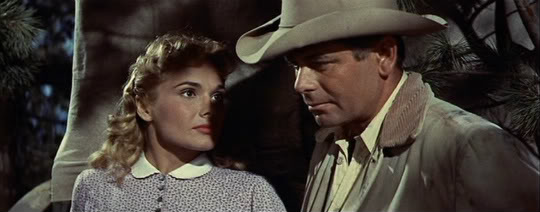
Glenn Ford was an excellent choice to play Jubal Troop, his edgy affability and that slight unease were well suited to the role. The character has an innate nobility and honesty, but there are demons lurking there too, torturing the man with personal doubt and a devalued sense of self-esteem. Ford had a gift for projecting all these qualities on the screen; perhaps that’s why he seemed at home playing in both psychologically complex westerns and film noir. In the following year’s 3:10 to Yuma, Ford and Felicia Farr played out one of the most touching and affecting romantic interludes it’s been my pleasure to see on film. This picture also features a romance between the two, just not as memorable or emotionally loaded as what was to come. Part of the problem is the weaker role handed to Ms Farr, but she still manages to convey something of that bittersweet tenderness in her scenes with Ford that would prove so effective in their next collaboration. The other, and much more substantial, female role was that of Valerie French. There was certainly nothing likeable about the part of Mae, whose infidelity (both real and imagined) sets three men at each other’s throats. Her frustrated sexiness is well realized and, by the end, in spite of her deceit, it’s hard not to feel some sympathy for her fate. Ernest Borgnine’s cuckolded husband draws even more pity though; the way he positively radiates a love for life means that his betrayal really hits home. His brash good humour makes him a favourite of the men, but also leaves him blissfully unaware of the coldness of his wife. When it suddenly dawns on Shep just how much of a fool he’s been, Borgnine’s highly expressive features show very clearly how deeply Mae’s playing around behind his back has affected him. Rod Steiger was always an extremely showy actor, forever in danger of allowing his intensity to spill over into inappropriate grandstanding. As the scheming and reprehensible Pinky, he just about manages to stay the right side of the line – although his tendency towards showboating does raise its head as the movie nears its climax. Among the supporting cast, Charles Bronson makes a strong impression as a hired hand who befriends Ford, and whose intervention at two critical moments help save the day.

Jubal has been available on DVD for a long time via Columbia/Sony in the US. The disc boasts a very good anamorphic scope transfer that looks rich and colourful. There are no extras offered, unless you count the preview snippets for other western titles from the company. The film remains an excellent example of Delmer Daves’ skill at telling a mature and thoughtful western tale. I think the fact that both the director and the star went on to make the better known 3:10 to Yuma a year later has overshadowed this picture to an extent. I’d say that anyone who enjoyed that movie will also appreciate the work on show here. This is yet another strong entry in the western’s golden decade, and fully deserving of any fan’s attention.

3:10 to Yuma

I guess, like everything else, the circumstances in which you view a movie will affect your perception of it. I just rewatched the 2007 3:10 to Yuma the other day having already reacquainted myself with the 1957 version the previous night. Now, I’ve seen the original many times and always held it in high regard although it’s not without its faults. So when I went to see the remake, during its theatrical run, I knew that the central story was a strong one and I was curious to see what it would turn out like. At the time I came away thinking that I had just seen a moderately entertaining but imperfect film. In short, I wasn’t overly displeased. The thing is though, I hadn’t seen the original for a few years at that point. Viewing the two versions so close together has forced me to alter my appraisal of the remake somewhat.

The plot of both films is derived from a short story by Elmore Leonard, and tells of a struggling Arizona rancher Dan Evans (Van Heflin in the original, Christian Bale in the remake) who witnesses a stage robbery carried out by notorious outlaw Ben Wade (Glenn Ford in the original, Russell Crowe in the remake). When Wade is later captured Evans volunteers to escort him to the town of Contention and put him on the titular 3:10 to Yuma state prison. Evans hopes that the money he earns from this will be enough to see him and his family through the drought that’s crippling his ranch. There follows a battle for Evans’ soul as Wade tries to buy, persuade and cajole the desperate rancher into letting him go while the clock counts down and the threat of attack by the outlaw gang draws ever nearer.

Those are the necessarily common elements, but if a remake is to have any purpose it must add to or change certain aspects of the original. Firstly, the 2007 version expands the story and runs about a half hour longer, most of this extra time being used to depict the journey to Contention and introduce more characters. This doesn’t really come off successfully for, despite being crammed with incident, it simply serves to slow down the central thrust of the story: the conflict and relationship between Evans and Wade. Where the original cut straight to the chase, the remake forces the viewer to sit through a lot of implausible action which seems to exist merely to dispose of a few superfluous characters. By the time Evans and Wade reach Contention and hole up in the hotel the momentum has been lost and the tension levels have dropped. The DVD of the 2007 movie contains an extra feature which carries the title An Epic Explored, and that tells a tale. This is essentially a small, intimate story based around two men and covering a short period of time. The 1957 version succeeds admirably in telling this story, whereas the remake has ambitions to be something altogether grander yet falls short of fulfilling them.

The other major difference in the two films is a change in emphasis and tone. The first movie presented Dan Evans as a man in a bad spot and dogged by ill fortune, but there was nothing pathetic or defeatist about him and the viewer can feel for him without ever being asked to. The new Dan Evans is, we are told over and over, a cringing loser who manages to elicit only pity from his captive rather than respect. In fact, even his family are contemptuous of him – Van Heflin’s distraught wife turned up in Contention to beg him to drop the matter and return home while Christian Bale’s other half disappears from the story early on like she just doesn’t give a damn what happens to him, and I’m not sure if I blame her. The ’57 movie showed Evans’ two boys to be a couple of nice respectful kids, while the ’07 one gives us a surly brat who never misses an opportunity to bad-mouth his father, regardless of the company they’re in, and left this viewer yearning to see him on the receiving end of a good hiding. All told, there are far too many jarringly modern touches to the remake; when Bale’s wife upbraids him for not making decisions together and his son throws another insult his way I was taken out of the film completely. Such moments defy all logic in terms of time and place – it’s akin to seeing a bunch of brawling cavemen interrupted by one of their number saying “Wait a minute fellas, surely we can talk this through like civilized men.”

Delmer Daves is a director who I feel has been severely underrated and a comparison of his work with that of James Mangold during two key sequences points this up. Take the scene with Glenn Ford and Felicia Farr first. When they stand on the porch and talk about their former lives there’s a very poignant sense of two lonely people and their sense of loss. As the camera follows Ford back into the saloon there’s a kind of innocent charm about his seduction of Farr, and then the camera zoom and music cue hit the mark perfectly when he asks the colour of her eyes. In contrast, Mangold just has Crowe sidle up behind Vinessa Shaw, grunt in her ear and off they go. The other sequence that highlights Daves’ superior handling of the material is during the lengthy wait in the hotel. While Ford stretches out on the bed he tries to tempt his captor into letting him walk with offers of a bribe. During this exchange the camera cuts back and forth between the faces of the two men, each time the focus zooms marginally closer on Van Heflin and ratchets up the tension. Mangold shoots the same scene mostly static and the result is that the tension doesn’t build and it simply falls flat.  Another problem is the ending of the remake. One criticism of Delmer Daves’ work was that his endings were often a bit of a cop out after what had gone before. The climax of the ’57 3:10 to Yuma was always its weakness but it feels deeply satisfying when compared to the absolute travesty that the remake offers as a conclusion. This is not to say that Mangold doesn’t do anything well. His handling of the action sequences is noteworthy, from the opening stage hold-up (complete with exploding horse) to the climactic gun battle/chase through the streets of Contention. The problem is that these have a comic book, Spaghetti western feel that sits a little uncomfortably with the dour tone of the rest of the picture.

I know Russell Crowe is a fine actor but when I compare his Ben Wade to that of Glenn Ford’s he comes off second best; there’s just not enough charm and too much of his natural oafishness showing through. I also prefer Van Heflin’s Dan Evans to that of Christian Bale but I don’t mean that as a criticism of the latter’s acting skill, rather I would put it down to the writing of the part. Ben Foster certainly outscores Richard Jaeckel as Wade’s henchman Charlie Prince; the role is greatly expanded in the remake and Foster really sinks his teeth into it. I also want to mention Peter Fonda, whose grizzled bounty hunter was one of the best things about the 2007 movie. How can you not admire a man who’s back in the saddle mere hours after being gut-shot and then operated on by a vet – what a guy!

So, I think I can safely say that my preference is for the 1957 3:10 to Yuma. However, people who come upon the remake with no knowledge of or exposure to the original may find it entertaining enough. Sure it’s chock full of implausibilities and boasts an outrageous ending but even I was willing to take these in my stride at first. Watching them consecutively as I did will only throw all those negatives into even sharper relief.

Broken Arrow

poster21

The 1950s were the heyday of the western. You can look at almost any other decade and find plenty of examples of exceptional westerns, but none can compare to the 50s in terms of the sheer number of intelligent, high quality productions. Broken Arrow (1950) was, to the best of my knowledge, the first western to portray the Indians as more than simple caricatures. This film doesn’t demonise them, nor does it present them as the mystical, tree-hugging hippies that our increasingly politically correct world seems to insist on. Instead it presents a people with their own way of life and their own system of values.

Tom Jeffords (James Stewart) is a former army scout who stumbles upon a wounded Apache boy and nurses him back to health. In doing so, he starts to regard the Apache as real people who think and feel, and who are not just inhuman killing machines that must be eliminated at all costs. When he is subsequently captured by a raiding party, his act of kindness, though viewed with suspicion, leads to his being spared. However, he is forced to witness three survivors of an ambush tortured to death; this is a war of attrition with no quarter given or asked for from either side. The point is made that these are a people with a strong sense of honor but there is no shying away from their capacity for brutality. Jeffords’ return to white society gives an insight into the cruelty and brutality on both sides, as the town’s residents display  both  shock and incredulity on hearing that he failed to take the opportunity to kill a wounded Apache. Sickened by the endless cycle of tit-for-tat violence, Jeffords takes it upon himself to seek out a meeting with Cochise (Jeff Chandler) in order to try to find some middle ground. The meeting does produce some limited results, and also brings him into contact with a young Apache maiden (Debra Paget). As Jeffords finds himself falling in love, so he seeks to broker a peace deal between Cochise and the army. The racism prevalent on both sides is shown clearly and the film, to its credit, doesn’t try to lecture the viewer on who was right and who was wrong. It assumes that adults are capable of making up their own minds – seems such an odd concept these days, doesn’t it?

£2

James Stewart gave one of his usual solid performances, and by the end of the movie you can see director Delmer Daves draw on some of the disillusioned bitterness that Anthony Mann would later exploit so successfully. Jeff Chandler’s portrayal of Cochise earned him an Oscar nomination (eventually losing out to George Sanders), and he is convincing in the role. Generally, the acting is fine all round with good work from Paget, Will Geer, and Jay (Tonto) Silverheels as Geronimo. Delmer Daves is a director who seems to be very underrated these days, but I feel he turned out some great movies (especially in the western genre) in the 50s. One criticism that could be levelled at him is that his endings were frequently a bit of a cop out, however, I don’t feel that it applies in this case.

Broken Arrow is a great example of a 1950s western and, if you have even a passing interest in the genre, it deserves a place in your collection. I watched the R2 DVD from Optimum which is far from a perfect disc. The colors vary from faded to strong and the image is generally soft. Having said that though, it’s by no means a terrible presentation and is certainly watchable throughout. There is a R1 release from Fox but I don’t own this and can’t comment on the transfer.


If anyone has been wondering where I’ve been, I just decided to take a little break from posting. As others have mentioned, you can reach the point where you post so often that it starts to feel like an obligation rather than a pleasure. As such, I’ve decided to post when I feel like it rather than try to fulfill some notional quota I’ve set myself. So, until the next time…