
Ten years after making Gunfight at the O.K. Corral director John Sturges paid a return visit to Tombstone. Where his earlier film drew to a close with the shootout of the title, Hour of the Gun takes it as the starting point and proceeds from there. Although the 1967 movie is more or less a direct sequel, it is a very different production. Those intervening ten years had seen the western evolve away from a brighter optimism to become something much darker. The Wyatt Earp of Hour of the Gun is far removed from the upstanding representative of justice and honor that had previously been the standard. This is a driven, vengeful man who manipulates the law more than he upholds it.
The first half of the film sticks pretty close to the known facts and it is only towards the end that it drifts off into the realm of fantasy. It opens at the O.K. Corral and is quite accurate in depicting what actually happened; all those involved in the real incident are shown to be there and, for the first time, behave in the way that history has recorded. The story continues with the trial of the Earps and what would come to be known as the Earp vendetta. It is only the ending, where Wyatt and Doc Holliday track down Ike Clanton in Mexico for a final confrontation, that departs radically from the truth. However, aside from greater veracity, the most distinctive feature of this film is the way Wyatt Earp is portrayed. In all the previous versions he was a man whose primary motivation was the service of justice and the badge of office that symbolized it. In Hour of the Gun he starts off in much the same mode, but the attacks on his family bring about a rapid and drastic change. This Wyatt Earp is an anti-heroic figure paying only lip service to the law as he takes advantage of his position to exact a cold and bloody revenge on those he holds responsible for the shootings of his brothers. Although he carries arrest warrants, it becomes increasingly clear to his companions on the posse, and to the viewer, that he has no intention of ever serving them. One by one, the hired gunmen are shot down in what amount to legal executions.

If you’re only familiar with James Garner as the easy-going Jim Rockford, then his work here is a revelation. His Wyatt Earp doesn’t indulge in shy romances or offer fatherly advice to wayward teens – he is instead the angel of death. For the most part he comes across as aloof and unemotional, yet there is a maniacal, almost psychopathic, gleam in his eyes in those scenes where he blasts away his enemies. Jason Robards was frankly too old to play Doc Holliday although he brings a world-weary cynicism to the part that is attractive. The script makes a number of references to his deadly reputation but his main function in the film is to act as the conscience to Earps dark avenger, taking him to task for using the law to his own ends. Robert Ryan was always good value in any film which he graced with his presence, and his Ike Clanton is more of a politically savvy string-puller than an out and out gunslinger. There’s also a small role for Jon Voight (his big screen debut) as Curly Bill Brocius. The direction from Sturges is a solid, professional job and the story moves along at a nice pace. I’ve become very fond of Sturges as a director; he was no groundbreaker or innovator like Ford, Peckinpah or Leone but he almost always turned out strong, quality product. The film also benefits from a fine Jerry Goldsmith score, downbeat and relentless like the story itself.
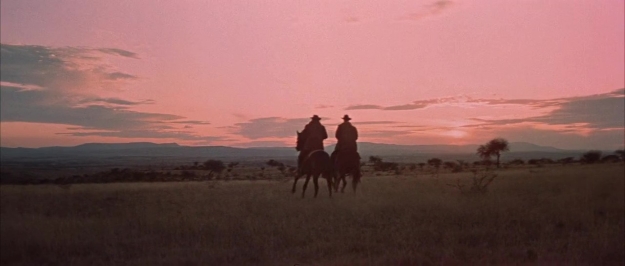
Hour of the Gun seems to be the Wyatt Earp film that no one remembers, and that’s a pity. I think it’s a little hidden gem of a movie that deserves much more recognition. MGM have had this out on DVD in R1 for a few years now in a mediocre interlaced transfer. It’s recently had a R2 outing in what looks like the same print but this time it seems progressive – at least it runs a lot smoother on my system. All things considered, I’d say this is a worthy addition to the Earp canon and a film that I’m more than happy to have in my collection.
 Riding the High Country