Madigan

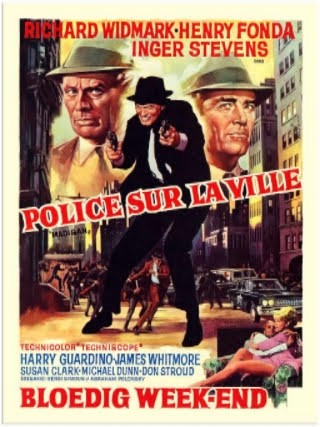
A little like the western, the crime story has remained one of the constants of genre filmmaking down the years. Any story which involves elements of crime has plenty of drama built-in so it’s only natural that cinema should take advantage of that.  The western had long been the dominant  genre in both cinema and TV until its gradual decline in popularity began in the mid-60s, and it was at that point that the crime yarn started to edge its nose in front. The detective/cop thriller really came into its own in the 1970s on the big and small screen. Madigan (1968) was one of those pictures which played a significant part in the flowering of the genre at that time, even inspiring its own, short-lived, television series a few years later.

Dan Madigan (Richard Widmark) is a New York detective, a veteran with a variable reputation. It could be said that his superiors regard him with a mixture of respect and suspicion. He has a distinguished record on the job but also the kind of casual attitude towards rules and regulations that rubs some up the wrong way. One of those is Commissioner Russell (Henry Fonda), the dry, straight arrow who has to try to juggle his police background with the political demands of his position. The ambivalence of Russell is borne out by the punchy opening section which sees Madigan and his partner, Rocco Bonaro (Harry Guardino), screw up what ought to have been a routine bust. The upshot is a dangerous suspect manages not only to elude arrest, but also relieves the two bulls of their service revolvers. This sets up the situation which dominates the rest of the film: the search for the dangerous fugitive and the consequent pressure placed on the shoulders of Madigan and Bonaro to atone for their initial carelessness before matters deteriorate further. Allied to this is the personal stress experienced by both Madigan and Russell, in the case of the former due to strained relations with his wife (Inger Stevens) while the latter finds his almost puritanical approach to life tested by the actions of colleague and childhood friend Chief Inspector Kane (James Whitmore).
One of the regular visitors and contributors to this site (you’ll know who you are) just recently remarked that he doesn’t see himself as one who subscribes to the auteur theory of filmmaking, and also cited Don Siegel as one of his favorite directors, comments which provided me with food for thought. In the past I was reluctant to embrace the notion of the auteur, feeling that it was largely an affectation of the more academic critics and too pat to be applied to so collaborative a task as making movies. Another of our regulars (who will probably recognize himself too) challenged me on this position and made me wonder if perhaps my own interpretation wasn’t too narrow. To cut a potentially long story short, I found myself reassessing my view and coming to the conclusion that the notion of the auteur in cinema needn’t necessarily be a restrictive one. I’m more comfortable now with the term in a broader sense, both in the way it’s used and the people it may be applied to. In short, I think Don Siegel can be referred to as an auteur.

A director such as Siegel is a product of the studio system, working his way up through the ranks and honing his talents in a variety of roles on a range of genre pieces. As I said, I’ve moved away from thinking of an auteur as some domineering presence impressing his vision relentlessly on the films he works on. Instead, I’ve come round to the idea of the auteur as the most influential member of the creative assemblage, someone whose distinctive mark can be discerned on the finished piece. And I think this can be said of Don Siegel; it’s common to consider him primarily as an action director but there’s usually something of himself, or at least his interests, on view in his films. It’s difficult not to be aware of his examination of authority and authority figures throughout his career, and Madigan is no exception.

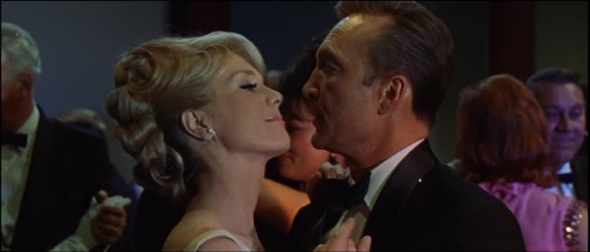
Siegel’s touch is visible enough to me, and he’s helped in leaving it there by the talents of accomplished cameraman Russell Metty, the writing of Abraham Polonsky and Howard Rodman, and a cool lounge score by Don Costa. While those individuals were all busy pooling their abilities to achieve the best results possible, it appears producer Frank Rosenberg’s contribution was less welcome. On the other side of the camera, both Widmark and Fonda gave the kind of coolly assured performances one would expect of actors with their experience and talent. Widmark’s trademark air of ambiguity is a good fit for the detective who treads the fine line of legality with the sure-footedness of a tightrope walker. Similarly, Fonda does stiff and prissy very well, and it’s all the more effective when the audience is aware  both of his internal conflicts and the hypocrisy of his overt moralizing. Inger Stevens had the meatiest of the female roles (although Susan Clark and Sheree North had parts of note too) and runs with it, getting across her dissatisfaction and frustration very successfully. In support, there’s uniformly good work done by Harry Guardino, Steve Ihnat, James Whitmore and Don Stroud.

Madigan has been available on DVD from Universal for a good few years now. The UK release I own presents the movie in anamorphic scope and uses a good print. Colors are strong and there’s good detail in the image. Additionally, there is no noticeable damage on view. Sadly, there aren’t any extra features offered, but I guess the film is the main thing and it does look very nice. I’ve always been a fan of detective/cop thrillers, regardless of whether they’re films, television shows or stories on the printed page, and Madigan is a prime example of good they can be. It’s tough, pacy, entertaining and has enough human interest to raise it above more mundane, one-dimensional fare. All told, it’s a polished piece of work from a top director, cast and crew. Recommended.

Apache Territory

The low budget western was arguably as important a representative of the genre as it’s more illustrious and more expensive cousins. The sheer quantity of programmers and B movies means they deserve attention by anyone claiming an interest in the western. Given the prodigious output, it’s hardly surprising that the quality varied considerably; some managed to transcend the restraints of their budgets, others were just downright poor but most were average efforts, offering an entertaining way to pass the time despite the weaknesses inherent in their production. Apache Territory (1958) is an example of what I’m referring to: a combination of good and bad elements that add up to a moderately diverting hour and something.

As the title say the action takes place n Apache territory, where the hero, Logan Cates (Rory Calhoun), is passing through on his way to Yuma. By his own admission, Cates is one of life’s drifters, a guy  with no particular purpose moving wherever the mood takes him. In this instance, it leads him towards trouble, someone else’s trouble to begin with but it’s soon to become his too. Seeing a group of riders about to be attacked by a band of Apache, he warns them and draws off the assault. It’s only a short-lived respite though as the sole survivor, along with a trickle of other refugees from the renegade raiding party gradually come together in search of safety. A disparate group, including an old flame of Cates’ (Barbara Bates) and her venal fiance (John Dehner), gather in an isolated desert oasis and prepare to wait out the siege. Water is plentiful, food is not, while mutual trust and goodwill are virtually non-existent. As the Apache press and probe, tempers fray and nerves jangle beneath the pitiless desert sun, and the numbers of the defenders are whittled down bit by bit.

Ray Nazarro is a name which probably isn’t all that familiar to many people. I’d say I’ve had a reasonable amount of exposure to movies of every size and shape in most genres and I’ll freely admit that I’ve only seen a handful of examples of Nazarro’s work. I have viewed  Domino Kid and The Hired Gun also starring Rory Calhoun, Top Gun with Sterling Hayden, and a few episode of TV shows such as State Trooper and Mike Hammer, and that’s about it, although I do have a few more titles to hand but not yet watched. Now if anyone spends their career working in the B units, it’s only reasonable to expect them to have a thorough understanding of the concept of economy. Budget filmmaking of any kind is dependent on exploiting resources to the full and wasting as little time and money as possible. Apache Territory certainly has that sense of urgency and pace one typically sees in a B picture, the plot takes precedence over all and characterization not only takes a back seat but also never penetrates deeper than is absolutely essential. The positive side of this is that the story keeps moving along and there’s no shortage of incident.

On the other hand, there are some negatives to take into consideration too. The opening section makes use of locations in Red Rock Canyon but this aspect is short-lived and it’s not long before events move to a studio set, a backlot mock-up of the oasis. While this adds a layer of claustrophobia, giving it that sense of a frontier chamber piece, the contrast with genuine locations is both apparent and somewhat jarring. This is a purely budgetary matter and I don’t think the director can be criticized for any of that. Nor do I feel Nazarro can be faulted for some weaknesses in the script. The screenplay is an adaptation of Last Stand at Papago Wells  by Louis L’Amour, a book I read some years ago and which I recall as being fairly faithfully reproduced here. The problems with the writing, for me anyway, relate to the tendency to rely on some unconvincing dialogue for exposition instead of showing things using cinematic language.

The film was a Rorvic production, meaning it was made via Rory Calhoun’s own company and offered him a strong, heroic role. Louis L’Amour stories generally involved central characters who were relatively uncomplicated, his strengths lying in his descriptions of action and landscape, his ability to communicate an authentic sense of time and place. Calhoun’s character in Apache Territory is pretty much one of those “what you see is what you get” types and he plays this undemanding part fine. The villains in such tales may not have much more depth or added dimensions but they tend to be entertaining. This film has two to enjoy – firstly, we get a snarling turn from Leo Gordon as a resentful and insubordinate cavalryman before he departs abruptly and violently, and then there’s the always welcome John Dehner. His assured work raised many a mediocre movie and he does well as the self-absorbed rival to Calhoun for the affections of Barbara Bates. Ms Bates was good enough as the refined woman who starts to see that she may have made a serious mistake and has the resolve and strength to try to reverse that before it’s too late. The only other female role went to Carolyn Craig, playing a timid massacre survivor who latches onto Tom Pittman’s California-bound orphan. As a sad little aside, Pittman, Craig and Bates all passed away under sudden and tragic circumstances.

Apache Territory was a Columbia release and Sony have made it available on DVD in the US as part of their MOD program. It has also been released in Spain and Italy, and I have the Spanish edition myself. The disc presents the film in a solid enough 16:9 transfer that is quite satisfactory – Spanish subtitles are offered but are optional and can be disabled. Overall, the movie is what I’d describe as routine. Tales involving isolated groups besieged and threatened from without and within are usually good value and Apache Territory is a middling, low-budget example. The lack of money does affect how it’s executed but there’s some nice action and suspense to offset that.

Horizons West

poster59_zpsujbuh5ax

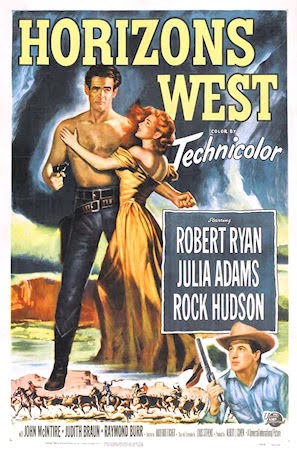
There are movies which look like they have everything going for them: a director with a substantial and significant reputation, a strong cast, and a promising script that is a blend of a couple of classic themes. All of this applies to Budd Boetticher’s Horizons West (1952) – add in the fact that the film was one of those handsomely shot Universal-International productions and one might reasonably expect it to be a cast iron winner.  However, the fact is it doesn’t quite live up to the build-up. It’s not a poor movie at all, just one which delivers a bit less than it could have – too much melodrama when more honest drama would have been preferable, and a series of conflicts which might have been more fully exploited.

The end of a war ought to signal a more peaceful era and maybe even a more hopeful one too. For the Hammond brothers, returning to their native Texas after taking part in the war between the states, the hopes are present although while Neil (Rock Hudson) wants nothing more than a return to the idyll he left behind when he signed on older brother Dan (Robert Ryan) is disgruntled enough to be in the mood for a different kind of struggle. By his own admission, Dan Hammond doesn’t like losing and almost immediately sets about changing the course of his fortune. This period of reconstruction in the vanquished South is one which can make men rich fast and, as always, draw the consequent attention of beautiful women. It just so happens that the allure of wealth and a woman crosses his path as soon as he enters Austin, and it also happens that both in this case belong to one man, Cord Hardin (Raymond Burr). It shouldn’t be any surprise that Dan will fall foul of this brash Yankee, nor that the clash is to set him on a path that tantalizes him with the promise of fulfilling his dreams but also creates a rift that threatens to irrevocably sour relations with his father (John McIntire) and Neil.

The title of the film – Horizons West – is both romantic and simple. Those two words pretty much encapsulate the spirit of the genre and I guess it’s no wonder that Jim Kitses used this as the title of his examination of the most influential figures in the western, a book I highly recommend to anyone who hasn’t yet read it. Yes, those two words conjure up all kinds of iconic imagery and it’s therefore difficult not to have heightened expectations. As I said above, this isn’t a bad little movie but everything from the title on down holds out the prospect of something greater and grander. Perhaps that’s a tad unfair as I have a hunch that were one to come to it after the credits had rolled, and unburdened by any great familiarity with director or stars, then it would prove a satisfactory and satisfying way to pass 80 minutes or so. I sometimes feel that approaching movies as “film buffs” means that all that associated baggage we bring along is simply adding an unnecessary degree of pressure to how we perceive films and assess their relative worth.

Director Budd Boetticher’s fame and reputation come principally from the films he made in the late fifties with Randolph Scott, what we refer to as the Ranown cycle. The greatness of those half-dozen westerns, a little interrelated cluster of bona fide masterpieces – cannot be disputed; they mark the director and his star out as giants of the genre. However, the flip side is the  way the towering reputation of those films tends to cast a deep shadow over the rest of Boetticher’s body of work. That his other, earlier movies do not attain those artistic levels shouldn’t be regarded as any particularly damning criticism. Generally, Boetticher had far less creative control over the films he was making as a contract director within the studio system, a fact which applied to almost all filmmakers. Boetticher, like any contract director, was employed to turn in a competently made product as efficiently as possible. This is what he did on titles such as Horizons West, the script of which lays the melodrama on thicker than it needed to and only scratches the surface of the theme of sibling rivalry and the differing perceptions of ambition within a family. The film always looks sumptuous (as Universal-International productions typically did) even if the on screen action is a little lacking at times. As usual, Boetticher shines brightest in the outdoor scenes and the action sequences, the final act being especially well-handled.

I’ve spent plenty of time singing the praises of Robert Ryan on this site before, and I’ll try to confine myself to pointing out the fact he rarely gave a disappointing performance and certainly didn’t do so in this instance. His edgy magnetism once again anchors the movie and he uses the duality of his character to great effect – I often think it was impossible for Ryan to play anything other than an interesting role. In terms of the development of the story, I would have liked to have seen more of the growing chasm between the two brothers. However, Rock Hudson was still in the early stages of his career and thus his part was limited somewhat – although each successive film would see his screen time expanded. Julie Adams was handed a good vampish role as the wayward wife of the northern carpetbagger and she makes for a very attractive presence. Raymond Burr was well on his way towards becoming virtually typecast as unsympathetic villains in these pre Perry Mason years – he played such parts very convincingly but he must surely have been bored by the dearth of variety at the same time. One of the delights of these studio vehicles was the richness of the supporting casts, and Horizons West certainly doesn’t disappoint on that score – John McIntire, Dennis Weaver, James Arness, Douglas Fowley, Tom Powers, Rodolfo Acosta and Walter Reed all add value to the viewing experience.

Some years ago, the only available copy of Horizons West was the German DVD by Koch Media, which I have. Since then, however, the movie has been released in the UK and the US, and probably in other territories as well. I can only comment on the Koch disc, which displays some genuinely eye-popping colors and is extremely sharp on occasion. There are some instances of softness though, and also some minor registration issues where the color can appear to bleed slightly. Overall though, I have to say the film looks very  fine. So, to sum up, we’re talking here about a solid movie featuring the talents of Boetticher and Ryan. Even if it has imperfections and isn’t up there with the very best work such people were capable of, it remains entertaining and worthwhile.


Ambush

Mention cavalry films to anyone familiar with classic era movies, and westerns in particular, and the odds are they will immediately think of John Ford. Even so, most of those same fans will be aware of the fact that he certainly wasn’t the only one to spin tales of the men and women populating the isolated and dusty outposts of the frontier. The self-contained communities, the remoteness and the ever-present danger of these settings meant they were bursting with potential as backdrops for a wide range of dramatic developments. Ambush (1950), with its focus as much on the tensions simmering away within the fort as the threats of the hostile land around it, and of course the strong Irish presence among the horse soldiers, appears reminiscent of a Ford movie. And yet it’s a different creature at heart; the sentimentality and whimsy aren’t  there, and the sense of community is not as pronounced.

There’s a fine, tense opening which underlines the perilous situation. It’s Arizona and Apache chief Diablito (Charles Stevens) has broken out of the reservation and is raiding. The first shot of the movie reveals the aftermath of a massacre, broken bodies strewn across the landscape amid the smouldering remnants of wagons, the only sound being the cries of the retreating raiders. Up in the mountains Ward Kinsman (Robert Taylor), some time scout for the army, is busy packing away the gold he has been prospecting for, but stops abruptly when a startled bird rises suddenly from a copse of bushes. His caution is understandable since the smoke drifting off neighboring peaks indicates Diablito isn’t far away. Still, it’s something of a false alarm as the alien presence is actually only that of Holly (John McIntire), another scout who’s been sent to bring Kinsman back to base. While that in itself is far from plain sailing, it’s achieved in due course and main thread of the story becomes apparent. A young woman by the name of Ann Duverall (Arlene Dahl) has come west in the hopes of finding her sister who has been abducted by the Apache. Her family is army and so she the influence needed to have a party under the command of Captain Lorrison (John Hodiak) assigned to the task. It’s hoped that Kinsman can be persuaded to sign on as scout, thus his summons back to the fort at short notice. What follows is the attempts to trace and rescue the captive woman, complicated by two romantic subplots. The first is a fairly standard affair involving competition between Taylor and Hodiak for the affections of Dahl. The other is treated as a subsidiary, although I feel it’s much more interesting, and concerns the forbidden relationship between a young lieutenant (Don Taylor) and the abused wife (Jean Hagen) of an enlisted man.

Ambush was the last movie made by Sam Wood, he died before its release, and it’s a solid piece of work with some memorable sequences, well-handled pathos and a nice line in suspense. Cavalry westerns, especially those which spend any amount of time in and around a fort or outpost, have a tendency to become a touch episodic. That’s the case here, as the film digs into the lives of the characters and builds towards the final confrontation with Diablito’s Apaches. The plus side of this though is that the scenes in the fort have a tight shadowy atmosphere, a reflection perhaps of the restrictive nature of army life and its effects on the personal lives of the characters. ON the other hand, there’s also plenty of location work on view, with New Mexico standing in for Arizona, and the outdoor action scenes are very well shot. If I have a criticism, it would be that some of the romantic stuff revolving around Taylor, Dahl and Hodiak could have been cut. I see it as being used to emphasize the rivalry between the two men but it’s not really necessary, adds little and slows things down somewhat. Aside from that, the movie carries only a little fat and moves along at a nice clip.

Taylor had already tried his hand at westerns back in 1941 in Billy the Kid. At that time he was 30 years old and, although arguably too old to be playing Mr Bonney, he looked a little fresh-faced for the genre. By the time of Ambush the war years were behind him, he was rapidly closing in on 40 and had taken on the harder look that would serve him well throughout the coming decade. Aside from the slightly jaded toughness that make his scenes with Dahl more interesting, there’s a surprising level of vulnerability on show too. It’s not so often that you see films of the era allowing their leading man to take a good old-fashioned hiding, but that’s exactly what happens to Taylor’s character at one point when he challenges Hodiak’s by-the-book officer to a fight. And Hodiak is fine too in that inflexible role although, as I mentioned before, the contrived romantic rivalry over Ms Dahl is something of a pointless distraction. Dahl’s role was mainly about looking good and keeping her potential suitors on their toes, and she manages both tasks easily. The more complex female part was given to Jean Hagen, she doesn’t get to exhibit the glamor of Dahl but it’s her conflicted yet loyal woman who makes the bigger impression – both actresses were cast together again in the following year’s Barry Sullivan crime picture No Questions Asked. Lots of good support is provided by Don Taylor (as Hagen’s would-be lover), the ever-reliable John McIntire, Bruce Cowling (who would go on to play Wyatt Earp in the underrated Masterson of Kansas), Leon Ames and Ray Teal.

There are plenty of options for watching Ambush as there are DVDs available from the Warner Archive in the US, as well as editions on the market in Spain and Italy. I have the Spanish version, although I did own the Archive disc too in the past and the transfer looks identical to my eyes. It’s one of those unrestored prints – cue markers and the odd scratch on view – that’s in reasonable shape overall. It could use a clean up but it’s not the kind of title whose profile, or market potential, is likely to justify the expense that would entail. So, Ambush offers a strong cast, authentic locations and good visuals. Marguerite Roberts’ script, taken from a Luke Short novel, maybe should have trimmed some material from the mid-section but that’s not what we could term a fatal flaw by any means – it remains a well-made and entertaining western.

Panhandle


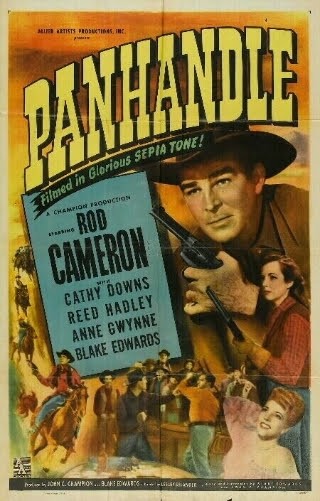
poster57_zpsnwhbw2ihCertain plot devices come up time and again in westerns, so much so that they can start to feel like old friends after a while. On occasion we even get a whole cluster of them all intermingled in one movie, although one tends to dominate when such a situation arises. Panhandle (1948) blends together the tale of the town tamer, the outlaw forced back into his old ways, and the perennial matter of settling scores. It’s that latter element – the quest for revenge, or perhaps it would be more accurate to talk of justice here – that comes to the fore in another stylish example of Lesley Selander’s work.

Mexico has frequently been portrayed on screen as a land of opportunity from a westerner’s perspective. Sometimes it has held out the possibility of attaining riches, at others of regaining something of the mythical freedom eaten up by the relentless advance of civilization. And it has also been viewed as the home of the second chance, a place of refuge and redemption of sorts, for the badman in search of spiritual solace. John Sands (Rod Cameron) is one of those men, a gunfighter trying to put his violent past behind him by living a simple but honest existence south of the border. Initially, it looks as though he has achieved some kind of peace selling leather goods, but unexpected news from the north is about to change all that. A young woman (Cathy Downs), unaware of his former identity and notoriety, drops the bombshell that his brother has been murdered in the town of Sentinel in the Texas Panhandle. In that instant, Sands’ life is transformed as he has been forced back to the way of the gun. His mission to exact retribution for the killing means a return to the US, to his own dark past and all the attendant dangers crossing the border represents to him – aside from confronting the guilty men, there’s also the little matter of an outstanding warrant for his arrest still circulating in the Lone Star state. Sands is going to have to negotiate this, and also the attentions of two very different women, before he can reach some form of closure and continue living on the terms he has chosen for himself.

The first thing one notices about the movie is the use of sepia tone, a look that I’ve never been especially fond of. In my mind, this kind of tinted photography will be forever associated with material of a much older vintage – silent films mainly – although that’s perhaps the thinking behind its use here, to reinforce the fact that the tale is unfolding in a different era. Whatever the reasoning, it’s a process that I find I get used to quick enough and it soon ceases to be something worth remarking on. If I have any particular issues, they relate to a few areas of the script that I feel were almost discarded after their introduction suggested something more was to be made of them. The question of Sands’ legal status in the US pops up early on when a lawman, played by Rory Mallinson, tries unsuccessfully to detain him. It’s mentioned again when certain interests in Sentinel make a play for his services as a town tamer, but then is essentially ignored. Even that aspect, the potential hiring of the outsider to clean up the undesirable elements gets elbowed aside when it looks like there might have been scope for some kind of commentary on way those with a less savory past were accepted on sufferance in times of need.

More time is allotted to the suggestion of a romance with Cathy Downs’ character, although this never develops, and a more overt one with Anne Gwynne. The latter situation doesn’t work all that convincingly in my opinion, and I can’t help but feel it’s a shame the storyline featuring Downs wasn’t built up more as there was more potential which could have been tapped into in that situation. Nevertheless, even if these aspects are not entirely satisfactory, they don’t weaken the film. Selander’s sure direction keeps the whole affair moving forward and switches the action smoothly between the studio backlot and the Lone Pine locations. As one might expect from this director, the action is neatly handled too, especially a fine bar room brawl and the climactic shootout on the muddy streets of Sentinel, with the rain pounding down and the harshly lit muzzle flashes signalling death for some and victory for others.

Panhandle was one of a number of films Rod Cameron made for Selander and it offered him a good rugged role. He was one of those actors who looked comfortable in westerns and provided a solid screen presence. This part was a good fit since he was believable as a hero and also as a villain in other films, so playing the outlaw struggling to reform himself was certainly within his range. One of the most enjoyable scenes in the picture comes when he’s pressed by a young Blake Edwards (who also had a co-writing credit for the movie) to divulge the details of the time he faced down Billy the Kid. Cameron draws the tale out wonderfully, holding the younger man rapt and milking the story for all its worth. And then he delivers a punchline that practically floors Edwards, and the viewer too, with its sheer audacity – a lovely moment. Cathy Downs and Anne Gwynne were an extremely attractive pair of leading ladies although, as I said above, it’s a pity the former isn’t used a little better. As for villains, Edwards is fine as the flashy hothead and Reed Hadley does good work too as his suave and deadly boss. In support, it’s nice to see familiar faces like Rory Mallinson and John Ford favorite J Farrell MacDonald, albeit in small roles.

Panhandle is available on DVD in both the US and the UK in Darn Good Westerns collections, from VCI and Odeon (now Screenbound) respectively. I have the UK edition and the transfer is just fair. The image generally looks soft and quite muddy in places  – I think the images i used above (despite the fact they’re reduced in size) give an indication of the picture quality. The disc offers the theatrical trailer as the sole bonus feature. This is a pretty good Selander film told in his usual economical style. The script, a debut effort for both Blake Edwards and John C Champion, has plenty of ideas and even if all of them aren’t as fully developed as they might have been, what happens on screen is consistently interesting. Another solid low-budget production with quite a bit to be said in its favor.


War Paint

It’s a pity the way low budget programmers, and those who made them, tend to get less critical attention and respect than their more expensive cousins. The result of this is that very good movies get lost in the shuffle and find themselves ignored as both the passage of time and the big name productions shunt them aside. I think Lesley Selander was a solid and skillful filmmaker, with a habit of turning out interesting and well crafted material, yet his name is unknown outside hardcore film buff circles. War Paint (1953) is one of those fairly obscure Selander westerns that highlights his strengths as a director.

The story concerns a treaty between the US government and an unnamed Indian tribe, one of those documents laboriously hammered out and promising peaceful co-existence between the two warring sides henceforth. In this case the agreement has been struck, and the document signed and sealed. The issue, however, is one of delivery. What we’re looking at here is a race against time to ensure the document in question is handed over to the native chief before nine days have passed and the deadline expires. The responsibility lies with one Lieutenant Billings (Robert Stack) and his small patrol. Initially, he’s tasked with handing the treaty over to the local Indian agent, but he’s not going to turn up as his body is lying somewhere out in the wilderness. Instead, it’s this man’s killer, Taslik (Keith Larsen), who also happens to be the chief’s son, that appears. Hitchcock always maintained that a good way to build up suspense was to make sure the audience knows a little more than the protagonists on screen, and that’s how it is in War Paint. While Billings and his troopers believe Taslik is leading them across the parched landscape towards his father’s village, the viewer knows that he has other plans in mind. Bit by bit, the suspicions of the weary and weakening men are roused as the desperately needed water remains elusive and the instances of ill-fortune start to add up.

What kind of words best sum up a Selander picture? Well, toughness and economy spring to mind right away, and War Paint provides an object lesson in both. The movie opens with a cagey and sparse duel among the desert dunes  – one man is first blinded and then gunned down while his partner is shot dead and his corpse scalped. This brutal little prologue sets the tone for the gritty story that subsequently plays out. On the surface, we get a solid outdoor adventure with the harsh Death Valley locations providing the backdrop for this man versus nature affair, and it’s very successfully executed even if it’s approached on that basis alone. Still, the more interesting films always have a little more going on to divert us, and War Paint adds some depth by fleshing out the characters – cavalrymen and natives alike – and affording us glimpses of their lives outside the events of the narrative. What we get is one of those microcosmic snapshots, where the hopes, dreams, disappointments and weaknesses of a random selection of humanity is laid before us.

I’ve looked at several examples of what can be referred to as the pro-Indian cycle of 50s westerns on this site before and in doing so I’ve become more aware not only of the number of such movies but also their range and position on the spectrum in terms of sympathy expressed. War Paint hits somewhere around the middle of this imaginary scale, striving for balance and the honesty that accompanies it. I think the exclusively outdoor setting helps with this, stripping away the trappings and distractions of civilization to let us look at things as they really are in the frank and merciless glare of the desert sun. The positive and negative aspects of these two rival cultures are put in front of us and we’re encouraged to appraise each one, taking into account the deceits and betrayals as well as the largess and nobility both are capable of.

Robert Stack didn’t feature in a huge number of westerns – he’s always going to be best remembered as television’s Eliot Ness and for his hilarious turn in Airplane! – but did make some and I think he had the kind of presence that worked well enough in the genre. As Lieutenant Billings, there’s an uncompromising, driven aspect to his character, the kind of thing which is to be seen in a lot cavalry officer parts. Such characteristics aren’t always explained adequately – frequently we’re just asked to accept that this is the way it is – but the writing in War Paint is again deserving of some praise for the way enough expository back story is sprinkled throughout the script to justify motivation and attitude. And this isn’t restricted to Stack; we discover little pieces of background information to round out the character of Joan Taylor’s vengeful young Indian woman and also that of Keith Larsen as her brother. Charles McGraw was able to put his gruffness to use either as a villain or as a good guy, and got to indulge in the latter here as the faithful sergeant always backing up his boss even when he’s wrestling with internal doubts. There’s good support from the likes of Walter Reed, Douglas Kennedy and John Doucette, and some patented nastiness from Peter Graves and Robert J Wilke.

War Paint has been available on DVD  for some time now, both as a MOD disc from the US and as a (now rather pricey) pressed disc from Sony/Feel Films from Spain. That Spanish disc looks fairly good, the image is sharp and colorful for the most part but there are some softer and less defined sections and inserts. The film could probably use a bit of a clean up overall but, realistically speaking, this is not the kind of title where the potential sales would justify the expense of such an undertaking. There’s a choice of the original English audio or a Spanish dub and the optional Spanish subtitles can be deselected either via the menu or on the fly from the remote. The trailer is included as an extra feature. This is an enjoyable film, as tight and rugged as you might expect from Selander and attractively shot on location – there’s not a single interior scene. It works on multiple levels and has the kind of maturity of outlook that characterizes the best of the genre’s output in the 50s. It gets my recommendation.

Riding Shotgun

Ever watch a movie and find yourself struggling to quite get a handle on it? I don’t mean in terms of following the plot, rather the direction in which the plot wants to lead your thoughts. Frankly, I’ve seen lots of films where the storyline has meandered all over the place and the focus seemed to shift continually. But it’s a whole different matter when we start talking about a small, tightly structured production, one where there’s an essentially simple story being told, yet where the theme and tone appear to vary almost from scene to scene. As I watched Riding Shotgun (1954) the other day I was struck by tonal shifts throughout, a kind of capriciousness in the scripting that meant a potentially interesting little movie fell short of what it might have been.

As soon as the credits roll there’s a sense that we’re going to get one of those noir-tinged westerns that can prove so satisfying, Firstly, we get a voice-over narration by the hero, Larry Delong (Randolph Scott), which lets us know that he took the job riding shotgun for the stagecoach line, and traveling all over the west as a result, for a very special reason – to find one particular man, and to kill him. The man in question is Dan Marady (James Millican), a notorious road agent or outlaw, and he’s well aware of the fact his nemesis is dogging his tracks. I don’t think I’m giving too much away here, as the following all occurs in the first 10 minutes or so of the film, by saying that Marady has a plan in place to lure Delong away from the stagecoach and then fake a raid on it to draw a posse out from the neighboring town. With the law off chasing the apparent attackers of the stage, the town will be left wide open so Marady and his men can enter at their leisure and pick off all they want in safety. That’s the plan, but a little carelessness means Delong remains alive and free, and in a position to warn the defenseless settlement of the impending raid. It’s at this point that the movie takes a turn off into more unusual territory – instead of being greeted as a savior, Delong first becomes the object of suspicion and distrust, and later an outright threat who has to be eliminated.

Coincidence, misfortune and misunderstanding provide the impetus for the plot of Riding Shotgun, the kind of circumstances that make for good drama,and can add to that sense of noir fatalism I alluded to earlier. With the revenge motif, the narration and the sight of Randolph Scott grimly determined to kill a man as opposed to, let’s say, bring him back for trial, everything appears to be in place for a solid B western suspenser. And yet it doesn’t really come off, and the reason is the uneven or uncertain tone I spoke about. For a story like this to work as it should, to be truly effective, it needs to be tackled as a straightforward and straight-faced yarn. The setting and build-up are suitably minimalist and claustrophobic, and director André de Toth frames some excellent compositions. As Scott’s character finds himself increasingly isolated and literally backed into a corner, there’s tension in abundance. However, we also get humorous undercurrents – the over-cautious and ever-hungry deputy (Wayne Morris), the grotty saloon keeper fretting about his costly mirror and addressing his son in Spanish while getting answered in German, and the (seemingly) deliberately obtuse townsfolk. The net result of it all is that the film is neither fish nor fowl, shying away from full-on suspense and flirting with the comedic elements, we end up with a film which feels slightly arch.

I wonder how this movie was received on release since, even now, I find it a little odd to see Randolph Scott so hell bent on killing off his enemy. I know he went to similarly dark places in a couple of the Budd Boetticher films a few years later but it still gives me pause. While I have reservations about the script I can’t fault Scott’s performance, but he rarely gave an unsatisfying performance by this stage in his career anyway. It’s nice to see James Millican, who often got cast in smaller but always memorable roles, handed a more substantial part as the chief villain; it doesn’t call for any great subtlety but there’s plenty of opportunity for some solid snarling and meanness. Millican’s principal sidekick is played by a young Charles Bronson (still being billed as Buchinsky) and his presence and potential can be clearly seen at this point. OK, I’m harping on the (not all that successful and also unnecessary) comic aspects again but I feel Wayne Morris is ill-served as a result. His conflicted deputy is an important character in the film, providing a lot of balance and accessibility. But the way the part is written undermines him at every turn and diminishes the role considerably, a great shame. There’s a good supporting cast featuring the likes of Joan Weldon, James Bell, Joe Sawyer, Frank Ferguson, Vic Perrin and John Baer, although many of them are given very little to do.

Warner Brothers put Riding Shotgun out on DVD years ago as part of a triple feature set with Man Behind the Gun and Thunder Over the Plains. Scott’s westerns were harder to find back then and only few were available to buy compared to now, and I remember being very pleased to see these films come on the market. The presentation is as basic as it gets with no bonus features included. Still, the film looks reasonably good with nice colors and no major print damage. I’ve spent a fair bit of time highlighting what I see as the deficiencies of this film but I feel I should also point out that even a relatively weak Randolph Scott western benefits greatly and is elevated by his presence alone. I don’t think I’ve seen a Scott western I didn’t enjoy on some level at least, which is a testament to the man’s talents. If I seem unduly critical of this one, then it’s mainly because I can see how a few minor tweaks to the script could have left us with a far stronger picture. Nevertheless, and despite its faults, it’s still worth a look.

The Incredible Shrinking Man

The cellar stretched before me like some vast primeval plain, empty of life, littered with the relics of a vanished race. No desert island castaway ever faced so bleak a prospect.

I guess what makes Sci-Fi such a popular genre is the way it takes fantastic or exploitative elements and uses them to present a story that is not only entertaining but, at its best, also thought-provoking. It is a genre where the visuals are frequently required to play a significant role, although I get feeling some of the more modern efforts play this up to the detriment of other aspects. Ideally, a successful Sci-Fi film ought to be a blend of interesting and/or well-realized effects and solid, challenging writing. And the emphasis really needs to be placed firmly on the latter, in my opinion. The Incredible Shrinking Man (1957) constitutes a textbook example of what I’m talking about, with direction by Jack Arnold and a script (adapted from his own novel) by Richard Matheson – two accomplished genre practitioners.

The plot is a relatively straightforward one, following the fortunes of Scott Carey (Grant Williams) and the bizarre turn his life takes after he’s exposed first to insecticide and then later to a cloud of radioactive dust. Neither one should amount to a big deal in isolation but the it’s the combination which sets in motion a genuinely life-changing process. It begins when Scott finds his clothes seem a little too big, his wife (Randy Stuart) initially scoffs that he’s just not eating properly but it soon becomes apparent that there’s something more unusual afoot. The plain fact is that he’s shrinking, getting progressively smaller and the doctors don’t look like they’re going to be able to halt it. The first half of the film focuses on the corrosive effect this has on Scott – his marriage comes under impossible strain, his job is gone and he becomes a virtual prisoner in his own home as the rubbernecking hordes jostle for a glimpse of this scientific conundrum. It’s no surprise that the poor man’s character begins to change too; his bitterness and frustration leads to a feeling of disgust with himself due to his apparent helplessness, and manifests itself in the increasingly snappy and intolerant way he interacts with his wife.

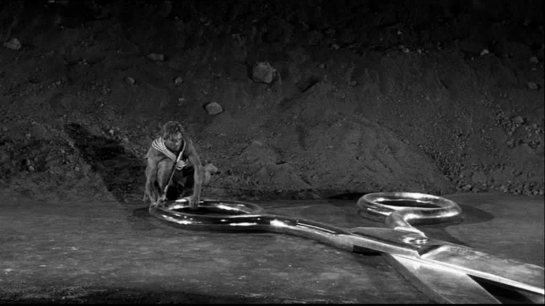
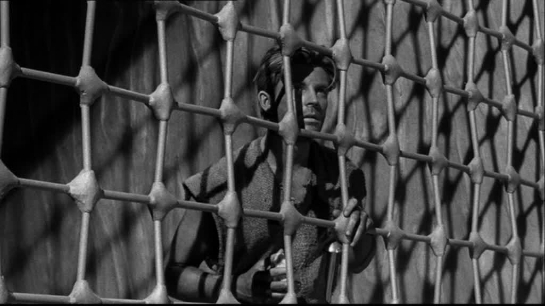
All of this is interesting enough and makes for compelling viewing. However, it’s the second half of the picture which bumps it up to a different level and takes it into the realms of the classics. In short, Scott is marooned in the wasteland that is the basement of his own home, presumed dead and threatened by both hunger and the kind of hazards one would merely brush aside normally. Everything comes together beautifully at this stage – the increased use of special effects, the tension and adventure arising from the new situation, and the spiritual and philosophical epiphany which Scott ultimately experiences. It’s this combination that so successfully draws one as a viewer, the excitement acting as the initial hook while the feeling and humanity which underpins it all reels one in.

The Incredible Shrinking Man is really a journey in search of oneself and, in the course of this quest, becomes a journey into the self. It’s all a matter of perception, ultimately; Scott starts out as man who defines himself in relation to the way the world around him perceives him. As he becomes physically smaller, so his sense of worth and vitality (even virility when it comes to his marriage) are diminished. There’s an intensifying frustration as he feels himself becoming less significant, transformed into a curiosity at best. But the moment he moves from the world he has known into the now nightmarish frontier that his own basement has become another change begins to take place. Forced to fall back on his own inventiveness and innate sense of survival, he comes to regard himself in a very different light. This is the point where Arnold’s directorial skills and Matheson’s writing make themselves most apparent – Scott’s battle to overcome the obstacles that nature has cast into his path restores his faith, and by extension ours too. There’s a sudden realization that the terms by which he had previously defined himself were wrong, or at least too rigid to be true. It all builds to that marvelous revelation that the smaller he becomes, the less it actually matters; in the grand scheme of things he continues to exist and influence whatever little corner of the universe he occupies, therefore his significance is not less just different.

Normally, I like to talk about the contributions of the various performers involved in a film. However, this time I’m going to confine myself to Grant Williams. He’s certainly not the only one in the movie but it’s his show for the most part and the focus is increasingly on him as the story develops. In a way, that structure mirrors the message of the tale – the character’s importance growing as his physical stature declines. Acting in any film which is heavily dependent on effects requires a fair bit of skill on the part of the performers as they often don’t have the visual markers to interact with. Williams had to deal with that aspect all the way through and in the latter stages it becomes all the more pronounced. I think it’s also worth noting that in addition to the relative lack of other performers to relate to, he had to contend with a role which was physically quite demanding.

The Incredible Shrinking Man has been issued on Blu-ray by Koch in Germany but I have only seen (impressive looking) screen captures of that disc. As it happens, I have two DVD versions of the movie: the stand alone  UK disc and the US one which is part of a large Sci-Fi set. There’s not a huge difference between those editions and the film looks generally fine, and is presented in its correct widescreen ratio. The classic era of Sci-Fi movies saw some schlock produced as well as some intelligent classics. The Incredible Shrinking Man is definitely one of the more intelligent entries – it’s also a moving and spiritually uplifting piece of work, perfectly encapsulated by Grant Williams’ closing monologue:

I was continuing to shrink, to become… what? The infinitesimal? What was I? Still a human being? Or was I the man of the future? If there were other bursts of radiation, other clouds drifting across seas and continents, would other beings follow me into this vast new world? So close – the infinitesimal and the infinite. But suddenly, I knew they were really the two ends of the same concept. The unbelievably small and the unbelievably vast eventually meet – like the closing of a gigantic circle. I looked up, as if somehow I would grasp the heavens. The universe, worlds beyond number, God’s silver tapestry spread across the night. And in that moment, I knew the answer to the riddle of the infinite. I had thought in terms of man’s own limited dimension. I had presumed upon nature. That existence begins and ends in man’s conception, not nature’s. And I felt my body dwindling, melting, becoming nothing. My fears melted away. And in their place came acceptance. All this vast majesty of creation, it had to mean something. And then I meant something, too. Yes, smaller than the smallest, I meant something, too. To God, there is no zero. I still exist!

The Big Heat

poster52_zpsuu5u64gu

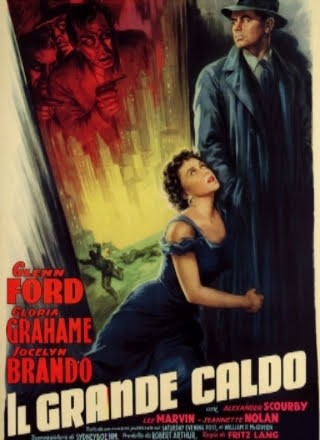
Over the years I’ve spent a fair bit of time talking about film noir, musing over what it is or isn’t and, perhaps inevitably, looking at quite a few borderline cases. I’m still not sure I could articulate exactly what constitutes film noir – although not being able to do so is hardly a big deal – but I do recognize a clear-cut example when I see it. Fritz Lang’s The Big Heat (1953) comfortably fits the bill with its harsh portrayal of a cruel and corrupt world and the merciless way it treats those who would resist it.

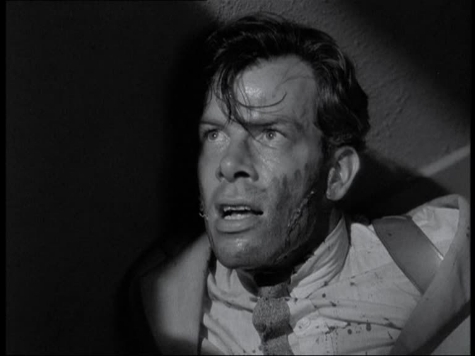
The first thing we see is a man reaching for a revolver and then calmly blowing his brains out as he sits at the desk in his front room. His wife (Jeanette Nolan) is alerted by the gunshot and appears shocked, but not too much and certainly not overcome by grief. If anything, she’s drawn more to the document her late husband left behind. The recently deceased was a cop, a dirty one who had been bought and paid for by the mob, and also smart enough to have retained some insurance. As the investigating officer, Bannion (Glenn Ford), remarks, when a cop takes his own life the department is always interested to find out the reason. Initially, there’s no reason to doubt the widow’s claims that her husband was suffering from ill-health and the case looks to be an open and shut one. Even when a girl in a clip joint makes allegations about a less than satisfactory private life, there’s nothing to prove it’s anything other than talk. It’s only after Bannion starts to get gently warned off that he grows more suspicious. As the underworld flexes its muscles and reveals the violence that has been lurking behind the thinnest of veils the full extent of official corruption becomes apparent. Had Bannion been prepared to play the game, matters would have ended there. However, his persistence, and perhaps recklessness or naivety, brings tragedy right into his own parlor. With the whole fabric of his being torn down around him, Bannion moves himself out to the fringes of society where he allows himself to become consumed with hatred, frustration and an unquenchable desire for vengeance.

£2

I’ve never made any secret of the fact I’m a big fan of Fritz Lang, and I’m especially fond of his Hollywood movies. Towards the end of his time in the US the budgets he operated under seemed to shrink but he always had a talent for economy in his storytelling anyway. The Big Heat exemplifies this neatly in the no-nonsense way it plunges headlong into the tale from the very first shot. The whole movie is a lean affair, pared down to its essentials visually, thematically and in terms of dialogue too. There’s no waste – not a word nor a gesture appears which doesn’t serve to drive the narrative on. Even the central idea (that of institutional corruption, an increasing staple of 50s film noir) is addressed in direct, matter-of-fact terms.

One of the most interesting aspects, for me at least, was the contrasting portrayal of family life on view. We’re introduced to Bannion’s domestic setup early on and it’s an attractive one, defined by the affection and banter between the detective and his wife (Jocelyn Brando) and the simple yet wholesome way they’re living. Later, when we’re introduced to the chief mobster, Lagana (Alexander Scourby), it’s a very different world which is presented. Where Bannion’s home is a relaxed place filled with informal conversation, Lagana’s mansion feels like a mausoleum of respectability, a soulless place where no hint of “dirty” talk is tolerated.

The other notable point to be made about The Big Heat is the frank way that violence is depicted. There’s real brutality in the actions of the mob and its principal enforcer (Lee Marvin), a sadistic pleasure derived from the infliction of pain and suffering. The film came along quite early in Marvin’s career and gave him the kind of role that was something of a gift for a young actor. In another of those instances of mirroring Ford’s honest cop is driven right to the brink of sanity and morality – he comes to embrace violence with almost the same gusto as Marvin’s sociopath. The crucial difference here though is that Ford draws himself back before he fully succumbs to his basest instincts. Actually, it’s a very solid part for him, requiring him to exercise a fair bit of range as his character travels along the painful arc from contented family man, through heartbreak and loss, to cold avenger. He’s partially saved or redeemed by his own innate decency, but an even more significant influence is provided by Gloria Grahame’s unfortunate moll. It’s her actions and what happens to her that breaks everything wide open, giving Ford his first real leads and also reawakening his ability to identify and empathize with people again. Ultimately, while The Big Heat is a film which sees very bad things happen to people, its message is a positive one about human nature. Sure society has its share of rottenness and violence may be lurking just round the corner, but decent people remain so at heart and there are always those willing to lay it on the line to help others.

£3

There was a time when it was difficult to see all of Fritz Lang’s films, although that’s no longer the case. Even back in the days when one had to search around for his stuff The Big Heat was one of the more accessible titles – I think it may actually have been one of the first films by the director I ever saw, at a time when his name wouldn’t have registered with me. Now there are a variety of DVDs and Blu-rays available from different territories so there should be no problem finding a suitable copy of the movie to view. I would imagine that most people with even a passing acquaintance with Lang will be aware of this film – it’s generally well regarded and the casting probably helps. Needless to say, it’s highly recommended for anyone who has yet to view it.


The Unsuspected

His day of reckoning must come. He is tormented by fear that someday he will make one false move, one slip that will betray him, and when he does, the lightning of justice will strike… the unsuspected.

Melodramatic words spoken over the air by the protagonist, the smooth and cultured host of a crime based radio show. And they’re appropriate too as The Unsuspected (1947) fully embraces the instances of melodrama blended into  the story. In fact, the film is made up of a variety of styles – the visuals are pure film noir while the theme and structure perhaps edge closer to the motifs associated with the Golden Age mystery, with at least a nod to the earlier “Had I but known” school of writing. This mix is a generally satisfying one and it’s only a couple of casting decisions which weaken it overall.

It starts off with a killing, a murder carefully disguised to resemble a suicide. The victim is the secretary of Victor Grandison (Claude Rains), writer, broadcaster and connoisseur of all things fine. While this is the jumping off point, the tale rapidly becomes complicated and twisty – a surprise birthday party for Grandison sees the arrival of a young man, Steve Howard (Michael North), who claims to have married the former’s ward, Matilda Frazier (Joan Caulfield), just before she disappeared. Hard on the heels of that revelation comes the news that Matilda has turned up alive and well, but apparently suffering from some form of amnesia as she has no recall of having married, or even having met, Howard. Still with us? Good, for we’re only getting warmed up; the Grandison household is packed full of dysfunctional types – his niece (Audrey Totter) and her drunken, dissipated husband (Hurd Hatfield) – and is a hotbed of plots, counter-plots, jealousy and greed. By the end, another handful of murders will take place and the masks slip far enough to allow the deceptions to be seen for what they are.

Although I deliberately avoided spoilers in the previous paragraph, the identity of the murderer is shown very early on and so this isn’t what we could refer to as a whodunit. If anything, it’s more akin to an inverted detective story where the focus is on how  the killer will be trapped. That aspect, along with the increasingly tangled web of deceit that is spun, is what tips the movie over into noir territory as opposed to a straight mystery/thriller. Added to all that, of course, are the visuals. The Unsuspected is one of those pictures which is largely set bound, perhaps reducing the realism but also increasing the control the director and photographer (Woody Bredell) have over the look and mood of it all. Warner Brothers films tended to have a very distinct look to their sets, and it’s a very attractive one. The studio also had some top professionals on its books, not least director Michael Curtiz. I sometimes think versatility can be a curse for filmmakers, especially when it comes to assessing their critical worth. Curtiz appears to be a prime example of this phenomenon – even a cursory glance at his credits will reveal the sheer number of high-class films he made over his long career and the range of genres he successfully worked in. That ability to turn his hand to virtually every kind of movie the studio sent his way has somehow worked against him  – he’s a man you cannot easily compartmentalize and thus he’s more difficult to  appraise. Yet his work remains immensely stylish and it could be said that his aesthetic goes a long way towards defining the look and feel of Warner Brothers, his long-term home.

Any time you see Claude Rains’ name in the credits of a film you can be reasonably sure of some entertainment. Even when he was handed small supporting roles he always gave value for money. The Unsuspected sees Rains taking the lead and receiving the lion’s share of screen time, and he’s a joy every time he appears – suave, silky and with that shading of understated menace. He’s well supported by Audrey Totter and Constance Bennett, the former slinking around and exuding a feline allure while the latter gets to deliver some great one-liners and wisecracks. Hurd Hatfield is serviceable enough as the washed up artist while Fred Clark and Jack Lambert are welcome faces as far as I’m concerned. All those are positives – however, there are also some less satisfactory elements which need to be acknowledged. Michael North  and Joan Caulfield make up the romantic pairing at the heart of the movie, the couple for whom the audience is supposed to be rooting. And here we have what is arguably the biggest weakness of the movie; both North and Caulfield come across as incredibly flat and frankly dull and it’s quite tough to really care what happens to either one. Bearing in mind that the complex plotting is built around what should be viewer sympathy for this central couple, the disconnect their performances encourage is problematic.

The Unsuspected is available on DVD in the US as part of the Warner Archive MOD program, and the film was also released in Spain. I have that Spanish edition, which I believe is a port of the US disc. The transfer does have the odd scratch and mark present but it looks quite good overall with nice levels of contrast and detail. Optional Spanish subtitles are offered and there is a 12 page booklet (in Spanish, naturally) included. There’s an awful lot going on in the story but I think everything remains focused in spite of that, and a much bigger issue is the lackluster characterizations in a couple of cases. However, there are enough good performances from others to help gloss over those deficiencies, and Curtiz and Bredell ensure everything looks terrific. I’ve seen comparisons drawn between The Unsuspected and Preminger’s Laura, and I can see where there are some superficial similarities. Still, this movie is a more straightforward affair and doesn’t have the feeling of obsessiveness that characterizes the Preminger film. Sure it has its faults, as I’ve alluded to, but it’s entertaining stuff for all that and worth checking out if you’re not familiar with it.