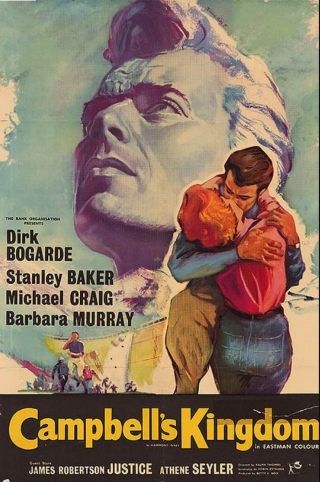
Campbell’s Kingdom

When is it reasonable to call a movie a western? Well the simple answer would be when it’s located within that area typically defined as the American West, essentially the far side of the Mississippi, and inside a relatively short period of time, although the jury is surely out on how rigorously the latter should be applied. Actually, even the geographical aspect is given a bit of leeway too in reality. Plenty of westerns have been set in Mexico and  others have stretched up into Canada too. The action in Campbell’s Kingdom (1957) takes place north of the border in contemporary Alberta so some might like to think of it as a western. Personally, I wouldn’t call it such, I see no need to hang that label on it or to scratch around in an effort to shoehorn it into the genre. It’s a British outdoor adventure, with a seam of intrigue running though it and a hint of romance almost as an afterthought. It’s also a very enjoyable movie with splendid visuals and some well executed sequences that blend action and suspense successfully.

The whole story revolves around Bruce Campbell (Dirk Bogarde), newly arrived from England in the frontier town of Come Lucky. That’s one of those place names that positively drips irony, the kind of small settlement just about hanging onto the ragged coattails of civilization, its economic viability precarious at best. And there’s irony too in the fact Campbell should end up there. If the town has a dubious future, then the lead character is a man with none at all. He’s been given only months to live and has made his way half way round to world to take up the tainted legacy left him by his grandfather. The old man, whose body is only glimpsed in the opening scene, has died an outcast, widely blamed for a swindle that fleeced the town’s inhabitants. I guess no man likes the thought of departing without leaving something positive behind and that was true both of the elder Campbell and the doomed nephew now seeking to make restitution for the past and peace with the present. Campbell’s route to familial redemption is not be a smooth one, the land bequeathed to him by his grandfather was thought to hide reserves of oil but the survey results filed appear to contradict that. Instead of providing a source of wealth that might help the town thrive once more, Campbell’s “kingdom” is due to be flooded subsequent to the construction of a dam. Morgan (Stanley Baker) is the ruthless and pugnacious construction boss who is determined to get the dam up as soon as possible, and Campbell and his kingdom swept aside. The plot basically devolves into a race to prove the existence of an oil field, and thus restore his family’s reputation, before the construction outfit and the mining interests behind it sink the entire endeavor.
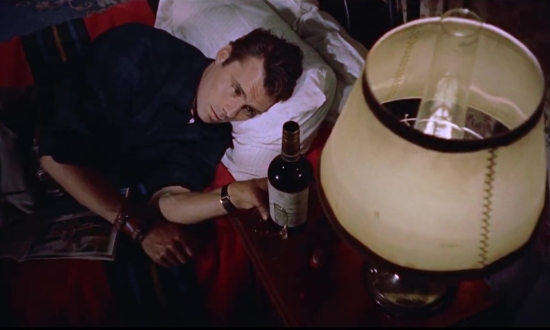
Campbell’s Kingdom is an adaptation of a Hammond Innes novel, the script of which was initially worked on by Eric Ambler,but the final product came via another novelist turned screenwriter Robin Estridge, with the cooperation of Innes himself. Typically, an Innes novel focuses on a lone protagonist, usually some competent, professional type, thrust into an adventure that has a reasonably compelling mystery at its core and that makes use of a potentially threatening natural environment. All of these elements are present in Campbell’s Kingdom, with the doomed hero aspect and the sins/secrets of the past angle exploited quite effectively. The location shooting, Ralph Thomas directing and Ernest Steward handling the cinematography, with the Italian Dolomites standing in for Alberta, has a crisp beauty and integrates seamlessly with the interiors filmed at Pinewood Studios. Thomas might appear a bit of a left-field choice for this type of story, he made a lot of quite light comedies (not least the series of Doctor adaptations of Richard Gordon stories with Dirk Bogarde), but the fact is he was one of those versatile journeymen able to take on almost anything that came his way. He made a few good thrillers in Venetian Bird, Checkpoint,The High Bright Sun and The Clouded Yellow, a slightly pedestrian but not wholly unworthy remake of The 39 Steps, as well as the classic war movie Above Us the Waves and some interesting dramas in The Wind Cannot Read and No Love for Johnnie.  The section where a landslide is triggered and a bridge dynamited to buy enough time for a convoy of trucks to sneak its way up the mountain via a cable hoist is deftly put together and offers some genuine suspense.

I don’t suppose Dirk Bogarde is anyone’s idea of an action hero, but he’s not playing that anyway. His character is a former insurance clerk, and one who has been in poor health to boot. As such, he does fine as the part is written and a few criticisms I have come across, both current and contemporary, questioning his suitability for the role seem churlish as a consequence. He was always better in more introspective moments and there are a smattering of those which allow him to play to his strengths. Stanley Baker has a one-dimensional part as Morgan, lots of drive and bullishness so he can show off that provocative intensity he displayed so well. It never taxes him though and there’s not much shading, but that’s no criticism of the man’s performance. Michael Craig is stoic and reliable as the sidekick – he has the somewhat thankless task of playing a man who loses out in the vaguely insipid love triangle, and doesn’t even get the chance to play a scene venting his frustration. Barbara Murray represents the other side of said triangle and she does have her moments, she’s not relegated to the type of decoration and background hand-wringing which sometimes befalls heroines in action films. The rest of the cast is a virtual Who’s Who of British cinema: Athene Seyler, Sid James, John Laurie, Robert Brown, Finlay Currie and so on. This results in a variety of ersatz accents that sometimes hit the mark. James Robertson Justice has a biggish part as the drilling expert and all the way through he speaks with the oddest Scottish burr I have ever come across – perhaps he was supposed to have some Scandinavian connection?

Campbell’s Kingdom was released on a fabulous looking Blu-ray by Network in the UK before that company folded. It also came out on DVD before that, and I think it’s had a BD release in the US as well. This is one of those movies that has no pretensions whatsoever. It’s not of the thick-eared variety, but nor is it straining to be anything other than a solid adventure. All told, this is an undemanding piece of entertainment with its heart in the right place.

This is a couple of days early – what’s a day or two between friends anyway! – but it’s close enough to the anniversary of my first ever blog post, which was all of seventeen years ago. There have been a fair few movies watched, written up and talked about in that time.
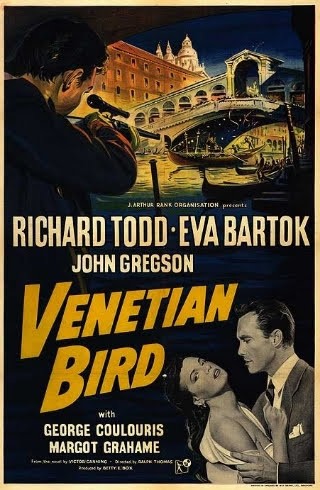
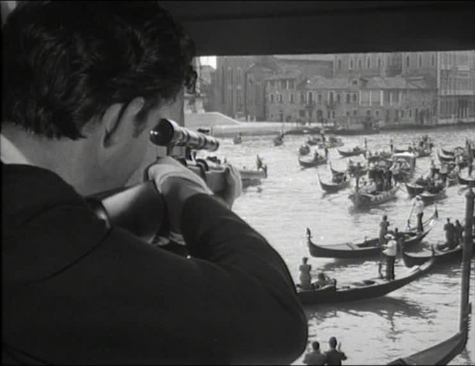
Venetian Bird

Post-war Europe made for an ideal backdrop for tales of intrigue and mystery. Aside from the fact the Cold War was never far from the minds of contemporary audiences, the natural chaos present in a continent still in the process of healing the wounds left by six years of all-out conflict created the conditions and circumstances which lent themselves to the telling of such stories. There are numerous examples of movies exploiting this turbulent and uncertain period, some of which – The Third Man, The Man Between, Diplomatic Courier, The House of the Seven Hawks, Berlin Express – I’ve already featured on this site. Ralph Thomas’ Venetian Bird (1952) is another which fits into this grouping, mixing in the themes of political chicanery and fake identities.

Confusion frequently follows in the aftermath of war; people get lost and people disappear. Many are forgotten, existing only as memories buried beneath the rubble, but not all of them. Edward Mercer (Richard Todd) arrives in Venice in search of a man who seems to have vanished. Mercer is a detective hired by a grateful American who wants to reward an Italian for his bravery during the war. The man he’s seeking is Renzo Uccello, but it’s not just a matter of looking in the phone book. Uccello is an elusive figure, and Mercer’s efforts to track him down draws the interest of others. He’s followed to his initial point of contact and the man he hopes will offer him a lead is first assaulted and later murdered. Thus it’s clear enough that certain parties don’t want the whereabouts of Uccello known. The question of course is why. Uccello isn’t being sought for any crime, quite the opposite. Mercer’s quest means delving into the past and Uccello’s activities with the partisans of the Italian resistance. As he digs deeper he’s encouraged to believe the object of his search has died, but Mercer remains unconvinced. Not only are there clues suggesting Uccello is very much alive, but there are also indications that he’s involved in something dark and criminal. The closer Mercer comes to the truth, the greater the danger as he is gradually pulled into the murky and volatile world of post-war Italian politics. Before long he finds his role switched from that of hunter to hunted. What started off as a routine investigation develops into conspiracy, assassination and a man hunt taking in the alleys, canal and rooftops of Venice.

Films which use political machinations as their basis can flounder under the weight of their own self-importance if they’re not careful. Mercifully, Venetian Bird keeps the political aspect firmly in the background, the motivations and allegiances are blurred and of importance to the characters rather than the audience. Victor Canning’s script, adapted from his own novel, remains focused on Mercer and his search for Uccello. There’s always the sense that powerful men are manipulating the events but the viewers only concern is how this affects the protagonist, not their wider impact. The pace does flag a little here and there, a little trimming of the script wouldn’t have hurt, but director Ralph Thomas and cameraman Ernest Steward create some nice noir-style visuals and draw as much suspense as possible from the tale – the climactic chase across the rooftops is especially well filmed and quite exciting. The location shooting in Venice is a big plus and adds a touch of realism to the pulpy story. The movie is also notable for its score, provided by the highly regarded Nino Rota.

Richard Todd was in the middle of a fairly strong run of movies when he made Venetian Bird – he’d recently come off The Hasty Heart and Stage Fright, and The Dam Busters was still ahead of him. As Mercer he was a solid leading presence, although I’m not sure he really got across the ambiguity of the character – Mercer is referred to as having taken part in certain illicit activities in Italy in earlier times. Still, he was personable enough and handled the physical stuff satisfactorily. Eva Bartok’s biggest Hollywood role was in Robert Siodmak’s The Crimson Pirate, made the same year, but I’m most familiar with her from a handful of British pictures. She had a fairly substantial part in this film as the principal link to Uccello, and does quite well – we’re never 100% sure where her loyalties lie and she managed the internal conflict of the character successfully enough. George Coulouris was always a welcome face in the movies and is good value as the local police chief. The other notable roles are filled, with variable success, by John Gregson and Sid James. You wouldn’t automatically think of either of these men as first choices to play Italians, particularly if you’re familiar with their body of work in British cinema. As such, it’s hard not to be distracted by their presence. In support, there are good turns from Walter Rilla (father of director Wolf Rilla) and Margot Grahame.

Venetian Bird was a Rank production and wasn’t the easiest movie to see for a long time. I used to own a promo DVD which came free with a Greek newspaper some years ago but the transfer was a poor one with a pronounced green hue. It’s recently been released in the UK by Strawberry Media (AKA Spirit) who distribute certain Rank/ITV titles. The disc is a vanilla affair containing just the movie and no extras whatsoever. The print used is in pretty good condition with no serious damage on view. Contrast seems to be set at the right level with nighttime scenes looking suitably inky and atmospheric. It has to be said that this company isn’t always the most reliable when it comes to aspect ratios but that’s obviously not an issue here with a 1952 movie. I’m not going to try making a case that Venetian Bird is a top British thriller but it is a solid and entertaining mid-range effort that’s professionally made. Overall, I think it’s an unpretentious film which flirts round the boundaries of noir. I always enjoy British movies of this period and the location shooting is a nice bonus. While it’s no lost classic, it’s worth checking out and it’s not at all a bad way to pass an hour and a half.

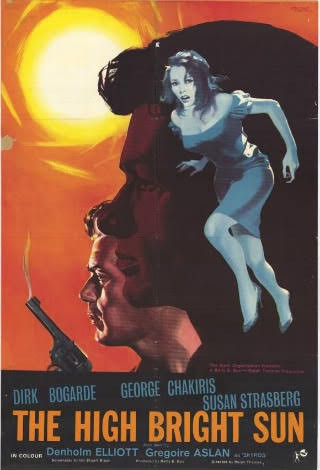
The High Bright Sun

I’m not sure how many movies have been set during the guerilla campaign in Cyprus in the 1950s, but The High Bright Sun (1964) is the only one that I can recall seeing. It’s all too easy for a story which makes use of such a background to become bogged down in politics and thus dilute the drama. However, this film has the good sense to avoid becoming too mired in ideological matters and instead concentrates on telling a suspenseful yarn that could have been relocated to most any conflict zone without losing its edge. As such, we end up with a well paced thriller that builds tension relentlessly and holds the attention right to the end.

The tale is all about finding oneself in the wrong place at the wrong time. Juno Kozani (Susan Strasberg) is a Cypriot-American student visiting the island where her father was born and staying with some old family friends. Having witnessed the aftermath of the fatal ambush of two British soldiers by EOKA guerillas, she is interviewed by an intelligence officer, Major McGuire (Dirk Bogarde). Although Juno can only tell him the few mumbled words of a mortally wounded sergeant, McGuire’s suspicions are aroused. He’s one of those jaded colonial campaigners who has grown accustomed to the guarded silence of the locals, and routinely takes it for granted that details will be withheld. In this case though, Juno has told him all she knows, but he has a hunch that the guerilla leader, Skyros (Gregoire Aslan), was involved. What both he and Juno are unaware of at this stage, however, is that her host is using his flawless respectability to cloak his involvement with the paramilitaries. Following a vaguely unpleasant dinner party attended by a family acquaintance, Haghios (George Chakiris), Juno blunders into the library and sees too much for her own good – a secret visit by Skyros. This is the point at which the story really shifts into gear, with Juno having inadvertently placed herself in a very dicey position. She now has to do her utmost to convince her hosts – and in particular, the hostile and dangerous Haghios –  that she didn’t notice anything untoward. In the meantime, McGuire is playing his hunch that Juno knows more than she can or is willing to say. By the by, it’s decided that Juno represents too great a threat and she finds herself the quarry of the seemingly unstoppable Haghios, first in a hunt across the beautiful countryside, and later holed up and under siege in McGuire’s apartment.

Director Ralph Thomas isn’t best known for his thrillers but he did dabble in the genre, including among his credits the excellent The Clouded Yellow and the unloved remake of The 39 Steps. The lion’s share of his work concentrated on comedies, but he plays down that aspect in The High Bright Sun, and succeeds in producing a tight thriller that draws you in as it goes along. The scene where Juno learns that what she thought was going to be a trip to the airport and safety is really a ploy to see her assassinated by the roadside is nicely shot. It also leads into the chase across the island where Thomas, and cameraman Ernest Steward, gets great value out of the stunning locations – Italy apparently standing in for Cyprus. The script, by Ian Stuart Black and Bryan Forbes, does contain some risible and admittedly clunky dialogue at a few points yet it also maintains its focus throughout and does its best to tell a story rather than descending into political diatribe. If anything it points out the dirty and indiscriminate nature of guerilla warfare, where the innocent often suffer the most at the hands of both combatants.

I thought all the actors turned in nicely measured performances, with Susan Strasberg doing fine as the girl caught out of her depth in a situation that’s spinning out of control. For the most part she underplays, and that’s fine as she’s supposed to be someone who must keep a careful check on her emotions lest she should betray herself. Dirk Bogarde wasn’t overly stretched in this one, though he does bring just the right degree of weary cynicism and self-effacing humour to his role. As the villain of the piece, the fanatical and homicidal Haghios, George Chakiris shows a surprising menace. He really did the coldly determined bit well, only the prospect of indulging in some physical violence bringing a gleam to his eye. There’s also a wonderful supporting part for Denholm Elliott as the apparently dissipated and alcoholic friend of McGuire who proves himself to be both ruthless and resourceful.

The High Bright Sun comes to DVD in the UK via Spirit, who have recently begun distributing a growing number of British titles from the ITV library. On the positive side, the film looks pretty good despite an apparent lack of restoration, without any major damage on view. The colour fares well and does justice to the location photography. The downside is that the movie opens with the credits letterboxed at about 1.66:1 before reverting to 1.33:1 for the remainder of the running time. I think we’re looking at an open matte transfer here, though it might be slightly zoomed too, judging from the extraneous headroom in some shots. This is by no means perfect, but it’s not a totally botched job either – a 1.66:1 movie doesn’t suffer as badly from a compromised aspect ratio as is the case with those composed for wider presentation. The disc is a very basic affair offering no subtitle options and no extra features. I found the film to be a well produced political thriller, with the emphasis on the thrills rather than the politics. It may not be an outstanding piece of work, yet the performances, scripting and direction are all professional and polished. Crucially for a thriller, it does deliver the necessary amount of suspense, tension and excitement. I’d call it a solid piece of entertainment that looks good and doesn’t outstay its welcome. I recommend giving it a chance – it’s certainly worth a look.