Plunder of the Sun

poster104-1

It is notoriously difficult to pin down what exactly constitutes Film Noir. Everybody seems to have their own list of titles that will variously include or omit a number of marginal entries. This 1953 movie would seem a likely candidate since it has a number of noir characteristics. The action, for the most part, takes place in Mexico, the lead is a down on his luck type drawn into intrigue, and the plot bears more than a passing resemblance to The Maltese Falcon. Furthermore, the director (John Farrow) had a fair noir pedigree, having overseen the likes of Where Danger Lives, Night Has a Thousand Eyes, and The Big Clock. So, does it qualify? I’m inclined to think not, but I can’t quite put my finger on the reason. The upbeat ending crossed my mind, but I don’t really buy into the theory that the style of everything gone before can be negated by the last few minutes – that would rule something like The Woman in the Window out of consideration as noir. Well, let’s just say that I don’t feel comfortable calling it noir – maybe someone else can offer a definitive answer.

The story opens in Oaxaca, Mexico and – via flashback and a noirish voice-over narration – takes us to Havana to introduce the main character, Al Colby (Glenn Ford), as a man on the bum and desperate to find the means to pay his debts and get back to the States. His hopes seem to be answered when he’s approached in a bar by a girl (Patricia Medina) in the employ of a crippled collector of artifacts (Francis L. Sullivan). Colby accepts the offer to book passage on a ship bound for Mexico with the aim of smuggling in a small package containing an old parchment. On board he meets the other main players, a spoiled rich girl (Diana Lynn) and a sinister archaeologist (Sean McClory). From there the action moves to Mexico and a treasure hunt ensues. So, there’s a race to possess a fortune, some dubious history, a fat man and a pair of duplicitous females – like I said, it all sounds like a cousin of The Maltese Falcon.

Glenn Ford is always an enjoyable actor to watch and he handles his fairly undemanding part well enough. Irish character actor Sean McClory looks a little startling with bleached blond hair and sunglasses, but his disbarred archaeologist (can an archaeologist be disbarred?), alternating between between charm and menace, is probably the best thing in the movie. Patricia Medina looks exotic and seductive and certainly fares better than the other female star, Diana Lynn, who has little more to do than impersonate Gloria Grahame.

Much of the film was shot on location in and around Oaxaca and makes good use of the ancient Zapotec ruins and pyramids. Paramount put this out on DVD a while back (before they decided to completely ignore their back catalogue) as part of the Batjac line. It looks very good and boasts a fine selection of extras, including a commentary,  featurettes on Sean McClory and the Zapotec locations, trailer etc. Bearing in mind that the movie clocks in at around 80 minutes, it’s a pleasant enough way to pass the time.
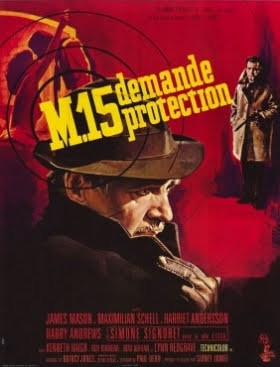
 

The Deadly Affair

poster18_zps6df1ef13

The 1960s were the heyday of the spy thriller with the market flooded in the wake of the success of Bond. Now most of these films fall into two broad categories – the glossy, gadget-laden Helm/Flint kind and the more pessimistic, downbeat Le Carre/Deighton kind. For one reason or another my own preferences lean towards the latter. The Deadly Affair is an adaptation of an early John Le Carre novel, and in no way attempts to glamorize the world of espionage. Instead, it focuses on petty betrayals and the slightly dingy suburban surroundings of the protagonists.

The story, as with many of this type, deals with the investigation of a possible mole in British Intelligence. James Mason plays Charles Dobbs (in the novel it’s George Smiley – I suppose the change of name is understandable enough given how little the character has to smile about here) who is charged with the task of investigating a civil servant. MI5 has received an anonymous letter concerning said civil servant and questions must, therefore, be answered. Dobbs appears satisfied that the letter is nothing more than a hoax, but the apparent suicide of the suspect seems inconsistent. It is the questions raised by this death that drive the rest of the  story along. There is also the secondary plot concerning Dobbs’ tortured domestic life with his nymphomaniac wife (played by Swedish actress Harriet Andersson) and the two strands are woven together successfully enough.

The film was directed by Sidney Lumet and has some nice location work around the vaguely depressing urban and suburban settings. Lumet’s style has never been the most exciting but that fits well enough with the mood – lots of grey skies and rain. Quincy Jones scored the picture and it’s one of the best things about it. The langourous, wistful jazzy music both evokes the mid-60s and reflects the emotional longings of the central characters.

The acting is a mixed bag, with the male characters coming off the best by far. James Mason is excellent and manages to convey the combination of determination, weariness, hopeless romanticism and pathos that the role requires – no mean feat that. To be honest, I don’t think I’ve ever seen Mason give a bad performance on screen and he ranks right up there as one of my favorite actors. There’s good support from Harry Andrews as a tough old retired policeman, and Roy Kinnear excels in a small role as a seedy, bigamous used car dealer. Maximilian Schell is adequate enough playing Dobbs’ old friend and former colleague, but nothing more. The female characters, however, are where the film falls down somewhat. Simone Signoret’s widow is too detached, although that may well be what the part of a concentration camp survivor demanded. The biggest problem, though, is Harriet Andersson. She gives one of the weakest performances I’ve seen in a long time. Given her role, you would have thought that some passion should be on display; but no, she’s ice-cold and blank throughout.

Overall, The Deadly Affair is a satisfying, if unspectacular movie. Currently, it’s available in R2 from Sony in a reasonable 1.85:1 transfer. The disc is a totally bare-bones one – literally. There isn’t even a real menu screen. While I’m grateful that the film is available, it has to be said that the cheap presentation of the disc is quite insulting.