Cowboy

“You’re a dreaming idiot, and that’s the worst kind. You know what the trail is really like? Dust storms all day, cloudbursts all night. A man has got to be a fool to want that kind of life. And all that hogwash about horses! The loyalty of the horse! The intelligence of the horse! The intelligence? You know a horse has a brain just about the size of a walnut. They’re mean, they’re treacherous and they’re stupid. There isn’t a horse born that had enough sense to move away from a hot fire. No sensible man loves a horse. He tolerates the filthy animal only because riding is better than walking…. Pour me a little more whiskey there, will you?”

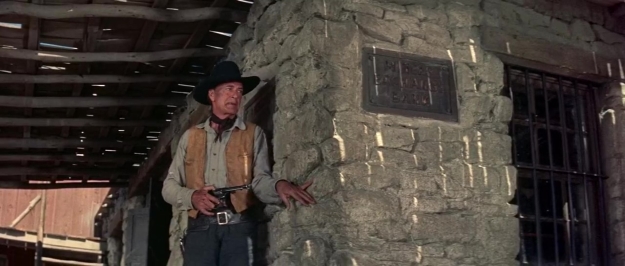
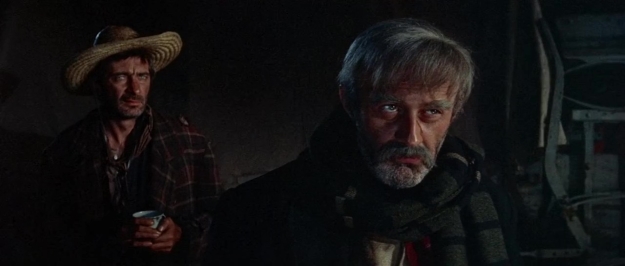
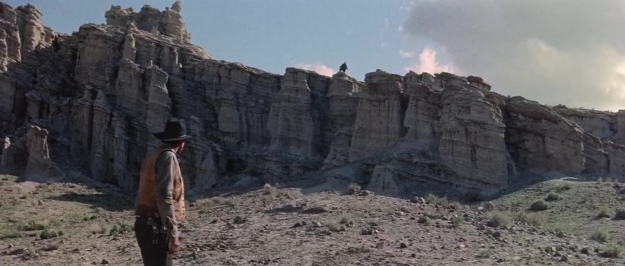
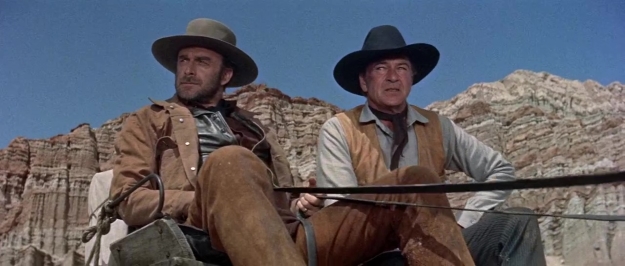
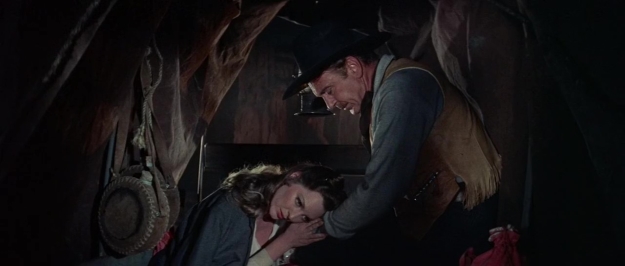
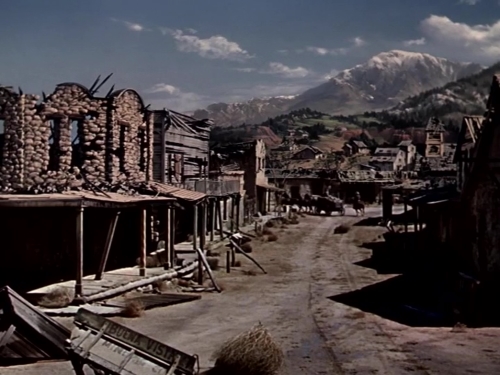
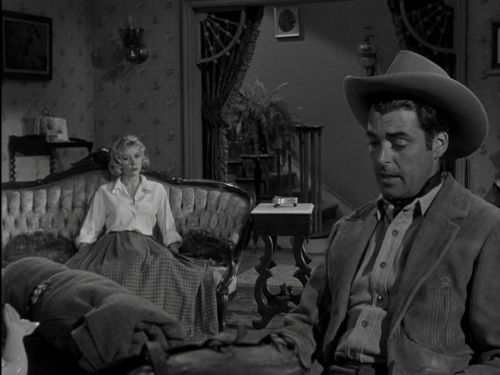
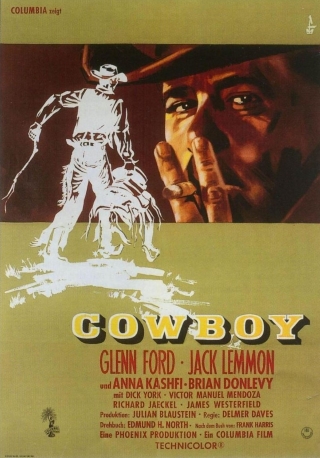
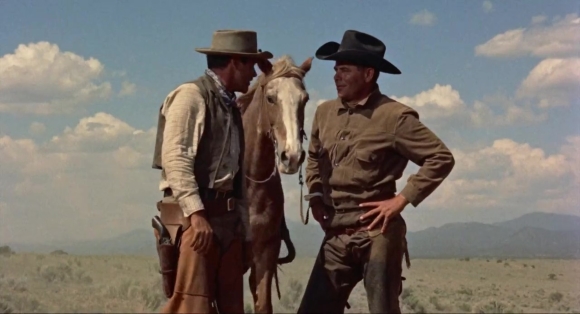
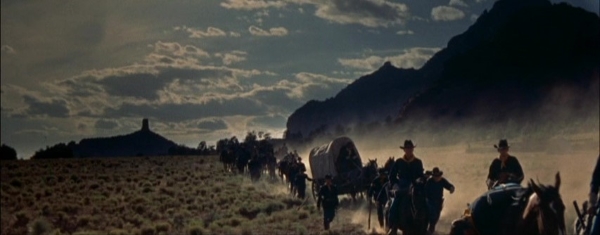
The myth, and how to deconstruct it. Those lines above, quoted by Glenn Ford’s world-weary trail boss as he lies in a hot bath he’s traveled the length of the country for, drinking whiskey from a china cup and shooting cockroaches off the wall, seem to rip the romantic facade away from the genre. We’re looking at a man who is bone tired, more than a little jaded and in no mood to indulge the highfalutin fantasies of Jack Lemmon’s lovesick hotel clerk. Delmer Daves’ Cowboy (1958) therefore creates the impression that the movie is going to dispense with legends and instead print some mean and ugly truths. In a way it does too, at least in the sense that the kind of codology Ford holds forth against gets short shrift, and for long stretches it looks as though the whole thing is building towards a grim revision of the genre. Nevertheless, the deeper myth, that which informs and elevates the western movie is, unsurprisingly, what Daves was searching for and what he skillfully reaffirms by the end.

The structure is classically circular, starting and ending in what what is nominally the same place, creating the impression of a tale turning back on itself but finishing up on a very different level as far as the development of the characters is concerned. The story is seen through the eyes of Frank Harris (Jack Lemmon), an ambitious young man first encountered working in a hotel in Chicago. This is not where he intends to spend the rest of his life though and the fact he has fallen for a young Mexican woman and incurred the displeasure of her father is one of the factor’s influencing his plans. When the expansive and free spending Tom Reese (Glenn Ford) and his rambunctious cowhands book into the establishment, this sets Harris thinking and a run of rotten luck at the card table for the trail boss provides an opportunity worth seizing. In short, Harris makes Reese a loan of his savings to get him out of trouble in return for a partnership on the upcoming cattle drive, one which will conveniently take him all the way to Mexico. What follows is a classic trail story, one beset by difficulties posed not only by the hardships of the terrain and the hazards of the Comanche, but also by those stemming from the personalities and idiosyncrasies of one’s traveling companions. This site often looks at westerns underpinned by the theme of redemption but here it’s not so much that aspect that grounds the film as those near relatives: growth and renewal.

Cowboy is based on an autobiographical work by Frank Harris called My Reminiscences as a Cowboy. Born on the west coast of Ireland in Galway, Harris went on to lead what might reasonably be termed a colorful life, traveling throughout the United States and Europe and earning fame or notoriety (depending as ever on one’s point of view) in the process. He certainly wouldn’t be the first writer who is alleged to have added some embellishment to his experiences so it is hard to say how accurate the source of what is presented on screen is. That notwithstanding, Cowboy, with its script by Edmund H North and and an uncredited and still blacklisted Dalton Trumbo, tells a rattling good yarn with plenty of incident, all of which is predicated on a solid core message.

Every time I come back to a movie directed by Delmer Daves I’m once again struck by his focus on the better aspects of human nature. I see this as the defining characteristic of his work, that simple faith in humanity and its capacity for rising above the petty and the ignoble, and that perspective forms a large part of what draws me back to his films regularly. As was mentioned above, the redemption motif is not present in the movie as it doesn’t feature characters who have wandered down the kinds of paths that require a trip to that destination. What we do get are men who have either lost touch with or have yet to attain a fully rounded appreciation of humanity. So growth and renewal are the dominant themes, which I regard as a welcome detour. Daves was always very much at home shooting outdoors and he makes fine use of the Arizona and New Mexico locations, beautifully photographed by Charles Lawton Jr and with a fine George Duning score to complement the imagery.

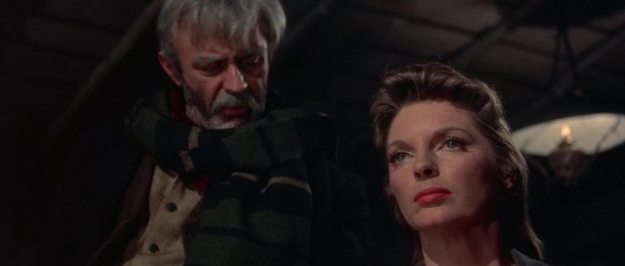
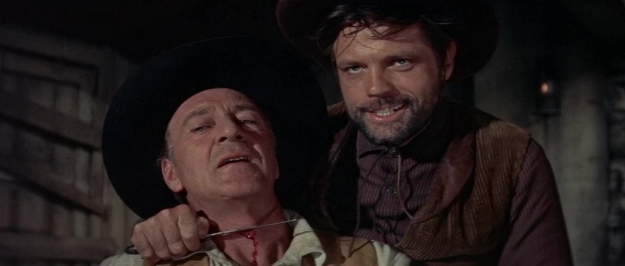
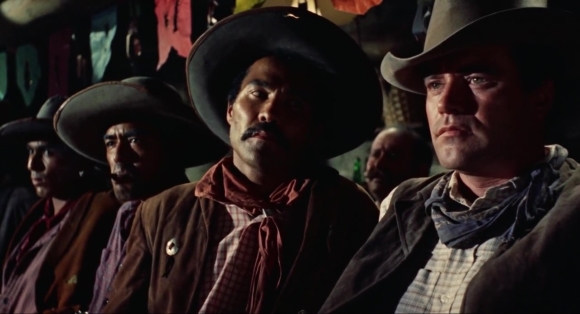
For a long stretch it appears as though the plot is going to chart a hard bitten course, Harris soon has the exuberance knocked out of him by the unforgiving nature of both the environment and his companions. The whole purpose of his trek across the border is shattered in one moment of appalling revelation, a moment which threatens to tip him into a pit of despair and bitterness that is deep and steep sided. Similarly, Reese spends much of his time indulging his cynicism and abrasiveness. To all intents and purposes, that dismissive diatribe quoted at the head of this piece starts to sound more and more like a summation of the myth-busting stall the film has set out. Yet it’s a deceptive impression, for the characters played by Lemmon and Ford respectively learn and grow as a result of their experiences and their effect on each other. Lemmon had a knack for essaying a unique type of passion and enthusiasm that often felt manic and brittle. He comes perilously close to cracking under the strain and the provocations that come his way, but he matures in the process and tempers his excesses in a way that transforms them into strengths. Ford’s destination is slightly different, but just as fulfilling for the character and the viewer too. His path is essentially one of rediscovery and renewal, the bluster and machismo discarded as he witnesses the negativity of his influence mirrored in the meanness that threatens to harden the heart and damn the soul of his youthful partner. In support Brian Donlevy plays it quiet and pensive in a way that he didn’t always get the chance to, a disillusioned gunslinger looking for a different kind of life. There’s something very moving about his ultimate fate, and it proves to be one of the prime catalysts spurring Ford’s epiphany. Anna Kashfi (Marlon Brando’s first wife) is the only woman in a very masculine movie and although her role is important for its impact on Harris in particular, she’s only in the film for a short time. Richard Jaeckel, Dick York, Frank DeKova and Strother Martin are among those who also provide telling little sketches that serve to flesh out the story.

Cowboy is a fine Delmer Daves western, perhaps weakened somewhat by the lack of a more positive female character of the type that bolstered and added depth to his very best movies. Still, there’s much to admire in what we do get, visually, thematically and in the work of the principal cast members.

With this post I have now managed to cover all of the westerns directed by Delmer Daves. He’s a filmmaker whose work I never weary of sampling whatever the genre and his movies have been regularly featured here over the years. Below are links to all of his westerns that I have posted about.

Broken Arrow

Drum Beat

The Last Wagon

Jubal

3:10 to Yuma

The Badlanders

The Hanging Tree

Seven Ways from Sundown

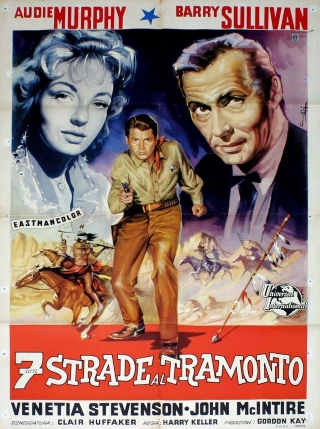
It’s strange the way a modest Universal-International western can somehow encapsulate just about all the most important themes that propelled the genre to greatness in its heyday. Yet, in another way, it’s perhaps also appropriate this should be true of a movie starring Audie Murphy and coming at a point in time close to the end of what can now be regarded as the golden age of the western. Seven Ways from Sundown (1960) weaves threads incorporating such ideas as the gradual taming of the West, Fordian notions of printing the legend, sacrifice, and of course redemption into the fabric of its consistently entertaining sub-90 minute running time.

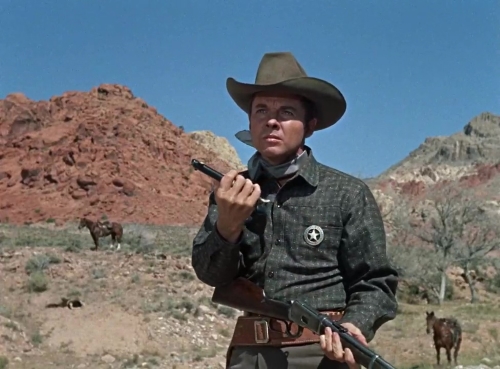
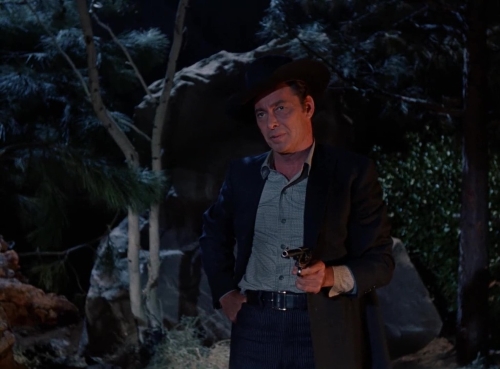
I like it when a movie pitches us right into the action. Seven Ways from Sundown opens with a shootout and the fire that ensues. The man responsible for this mayhem is Jim Flood (Barry Sullivan) and it’s soon established that he’s a man with an impressively fearsome reputation. Riding into the aftermath of Flood’s handiwork and drawing the ire of the exasperated townsfolk is an unsuspecting Texas Ranger rookie with the unique and memorable name of Seven Jones (Audie Murphy) – all the members of his family were unimaginatively named numerically, although his mother apparently tried to add some individual character and color by extending it to Seven Ways from Sundown Jones. His first assignment as a Ranger is to accompany a veteran sergeant, Hennessy (John McIntire), and effect the arrest of Flood. At this point the viewers are let in on a piece of information that Jones is not privy to, namely that Flood killed his elder brother. When Jones later catches up with Flood and sets about the laborious and perilous task of seeing him returned to face justice this hidden fact adds an anticipatory edge to the drama and alters the dynamic of the narrative to an extent. Suspense, guilt and the hint of another mystery are drawn into the story, further enriching it. This fluid, shifting quality is heightened and gains greater significance as we witness Flood’s roguish self-awareness slowly charm the simple and straightforward Jones. All told, it sets up a climax that manages to be at once fitting, affecting and satisfying.

Seven Ways from Sundown has what might be termed an interesting background. It was written by Clair Huffaker (Posse from Hell, Rio Conchos), adapted from his own novel and so has a solid pedigree to start off. A bit of browsing around the internet reveals that the movie was initially directed by George Sherman till an apparently serious row with Audie Murphy lead to Sherman’s departure and his replacement by Harry Keller (Quantez, Six Black Horses, Man Afraid). I’ve not been able to find a source for this though, nor have I managed to ascertain exactly how much of Sherman’s footage (if any) remains in the picture. The arc traced by the story and indeed the ethical journey undertaken by the main characters certainly seem like the kind of material that would have appealed to Sherman and which he would have handled with his customary sensitivity; the short interlude with the hero worshiping youngster, the brief yet still poignant moments spent over the old Ranger’s grave, as well as the low key romance with Venetia Stevenson all feel like the kind of thing Sherman would have relished.

Audie Murphy was doing some terrific work around this time – Posse from Hell, Hell Bent for Leather, The Unforgiven, No Name on the Bullet to name just a few westerns, as well as The Quiet American, every one of which are high quality movies. I would rate Seven Ways from Sundown as belonging up among his best movies, not necessarily due to Murphy’s own performance, which is perfectly fine, but more for the film that is built around it. Murphy plays it fresh and innocent even though he had over a decade’s worth of movies behind him at that point, and the contrast between the mentality and viewpoints of Jones and Flood is indicative of a West that was nearing a turning point. Murphy’s Ranger is open-hearted and honest, brimming with optimism and faith in man’s better nature, whereas Flood’s knowing charm masks if not cynicism then a touch of regret and an awareness that drifts near and flirts with an acknowledgement of the fact that his time is short. By the time this film was made change was in the air, the following decade would see the number of westerns produced drop off and a discernible shift in tone within a few years. Maybe this is not overtly expressed, but hints of it are there should you care to look for them.

Seven Ways from Sundown came out only a few years after Barry Sullivan had taken leading roles in westerns such as Dragoon Wells Massacre and Forty Guns, but it more or less marked the end of his time in such headline parts and he would shortly embark upon a two season run on television playing Pat Garrett in The Tall Man and then drift into supporting/character roles. Perhaps I’m reading too much into it, but I like to think his actions in the last reel represent something of a redemptive sacrifice when he’s confronted with both the impact of his actions and the realization that he’s finally running out of road – this complements and builds naturally on the moment of dreadful guilt that washed over him earlier when he understood that he had taken the life of an old friend. Venetia Stevenson, daughter of John Ford favorite Anna Lee and director Robert Stevenson, is someone I remember most for Day of the Outlaw and the effective low budget horror movie The City of the Dead. She shares a few good moments with Murphy, particularly towards the end when she puts him straight on the danger posed by Flood’s recklessness and then becomes an unwitting catalyst for the tragic yet apt climax. John McIntire could generally be relied upon to provide a touch of class to any movie and he does so here as Flood’s former associate. It’s a quiet performance and quite a touching one.

Seven Ways from Sundown has had a few releases on DVD in various European countries although I don’t think any of them present the movie in its correct widescreen ratio – it ought to be 1.85:1. I’ve certainly never seen it in anything other than open-matte, which while not ideal is at least better than a cropped version. All told, I consider it to be a superior Audie Murphy vehicle buoyed up by an eye-catching turn from Barry Sullivan that contains a generous measure of depth and subtlety.

Drango

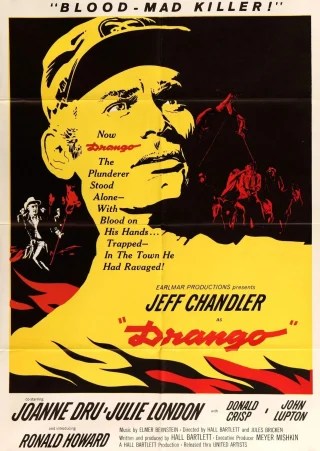
Drango (1957) is a somewhat obscure western that makes for interesting viewing. Taken as a document of the Reconstruction era in the wake of the Civil War, it doesn’t really succeed or at least it’s not especially convincing. On the other hand, it is very effective indeed as an examination of redemption, and in this case atonement. It’s far from the first time I’ve featured a movie driven by that theme as the classic western era is awash with examples. The fact that the film largely succeeds in spite of some of its weaknesses is due in no small part to the work of its star Jeff Chandler.

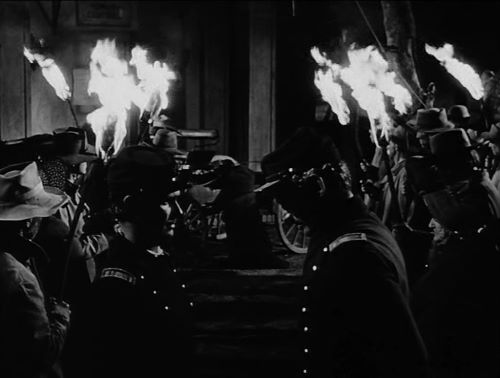
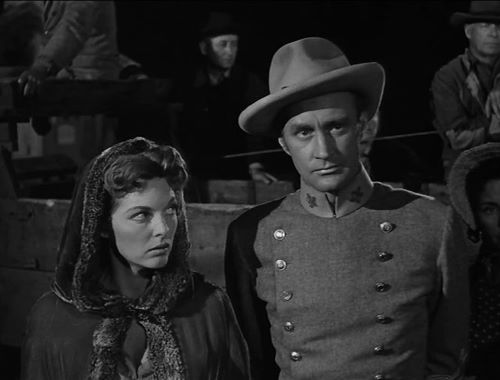
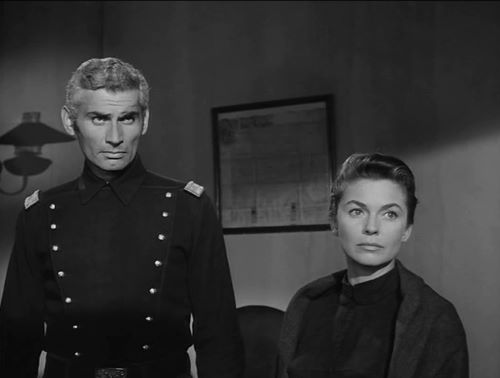
One can practically taste the hostility at the beginning of the film. The implacably  surly expressions of the inhabitants of the small town in Georgia which greet the new military governor give a strong indication of what lies ahead. It’s the post-Civil War period and the old wounds are still raw, old resentments still nurtured. The new governor is Major Drango (Jeff Chandler) and there is a brief, blink and you miss it reference to his past before more immediate concerns take over. Drango’s mission is to get things back to normal as soon as possible, which naturally involves seeing that law and order is restored. This kind of task requires considerable bridge building skills, something Drango sets about practicing as soon as possible. However, he is presented with an obstacle, a settler (Morris Ankrum) on an outlying farm turns up in his rooms hoping to persuade the Major to transport him to the nearest garrison for trial. This man was unsympathetic to the Confederacy and a raid on his property by returning veterans saw a man killed. Not unnaturally, he is dubious about receiving a fair trial in his home town. The rancor of his fellow citizens is tangible during his arraignment and his fears are to be proved correct when he’s subsequently abducted from the jail and lynched in the town square. It’s here that Drango’s guilt is first apparent, not least when faced with the scorn of the dead man’s daughter (Joanne Dru), and as the story progresses it becomes increasingly obvious that this is something he wears like a second skin. What is also clear is the fact that this guilt is rooted in something deeper, although exactly what is only revealed late in the day. In the meantime, he sets about winning hearts and minds, a goal made even more difficult by the subversive plotting of one of the town’s faded gentry (Ronald Howard), a man hell bent on fanning the flames of conflict once more.

Drango was made by Jeff Chandler’s production company Earlmar and he got hold of some fine talent to work on it. Elmer Bernstein wrote the score and those characteristic riffs and hooks he frequently employed can be heard throughout. The cinematography comes courtesy of James Wong Howe and his lighting of interiors and the nighttime scenes is as exemplary as one might expect. Hall Bartlett and Jules Bricken co-direct in a fairly matter-of-fact fashion but the pacing is good. Yet, as I mentioned at the top of this piece, there are weaknesses. If a film wants to be regarded as a serious consideration of the mood and effects of the Reconstruction era, then it’s not unreasonable to expect some reference to slavery. After all, this is set in a town in Georgia and a few of the characters live in the type of mansions to be found on plantations yet there is no mention whatsoever made of this. What’s more, the entire cast contains not one black face, which again strikes me as very odd indeed given the time and location depicted. The result is that there is a degree of artificiality to this image of a post-Civil War town and consequently the whole north-south friction aspect feels a bit fake. The film in essence starts to feel somewhat generic in its portrayal of post-conflict tensions. However, this is basically background material and what rescues the movie is the strong focus on atonement and redemption.

Jeff Chandler was an authoritative presence, a quality which grew as the years passed. He had what is commonly termed gravitas but that alone can make for dull viewing. Chandler’s great strength lay in his ability to convey a certain frailty behind the authority. He has a number of scenes where he gets to boss the situation, glaring down a horde of hungry and desperate townsmen as well as punching out a belligerent, bottle-wielding foe. He also makes a few speeches, which are heartfelt and impassioned but his best moments come in the smaller, quieter passages. The sensitivity of the man is clearly discernible when he has to extract a bullet from a patient who is still conscious, the concentration and reflected pain writ large on his features. Then there’s the potency of a simple and wordless scene where he leaves a few humble presents for a family of orphans on Christmas Day, and of course his carefully controlled outrage as he carries the remains of a youngster who has perished in a deliberate arson attack. All of this is buttressed by the corrosive guilt the man is carrying within – it’s only really when his true past is hauled out in the open that the reasoning which underpins his compassion makes sense.

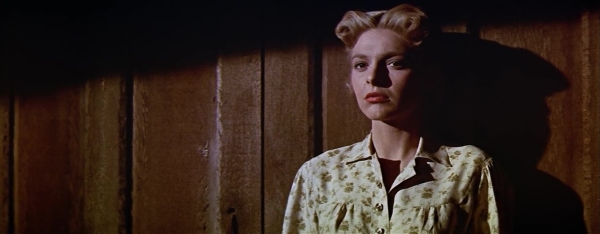
Joanne Dru exudes stoicism as the woman who has lost her father, lost everything in life if truth be told. Her slow drift from bitterness to acceptance and finally love is achieved naturally and organically. Ronald Howard, in his first Hollywood film, provides an object lesson in pride and ruthlessness as the Canute-like figure who yearns for even more bloodshed. Julie London (Saddle the Wind, The Wonderful Country, Man of the West) was always an attractive addition to any cast and while her part here is less developed and less interesting than that of Joanne Dru, she brings an air of class to proceedings whenever she appears. There’s good support from Donald Crisp, Walter Sande, John Lupton, Milburn Stone and the curmudgeonly Chubby Johnson.

Drango is a hard-edged and at times quite dark redemptive western. Maybe it does not do or get everything right, but it’s a movie with its heart in the right place all the same. This is bolstered by a characteristically compassionate performance from Jeff Chandler, an actor who rarely if ever disappoints. As far as availability is concerned, there are DVDs from France and Italy, the latter looking crisp and clean though almost certainly presented open-matte. All told, this is a satisfying western that is well worth a look.

Tall in the Saddle

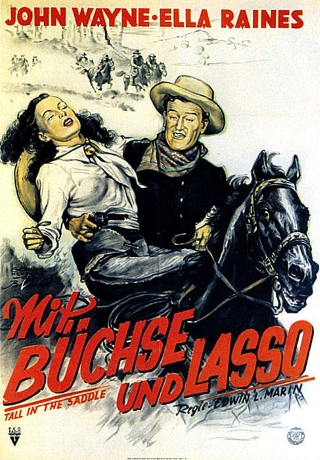
Maybe I should have been an engineer. Or perhaps not. Bridges and links and halfway houses in all their forms hold a fascination for me, just not in the structural sense. If you watch enough movies, patterns emerge and it’s difficult not to think in terms of eras and their associated styles. The western continues to draw me and over the years I’ve developed a deep affection, one might even say a love of the variety that came to fruition during the 1950s. Of course no genre reaches maturity suddenly or spontaneously, nor does it do so in a uniform fashion. It’s a gradual process and a fluid one, advancing and retreating from movie to movie and this is even discernible within individual movies themselves. I think that it was somewhere in the late 1940s, when that post-war sensibility had begun to make itself felt across a whole range of genres, that the western really found its feet. However, the preceding years hint at some of the bridge building that was underway, and a film such as Tall in the Saddle (1944) is of interest in that respect. There is a distinct flavor of the breezier 1930s western to parts of it, and also a hint of what would develop in the years ahead, that latter aspect possibly making itself felt as much in the visuals as anything else. And then there is the evolution of the screen persona of John Wayne to be considered.

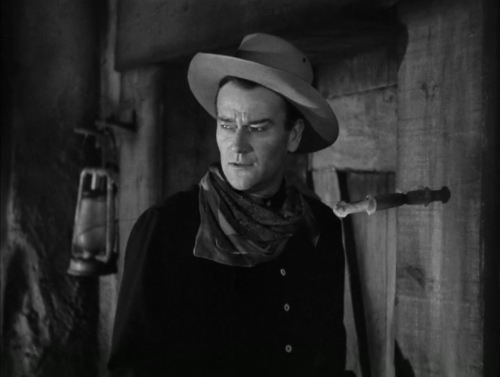
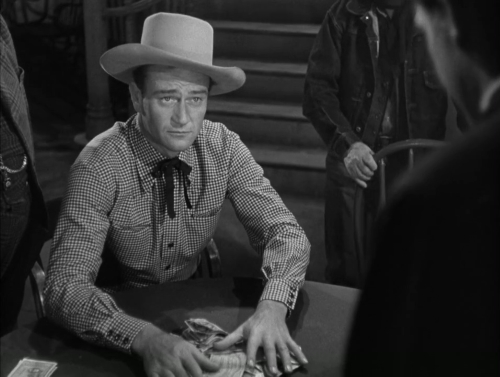
A mystery of one type or another is typically an attractive hook upon which to hang a story and a lead who is himself introduced as something of a mysterious figure is even better. Rocklin (John Wayne) is just that, a man with a surname and nothing more, hitching a ride on a stagecoach and on his way to start afresh. Bit by bit, a little more is revealed about him, but only very gradually and only that which it’s necessary for the viewer to know. This is very much in keeping with the western tradition, a figure striking out towards new frontiers, an identity defined by his actions and behavior in the present rather than any preoccupation with a past that is of no consequence. In a sense, Rocklin (and by extension the man playing him) is a representation of the West, resourceful and independent, forward-looking and unsullied by pettiness or corruption. He seems to fit right in with the ruggedness of his surroundings, simultaneously aware of the dangers and risks yet not intimidated by them. That his journey west has a purpose is never in doubt, but this is slowly revealed and only fully brought to light at the end of the picture. As we go along it’s enough for the viewer to be aware that Rocklin has been deprived of something that he had expected to find, and that he’ll not rest till he finds out who is responsible for this. The man he thought he’d be meeting has been killed and he’s now been cast adrift, the work he thought he’d be doing is no longer so appealing so he ends up accepting a job as foreman for the tomboyish Arly Harolday (Ella Raines).  I don’t want to go into too many plot details here – it’s a fairly convoluted business involving inheritances, land grabs and assorted betrayals – but suffice to say that Rocklin finds himself tangled up in local disputes and as well as one of those romantic triangles where there’s never the slightest doubt how it’s all going to turn out. I guess the point I want to make here is that the tale itself is of less interest or importance than the way it’s told and the people who are involved in the telling.

Edwin L Marin’s credits as director stretched back to the 1930s, but I think Tall in the Saddle marked the beginning of the more interesting phase of his career, one that would be curtailed by his untimely death in 1951. From this point on he would make a series of entertaining westerns with Randolph Scott, as well as a number of crime pictures with George Raft. None of these would be considered classics or anything but they are good movies overall. The script here (by Paul Fix, who also has a memorably sly supporting role) is arguably too busy, albeit with a few good lines, but Marin keeps it all moving along so that it never gets bogged down in the kind of intricacies that aren’t all that engaging. Surprisingly for a western, the interiors are more visually pleasing than the exteriors, which is probably due to the work of cinematographer Robert De Grasse, a man who filmed a string of fine genre pictures in the mid to late 1940s, such as The Body Snatcher, The Clay Pigeon, Follow Me Quietly, Crack-Up and The Window.

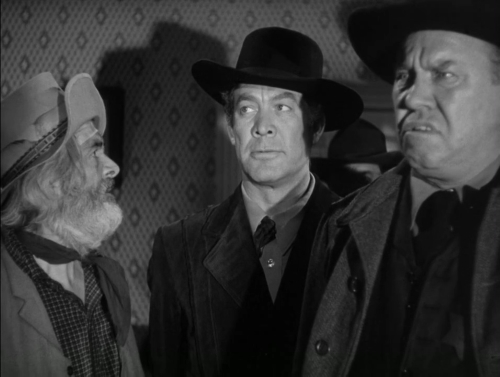
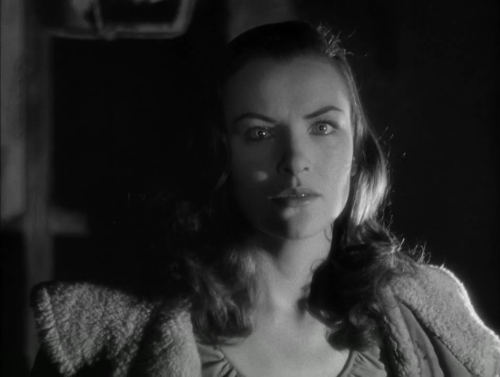
As I mentioned above, Tall in the Saddle comes across as something of a bridging exercise now, not least for the the way it slots into John Wayne’s career path. Both John Ford and Raoul Walsh had begun the process of molding that iconic image, but it would be the late 1940s before his full potential was realized. Still, Wayne’s growing confidence on screen was apparent here – his handling of himself in the action scenes, especially his confrontation of a hapless Russell Wade and the determined way he faces down and pistol whips Harry Woods, is exemplary. What’s more, there is a real spark between Wayne and Ella Raines, her spitfire allure demonstrating how well he responded to being paired off with leading ladies who were capable of giving as good as they got. Ward Bond provides good value too in one of those oily parts he excelled at. Audrey Long is an attractive if slightly ineffectual presence as the other side of the love triangle involving Wayne and Raines. In support Gabby Hayes is his usual self – personally, his shtick is something I can take or leave depending on my mood, but some will be more tolerant. Other familiar faces on display are Russell Simpson, Frank Puglia and George Chandler. A young Ben Johnson is supposed to be in there somewhere too, but I’ve never been able to spot him.

Tall in the Saddle can’t be classed as a great western, or a great John Wayne movie, but it is quite intriguing as a kind of cinematic pathfinder, strongly influenced by the films that preceded it and looking ahead to the riches the genre would unearth in the years to come as well. It’s also an entertaining and enjoyable watch, all of which makes it a worthwhile viewing experience.

The Professionals

La Revolución is like a great love affair. In the beginning, she is a goddess. A holy cause. But, every love affair has a terrible enemy: time. We see her as she is. La Revolución is not a goddess but a whore. She was never pure, never saintly, never perfect. And we run away, find another lover, another cause. Quick, sordid affairs. Lust, but no love. Passion, but no compassion. Without love, without a cause, we are nothing! We stay because we believe. We leave because we are disillusioned. We come back because we are lost. We die because we are committed.

Random musings on the nature of revolution, words which have an attractive feel, a weary patina lying somewhere just the right side of cynicism. That, I think, is the effect they are meant to convey, but therein is their problem, and by extension part of the problem of the movie they appear in. Hearing them spoken by Jack Palance’s wounded rebel and reading them back here leaves me with the impression that they have been crafted for just that, for effect rather than for truth or out of any real conviction. I watched The Professionals (1966) again the other day, a movie I’ve seen  fair few times now, and came away from it thinking it entertaining enough although somewhat lacking in substance. Like so many films by Richard Brooks, it doesn’t do much wrong, doing a lot right in fact, yet never actually amounts to as much as the filmmaker would have us believe.

During the latter half of the Mexican Revolution a group of four men, introduced via brief sketches during the opening credits, are hired by a wealthy businessman to get his kidnapped wife back. That’s the plot of the movie in a nutshell. It’s a simple enough setup, fleshed out by the colorful nature of a some of the leads as well as the dynamic created by their intertwined pasts, and of course the turbulent background of a country riven by internal conflict. The hired hands are led by Rico Fardan (Lee Marvin) a former associate of Pancho Villa, Bill Dolworth (Burt Lancaster) a womanizing rogue with a talent for blowing things up, Ehrengard (Robert Ryan) a diffident wrangler, and Jake (Woody Strode) a tracker and expert with a longbow. Their employer is one J W Grant (Ralph Bellamy), an ageing tycoon married to the much younger Maria (Claudia Cardinale). On the other side is Raza (Jack Palance), one of those bandits with a reputation approaching legendary status. The story is broken into a classic three act structure – the preparation and the journey out, the rescue, and the ride back leading to the denouement. If it sounds a bit formulaic, that’s because it is. There aren’t really too many surprises and the twist that is supposed to grab the viewer comes as more of a shock to the characters on screen.

This probably sounds more negative than I mean it to – the film is (as one would hope from the title) all very professionally shot and put together. It’s amiable and exciting in all the right places, the big set piece assault on Raza’s hacienda is filmed with style, the dialogue is peppered with memorable one-liners, and Conrad Hall photographs the desert locations beautifully. Yet when it all wraps up and the final credits roll, I can’t help feeling I’ve just had the cinematic equivalent of an attractively packaged fast food meal – pleasing and enjoyable while it’s there in front of you, but not something that is going to linger long in the memory when it’s finished.

A film scripted and directed by Richard Brooks (The Last Hunt) from a novel by Frank O’Rourke (The Bravados) inevitably raises expectations given the examples of the author’s and the director’s work cited. I guess that’s why it belongs in my own personal category of movies I like and enjoy even though I don’t believe they warrant an especially high rating. Films such as The Last Hunt and The Bravados stay with you long after they have been viewed, the performances and themes, the images and the very philosophy underpinning them have a way of boring into one’s consciousness and commanding attention. I guess what it comes down to is this – those are movies which touch on greatness, The Professionals is fun.

Lee Marvin and Jack Palance appeared in, by my count, four movies together – in additions to this, there’s Attack, I Died a Thousand Times and Monte Walsh. I feel confident that the latter is by far the best of them, closely followed by Aldrich’s intense study of men in war. The fact is all of the star players, and I’m counting Lancaster, Ryan, Cardinale, Strode and Bellamy here, all made much stronger films, all had roles that stretched them and highlighted their strengths to a greater degree than this. On the other hand, every one of these people are in essence playing types in The Professionals. This is not to say their performances are poor or weak, merely that the way the roles are written allow for next to no development – there are hints of back stories, mentions of experiences that would shape characters, but none of those characters grow over the course of the story. What we see at the start is pretty much the same as what we see at the end.

So, is The Professionals a good movie? The critics seem to have been kind over the years and its reputation remains strong. I like it well enough myself; I’ve watched it a number of times and I’m not in the habit of doing so with films which hold no appeal. Even so, I retain reservations about it, which I think is representative of my attitude to or how I respond to much of Richard Brooks’ work. Parts of his oeuvre hit the mark, have an impact beyond the immediate and provoke me in some way. On the other hand, all too often I find I’m left only half satisfied.

The Last Frontier

“Civilization is creepin’ up on us…”

There’s a similar sentiment, and indeed similar words, expressed at the start of Raoul Walsh’s The Tall Men. Indeed it could be said that variations on this theme run all through the western genre. Can it be said then that the western is at heart an unfolding elegy? One would certainly be justified in applying that label to many of those movies made in the late 1960s and on into the following decade, what have come to be referred to as revisionist works. Yet the roots of that can be found in the classic era, the golden age of the genre in the 50s, when the spirit of celebration, of hope and redemption, were just beginning to be tinged with a hint of regret at the gradual drift away from an ideal. Even the title of Anthony Mann’s The Last Frontier (1955) catches a flavor of that crossing of the Rubicon. Granting that the notion of the Old West as some pastoral idyll was as much myth as reality, it seems fitting that the process which plays out before the viewer is not framed in terms of tragedy, although there are clearly tragic elements woven into it all, but is instead presented as a natural and perhaps desirable step towards the inevitable.

The opening of The Last Frontier presents an image of perfect wilderness, of a land largely untouched by man. Yet we see three men making their through the rocks and trees. This is Jed Cooper (Victor Mature) and his two companions Gus and Mungo (James Whitmore and Pat Hogan), and before long the earth around them seems to take on another form as an encircling band of Sioux rise up from the grass and scrub as though they were children of the soil itself. The thing is both groups, the trappers and the Sioux alike, give the impression of being just another natural extension of their environment. Nevertheless, the trappers are made aware of the fact they have come to represent the intruder, are promptly deprived of their weapons, horses and bearskins and warned to stay clear of the forests. Why? In brief, the arrival of the army and the construction of a fort has altered the way the Sioux now perceive them. Indignant and resigned yet still alive, Cooper makes for the fort in search of some form of compensation for the loss of a year’s worth of hides. What he gets, however, is the offer of employment as a scout under the young acting commander Captain Riordan (Guy Madison). Despite the reservations of his friends, Cooper is beguiled by the thought of a blue tunic with brass buttons and wonders if he might not get to wear one at some point. Thus he begins to fall under the spell of civilization, a feeling further enhanced when he makes the acquaintance (albeit in a drunken and rambunctious state) of Mrs Marston (Anne Bancroft), the wife of the absent senior officer. Colonel Marston (Robert Preston) is at that point on the other side of Red Cloud’s Sioux, which by Cooper’s calculation means he’s probably dead.

As it turns out he’s very much alive and Cooper’s efforts to guide him and what remains of his command back to the safety of the fort earn him little in the way of gratitude. Marston is far from being a well man, psychologically at least. He carries the scars of shame and defeat, haunted by the ghosts of the 1500 souls he led to their graves at Shiloh. The western is full of men in desperate need of redemption, though as often as not the wounds they seek to heal are neither so deep nor so raw as those which afflict Marston. His goal is to excise the pain of defeat through victory over Red Cloud. Unwittingly, Cooper’s growing need to embrace civilization and all he perceives it as offering leaves him pinned at the center of both an emotional and military crisis that Marston is hell bent on engineering. Ultimately, all the elements will be drawn together in a swirling maelstrom of dust and death.

The westerns of Anthony Mann are among the greatest of the classic era. They typically feature driven and obsessive heroes, and of course the concept of redemption is never far from the surface. That sense of redemption, of restoring oneself spiritually, of paying one’s debts and regaining one’s rightful path in life is a powerful one and Mann spent a decade exploring it. In The Last Frontier the character most noticeably driven is Marston, a man who has hounded himself to the brink of sanity and even of humanity. He is not the hero of the piece, though one could say that if he doesn’t quite redeem himself he does get to earn his peace, although it comes at a considerable cost to others. Cooper is the undoubted hero, a crude and unfinished product of nature, one who doesn’t need redemption in the sense of making atonement but rather one who has reached a critical point in life and requires guidance. I guess there’s something ironic in the figure of the pathfinder in the wilderness threshing around at the gates of civilization and needing help to regain his course. Yet that is what happens.

I think that the message of this movie is that no state or situation is to be sought in itself, that the myth of the free and open west is only sustainable and valid if it’s viewed as a stage in a process, an attractive stage in many ways but not a permanent destination. Marston’s relentless drive toward confrontation comes to the only end that it can, and of course history leaves us in no doubt that the staunch resistance to change of Red Cloud was similarly doomed. So what then of the other options? There is a strong feeling that the settler can only go so far till the siren call of civilization drowns out the pull of the untamed land. There is a pivotal moment late on when Mature, having abandoned the fort in the wake of one of those brutal fights so typical of a Mann film, must confront the fact that he can go no further. His journey is going to have to continue along a different path, one which leads back to civilization or whatever form of it he cares to shape for himself. Mungo, the native, is not restrained in the same way and is thus free to proceed on his own trek, one which is expressed in Mann’s characteristic cinematic language as a journey forever upwards, always ascending and always seeking to attain some higher place. Maybe both are heading for the same destination, just taking different routes to get there?

I haven’t given a lot of attention to the performances in this movie, which is a bit of a departure from my usual formula. That’s mainly due to my choosing to focus more on the themes and ideas underpinning the movie, as well as the fact that all of the principals are uniformly excellent. However, I would like to single out some remarkable work from the often maligned Victor Mature – he really gets into the character of the unpolished trapper, investing the part with a passion and raw energy that is wholly convincing as he cannons back and forth between confusion, wonder and enthusiasm. I think it’s a terrific performance. A word too for the cinematography of William C Mellor, where he and Mann fashion a neat juxtaposition of dark and claustrophobic conditions within the (confining, civilizing or both?) walls of the fort and the bright, open airiness of the surrounding landscape. As far as I know, the only Blu-ray release of The Last Frontier is the German edition. It is a good if not great transfer, certainly a step up from the rather indifferent DVD but I must say I’m mystified why this interesting Anthony Mann film remains unreleased in the US or UK with the kind of supplementary material it surely warrants.

As an aside, and for what it’s worth, yesterday marked sixteen years to the day since my first uncertain blog entry.

Drum Beat

The idea that in order to resolve a problem one ought to have first hand knowledge of it appears sound. That’s the theory that Drum Beat (1954) puts forward, that a the best man to negotiate a peace is one who has been intimately involved in the hostilities. It’s a variation of sorts on the notion of setting a thief to catch a thief, only imbued with the kind of latent optimism that characterizes the work of writer and director Delmer Daves. It takes some real events and people from the Modoc War and uses them as the basis for a story that champions the need for rapprochement, hammering home the point that the harder it is to win, the more meaningful it becomes. The movie shares some similarities with Daves’ groundbreaking Broken Arrow, although it’s not as good that earlier film. Nevertheless, all of the director’s westerns are worthwhile in my opinion and even if Drum Beat doesn’t quite measure up to his stronger efforts, that is not to say there is nothing to recommend it.

The movie opens in Washington, in the White House in fact. There’s a marvelous informality to this, something that is hard to conceive of nowadays, as Johnny MacKay (Alan Ladd) simply walks right in and states that he has an appointment to see President Grant. It’s all about a new initiative aimed at bringing the Modoc War to an end. Washington wants to see the conflict resolved through negotiation and diplomacy, and that is where McKay comes in. His brief is to make contact with the Modoc chief Captain Jack (Charles Bronson) and attempt to coax him back to the reservation. MacKay would appear to be an odd choice for the role of peacemaker given his history as a famed Indian fighter, not to mention the fact his family had been slaughtered in an earlier massacre. Yet he’s the one selected and it’s precisely because of his background that he has made the cut. Jack is not the type to be swayed by professional purveyors of platitudes, he too is a man of action and as such more likely to pay heed to someone whose fearsome reputation precedes him. MacKay is of course aware of the magnitude of the challenge facing him and once back on the frontier it quickly becomes apparent to the viewer too. When two antagonistic cultures are living in close proximity then resentment can easily flare into something much more dangerous as a result of pettiness and relatively minor gripes getting out of hand. That proves to be the case as slights and harsh words lead to aggression and then senseless killing, only to be followed up by more tit for tat revenge before exploding into full on warfare. All the while, MacKay has to maintain his own self-discipline and sense of duty, partly as he’s given his word and partly because he gradually realizes that his mission represents the only way out of the impasse.

Drum Beat was the second western for Delmer Daves, following on from Broken Arrow and sharing some common themes, including the quest for some kind of peaceful co-existence between settlers and the native population, and also the idea of interracial relationships. Broken Arrow dealt with both more effectively, perhaps because of the characterizations of Jeff Chandler and Charles Bronson as Cochise and Captain Jack respectively, and also because the leads in both films approached their roles in a different way, but I’ll come to that a little later. Daves would go on to write the script, but did not take on the director’s responsibilities, for the following year’s White Feather and that too is a more satisfying movie all round. While there are aspects of this movie which are less successful, what does work is the director’s eye for a beautiful composition. There are some terrific shots of the Arizona locations on view, the mythic landscape dominating the CinemaScope frame and the frequently minuscule figures within it in a way that recalls Ford.

I’ve read some critiques of the movie that state it presents a far less favorable image of the Modoc than Daves’ previous western. I can see how that impression can be formed and I’ll admit there are some grounds for it, but I’m not convinced it’s entirely accurate. Jack’s faction is shown as reckless, mercurial and belligerent, but that’s as much a reflection of the character of the man as anything. The other side of the coin is presented by Marisa Pavan and Anthony Caruso as the siblings who favor reaching some kind of accommodation. What’s more, the whole point of the story, as I see it at least, is the that the drive for peace between two implacable forces is never going to be an easy process and it’s difficult to convey such a message without emphasizing warlike tendencies. Admittedly, Jack’s Modocs do appear more violent and their grievances receive precious little attention while the inherent prejudice and shortsightedness of the other side is mainly confined to Robert Keith’s hot headed character. What Daves does eschew is piety and self-righteousness. The character of the easterner Dr Thomas is portrayed as pompous, priggish and ultimately ineffectual, while the preacher who attends Jack in his cell at the end is given short shrift.

What then can we say about the actors? Alan Ladd had just made one of the great westerns in Shane and his career was at its peak. For all that, his performance here is decidedly subdued, not just the usual quiet understatement he often brought to the screen, but a calm detachment that seems overdone. I get that his character is a man who has had to rein in his emotional reactions in order to fulfill the mission he’s been handed, but all the provocation, tragedy and bubbling passions that are erupting around him arguably call for a more dynamic response. Charles Bronson fares better in a showy part as the Modoc warlord, strutting and powerful and with a gleam in his eye. It’s an entertaining turn, but there’s not a lot of nuance to it. Daves typically got good results from the female cast members and I think Marisa Pavan in particular comes across well in her selfless devotion to Ladd’s character. I find it pleasing that Pavan (the twin sister of Pier Angeli) is still with us and I hope to feature more of her work here – The Midnight Story is a film I plan to get round to in the (hopefully) not too distant future. Happily, Dubliner Audrey Dalton is another screen veteran who is still going strong. She represented the other point in the romantic triangle alongside Pavan and Ladd, although I don’t feel that whole subplot really plays out in an especially compelling way. That coolness and distance displayed by Ladd does it no favors. As for support, we’re somewhat spoiled with a long list of names drifting in and out including Warner Anderson, Rodolfo Acosta, Elisha Cook Jr, Frank Ferguson, Willis Bouchey, Robert Keith, Isabel Jewell and more.

Drum Beat was impossible to see in its correct ‘Scope ratio  for a long time until it came out via the Warner Archive. I’ve not yet seen a movie by Daves that I dislike, and most of them are films I unreservedly love. However, Drum Beat is a bit disappointing, not least when it is set beside the towering achievements of his other westerns. It looks beautiful in places and it has that intuitive feel for the Old West that one expects. Still, his trademark sensitivity only appears sporadically, not surprisingly most evident in those scenes where his female characters are prominent – Pavan’s sacrifice and its aftermath, the dignity and regard she and Dalton extend to each other, Isabel Jewell’s cameo, and so on. I’d term it a good western for the most part, but only a moderate entry among this director’s credits.

River Lady

Movies that exist at the periphery regularly catch my attention. They may be movies that occupy a place on the margins of a particular genre, they may be transitional efforts that straddle different eras, or they may even be a bit of both. Such is the case with River Lady (1948) a film which is not entirely successful, partly as it’s difficult to pin down the genre – a hint of the western, a dash of riverboat melodrama, and a pinch of the frontier adventure – and partly due to the time it was made. While it might not be the kind of movie that broke new ground or made a strong enough impression to encourage frequent revisits, it is still engaging in the way so many of George Sherman’s titles are.

I’ve lost count of how many westerns have turned a spotlight on the encroachment of civilization on the frontier. Sometimes it’s a matter of the railroad hammering out an iron clad tattoo across the plains and relentlessly shoving the old world to one side. At other times it is the stringing of the telegraph line, or the gradual extension of the reach of the law itself. River Lady concerns itself with the expansion of organized business interests, in particular the conflict between small, independent logging outfits and the hungry syndicates. Nevertheless, corporate kerfuffles of any type have a limited appeal at best and it’s always advisable to bring the human drama and the human faces of the players and antagonists to the fore. So it is that attention is focused on a roughneck logger called Dan Corrigan (Rod Cameron) and Sequin (Yvonne De Carlo), the owner of the titular paddle boat and undisclosed boss of the syndicate which is buying up all the struggling outfits on the river. This allows for a double-edged conflict, both the tangled business affairs and the romantic tug-of-war between a hardheaded free spirit such as Corrigan and the ambitious and manipulative Sequin. And any time the mixture looks like drifting off the boil the silky and stealthy Beauvais (Dan Duryea) is on hand to stoke it up once again.

As has been stated, in terms of genre, there’s a fluidity to the movie that mirrors the flow of the timber down the river. I guess that could be seen as versatility in the script, or even as a determination to resist the imposition of boundaries on the part of the filmmakers. However, it makes it hard to get a handle on the movie, a situation I’ve found can crop up from time to time in mid to late 1940s westerns, where it’s possible to detect elements of breezier B pictures rubbing shoulders with themes that carried a bit more weight. One could even say something similar about George Sherman’s career trajectory itself at this point. The rights to the story drifted around Universal for many years before the movie was finally made and perhaps this fairly lengthy gestation period has something to do with the feeling that the finished product imparts.

Rod Cameron is third billed but has the leading role. He provides a strong physical presence, although he does end up on the receiving end of a terrific beating meted out by Duryea at one stage. His acting is adequate overall, but the way his character is written is problematic. I think it’s clear enough that the intention is for a redemptive arc to be traced, which is fine as far as it goes. The thing is though that, as written, Corrigan isn’t really a likeable figure for much of the film’s running time. He’s not just a man who is on a learning curve, he’s downright unpleasant to the women in his life and comes across as spoiled and petulant instead of grittily independent. Duryea, as the villain of the piece, actually brings more nuance and therefore more interest to his part. I suppose it comes down to the fact that Duryea, even when we was showboating shamelessly or backstabbing with the worst of them, had a soulful air about him. Top billing went to Yvonne De Carlo but she is off screen for far too long and her role ends up largely undeveloped. Helena Carter is her romantic rival for Cameron’s affections and actually gets the more rewarding part. In support, John McIntire, Florence Bates and Jack Lambert all have their moments.

As a Technicolor production, River Lady might be expected to look better than it does. I have a German DVD that is acceptable all told, but there is a certain muddiness to it too. Perhaps the fact the movie is part of a George Sherman box that has it packaged alongside solid Blu-ray versions of The Last of the Fast Guns and Red Canyon serves to draw attention to its weaknesses.

Viewing notes – in brief

Just a few very brief comments to ensure the place doesn’t stagnate completely, which I’ve posted elsewhere, all on some movies I’ve been revisiting lately. Normal service should be resumed soon. I hope.


The Magnificent Seven (1960)

God knows how many times I’ve seen this over the years. Even so, as soon as Bernstein’s famous score kicks in there’s that same tingle of excitement and anticipation I first experienced as a child. Even though John Sturges is almost certainly best remembered for his longer movies such as this and The Great Escape, I think he did his most effective work on the shorter and more tightly structured films he made in the previous decade. While the first half of this one has some terrific scenes and moments – Calvera’s initial appearance, the ride up to Boot Hill and back etc – there is padding there too.
Something else I’ve become aware of over time is the way Steve McQueen’s “look at me” performance has lost a lot of its appeal. I find it very self-conscious, mannered and less satisfying every time I see it. On the other hand, Brynner’s work stands up well while Bronson is crafty, subtle and quite affecting.


The 39 Steps (1935)

Donald Spoto reckoned this movie improved with age and familiarity and I fully agree. It’s the best version of Buchan’s story (not the most faithful by any means, but that’s neither here nor there) and I consider it the best of Hitchcock’s British movies. The Lady Vanishes might run it close, but it’s the little moments, what John Ford would refer to as grace notes, such as Peggy Ashcroft’s aching wistfulness or Lucie Mannheim’s doomed spy that elevate it.


The Wrong Man (1956)

More Hitchcock and this time a man trapped in the relentless and merciless machine that is the justice system. I’ve a hunch I only saw this film once before, and that was a very long time ago. In some ways it is atypical Hitchcock, stylistically anyway – measured, sober, with a gritty realism. In another sense, thematically, it’s very characteristic with the title itself telling us that and it’s also very Catholic, even more so than I Confess.

My memory was of a rather harsh and decidedly grim picture and that’s exactly what it is, and it’s possibly the reason why it’s so long since I revisited it. Still, it’s a terrific movie which is held together by two fine, understated performances. Henry Fonda was always an immensely dignified actor, even down to his posture and gait, that quality adding much to his portrayal of a shell-shocked regular guy. Of course the real gut punch comes from what happens to Vera Miles, something which can’t be easy to convey in such a controlled way.

Domino Kid

Domino Kid (1957) is a small movie, the kind of picture that that was relatively inexpensive to make and could be relied on to fill the bottom half of a bill. Somehow, probably due to the wealth of industry experience the people working on such features were able to bring to them, these films often managed to be briskly entertaining while at the same time there was a solid core that explored, to a limited extent at least, the themes one would anticipate from a bigger budget, more ambitious production. In this case, the theme that provides the backbone for the story is revenge, the ethical chasm it represents and the hollowness of the reward it promises those who would pursue it.

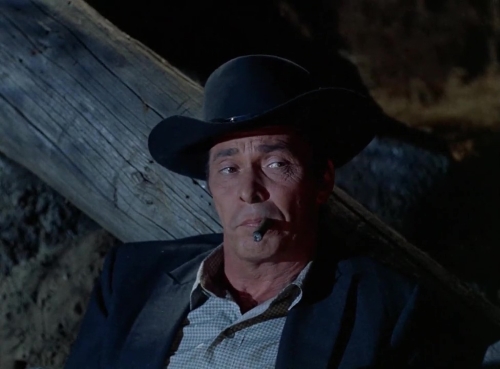
Domino Kid is a sparse movie, never putting more people on screen at any one time than is strictly necessary. And there is an urgency to it too, the opening shot is quite literally a shot, one delivered from one anonymous figure in a saloon bar and fatally received in the belly of another. The very abruptness of this beginning, its unsentimental, businesslike violence is an indication of the mood or tone of the story itself. Domino (Rory Calhoun) is a man with a powerful appetite for revenge. Having returned from the Civil War to find his family dead and his home raided, he lives now to visit retribution on those responsible. The first reel has a whiff of what was to come in the western genre about it: those bleakly deserted streets in mean looking towns, the lone avenger clad in a low profile black and white outfit, chewing on a cheroot and with a manner that is largely taciturn yet still capable of the occasional dry witticism, the succession of cold and calculated killings – isn’t there something suggestive of the early spaghetti westerns to that? Sure I may be reaching here, but the imagery and mood evoked had my mind drifting off in that direction, and of course nothing appears out of the blue in filmmaking, trends and styles evolve and are picked up on and adapted gradually, even from the unlikeliest of sources. Still, this feel doesn’t go much beyond the early scenes. It thereafter develops along more traditional lines, with Domino returning to the town of his birth and youth and realizing his reputation has preceded him, disconcerted to find himself greeted with open suspicion as opposed to open arms.

The story plays out as a personal conflict, Domino’s own struggle with his conscience, at once pulling him towards seemingly irreconcilable poles representing a cold and unnourishing revenge on the one hand and the warmth of acceptance and civilization on the other. The whole business is further complicated by the reemergence of his feelings for old flame Barbara (Kristine Miller), and the hostility he runs foul of in the shape of the newly arrived financier, and rival for Barbara’s affections, Wade Harrington (Andrew Duggan). There are a few unforeseen developments and detours before the end, but the point about the ultimately unpalatable nature of revenge, be it served hot or cold, is clearly and justifiably made.

Rory Calhoun had recently made the excellent Red Sundown with Jack Arnold at Universal-International but was keen to branch out on his own. He formed his own production company Rorvic in partnership with Victor Orsatti, and Domino Kid was one of the movies that came from that venture. The Rorvic productions I have seen, a number of which were directed by Ray Nazarro, were entertaining enough, but I still think they lacked something of what the bigger studio pictures could offer and I feel that a look at The Saga of Hemp Brown, which was made when Calhoun went back to work for Universal-International, highlights that. Nevertheless, Calhoun does put in a good performance in the lead here, blending the positive and negative sides of his character skillfully and endeavoring to present us with a fairly rounded individual.

A few months ago, I watched Kristine Miller playing the leading and pivotal role in Joseph M Newman’s remarkably ethereal war film Jungle Patrol. This movie doesn’t offer her such a memorable part, but she does bring a classy and effective presence to proceedings and Calhoun was obviously impressed enough to have her cast in a couple of episodes of his TV show The Texan. Andrew Duggan has an interesting and quite an ambiguous role as the newcomer who makes little effort to conceal his resentment of Domino. His career would see him cast as all kinds, and he had that ability to essay characters who could leave audiences guessing. James Griffiths turns up very briefly and bows out just as rapidly, but even so it’s never a chore to watch him on screen. Other supporting roles are filled by Yvette Duguay (The People Against O’Hara), the recently deceased Eugene Iglesias , Robert Burton and the hulking Peter Whitney. For a film with such a brief running time, Domino Kid offers opportunities for each one of those performers to make not only an impression, but an important contribution to the development of the story.

To the best of my knowledge, Domino Kid has never been released on DVD anywhere – of course, if anyone reading this knows otherwise, I should be delighted to be proved wrong. Fortunately though, it is not hard to track it down online, and it can be viewed in very good quality, from a nice widescreen print that displays little or no damage. To tell the truth, there are still a number of Rory Calhoun movies which have not been released on any form of disc. I’d like to think there’s still a chance to see a few of those gaps plugged, but even if we don’t I am pleased that the majority can be accessed. Domino Kid is, without question, a modest production that doesn’t try to overreach itself or aim too high. In spite of its inherent limitations, it takes a common western theme, indeed one which is very familiar from all types of drama, and uses it well. It’s worth remembering that B movies don’t have to be bad movies, and this is an example of one that is actually rather good.