Wyatt Earp

poster14

“Some people say it didn’t happen that way…..”

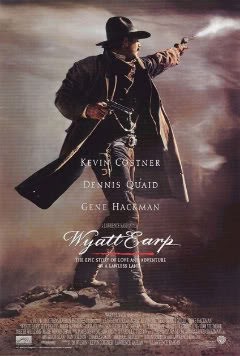
I want to preface this piece by saying that Wyatt Earp is a film for which I’ve never had any particular fondness. However, having said that, I’ve just watched it again after making a conscious decision to try and keep an open mind, and hopefully be as objective as possible. I first saw the film during its initial theatrical run and then later on DVD. I can’t honestly say that I was relishing the prospect of another viewing but I didn’t feel I could round out my series without revisiting this movie. For most film fans any discussion of Wyatt Earp almost always leads to its being compared to Tombstone. Given that both films featured the same lead characters and came out so close together, such comparisons are inevitable but not necessarily fair. While Tombstone focuses on one particular time and place, Wyatt Earp is a sprawling epic that attempts to cover the course of the man’s life. I used to wonder if the fact that I saw Tombstone first colored my opinion in any way, but I don’t now believe that’s the case. I thought Wyatt Earp was a flawed picture on my initial viewing and I still feel the same.

The story begins during the Civil War when Wyatt was helping look after the family farm in Iowa while his older brothers James (David Andrews) and Virgil (Michael Madsen) were off fighting. He is shown attempting to run away to enlist only to be caught and brought back by his father (Gene Hackman). This event, and the subsequent return from war of the brothers, is the cue for some heavy-handed speech making from Hackman. The point of this is to show how Wyatt’s views and attitudes were formed from an early age but I’ve never been keen on this technique for showing character development, it’s always struck me as a lazy way of making a movie. Anyway, having bludgeoned home the point that blood ties are the major motivating force in the young man’s life, the film follows the family on their long trek west to the promised land of California. From there we get snippets of Wyatt’s time as a teamster and how he gained experience in facing down bad men. A fair amount of time is spent on his move to Missouri in order to marry his childhood sweetheart, who succumbs to typhoid soon after the marriage. I found this part of the film dragged a lot although the purpose of its inclusion is to provide an explanation for Wyatt’s later emotional detachment. The pace does pick up when Earp moves to Wichita, Dodge, and ultimately Tombstone, all the while building and expanding his reputation as a fearsome lawman. This is certainly the strongest section of the film and it has to be said that the producers went to great lengths to recreate the look and feel of those wide open frontier towns. It’s also the part of the film that introduces some major characters Doc Holliday (Dennis Quaid), his woman Big Nose Kate (Isabella Rossellini), and Bat and Ed Masterson (Tom Sizemore & Bill Pullman).

Everything builds towards the fateful confrontation with the Cowboys in Tombstone and its aftermath. The O.K. Corral scene is filmed well enough but it just doesn’t carry the punch that such a defining event should; after all, had this not taken place no one would ever have thought to make films about these characters. The resulting vendetta is nowhere near as exciting as it should be and never conveys the sense of the righteous settling of scores that one expects. One major gripe that I had was in the scene showing the climactic gunfight at Iron Springs. Before this the character of Johnny Ringo had barely been mentioned, let alone portrayed. Yet here we have the Earp posse riding into a hail of gunfire, and Doc shouts out the name of Ringo before blasting a faceless man high up in the rocks. If the writers hadn’t wanted to use this character, that’s fair enough – just ignore him. But the way it was handled made me feel that they were sitting around and suddenly realised that here was another name they had to check off the list before things could be wrapped up. In a sense this sums up a serious weakness in the movie, namely the portrayal of the villains. If you’re going to make a big film then you need to ensure that the bad guys are big and bad too. In Wyatt Earp the Cowboys are poorly defined and never provide any real feeling of threat, they’re just a bunch of grubby, unshaven guys who look vaguely mean. Of course I’m aware that this may be closer to the truth but the point is that such realism does not make for a good film. Let’s just say it’s never good news when one of your principal baddies is played by Jeff (straight-to-video) Fahey.

So, for me, the greatest flaws in the movie are the acting and the scale. Costner’s acting style may well be an acquired taste, if so I have yet to acquire it. I could be generous and say that his is a restrained performance but the truth is that he simply comes across as wooden. Every line, no matter what emotion lies behind it, is delivered in the same careful, measured tone. Even if this is true to the character it makes it impossible for the viewer to connect in any way. Dennis Quaid’s Doc Holliday definitely comes off the best but, again, it’s hardly an endearing performance. The real man may not have been a charming figure, but Quaid gives us an irritable and irritating jerk that even Wyatt Earp would have had a hard time considering a friend. There’s also something forced about his interpretation; he certainly looked the picture of bad health but I always had the sense that I was watching an actor in a role, not a real person. The support cast are largely disappointing but the best of the bunch is probably Bill Pullman as the ‘affable’ Ed Masterson. Michael Madsen’s Virgil Earp is generally colorless, but then I’ve always thought that Madsen is a rather limited actor who’s nowhere near as tough as he’d like to think. In general, the cast is filled up with too many nobodies and TV actors, which means too many flat and lifeless performances.

As I said, the scale of the film is another problem – and one that seems to dog many of Costner’s projects. In brief, it’s too long and tries to pack in too much. By attempting to chart the life of this man the film has both too much detail and too little. This results in characters coming and going without the audience getting the chance to know them in any way. Having said that, it does look good and there are some beautifully composed shots of the western landscape. Also, James Newton Howard’s score has that soaring, epic feel to it. Ultimately, though, the film disappointed me and left me feeling as cold as the Alaskan landscape in the final shot.

Wyatt Earp is on DVD from Warner in R1 and R2 in its theatrical cut. As far as I know, the extended cut has never been available on DVD – in a sense I’m grateful for that since I’m of the opinion that a few more trims wouldn’t have hurt this one. I know some may see this as a bit of a hatchet job, but I have tried to give my own honest assessment of the movie and what I feel are its flaws. I hope my efforts at articulating my views make some sort of sense.

So, one month and eight films later, I have come to the end of my series of reviews of the Wyatt Earp movies. I have to say it has been enjoyable for me to go through them all back to back, and I can only hope the readers of this blog haven’t been bored witless by it. What I have noticed most in this lengthy perusal, apart from the increasing focus on realism, is how the character of Wyatt Earp evolved – from the generic and uncomplicated western hero of Randolph Scott, to the taciturn and unsympathetic professional of Kevin Costner. Each characterization added a little more depth to the legend and simultaneously stripped away a little of the myth to reveal more of the darkness inside. I still feel that, despite all the inaccuracies, My Darling Clementine is the best of all the films. I would rank Tombstone as the most entertaining and arguably the most accessible. Unfortunately, I would have to place Wyatt Earp far down the list, maybe even at the bottom – it was just too ambitious and ultimately unable to deliver all that it promised.


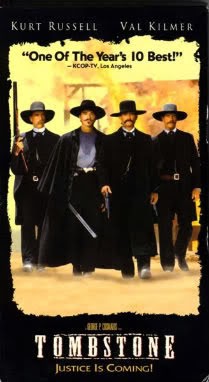
Tombstone

poster9

No. Make no mistake; it’s not revenge he’s after…it’s a reckoning.

Is Tombstone the best western of recent years? Perhaps not, but it must surely rank as one of the most entertaining. Eastwood’s Unforgiven may have more things to say, it’s themes may run deeper, but despite its undeniable quality it is nowhere near as much fun as Tombstone. When one sets about telling a story that has already been committed to celluloid as many times as this one has, it’s no mean feat to produce something which avoids staleness. The trick was to make a film that stayed closer to the historical facts than any previous effort, yet compress it and ensure that the pacing didn’t suffer. Tombstone manages to maintain this fine balance: the facts are mostly adhered to, but some are altered for dramatic effect and, crucially, the script never allows itself to getbogged down in tedious minutiae.

The title of the film makes it plain that it’s going to deal with the portion of Wyatt Earp’s life spent in the town of Tombstone, and the events surrounding it. Of course references are made to the lives and exploits of the Earps in the years preceding the story but they’re never labored, serving only to clarify the reputation of Wyatt. The opening of the film is a short montage of black and white shots with a voiceover by Robert Mitchum to establish time and place. This little sequence ends with the famous shot from The Great Train Robbery (1903), where a gun is fired straight at the audience. In truth, this is only one of many homages paid to the classic westerns of years gone by, the film is littered with them. From there on, it’s pure blood and thunder stuff as we get our first glimpse of the villains of the piece, the Cowboys, riding into a Mexican pueblo to massacre a wedding party as an act of vengence. The real Cowboys were a band of outlaws who came together from time to time to engage in various criminal acts. The movie, in order to heighten the drama, gives the impression that they were a closely knit group – a sort of western prototype for the mafia. The Earps, on the other hand, are shown to be former lawmen (except the younger Morgan) who have no interest in a confrontation, preferring to spend their time building up their finances via gambling. Some of their less savoury activities, such as their alleged involvement in prostitution, are glossed over, although Ike Clanton (Stephen Lang) frequently refers to them as pimps. They only find themselves drawn into conflict with the Cowboys after the killing of town marshal Fred White (Harry Carey Jnr) forces their hand. As a result, the situation soon deteriorates rapidly, culminating in the gunfight at the O.K. Corral, the Cowboys’ retribution, and Wyatt’s subsequent vendetta.

The centrepiece is undoubtedly the shootout at the O.K. Corral, and this is filmed with much more attention to the real details than ever before. The movie takes pains to show who shot who, when, where and how. Even the dialogue sticks close to what has been recorded, with Wyatt (Kurt Russell) telling Ike to either get to fighting or go (he went) and Doc Holliday (Val Kilmer) delivering the memorable “You’re a daisy if you do” before dispatching Frank McLaury. It’s a well filmed scene which captures not only the spontaneous excitement but also the nervy disorganisation of the event. The aftermath of this was a lot of legal shenanigans before the Cowboys took bloody revenge on the Earps. The movie skips over the legal wrangling completely and condenses the Cowboys’ attack into one night of violence. While this may be taking liberties with the facts, it helps the film immeasurably by ensuring the narrative keeps moving. The greatest divergence from the truth takes place during the depiction of the vendetta. There were nowhere near as many people killed as the movie suggests, although the entertainment value would have been greatly reduced if this had been insisted on. Even so, the film still manages to include some genuine happenings here, such as Wyatt’s shotgun duel with Curly Bill (Powers Boothe) and the stopover at the ranch of Arizona cattleman Henry Hooker (Charlton Heston).

The acting is dominated by Kurt Russell as Wyatt, Val Kilmer as Doc, and Michael Biehn as Johnny Ringo. These three performances are central to the success of the movie and they’re so good it’s hard to imagine anyone else filling the roles. Russell plays Earp as a cold pragmatist driven to action only by family loyalty, and an emotional icicle who’s gradually thawed out by Dana Delany’s slightly goofy but attractive actress. Michael Biehn’s Ringo is a study in madness and evil, alternately killing priests, quoting in latin, and screaming at the Earps that he wants their blood and souls. The real standout, though, is Val Kilmer as the screen’s definitive Doc Holliday. It is unlikely that Kilmer will ever play a better part (he’s certainly done nothing approaching it since) than the doomed lunger. He gets all the best lines and delivers them with such fatalistic charm that you can’t help liking him. The script also offers him a great exit; if that deathbed scene doesn’t bring a tear to your eye then you’ve obviously mislaid your heart somewhere. It’s nice to see a nod to the classic westerns with the casting of Harry Carey Jnr and Charlton Heston, and Robert Mitchum’s narration – Mitchum was to have played Old Man Clanton but a back injury on the first day of filming put paid to that. A few other references to the movies of the past come with Dana Delany singing Red River Valley (one of John Ford’s favorites) and Russell channelling the spirit of Henry Fonda as he reclines on the boardwalk with his heels on the hitching post before marching off to the O.K. Corral and immortality.

The only DVD of this film worth owning is the R1 Director’s Cut. The anamorphic scope transfer is generally good, though there is visible edge enhancement. The 2-disc set has a number of extras including a commentary from director George P. Cosmatos and, most importantly, it is the only complete version of the film. The added scenes, while not of huge significance, do help fill in a few gaps in the narrative. Although Tombstone will probably never attain the status of one of the great westerns I still get an enormous kick out of it every time I see it.


Hour of the Gun

Ten years after making Gunfight at the O.K. Corral director John Sturges paid a return visit to Tombstone. Where his earlier film drew to a close with the shootout of the title, Hour of the Gun takes it as the starting point and proceeds from there. Although the 1967 movie is more or less a direct sequel, it is a very different production. Those intervening ten years had seen the western evolve away from a brighter optimism to become something much darker. The Wyatt Earp of Hour of the Gun is far removed from the upstanding representative of justice and honor that had previously been the standard. This is a driven, vengeful man who manipulates the law more than he upholds it.

The first half of the film sticks pretty close to the known facts and it is only towards the end that it drifts off into the realm of fantasy. It opens at the O.K. Corral and is quite accurate in depicting what actually happened; all those involved in the real incident are shown to be there and, for the first time, behave in the way that history has recorded. The story continues with the trial of the Earps and what would come to be known as the Earp vendetta. It is only the ending, where Wyatt and Doc Holliday track down Ike Clanton in Mexico for a final confrontation, that departs radically from the truth. However, aside from greater veracity, the most distinctive feature of this film is the way Wyatt Earp is portrayed. In all the previous versions he was a man whose primary motivation was the service of justice and the badge of office that symbolized it. In Hour of the Gun he starts off in much the same mode, but the attacks on his family bring about a rapid and drastic change. This Wyatt Earp is an anti-heroic figure paying only lip service to the law as he takes advantage of his position to exact a cold and bloody revenge on those he holds responsible for the shootings of his brothers. Although he carries arrest warrants, it becomes increasingly clear to his companions on the posse, and to the viewer, that he has no intention of ever serving them. One by one, the hired gunmen are shot down in what amount to legal executions.

If you’re only familiar with James Garner as the easy-going Jim Rockford, then his work here is a revelation. His Wyatt Earp doesn’t indulge in shy romances or offer fatherly advice to wayward teens – he is instead the angel of death. For the most part he comes across as aloof and unemotional, yet there is a maniacal, almost psychopathic, gleam in his eyes in those scenes where he blasts away his enemies. Jason Robards was frankly too old to play Doc Holliday although he brings a world-weary cynicism to the part that is attractive. The script makes a number of references to his deadly reputation but his main function in the film is to act as the conscience to Earps dark avenger, taking him to task for using the law to his own ends. Robert Ryan was always good value in any film which he graced with his presence, and his Ike Clanton is more of a politically savvy string-puller than an out and out gunslinger. There’s also a small role for Jon Voight (his big screen debut) as Curly Bill Brocius. The direction from Sturges is a solid, professional job and the story moves along at a nice pace. I’ve become very fond of Sturges as a director; he was no groundbreaker or innovator like Ford, Peckinpah or Leone but he almost always turned out strong, quality product. The film also benefits from a fine Jerry Goldsmith score, downbeat and relentless like the story itself.

Hour of the Gun seems to be the Wyatt Earp film that no one remembers, and that’s a pity. I think it’s a little hidden gem of a movie that deserves much more recognition. MGM have had this out on DVD in R1 for a few years now in a mediocre interlaced transfer. It’s recently had a R2 outing in what looks like the same print but this time it seems progressive – at least it runs a lot smoother on my system. All things considered, I’d say this is a worthy addition to the Earp canon and a film that I’m more than happy to have in my collection.

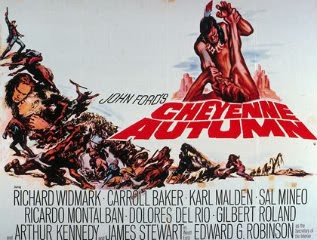
Cheyenne Autumn

poster11-1

John Ford made Cheyenne Autumn in 1964 and with it he bade farewell to the western, the genre with which he was and is most frequently associated. By his own admission, Ford wanted this to be his attempt at setting the record straight with regard to the injustices visited upon the American Indians. Taken as such, it is fairly successful in depicting a people hounded almost to the point of extinction, without indulging in the politically correct schmaltz that more recent Indian centered epics have fallen prey to. Yet it is not a perfect film and does have its faults, not the least of which are the uneven tone and, to a lesser extent, some of the casting decisions.

The story concerns the Cheyenne who, having been moved to a reservation in Oklahoma, were dying a slow death as a result of disease, starvation and neglect. When a promised meeting with a Congressional committee fails to materialise, they take the bold and, in their minds the only viable, decision to strike out on a march back to their tribal homeland in Montana, 1500 miles to the north. Their journey is seen from the perspective of both the Cheyenne chiefs (Gilbert Roland & Ricardo Montalban) and the soldiers (under the command of Richard Widmark) charged with running them to ground. While the film’s sympathy lies with the hunted, the main focus is on the the various soldiers and civilians who pursue or encounter them. This is both a strength and a weakness of the film; a weakness because the characters of the Cheyenne are never explored in any great depth. The strength comes from the way the white characters are represented as holding a whole variety of, often conflicting, views on the fugitives.

The roles of the principal Cheyenne characters are filled by Mexicans (Montalban, Roland & Dolores Del Rio) and an Italian (Sal Mineo). In truth, this doesn’t work out too badly (I’ve never felt that a part can/should only be played by an actor of the same ethnic origin as the character – it’s called ‘acting’ fer chrissakes!) although Sal Mineo is far too much of a wuss to be taken seriously as a fiery Cheyenne warrior. Richard Widmark is good, as always, as the reluctant cavalryman who knows he has a job to do but also knows he doesn’t have to enjoy it. Pat Wayne is quite wooden as a young Lieutenant who experiences a “road to Damascus” type conversion, going from rabid bloodlust to outraged empathy over the course of the story. Karl Malden is a caricature of a Prussian officer whose blind devotion to duty and orders ultimately leads to tragedy. There are also small roles for George O’Brien (a ‘the-only-good-Indian-is-a-dead-Indian’ Major) and Sean McClory (a professional Irishman). Ben Johnson and Harry Carey Jnr appear as cavalrymen and get to show off some mighty impressive horse-riding skills – and there’s a nice running joke where Widmark can never remember that Carey is playing a character called Smith, referring to him variously as Jones, Murphy etc.

£36

Now a word about the Wyatt Earp scene in the movie. To be blunt, I hated it when I first saw it and I still hate it. The whole thing feels wrong, like it was grafted in from another picture. It’s the kind of sequence that wouldn’t be out of place in a ‘Carry On’ film – that bad! We get twenty minutes of Earp (James Stewart) and Doc Holliday (Arthur Kennedy) playing poker in Dodge City and having their game interrupted by the news of the Cheyenne being sighted nearby. There follows a Wacky Races type chase through the desert, culminating in a saloon girl losing her dress and winding up with her legs around Stewarts neck. Laugh, I thought I’d never start. In his biography of Ford, Joe McBride claims that the director used this sequence as a means of highlighting (through satire) the casual racism of the civilian population, but I don’t buy it. That bigotry had already been shown when a trail hand (Ken Curtis) callously murdered and scalped an Indian begging for food. In fact, the power of the aforementioned scene is effectively ruined by the subsequent clowning of Curtis in Dodge. I can’t think what came over Ford but this part of the movie definitely didn’t need to be shot.

Warners put Cheyenne Autumn out on DVD as part of their ‘John Ford Film Collection’. As far as I know it is still only available as part of that set. The transfer is probably the best of all the films in the collection. It’s anamorphic scope with no damage of any consequence and strong true colors. The disc carries a commentary from Joe McBride and a featurette on the film and the historical events that inspired it. Maybe it’s not Ford’s best film but it works well enough for the most part, offering a different perspective from the director yet retaining his trademark visual and narrative touches.

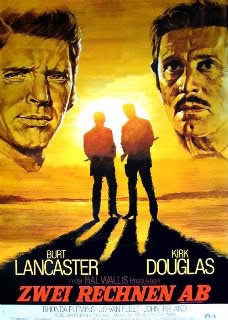
Gunfight at the O.K. Corral

poster8

With Gunfight at the O.K. Corral (1957) John Sturges took his turn at putting Wyatt Earp’s story on the screen. When this film is compared to those which went before, there can be no doubt that it does come closer to the truth. There are more characters represented who actually played a part in the real events, small incidents which have a basis in fact are shown, and a little back story is provided. Having said all that, there are still lots of inaccuracies with names being changed and things not happening as they really did. Still, this is not a documentary, it’s a movie – and a highly polished and entertaining movie at that.

Frankie Laine’s rendition of the title song opens the movie as Wyatt Earp (Burt Lancaster) rides into Fort Griffin, Texas in pursuit of Ike Clanton. During his stay he meets Doc Holliday (Kirk Douglas), whom he subsequently saves from an angry mob intent on lynching him. This places Holliday in his debt and provides the basis for the two men’s friendship. As the film proceeds we see Earp and Holliday cross paths again in Dodge City before moving on to Tombstone, and the famous showdown. The fact that each segment is both punctuated and linked together by the theme song gives the film a slightly episodic feel. Mind you, that’s not a criticism; Laine’s vocals work almost as well as Tex Ritter’s do in High Noon (both of which, coincidentally, were scored by Dimitri Tiomkin). There are romantic sub-plots thrown in for the two leads – the one involving Earp and a lady gambler (Rhonda Fleming) is mostly superflous, while the stormy, abusive relationship between Holliday and Kate (Jo Van Fleet) works better since it does serve to drive the narrative forward.

£38

Gunfight at the O.K. Corral was the second film that Lancaster and Douglas made together and they work well in tandem, each playing nicely off the other. Lancaster’s Wyatt has more of a hard, grim edge to him than was seen in previous incarnations. At one point Holliday tells him, “You know Wyatt, you and I are pretty much alike actually. Both of us live with a gun – the only difference is that badge.” However, Sturges doesn’t explore this side of things too much, and it would be left to later films to point out the fact that Earp’s badge might have been used as a mere convenience. Kirk Douglas’ Doc Holliday follows the usual pattern of presenting him as a tortured and volatile soul, but his self-loathing has a greater pathos than either Romero or Mature brought to the role, and it’s a vast improvement. John Ireland makes his second appearance in an Earp film, playing Johnny Ringo (he was Billy Clanton in My Darling Clementine) and again comes to a sticky end. In fact there are lots of familiar faces: Dennis Hopper, Kenneth Tobey, DeForest Kelley (Star Trek’s ‘Bones’), Lee Van Cleef, Jack Elam etc.

Now a word about those items the movie got right, and those it didn’t. On the plus side we get a full complement of Clantons and McLaurys, Doc’s woman Kate is present, and Bat Masterson appears in Dodge City. Earp and Holliday are shown to meet in Fort Griffin and later in Dodge, where Doc saved Wyatt’s life as he attempted to stop a fight in a saloon. There’s also a brief reference to Old Man Clanton being shot dead as a result of his rustling activities. As for the negatives, James Earp is again falsely portrayed as the youngster of the family whose death is the catalyst for the gunfight – in truth he was the eldest and lived to a ripe old age. Ike Clanton and Johnny Ringo didn’t die at the O.K. Corral, Ringo wasn’t even there. Also, the corrupt County Sheriff has his name changed from Behan to Wilson.

The film is out on DVD from Paramount in R1 in a wonderful looking widescreen transfer. I haven’t seen the R2 to compare but I imagine it uses the same transfer. There is only very minor damage to the print and the colors are strong. Unfortunately, the disc is utterly barebones with not even a trailer present. The lack of supplements aside, this a great example of a 50’s western and one of the better movies about Wyatt Earp.


Winchester 73

Down through the years there have been a number of significant collaborations between directors and actors, such as Ford and Fonda, Ford and Wayne, and Huston and Bogart. In 1950 another such partnership was born, that of Anthony Mann and James Stewart. Their work together was to change the direction of both their careers, and produce some of the best cinema of the decade. Anthony Mann had made his reputation with a series of fine noirs in the last half of the 40s, but he had never done a western. James Stewart’s name had been built on the light leading man roles he excelled in before the war; with the exception of the comedic Destry Rides Again he was another relative stranger to the Old West. However, as a result of the success of Winchester 73 the names of both men would be forever linked to the oldest genre of them all. They went on to make eight films together, five of them westerns.

The story concerns Lin McAdam (Stewart) who arrives in Dodge City on July 4th 1876 and enters a sharpshooting contest presided over by none other than Wyatt Earp (Will Geer), Virgil Earp and Bat Masterson. The contest’s first prize is the famous rifle of the title, and it soon comes down to a run-off between McAdam and Dutch Henry Brown (Stephen McNally). There’s clearly a history of bad blood between the two men, and when McAdam wins it’s not long before Dutch Henry robs him and makes off with the gun. The film then chronicles McAdam’s search for his stolen rifle, and his pursuit of the man who took it. But that’s really only a plot device, a kind of Hitchcockian McGuffin – something of greater significance to the characters than it is to the audience. While the gun is admired, valued and coveted by everyone who comes across it, it is not the sole, nor even the most important reason for McAdam’s dogged quest. This is a dark tale of revenge and the settling of old scores and, despite the dropping of a number of hints, the cause is not stated explicitly until the end.

James Stewart’s pre-war career consisted mainly of Mr Nice Guy roles, while the years following his return found him floundering around in search of a niche. Although It’s a Wonderful Life and Rope offered him roles with a greater complexity, Lin McAdam was a complete departure for him. This part, and subsequent ones with Mann, allowed him to display a cold ruthlessness that the public hadn’t seen before. In addition, he seems so completely at home in the saddle that it’s hard to believe this was his first serious western character. The film boasts a marvellous cast of character actors and up and coming talent: Stephen McNally and Dan Duryea (playing Waco Johnny Dean – lots of exotic character names in this movie) as villains, Shelley Winters as a luckless saloon girl, Millard Mitchell, John McIntire, Jay C. Flippen, and early parts for Tony Curtis and Rock Hudson.

The character of Wyatt Earp is really only incidental to the story here. His appearance is limited to the first twenty minutes or so and doesn’t add much to the narrative. Earp was an assistant marshal in Dodge at around the time the story takes place but the film suggests he was the principal lawman in the city. Will Geer portrays him as a folksy, down home type which seems at odds with the popular conception of the man. When McAdam challenges his authority early on, he fumbles around in his vest pocket for his tin star before almost sheepishly revealing his identity. One would have expected the real Earp to have kicked the upstart’s butt up and down the street.

Winchester 73 is a Universal release on DVD in R1 and R2, and it’s a fine looking disc. Not only is the transfer clean and tight, but there’s one fantastic extra. The film comes with a feature length scene specific commentary by James Stewart. I’m not usually one who gets too excited by extras in general, especially commentaries – but this kind of stuff is cinematic gold dust. Most of the stars of this period were long gone by the time the idea of recording commentaries occurred to anyone, so this is one to be treasured.


My Darling Clementine

poster7

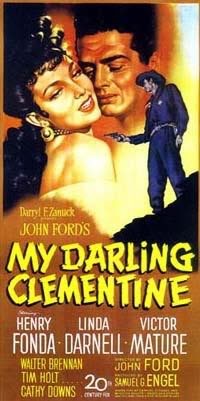
John Ford always maintained that his version of the events at the OK Corral was based on conversations that the director had had with Wyatt Earp himself. While Ford probably did know Earp (the old lawman reputedly spent a lot of time on and around the early Hollywood sets in his later years) and likely talked with him about what happened in Tombstone, the story played out in My Darling Clementine (1946) is most assuredly not the truth. Despite Ford’s grandiose claims of authenticity, his film is really a remake of Dwan’s Frontier Marshal. Both movies were based on the Stuart N. Lake book, and both are highly romanticized accounts. The difference is that, where Dwan’s film is a workmanlike effort, Ford’s take has all those little artistic touches that move it onto another level. Of course Ford was known for spinning the most outrageous yarns when it suited him, but the huge historical errors don’t change the fact that his film is still the best version by far of the famous story.

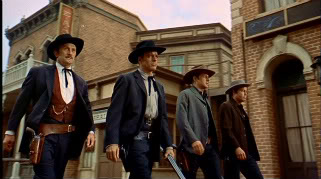
The Earp brothers actually feature in this film unlike the earlier version from Dwan. Wyatt (Henry Fonda), Morgan (Ward Bond), Virgil (Tim Holt) and James (Don Garner) stop off outside of Tombstone while on a cattle drive. On the recommendation of Old Man Clanton (Walter Brennan) they take a trip into town, leaving little brother James to stand watch over the herd. On their return the three older brothers find their cattle have been rustled and James killed. Suspecting the Clantons of perpetrating the crime, Wyatt accepts the position of town marshal. What follows is a picture of the emergence of civilization (most notably represented by the founding of the town’s first church), and the effects it has on the characters.

Wyatt is transformed from a dusty, unshaven trail hand into the coiffed and suit-wearing face of the law and civic respectability. The scene where Wyatt primly escorts Clementine Carter (Cathy Downs) along the main street of Tombstone towards the new church, with the strains of ‘Shall we gather at the river’ playing in the background, is deservedly famous and remains one of the most touching and romantic sequences ever put on film. This contrasts sharply with the Clantons, who are shown as a bunch of barely human barbarians. A marvelously sadistic moment takes place when Old Man Clanton savagely horse whips his sons before berating them : “When you pull a gun, kill a man.” The bridge between the two extremes is provided by Doc Holliday (Victor Mature) – a man with a cultured background (at one point quoting from Hamlet to help out a drunken actor) who is consumed with self loathing at the knowledge of what he has become.

Henry Fonda plays Wyatt with nobility and that quiet dignity that he seemed to bring to all his roles. The self-conscious diffidence he shows fits perfectly for a man who has been more accustomed to living rough in the wilds. It’s no bad thing either that Fonda always seemed comfortable in a western setting, able to mount and sit a horse naturally. I wish I could say the same thing for Victor Mature but, however hard I try, I just cannot accept him in western roles. I’ve seen Mature in many other genre films and thought him fine, but when it comes to westerns – no thanks. I know this is just a personal prejudice but, for me, his casting doesn’t work at all*. Walter Brennan’s Old Man Clanton makes for a wonderful villain, a figure of pure evil who has molded his sons in his own image – especially the leering Billy (John Ireland) and the slow-witted, and vaguely psychotic, Ike (Grant Withers). Linda Darnell’s Chihuahua is something of a caricature of the typical Mexican spitfire, but she does elicit a lot of sympathy as a woman passionately in love with a man who repeatedly spurns her.

Since the bulk of the story takes place in and around Tombstone, Ford makes less use of Monument Valley than he would in other pictures. However, there are a few scenes that feature his favorite location and they look magnificent as always. Much attention is paid to the town, to all the little rituals of frontier life, and the variety of characters who inhabit it. The celebration of community is pure Ford and you get the feeling he enjoyed recreating this much more than he did the action scenes. Having said that, the inevitable shootout at the OK Corral, though wildly inaccurate, is both stylish and excitingly executed.

My Darling Clementine has been available for some time now on DVD from Fox, but has recently been reissued with the addition of Frontier Marshal as an extra. The transfer is exactly the same on the new disc, but that’s not a criticism since there wasn’t much that needed improvement anyway. You get to choose between the final release version of the film and the pre-release cut, and I’m not really sure which I prefer. I feel the edited version is tighter but I also think Ford’s original cut of the farewell scene between Wyatt and Clementine is better. I suppose we should be grateful that we have both versions to compare. Either way, this is a special film and one that does reward repeated viewings.

*EDIT – Sometimes we speak dismissively of hindsight, but sometimes now I look back on pieces I wrote many years ago and see that old adage about the viewers changing but not the movies as gaining in truth all the time. I now feel that I was overcritical of Mature, and quite unfair in my assessment of his performance here,  when I first put this up well over a dozen  years ago.

Frontier Marshal

72efsb7

Wyatt Earp was and is one of the most enduring figures in the mythology of the Old West. I’ve always enjoyed seeing how such people were represented on film, how those representations have evolved over time, and how that evolution reflects changes in the western itself. I’d been planning on running a series of pieces on the various movie incarnations of Wyatt Earp – so here goes. I’m going to look at as many of the screen portrayals of the man as possible; both those that have the famous lawman as the main character, and those that only feature him incidentally. I don’t say that this will be an exhaustive list but it will deal with all the major films chronologically.

1939 was something of a defining year for the western, a turning point – the year the genre started to grow up. After the box office failure of The Big Trail (1930) the western found itself relegated to B movie status. Studios were unwilling to lavish money on what they saw as a bad risk, and so the western would languish on the bottom half of the bill for the remainder of the decade. 1939 was to change all that. John Ford’s Stagecoach, De Mille’s Union Pacific, and Henry King’s Jesse James showed that there was still gold to be found in ‘them thar hills’, and the western returned to A list respectability. Along with those illustrious titles came Allan Dwan’s Frontier Marshal.

I suppose I should start by saying that if you’re one of those who are sticklers for historical accuracy, then this is not the film for you. This adaptation of Stuart N. Lake’s book has a character called Wyatt Earp, who was a lawman in Tombstone – and that’s about as close to the real facts as it gets. In fact, the movie might just as well have been about any marshal in any burgeoning frontier town. There’s a nice little montage sequence at the beginning that establishes the birth and growth of Tombstone, before introducing Earp (Randolph Scott). It’s made abundantly clear that Tombstone is a wide open town where pretty much anything goes. Earp finds himself reluctantly roped into the job of marshal and, by extension, into conflict with the town’s less savoury elements – outlaw Curly Bill Brocius (Joe Sawyer) and his saloon-keeping ally Ben Carter (John Carradine). He also meets the notorious gunslinger Doc Holliday (Cesar Romero), although for some unfathomable reason the script chooses to refer to him as ‘Halliday’. Together, the two heroes take on the might of the criminals in an effort to bring law and order to the streets of Tombstone, culminating in the legendary gunfight at the OK Corral. This scene is pure fantasy since the only relationship to the truth here is that it involves Wyatt Earp and has some people getting shot.

Randolph Scott plays Earp as an arrow straight hero. It’s not a bad performance and more or less par for the course for the era. In later years, Scott would show his ability to play much more complex characters but he was rarely given the opportunity to do so at this stage in his career. Cesar Romero is surprisingly good as the guilt-ridden Doc, though it has to be said that the part has afforded the chance to shine to every actor who ever played the role. The outlaws are portrayed as the standard cardboard cutout villains, although John Carradine always lends a touch of class to any part. Some time I must do a count of how many films I own that feature Carradine, for he seems to turn up everywhere. And while I’m talking about ubiquitous actors, there are parts also for Ward Bond and Lon Chaney Jr. Binnie Barnes is the tough saloon singer in love with Doc, and competes for his affections with the more refined Nancy Kelly. One other interesting piece of casting has Eddie Foy Jr playing his own father, who was supposed to have been performing in Tombstone when the gunfight at the OK Corral took place.

Generally, this is a pretty decent western, and only fails if you expect to learn something about the real Wyatt Earp. There are no Clanton’s, no McLaury’s, and no Virgil or Morgan Earp. If you view it as simply another western about a marshal cleaning up the town, it works well enough. The film  is now available as a bonus feature on the recent R1 ‘Ford at Fox’ release of My Darling Clementine. While it is included in the smaller sub-set it is missing from the full box, but there was a mail-in to allow those who missed out on it to receive the film. The presentation of what is essentially just an extra is excellent, with a very nice, clean transfer. There’s even a trailer and stills gallery included – another fine piece of work from Fox.


Rio Bravo

wayne1

“A game-legged old man and a drunk. Is that all you got?”

“That’s what I’ve got.”


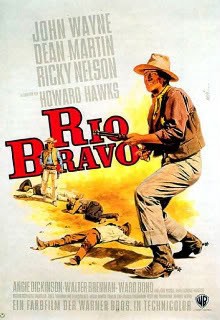
When Sheriff John T Chance (John Wayne) hands that laconic reply to the question from his friend Pat Wheeler (Ward Bond), it more or less sums up what the whole film is trying to say. Anybody who has ever seen a few Howard Hawks movies will know just how much store he set by the idea of professionalism. The small group of self-contained professionals is a recurrent theme in his work, and Rio Bravo may be the best example of this.

I won’t go into the plot in great detail here since it is, frankly, a little thin for a film with a running time creeping up towards two and a half hours. Chance arrests Joe Burdette (Claude Akins) for murder and must hold him in the town jail until the Marshal arrives. All the time, the town is under a virtual state of siege from the hired gunmen of Joe’s brother, Nathan (John Russell). Throw in a typically Hawksian romance between Chance and a poker playing drifter called Feathers (Angie Dickinson), and that’s it. However, this is really a character driven movie, and the plot functions mainly to provide the necessary circumstances to allow the characters to interact. It is this interaction that elevates Rio Bravo to the status of one of the great westerns. I’d challenge anyone to sit through this and not feel for these people by the end; more than that, you actually get the sense of coming to know them. Think about Chance’s coolly competent lawman who’s reduced almost to an awkward schoolboy when confronted with a sassy, attractive woman; Dude’s (Dean Martin) drunken deputy who must face down his personal demons if he’s ever to retrieve his self-respect from the whiskey bottle where he left it; and let’s not forget Stumpy (Walter Brennan), the trigger-happy cripple whose cackling and complaining adds so much warmth and humour to it all.

John Wayne gives one of his most relaxed performances in this film and while this has been criticised by some, I think it fits the pace of the piece. The acting is understated and just plain likable from a man whose talents many are quick to criticise and slow to acknowledge. It’s hard to imagine any other actor playing this part with the natural confidence displayed by Wayne. Dean Martin’s Dude remains convincing as the character gradually transforms himself from a pitiful rummy fishing for drink money in spittoons into a man proud enough to enter by the front door once again. When the doubts and temptations assail him and threaten to haul him back into oblivion, you can’t help rooting for him. The great Walter Brennan has a high time with his role as Stumpy and manages to steal nearly every scene he appears in. The only weak performances come from Angie Dickinson and Ricky Nelson. But if you remember that Dickinson was meant to provide eye candy, Nelson was there to draw in contemporary youth, and that the real focus was on Chance, Dude and Stumpy then it doesn’t seem so important.

While most western directors liked to get out into the wide open spaces, Hawks opted to shoot the entire film within the confines of the town. This has the effect of creating both a claustrophobic tension and a comfortable coziness. In keeping with the theme of professional lawmen, the film itself exudes a slick professional feel. The maturity of Hawks direction can be seen in the first five minutes of the movie, when the status of the main characters and the basis of the plot are presented clearly and explicitly without one word of dialogue being spoken. The script by Jules Furthman and Leigh Brackett may develop at a leisurely pace, but it’s always logical and it’s packed full of memorable lines. Mention should also be made of the score by Dimitri Tiomkin; it complements the action perfectly and the use of the Deguello is yet another of the joys the film has to offer.

I can’t finish this piece without referring to the fact that Rio Bravo was Howard Hawks’ riposte to High Noon. Hawks took exception to the idea of a lawman running around town desperately seeking help from a scared and apathetic citizenry. This was anathema to a man who worshipped at the altar of the professional ethic. To Hawks, a man ought to play the cards dealt to him regardless of the odds stacked against him. Now I have no interest in discussing the politics, either implicit or explicit, of these two films but I do find myself drawn more often to Rio Bravo. While I like and admire High Noon, it concentrates on the selfish fears of men where Rio Bravo celebrates the camaraderie and warmth of humanity – I know which I find more appealing.

For a long time Rio Bravo was only available on DVD on a bare-bones edition. Last year saw the release of a 2-disc SE with a commentary and lots of special features. Initial reports were that the transfer was significantly darker than the old version and I was wary of the upgrade. However, I eventually decided to take a chance and was pleasantly surprised. The new transfer is darker but then the old one was too washed out and faded anyway. It’s not perfect but I do feel it’s an improvement on the original and I have no regrets whatsoever about purchasing it. Maybe Rio Bravo isn’t the best western ever made but, if not, it’s only a few paces behind. Over the years, I’ve probably viewed this film more than any other and I continue to enjoy it – that’s as good a recommendation as I can offer.


Red Sun

bronson1

Charles Bronson and Toshiro Mifune take on a gang of desperadoes led by Alain Delon. Add the decorative charms of Ursula Andress and Capucine to the mix, stir it all up under the watchful eye of original Bond director Terence Young, and the result is the 1971 samurai western Red Sun. How can you not love such a movie? While you can find a number of films, from The Magnificent Seven on, that took their cue from and remade Japanese stories, the mixing of genres is not so common (I could mention a recent movie that borrows the basic premise but I don’t want to dirty up this piece by referencing it).

The  plot  goes like  this: the Japanese ambassador to the USA is travelling cross country to Washington when the train he’s using is held up by an outlaw gang. The robbery is masterminded by Link (Bronson) and Gauche (Delon), and their objective is a safe full of money. It’s just bad luck that the Asian diplomat happens to have chosen this train and gets himself robbed too. Having already murdered a few innocent people, Gauche shows just how ruthless he really is by knocking off one of the ambassador’s samurai guards, stealing a priceless sword, double-crossing Link, and leaving him for dead. So our two heroes, Mifune and Bronson, must set out in pursuit of the duplicitous Frenchman; one seeking to recover the sword and uphold his honour, and the other just seeking the stolen money that has been stolen from him. For Mifune there is the added complication that he has been given just seven days to accomplish his mission; should he fail to do so he will be forced to take his own life.

Red Sun came along towards the end of Spaghetti/Euro western cycle and it manages to add a new twist to it with the inclusion of the samurai angle. Now if someone were to offer you a meal consisting of a Spanish omelet, sushi and good old bacon & beans all mixed up together you’d probably feel a little queasy at the prospect. However, from a cinematic point of view, it doesn’t turn out so bad – in fact it manages to remain quite appetising. This is not a film that is trying to make any serious points and, as long as you keep that in mind, it provides some marvellous entertainment. Nevertheless it is nice to see the relationship between Bronson and Mifune’s characters blossom as each comes to acquire a respect for the other. Mifune is fine as the taciturn, honour bound warrior and Bronson (on the verge of international action stardom) is very likable as the wisecracking bandit. Alain Delon is a very one-dimensional villain, but the movie isn’t about character studies anyway. Capucine and Ursula Andress were really just along as eye candy, and that was alright by me. So, the film has copious amounts of gun and swordplay, the Cavalry, Mexican bandits, a marauding Comanche raiding party, and a catchy score by Maurice Jarre. It’s hard to imagine what else the producers could have thrown in.

Red Sun comes on DVD in R2 from Cinema Club in a fairly decent print, except it’s not OAR. The film should be shown 1.85:1 but the R2 is full frame. It looks like an open matte transfer, rather than pan & scan, since there is far too much headroom on view. I believe there is a widescreen version available somewhere, but I can’t recall where – Japan maybe? All in all, I found the movie undemanding and fun. Bon Appetit!