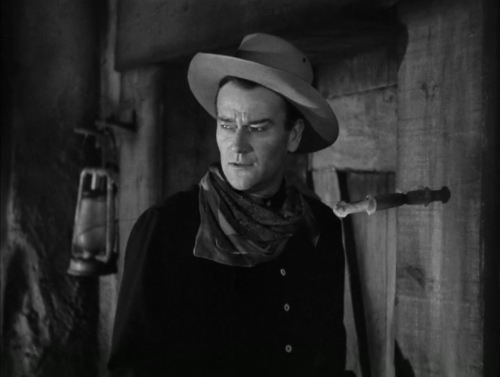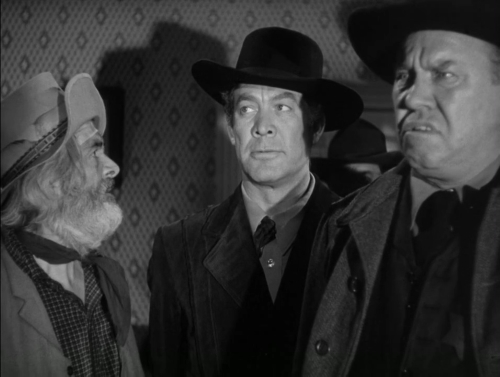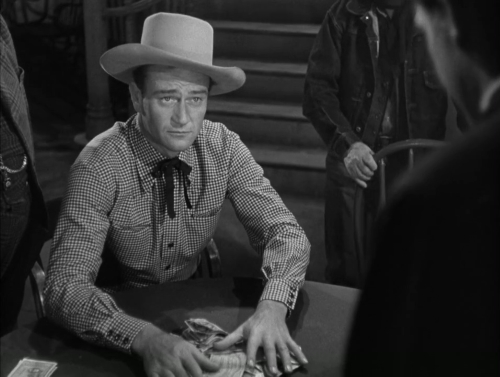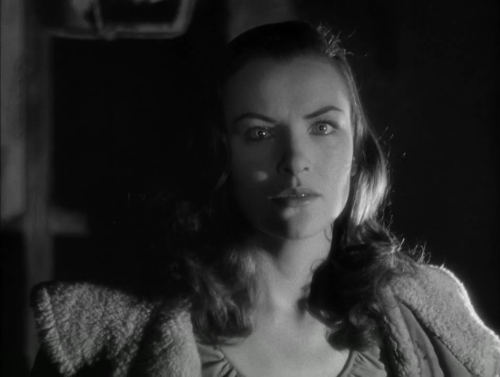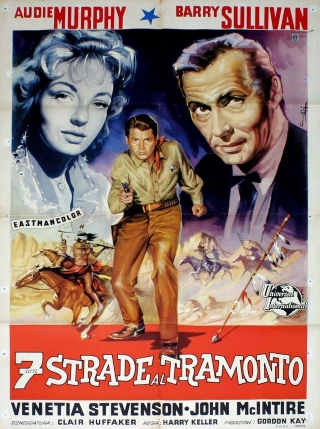
Drango

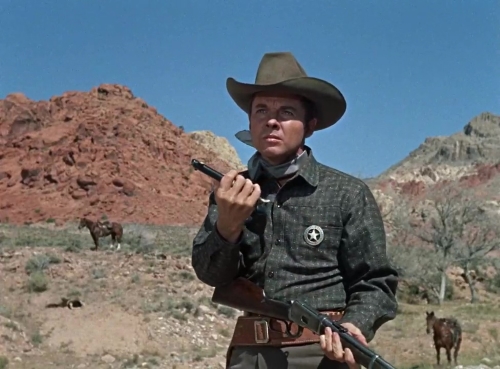
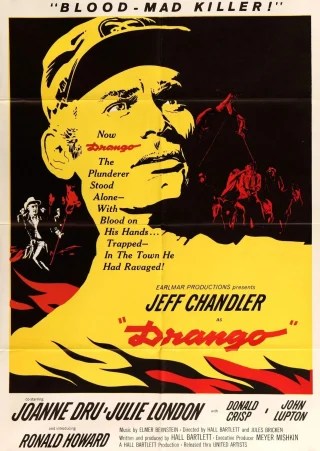
Drango (1957) is a somewhat obscure western that makes for interesting viewing. Taken as a document of the Reconstruction era in the wake of the Civil War, it doesn’t really succeed or at least it’s not especially convincing. On the other hand, it is very effective indeed as an examination of redemption, and in this case atonement. It’s far from the first time I’ve featured a movie driven by that theme as the classic western era is awash with examples. The fact that the film largely succeeds in spite of some of its weaknesses is due in no small part to the work of its star Jeff Chandler.

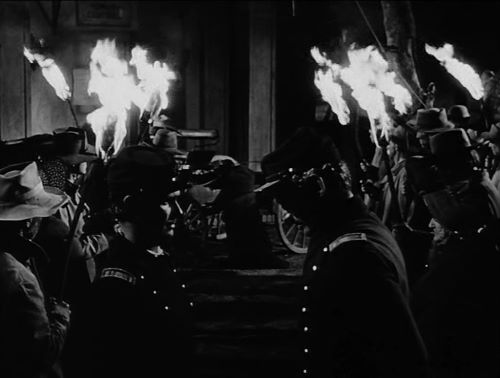
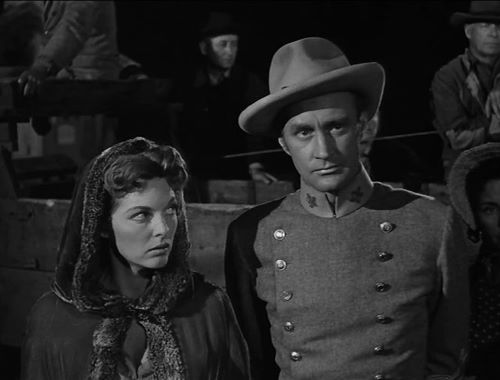
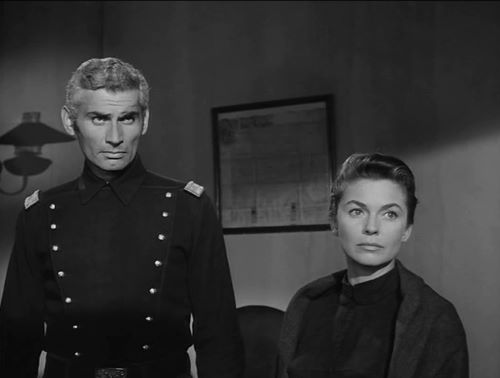
One can practically taste the hostility at the beginning of the film. The implacably  surly expressions of the inhabitants of the small town in Georgia which greet the new military governor give a strong indication of what lies ahead. It’s the post-Civil War period and the old wounds are still raw, old resentments still nurtured. The new governor is Major Drango (Jeff Chandler) and there is a brief, blink and you miss it reference to his past before more immediate concerns take over. Drango’s mission is to get things back to normal as soon as possible, which naturally involves seeing that law and order is restored. This kind of task requires considerable bridge building skills, something Drango sets about practicing as soon as possible. However, he is presented with an obstacle, a settler (Morris Ankrum) on an outlying farm turns up in his rooms hoping to persuade the Major to transport him to the nearest garrison for trial. This man was unsympathetic to the Confederacy and a raid on his property by returning veterans saw a man killed. Not unnaturally, he is dubious about receiving a fair trial in his home town. The rancor of his fellow citizens is tangible during his arraignment and his fears are to be proved correct when he’s subsequently abducted from the jail and lynched in the town square. It’s here that Drango’s guilt is first apparent, not least when faced with the scorn of the dead man’s daughter (Joanne Dru), and as the story progresses it becomes increasingly obvious that this is something he wears like a second skin. What is also clear is the fact that this guilt is rooted in something deeper, although exactly what is only revealed late in the day. In the meantime, he sets about winning hearts and minds, a goal made even more difficult by the subversive plotting of one of the town’s faded gentry (Ronald Howard), a man hell bent on fanning the flames of conflict once more.

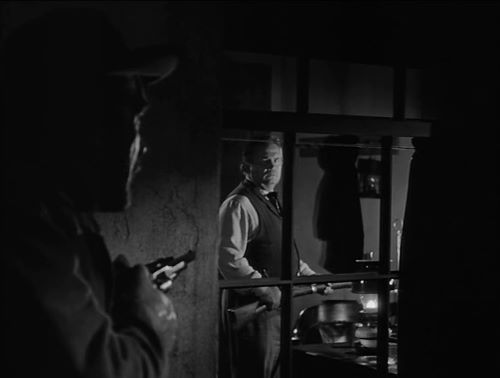
Drango was made by Jeff Chandler’s production company Earlmar and he got hold of some fine talent to work on it. Elmer Bernstein wrote the score and those characteristic riffs and hooks he frequently employed can be heard throughout. The cinematography comes courtesy of James Wong Howe and his lighting of interiors and the nighttime scenes is as exemplary as one might expect. Hall Bartlett and Jules Bricken co-direct in a fairly matter-of-fact fashion but the pacing is good. Yet, as I mentioned at the top of this piece, there are weaknesses. If a film wants to be regarded as a serious consideration of the mood and effects of the Reconstruction era, then it’s not unreasonable to expect some reference to slavery. After all, this is set in a town in Georgia and a few of the characters live in the type of mansions to be found on plantations yet there is no mention whatsoever made of this. What’s more, the entire cast contains not one black face, which again strikes me as very odd indeed given the time and location depicted. The result is that there is a degree of artificiality to this image of a post-Civil War town and consequently the whole north-south friction aspect feels a bit fake. The film in essence starts to feel somewhat generic in its portrayal of post-conflict tensions. However, this is basically background material and what rescues the movie is the strong focus on atonement and redemption.

Jeff Chandler was an authoritative presence, a quality which grew as the years passed. He had what is commonly termed gravitas but that alone can make for dull viewing. Chandler’s great strength lay in his ability to convey a certain frailty behind the authority. He has a number of scenes where he gets to boss the situation, glaring down a horde of hungry and desperate townsmen as well as punching out a belligerent, bottle-wielding foe. He also makes a few speeches, which are heartfelt and impassioned but his best moments come in the smaller, quieter passages. The sensitivity of the man is clearly discernible when he has to extract a bullet from a patient who is still conscious, the concentration and reflected pain writ large on his features. Then there’s the potency of a simple and wordless scene where he leaves a few humble presents for a family of orphans on Christmas Day, and of course his carefully controlled outrage as he carries the remains of a youngster who has perished in a deliberate arson attack. All of this is buttressed by the corrosive guilt the man is carrying within – it’s only really when his true past is hauled out in the open that the reasoning which underpins his compassion makes sense.
Joanne Dru exudes stoicism as the woman who has lost her father, lost everything in life if truth be told. Her slow drift from bitterness to acceptance and finally love is achieved naturally and organically. Ronald Howard, in his first Hollywood film, provides an object lesson in pride and ruthlessness as the Canute-like figure who yearns for even more bloodshed. Julie London (Saddle the Wind, The Wonderful Country, Man of the West) was always an attractive addition to any cast and while her part here is less developed and less interesting than that of Joanne Dru, she brings an air of class to proceedings whenever she appears. There’s good support from Donald Crisp, Walter Sande, John Lupton, Milburn Stone and the curmudgeonly Chubby Johnson.

Drango is a hard-edged and at times quite dark redemptive western. Maybe it does not do or get everything right, but it’s a movie with its heart in the right place all the same. This is bolstered by a characteristically compassionate performance from Jeff Chandler, an actor who rarely if ever disappoints. As far as availability is concerned, there are DVDs from France and Italy, the latter looking crisp and clean though almost certainly presented open-matte. All told, this is a satisfying western that is well worth a look.

Circle of Danger

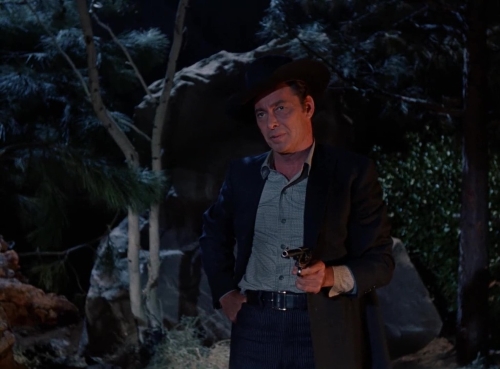
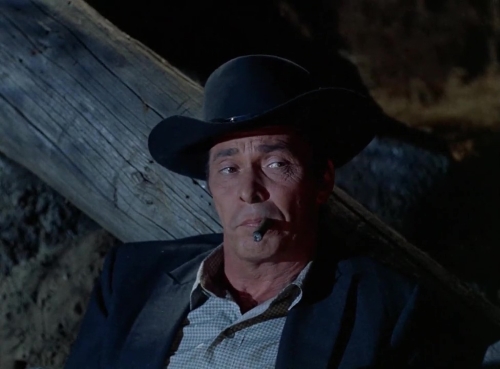
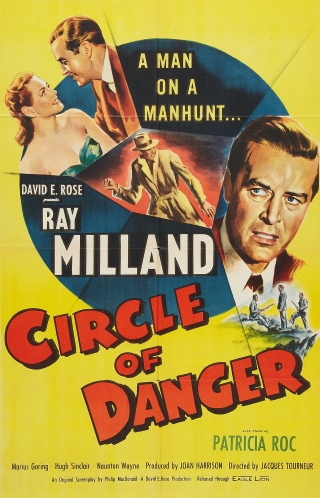
Trails followed by hunters have a nasty habit of going cold very fast, but how long does it take a dish to get correspondingly cold? After all, there is that popular tip about the ideal temperature for serving up revenge. One would have thought five or six years ought to do the trick, and that’s about the time Ray Milland’s character takes to get round to seeking out the man responsible for the death of his brother towards the end of WWII in Circle of Danger (1951). Yet revenge is such a corrosive business, rarely bringing any kind of satisfaction to those who most desire it, and then there’s always that thorny question of whether or not it’s actually justified.

It’s perhaps a little unexpected to see a movie mainly shot in and featuring a cast and crew drawn largely from the UK opening on a salvage vessel operating off the Florida coast. Well that’s where we first come across Clay Douglas (Ray Milland) as he and his partner have just struck gold, or maybe I should say tungsten. This is the opportunity Douglas has been waiting for, five years of hard work finally paying off and allowing him to trade in his share in the business for thirty thousand dollars. He’s not looking to retire or anything, instead he’s been working to earn enough money to fund a trip to the UK in search of the truth about the demise of his younger brother. Despite his seemingly easy manner, Douglas is something of a driven man, fully focused on finding out how the kid brother he had almost single-handedly brought up came to die on a commando raid. People die all the time during major conflicts, even those plying trades nowhere near as perilous as that of a commando. So why would a man travel half way round the world to dig into this particular event? The fact is that the fog of war seems to lie especially thick around it all, and there was a rumor that the younger Douglas was dispatched by one of his own comrades in arms. The hunt for the truth has Clay Douglas cannoning round all the points of the compass, from London to the valleys of Wales and on to the Highlands of Scotland. Both the war and the subsequent passage of time has whittled the list of men who might be able to furnish him with the information he craves down to a mere handful. And it remains to be seen whether the tale that emerges is the one he had hoped to hear at the outset.

Straightforward revenge stories are never all that interesting. Sure there’s a certain visceral thrill to be tapped into if the elements are lined up in the right way, but such yarns tend to take on an exploitative feel which I generally find unappealing. The better examples, and I think Circle of Danger qualifies as such, raise questions that ought to make both the protagonist on the screen and the audience facing it a trifle uncomfortable. It all boils down to whether or not life’s thorny tangles can be adequately addressed in cut and dried, binary terms. I don’t think it’s giving too much away here to say that Philip MacDonald’s script turns the central quest back upon itself by the end, forcing not only the avenger to question himself, but also requiring the viewer to reassess a number of preconceptions we’ve been hitherto encouraged to blindly accept. This renders that three cornered confrontation on the Scottish moor all the more fascinating, and consequently leads to a resolution which is enriched by its acknowledgment of the sometimes ambiguous nature of justice. A delicate subject of this kind needs to be handled sensitively, not with a heavy lump hammer approach, so producers Joan Harrison and David E Rose deserve credit for securing the services of a director  with the lightness of touch and subtlety of Jacques Tourneur.

There has to be something steely and almost obsessive about a man who is prepared to hand over a significant chunk of his life in the pursuit of retribution. I wouldn’t want to claim it is a state of mind exclusive to the years following the Second World War but, in cinematic terms at least, it is a motif that was explored recurrently and came to characterize more than a few screen protagonists – James Stewart was a prime example of this phenomenon but he was certainly not the only one. This needs a quality of intensity to carry it off, something Ray Milland touches on throughout Circle of Danger, particularly in the climactic scenes in the Highlands, but probably not as consistently as he might have. That’s not to say his character is ever less than focused on the ultimate prize, but he does drift towards casualness bordering on nonchalance on occasion, not least when he’s flirting with Patricia Roc. She brings a freshness and vitality to the movie, a teasing allure that still allows her to switch to a more serious mode when she senses betrayal of one form or another. The other person vying for her attention is Hugh Sinclair’s reticent Scot, the one-time leader of the commando group and a man who seems none too keen on furnishing any more details on past than he can help. His is a key role and Sinclair does well in getting across both the caution of the man as well as what I can only term contained suffering. Then there is Marius Goring giving an energetic yet wholly credible performance as the man whose homosexuality is never openly stated (it is a 1951 movie after all) but which is very clearly alluded to. I think one of the most interesting aspects of the script in general is way it encourages the audience to make various initial assumptions about all three of the male characters before challenging these preconceptions and upending them.

Circle of Danger had been released on DVD by the now defunct Network in what was an entirely acceptable edition. However, it has recently reappeared on Blu-ray via Studio Canal – I haven’t seen that transfer yet but I would expect it to enhance the visuals, and there are some fine looking shots in the film courtesy of cinematographer Oswald Morris. This is a good movie, deftly directed by Jacques Tourneur and cleverly written by Philip MacDonald, drawing the viewer in, setting up certain expectations and then neatly subverting them in a way that continually poses questions which tend to defy pat or convenient answers. It’s a film I’m happy to recommend.

Man-Trap

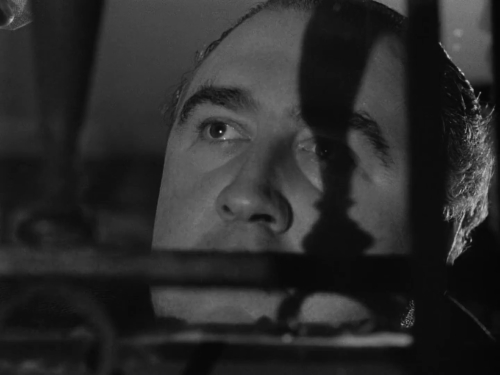
By the 1960s film noir had had its day, at least that’s what the critical consensus tells us. Anything after that gets variously referred to as post-noir, neo-noir etc. I don’t know, age has made me less interested in labels and I find myself paying only scant attention to them these days; they are useful for marketing purposes and the like, but I’m not selling anything. So, all of that is just in the nature of a disclaimer lest anyone should object to my hanging the tag film noir on Man-Trap (1961) – I did so because the subject matter, resolution, personnel and general feel pointed in that direction for me.

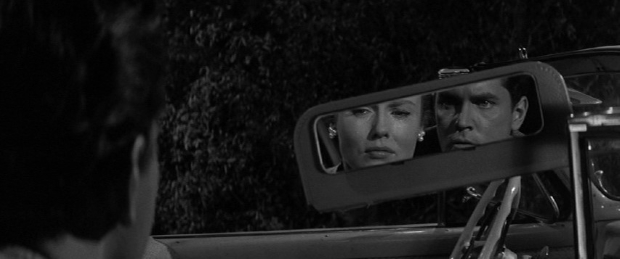
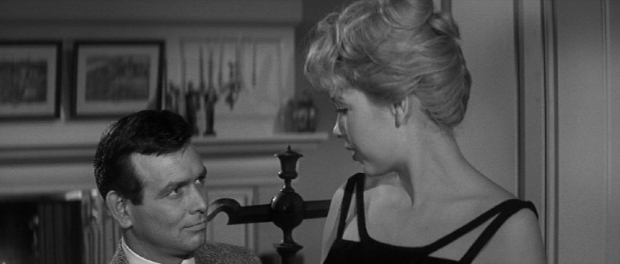
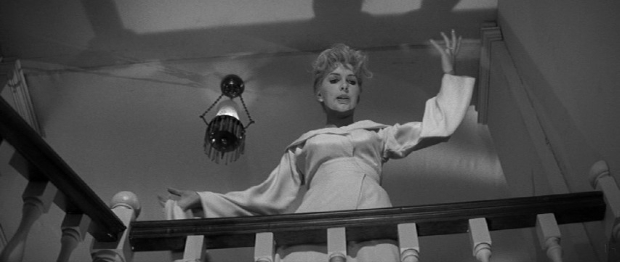
There’s a brief opening section, a prologue of sorts, which takes us back to 1952 and Korea. The purpose is to establish some facts that will influence the story to be told. We learn that Matt Jameson (Jeffrey Hunter) is a decorated war hero who got a medal pinned to his tunic and another piece of metal inserted in his skull while saving the life of his comrade in arms Vince Biskay (David Janssen). Years pass and Matt is trapped in an unsatisfying job and a marriage to the boss’ daughter Nina (Stella Stevens) that is even more toxic. He’s essentially been consigned to a suburban hell, an American nightmare of disillusionment and disenchantment. So, when Vince turns up, apparently out of the blue, brimming with roguish charm and a business proposition, Matt is moderately receptive to say the least. Vince has been hiring his services out to the highest bidder in Central America and in so doing has hit on a scheme to profit from political unrest and bag a cool $3 million dollars. As Matt’s relationship with the alcoholic and promiscuous Nina deteriorates, his desire for his secretary as well as the promise of full financial independence drives him to fall in with Vince’s scheme. All of this leads to a botched heist and a radical change of plan as the law, hitmen and domestic discord all begin to apply pressure.

Man-Trap is full up of the kind of bad choices, ill fortune and empty opportunities that characterize film noir. Perhaps it doesn’t have the classic look, but that arguably evolved over time anyway and the slightly flat, TV movie appearance of the visuals is not entirely out of keeping with other late era offerings. Aside from a couple of television shows, this was only Edmond O’Brien’s second feature as director after his collaboration with Howard W Koch on Shield for Murder. It’s only a partially successful effort though, the low budget is always noticeable and the script isn’t all it could be. On the plus side, the heist sequence and its aftermath through the streets of San Francisco is well filmed and quite exciting. O’Brien manages to fit in some imaginatively framed shots here and there, but the writing remains problematic – the screenplay is an adaptation of a John D MacDonald (Cape Fear) story, which maybe creates unrealistically high expectations. The high point is the heist and the momentum is never regained after it takes place. That wouldn’t have to be a problem if the film wound up faster, but there’s still a whole lot of storytelling to get through before the credits roll.

I also get the impression that either O’Brien or the screenwriter Ed Waters wanted to make the movie a critique of the state of middle class America as much as a thriller, but ended up with those elements orphaned and only partially addressed. Matt and Nina’s rotten marriage feeds into this but it’s the portrayal of the appalling neighbors which hammers it home. This suburban degeneracy is peopled by a gallery of grotesques, sad swingers who spend their time boozing, leering and gossiping. It’s a snapshot of the moral decay simmering below the surface of the backyard barbecues. Maybe  it’s the presence of Jeffrey Hunter that had me thinking how it was vaguely reminiscent of aspects of Martin Ritt’s No Down Payment, though that is a far superior movie on every level and indeed almost like a Douglas Sirk film with the varnish scraped off. Man-Trap can’t aspire to that and although these aspects are diverting enough, I feel it might have worked better all round had it avoided them and kept its focus tighter.

As for the acting, Jeffrey Hunter does reasonably well as the dissatisfied Matt, uncomfortable and unsettled for much of the running time, but the developments in the latter stages of the movie don’t succeed. Everything takes a detour into the type of ill-starred territory one would associate with a Cornell Woolrich tale yet it lacks the suspense that give such fatalistic fables their teeth. David Janssen, however, is excellent throughout. He nails the charm and duplicity that define the character of Vince, beguiling and bedeviling just about everyone he comes into contact with. On the other hand, the real weak link for me was Stella Stevens. She does well in the early scenes where her coquetry is to the fore, but the more her angst and desperation grow, the less convincing she becomes. In the end, it feels like a very transparent performance and it hurts the film as a result.

Man-Trap was a Paramount production and got a release in the US via Olive Films some years ago. That was a solid transfer, crisp and attractive in the way black and white ‘Scope movies tend to be. Olive are now defunct of course so I’m not sure how readily available the film is these days. All told, it’s a picture that works in places – Janssen’s characterization, the heist – but falls down due to scripting issues and some unsatisfactory work from the leading lady.

Tall in the Saddle

Maybe I should have been an engineer. Or perhaps not. Bridges and links and halfway houses in all their forms hold a fascination for me, just not in the structural sense. If you watch enough movies, patterns emerge and it’s difficult not to think in terms of eras and their associated styles. The western continues to draw me and over the years I’ve developed a deep affection, one might even say a love of the variety that came to fruition during the 1950s. Of course no genre reaches maturity suddenly or spontaneously, nor does it do so in a uniform fashion. It’s a gradual process and a fluid one, advancing and retreating from movie to movie and this is even discernible within individual movies themselves. I think that it was somewhere in the late 1940s, when that post-war sensibility had begun to make itself felt across a whole range of genres, that the western really found its feet. However, the preceding years hint at some of the bridge building that was underway, and a film such as Tall in the Saddle (1944) is of interest in that respect. There is a distinct flavor of the breezier 1930s western to parts of it, and also a hint of what would develop in the years ahead, that latter aspect possibly making itself felt as much in the visuals as anything else. And then there is the evolution of the screen persona of John Wayne to be considered.

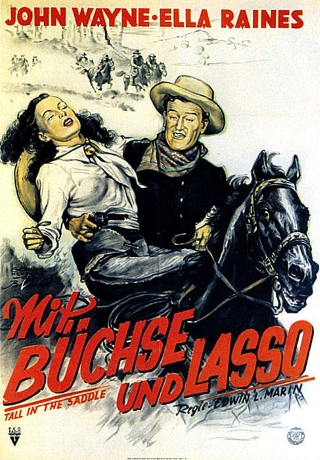
A mystery of one type or another is typically an attractive hook upon which to hang a story and a lead who is himself introduced as something of a mysterious figure is even better. Rocklin (John Wayne) is just that, a man with a surname and nothing more, hitching a ride on a stagecoach and on his way to start afresh. Bit by bit, a little more is revealed about him, but only very gradually and only that which it’s necessary for the viewer to know. This is very much in keeping with the western tradition, a figure striking out towards new frontiers, an identity defined by his actions and behavior in the present rather than any preoccupation with a past that is of no consequence. In a sense, Rocklin (and by extension the man playing him) is a representation of the West, resourceful and independent, forward-looking and unsullied by pettiness or corruption. He seems to fit right in with the ruggedness of his surroundings, simultaneously aware of the dangers and risks yet not intimidated by them. That his journey west has a purpose is never in doubt, but this is slowly revealed and only fully brought to light at the end of the picture. As we go along it’s enough for the viewer to be aware that Rocklin has been deprived of something that he had expected to find, and that he’ll not rest till he finds out who is responsible for this. The man he thought he’d be meeting has been killed and he’s now been cast adrift, the work he thought he’d be doing is no longer so appealing so he ends up accepting a job as foreman for the tomboyish Arly Harolday (Ella Raines).  I don’t want to go into too many plot details here – it’s a fairly convoluted business involving inheritances, land grabs and assorted betrayals – but suffice to say that Rocklin finds himself tangled up in local disputes and as well as one of those romantic triangles where there’s never the slightest doubt how it’s all going to turn out. I guess the point I want to make here is that the tale itself is of less interest or importance than the way it’s told and the people who are involved in the telling.

Edwin L Marin’s credits as director stretched back to the 1930s, but I think Tall in the Saddle marked the beginning of the more interesting phase of his career, one that would be curtailed by his untimely death in 1951. From this point on he would make a series of entertaining westerns with Randolph Scott, as well as a number of crime pictures with George Raft. None of these would be considered classics or anything but they are good movies overall. The script here (by Paul Fix, who also has a memorably sly supporting role) is arguably too busy, albeit with a few good lines, but Marin keeps it all moving along so that it never gets bogged down in the kind of intricacies that aren’t all that engaging. Surprisingly for a western, the interiors are more visually pleasing than the exteriors, which is probably due to the work of cinematographer Robert De Grasse, a man who filmed a string of fine genre pictures in the mid to late 1940s, such as The Body Snatcher, The Clay Pigeon, Follow Me Quietly, Crack-Up and The Window.

As I mentioned above, Tall in the Saddle comes across as something of a bridging exercise now, not least for the the way it slots into John Wayne’s career path. Both John Ford and Raoul Walsh had begun the process of molding that iconic image, but it would be the late 1940s before his full potential was realized. Still, Wayne’s growing confidence on screen was apparent here – his handling of himself in the action scenes, especially his confrontation of a hapless Russell Wade and the determined way he faces down and pistol whips Harry Woods, is exemplary. What’s more, there is a real spark between Wayne and Ella Raines, her spitfire allure demonstrating how well he responded to being paired off with leading ladies who were capable of giving as good as they got. Ward Bond provides good value too in one of those oily parts he excelled at. Audrey Long is an attractive if slightly ineffectual presence as the other side of the love triangle involving Wayne and Raines. In support Gabby Hayes is his usual self – personally, his shtick is something I can take or leave depending on my mood, but some will be more tolerant. Other familiar faces on display are Russell Simpson, Frank Puglia and George Chandler. A young Ben Johnson is supposed to be in there somewhere too, but I’ve never been able to spot him.

Tall in the Saddle can’t be classed as a great western, or a great John Wayne movie, but it is quite intriguing as a kind of cinematic pathfinder, strongly influenced by the films that preceded it and looking ahead to the riches the genre would unearth in the years to come as well. It’s also an entertaining and enjoyable watch, all of which makes it a worthwhile viewing experience.

Spy Hunt

Sampling the pleasures of the uncomplicated world of B movies is something I never tire of. Remember, despite what some glib types might tell you, a B movie does not mean a bad movie. There is an art to producing a slick and brisk piece of entertainment on a budget. Back in the days of the big studios, this was easier to do of course. There were specialized units dedicated to churning out support features and a large pool of talent on both sides of the camera who could be relied on to produce work that might not have cost a lot but was still polished and professional. Spy Hunt (1950) is an example of this, a 75 minute mystery adventure, shot with a certain elan by George Sherman using an attractive cast and benefiting from a script derived from a Victor Canning novel.

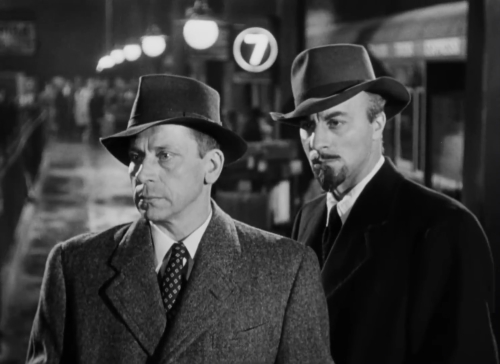
As soon as the titles appear on screen, it will be apparent to anyone familiar with films of this era that we’re in solid B territory. Those titles are accompanied by the immediately recognizable music that was used to introduce the Rathbone/Bruce Sherlock Holmes series for Universal throughout the 1940s.  Others may disagree, but I find something rather comforting in that, like meeting up with old friends after a long separation. Then the opening scene takes place on a train, even better a train speeding through the night to some unspecified destination – and so we are powered along from the sense of the familiar towards the unknown, with pace, urgency and mystery jogging by our side. A furtive figure locks himself in, and proceeds to conceal a strip of microfilm inside a cigarette. Disembarking on a platform in Milan, that same man lights up, takes a brief drag on the cigarette, and then discards it with elaborate casualness. He’s caught the attention of someone first, however. Someone who nonchalantly recovers that cigarette and saunters off alone. The someone in question is a woman by the name of Catherine (Marta Toren), a spy or courier for some government – the name is never revealed and it’s not something the viewer needs to know anyway as the microfilm itself is in the nature of a Hitchcockian MacGuffin, a plot device that is vital to the characters but of only  marginal importance to the audience. Some sly subterfuge on Catherine’s part ensures that said microfilm ends up secreted within the collar of one of a pair of panthers being transported across Europe and eventually on to a circus in the US.  To do so, she first has to distract the big cats’ escort, a drifter called Steve Quain (Howard Duff) who is keen to earn his passage back to the States. It all sounds like a neat if somewhat convoluted plan, but others are on to it and what ought to have been a harmless deception ends up with the freight car being uncoupled and derailed, two dangerous cats inadvertently released into the wilds of Switzerland, and Quain facing the threat posed by a ruthless but unidentified antagonist who is eager to reclaim the elusive microfilm.

The title says it all really, the film being essentially a pursuit by spies and assorted agents of a piece of damning evidence, blending in elements of the whodunit (the identity of the villain is deftly kept a matter of suspicion and conjecture till near the end) and the outdoor adventure. The fact that the escaped panthers pose a real danger to all who cross their path, animals and people alike, provides an original twist to what would otherwise be a fairly standard espionage yarn. While I’ve read a few Victor Canning novels and seen a number of adaptations of his work – Golden Salamander, Venetian Bird, The House of the Seven Hawks, and Hitchcock’s Family Plot – I’ve not yet had the opportunity to read Panther’s Moon, which was the basis of this film, but scanning a brief synopsis of its plot suggests the movie is quite faithful to the source material. George Sherman directs with assurance, wasting no time on the irrelevancies and managing to create a few notable setups that emphasize the suspense, from the atmospheric views of the railway siding by night to carefully composed overhead shots in the Swiss inn as well as some fine close-ups.

Howard Duff presents an honest, two-fisted likeability in the lead that was a trademark of his time at Universal. Marta Toren makes for a resourceful spy and an attractive headache for Duff. Neither one is stretched dramatically yet they turn in the type of work that makes it no chore whatsoever to spend an hour and a bit in their company. Robert Douglas and Philip Friend are dutifully suspicious in  support and are well backed up by Walter Slezak, Philip Dorn and Kurt Kreuger. Watching these actors do their thing had me thinking how I often find myself influenced by the roles I first saw certain performers take on. For instance, Slezak has a relatively benign part in this movie, but somewhere at the back of my mind (and this is despite my knowledge of his work in sympathetic roles such as that in Mankiewicz’s People Will Talk) I still associate him with sinister characters like those he played in Lifeboat or The Fallen Sparrow. Similarly, for better or worse, I find I forever associate Philip Dorn with Passage to Marseille and Kurt Kreuger with Preston Sturges’ Unfaithfully Yours.

Spy Hunt has been released by Kino in the US in one of their film noir sets. Previously, it had been a title, like so many Universal-International movies, that one read or heard about while wondering if a copy that was viewable would ever turn up. The last few years has seen some remarkable progress in that area and there are now far fewer of these “lost” rarities. Having said that, I do want to point out that I can see no real justification for marketing this movie as film noir. That’s not meant as a criticism of the film, just a footnote for those who haven’t seen it to make them aware that it’s an espionage mystery first and foremost. Of course if the film noir label makes it easier to market it and get it out there for people to see, then so be it.

The Wild North

You want to go in like this? You want people to talk about it the the rest of their lives, how the mouse brought back the cat?

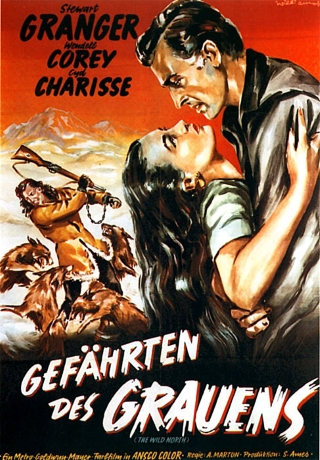
The taglines used by the marketing men for The Wild North (1952) tended to emphasize the man vs nature and and the man against man aspects of the movie. These elements are there without question, but I find much of the story boils down to the matter of reversals as well as our old acquaintance redemption. It is one of those bracing and beautiful outdoor adventures – some might term it a western, but I’m not convinced and I see no need to hang that label on it – that places its characters, both willingly and unwillingly, beyond the bounds of civilization and invites us along to observe how they react and respond to the challenges this presents them with.

More than one wilderness based movie has opened with the visit of the protagonist to town or to some kind of settlement, and such stopovers almost inevitably lead to trouble. Such is the case here as Jules Vincent (Stewart Granger) makes one of his infrequent trips back to what passes for civilization, looking for a chance to get drunk and maybe find some attractive company. Well the liquor is easy enough to come by and the nameless Indian girl (Cyd Charisse) singing in the saloon satisfies on the other score. However, he also manages to draw the attention of a loud, aggressive type called Brody (Howard Petrie). Despite their initial antipathy, Vincent agrees to take Brody along as a passenger on his journey back north alongside the girl who has convinced him of her desire to return to the wild country she hails from. It’s giving nothing in particular away here when I say that Brody soon winds up dead. His demise is never shown – this is not to create any sense of ambiguity regarding his fate, but I guess it’s meant to lessen the impact of the viewer’s knowledge that Vincent has become a killer. The reason given is that Brody’s determination to take on the lethal rapids was putting everyone’s lives at risk yet Vincent has no faith in a jury of townsmen’s ability to appreciate the necessity for his actions. So he takes the girl and runs north, bent on losing himself in the environment he knows best. As with all the best Mountie stories however, the law, in the shape of Constable Pedley (Wendell Corey), is not to be denied its man.

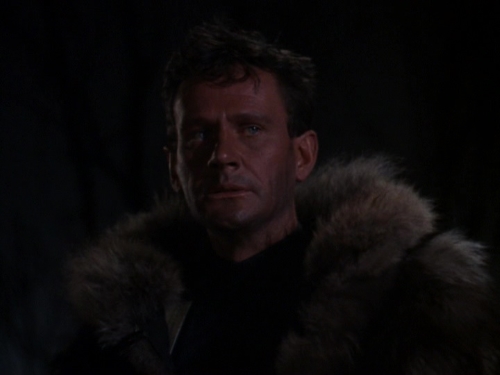
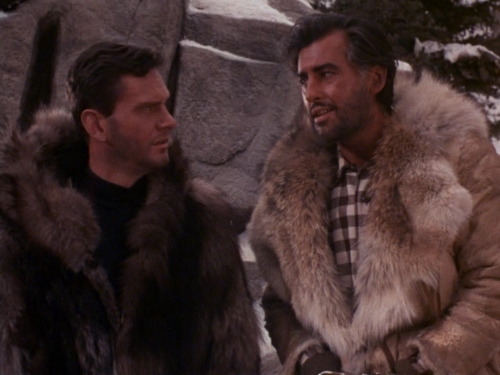
What follows develops largely into a two-hander as Pedley arrests Vincent and sets out on the long and treacherous trek back though the harsh winter conditions. One would expect conflict and friction between the two men, which is indeed present, but this doesn’t take refuge in the hackneyed hiding places of some lesser films. The rivalry is tempered from the outset by a grudging mutual respect  and fondness, the kind that only two very different characters can experience. Pedley has a job to do and will see it through no matter what yet he has no personal axe to grind with his captive and actually likes him. Similarly, Vincent sees in his captor a man he can admire to some extent. In spite of the apparent contrast in one man’s untamed ebullience and another’s steely but witty intelligence, there is a strong sense of humanity binding these two together. That bond becomes ever stronger and more vital as they both face threats to life and limb from thieves, an avalanche, and a terrifyingly tenacious pack of wolves.

Stewart Granger is in fine form in his second of three films with director Andrew Marton, King Solomon’s Mines and Green Fire being the others. He gets across the brashness of the trapper, the love of the outdoors (something I think the star shared in reality) and also that streak of ruthlessness that must surely be found in all such men. There are a couple of occasions where that latter aspect is allowed to manifest itself even if it’s quickly suppressed as his character’s basic humanity asserts itself more forcefully. However, it is there and it lends an authentic air of danger to Jules Vincent. Set against that is Wendell Corey’s much quieter work, and the two approaches genuinely complement one another. Corey could appear stiff and far too reserved in certain films yet he brings a marvelously controlled charm to this role. He’s no rigid authoritarian, but nor is he a pushover. While he’s competent and organized, he has heart and humor as well as a well judged awareness of his own limitations and loneliness. Ultimately, I think this is what makes the film work, the acknowledgment by both men of their respective strengths and weaknesses. As the threats pile up and the roles are reversed, it’s the redemptive reflex they both respond to that give it its heart. In their own different ways they save each other and by doing so save themselves. Cyd Charisse is only in the picture intermittently and anyone waiting for some tiresomely contrived romantic triangle to arise will be disappointed. She is absent from the long main section and I think that’s actually just as well as it allows the focus to remain firmly on the struggles of Corey and Granger in the snowy wastes. Support comes from an abrasive Howard Petrie, Ray Teal as a shifty trapper, Houseley Stevenson (in one of his last feature roles), and J M Kerrigan.

Films which use the great outdoors and wilderness landscapes as their backdrop can sometimes drift into mindless action that loses its impact when overused or they can linger too lovingly on the visual splendor of their locations. The Wild North avoids these pitfalls by remembering that the essentials of the story stem from the character dynamic, that its success derives from within rather than from the more superficial elements. It’s a matter of balance, something which I feel this movie achieves and it manages to become a positive, uplifting, life-affirming experience in the process.

The Professionals

La Revolución is like a great love affair. In the beginning, she is a goddess. A holy cause. But, every love affair has a terrible enemy: time. We see her as she is. La Revolución is not a goddess but a whore. She was never pure, never saintly, never perfect. And we run away, find another lover, another cause. Quick, sordid affairs. Lust, but no love. Passion, but no compassion. Without love, without a cause, we are nothing! We stay because we believe. We leave because we are disillusioned. We come back because we are lost. We die because we are committed.

Random musings on the nature of revolution, words which have an attractive feel, a weary patina lying somewhere just the right side of cynicism. That, I think, is the effect they are meant to convey, but therein is their problem, and by extension part of the problem of the movie they appear in. Hearing them spoken by Jack Palance’s wounded rebel and reading them back here leaves me with the impression that they have been crafted for just that, for effect rather than for truth or out of any real conviction. I watched The Professionals (1966) again the other day, a movie I’ve seen  fair few times now, and came away from it thinking it entertaining enough although somewhat lacking in substance. Like so many films by Richard Brooks, it doesn’t do much wrong, doing a lot right in fact, yet never actually amounts to as much as the filmmaker would have us believe.

During the latter half of the Mexican Revolution a group of four men, introduced via brief sketches during the opening credits, are hired by a wealthy businessman to get his kidnapped wife back. That’s the plot of the movie in a nutshell. It’s a simple enough setup, fleshed out by the colorful nature of a some of the leads as well as the dynamic created by their intertwined pasts, and of course the turbulent background of a country riven by internal conflict. The hired hands are led by Rico Fardan (Lee Marvin) a former associate of Pancho Villa, Bill Dolworth (Burt Lancaster) a womanizing rogue with a talent for blowing things up, Ehrengard (Robert Ryan) a diffident wrangler, and Jake (Woody Strode) a tracker and expert with a longbow. Their employer is one J W Grant (Ralph Bellamy), an ageing tycoon married to the much younger Maria (Claudia Cardinale). On the other side is Raza (Jack Palance), one of those bandits with a reputation approaching legendary status. The story is broken into a classic three act structure – the preparation and the journey out, the rescue, and the ride back leading to the denouement. If it sounds a bit formulaic, that’s because it is. There aren’t really too many surprises and the twist that is supposed to grab the viewer comes as more of a shock to the characters on screen.

This probably sounds more negative than I mean it to – the film is (as one would hope from the title) all very professionally shot and put together. It’s amiable and exciting in all the right places, the big set piece assault on Raza’s hacienda is filmed with style, the dialogue is peppered with memorable one-liners, and Conrad Hall photographs the desert locations beautifully. Yet when it all wraps up and the final credits roll, I can’t help feeling I’ve just had the cinematic equivalent of an attractively packaged fast food meal – pleasing and enjoyable while it’s there in front of you, but not something that is going to linger long in the memory when it’s finished.

A film scripted and directed by Richard Brooks (The Last Hunt) from a novel by Frank O’Rourke (The Bravados) inevitably raises expectations given the examples of the author’s and the director’s work cited. I guess that’s why it belongs in my own personal category of movies I like and enjoy even though I don’t believe they warrant an especially high rating. Films such as The Last Hunt and The Bravados stay with you long after they have been viewed, the performances and themes, the images and the very philosophy underpinning them have a way of boring into one’s consciousness and commanding attention. I guess what it comes down to is this – those are movies which touch on greatness, The Professionals is fun.

Lee Marvin and Jack Palance appeared in, by my count, four movies together – in additions to this, there’s Attack, I Died a Thousand Times and Monte Walsh. I feel confident that the latter is by far the best of them, closely followed by Aldrich’s intense study of men in war. The fact is all of the star players, and I’m counting Lancaster, Ryan, Cardinale, Strode and Bellamy here, all made much stronger films, all had roles that stretched them and highlighted their strengths to a greater degree than this. On the other hand, every one of these people are in essence playing types in The Professionals. This is not to say their performances are poor or weak, merely that the way the roles are written allow for next to no development – there are hints of back stories, mentions of experiences that would shape characters, but none of those characters grow over the course of the story. What we see at the start is pretty much the same as what we see at the end.

So, is The Professionals a good movie? The critics seem to have been kind over the years and its reputation remains strong. I like it well enough myself; I’ve watched it a number of times and I’m not in the habit of doing so with films which hold no appeal. Even so, I retain reservations about it, which I think is representative of my attitude to or how I respond to much of Richard Brooks’ work. Parts of his oeuvre hit the mark, have an impact beyond the immediate and provoke me in some way. On the other hand, all too often I find I’m left only half satisfied.

The Barefoot Contessa

“I suppose that when you spend most of your life in one profession you develop what could be called an occupational point of view.”

Write what you know. Isn’t that the classic line of advice offered to all budding scribes? When Humphrey Bogart’s character speaks those words above as the camera pans on the opening scene of The Barefoot Contessa (1954) there is at the very least a flavor of that sentiment on display.  And if Hollywood knows anything, it surely knows about the path to fame and about each and every pothole mining the route that leads there. Self-awareness, so long as it’s kept on a short enough rein to prevent its spinning off into self-indulgence, can be healthy; it grants perspective and that along with what I can only term soul are the essential ingredients of creativity. So “Hollywood on Hollywood” has been a productive sub-genre over the years, permitting the movies and their makers to take a look at themselves and inviting the viewer to peel back a corner of the mask for a glimpse of what lies behind. Such films generally fall into two categories, ranging from the celebratory to the acerbic. The Barefoot Contessa lands somewhere in the middle, perhaps because it is itself a story pitched halfway between Hollywood exposé and a meditation on fate.

That air of fatalism pervades the movie, right from the rainswept introduction in an Italian cemetery, where a pensive Harry Dawes (Humphrey Bogart) casts his mind back over the few short years when he came to know the titular character. He stands a little apart, slightly detached from the other assorted mourners, although all of them are separated from each other in pairs and little clusters. This detachment is somehow appropriate, as fitting in its own way as the low key setting of this last farewell. These people have gathered to pay their respects to Maria Vargas (Ava Gardner), a one-time flamenco dancer from the back streets of Madrid who would later find fame on the screen as Maria D’Amato, before ending her life as the Contessa Torlato-Favrini. It’s appropriate because although the movie traces the brief rise and fall of Maria Vargas everything that is shown is filtered through the perceptions of others, those who tell her story to the viewer. Harry Dawes does the lion’s share of the telling, he was the one who was credited as having “discovered” her or mentored her in any case. As we segue into a flashback to the club in Madrid where Maria dances by night, the tone is set with great deftness. Her dancing is never observed, only the reactions of the audience provides a sense of her. While the camera roves around the assorted patrons, it becomes clear the woman who holds them all rapt is offering a reflection of what they all feel – the responses vary from frank admiration to surreptitious desire, as love, passion, frustration and shame flash across the screen and the faces of the assembled watchers in waves. And then it’s over, the dance is done and the star vanishes back to her own privacy as the beaded curtain swings back into position.

In what might be taken as a subtle dig at Hollywood forever playing catch-up with regard to popular trends, no sooner has the main attraction vacated the stage than the people from the movies arrive. The aforementioned Harry Dawes is tagging along with Kirk Edwards (Warren Stevens) a buttoned up producer reminiscent of Howard Hughes, Oscar Muldoon (Edmond O’Brien) whose glittering eyes and glistening face speak of perspiration and PR, and a burnished blonde courtesan by the name of Myrna (Mari Aldon). Kirk Edwards is a mean vulgarian, a shell of a man high on his own sanctimony and motivated only by the manipulative power of the dollar. He has flown his entourage all the way to Spain to see Maria Vargas dance and maybe offer her a contract. And now he has arrived too late, but such a man cannot countenance this kind of ill-fortune. He orders, savoring the humiliation the whole process entails, first Oscar and then Harry to fetch the aloof dancer to his table. While Oscar sweats and schmoozes Maria out of agreeing to a screen test, Harry is left with literally no option but to track down and persuade her to change her mind. Where Oscar’s sweat failed, Harry’s sincerity triumphs and Maria is on her way to stardom.

Exit Harry, temporarily. And enter Oscar, the vacuous nature of the publicity man firmly to the fore as he takes up the narration, charting the course of a life and spirit he freely admits he could never quite fathom. Of course Oscar doesn’t do depth, he does his master’s bidding. Partially due to the liberating effect of being around a woman who has no time for the fakery and front that stardom seems to demand, he sees his world view shifting ever so slightly. His remit is to guide us through the downfall of Kirk Edwards and Maria’s move on to the next phase of her life as the principal exhibit of Alberto Bravano (Marius Goring), a Latin playboy with no discernible character. This is a shorter interlude, a stepping stone on the way to Maria’s ultimate destination. Soon, the tale is taken up by Vincenzo Torlato-Favrini (Rossano Brazzi), the tortured aristocrat who is tragically incapable of real love, able only to venerate and deify. It is he who commissions the marble statue of Maria that will ultimately mark her final resting place, a cold approximation of beauty that is as cold and blank as his own helpless passivity.

Ava Gardner’s Maria Vargas drifts through the movie, and I use that term quite deliberately. As I said, at the beginning, the story is deeply fatalistic. Both by her words and her actions the lead character is presented as a woman unable to, or perhaps unwilling to, completely break from the past and take command of her destiny. The whole barefoot business ties into this, an explicit acknowledgment that the past is an integral part of oneself, functioning either as a brake on ambitions and aspirations or as a means of grounding one in reality. I don’t say this is a philosophy I particularly sympathize with, but it is there, it defines the whole mood of the piece and is well realized. Ava Gardner’s performance here is key to that realization and is almost a subversion of her typical screen persona. Earthy is the word that  frequently springs to mind when I think of her rather than ethereal yet it is the latter quality which she conveys throughout much of the film. Sure she has her moments of fire, but she never allows her natural vigor to overshadow that acceptance of a life directed by the golden threads of the Moirai.

The Barefoot Contessa is not a film that works for everybody, maybe due to that air of languor that grows out of its core fatalism. Then again it might be the wordiness of the script that bothers some, but I’d argue that anyone knowingly approaching a Joseph L Mankiewicz film and finding that aspect an issue ought to know better in the first place. Personally, I’m inclined to think that the third act, that beautifully shot and achingly poignant Italian interlude is most problematic. It is not a question of where the film is going or even where it ends up that hurts it, rather it is the playing of Rossano Brazzi that I think takes the edge off it all. Although I’ll concede he gets the futile desperation of his character across, I don’t think Brazzi was ever the most magnetic presence at the best of times and that becomes an issue here. It is undoubtedly a tricky part to carry off, but I just do not see him as the object of Gardner’s grand passion, the man who has that something which she never found elsewhere. Without that, one of the main props of the story is seriously weakened.

Bogart’s name was top of the bill and his bookending of the narrative is nicely judged. His later films weren’t always all they could have been, even if his own work was as strong as ever for the most part. His peak years were often characterized by that tough insolence that has spawned so many imitators, but he had more to him than that when he wanted or was allowed to show it. The Barefoot Contessa lets him reveal a warmer side than usual. Even if it’s tempered by the weariness and regret that came easily to him, there is an empathy on display which is very attractive. In support Edmond O’Brien sweet talked his way to an Oscar playing Oscar; there’s a degree of showiness as there nearly always is with award winning turns and he makes what is on paper a pretty miserable character more appealing than he probably ought to be, still it’s an engaging and memorable bit of work. Warren Stevens achieves an almost reptilian stillness as the soulless tycoon and it’s fun seeing him face off against a very theatrical Marius Goring in their big confrontation scene. Valentina Cortese, Elizabeth Sellars and Mari Aldon all have their moments even though their parts are relatively minor.

The Barefoot Contessa got a Blu-ray release in the US from the now defunct Twilight Time and then later in the UK via Eureka. I have that UK BD which now appears to have gone out of print and it’s a fine looking transfer of the movie that makes the most of Jack Cardiff’s beautiful cinematography. I don’t always mention scores or soundtracks, which I know is remiss of me, and so I want also to take the opportunity to draw attention to Mario Nascimbene’s evocative work on the movie. I wouldn’t want to claim The Barefoot Contessa is a flawless work as I am aware that it has its weaknesses and doesn’t appeal to all. However, it is and has long been a favorite of mine, ever since I stumbled on an early evening TV broadcast nearly forty years ago.

Well, that about wraps it up for 2023. I’d like to say thank you to everybody who came along for the ride over the last twelve months. Here’s to 2024 and here’s hoping it brings peace and happiness to us all. Happy New Year!

Storm Fear

Confinement breeds volatility. And confinement, be it physical, emotional, spiritual or social, is a key element in film noir. As space is limited, so is the room for maneuver and so are the options available to the protagonists. This is provides a situation ripe with dramatic potential – take a small group of characters menaced by an external threat and simultaneously squeezed by internal pressures and sit back to watch what happens. This is the essence of Storm Fear (1955), and it’s a formula which has been employed on and off by filmmakers in productions as diverse as Day of the Outlaw, The Small Voice and Key Largo.

Storm Fear has its characters in uncomfortable places all the way through, right from the beginning when young David Blake (David Stollery) and Hank (Dennis Weaver), the hired help, come in from the snow, into the remote mountain cabin. David’s mother Elizabeth (Jean Wallace) is guarded and somehow restrained while her husband Fred (Dan Duryea) is even more detached. The mood and atmosphere of the cabin and its occupants is wrong, discontent and dissatisfaction pervade like some insidious form of emotional dry rot. Fred is a man bowed and broken by personal and professional failure, a shuffling, shambling figure forever burrowing deeper into the oversized scarf he twists and kneads, his comfort blanket in a world from which he has retreated. Elizabeth is a martyr to duty and disenchantment, going through the motions in a barren and loveless marriage. Suddenly, this chill facade is shattered by the arrival of Fred’s brother Charlie (Cornel Wilde). Charlie is a hood, a no-good type with a long history of crime following him around, and on this occasion he’s also got two accomplices in tow (Lee Grant & Steven Hill). He is on the run after a bank raid has netted him a sack full of money, a bullet in the leg and a looming murder rap. All of that ought to amount to a fair amount of pressure within and without yet there is the added complication of the tangled relationship which links Charlie, Fred and Elizabeth.

Cornel Wilde made his debut as a feature director with Storm Fear. He was also the producer and had Horton Foote adapt the novel of the same name by Clinton Seeley for the screen. In fact, Wilde assembled some impressive talent behind the cameras, with Elmer Bernstein providing the score and Joseph LaShelle taking care of the cinematography. As a result, this movie has a polished and highly professional look. Wilde paces everything well, drawing ample tension from the lengthy scenes within the cabin as the characters fume and feud. The climactic scenes out on the mountain, as the cold and weariness takes their toll, open things up somewhat, but that’s only in a superficial sense. The stark landscape and harsh conditions impose their own restrictions and in classic noir fashion the poor choices these people have been making throughout their lives narrow all their avenues of escape. It’s not so much a matter of being unable to stop what’s coming as being unable to outrun what went before.

Wilde’s acting is solid, he adds a slight stammer to his character’s delivery to indicate his core insecurity. It’s an affectation of sorts but it fits the character and he never makes it feel forced. Jean Wallace, who was married to Wilde, is especially strong in a difficult and multifaceted role. She is called upon to range from guilt and remorse to resilience and resolve. It amounts to a tricky balancing act on her part and she carries it off successfully all told. I guess most viewers will be accustomed to seeing Dan Duryea take on showy parts. As such, his portrayal of Fred Blake could be regarded as something of a departure. It’s a comparatively quiet role, contemplative and reproachful to the point of being ineffectual, with a hint of puritanism lurking below the surface. I’m not sure it works though. Lee Grant, making a rare screen appearance in the middle of those lost years when she was victimized by the blacklist, is almost unrecognizable as the bleached moll with a considerable thirst. I’ve seen largely positive reactions to Steven Hill’s turn as Wilde’s psychotic sidekick, but I can’t say I appreciated his work here. Hill was an alumnus of the Actors Studio and that is very apparent here. I’ve never been a fan of method acting although I’ll concede some such as Montgomery Clift made it work for them. Hill, a little like Rod Steiger at his most excessive, never leaves the viewer in any doubt that he is giving a Performance, and not for one moment did I feel he was anything other than an actor playing a part.

Kino released Storm Fear in the US years ago and it’s a handsome looking production. LaShelle’s crisp cinematography comes across well and the pacy, self-contained story never outstays its welcome. It’s a late-era film noir that harks back to the previous decade’s focus on personal rather than wider societal conflicts. While I have some reservations about a few of the performances, there are a lot of good things going on and the movie is certainly worth a look.

Ten of the Best – Women of the West

Over a decade ago (it really doesn’t seem that long… ) I posted a list of western actors. I followed that up with a post on western directors, film noir directors, and film noir stars. The latter included a mix of male and female stars and it has long been my intention to put up a list that would balance that first entry by turning the spotlight on the women who made significant contributions to the western. I’m not sure why I’ve left it so long, I guess other things just kept getting in the way and it got shunted off for another day. There are those who would say the western is an inherently masculine genre, but I don’t feel that’s a fair or just assessment. The western was and remains one of the greatest of all cinema genres precisely because it was so malleable, was so dependent on absorbing myriad influences, and drew highly creditable work from such a wide range of personnel. So, let’s cut to the chase and have a look at ten actresses who added immeasurably to my my enjoyment of my favorite genre.

Felicia Farr

I can’t imagine opening this list with anyone else. Felicia Farr’s part in 3:10 to Yuma is comparatively small yet it’s a pivotal one. Those short scenes she shares with Glenn Ford’s outlaw are memorable and powerfully touching, adding another layer of yearning and regret to an already poignant movie. Director Delmer Daves also used Farr in two other fine westerns, The Last Wagon and Jubal, while George Sherman cast her to good effect in Hell Bent for Leather and Reprisal.

Virginia Mayo

Making her western debut in Colorado Territory, Raoul Walsh’s remake of his own High Sierra, Mayo impressed herself on the genre right away. I won’t go into spoilers here for those who haven’t seen it but the climax of that film is as tragic as it is poetic, and Mayo’s actions give it its power. Walsh would cast her again in the underrated Along the Great Divide while she had other good parts in The Proud Ones, Great Day in the Morning and  Fort Dobbs to name just a few.

Dorothy Malone

While Virginia Mayo was the passionate, beating heart of Colorado Territory, her rival for the affections of Joel McCrea’s doomed outlaw was a coquettish and calculating Dorothy Malone. She would take on some terrific roles throughout the 50s, including some very respectable films noir as well as a couple of plum parts for Douglas Sirk – the superlative The Tarnished Angels and an Oscar winning performance in Written on the Wind – and of course plenty of westerns. Among the highlights are At Gunpoint (why has this movie never had a decent release anywhere?), Pillars of the Sky, Quantez, The Last Sunset and Warlock.

Barbara Stanwyck

One of cinema’s great actresses, Stanwyck made  couple of westerns in the 1930s and 1940s (Annie Oakley, Union Pacific and California) but it was in the 50s that she made her mark on the genre, and fell in love with it in the process. Starting off with the emotionally charged and wondrously melodramatic The Furies for Anthony Mann, she would regularly return to the west. Some of those films were only partially successful, but a movie like The Violent Men has much to recommend it and Samuel Fuller’s Forty Guns is an enduring classic in my opinion.

Vera Miles

Anyone who worked with John Ford, and was cast in major roles in his films has to be worthy of consideration here. Vera Miles had started out in the genre with a part in The Charge at Feather River and in Jacques Tourneur’s Wichita. These are fine movies by any standard yet a top role in The Searchers, which is arguably the best western of all time, and one of the best films of any kind, lifted her into a different league. The fact Ford cast her again in The Man Who Shot Liberty Valance, one of the key films marking the close of the classic western era cements her place for me.

Maureen O’Hara

The Ford connection is strong with the next entry on the list, even if their western collaboration was limited. The fiery Irish redhead had already made Comanche Territory when Ford used her opposite John Wayne in Rio Grande, unfairly regarded by some as the least of the director’s Cavalry Trilogy. She would work memorably with Ford and Wayne again in other genres and went on to make good westerns such as War Arrow (George Sherman) and The Deadly Companions (Sam Peckinpah’s debut feature).

Claire Trevor

Sticking with Ford (and indeed Wayne) for the present, we now come to Claire Trevor. It’s hardly too much to say that Stagecoach was instrumental in boosting the status of the western, lifting it firmly and decisively into the A class where it would continue to hold a dominant position for the next quarter of a century. Trevor’s turn as Dallas, the “fallen woman” driven out of polite society only to find love, respect and a future with Wayne’s Ringo Kid, is a superb piece of work. Perhaps her subsequent westerns didn’t offer the same scope for her abilities – Texas, Dark Command (Raoul Walsh), The Desperadoes, The Stranger Wore a Gun – but she was a regular visitor to the cinematic west, and that ride on the Lordsburg stage counts for a lot.

Katy Jurado

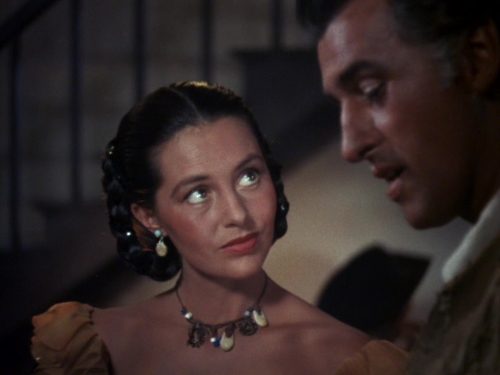
The Mexican actress with maybe the most soulful pair of eyes in the business. The wistful look she bestows on Gary Cooper as he stands alone in an empty street in High Noon is as good a way to announce one’s arrival in the genre as I can think of. She brought her unique quality to such movies as Broken Lance, Man from Del Rio and The Badlanders throughout the 1950s. Her appearances in westerns tailed off after that, One-Eyed Jacks with Brando in the next decade and then a small but hugely affecting part in Sam Peckinpah’s Pat Garrett and Billy the Kid.

Julie Adams

Anyone familiar with my writing over the years will be aware of how much I enjoy the output of Universal-International, and the westerns that studio produced are among my favorites. Sometimes it feels as though it’s impossible to watch a U-I western and not see her. Budd Boetticher frequently used her in his movies for the studio – Wings of the Hawk, Horizons West, The Man from the Alamo – and she had good roles for Anthony Mann in Bend of the River and Raoul Walsh in The Lawless Breed and then later on in Joseph M Newman’s The Gunfight at Dodge City.

Debra Paget

Starting out with some small roles in notable films noir (House of Strangers, Cry of the City), Paget struck western gold in the influential Broken Arrow for Delmer Daves. In a sense, one could say she became typecast in westerns, finding herself playing yet again a Native American in White Feather (scripted by Daves) and the powerful and visceral The Last Hunt for Richard Brooks. Typecast or not, she brought a great deal of dignity to those parts and the western genre would be poorer without her performances.

So there it is, my list of ten actresses who have enriched the western over the years. I had to indulge in a bit of ruthless trimming to keep it down to ten, but that’s to be expected and I also anticipate that my picks aren’t going to satisfy everyone. Well, that’s the nature of lists and half the fun is hearing others point out who they would have included instead. Feel free to disagree in the comments section below.