Bedelia

The movie industry has always been keen to capitalize on what is perceived to be a winning formula, one glance at the franchise-heavy roster of movies that get approved these days ought to provide ample evidence of that. When Otto Preminger’s adaptation of Laura proved successful, it should not comes as any surprise that another novel by Vera Caspary with a single word title derived from a woman’s name soon caught the attention of filmmakers. So it was that Bedelia (1946) came to the screen, not via Hollywood this time though, but through Rank in the UK. It is an interesting yet not wholly successful work, partly due to the fact that inverted mysteries such as this tend to be tricky subjects at the best of times, and partly as a result of a cast that, the leading lady excepted, feels a little lackluster.

The opening plays out over a portrait of Bedelia (Margaret Lockwood), with a narrator leading the viewer into the story, placing the opening scene in pre-WWII Monte Carlo. The narrator is a man by the name of Chaney (Barry K Barnes), ostensibly a painter but it’s clear enough that this is not his real profession. He’s a hunter of sorts, I suppose, and it is apparent that the title character is his quarry. She is on her honeymoon, having just married the older and decidedly staid Charles Carrington (Ian Hunter). Chaney quietly finagles his way into making the acquaintance of this couple of newly-weds. Carrington is a man in love, starry eyed and besotted in the myopic way that only those caught up in the romance of a late spring can be. Chaney has no such illusions to trouble or dazzle him and he, as do we the viewers, sees that Bedelia has constructed an elaborate cocoon of deceit around her, a shell of deception to hide her true motives and character. I don’t think it constitutes a major spoiler if I state outright that this woman is what we would now refer to as a serial killer, one who collects well-to-do if not explicitly wealthy husbands in order to dispose of them and cash in on the insurance. Carrington has become her latest acquisition, and by the time they return to his home in England, his fate has effectively been sealed. It only remains to be seen whether, or indeed how, her scheme will succeed, or whether Chaney, her husband or those in their social circle will manage to put paid to it.

Vera Caspary’s source novel was set in the US, but the film saw the action shifted to the UK. Like all inverted mysteries, it is essentially a tale of suspense, relying on the viewer becoming absorbed in the process of following a criminal who is planning out what they hope will be an undetectable crime. The suspense arises from our being that half step ahead, knowing what the ultimate goal is, and juggling hope and frustration as we will the would-be victim to shake the sleep from their eyes, and wonder how or if the inevitable can be sidestepped. In a sense, it is hard to avoid comparing this film to Laura, although I dislike doing so in general and on principle – I reckon if a writer or filmmaker has taken the trouble to produce a work for our entertainment, then the least we can do is try to appreciate it or assess it as a discrete entity. As I say though, the temptation is there, and I feel the film comes up a little short under the circumstances. The story is good enough, Lance Comfort’s direction is smooth and suitably stylish, and Freddie Young’s cinematography contains some attractive flourishes, although it’s not difficult to see where it’s all headed.
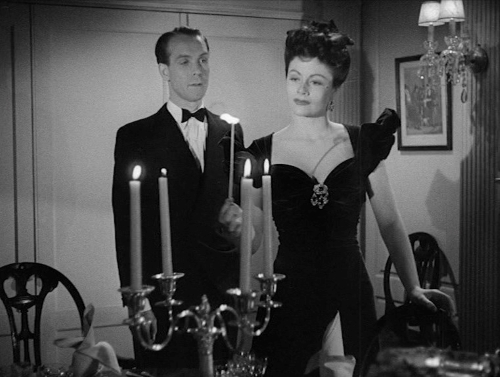
Margaret Lockwood was one of the biggest stars of British cinema in the 1940s, courtesy of her work for Hitchcock, Carol Reed and the Gainsborough melodramas. She is fine as the title character, a deeply disturbed woman who successfully buries her greed and duplicity beneath a poised and polished exterior. We are onto her right from the beginning, those petty lies and that odd reluctance to be photographed or even have her portrait completed sending out strong signals of the presence of a wrong ‘un. Yet she displays a kittenish charm that serves to dilute the evil we know lurks beneath the surface, and adds the kind of layering to the character that allows the viewer to care about her even as we hope to see her machinations foiled. I won’t go into details here as I think that would be straying too deep into spoiler territory, but it’s worth noting that a separate and radically different ending was shot for US audiences. I’ve only seen the British ending myself, and I feel it is both appropriate and satisfying in the context of all that went before.

Ian Hunter had a long an varied career, starring in a number of early films for Hitchcock before heading to Hollywood and working with the likes of Frank Borzage and John Ford. By the mid to late 1940s he was back in Britain and Bedelia presented him with a worthwhile role. There is a good deal of high octane melodrama in this picture and his calm, slightly wounded stoicism acts as a counterweight to Lockwood’s more highly strung central performance. He grounds it all and provides the sympathetic figure the audience needs to identify with. This is all the more important as Barry K Barnes invests the character of Chaney with a rather colorless and oddly fey quality, somewhat remote and chilly. As for the others, Anne Crawford probably has the other fairly significant part yet, as with most of the supporting players, there is a sense of someone flitting in and out of proceedings without really making a lasting impression.

Bedelia was released on DVD in a very nice print from Odeon/Screenbound a few years ago, but it looks as though it has since drifted out of print. It’s a solid mystery/melodrama with a hint of film noir about it and definitely worth checking out should the opportunity arise. The inverted structure may not work for everybody and the cast, apart from Lockwood and Hunter, feel a bit anonymous. That said, it does look good and the resolution is bleakly satisfying.

Home to Danger

Somehow, without consciously having planned to do so, I’ve seen myself on a British thriller kick this summer and therefore embarked on this series of short pieces to log my thoughts and impressions as I’ve been going along. There hasn’t been any particular pattern followed but I have permitted certain films to lead me on to others, linking them up in a vague and loose form that probably makes little sense to anyone apart from myself. I appreciated Guy Rolfe in You Can’t Escape, had a fine time with Lance Comfort’s Tomorrow at Ten, and just recently enjoyed Terence Fisher’s direction of The Last Man to Hang. Those titles and the others I’ve been highlighting are all either films noir or crime/mystery pictures of one kind or another. All of this leads me to Home to Danger (1951), a film noir/whodunit hybrid starring Guy Rolfe, produced by Lance Comfort and directed by Terence Fisher.

Barbara Cummings (Rona Anderson) is the one coming home and the danger referred to lies in the stately pile she has just inherited from her late father. She’d been in Singapore and had left England under something of a cloud and so she feels a certain reticence about her arrival back in the family residence, particularly when she learns the inquest into her father’s death recorded a verdict of suicide. There’s a touch of guilt there but not too much – she knows she wasn’t responsible and no=one seems keen to attach any blame in that direction. However, it’s also clear that late changes to the old man’s will meant Barbara comes into everything of value, while some others who might have had what could be termed expectations have been either cut out at the last minute or not had the chance to be included. Although Barbara has an ally and someone to look out for her in the shape of debonair author Robert Irving (Guy Rolfe), there is a very real sense of menace following a botched attempt on her life. The question is who is behind it all, and what’s their motive?

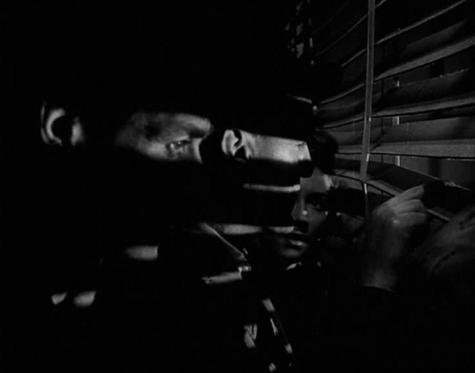
Home to Danger is one of those slightly unusual amalgams of the country house whodunit and an urban film noir. The former characteristics are to the fore in the earlier stages following the new heiress’ return home. Terence Fisher gets good mileage from the manor house surroundings, and moves his camera around atmospherically, also creating some memorable and noteworthy visuals during the shooting of the exteriors. The action then switches back to town for a time in the course of the investigation into extremely dubious shooting. Again, Fisher is to be commended for altering the style appropriately and presenting different, but equally effective, imagery. The plot is entertaining and engaging enough and the director ensures, with the aid of those shifts back and forth in location, that the hour or so running time is full of incident.

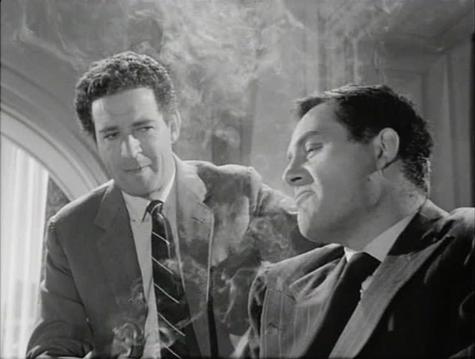
Rona Anderson and Guy Rolf make for an attractive leading couple. Anderson has vigor and guts, and a quality which makes one want to root for her. Alongside her is the suave and assured Rolfe, winning viewer sympathy every bit as effortlessly. The likes of Francis Lister and Alan Wheatley drift in and out of the shadows and keep us guessing as to their real aims. A little further down the cast list is a young Stanley Baker, making the most of his smallish but vital role as a faithful and simple servant, hinting at the great things still to come later in his career.

Home to Danger should be easy enough to locate. It is available on DVD as part of a double bill with Montgomery Tully’s Master Spy in the UK via Renown. As far as I know, it’s also been released in the US as part of a set of British thrillers from a few years back. The transfer is mostly OK; although there is some weird shimmering effect that I noticed early on, it seems to settle down as the film progresses. The movie itself is a modest enough affair which, nevertheless, manages to pull off all it sets out to do. It tells a good crime story efficiently in a little over an hour, with an attractive cast and professional and stylish direction by Terence Fisher.

Tomorrow at Ten

Finding myself writing about a lot of crime movies of late, I consequently find myself ruminating over what goes into making these genre pieces successful. Well of course it is a combination of writing, acting and direction, with a some additional assistance from sets, photography and music from time to time. Still those are broad terms which encompass a lot, but I think one critical element that grows out of their synergy is what we term suspense.  The best examples of the crime movie trade heavily on this, using it to hook and then captivate the audience. Tomorrow at Ten (1963) is a first-rate British crime picture that does this in superb style.

Sometimes I think that the worst crimes can inspire  the best films. Kidnapping is an especially nasty and traumatic piece of work, putting a life at risk and simultaneously exerting sadistic psychological pressure on those faced with the ransom demands. That’s in real life. However, in the fictional world of the movies the dramatic potential of such situations is practically boundless and, depending on the perspective from which the story is seen, multi-faceted too. Here we are introduced to man calling himself Marlow (Robert Shaw) who is in the process of adding the finishing touches to a meticulously planned scheme; in the secluded house he has rented, we see him happily gutting a child’s stuffed toy and snugly fitting what is clearly a device with a timer. This golly will be used superficially as a comforter for the little boy Marlow will abduct and also as a form of dreadful insurance to secure the cooperation of the victim’s father.

It’s barefaced stuff, snatching the boy and then presenting himself to the shocked parent to calmly demand money and immunity. Marlow is counting on his threats either keeping the police out of the affair or inducing the wealthy father to use his influence to neuter their efforts. But he reckons without the grim determination of DI Parnell (John Gregson), a man with a clear and uncompromising sense of justice. In the finest dramatic tradition though, even the best plans hit snags, and in this case it’s a huge one. In fact, the powerful emotions released by his actions has wholly unforeseen results for Marlow, dragging the story in a different more intense direction and raising the suspense to a completely new level.

Briefly scanning back through pieces I’ve written here in the past and I don’t believe I’ve included any films directed by Lance Comfort yet. Bearing in mind how many of his movies I have to hand, this seems like an odd omission and certainly not an intentional one. Comfort worked in a range of genres but he had a real talent for crime movies and thrillers, and he also managed to wring the very best out of some particularly spare projects. Tomorrow at Ten makes use of a small central cast, around a half dozen people and keeping the focus on Gregson and Shaw in particular. When one thinks of these British quickies there’s a tendency to expect simple and direct visual setups, but Comfort had the experience and the resultant confidence to move his camera around more imaginatively and there are a number of extraordinarily stylish shots on view. And he was a highly professional filmmaker, never losing sight of the thread of the narrative and the necessity to keep everything moving relentlessly towards the resolution.

Robert Shaw was one of the big stars of British cinema, although he had yet to make his major breakthrough – that was to come shortly with his portrayal of the cold and dangerous Red Grant in From Russia With Love.  As an exercise in frighteningly psychopathic behavior, Tomorrow at Ten provided a pretty good warm-up, allowing him to create a genuinely memorable villain – there’s something chilling about his gleeful appreciation of his own cunning. Opposing hm is the stolid and reassuring presence of John Gregson as the dogged and principled policeman. As the plot develops, it’s Gregson who gets the greater share of screen time and he brings the audience along on the emotional journey as he hunts against the clock for the clue that may vindicate his methods and, more importantly, save an innocent life.

Tomorrow at Ten was released on DVD by what was Odeon well over ten years ago. That edition appears to have gone out of print now but, as far as I can see, there should be used copies available to buy for reasonable prices online. The transfer on that DVD was in Academy ration, which is unlikely to have been correct for an early 60s film. There are also some instances of print damage to be seen but overall the presentation is perfectly watchable. The movie itself is wonderful little hidden gem, one where the suspense is increased artfully and built around a mightily absorbing tale. Highly recommended.