The Iron Curtain

The 50s saw the red scare, fanned by McCarthyite rhetoric, blaze into life in Hollywood. With the HUAC inspired blacklists casting a dark pall over the movie capital, there was a kind of desperation in the air, a need to prove one’s patriotism and simultaneous rejection of the evils of communism. This meant the decade saw the production of a number of films directly addressing the issue and sending out a message to the witch-hunters that the industry was aware and prepared to play ball. Whatever contemporary reactions may have been, these films, by and large, not only seem lousy when viewed today but they also remind us of all those careers and lives left in tatters by the taint of the blacklist. From a purely artistic standpoint, the ham-fisted presentation of political dogma and the judgemental tone adopted both bog down the narrative and, in the worst cases, leave a very sour taste. However, there are always exceptions, and William Wellman’s The Iron Curtain (1948) is one of the more polished and less hysterical pieces of work from a generally unsavoury interlude in cinema history. I think this is partly due to the skills of Wellman as a filmmaker, and partly as a result of the production taking place right at the beginning of HUAC’s reign of terror, before it’s raging paranoia had fully matured.

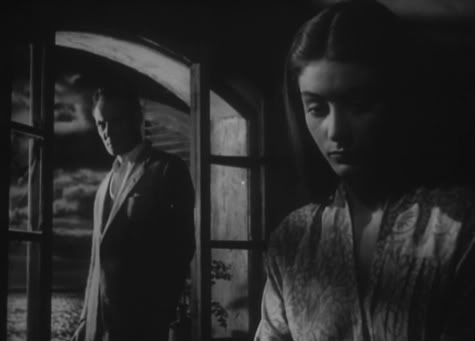
In keeping with a lot of Fox movies of the time, the film opens with a declaration that what we’re about to see is a true story, shot on real locations. The cool, authoritative tone of the narrator further enhances the sense that this is something more than mere Hollywood fantasy. I’ve often found that there’s a tiresome quality to some of these earnest eulogies to the dedication and responsibility of various government agencies remaining ever vigilant in the face of multiple threats from without and within. What sets the introduction of The Iron Curtain apart is its location if nothing else. The entire film takes place in Ottawa, Canada, so we are spared yet another hymn to the efficacy of the FBI, Treasury agents or other assorted G Men. Instead, the plot follows the establishment of a Soviet fifth column in Canada during the war and its subsequent dismantling as the big freeze of the Cold War set in. As I said, the movie doesn’t takes us behind the scenes of one of those complex government sting operations that were much favoured by contemporary filmmakers, but concentrates on telling the tale of how one man brought a spy ring to its knees off his own bat. The man in question is Igor Gouzenko (Dana Andrews), a cipher clerk freshly assigned to the Soviet embassy in Canada. The first third of the film goes to great pains to establish how loyal Gouzenko was to his own country and political system, one of those resolute, unthinking servants of the state with clear and direct convictions. As we observe the steadfast Gouzenko going manfully about his duties, we’re also afforded a view into the closed world of the Soviet diplomatic mission. And it’s a drab, forbidding world at that, peopled with stony-faced officials and dripping an atmosphere of suspicion and secrecy. There’s also a glimpse at the careful construction of the spy network, whose eventual unravelling provides the dramatic backdrop for the latter stages of the story. It’s Gouzenko who brings the whole thing crashing down, and his motivation for doing so is a slow realization that he’s serving a flawed master. The catalyst for his decision is the arrival in Canada of his wife Anna (Gene Tierney), and the birth of a son. The presence of this human element greatly strengthens the story and adds to the dramatic tension of the final third. By doing so, the political aspects necessarily take a back seat to the unfolding drama of a family suddenly cast into a perilous situation.

Even if it’s viewed purely as a propaganda piece, then I think The Iron Curtain is remarkably successful. The reason for that is the script and Wellman’s ability to sidestep the trap of sensationalism and instead adopt a more matter of fact tone, letting the events and their inherent drama speak for themselves. Of course, the air of quiet dread that seems to hang over the scenes in the embassy emphasises the stifling lack of personal and intellectual freedom, but this is quite subtly achieved. The ever-present music from Soviet composers, the inclusion of which in the score apparently caused something of a minor international incident at the time, has the effect of building up the brooding, sinister feel. The only time we take a detour into the realm of direct political preaching is when one of the Soviet residents (Eduard Franz) seals his own fate by getting drunk and lamenting the betrayal of the ideals of the revolution by the apparatchiks who have risen to prominence in Moscow. As a thriller, the film really comes into its own in the final third, as Gouzenko decides to take that leap of faith and defect. Wellman, and cameraman Charles G Clarke, employ classic film noir techniques of lighting and shooting angles to ratchet up the tension during Gouzenko’s theft of incriminating documents from the embassy, and then again in the climactic standoff in his apartment. Another notable aspect of the film is how the government agencies – I’m guessing the Canadian setting facilitated this slight subversion – are conspicuous by their lack of involvement. In fact, there’s initially a downright refusal on the part of the authorities to become involved in what they take to be the ravings of a lunatic.

Dana Andrews was never one of the most emotive or demonstrative of actors, the kind of guy who tended to keep it all inside and bottled up. Such characteristics can unfairly lead to accusations of woodenness when the truth is it’s simply another, and no less effective, style of performing. As it happens, that tight-lipped anxiety that he had a talent for fits the character of Gouzenko to a tee. After all, this is a man who’s been trained to exert self-control in the first place and who then finds himself in a situation where both his own and his family’s survival depends on the maintenance of a facade. Still, Andrews conveyed more than a blank countenance when he had to, the eyes in particular registering the mounting pressure Gouzenko was subjected to. Gene Tierney was making her fourth film alongside Andrews, the most successful being their partnership in Laura a few years earlier, and was good enough in a fairly undemanding role. Her main purpose was to act as a softening and humanizing influence on her previously stiff and determined husband, and that’s how she comes across. However, arguably the most memorable work is produced by the supporting cast. Berry Kroeger was making his screen debut as the shadowy head of Canada’s communists and carries off the part of the principal villain with aplomb. Playing such a Machiavellian puppet master required a good deal of restraint combined with implicit menace. Kroeger was blessed with the features and voice that were ideally suited to this kind of role and he makes a very strong impression. Stefan Schnabel also shines as the head of the NKVD, masking a dangerous ruthlessness with an outwardly reasonable persona. And finally, June Havoc appears as the embassy secretary with a wandering eye and a special brief to vet the reliability of all new staff.

I think the only DVD edition of The Iron Curtain to date is the one issued in Spain by Fox/Impulso. In terms of picture quality, it’s one of their mid-range efforts. There hasn’t been any restoration work done, as can be seen from the cue blips and so on, but the print used is in generally good condition and doesn’t display noticeable wear. Extras are limited to the usual gallery and text data on the cast and crew. The disc offers English and Spanish soundtracks – the Spanish subtitles are optional and can be deselected via the setup menu. While I certainly don’t think this film represents Wellman at his best, it is an interesting addition to his body of work. The main attraction of The Iron Curtain though lies in its historical significance, coming as it does near the beginning of the red scare. It’s interesting to observe the comparatively restrained approach it takes to its emotive subject matter in contrast to some of the more hyperbolic and offensive offerings that the following decade would eventually produce. Generally, this is worthwhile viewing for fans of Wellman and for providing a snapshot of early Hollywood reactions to the HUAC assault.

The High Bright Sun

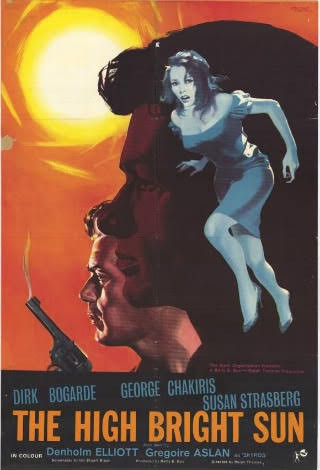
I’m not sure how many movies have been set during the guerilla campaign in Cyprus in the 1950s, but The High Bright Sun (1964) is the only one that I can recall seeing. It’s all too easy for a story which makes use of such a background to become bogged down in politics and thus dilute the drama. However, this film has the good sense to avoid becoming too mired in ideological matters and instead concentrates on telling a suspenseful yarn that could have been relocated to most any conflict zone without losing its edge. As such, we end up with a well paced thriller that builds tension relentlessly and holds the attention right to the end.

The tale is all about finding oneself in the wrong place at the wrong time. Juno Kozani (Susan Strasberg) is a Cypriot-American student visiting the island where her father was born and staying with some old family friends. Having witnessed the aftermath of the fatal ambush of two British soldiers by EOKA guerillas, she is interviewed by an intelligence officer, Major McGuire (Dirk Bogarde). Although Juno can only tell him the few mumbled words of a mortally wounded sergeant, McGuire’s suspicions are aroused. He’s one of those jaded colonial campaigners who has grown accustomed to the guarded silence of the locals, and routinely takes it for granted that details will be withheld. In this case though, Juno has told him all she knows, but he has a hunch that the guerilla leader, Skyros (Gregoire Aslan), was involved. What both he and Juno are unaware of at this stage, however, is that her host is using his flawless respectability to cloak his involvement with the paramilitaries. Following a vaguely unpleasant dinner party attended by a family acquaintance, Haghios (George Chakiris), Juno blunders into the library and sees too much for her own good – a secret visit by Skyros. This is the point at which the story really shifts into gear, with Juno having inadvertently placed herself in a very dicey position. She now has to do her utmost to convince her hosts – and in particular, the hostile and dangerous Haghios –  that she didn’t notice anything untoward. In the meantime, McGuire is playing his hunch that Juno knows more than she can or is willing to say. By the by, it’s decided that Juno represents too great a threat and she finds herself the quarry of the seemingly unstoppable Haghios, first in a hunt across the beautiful countryside, and later holed up and under siege in McGuire’s apartment.

Director Ralph Thomas isn’t best known for his thrillers but he did dabble in the genre, including among his credits the excellent The Clouded Yellow and the unloved remake of The 39 Steps. The lion’s share of his work concentrated on comedies, but he plays down that aspect in The High Bright Sun, and succeeds in producing a tight thriller that draws you in as it goes along. The scene where Juno learns that what she thought was going to be a trip to the airport and safety is really a ploy to see her assassinated by the roadside is nicely shot. It also leads into the chase across the island where Thomas, and cameraman Ernest Steward, gets great value out of the stunning locations – Italy apparently standing in for Cyprus. The script, by Ian Stuart Black and Bryan Forbes, does contain some risible and admittedly clunky dialogue at a few points yet it also maintains its focus throughout and does its best to tell a story rather than descending into political diatribe. If anything it points out the dirty and indiscriminate nature of guerilla warfare, where the innocent often suffer the most at the hands of both combatants.

I thought all the actors turned in nicely measured performances, with Susan Strasberg doing fine as the girl caught out of her depth in a situation that’s spinning out of control. For the most part she underplays, and that’s fine as she’s supposed to be someone who must keep a careful check on her emotions lest she should betray herself. Dirk Bogarde wasn’t overly stretched in this one, though he does bring just the right degree of weary cynicism and self-effacing humour to his role. As the villain of the piece, the fanatical and homicidal Haghios, George Chakiris shows a surprising menace. He really did the coldly determined bit well, only the prospect of indulging in some physical violence bringing a gleam to his eye. There’s also a wonderful supporting part for Denholm Elliott as the apparently dissipated and alcoholic friend of McGuire who proves himself to be both ruthless and resourceful.

The High Bright Sun comes to DVD in the UK via Spirit, who have recently begun distributing a growing number of British titles from the ITV library. On the positive side, the film looks pretty good despite an apparent lack of restoration, without any major damage on view. The colour fares well and does justice to the location photography. The downside is that the movie opens with the credits letterboxed at about 1.66:1 before reverting to 1.33:1 for the remainder of the running time. I think we’re looking at an open matte transfer here, though it might be slightly zoomed too, judging from the extraneous headroom in some shots. This is by no means perfect, but it’s not a totally botched job either – a 1.66:1 movie doesn’t suffer as badly from a compromised aspect ratio as is the case with those composed for wider presentation. The disc is a very basic affair offering no subtitle options and no extra features. I found the film to be a well produced political thriller, with the emphasis on the thrills rather than the politics. It may not be an outstanding piece of work, yet the performances, scripting and direction are all professional and polished. Crucially for a thriller, it does deliver the necessary amount of suspense, tension and excitement. I’d call it a solid piece of entertainment that looks good and doesn’t outstay its welcome. I recommend giving it a chance – it’s certainly worth a look.

The Naked Edge

poster314-1

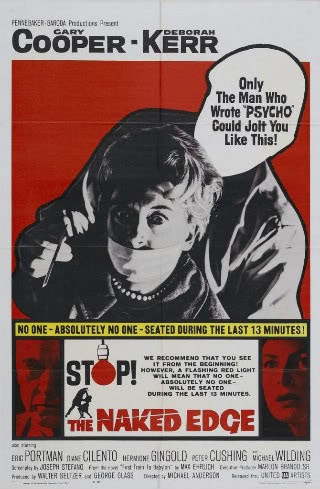
I guess it’s inevitable that cinema, like most any form of artistic expression, will be influenced by the body of work that already exists. Remakes, reimaginings and homages seem to have been with us forever, and one figure who’s arguably been imitated more than any other is Alfred Hitchcock. Both the stories he was drawn to and the filming techniques that he frequently employed have been referenced so many times that there’s a subgenre of “Hitchcock style” thrillers. The Naked Edge (1961) may not be all that well-known but it certainly belongs in that category. Of course, as with most (all?) imitations, it fails to live up to the standards of the movies it alludes to – once a filmmaker sets out on this path he necessarily sacrifices a lot of his own individuality. Still, that doesn’t mean that the movie in question can’t be entertaining in its own right; after all, half the fun for the viewer comes from recognizing the source of inspiration.

The pre-credits sequence opens proceedings in lurid fashion with a murder – a businessman taking a knife to the guts – and hurls the viewer right into the action. There follows a trial where the evidence of George Radcliffe (Gary Cooper), an American resident in London, appears instrumental in securing the conviction of Donald Heath (Ray McAnally) for the murder of their boss and the accompanying theft of the firm’s money. Heath, naturally perhaps, protests his innocence and Radcliffe hastily exits the emotive atmosphere of Old Bailey with his former colleague’s accusations of treachery ringing in his ears. Even at this early stage, the clouds of suspicion are gathering around Radcliffe; the unrecovered loot, his talk of suddenly acquired wealth and an edgy encounter with a disbarred solicitor (Eric Portman) initially stir doubts. Jump forward six years and we find Radcliffe now heading a successful partnership and clearly wealthy. However, it’s only when a long-lost blackmail letter is delivered to his wife that we get to the nub of the matter. Radcliffe’s wife, Martha (Deborah Kerr), may have harboured a few mild suspicions before, but the letter that explicitly accuses her husband of murdering his employer and using the stolen money to finance his own business plants a particularly stubborn seed. A combination of apparent evasiveness by Radcliffe when asked any questions about the murder and subsequent trial and some downright suspicious behaviour on his part cause Martha’s doubts to grow. The deeper she delves into the past, the more convinced she becomes that the full truth may not have come out in court. With her marriage starting to crumble in this sea of distrust, it gradually dawns on Martha that her own life may be in jeopardy too.

£38

A few years earlier, Michael Anderson had directed another “woman in peril” picture – Chase a Crooked Shadow – and in my review of that I commented on his tendency to indulge in some self-conscious effects. The Naked Edge was clearly trying to tap into a Hitchcock vibe (the poster prominently highlights the involvement of Psycho screenwriter Joseph Stefano), and Anderson’s direction makes use of countless low angle shots and zooms. Of course, this isn’t an especially bad thing as we’re treated to some nicely composed shots that accentuate the tension. The climax, where preparations are meticulously laid for an attempt on Martha’s life, consists of a whole series of well-judged shots cut together expertly. Where the film does become overly derivative, and indeed contrived, is in the poor handling of the dialogue. It reaches the point where I found myself imagining the writers sitting around and scratching their heads over how they could mangle the words a bit more to ensure the ambiguity of Radcliffe’s character was rammed home. I feel a lighter touch would have sufficed.

Cooper’s performance in the lead contains enough of the man’s own natural diffidence and reserve to get the job done satisfactorily. This was Coop’s last screen role and, even if he doesn’t look exactly ill, he does exude an air of age and weariness. In all honesty, I generally find it difficult to watch performances from actors when I know they hadn’t long to live afterwards – it’s even harder when the person is someone whose work I’ve grown to admire. Whenever Cooper talks about safeguarding his future I can’t help but get that hollow, sinking sensation. In the role of Martha, Deborah Kerr was handed what was really the pivotal role; she’s the one from whose perspective the unfolding events are seen. In order for the viewer to retain doubts it was necessary for Kerr to convincingly portray a woman who could never be quite sure of anything herself. I think she managed that, never allowing histrionics to overwhelm her character and thus alienate the audience. For the most part, the supporting roles are fairly small yet highly memorable. No-one possessing even a passing familiarity with British cinema of the period  could fail to be impressed by a cast list that features: the aforementioned Eric Portman and Ray McAnally, Peter Cushing, Michael Wilding, Wilfrid Lawson, Diane Cilento, Hermione Gingold and Joyce Carey to name but a few.

The Naked Edge is out on DVD in the UK from Cornerstone/Palladium. The film is letterboxed (not anamorphic) at about 1.66:1, which would fit a film of this vintage. The transfer is generally good and fairly clean, although I did notice at least one cue blip. There is a certain softness to the image at times and the black levels are decidedly on the grey side. While I wouldn’t term it a displeasing transfer, it could stand some improvement too – even so, it’s never less than watchable. There are no subtitles offered and no extras. So, how do I rate it as a movie? As I’ve already said, the whole “woman coming to distrust a suspicious husband” storyline invites obvious comparisons with Hitchcock; Anderson’s direction throughout only compounds that, and there’s a short sequence that replicates one of Hitch’s more heavily criticised ploys. On the whole though, I think the film is generally successful in keeping the atmosphere tense and the viewer guessing. Let’s call this a cautious recommendation.


Payroll

poster96_zpsmeo0wngl1

As British cinema entered a new decade in the 1960s it was possible to discern a shift in attitude, a gradual move away from the style that been dominant in the post-war years. Previously, films had concentrated largely (though by no means exclusively) on the middle classes and the concerns that occupied them. That aspect had been especially noticeable in crime pictures and thrillers; and while it’s not without its attractions and merits, it did impose certain restrictions and sometimes led to an oversanitized or slightly twee form of storytelling that set it apart from the grittier fare that US audiences were exposed to. Naturally, there were exceptions, but they were fairly thin on the ground. However, a film like Payroll (1961) fixed the spotlight squarely on the professional criminals of the lower classes, and the result was a much more explicit portrayal of violence and sexual relations than had been the case before.

Payroll is a heist movie and develops according to the usual formula for such films: planning, execution, and the inevitable unravelling of everything. The story follows three interconnected strands, all of which are vital in bringing about the final resolution. Thus, we see the tale of the criminals, the accomplice, and an unfortunate victim all become bound together in a heady mix of violence, sex and double-cross. The opening has plans being laid to snatch the payroll of a Newcastle factory. The four man gang engaged in this little conspiracy is headed up by Johnny Mellors (Michael Craig), who acts as both the brains and the muscle of the quartet. What initially appears to be a straightforward job is complicated by the decision of the management of the factory to alter their procedure. Abandoning their old methods for having cash delivered, they choose to employ a new security firm with a seemingly impenetrable armoured car at its disposal. Naturally, this necessitates a change of tack on Mellors’ part, and so he puts the squeeze on his inside man, Pearson (William Lucas), to seek out the specs of the armoured car in order to establish its weaknesses. The reason behind Pearson’s involvement with these types is an old and familiar one – a desire to make a quick buck. His wife, Katie (Francoise Prevost), is a war refugee and a greedy woman, frustrated by her nondescript husband’s failure to make good on the potential she thought he had. A weak man living in the shadow of a sneering woman’s disapproval is a prime candidate for corruption, and so Pearson bows to the pressure brought to bear on two fronts. When the subsequent robbery turns sour and leaves two men dead, one of whom is the driver and boss of the security firm, the cracks in Mellors’ plan start to show themselves. Pearson finds himself facing the dual threat of a duplicitous and adulterous wife while also being stalked by a vengeful and suspicious widow (Billie Whitelaw). At the same time, Mellors is struggling to hold in check the increasingly volatile forces within his spooked gang. Ultimately, the sour combination of murder, illicit relationships and plain rotten luck bring matters to a head, and a bleakly satisfying conclusion.

£38]

One of the pleasures of watching British thrillers of this vintage is the glimpse we get of cities and landscapes now transformed. The location filming around Newcastle adds to the gritty and realistic feel of the piece by placing the characters in the down at heel urban world that the genteel classes didn’t inhabit. It’s not hard to see why these men and women might find themselves driven by their desire to escape the drab surroundings. Director Sidney Hayers shot a lot of the movie around run down businesses and decaying lockups, all of which add to the aura of despair. He also did fine work when it came to dealing with the action scenes; the heist itself, a brutal street mugging, and a grotesque double murder in a swamp all reveal an urgent and dispassionate style that’s highly effective.

The casting was also spot on, with Michael Craig displaying the kind of machismo and edgy charm that fits right in with his role as the ruthless gang boss. Of the others making up the criminal foursome, Kenneth Griffith probably comes off best as the jittery, conscience-stricken weak link. Of course, William Lucas is arguably even more successful in conveying human frailty as Pearson; a thoroughly beaten man who’s driven to the very edge of reason by his own guilt and the provocation of his grasping spouse. Francoise Prevost really nailed her portrayal of a latter-day femme fatale, goading her husband into crime before betraying him sexually, and finally crossing up her lover for profit. The other female role, that of Billie Whitelaw’s avenging widow, is equally powerful. The mask-like set of her features takes on a terrible aspect as her relentless quest for righteous retribution drives one man out of his mind and another to his death.

Payroll has been released on DVD in the UK by Optimum and it looks very good. The film is presented in a progressive and anamorphic transfer at 1.66:1, and the print used is in particularly good shape. The image is clean and sharp, and I can’t honestly say I was aware of any significant damage. As usual with Optimum titles, there are no extras offered and no subtitles. However, the movie itself is a genuine keeper. If you’re looking for a hard-edged British thriller with steel in its guts then you won’t go far wrong with Payroll. It has that post-noir feel to it that’s enormously attractive, and I strongly recommend checking it out.


23 Paces to Baker Street

The films which I’ve been writing about lately have all been fairly heavy on symbolism and meaning, so maybe it’s time to dip into something lighter for a change. As such, I feel that a tight, solid mystery that has no pretensions of being anything other than a piece of entertainment is as good a choice as any under the circumstances. This seems a fair summation of 23 Paces to Baker Street (1956) – a not especially well-known thriller that nevertheless features an intriguing plot and polished, professional work from all the participants. The movie belongs in a small sub-genre of films (e.g. The Spiral Staircase, Rear Window, Wait Until Dark) where the hero/protagonist is suffering from either a temporary or permanent disability. There’s nothing particularly exploitative about these films, the disability in question serving merely as a means of increasing tension or suspense – and often, paradoxically, emphasizing the superiority of the hero over the villain.

The story here derives from a book by Philip MacDonald (author of some excellent mysteries like The Rasp and The List of Adrian Messenger)  and concerns a blind playwright who finds himself inadvertently drawn into a shadowy plot. Phillip Hannon (Van Johnson) is an American residing in London, having suffered some unspecified accident which has left him blind. That this misfortune has shaped his somewhat irascible character is established early on when his work is disrupted by the unexpected arrival of an old flame, Jean Lennox (Vera Miles), who evokes understandably painful memories of happier times. It’s as a result of this visit that Hannon, perhaps wanting to prove his independence, sets off alone to a local pub for a drink. And here’s where the mystery begins; while seated in a booth, he overhears snippets of a conversation through the partition with the adjoining lounge bar. Of course his lack of sight rules out the possibility of identifying the man and woman involved, but what he hears is sufficient to arouse his suspicions that something, conceivably an abduction, is being planned. The problem is that with his disability preventing a straightforward pursuit, and the police’s subsequent insistence that the meaning of the fragmented dialogue is open to interpretation, he’s at a loss to know how to proceed. However, bit by bit, through a combination of good fortune and dogged amateur sleuthing by Hannon, Jean and his servant (Cecil Parker), the body of evidence starts to grow. Everything builds relentlessly towards a tense climax that is reminiscent of Rear Window, where the hero finds the means to turn his physical handicap to his own advantage.

What makes a story like this succeed is the presence of the physical disadvantage which the protagonist has to overcome. Having a hurdle such as Hannon’s blindness to negotiate makes it easier to sustain the viewer’s interest and demands an added touch of creativity in the scripting. I’ve often found that when a tale involves merely exploiting the massive manpower and resources available to law enforcement agencies, it’s much more difficult to feel sympathy for the hunters. Maybe that’s just my natural identification with the underdog coming through, but the (almost) lone and struggling figure always seems more attractive. Henry Hathaway’s direction is smooth and professional in a movie where the action is largely confined to interiors – entirely appropriate since the focus is on a man whose mobility is necessarily limited by his condition. The wide screen of scope is ideal for creating a sense of space in outdoor shots, but Hathaway’s experience meant that he was also aware that careful composition resulted in equally effective visuals in interiors. Generally, there’s a tense atmosphere maintained throughout, but there’s also a nicely judged comedic interlude where Hannon sends his servant/secretary off in pursuit of a suspect; Cecil Parker brings a welcome, lightly comic touch to this stalking sequence and the subsequent reporting of his progress. In the lead, Van Johnson is mostly fine in conveying an alternating mix of frustration and enthusiasm, the shape of the investigation both reflecting and influencing his moods. I also found him convincing as a blind man, the only time he let it slip a little was during the climax where a few reactions didn’t quite ring true. Vera Miles wasn’t given a lot to do as the faithful former lover, much of the time playing a clichéd and stereotypical character. Of course, that no real criticism of the actress, just the part she was handed. The supporting cast is full of fine British character actors: the aforementioned Cecil Parker, Maurice Denham, Estelle Winwood, Patricia Laffan and, in a droll turn as an assassin that reminded me a little of Edmund Gwenn in Foreign Correspondent, Liam Redmond.

23 Paces to Baker Street is a Fox production and remains absent on DVD in both the US and the UK, however, I believe there’s a copy of the film available in Spain but I haven’t seen it. Instead I picked up the Australian release by Bounty Films when it was issued late last year. The disc is completely barebones, but the transfer is pretty good. The movie is presented correctly in anamorphic scope and although it doesn’t appear to have undergone any kind of restoration there’s no especially distracting damage either. The colours are strong, the film has been transferred progressively and the price is acceptable. The only beef I have with the presentation, and it’s a very minor one, is the curious decision to market the title as part of the Bounty Noir Classics line – this is a standard mystery/whodunit and doesn’t even approach noir territory. This is an entertaining, glossy and well-paced thriller that’s capable of holding the viewer’s interest from beginning to end. I found it satisfying and have no problem giving it the thumbs up.

Violent Saturday

poster297

Stories about heists that invariably go wrong somewhere along the line have a kind of evergreen quality about them. I don’t think it’s anything as simple as the need to see the moral balance restored that’s the attraction, instead it’s more a kind of perverse wish fulfillment for all of us living in an imperfect world to witness even the most meticulous plans of smart guys turn pear shaped. Violent Saturday (1955) is one such movie, detailing the build-up, execution and aftermath of a bank robbery in a small town. It’s also a film which takes its time creating expectations about certain characters, only to show that those assumptions can frequently be misleading.

Essentially this is a film of two halves. The opening section is something of a darkly soapy melodrama, wherein the principal characters, and their roles in the community, are all established. The two people that are focused on most are Boyd Fairchild (Richard Egan), the heir to the local copper mining facility, and the mine foreman Shelley Martin (Victor Mature). These men are living in the brave new world of a booming 50’s America, all shining, chrome-laden automobiles and homes filled with the latest modern conveniences. Yet, despite the trappings of material success that surround them neither man is particularly at ease with himself. Fairchild is drinking too much in an attempt to blot out the inferiority complex that comes with being the son of a self-made millionaire, and keep his mind off the numerous affairs his wife has indulged in. Martin, on the other hand, is carrying round an entirely different set of baggage; his marriage is a happy one and his success is all of his own making but he’s burdened by a sense of guilt for not having seen active service in the war, a feeling of inadequacy compounded by his failure to appear heroic in the eyes of his young son. Additionally, we’re afforded glimpses into the lives of a few of the town’s other citizens – a financially pressed librarian driven to petty larceny, and the outwardly prim but repressed and voyeuristic bank manager. While these various strands of small town life are being laid before us, three strangers weave their way among them. These men (Stephen McNally, Lee Marvin and J Carrol Naish) are career criminals, come to a town they see as a soft touch to raid the bank. As the citizens go about their daily lives and try to cope with their personal issues, the three newcomers calmly and deliberately plan their heist. The second part of the movie, and the most gripping, sees the paths of all the disparate characters converge on a Saturday afternoon in an explosion of physical and emotional violence.

£29

Director Richard Fleischer’s career was on an upward curve at the time Violent Saturday was made; he’d come off making a number of interesting noir movies, two of which (Armored Car Robbery & The Narrow Margin) are especially noteworthy. While I don’t believe Violent Saturday is film noir, it does display some of the style/genre’s sensibilities – the doomed robbers and the facade of respectability concealing a darker reality. The structure of the film is clearly designed to provide a back story for the characters and flesh them out, thus heightening the impact of the abrupt intrusion of violence into their lives. As far as that goes it’s only partially successful; the introduction of the librarian and the bank manager has a dramatic potential that’s never fully explored, and in the former’s case the the plot leaves her fate dangling and neglected. The banker (Tommy Noonan) does at least play a pivotal role, albeit in a negative way. His creepy passivity undergoes a transformation in the course of the heist and he finally resolves to take some positive action in his life. It’s unfortunate, however, that his new found steel acts as the catalyst for the bloodletting that follows. Victor Mature was well cast in the role of the family man dogged by the shadow of cowardice. There was always an undercurrent of melancholy and sensitivity about him, and the film puts that to good use. He too experiences a reversal of fortune, where adversity reveals an inner strength and toughness whose existence he doubted. Having said that, the message that’s ultimately conveyed by his actions, and the reactions of others to them, isn’t one that sits entirely comfortably with me. Of the three criminals, both McNally and Naish perform competently without ever being particularly memorable. The real star is Lee Marvin. Dapper in appearance and ruthless in behaviour, he gets the better lines and makes the most of them. It says a lot for Marvin’s talents that he could take what was basically a minor supporting role and deliver the most telling performance in the whole movie. It’s also worth mentioning that Ernest Borgnine has a small, and incongruous, part as an Amish farmer who finds himself and his family drawn into the turbulent events.

To date, Violent Saturday has had three releases on DVD (in Spain, the US and Australia), none of which appear ideal. All of these discs offer the film a non-anamorphic scope transfer. The Spanish release is via Fox/Impulso and, the letterboxing aside, sees the movie looking quite nice. The lack of anamorphic enhancement does take away from the overall sharpness of the image but, on the plus side, the colours look strong and true, and the print doesn’t suffer from any significant damage. Extras, as on the majority of Fox/Impulso titles, consist of some text-based material on cast and crew along with a gallery. Subtitles on the English track can of course be disabled via the menu. The movie itself is a solid crime drama that builds nicely to a suspenseful and action-filled conclusion. It’s not quite top flight material, but it’s not too far off either. I’d rate it as a smoothly directed piece of entertainment that could have used a little extra polish on the script.


Golden Salamander

In the years following the war the British film industry was turning out some quality pictures. The best of them remain rightly celebrated and the poorer efforts have been all but forgotten. There is, however, a kind of murky middle ground crammed full of the kind of movies that were a cut above the average yet not quite top flight material either. I often find myself drawn to these films as there’s much to admire but, seeing as they’re largely off the radar of present day viewers, little or no critical analysis to be found. The Golden Salamander (1950) is a handsomely shot movie, well acted, engagingly plotted and filmed on location. All in all, it has a lot going for it – it should be better known but the fact is it’s something of an obscure film. If this blog has any purpose other than providing a platform for me to record my thoughts then it’s to be hoped that, from time to time, it also introduces someone, somewhere to the kind of picture they might never otherwise have heard of or thought about.

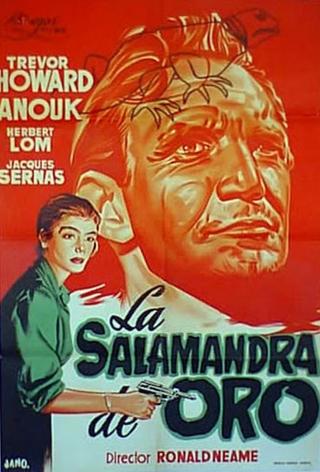
The movie kicks off strongly and initially looks like it’s going to play out like a noir picture. A car is making its way along a stretch of road in Tunisia in the middle of a violent storm. The rain is hammering down relentlessly and the darkness is closed in oppressively on all sides with only the headlights cutting a feeble path ahead. Hunched in the gloom, the driver squints through the rain-streaked windscreen and forges on. By sheer luck he avoids running slap into a landslide that’s taken out the road. As he gets out to try to discover a way round the obstruction, he comes upon a wrecked and abandoned truck. His good fortune in avoiding an accident is revealed to be one of those sneaky tricks of fate when he finds that the truck was apparently part of a gun running operation. This whole sequence takes place without a word of dialogue and the murkiness of a rotten night is only broken by the occasional flashes of lightning that draw attention to the important sights. That wonderful atmosphere is retained as the tired and muddy traveller makes his way to the nearest town, and the welcoming light of the local inn. It’s here that we learn his identity: David Redfern (Trevor Howard), a British archaeologist sent to catalogue and collect some ancient artifacts (including the golden salamander of the title) before overseeing their shipping. His close call on the washed out road has placed him in a perilous position though, with the gun runners suspecting (though at first not sure) that he’s seen something. What draws him deeper into danger is his becoming romantically involved with the young proprietress of the inn, Anna (Anouk Aimee), whose brother is part of the smuggling gang. The plot is a straight thriller that sees Redfern first wrestling with indecision before resolving to take action when a tragic turn of events forces his hand. Even then he has to face up to the fact that the town is a nest of corruption where it’s impossible to be sure who, if anyone, can be trusted.

The two greatest strengths of the film are the visuals and the location work. This was one of director Ronald Neame’s earliest efforts and he, along with cameraman Oswald Morris, takes turns at bathing the screen first in deep, moody shadow and then in bright sunlight. For an up and coming director Neame shows great skill in his handling of composition and framing too, drawing the eye to the pertinent and subtly altering the mood with clever placement of characters and objects. The location shooting in Tunisia adds an air of realism that’s a big asset and lends a greater sense of openness to the exterior work. So much for the positives; the weakness lies primarily in the script, as is so often the case. While I understand that the romance between Redfern and Anna is a necessary ingredient and provides the motivation for the hero to finally act decisively, it has to be said that it’s never a convincing one and, furthermore, slows the story too much in the middle. It leads to that old problem of a strong opening and climax held together by a slightly stodgy and flabby middle section.

Of course, the fact that so much of this part of the story depends on the interaction between Trevor Howard and Anouk Aimee is a contributory factor too. Howard plays the role of Redfern with a slight stiffness, but in fairness I think that’s simply a part of the character and can’t really be taken as a criticism of the performance. The thing is he looked a good deal older than his years at that time and having him play off a teenage Anouk Aimee is a little disconcerting. Additionally, she was acting in only her first English language film and that does seem to have had an effect on her performance – her delivery is never natural and she looks vaguely uncomfortable throughout. Still, there are some fine supporting turns to shore matters up: Herbert Lom is first class as the main heavy, Miles Malleson downplays his comic side as the local policeman, and Wilfrid Hyde-White has a great little part as the slightly seedy pianist channeling Hoagy Carmichael.

I used to have a copy of Golden Salamander that I got as a freebie with a Greek newspaper years ago, and it was a fairly ropey transfer. However, the film has just recently been released in the UK on DVD by Odeon. The disc isn’t a perfect one, there’s a softness to the image here and there, and a few speckles. Having said that, there are also stronger sections where detail is much better defined and print damage is generally minimal. Extras are a selection of trailers for other Odeon titles, a photo gallery and a booklet of liner notes. I’m not going to claim that this movie is a classic just waiting to be rediscovered; there are the issues with scripting and structure to take into account. Still and all, it is a good mid-range effort that has more than enough plus points in its favour to earn it a recommendation.

Spellbound

I’ve heard Alfred Hitchcock’s Spellbound (1945) described as a tale of the lunatics taking over the asylum, and that’s actually not a bad summation. Despite sounding like a glib dismissal, it neatly encapsulates the basic premise of this movie. Exploiting the then fashionable trend for psychoanalysis, and enthusiastically supported by firm believer David O Selznick, it’s a romantic mystery served up as a kind of Freudian stew – and a very tasty one at that. Like all of Hitchcock’s films made for Selznick the producer’s fingerprints are visible everywhere, but there are plenty of instances of that familiar visual flair to ensure that you never forget who directed it.

Amnesiacs always make good protagonists in any movie, the blanked out memories that need to be recovered before any sense of order can be restored automatically generate mystery, and so it is with Spellbound. Our hero (Gregory Peck) is referred to variously as Dr Edwardes, JB, and finally as John Ballantyne (I’ll stick with JB for the purposes of this piece as that’s the moniker he carries for most of the running time) while he struggles to find out his real identity, and more crucially whether or not he’s a murderer. His arrival at a New England psychiatric hospital posing as the new director is initially taken at face value. There are a few comments passed regarding his relative youth for such a responsible position, but there are no other eyebrows raised. What it does spark though is an unsuspected passion in the emotionally repressed Dr Constance Petersen, thus providing JB with one priceless ally. Such a deception cannot hope to endure long though and, sure enough, it’s inevitably revealed that the real Dr Edwardes is in fact dead and the impostor taking his place is very likely his killer. So, still in search of who he is and what he did, JB goes on the run with Constance joining him after a short interval. It’s here that the picture comes into its own, as Constance, with the aid of her old tutor Dr Brulov (Michael Chekhov), employs Freudian psychoanalytic techniques in a race against time to probe the depths of JB’s subconscious and discover the truth. It all culminates in the famous dream sequence, designed by Salvador Dali, whose interpretation lays bare all the secrets. The whole thing is pure, escapist hokum but it’s executed with such style and conviction that you’re completely drawn in. It’s a good illustration of how, apart from his technical achievements, Hitchcock was masterful at taking stories that were essentially tosh and coaxing the viewer into accepting their credibility for the duration of the movie.

I mentioned earlier Selznick’s enthusiasm for the subject matter, and I’d say that’s directly responsible for the film’s biggest weakness. Such was the producer’s zeal that he insisted on the involvement of an adviser on all things psychoanalytical. The result is an overly pious attitude towards the science depicted, from the cloyingly reverential foreword to the kind of mangled dialogue that even Ben Hecht was hard pressed to shape into something presentable. The contrast between the kind of clumsy exposition that Selznick wanted and Hitchcock’s talent for economical storytelling is clear to see in one scene near the end. In the space of a thirty second montage, consisting only of close-ups of Ingrid Bergman’s increasingly desperate features and a few imploring lines, the the trial, conviction and sentencing of JB is dealt with fully. Similarly, the whole, lengthy sequence at Brulov’s house could have proven intolerable in the hands of a lesser director. Instead, through the combination of a wonderfully idiosyncratic performance by Michael Chekhov, Hitchcock’s arresting visual style and the scoring of Miklos Rozsa (alternating between lush romanticism and the unnerving strains of the theremin), it stands as the strongest section of the entire film. Of course, in other places, some of the bravura touches could be said to serve no better purpose than to draw attention to their own inventiveness: the revolver discharged directly into the camera at the end springs to mind, but that’s such a memorable shot that it feels uncharitable and unnecessarily sniffy to complain about it.

It’s said that Hitchcock originally wanted Cary Grant for the lead, and Peck’s performance has been criticized for being a touch too aloof. I can understand where that’s coming from, Peck had yet to find his feet fully in cinema, although I also feel he was actually right for the part. Had Grant been cast I have a hunch he would have brought too much of himself, that innate self-confidence, to the role and thus rendered it less believable. As it stands, Peck had just the right measure of insecurity about him to get across the edginess of a man who doesn’t even know his own name let alone whether or not he’s a criminal. Whatever reservations anyone may have about Peck, it’s hard to fault Ingrid Bergman’s Constance Petersen. She brings real charm and innocence to the part of the slightly uptight academic who gradually learns that there’s a vast gulf between theory and practice when it comes to matters of the heart. There’s nothing the least bit goofy about her, she’s clearly a highly intelligent and capable woman but there’s also a touching vulnerability as a result of her sheltered lifestyle. Aside from the principal performers, there are a couple of excellent cameos in the mix too – the middle-aged cop and his partner discussing the issues he’s having with his mother who are in some ways reminiscent of the travelling salesmen in The 39 Steps, and Wallace Ford as the persistent pest in the hotel lobby – these don’t add anything at all to the narrative but they do enrich the whole experience.

Spellbound has had a variety of releases on DVD in different territories; my copy is the old Pearson release from the UK, which I think has been repackaged and subsequently issued by Prism. I guess there may be better versions out there but that old UK disc is pretty good to my eyes. There aren’t any problems with the transfer, which is clean, sharp and free from damage. There are a range of extras, from text bios and trivia to a gallery and a few clips of Hitchcock interviews etc – I’m pretty sure the latter is replicated on the other Hitchcock titles from Pearson. The movie itself is one of Hitch’s better than average 40s offerings, not as good as Notorious or Shadow of a Doubt but still technically accomplished and very entertaining. There are the familiar motifs (the wrong man on the run and the blonde Girl Friday) and the psychoanalysis angle is quite enjoyable. Like most of the director’s films, it has a high rewatch value regardless of how familiar the plot may be – recommended.

Diplomatic Courier

poster236

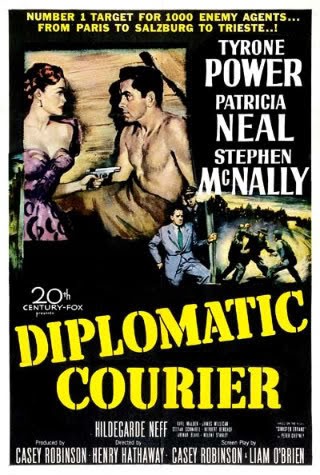
In the past I’ve done a few write-ups on those thrillers that take advantage of the devastated world of post-war Europe. The uncertainty evoked by time and place, the dreams of a better future coupled with the knowledge that the dangers of the past are no further away than a glance over the shoulder, is a strong foundation on which to build tales of intrigue and deception. In the late 40s and early 50s, as the chill of the Cold War was spreading, there was an abundance of such movies. I think the appeal of these pictures, despite the patriotic trappings required by the contemporary political climate and the inevitable loss of immediacy with the passage of time, lies in their ability to tune into the despair and disillusionment of those displaced and damaged by war and the subsequent carving up of a continent. Diplomatic Courier (1952) is one of the lesser known examples of this sub-genre, despite its boasting a strong cast. This film is not without its flaws but, taken as a whole, it remains a slick and atmospheric espionage thriller.

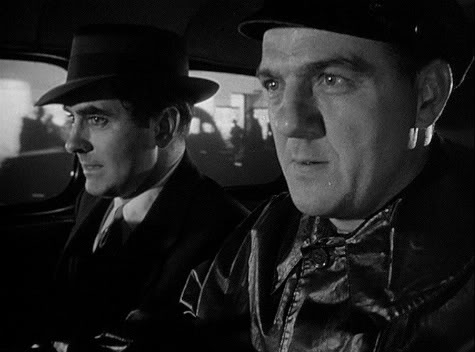
It starts off with one of those voice-of-God narrations, extolling the virtues of dedicated government agencies, which I tend to find irritating but quickly settles down to telling the story in a more traditional way. In short, a coded document originating in Romania needs to be passed to a courier in Salzburg for transportation back to the US. Sounds simple enough in itself, and thus our courier, Mike Kells (Tyrone Power), is promptly dispatched to do the business. Of course, things don’t quite run according to plan and Kells’ contact winds up dead on the railway line outside the city, without having completed the exchange. The circumstances leading to the murder aren’t clear as they were preceded by a series of cat and mouse shenanigans aboard the train involving a couple of heavies (one of whom is Charles Bronson in a blink and you miss him role) and an unidentified blonde. Kells now finds himself high and dry, and his only lead is the blonde, a Czech refugee called Janine Betki (Hildegard Knef), on her way to Trieste. His only option is to travel to the Italian city, track down Janine, and hope that she can lead him to the missing document. Again, the errand seems uncomplicated yet Trieste is a nest of spies and assassins, with danger lurking and ready to pounce within its ruins and darkened courtyards. Trying to run down one female in an unfamiliar and hostile locale ought to be problem enough, but Kells faces the added complication dealing with the attentions of an amorous American pleasure seeker, Joan Ross (Patricia Neal), who he met after falling asleep on her mink clad shoulder en route to Salzburg. What emerges is that both these women have a central role to play in the mystery, the question though is which one, if either, can be trusted.

£11

The whole thing moves along at a brisk pace under Henry Hathaway’s direction, but I do feel the script could have used some tightening to cut down on the kind of disposable dialogue that just serves to slow the momentum. Also, there are a few too many convenient arrivals at crucial moments. Having said that, Hathaway, aided by cameraman Lucien Ballard, creates some nice images and takes full advantage of the European locations. The best scenes are those with Kells blundering around Trieste following up clues that frequently leave him even more confused than ever. By this time, Tyrone Power had left his swashbuckling days behind him and was exploring more varied roles. I thought he was pretty good as the messenger boy thrown in at the deep end and unsure of who’s really on his side, apart from a faithful but hyperactive Karl Malden. Both Patricia Neal and Hildegard Knef gave strong but very different performances – the former oozing a kind of feline sexuality, while the latter tapped into a credible blend of vulnerability and grit. Of the two, I’d say Knef produced the the better work, probably due to her character benefiting form greater depth. I mentioned earlier a fleeting appearance by Charles Bronson, and it’s also worth pointing out that’s there’s a small part for Lee Marvin in there too.

Diplomatic Courier is available on DVD from Fox in Spain – the only release of the movie anywhere that I know of – in a pretty good edition. The print is quite clean and crisp, but there is a fair bit of grain in evidence early on. Actually, I can’t work out if it’s genuine film grain or some kind of digital noise; I have a hunch it’s the latter but I’m not expert enough to call it for sure one way or the other. Whatever, it fades after the first ten minutes or so. The Spanish subs are removable via the set up menu, and the extras are limited to a gallery and some text based cast and crew info. This was my first viewing of the film, a total blind buy, and I enjoyed it a lot. I did have some issues with the script, but the acting is good overall and the direction and location photography are very stylish. Yet another picture that deserves a wider audience.


So Long at the Fair

poster220

We spend a lot of time these days bemoaning the lack of originality in cinema, citing the number of remakes and the fondness for rehashing plots and concepts. However, the truth is that this isn’t an especially new phenomenon; it’s been going on for almost as long as people have been going to the movies. So Long at the Fair (1950) is an example of a film that’s based on a hoary old tale, an urban myth if you like, which has been used in a number of productions – The Lady Vanishes (1938), Dangerous Crossing (1953), and an early episode of Alfred Hitchcock Presents, to name a few, have all borrowed to a greater or lesser extent from the same basic idea. The point I’m trying to make here is that a perceived lack of innovation in the central plot theme is not necessarily always a bad thing – the real test is in the execution of the script. Even the most familiar of stories can still grip the viewer as long as they are presented in an interesting way.

Events in the film revolve around the Paris Exhibition of 1889, and a young brother and sister, Johnny and Vicky Barton (David Tomlinson and Jean Simmons), who happen to be visiting the capital. Thinking themselves lucky to have secured accommodation when all the city is awash with tourists, they proceed to enjoy their first night out on the town. The bustling, thronged atmosphere is nicely conveyed through scenes of cafe life on the pavements of Montmartre, and later at the Moulin Rouge. These two young people, having sampled the cosmopolitan night life, return exhausted to their hotel to get some rest and prepare for further excitement the next day. However, that’s not to be. When Vicky awakes she finds herself confronted with a situation that at first arouses puzzlement, but soon descends into despair and fear. What has happened is that Johnny has disappeared, but that’s only the half of it. As soon as Vicky starts to ask questions she’s presented with the even more perplexing problem that not only does nobody seem to remember seeing her brother but they insist, to a man, that he was never there in the first place. As if that’s not bad enough, there’s the downright chilling discovery that the room Vicky remembers her brother occupying doesn’t even exist, despite her having visited him in it. The unfolding of this nightmare scenario is nicely handled, with each new shock being added incrementally and the girl’s panic growing accordingly. Finding no solace at the hotel, Vicky turns to the authorities, the consulate and the police, who both display sympathy but also a healthy, and understandable, dose of scepticism. While the distraught girl witnesses one possible avenue of inquiry after another relentlessly closed to her, and her belief in her own sanity being stretched to the limit, the viewer is made subtly aware that something dark and inexplicable is taking place behind the scenes. Enter George Hathaway (Dirk Bogarde), an artist struggling to make a go of his new-fangled impressionist works and an unlikely but welcome ally for the increasingly desperate Vicky. With the backing of someone who’s willing to take her story at face value our heroine now has the opportunity to get to the heart of the mystery. The solution, when it comes, may seem a little contrived but it is logical and ties up all the loose ends in a very satisfactory manner. Added to that, and perhaps most importantly, the whole thing is achieved both stylishly and without any relaxation of the tension.

£10

Terence Fisher shared the directing credits with Antony Darnborough, and the sumptuous and stylised sets bring to mind the look of the Hammer films that the former would go on to make his name in. Despite a number of outdoor scenes, there’s a real sense of claustrophobia to the whole production that emphasises the shortage of options open to Vicky. When the action returns to the ornate, overdecorated interior of the hotel this stifling feeling is heightened even further – the intricacy of the decor being highly suggestive of unpalatable secrets that need to be disguised by an opulent exterior. There are also two fine set pieces that grab the attention, the first being a horrific accident that befalls a hot air balloon carrying the one person who may be capable of corroborating Vicky’s unlikely story. The other is an extended sequence that sees Hathaway stealing through the hotel by night in an effort to secure evidence that will convince the authorities to act. Fisher really piles on the suspense as the young artist slips in and out of shadow along corridors and staircases, narrowly avoiding the staff as they go about their regular nightly rituals, to get his hands on the tell-tale receipt books.

Jean Simmons was asked to carry the picture for long stretches, and she brought it off very well. She had that doe-eyed innocence that almost guarantees sympathy and used it to maximum effect. However, there’s more to her performance than mere pouting for the camera; her mounting feeling of hopelessness as one door after another slams shut in her face is always believable. Dirk Bogarde’s role was a good deal more straightforward, but he too played it to perfection. There’s a nice mix of the gauche and the determined in his portrayal of an unexpected knight in shining armour. As for the supporting cast, there are welcome turns from familiar faces such as Felix Aylmer, Andre Morell and a young Honor Blackman. The strongest work though is done by Cathleen Nesbitt as the forbidding hotel manageress, whose sour features are perfect for conveying a very subtle menace.

So Long at the Fair has just recently been released on DVD in the UK by new label Spirit, although they are an affiliate of ITV/Granada. The transfer is a reasonable one without being especially remarkable. The film doesn’t appear to have undergone any restoration and there are the usual age related artifacts to be seen, but they’re never particularly distracting. If anything, the image is a little too soft but I wouldn’t call it a fatal flaw either. The disc itself is completely barebones, no trailer, no subtitles, just the movie. Despite that, I think the film is very entertaining; even if the plot is one that you’re largely familiar with it still holds the attention throughout. For those who have no acquaintance whatsoever with the story it ought to prove even more gripping. In brief, there’s a genuine puzzle plot, fine performances, and tight, smooth direction. I give it my recommendation.