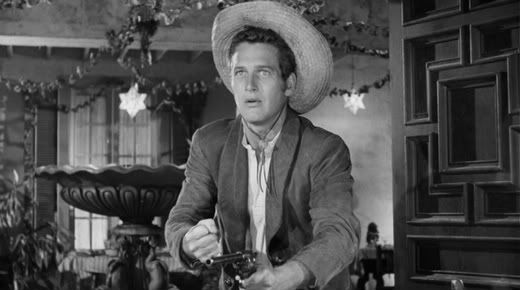
Viewing Notes – A Month with Hitchcock

Without having initially planned to do so, I ended up watching a selection of movies directed by Alfred Hitchcock all through September. I tried to choose those titles I had not seen for quite some time and have been jotting down and recording my thoughts on each in brief as I’ve gone along. Having done so, I figured I might as well assemble them here as an end of month round-up. So here goes:
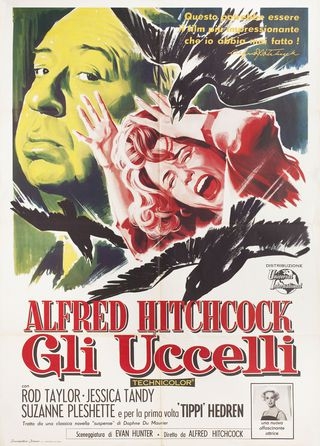
The Birds (1963)

It’s been many years since I last watched this and I’d forgotten just how well constructed it is, not to mention its technical proficiency bearing in mind the era.
That long, slow build-up is the work of a deeply confident filmmaker. It’s never boring or tedious and the gradual, estrogen-fueled tension, with all the cats among the pigeons, is drawn ever tighter in tiny but finely judged increments. When the full chaos is finally unleashed in the apocalyptic latter half Rod Taylor does get to flex bit of muscle, literally and figuratively.
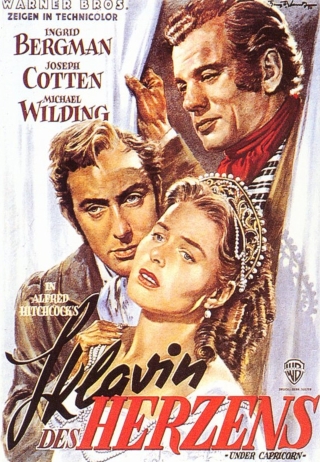
Under Capricorn (1949)

Very much lesser Hitchcock, a movie which barely anyone ever has a good word to say for. Well, I’ll at least say that it is handsomely shot, courtesy of Jack Cardiff, and the acting is fine even if Michael Wilding does lay the whimsy on with a trowel at times.
But yes, it is a problematic movie. And that is largely because it tells a story which is thin, not uninteresting in itself but too thin for its running time. It needed to be trimmed and compressed, which would have been hard to do because of the other great flaw – the director’s insistence at the time on experimenting with long takes. It hamstrung the previous year’s Rope (though that one has other issues dragging it down too) and was a technique that was antithetical to Hitchcock’s style.
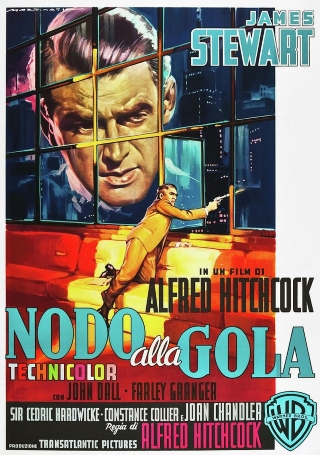
Rope (1948)

I’ve never especially liked this. The technical ambition is admirable, and I’ve always been somewhat hypnotized by the seamless skill involved in the gradual change in the lighting of the studio bound skyline as the tale unfolds in real time. However, the whole continuous take conceit imposes huge limitations on the cast and crew and the process must have been a genuine pain for everyone involved. As with Under Capricorn, the entire business works to undermine the director’s natural strengths.

The biggest problem I have with the movie though is the coldness and indeed the malice at its core. Nobody aside from Cedric Hardwicke’s anxious and compassionate father comes out of it well. That’s not to say it’s badly played of course. Granger could do that weak sister act with his eyes closed and Dall has the clinical and supercilious aspects down pat too – he always seemed to manage that though and there’s a hint of that inherent unlikeability also found in Laurence Harvey in all his parts. James Stewart nails the creeping suspicion that blossoms into horror and then outrage and (self?) disgust. But his character is not really sympathetic either – a man of his intelligence ought to have realized the kind of seeds his intellectual posing was planting.
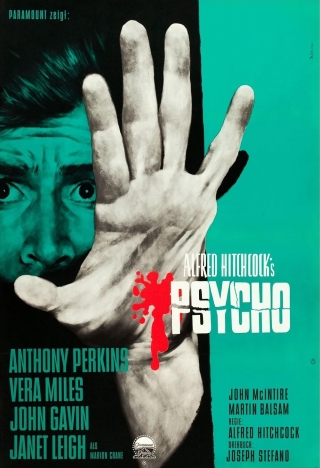
Psycho (1960)

It’s probably 15 years, maybe even more, since I last watched this. The first half always worked best for me and I still feel the same. The paranoia and gnawing guilt of Janet Leigh’s Marion is perfectly encapsulated in the minimalist style of that whole opening section – the rain, the ever more frantic musing, Herrmann’s nervy score and those seemingly permanent close ups of Leigh’s huge, expressive eyes.

And then there’s that frankly sublime sequence in the motel cabin. Cagey and uncomfortable, pathetically flirtatious and taut all at the same time. I reckon it’s the best scene in the entire movie. What follows in the last hour engages me less. It remains visually astounding and technically flawless, but too much of the artful subtlety drains away with the bath water. It still grips and shocks at times, just much more conventionally and it never again approaches the emotional precipice that was teased by the interaction amid stuffed birds, sandwiches and milk.

Nevertheless, it is still undeniably a great piece of cinema, the heights approached and attained in that first hour and the total assurance of a director genuinely in love with his medium are enough to ensure that.
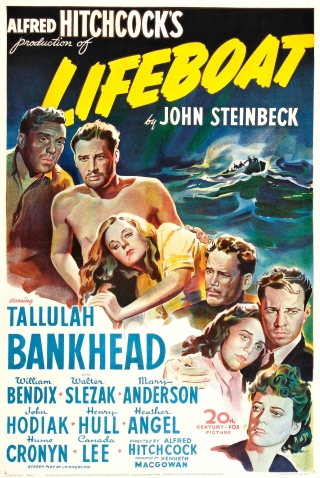
Lifeboat (1944)

A wartime propaganda picture from Hitchcock. Still, being a Hitchcock movie there’s more to it than that – by a circuitous route it winds up as something of a celebration of cohesiveness. Just about every stratum of western society is represented, from Henry Hull’s super rich kingpin to John Hodiak’s blue collar revolutionary, from the stoicism of Canada Lee to the louche decadence of Tallulah Bankhead. All the disparate characters are by turns gulled, threatened and finally drawn together by the malignant presence of Walter Slezak’s cool and cunning Nazi.

It’s another of the director’s challenges to himself, an exercise in the potential of confinement that makes up for in intensity what it arguably lacks in suspense. Alongside the more eye-catching dramatics of those further up the cast list, it’s satisfying to watch the slow development of a gentle romance between fairly regular Hitchcock collaborator Hume Cronyn and Mary Anderson, an actress who never much graduated beyond supporting roles except perhaps in the rarely seen but rather good Chicago Calling.
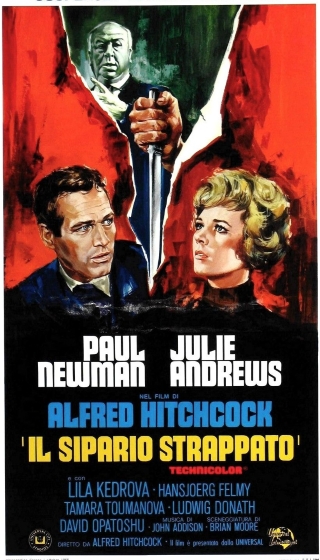
Torn Curtain (1966)

This is the point at which Hitchcock’s decline can be discerned. This Cold War thriller starts out as a double-cross drama where the bluff is drawn out too long before turning into a more successful cross-country chase, the kind of affair Hitchcock could make with his eyes closed.

The first half of the movie misses more than it hits, the brief bookstore scene in Copenhagen errs just on the right side of oddness, but the drab grey/green palate when events move to East Germany reflects the dullness of much of that section, not helped by a listless and detached performance by Paul Newman and an uncomfortable looking Julie Andrews. Some of it does work though – I like the entire build up to the farmhouse scene where the Stasi spook Gromek is laboriously disposed of, and Ludwig Donath is spikily entertaining as a caricatured professor.

The bus ride/pursuit has its moments, helped by John Addison’s slightly eccentric score and an earnest David Opatoshu. There are a few late flourishes too – the hiding among a crowd/creating a distraction ploy is revisited for at least the fourth time – off the top of my head variations thereof are employed in The 39 Steps, Saboteur and North By Northwest if not more.

So, a mixed bag all told. I guess it does more wrong than it does right yet I’ve always had a greater fondness for it than it probably deserves.
How the West Might Have Been Won

While my previous post arguably brought up the matter of the parameters one applies to the notion of the western, it was a few comments leading on from that which added some impetus and got me thinking a bit more. I guess I have my own idiosyncratic criteria which I wouldn’t expect to satisfy everyone. So be it, but that wasn’t the direction I now found my thoughts running in anyway. What I ended up contemplating was the course that the western as a genre charted after it had peaked in the late 1950s and on into the early 1960s. Reaching a peak means that some form of change is inevitable, but the path the genre adopted led to a sustained decline. That path essentially operated on two levels: one the one hand, there was that slightly desperate and ultimately unsatisfying effort to ape the nihilism at the heart of the spaghetti western, while on the other hand, there grew up a fruitless attempt to cling to the tropes of the classic form, one rendered stale by the crucial absence of thematic richness. Somehow these twin approaches converged at the artistic quagmire that came to be referred to as the revisionist western, where the myth was not merely deconstructed but practically obliterated. Yet what if an entirely different approach had been pursued instead, one which filmmakers had flirted with and dabbled in but failed to fully embrace?

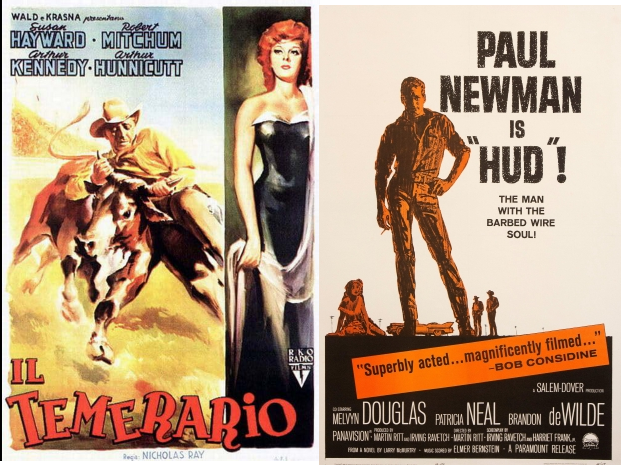
I’m speaking here of what is sometimes called the modern or contemporary western, and I’m also well aware that there will be those who struggle to accept that such movies are “real” westerns at all. While I can’t say I share such reservations, I do understand them. Fairly recently, I happened to revisit a couple of movies that fall into this category, The Lusty Men (1952) and Hud (1963), with a view to maybe writing them up separately. Nevertheless, it now seems apposite to fold them into this piece on what I’ve been toying with for a while now, namely that the western might have been better served  in the long run had filmmakers made a clean break and gone a different way. I guess it’s always easy to spot missteps when one has the benefit of hindsight to frame it all, but looking back at so many less than satisfactory westerns that were made from the mid-1960s on does create the impression of people trying to recapture lightning in a bottle. Instead of reaching for the unattainable, I can’t help but wonder if the people making westerns wouldn’t have been better off acknowledging that the way to secure the future of a genre so strongly rooted in the past was to allow it to naturally evolve into a recognizably modern form which still retained something of the spirit that made it great in the first place.

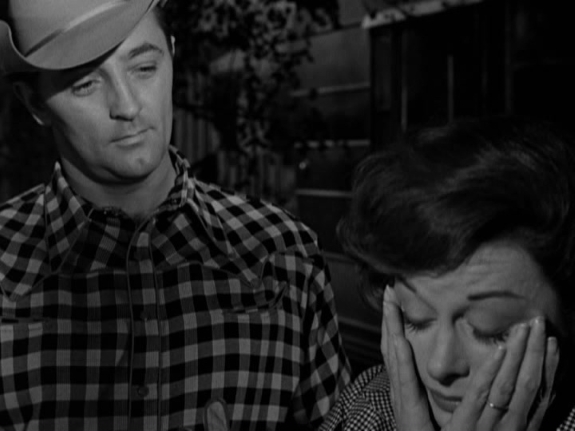
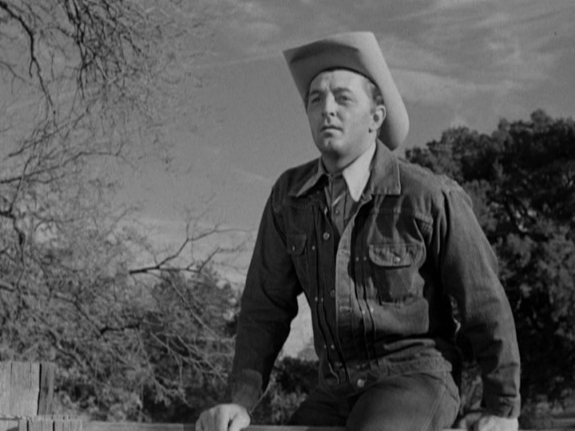
In The Lusty Men Nicholas Ray stirs together the doomed romanticism of Jeff McCloud (Robert Mitchum), a dwindling band of itinerant rodeo performers and one of his characteristically uneasy relationships. From the moment a limping and broken McCloud gazes with the kind of melancholic longing only Mitchum could impart so effortlessly at his childhood home, it’s clear he is meant to represent some bridge between a lost idyll and a world where skills once carefully acquired to tame the land itself are now of use primarily for display and entertainment. Wes Merritt (Arthur Kennedy), his protege, sees this the other way round – that the shows and spectacle may be a way to reconnect with the land. The whole movie traces McCloud’s slow reconciliation with the man he has now become, of the fact the world no longer holds a place for him. It also charts Merritt’s concurrent but bumpy journey back to his origins, aided by the tough earthiness of his wife (Susan Hayward) and by McCloud’s sacrifice. The world of Ray’s The Lusty Men is very much a contemporary one, and never tries to suggest otherwise, but by the time those still standing take stock of the lessons learnt and head back to the land which spawned them they are strengthened by their experience. The viewer too is fortified by the time spent tagging along on their journey, and that’s in no small part down to the way the essence of the classic western is transferred to the mid 20th century setting.

Martin Ritt’s Hud, adapted from a Larry McMurtry novel, came along a decade later and is a darker affair all told. It’s a film about change and passing, about a fractured family dealing with the notion of passing, of guilt and blame and principle. Paul Newman’s titular character is the new face of the west, amoral and self-absorbed, straining against ties to the past as represented by his father (Melvyn Douglas) and casually dismissive of a future hinted at by his nephew Lonnie (Brandon deWilde). Buoyed by two superb Oscar winning performances from Patricia Neal and Douglas, the former touching on a marvelous sense of resignation and regret, while the latter simply exudes pain and dignity, it scratches away at the mythology of the west. The culling of the herd is sobering in its matter of fact coldness, and Douglas’ subsequent putting down of his prized Longhorns, the last of the breed, is deeply symbolic and even more traumatic on a personal level – the hurt of the man is palpable. There is a bleakness to all this, yet the ending also looks to the resilience of the genre. If Hud’s shutting out of the modern world is indicative of a dead-end insularity, then Lonnie’s rejection of his uncle’s negativity and his striking out alone in the world looks toward a different horizon, an approach the genre itself is built upon.

While what I’m going to call ‘regular’ westerns made from the middle of the 1960s onward are very much a mixed bag for me – with far too many misses weighing down the hits – I don’t think I’ve seen a ‘modern’ western that actually disappointed me. The form continues to be made, and quite successfully too if TV shows such as Yellowstone are any kind of guide, but it still feels as though it is only visited from time to time. Admittedly, I’m doing no more than musing and hypothesizing here, spitballing something I’ve not yet reached a conclusion on myself. Increasingly though, I think Hollywood may have missed a trick by not abandoning the traditional western at some point in the late 60s, or at least by the 1970s, and turned the genre away from the static form it devolved into. Had this happened, had it become a contemporary rather than a historical form, perhaps we would be talking about the western in entirely different terms today, as a still thriving genre.

Hombre

poster217-2

We all die, just a question of when.

I’m an unashamed fan of westerns from the 1950s, the genre’s golden years, but I’m also pretty fond of those from the following decade. By the end of the 60s, with the spaghetti western in the ascendancy, revisionism was in the air, though that movement wouldn’t come to full fruition until we pass into the 70s. For the classic Hollywood western these were the transitional years, a painful period in some ways, with the genre thrashing about in search of direction. Such times tend to bring about a combination of successes, throwbacks and misfires. When we view the era in this light, I think it’s fair to say that the 1960s was a decade that was simultaneously fascinating and frustrating for western fans. Ultimately, revisionism would strip the genre down to the bone and train a probing searchlight on its innermost workings. One could write an in-depth study on the effects of this process, and I have a hunch the conclusion would be that no genre, least of all one so firmly rooted in myth as the western, could emerge unscathed from such an intimate examination. But I’m not going to take on that task here; instead I’m going to look at one of those late 60s westerns that seemed to benefit from the turmoil of the time, Martin Ritt’s Hombre (1967). Here we have a movie that avoids the outright nihilism of the Euro western, retains the structure and moral complexity of the best 50s efforts, and looks forward to the bleak honesty of revisionism. In short, it becomes a kind of philosophical meditation on social responsibility.

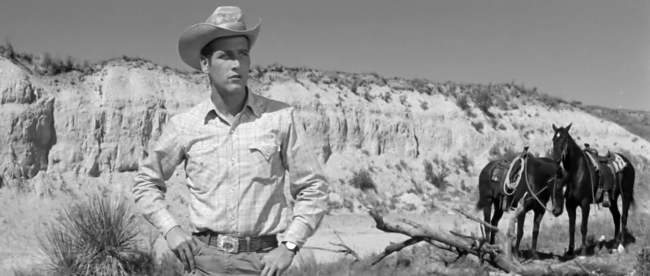
The classic western hero has frequently been characterized as a loner, a man drifting along on the fringes of society for one reason or another. Such a ploy isn’t accidental of course; it allows us to connect with the spirit of freedom and individualism that’s a significant part of the western’s attraction, and also helps objectify the view of society and encroaching civilization. Generally though, the hero does feel himself drawn in some way towards the society he observes. Hombre presents us with John Russell (Paul Newman), a white man raised by the Apache who has categorically rejected the ways of his own race. He’s first seen in his preferred environment, rounding up wild horses, and has clearly been fully integrated into the Apache lifestyle. However, news of an inheritance – a beaten up boarding house – brings him back to white society, at least temporarily. Arriving in town, he’s adopted the outward appearance of his own people but retains the cool detachment of the Apache. Essentially, Russell has made it his business to mind his own business – to have as little contact with the white world he has rejected as possible. He sells up and books passage on the last stagecoach out. Yet, the interrelated nature of society doesn’t really work that way; all action, even calculated inaction, has its consequences. In a sense it’s Russell’s single-minded detachment that lays the groundwork for what follows.The sale of the boarding house, effectively acts as the catalyst that finally pushes at least one man towards crime, and Russell’s own determination to avoid intervention in the affairs of others ensures that a bullying outlaw, Grimes (Richard Boone), gets to ride the stage. The first hour of the film is a fairly sedate affair, concentrating on establishing the character of each passenger and offering some insight into their relationships. Collectively, they add up to a cross-section of frontier types: the outwardly respectable older man and his younger, disillusioned wife, a young couple coming to terms with the realities of married life, the veteran driver who’s long since bid farewell to his ideals, the woman who has been around and remains a survivor, the swaggering bully, and the enigma that is Russell. Locked within the confines of the bumpy stagecoach, the tensions, prejudices and fears of this disparate little group simmers away just below the surface. The pressure comes to a head when they are held up on a remote part of the trail, and the truth about each one emerges. Abandoned in the wilderness, and facing the very real prospect of perishing, they turn towards Russell to guide them out. But Russell is now in something of a quandary; apart from the fact he’d been shunned due to his Apache affiliations, he feels no obligation towards his fellow man anyway. He’s faced with a philosophical dilemma  – does he follow his head and leave these people to the fate he reckons they deserve, or does he listen to that still distant voice within that urges empathy.

If we count Hud, then Martin Ritt made three westerns with Paul Newman, and all of them have their points of interest. Adapted from the Elmore Leonard novel of the same name, Hombre is the closest to the traditional western. The basic structure owes much to John Ford’s classic Stagecoach, but it’s a much more cynical affair. The two films do share the vital element of spiritual redemption for their hero, but Ritt’s movie reaches that point in a more tragic and bitter way. The script raises interesting questions about how much we owe others, how far we should go for those we deem undeserving of our sympathy, and whether intervention or isolation is the correct approach. Bearing in mind the film was made while the war in Vietnam was still raging, I think that last issue must have been in the minds of the filmmakers. However, leaving that aside and looking at things from a purely personal perspective, the problems continue to be thorny. Russell not only knows that assisting the abandoned travelers will add to his own peril, but his years living outside of white society have meant that he no longer identifies with these people. Circumstances have resulted in his being caught in a kind of cultural no-mans-land, where his head and heart are in conflict. In cinematic terms, this is a reflection of the position the western itself was facing in 1967, with its soul and conscience pulling in one direction while social and economic factors were pressuring it to go another way. Visually, with the aid of James Wong Howe’s great cinematography and the Arizona landscape, it bears all the hallmarks of the classic western, but the existentialist undertones of its theme point to the future.


Mrs Favor: I can’t imagine eating a dog and not thinking anything of it.
John Russell: You even been hungry, lady? Not just ready for supper. Hungry enough so that your belly swells?
Mrs Favor: I wouldn’t care how hungry I got. I know I wouldn’t eat one of those camp dogs.
John Russell: You’d eat it. You’d fight for the bones, too.
Mrs Favor: Have you ever eaten a dog, Mr. Russell?
John Russell: Eaten one and lived like one.

Paul Newman was an adherent of the method style of acting. Now I’m no fan of the method and the frequently affected performances that it encouraged. I understand it is meant to help the actors dig deeper within themselves and find a truth in their role yet it often seemed to produce the polar opposite, a mannered performance that actually draws attention to itself. Some of Newman’s early roles are badly blighted by this in my opinion. However, by the time he came to Hombre he had moderated his acting style, and what we see on screen is far better, far more involving. As far as I can remember, and it’s been a few years since I read Leonard’s novel, Newman’s portrayal of John Russell is pretty close in spirit to how the character came across on the page. It’s a very quiet performance; I think the stillness of the man, the eternal patience of his Apache side is perfectly captured. There’s a great sense of his being aware of everything, absorbing the sounds, smells and moods around him and storing them away. When he’s aroused to action there’s a jarring abruptness to it that makes it all the more effective. The first instance takes place in a cantina where Russell sits and calmly watches and listens to his Apache companions being goaded by two ignorant redneck types. We’re expecting something, a reaction of some kind, maybe a rebuttal from this soft-spoken man. But the sudden swing of his rifle butt to shatter and drive the splinters of a whiskey glass into the face of the barroom lout is both shocking and satisfying. In a similar vein, the later eruption of aggression when he opens fire on Boone when he comes to parley is made more intense by the apparent calm that precedes it.

Richard Boone’s crafty and cunning Grimes is the ideal foil to Newman’s motionless and emotionless Russell. Boone gave countless performances that were straight out of the top drawer and Grimes has to rank up there among the finest. He had a real knack for conveying a quiet threat – there was always the feeling that here was a man it would be foolish to cross. His first scene in the station when he intimidates a soldier into turning the last ticket available over to him illustrates this quality well. There’s something in that craggy face and low-pitched voice that conveys his intent far more effectively than bluster and showboating; not an easy task but when it works, it works wonderfully. Of the three female roles in the movie, Diane Cilento had the most substantial and the one with the greatest significance. Generally, I feel she was an underrated performer who was always interesting to watch. She played the most down to earth of the three women on that stagecoach, and the one with the lowest social status. Russell’s decision to sell up saw her out of a job and on the streets but with her spirit unbroken. The script offered her several opportunities to shine and she took each one, displaying an earthy and attractive honesty. She was also fortunate to be playing the character whose mentality the average viewer could most readily identify with, providing a kind of bridge between Newman’s omnipotent aloofness and the self-interest of the others.

Fredric March had a nice little late career turn as the corrupt Indian agent, the one whose presence poses the greatest danger to the survival of the group. Basically, he represents all that’s wrong with the society that Russell has rejected – corruption, vanity, weakness and hypocrisy. Still, despite portraying a deeply unpleasant person, March manages to inject a good deal of pathos into his performance and leaves you feeling a little sorry for this man who has transitioned poorly from the successes of his youth; he did something similar in Inherit the Wind, where he tapped into the human frailty of another character who was essentially unsympathetic. Martin Balsam was a first-rate character actor who enriched many a great movie – 12 Angry Men & The Taking of Pelham One Two Three to mention just two – with his everyman persona. As the stagecoach driver who has come to terms with his own limitations and realizes that he can no longer fight the tide of progress, he’s another figure with whom the audience can connect.

As far as I can tell, Hombre has never been released on DVD in the UK, though it is readily available from both the US and continental Europe. I have the Dutch DVD from Fox, which presents the movie most satisfactorily. The film is presented in anamorphic scope and the transfer is very pleasing with good colour and definition to show off James Wong Howe’s location photography. The disc offers a wide selection of subtitle options and the only extra feature is the theatrical trailer. For me, Hombre is a highly successful piece of work that hits the mark on a number of levels: as an entertaining western movie, an examination of race and social cohesion, and also contextually, for the position it occupies in the development of the genre. I consider the latter to be the most fascinating aspect, and yet another link between what may superficially appear to be irreconcilable eras. Nevertheless, whatever way one opts to view the film, it makes for a rewarding and thought-provoking experience.


The Left Handed Gun

Poster

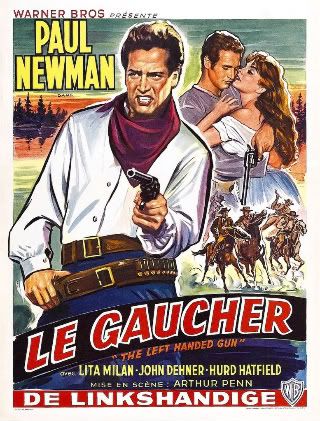
Now we come to The Left Handed Gun (1958) – a far superior movie to The Outlaw yet it’s not without its faults. This film sticks closer to the known facts about the Kid but it also portrays him as one of those mixed-up youngsters that became fashionable during the 50s. Whatever one’s feelings are on that particular slant, the performance given by Paul Newman in the lead role is problematic to say the least. I’ll talk about that more later but I honestly feel it constitutes the weakest part of the whole picture.

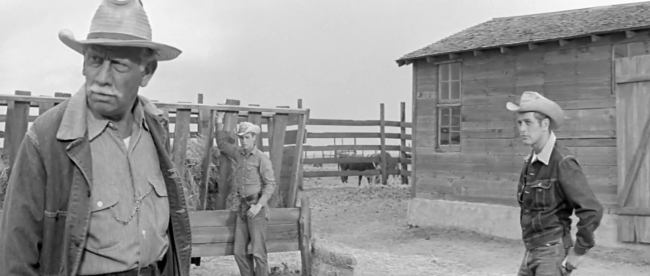
The first view of Billy (Paul Newman) shows an exhausted figure on the point of collapse stumbling across a western landscape. His meandering path leads him to a group of horsemen tending herd. These men are in the employ of Tunstall, and the old man obviously feels some kind of pity for the barely articulate figure he’s chanced upon as he gives him a job there and then. There are some mutterings from Tunstall’s more experienced men who’ve heard of the Kid’s murky past, but the boss keeps faith in his new man and even makes a start on teaching the illiterate youngster to read. The point here is to show the ever strengthening bond between the Kid and Tunstall, but this section of the movie moves so fast that by the time the latter is gunned down it’s hard to believe that any real or lasting affection could have had time to develop. As such, it’s a little difficult to swallow the idea of the Kid being so consumed with grief for his new mentor that he will set out on a murderous quest for vengeance. Nevertheless, that’s precisely what happens as the Kid, along with two equally unsophisticated cowboys (James Best and James Congdon), resolves to track down and kill the men responsible for Tunstall’s death. As he begins this task, the Kid has a fateful meeting with a man whose path he will cross many times, Pat Garrett (John Dehner). At the same time, we also get our first glimpse of another recurring character in the drama – Moultrie (Hurd Hatfield), a kind of wandering fool who seems to turn up wherever the Kid goes and who’s destined to play a significant role in sealing his eventual fate. While he and his two sidekicks are living as fugitives in Mexico, the Kid discovers that the new governor, Lew Wallace, has declared an amnesty for those involved in the Lincoln County War. Initially, it looks like there may be some kind of future that doesn’t involve killing and running, but the Kid’s impulsive and obsessive nature draws him back to the old blood feud, and a date with a friend that can only be postponed but never avoided.  

Paul Newman as the Kid.

Ok, let me start by getting something off my chest – I’ve never been a fan of method acting. There. I’ve always felt that the method has been responsible for some incredibly phony performances from otherwise talented actors. Of all the movies I’ve seen Paul Newman in (and there have been a few stinkers along the way) I’d rank his Billy the Kid as maybe his worst turn. I don’t believe I’ve seen another role where his performance was so affected and unnatural. I quite understand that he was trying to convey the fact that the Kid was essentially an ignorant and directionless young man who got dragged into events that were beyond his control and maybe even beyond his full comprehension. However, the constant “look at me, I’m acting” moments really become irritating the longer the film goes on. John Dehner helps overcome this shortcoming though as he gives a quieter and more thoughtful performance as Billy’s nemesis. I’m not sure there are any real heroes in ths story, but Dehner’s Garrett comes closest and he’s certainly easier to sympathise with than anyone else. As for the supporting players, James Congdon and James Best are good enough as the Kid’s loud and slightly dumb pals – Congdon’s maybe the less likeable one but he does get a memorable death scene. Hurd Hatfield’s Moultrie is a puzzling piece of work; he’s not really a character at all  (unless you view him as a Judas figure) but a kind of allegory for a press and public grown disenchanted by the unreality of the myth they have created themselves. A word now about director Arthur Penn. In truth, he wasn’t one of my personal favourites as a western filmmaker and he only made a handful of films within the genre anyway. Of those, I’d say The Left Handed Gun was the best of them. I couldn’t fault his work on this movie and the Mexican scenes in particular have a real lyrical quality that’s very attractive. My only complaint would be that he didn’t do more to rein in Newman’s excesses – had he done so the film would work better as a whole.

The DVD of The Left Handed Gun issued in the US by Warners, as part of their Paul Newman set, shows off the movie very nicely. The anamorphic transfer is mostly crisp and clean and contrast levels looked good to me. The disc also contains a commentary by director Arthur Penn and the trailer. All in all, a very satisfactory package. For the film itself, I have mixed feelings; there are moments of real quality and intensity but I have a problem getting past that overdone performance by Newman. As a movie about Billy the Kid, I’d rate it medium to good. The potential was there for this to have been a much better picture though and I can’t help feeling a little disappointed by that.