Deadline – U.S.A.

“…the right of the public to a marketplace of ideas, news and opinions. Not of one man’s, or one leader’s, or even one government’s.”

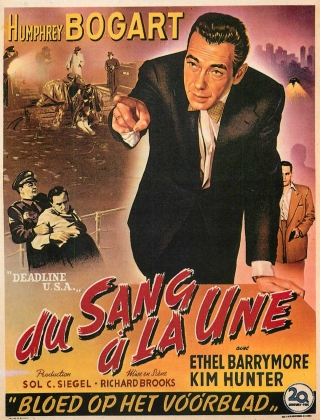
That eulogy to the Fourth Estate, not merely to its desirability but to its necessity as a vital pillar of a functioning democracy is delivered relatively late on in Deadline – U.S.A. (1952) by Humphrey Bogart’s committed and conscientious editor. It might come late in the movie yet everything has been building towards that and the narrative would already have led us to that conclusion even if the script had not spelled it out. If this point needed to be made back in 1952, it is arguably even more essential now where the current era of demagoguery sees the foundations of democracy chipped away at on a daily basis.
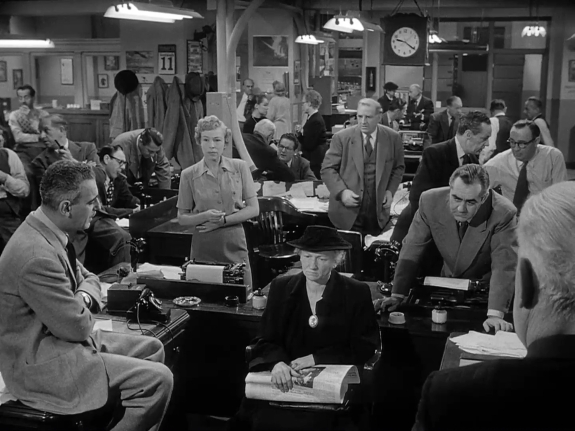
On various occasions throughout the film various characters refer to a murder, a wake and a funeral. It’s as though the shadow of death hangs heavily over the entire project. However, it’s not the death of person, even though there are a handful of those folded into the plot, but instead the demise of a newspaper which is alluded to. This sense of a paper as a living entity, with as much conscience and soul as a human being, pervades the movie. To be perfectly frank, the newspaper in question could be said to have more human characteristics than some of the individuals portrayed. Anyway, this anthropomorphism is key to understanding Deadline – U.S.A. and the points writer and director Richard Brooks seeks to hammer home. The paper in question is The Day, a publication which prides itself on its standards and its history. The editor Ed Hutcheson (Humphrey Bogart), as well as the staff, regards it as a newspaper as opposed to a purveyor of sensationalist yellow journalism. Despite that noble intent, or a cynic might posit because of it, The Day is on its way out. Life support is about to be unplugged and the owners, the detached and disinterested heirs of the founder, are in the process of selling off the carcass to a competitor whose primary interest is buying it in order to close it down and thus corner the market. The viewer is invited to follow the final days of this venerable institution where regardless of the sense of inevitability, there is also a resilience on show. Maybe it’s a losing battle but Hutcheson isn’t going down without a fight and the battlefield he’s chosen for the paper to stage its last stand is one reigned over by Tomas Rienzi (Martin Gabel).
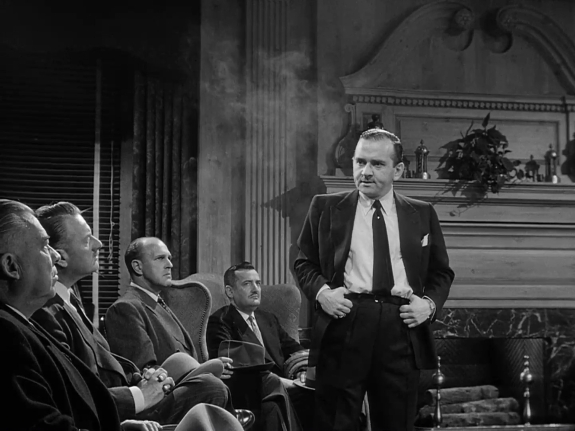
Rienzi is an old school hood, one of those guys where the patina of civilization is especially thin. He’s been investigated for corruption and graft but nothing seems to stick. This time may be different though – the body of a mink clad good-time girl has been fished out of the river and gradually a trail leading back to this Teflon don becomes apparent. In essence, a race takes place to see whether all the connections can be made before the courts put the seal on the sale of the paper, or before Rienzi’s enforcers can make enough witnesses and whistleblowers disappear. While there are other subplots touched on to varying degrees, it is here that the movie sets out its stall. Brooks wants to make the point that real journalism serves a vital civic purpose – “to comfort the afflicted and afflict the comfortable” if you like. Personally, I think his argument is both valid and worthwhile, maybe even more pronounced now than it was all those decades ago. If the printed press has gone into near terminal decline, the voice, function and long established ethics of the legacy media remain essential, even as they come under attack from a range of chiselers and charlatans.
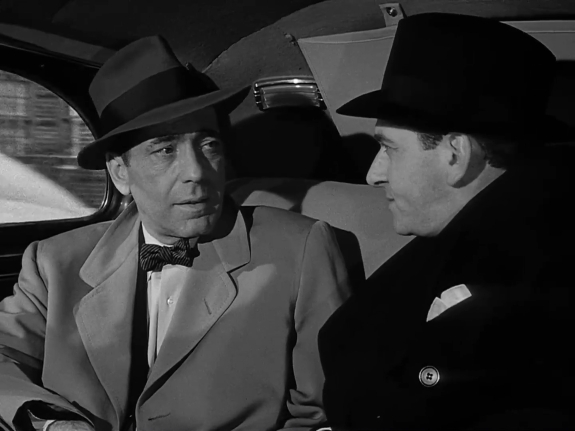
Movies about journalism, indeed the same could be said for that other subset movies about the movies themselves, seem to have their own  special energy. That such productions should exhibit a vitality ought not to be much a surprise when one stops to think how many writers and filmmakers had a background in journalism. The accepted wisdom is to write about what you know and there’s plenty of evidence to suggest that this kind authenticity does lend an added touch of passion to proceedings. Richard Brooks was one of those writer/directors who started out working as a reporter and the latent respect for the trade colors what he puts up on the screen in Deadline – U.S.A.  – that said, I do seem to recall seeing an interview he gave many years later where he expressed dissatisfaction with the title, feeling that it was meaningless in itself. Well if the title is somewhat awkward, the arguments underpinning the plot are not. Brooks keeps it moving along, capturing the noise and urgency of both the newsroom and the press room. There are a couple of instances of less convincing back projection but Milton Krasner has it looking attractive for the most part. Outside of the newspaper building itself, the most effective scene is that inside Rienzi’s car, where he and Hutcheson spar and both Bogart and Gabel make the most of Brooks’ snappy dialogue.
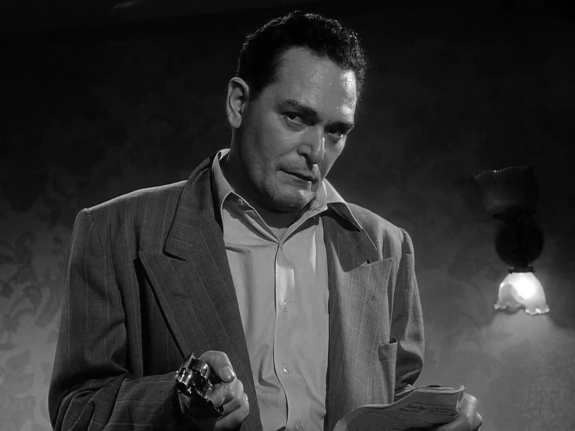
By this stage Bogart was an old hand at either playing it tough and cynical or tough and noble. He goes down the latter path here and his conviction is never in doubt whether he’s trading threats with a mobster or arguing ethics in the boardroom. The only less convincing aspect is his attempt to rebuild his marriage with his ex-wife Kim Hunter. She was an accomplished actress with successful work in A Streetcar Named Desire and A Matter of Life and Death behind her yet there’s a certain listlessness to her performance in this film which weakens that plot strand. On the other hand, Martin Gabel is a fine adversary for Bogart, desperate to convey respectability – “I’m in the cement and contractin’ bu’iness” – while his rough edges keep poking through the facade. There’s plenty of menace on display from Gabel, a man I’ll always associate with the role of Strutt in Hitchcock’s Marnie, but who also directed the atmospheric The Lost Moment.
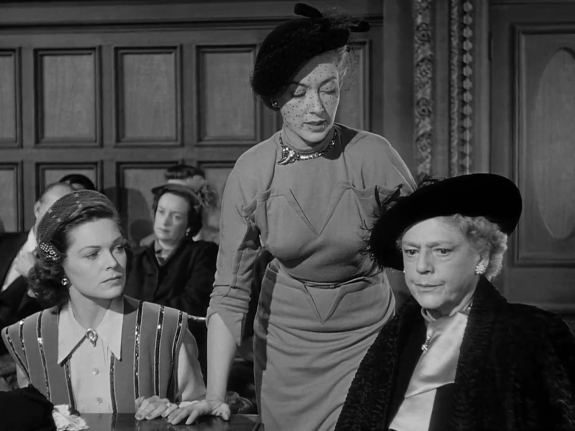
As is frequently the case with big studio productions of the era, there is strong support from a deep cast of familiar faces. Ethel Barrymore rolls out her wise old owl act once more, but she does it so well and so attractively that it’s a pleasure to watch. Ed Begley is comfortably solid, and Paul Stewart (someone else who could shift with ease between villainous and sympathetic parts) casts alternately weary and wary looks from beneath his ever expressive brows. Joseph De Santis has a ball as the scumbag brother of the murder victim, smirking and sweaty as he chisels his way to an undeserved payday before making a spectacular exit where he literally becomes front page news. Jim Backus, Tom Powers, Warren Stevens, Fay Baker, Joe Sawyer and Willis Bouchey among others drift in and out. Apparently, James Dean had a small uncredited part but I’ve never been able to spot him even after numerous viewings.
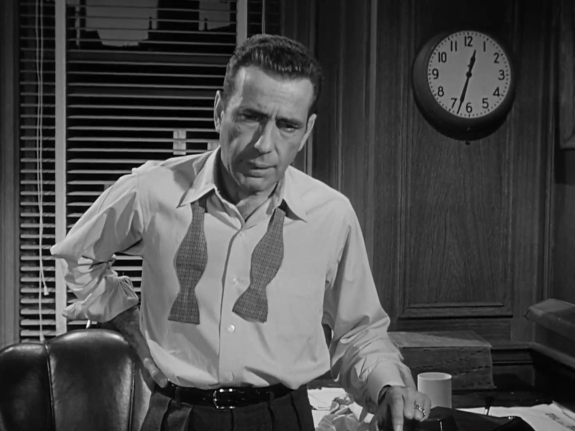
I’m not sure how well regarded Deadline – U.S.A. is or what kind of reputation it has. I do know I’ve always liked it, it has one of those roles which feel tailor-made for Bogart and the sentiments of the script appeal. I guess I’m something of a sucker for movies focused on newspapers and reporters. It should be easy enough to access in good quality these days; this was not always the case but there are high grade Blu-rays and DVDs of the movie available in most territories now – I have the German DVD myself. While the more venal sections of society endeavor to undermine public trust in the integrity of the mainstream media, it’s good to remind oneself of how important it was and is to all of us.

As an Amazon Associate I earn from qualifying purchases made through links on this page. 


The Professionals

La Revolución is like a great love affair. In the beginning, she is a goddess. A holy cause. But, every love affair has a terrible enemy: time. We see her as she is. La Revolución is not a goddess but a whore. She was never pure, never saintly, never perfect. And we run away, find another lover, another cause. Quick, sordid affairs. Lust, but no love. Passion, but no compassion. Without love, without a cause, we are nothing! We stay because we believe. We leave because we are disillusioned. We come back because we are lost. We die because we are committed.

Random musings on the nature of revolution, words which have an attractive feel, a weary patina lying somewhere just the right side of cynicism. That, I think, is the effect they are meant to convey, but therein is their problem, and by extension part of the problem of the movie they appear in. Hearing them spoken by Jack Palance’s wounded rebel and reading them back here leaves me with the impression that they have been crafted for just that, for effect rather than for truth or out of any real conviction. I watched The Professionals (1966) again the other day, a movie I’ve seen  fair few times now, and came away from it thinking it entertaining enough although somewhat lacking in substance. Like so many films by Richard Brooks, it doesn’t do much wrong, doing a lot right in fact, yet never actually amounts to as much as the filmmaker would have us believe.

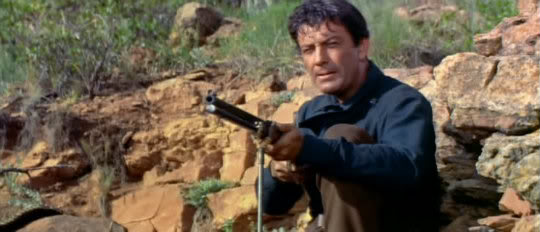
During the latter half of the Mexican Revolution a group of four men, introduced via brief sketches during the opening credits, are hired by a wealthy businessman to get his kidnapped wife back. That’s the plot of the movie in a nutshell. It’s a simple enough setup, fleshed out by the colorful nature of a some of the leads as well as the dynamic created by their intertwined pasts, and of course the turbulent background of a country riven by internal conflict. The hired hands are led by Rico Fardan (Lee Marvin) a former associate of Pancho Villa, Bill Dolworth (Burt Lancaster) a womanizing rogue with a talent for blowing things up, Ehrengard (Robert Ryan) a diffident wrangler, and Jake (Woody Strode) a tracker and expert with a longbow. Their employer is one J W Grant (Ralph Bellamy), an ageing tycoon married to the much younger Maria (Claudia Cardinale). On the other side is Raza (Jack Palance), one of those bandits with a reputation approaching legendary status. The story is broken into a classic three act structure – the preparation and the journey out, the rescue, and the ride back leading to the denouement. If it sounds a bit formulaic, that’s because it is. There aren’t really too many surprises and the twist that is supposed to grab the viewer comes as more of a shock to the characters on screen.

This probably sounds more negative than I mean it to – the film is (as one would hope from the title) all very professionally shot and put together. It’s amiable and exciting in all the right places, the big set piece assault on Raza’s hacienda is filmed with style, the dialogue is peppered with memorable one-liners, and Conrad Hall photographs the desert locations beautifully. Yet when it all wraps up and the final credits roll, I can’t help feeling I’ve just had the cinematic equivalent of an attractively packaged fast food meal – pleasing and enjoyable while it’s there in front of you, but not something that is going to linger long in the memory when it’s finished.

A film scripted and directed by Richard Brooks (The Last Hunt) from a novel by Frank O’Rourke (The Bravados) inevitably raises expectations given the examples of the author’s and the director’s work cited. I guess that’s why it belongs in my own personal category of movies I like and enjoy even though I don’t believe they warrant an especially high rating. Films such as The Last Hunt and The Bravados stay with you long after they have been viewed, the performances and themes, the images and the very philosophy underpinning them have a way of boring into one’s consciousness and commanding attention. I guess what it comes down to is this – those are movies which touch on greatness, The Professionals is fun.

Lee Marvin and Jack Palance appeared in, by my count, four movies together – in additions to this, there’s Attack, I Died a Thousand Times and Monte Walsh. I feel confident that the latter is by far the best of them, closely followed by Aldrich’s intense study of men in war. The fact is all of the star players, and I’m counting Lancaster, Ryan, Cardinale, Strode and Bellamy here, all made much stronger films, all had roles that stretched them and highlighted their strengths to a greater degree than this. On the other hand, every one of these people are in essence playing types in The Professionals. This is not to say their performances are poor or weak, merely that the way the roles are written allow for next to no development – there are hints of back stories, mentions of experiences that would shape characters, but none of those characters grow over the course of the story. What we see at the start is pretty much the same as what we see at the end.

So, is The Professionals a good movie? The critics seem to have been kind over the years and its reputation remains strong. I like it well enough myself; I’ve watched it a number of times and I’m not in the habit of doing so with films which hold no appeal. Even so, I retain reservations about it, which I think is representative of my attitude to or how I respond to much of Richard Brooks’ work. Parts of his oeuvre hit the mark, have an impact beyond the immediate and provoke me in some way. On the other hand, all too often I find I’m left only half satisfied.

The Last Hunt

Westerns, especially the classics of the 50s, tackled just about every theme imaginable, often passing comment on universal concerns that transcend the genre itself. That of course is one of the western’s great strengths, it’s ability to resonate widely. However, the genre has also dealt with what might be termed more direct concerns too, actions and events that impacted  on the shaping of the frontier and the course of US history. Bearing in mind that the old west was essentially a wilderness, it’s no surprise that animals occupied such an important place in the minds of those who lived there. There are countless examples on film highlighting the importance to the native people and settlers alike of the horse. How many times have we witnessed the contempt and hatred directed towards horse thieves? In a primal landscape covering vast distances, the theft of a man’s sole means of transport was naturally one of the foulest crimes. However, the horse wasn’t the only animal which played a significant role in the development of the frontier. The buffalo, that great beast which sustained and dominated the lives of the plains Indians, was every bit as vital in its own way. As such, it’s perhaps surprising that The Last Hunt (1956) is one of the few westerns that concentrates on the fate of those creatures which once roamed in huge numbers across the continent.

The Last Hunt is the story of two quite different men, Sandy McKenzie (Stewart Granger) and Charlie Gilson (Robert Taylor), who enter into an uneasy partnership. Sandy is a famed buffalo hunter, but he’s also a man sickened by killing and has abandoned his old profession to turn his attention to the cattle business. However, fate has other ideas and, when a buffalo stampede wipes out his herd, a chance meeting with war veteran Charlie leads him reluctantly back to hunting. While Sandy has seen more than enough bloodshed, Charlie has something approaching an obsession with death. Charlie’s wartime experiences have clearly left a mark, and he seems to live to kill. The contrasting approaches of the two  men is highlighted during one of the hunt scenes. Having established a stand, the camera switches between this pair as they go about the slow, methodical business of picking off the buffalo herd. Charlie’s features are fixed in a mask of sadistic delight as one animal after another drops and breathes its last. Conversely, Sandy is stricken by conscience and is on the verge of breaking down and weeping at the thought of the devastation he’s participating in. If the radically different perspectives of the partners weren’t a great enough source of conflict, their rivalry is further complicated when Charlie captures a young Indian girl (Debra Paget) and takes her as his woman. Along with his wide sadistic streak, Charlie is also an unashamed racist with a deep suspicion and hatred of the Indian. He considers the girl to be his personal property, one of the spoils of war if you like, to be used or abused as he pleases. Not only does Sandy regard this kind of boorishness as an affront  to his sense of morality and civilized behaviour, but he also finds himself developing feelings for the girl himself. Charlie’s mounting paranoia and Sandy’s growing self-disgust, fueled both by their slaughter of the buffalo and the presence of the girl in their midst, see the tensions rise inexorably. Sooner or later, these two will have to face off and settle their scores, and the climax of the movie is a memorably chilling one in every sense as the final confrontation takes place during a freezing blizzard.

Richard Brooks started out as a writer, scripting films such as Brute Force, Crossfire and Key Largo before moving into directing with the Cary Grant suspenser Crisis in 1950. He didn’t work much within the western genre, making only Bite the Bullet, The Professionals and The Last Hunt. As a writer, he tended to tackle complex and controversial subjects and his first western as director (with a script credit too) saw him continue in a similar vein. The Last Hunt works in the theme of racism alongside its ecological message; the systematic elimination of the buffalo was essentially a government sponsored programme once the realization set in that the army wasn’t going to defeat the Indians through conventional military tactics. The buffalo had a special place within Indian culture, providing not only a source of food but also many of the essentials of life. The Indians used almost every part of the animals to make clothing, shelter, and tools. Therefore, it’s impossible to overestimate the status of these creatures as far as the native people were concerned. Brooks highlights the mysticism involved when he features a white buffalo, a sacred figure. This device also serves to draw attention again to the differences between Charlie and Sandy: Sandy is entranced by the sight of such a rarity, while Charlie sees only profit and immediately slays it. Although this is, superficially at least, a fairly simple tale, there’s a lot going on and Brooks blends it all together very successfully, ensuring that a brisk pace is maintained without sacrificing any of the necessary character development.

Robert Taylor is an actor whose work I’ve featured regularly on this site and The Last Hunt offered him one of his very best roles, maybe even the best. Generally, he played heroic figures but this film saw him take on the persona of an irredeemable rogue. I’ve read comments in the past which indicated Taylor had  doubts about his own abilities as a performer, but roles such as Charlie Gilson prove that there was no basis for such harsh self-criticism. I always feel the best and most effective movie villains have the knack of drawing a degree of sympathy or pity from the viewer, and that’s the case with Taylor’s portrayal here. There’s no question that Charlie is a bad lot, but Taylor brought a certain fragility to the part and that adds an interesting variation to what could have been a bland and routine character.

Stewart Granger might seem an odd choice for a western hero but here, in his second genre picture, he’s both comfortable and convincing. Apparently, Granger took to the whole western experience off-screen too and was well thought of by the crew. He’s very effective as the conscience-stricken counterbalance to Taylor’s killing machine and the two actors play well off each other. The Last Hunt is another of those movies with a small central cast; they’re usually quite successful at rounding out the characters and offering some more depth. In this case, the two protagonists benefit more from the increased focus though. Debra Paget as the captive Indian girl is never named and remains a slightly colourless presence throughout, albeit a strikingly attractive one. After appearing in Broken Arrow, this was Paget’s third outing as an Indian maiden and it must have looked like she was going to be permanently typecast at this point. Whatever you say about Paget, I don’t think anyone could mistake Russ Tamblyn for a native American. Nevertheless, he was cast as the half-breed hired by Sandy and Charlie, and his sympathetic presence is used to emphasize the blind bigotry of the latter and the relative enlightenment of the former. Best of all among the supporting players though is Lloyd Nolan, another initially questionable choice for a western. Nolan had a very  urban air about him and I tend to think of quick talking cops and the character of Michael Shayne whenever I see him. Still, he really embraced the part of the one-legged buffalo skinner and turned in a very  memorable performance.

For a long time The Last Hunt was only available on DVD in Europe. However, the film has recently made its US debut via the Warner Archive. I can’t comment on the quality of that particular transfer though as I don’t own a copy. I have the French release by WB, which looks reasonable although the scope image is letterboxed and non-anamorphic. In common with the majority of Warner titles released in Europe, it’s a bare bones affair with optional subtitles that can be deselected on the setup menu. The movie itself is a real keeper, a bit of a neglected gem that looks good, has fine performances, and makes a number of interesting points about man’s impact on the environment and race relations. The wider availability of this title on DVD may hopefully raise the profile of a film that’s well deserving of some renewed attention.