Viewing Notes – A Month with Hitchcock

Without having initially planned to do so, I ended up watching a selection of movies directed by Alfred Hitchcock all through September. I tried to choose those titles I had not seen for quite some time and have been jotting down and recording my thoughts on each in brief as I’ve gone along. Having done so, I figured I might as well assemble them here as an end of month round-up. So here goes:
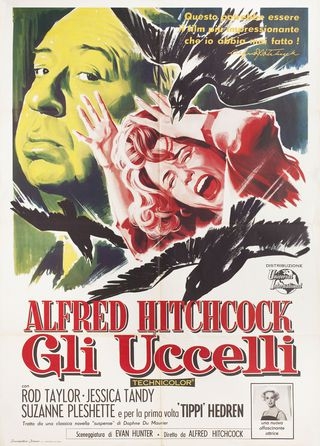
The Birds (1963)

It’s been many years since I last watched this and I’d forgotten just how well constructed it is, not to mention its technical proficiency bearing in mind the era.
That long, slow build-up is the work of a deeply confident filmmaker. It’s never boring or tedious and the gradual, estrogen-fueled tension, with all the cats among the pigeons, is drawn ever tighter in tiny but finely judged increments. When the full chaos is finally unleashed in the apocalyptic latter half Rod Taylor does get to flex bit of muscle, literally and figuratively.
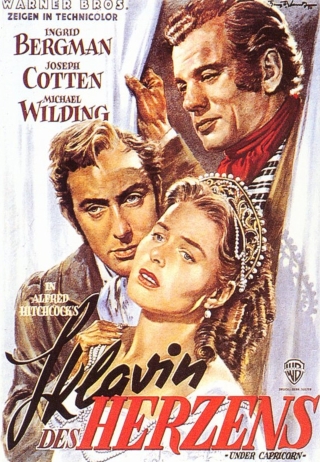
Under Capricorn (1949)

Very much lesser Hitchcock, a movie which barely anyone ever has a good word to say for. Well, I’ll at least say that it is handsomely shot, courtesy of Jack Cardiff, and the acting is fine even if Michael Wilding does lay the whimsy on with a trowel at times.
But yes, it is a problematic movie. And that is largely because it tells a story which is thin, not uninteresting in itself but too thin for its running time. It needed to be trimmed and compressed, which would have been hard to do because of the other great flaw – the director’s insistence at the time on experimenting with long takes. It hamstrung the previous year’s Rope (though that one has other issues dragging it down too) and was a technique that was antithetical to Hitchcock’s style.
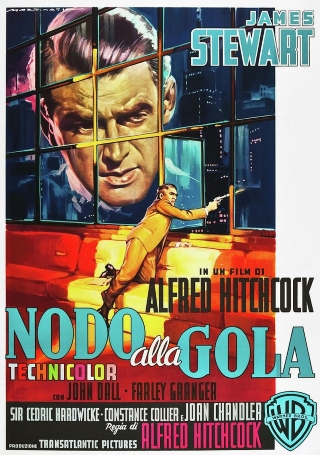
Rope (1948)

I’ve never especially liked this. The technical ambition is admirable, and I’ve always been somewhat hypnotized by the seamless skill involved in the gradual change in the lighting of the studio bound skyline as the tale unfolds in real time. However, the whole continuous take conceit imposes huge limitations on the cast and crew and the process must have been a genuine pain for everyone involved. As with Under Capricorn, the entire business works to undermine the director’s natural strengths.

The biggest problem I have with the movie though is the coldness and indeed the malice at its core. Nobody aside from Cedric Hardwicke’s anxious and compassionate father comes out of it well. That’s not to say it’s badly played of course. Granger could do that weak sister act with his eyes closed and Dall has the clinical and supercilious aspects down pat too – he always seemed to manage that though and there’s a hint of that inherent unlikeability also found in Laurence Harvey in all his parts. James Stewart nails the creeping suspicion that blossoms into horror and then outrage and (self?) disgust. But his character is not really sympathetic either – a man of his intelligence ought to have realized the kind of seeds his intellectual posing was planting.
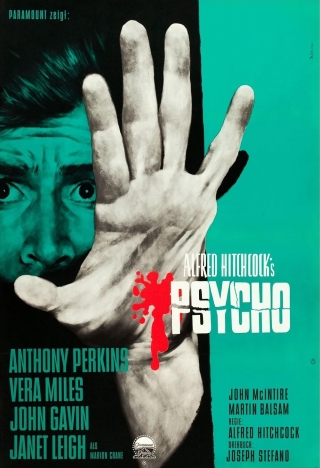
Psycho (1960)

It’s probably 15 years, maybe even more, since I last watched this. The first half always worked best for me and I still feel the same. The paranoia and gnawing guilt of Janet Leigh’s Marion is perfectly encapsulated in the minimalist style of that whole opening section – the rain, the ever more frantic musing, Herrmann’s nervy score and those seemingly permanent close ups of Leigh’s huge, expressive eyes.

And then there’s that frankly sublime sequence in the motel cabin. Cagey and uncomfortable, pathetically flirtatious and taut all at the same time. I reckon it’s the best scene in the entire movie. What follows in the last hour engages me less. It remains visually astounding and technically flawless, but too much of the artful subtlety drains away with the bath water. It still grips and shocks at times, just much more conventionally and it never again approaches the emotional precipice that was teased by the interaction amid stuffed birds, sandwiches and milk.

Nevertheless, it is still undeniably a great piece of cinema, the heights approached and attained in that first hour and the total assurance of a director genuinely in love with his medium are enough to ensure that.
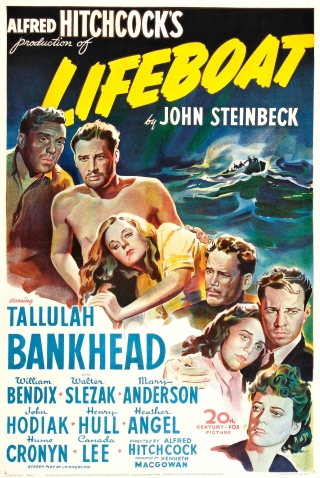
Lifeboat (1944)

A wartime propaganda picture from Hitchcock. Still, being a Hitchcock movie there’s more to it than that – by a circuitous route it winds up as something of a celebration of cohesiveness. Just about every stratum of western society is represented, from Henry Hull’s super rich kingpin to John Hodiak’s blue collar revolutionary, from the stoicism of Canada Lee to the louche decadence of Tallulah Bankhead. All the disparate characters are by turns gulled, threatened and finally drawn together by the malignant presence of Walter Slezak’s cool and cunning Nazi.

It’s another of the director’s challenges to himself, an exercise in the potential of confinement that makes up for in intensity what it arguably lacks in suspense. Alongside the more eye-catching dramatics of those further up the cast list, it’s satisfying to watch the slow development of a gentle romance between fairly regular Hitchcock collaborator Hume Cronyn and Mary Anderson, an actress who never much graduated beyond supporting roles except perhaps in the rarely seen but rather good Chicago Calling.
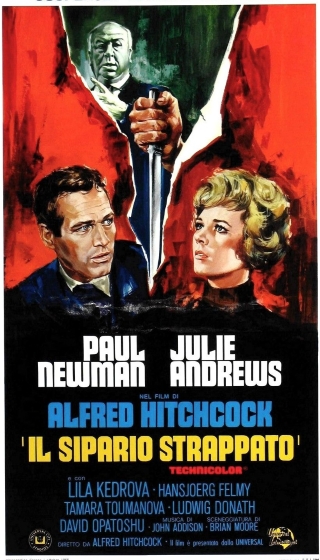
Torn Curtain (1966)

This is the point at which Hitchcock’s decline can be discerned. This Cold War thriller starts out as a double-cross drama where the bluff is drawn out too long before turning into a more successful cross-country chase, the kind of affair Hitchcock could make with his eyes closed.

The first half of the movie misses more than it hits, the brief bookstore scene in Copenhagen errs just on the right side of oddness, but the drab grey/green palate when events move to East Germany reflects the dullness of much of that section, not helped by a listless and detached performance by Paul Newman and an uncomfortable looking Julie Andrews. Some of it does work though – I like the entire build up to the farmhouse scene where the Stasi spook Gromek is laboriously disposed of, and Ludwig Donath is spikily entertaining as a caricatured professor.

The bus ride/pursuit has its moments, helped by John Addison’s slightly eccentric score and an earnest David Opatoshu. There are a few late flourishes too – the hiding among a crowd/creating a distraction ploy is revisited for at least the fourth time – off the top of my head variations thereof are employed in The 39 Steps, Saboteur and North By Northwest if not more.

So, a mixed bag all told. I guess it does more wrong than it does right yet I’ve always had a greater fondness for it than it probably deserves.
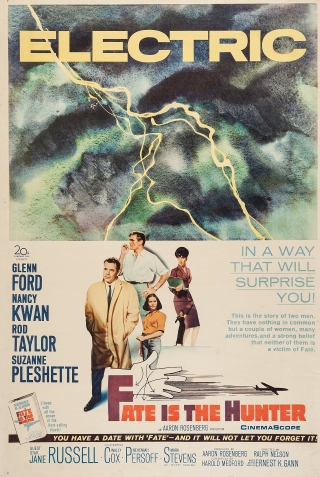
Fate Is the Hunter

“When your number’s up, why fight it, right? And if it’s not, why worry about it?”

Fate and faith. That line quoted above is delivered with a kind of petrifying calm by Rod Taylor’s flyer during one of the many times he and his maker passed within a hair’s breadth of one another in Fate Is the Hunter (1964). He is by his words and by his actions a fatalist, believing that most of what happens in life, the larger scale concepts at any rate, are beyond one’s control. It’s part of his attraction, lending a devil may care aspect to him that draws people when it’s carried off with aplomb. And then there is faith, such an important and defining principle in the human condition. One may or may not subscribe to the former, but the latter (and not necessarily in a religious sense) surely touches all of us and influences our approach to life. Both of these ideas are explored in Ralph Nelson’s movie, where the trappings of the genre picture – in this case the aviation thriller/disaster movie – are used to frame a fairly simple tale of one man’s belief in the character of his friend and, consequently, in his own judgement.

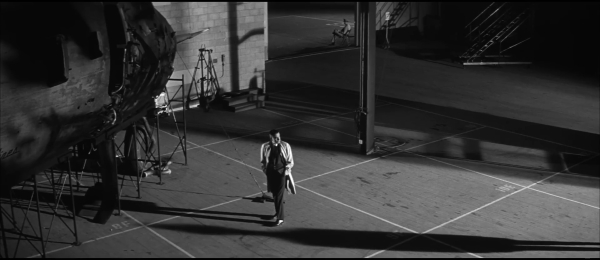
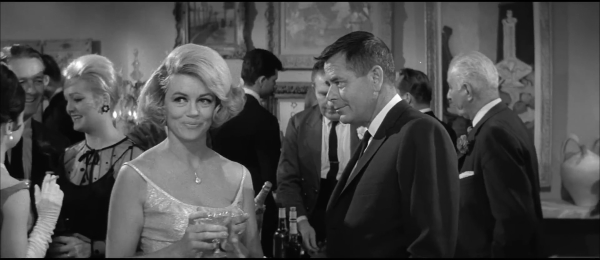
There is a lengthy prologue, the routine preparations for a transnational flight filling up most of the time and introducing three main characters – pilot Jack Savage (Rod Taylor), his friend airline executive Sam McBane (Glenn Ford), and stewardess Martha Webster (Susanne Pleshette). So yes, all fairly routine, until it’s not. A fault in an engine, then a communications glitch, and then the other engine fails. And then the crash. Of those on board only the stewardess survives and it falls to McBane to sift through the little evidence available in order to fix the cause of the disaster. The airline seems keen to put pilot error on the part of Savage forward as the reason, and the air of raffish irresponsibility he spent his life cultivating backs up this approach. However, McBane is unconvinced, partly due to a sense of self preservation as his championing of Savage over the years has left his own acuity at least on the periphery of suspicion, but perhaps more importantly he balks at the notion his friend was so careless as to be the one solely responsible. In his efforts to see beyond the easy way out, he finds himself delving into the past, the past of Savage to be exact, trying to clear the man and in a way trying to clear his own conscience, to validate his faith in a friend and in himself.

Anyone going into this movie with the expectation of seeing a thriller of some kind is likely to be disappointed. There is the tense build up to the crash in the prologue, and a pretty suspenseful reconstruction undertaken right at the end, but that’s about it in terms of standard thrills. The rest of the movie, the bulk of the narrative, is a character study, an examination of who Savage was and why he acted as he did, largely told by means of multiple flashbacks, each one colored somewhat by the sensibilities of the person doing the telling but also by the spirit of the man himself. By the end, we have gained a broader perspective on this ebullient fatalist, the views of those touched most deeply by their contact with him having reshaped this both subtly and decidedly. The net result is that the truth is arrived at by a combination of chance and logic that is apt under the circumstances, and on a deeper level McBane feels vindicated not only since he has salvaged the reputation of his friend but because in so doing he has reaffirmed the primacy of faith.

Ralph Nelson had a spotty, patchy kind of career, veering wildly from genre to genre and hard to pin down stylistically. Fate Is the Hunter was a memoir penned by aviator Ernest K Gann, the stories contained in that book have given rise to a number of movies but this particular film just borrows the title. Maybe Gann himself was unhappy about the result but the movie is attractively shot by Milton Krasner, has a score by Jerry Goldsmith which manages to be both haunting and lush, and is thematically consistent in a way that is satisfying.

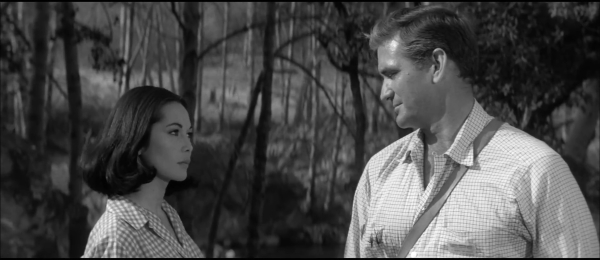
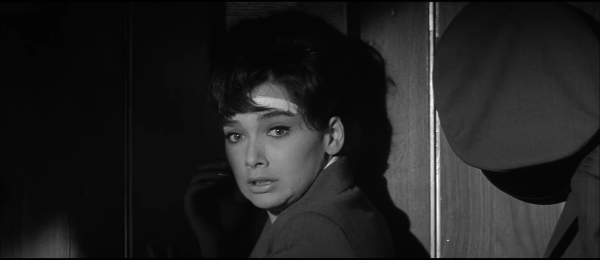
Ford plays it low-key for the most part, a quiet performance that suggests maturity and fits his character. Taylor could be big and showy on occasion all through his career, but he too had a quietness, an introspective side that he was able to tap into and it serves him well at a few key moments. The piecing together of the various facets of a man’s life and character through the vignettes presented in the flashbacks allows a succession of performers to drop in and sketch a few more lines in the emerging portrait of Savage. Mark Stevens’ noir heyday had passed yet he brings a fine sense of weary dissipation to the role of an alcoholic former buddy who owes much to Savage. Dorothy Malone ( The Tarnished Angels)gushes glamorously as a socialite ex-fiancée in a brief interlude, while Nancy Kwan (The World of Suzie Wong) has a slightly more substantial part and consequently adds a good deal more to our understanding of the pilot. Susanne Pleshette, on a good run around this time and only a year after co-starring with Taylor in Hitchcock’s The Birds, brings a touching bewilderment to it all, wondering why she should have been singled out to live when everyone else perished. She was an actress who always had a gutsiness about her and that aspect is on show when she has to confront her fears and thus make perhaps the vital contribution to the final resolution.

Fate Is the Hunter is the kind of film that isn’t quite what it seems to be on the surface. There is aviation drama to satisfy those drawn to the title by that aspect but that’s only incidental I’d say. At heart, the movie is about perceptions and assumptions, how chance and belief can combine to shape a life, how one’s impressions and suppositions may not be as dependable as we hope, and how reason can transcend the random while also bolstering faith and friendship.

Dark of the Sun

poster020

There haven’t been too many movies based around the modern mercenary trade – The Wild Geese, The Dogs of War, The Last Grenade and, if you stretch the point, the recent Blood Diamond are the ones that spring to mind. There are, of course, lots of examples of mercenary characters in westerns but that’s not really the same thing. Of those mentioned, The Wild Geese isn’t much more than a Boy’s Own adventure, albeit a fairly enjoyable one. The Dogs of War spends way too much time on behind the scenes machinations and The Last Grenade is just not a very good film. Jack Cardiff’s 1968 production Dark of the Sun is a cut above all these and is arguably the best movie in this small sub-genre.

The story is set during the Simba revolt in the Congo in the mid 60s, when that vast, former Belgian colony was on the point of implosion. A mercenary group, under the command of Curry (Rod Taylor), are engaged to drive a train into the interior and evacuate the European inhabitants of an isolated mining town which is threatened by the advance of the Simba rebels. The reason this particular town is on the fast track for relief is because there happens to be a fortune in uncut diamonds waiting around for whoever arrives first. Curry, and comrade in arms Ruffo (Jim Brown), sets out with his hastily assembled group in the hope of beating the Simbas to the chase. Everything zips along at a good pace, packing in a chainsaw fight, a confrontation with the U.N. forces, and the rescue of a massacre survivor (Yvette Mimieux) before the train arrives at its destination. At this point the tension rises, as the diamonds are in a vault whose time lock won’t open for another three hours, and the rebels are inching ever closer.

Rod Taylor gives one of his best performances as the hard as nails soldier of fortune and there’s none of the phony posing so prevalent in more modern action heroes. Taylor seems genuinely tough and the climax, where he gives full rein to his outraged fury at the fate of his best friend, is powerful stuff indeed. Jim Brown was no great shakes as an actor but his calm, reasonable Ruffo provides an acceptable counterweight to the simmering Curry. Peter Carsten makes for a great villain as an unapologetic ex-Nazi, and there’s good support from the seasoned Kenneth More and Andre Morell. This is pretty much a man’s movie so there’s not a lot for Yvette Mimieux to do, but she does look sexy and appealing and that’s good enough for me.

If you’ve ever seen a movie photographed by Jack Cardiff you will know how effortlessly good everything looks. Although he is the director here, the movie remains visually pleasing and is only occasionally spoiled by some poor rear projection. The score by Jacques Loussier (I don’t believe I’ve heard anything else by him) is another major plus; it’s a jazzy, downbeat effort that enhances the mood of the picture perfectly. The source material was a novel of the same name by Wilbur Smith. Smith knocked out some good, tight action thrillers early in his career before sliding into the (probably more lucrative) field of the bloated, historical soap opera. I don’t know who provided the inspiration for Smith’s characters but I suspect he may have been thinking of Mike Hoare. Either way, I believe the film’s makers had one of Dublin’s less celebrated figures in mind – if you can get your hands on a copy of ‘Mad’ Mike’s own memoirs, Congo Mercenary, you ought to notice some parallels.

As far as I know, Dark of the Sun remains unavailable on DVD anywhere but there was some talk of Warner giving it a release in R1. It has turned up on TCM in the past but I would love to see it get a proper release – it’s a very good movie whose stock should rise if only it were more readily available.

EDIT January 2012 – The movie has now been given two official releases. The first is the Warner Archive MOD from the USA which I haven’t seen. It’s also been issued in Spain by Suevia, a company whose output is variable in quality. However, I’m pleased to say the Spanish disc is more than acceptable. It’s been transferred progressively in anamorphic scope and looks generally sharp. The colours are rich and there’s no problem with subs – the disc offers the option of French, Spanish or no subtitles on the English track. Extras are limited to the trailer. All in all, it’s a very satisfactory release.