The Adventures of Sherlock Holmes

I’m going to break you Holmes. I’m going to bring off right under your nose the most incredible crime of the century, and you’ll never suspect it until it’s too late. That will be the end of you Mr. Sherlock Holmes. And when I’ve beaten and ruined you then I can retire in peace. I’d like to retire; crime no longer amuses me. I’d like to devote my remaining years to abstract science.

The Sherlock Holmes character has come to the screen (both big and small) in many shapes and forms over the years and almost everyone has their own favorite incarnation. As often happens, the first version I saw or at least have a memory of has become my preferred choice. For me, the evening television screenings of the Basil Rathbone and Nigel Bruce movies cemented them in my consciousness to the point where I automatically see their faces first when the characters of Holmes and Watson are mentioned. The interpretations, adaptations and settings were far from what a purist might find acceptable, but I don’t care about any of that. These performers and their films carry me back almost 40 years and will always occupy a special place in my affections.

The Adventures of Sherlock Holmes (1939) wasn’t an adaptation of any of Conan Doyle’s stories, although the estate is credited, presumably for the use of the characters themselves. The script instead claims to be derived from the stage play by William Gillette. It opens with the dismissal of a murder case against arch-criminal Professor Moriarty (George Zucco), just as Holmes (Basil Rathbone)dramatically bursts into the courtroom with evidence he maintains will shoot the alibi of his adversary to pieces. With the verdict already in, he’s too late of course and there follows a neat little scene with the two rivals sharing a Hansom cab that spirits them away amid a torrential downpour. It’s at this point that Moriarty makes the little speech I used at the top of this piece, setting up the plan for revenge which dominates the remainder of the picture. I won’t go into too much detail here as much of the pleasure of the movie is to be had from watching the slow unfolding of two ingenious plot strands simultaneously. The lion’s share of the running time is taken up with the grotesque and macabre stalking experienced by Ann Brandon (Ida Lupino) and her ill-fated relatives.

1939 is often referred to as the golden year of cinema’s Golden Age due to the sheer number of successful and high quality pictures produced and released during those twelve months. This is something I wouldn’t want to argue with as even a cursory glance reveals the depth and breadth of the quality projected onto the silver screen in that year – from award-wooing prestige vehicles to crowd-pleasing genre pieces, just about every possible taste was catered to and it would be a mean-spirited film fan indeed who failed to hit on something to captivate him or her. Last time I was highlighting a tightly budgeted western shot by Alfred Werker, this time it’s the same director but the money men were a little more generous. Fox had already scored a success with Rathbone and Bruce in their wonderfully atmospheric version of The Hound of the Baskervilles and this was their follow-up. Werker had the resources of the studio backing him up in this moodily impressive effort, the sets looking rich and classy and Leon Shamroy displaying his photographic talents as cinematographer. There’s been some conversation on here of late relating to the relative merits of set based film production after I looked at a movie where I felt the backdrops were less than satisfactory. The Adventures of Sherlock Holmes, on the other hand, presents us with the flip side of the coin, where much of the enjoyment of the movie stems directly from the marvelous artistry involved in creating those fogbound and gas-lit cobble streets down which hacks chase their cabs speeding their fares to or from the scene of mystery and intrigue.

The two films made by Fox had Holmes and Watson fighting crime in the Victorian surroundings in which their creator had originally placed them. Subsequent tales of mystery and detection undertaken by Rathbone and Bruce would be produced on a smaller budget for Universal (my friend and regular contributor to discussion on this site, Sergio, is in the process of going through that series here, and others like 100 Films in a Year have done so too) with the characters operating in a contemporary setting. Purists may rail against such liberties but they never concerned me particularly. The Adventures of Sherlock Holmes retains the era of Conan Doyle’s literary detective yet it will no doubt displease some as a result of the way certain central characters are portrayed.
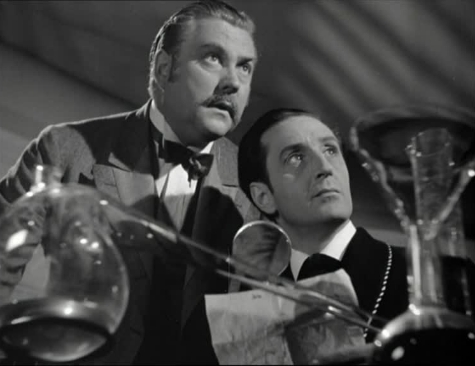
Is there a definitive screen Holmes? Plenty of people would argue that Jeremy Brett nailed it on television. Having gone back and revisited a number of episodes of the Brett series, I’d say there’s a strong case to be made for this assertion and I wouldn’t seek to dissuade anyone from holding this opinion. And still I find I return to Rathbone, for those reasons I mentioned above; I’ve since read the novels and short stories and seen other interpretations that may have gotten closer to the sleuth on the printed page, but Rathbone was the one I came across first and thus will always be my Holmes. There’s a terrific energy and restlessness about the man and it contrasts nicely with the moody abruptness which can bubble up to the surface on occasion. Nigel Bruce’s Watson tends to come in for a fair bit of stick and derision for the bumbling and clowning, and I can quite understand how that must grate for those familiar with the capable and competent figure of the books. Sure there’s something of the overgrown child about Bruce’s performance, even so I like it fine and there’s good chemistry between him and Rathbone – I think the affection the characters have for each other is quite apparent and nicely illustrated by the little exchange right at the end of the movie. As Moriarty, George Zucco is delightfully creepy and dangerous. He would reappear in the Universal film Sherlock Holmes in Washington, though playing a different role. A young Ida Lupino was just seeing her career take off at this point and I think she does well as the girl whose family appears to be cursed in some way and haunted by dark South American secrets. In support, we have E E Clive, Henry Stephenson, Alan Marshal, series regular Mary Gordon, and Terry Kilburn.

I have all the Rathbone/Bruce series on the UK set issued some years ago by Optimum and the transfers sourced from the UCLA restorations are very good. There’s some damage to the prints of course but nothing major. Among the extra features on The Adventures of Sherlock Holmes is a commentary track by Holmes writer David Stuart Davies. It’s worth noting here that there are various Blu-ray editions of these films available both in the US and in Europe – I’ve yet to pick one up but the quality is excellent by all accounts. As for this movie, it’s a fine tale with bags of creepy atmosphere and ought to satisfy fans of Holmes and the wider mystery genre too. It would serve as a good introduction to the Rathbone/Bruce take on Holmes and Watson and the brisk pacing is such that it never outstays its welcome.

The Hound of the Baskervilles

£17

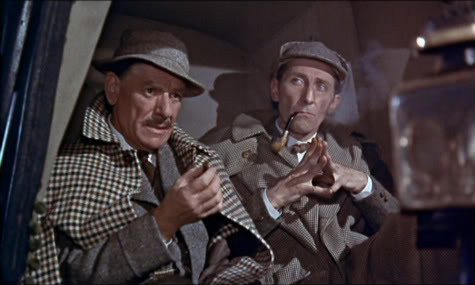
The Hound of the Baskervilles must surely be the most familiar and famous Sherlock Holmes story of all. With its mixture of mystery and horror elements, and consequent crossover appeal, it’s easy to see why Doyle’s story has attracted so many filmmakers down through the years. My own favourite adaptation of the story remains the Rathbone and Bruce effort from 1939, but Hammer’s 1959 production does come very close to being its equal. There are a number of liberties taken transferring this classic story from the page to film, but I think I’ve said before that this never especially bothered me since I often feel that, for all their classic status, there are aspects of Doyle’s original writings that can be a little tedious. Hammer certainly tweaked the material here and there but the essence of the story remains and, when all’s said and done, that’s as much as anyone should reasonably expect from a literary adaptation.

The story, for those unfamiliar with it, concerns the legend of a curse on the aristocratic Baskerville family, wherein the male heirs are doomed to meet a grisly fate visited upon them by the mythical hound from hell. When the penultimate holder of the title dies alone under mysterious circumstances on the bleak moors, the last of the Baskervilles, Sir Henry (Christopher Lee), returns to his ancestral home. Fearing for the safety of the new occupant of Baskerville Hall, a local physician, Dr Mortimer (Francis De Wolff), calls on the world’s greatest consulting detective (Peter Cushing) for advice. Mortimer’s account of the origin of the curse is told in flashback and forms the prologue of the film, setting things off at a storming pace that rarely lets up. The only slackness that occurs, and it’s very slight at that, is when Holmes sends Watson (Andre Morell) off alone to play nursemaid to Sir Henry. At this point Holmes is absent from the screen and the film suffers a little for it. However, this is a feature of the source material that can’t be avoided – anyway it offers the opportunity to see Watson acting on his own initiative for a change, and that alone means that it doesn’t deserve to be criticised too harshly. The scenes on the moors at night have an eerie, supernatural quality (lashings of mist and a soft green glow emanating from ruined buildings) that were the stock in trade of Hammer films and house director Terence Fisher. When Holmes eventually returns to the screen the film immediately gets a new lease of life, with Cushing lending a sense of urgency and energy. The final denouement takes place among the same spooky ruins that provided the backdrop for the opening, and this is the point where the movie disappoints a little. Until then the hound itself had never been as much as glimpsed, the characters only referring to it in hushed and fearful tones and it’s unearthly howls being heard echoing across the moors. Given the anticipation that such a build-up encourages, it’s hardly surprising that the beast struggles to live up to it in the flesh.

£2

The Hound of the Baskervilles is credited as being the first Holmes film in colour, and Hammer certainly did it proud. The opening is a riot of rich, vivid hues that look as pretty as anything the studio ever produced. James Bernard’s typically powerful score adds to the melodramatic atmosphere and Fisher’s direction is suspenseful and pacy (something which he’s occasionally been accused of neglecting in favour of atmosphere). Cushing and Morell were inspired casting, with the former providing one of the finest portrayals of the great detective on screen. He comes as close as anyone ever has to capturing the essence of the character, combining athleticism with erudition, waspish arrogance, and a sly humour. Morell moves Watson away from the bumbling foolishness of Nigel Bruce to offer a more serious sounding board for the wits of Holmes. Lee gives his usual professional performance as the last of the Baskervilles who falls for the sexy and feral Marla Landi, although he does succumb to a bout of the Elmer Fudds at one point (Come on now. Why did you wun away?). The support cast is as good as one would expect from a Hammer picture, with Miles Malleson doing a nice comic turn as a spider-loving clergyman while John Le Mesurier, Ewen Solon and Francis De Wolff lurk menacingly.

The Hound of the Baskervilles is one of MGM’s catalogue DVDs, and that means it’s just about adequate. The studio rarely seemed to consider it necessary to give their 1.66:1 titles an anamorphic transfer, and this release follows that pattern. There are also a variety of damage marks but none of them are seriously distracting. The R2 carries no extras save the theatrical trailer. Generally, this is an excellent Holmes film and, since it’s also one of Hammer’s best, it’s a pity the studio never followed it up and turned it into one of their series. Cushing and Morell had the makings of a fine team and it’s tempting to wonder what they could have done with the characters had they been given an extended run, but I understand the film just didn’t turn a big enough profit for Hammer to keep it going. However, they did leave us with a strong movie that holds up well to repeated viewings.

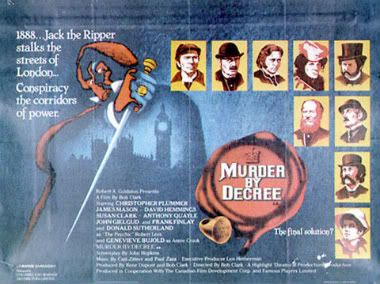
Murder By Decree

Poster

I’ve always been a fan of Sherlock Holmes films. However, strange though it may seem, the stories and novels which inspired them never grabbed me in the same way. This may be due in part to the fact that I was first exposed to the screen Holmes rather than the literary Holmes, or it may be that my subsequent reading of Doyle’s stories left me a little underwhelmed. My earliest memories of the great detective and Dr. Watson were the films with Basil Rathbone and Nigel Bruce. Over the years I’ve seen many more actors take on the role, from Peter Cushing and Andre Morell through to Jeremy Brett and Edward Hardwicke. However, Rathbone and Bruce have remained the definitive screen incarnations – seems to bear out the old saying about first impressions. Murder By Decree (1978) offers Christopher Plummer in the role of Holmes and James Mason as Watson. I found them to be probably my second favorite pairing although the Cushing/Morell combination would run them pretty close.

This film has nothing to do with the Doyle stories (not always a bad thing) but simply takes his characters and transplants them into the Jack the Ripper mystery. This wasn’t the first time Holmes had been called upon to attempt to crack the famous unsolved murders on screen; that distinction belongs to A Study in Terror, made a decade before. While the earlier film was made on a more modest budget, Murder By Decree was an expensive production filled with big names. The plot has Holmes called into the case in its latter stages as a result of an anonymous tip-off. He is met with open hostility from the authorities in the form of Sir Charles Warren (Anthony Quayle). The mysterious informants later turn out to be members of a citizens’ committee (in reality anarchist agitators) who have taken a special interest in the murders. Holmes investigation takes him through the seedy and foggy backstreets of Victorian Whitechapel, where his and Watson’s conversations with the friends of the murdered women draw him closer to an unpalatable conclusion. When he finally visits an asylum to meet an inmate called Annie Crook (Genevieve Bujold), the talk he has not only confirms his suspicion but also leads that monument to logical reasoning to break down and weep. I won’t spoil the ending for anyone who hasn’t seen the film, but I will say that it will scarcely come as a surprise as it involves a fanciful theory that has been frequently expounded.

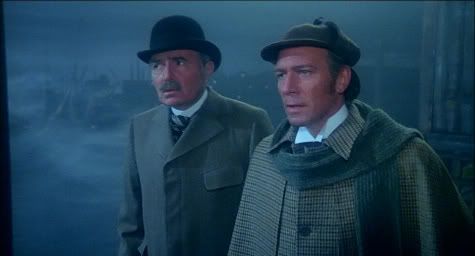
James Mason & Christopher Plummer - The game's afoot!

Christopher Plummer gives a performance as Holmes which brings out the humanity of the man better than anyone else I’ve seen. I’m not going to claim that this is Holmes as Doyle wrote him; by all accounts, Jeremy Brett managed to nail that one. Instead of the aloof character of literature we get a more rounded man and it is genuinely affecting to see him display honest emotion in the scene with Genevieve Bujold. He also gives a fine speech at the end when rails against Lord Salisbury (John Gielgud) and the hypocrisy of the powers that be. James Mason’s Watson is closer to the spirit of Doyle and not the bumbling, yet engaging, buffoon that Nigel Bruce made famous. Having said that, he does have his moments – the “You squashed my pea!” business never fails to raise a smile with me. The film is a very starry one with many good character turns: Anthony Quayle gives a wonderfully distasteful portrait of upper-class arrogance, David Hemmings is a policeman with his own private agenda, Donald Sutherland’s frightened psychic haunted by his own visions, and no Holmes film would be complete without Lestrade (Frank Finlay).

Murder By Decree is out on DVD in both R1 and R2. I have the R2 from Momentum and it has a pretty good anamorphic transfer and includes the theatrical trailer. I’m not sure if the R1 from Anchor Bay tops it but I’m happy enough with what I have. All in all, I think this is a very entertaining Holmes film which positively drips atmosphere. It features some great photography and excellent acting, and successfully blends the characters into a set of real historical circumstances. The resolution doesn’t particularly convince but, given the nature of the events, that’s always going to be the case. Unless you’re expecting a movie that sticks rigidly to Doyle’s characters you shouldn’t be disappointed.