
Patterns, connections, trends and interdependence. These are things which draw my attention in general, and in cinema in particular. I’d like to think that visitors to this site have noticed this from time to time, and I’d be even more pleased if I’d managed to pique the interest of some by following up on certain threads that suggest themselves to me. Redemption is the one theme that I guess stands out from the crowd of other ideas, and it’s certainly the driving force behind Rogue Cop (1954), which I want to focus on today. I’d also like to touch on what I feel is a defining feature running thorough 1950s cinema as a whole and maybe then cast an eye over the shape and texture of noir at that time. So yes, it ought to be clear enough that I’m setting myself a nice uncomplicated and unambitious task with this one…
Rogue Cop opens in an understated and matter-of-fact manner, with the credits running over a series of background images of cops going about their daily business in the city, making and taking calls, driving squad cars and all seguing into a nighttime scene where the sirens scream and the neon flickers. Throughout this it remains everyday, mundane and routine, even as a showgirl drifts out of the theater where she’s been working and makes her way to a penny arcade. Even there the drug deal she’s intent on completing is nothing out of the ordinary, nor indeed is the casual filleting of her pusher by a competitor. So there you have it, life and death played out as just another unremarkable event in an overlit and gaudy locale – the whole process as cheap and throwaway as the scene of the crime itself.
Yet, in plot terms, this is more than just another statistic to write up in the records. Chance, that old staple of any self-respecting film noir, steps in and sees to it that the killer who is coolly departing should bump into a young patrolman. This man on the beat is Eddie Kelvaney (Steve Forrest) and while he doesn’t make a pinch he does get a good enough look at the knife man to be able to make an identification. Had he not been there at that moment, or had another less ethical man been pounding that particular pavement, the tale would have meandered off in a different direction. But he was there and the fates would also have it that his older brother Chris (Robert Taylor) is a detective with a lot of shady contacts, with the healthy bank balance and unhealthy reputation that brings. Pressure will be brought to bear on Chris to ensure Eddie toes the line and forgets who he saw and where he saw him. Were it only about Chris himself, this would not be a problem; however, Eddie is an idealist and a man who holds firm to the principles of decency his late father lived by, and which his brother professes to regard with contempt. What follows is that age old contest, the battle for the soul of a man with temptation taking place in an urban wasteland with winking lights as opposed to the deserts of antiquity.

Rogue Cop was adapted from a novel by William P McGivern, the man who provided the source material for Fritz Lang’s punishing examination of corruption and abusive relationships The Big Heat. Similar to Lang’s movie the noir quotient of this production stems as much, and probably more, from the theme as it does from the visuals. While John Seitz shoots the whole thing beautifully and earned himself an Oscar nomination for cinematography, it’s not got that painted shadows look that the term film noir so often conjures up. It’s got a brighter appearance in general and director Roy Rowland aims for the kind of pared down and uncluttered visual simplicity that Lang had been working on.
Is it possible then that the look here was a reflection of the thematic shift taking place within film noir itself? Noir in the 1940s felt as though it concerned itself primarily with disenchantment and compromised morality on a personal, and thus more intimate, level. Moving into the next decade saw a cleaner and simpler aesthetic gain prominence, which might suggest that thematically it was drifting towards a more sharply defined ethical conundrum. The focus was increasingly on decay in institutional terms, and the ethical deficiencies in broader society. A good deal of the action is situated in flash night clubs and swish apartments, well-lit and with the type of surface gloss that is deceptive – a store-bought glamor that seeks to blind us to the real cheapness, the shabby abuse and exploitation lurking behind it all.
There are those who will tell you a film noir has to have a femme fatale. Personally, I feel she is a common or typical feature but not an essential one, although I do think a strong and pivotal female role in general is vital. Rogue Cop offers two such parts – Janet Leigh’s jaded entertainer desperate to escape the sins of the past and, giving a terrific performance, Anne Francis’ boozy moll who suffers grievously for a moment’s tactlessness. These two are key to the development of the plot and in determining the path Taylor’s dirty cop will follow.
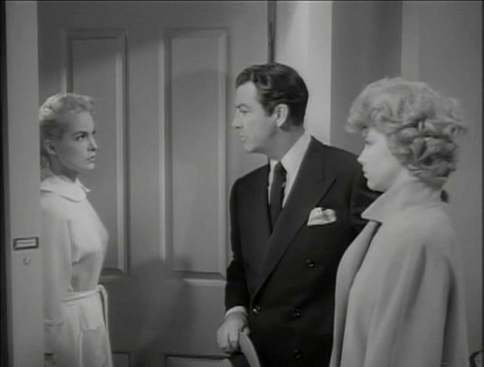
Taylor is, right from the beginning, a man trying to save himself, a man hungry for redemption, even if he doesn’t realize it till later. The fact remains though that the itch is there, the mask of cynicism barely disguising the intensity of his concern over his brother’s welfare. He’s only a short step away from acknowledging his desire to find a way out – and that tipping point is achieved first by the fate of his brother, later intensified by the treatment of Francis, and finally confirmed by the constancy of Leigh. It’s this spiritual quest that lends weight to the whole movie and lifts it above a mere run-of-the-mill critique of corruption. All of which had me wondering why exactly this theme of redemption is to be seen all through 1950s cinema. I’ve often written about it here in relation to the western, where it found perhaps its truest expression, but it transcended genre and is almost ubiquitous. Was it a reaction, albeit a delayed one, to the war years? And did it climax at or around the end of the decade? My feeling is that it had – with the closing of the classic noir cycle and the gradual winding down of the golden age of westerns. Still, this is just a feeling on my part and others may be able to offer a more definitive answer.
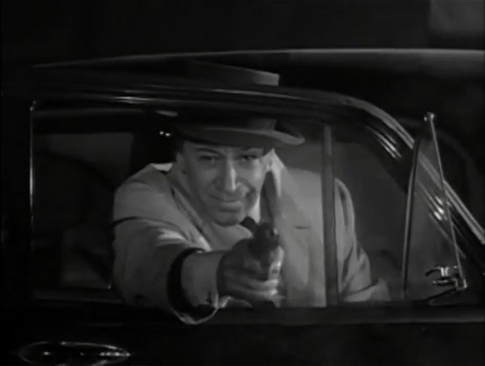
Of course Rogue Cop, being released in 1954, wasn’t coming at the end of any cycle. In fact, it signaled a return for at least one person to bigger pictures than had been the case for a while. That person was George Raft, one of the early stars of the gangster movie whose star slowly faded through the 1940s. I’ve heard it said – although I’d be happy to be corrected on this if anybody knows different – that Raft at the height of his fame was very choosy about his roles and became very cautious about the image he was projecting on screen. Essentially, he was said to be turning down anything that involved a persona which was less than squeaky clean, something which always struck me as a singularly petty and counterproductive approach. As the chief villain here, Raft is very good indeed, full of malice and vindictiveness. Watching him get this across so successfully had me thinking about the secret of getting under the skin of a villain, of making or becoming a bad man on screen. That demands both self-confidence and humility, it requires that an actor be big enough in his soul to be comfortable playing someone genuinely small and mean of spirit. In short, it needs courage.
Unfortunately, Rogue Cop remains on the missing list as far as official releases on disc are concerned. It is easy enough to watch online in passable condition but it deserves to be available commercially. Whatever is holding that up, it’s not the quality of the movie itself. This is a superb 50s film noir with first rate performances all round from an excellent cast, and a solid script which offers plenty of food for thought while simultaneously raising a number of interesting questions.
 Riding the High Country
A delayed reaction to the war years feels like the most likely reason for the aesthetic change noted. After examining our own souls, we must look at the ripple effect of the corruption of institutions. I find it interesting how certain moods will impact a viewing choice. I know when I want a 1940s or a 1950s noir. The palette must be chosen carefully.
Robert Taylor impresses me in his 1950s work. This is certainly among the things he must have looked back at with pride if that was part of his career thinking.
Keep setting yourself these “easy” projects.
LikeLiked by 1 person
Thanks for that. I maybe tried to tie in too much stuff all in one go but sometimes it’s down to what occurs to you as you watch and the direction the movie encourages your thoughts to follow.
Taylor appeared to get right into the character and what he produces on screen is very powerful and convincing.
LikeLike
Colin
Superb write up of a superb film. Beats the hell out of anything I could come up with. I am not really a Raft fan, but as you point out, he elevates his game in this one. The female leads are also in top form as is the whole supporting cast. I always enjoy seeing Alan Hale Jr in bit parts. The older Taylor got, the better suited for roles like this he became. Just like in his later westerns, he has that slightly shopworn look that fits perfectly.
Again, well done my good man.
Gord
LikeLiked by 2 people
I’ve generally found Raft to be not all that interesting but I do want to give him another go – I’ve acquired a fair number of his movies over the years and I want to work through them bit by bit to see which ones feel more worthwhile.
LikeLiked by 1 person
Colin
One Raft film I really must admit to liking is 1949’s RED LIGHT. A great revenge noir with decent work from Raft . It also features one of Ray Burr’s best villain parts.
Gord
LikeLiked by 1 person
I have a copy of that one so I’ll bear it in mind for a future viewing. I remember thinking Johnny Allegro was OK, but it’s a hazy memory at best.
LikeLike
Excellent essay, Colin, not only on “Rogue Cop” itself but on the theme of redemption that emerges in the 50’s Noir and Western films. I thought the acting in “Rogue Cop” was superior with Ann Francis standing out as the bibulous and doomed gun-moll. Roy Rowland also does a terrific job with the supporting cast. It was fun watching Olive Carey playing against type as Taylor’s frumpy informant. Peter Brocco was appropriately sleazy as “Wrinkles” Fallon and Robert Ellenstein’s principled cop is a fine counterpoint to Taylor’s depravity. I also thought Ben Edwards was a very nasty hitman.
The simmering tension erupts several times in some nicely done action scenes. Robert Taylor lays a brutal beating on the bigger Alan Hale, Jr. and there is a well-staged shoot out at the end. I can’t recall another Rowland film that I’ve watched, but I think he does an outstanding job with “Rogue Cop”.
Sidney Boehm who wrote “The Big Heat” and “Side Street” delivers a superior screenplay. Boehm also wrote the 1950 crime procedural “Mystery Street” which I recently watched and enjoyed immensely.
A bit off-topic, but I still can’t get over the fact that Steve Forrest is Dana Andrew’s brother.
LikeLiked by 1 person
Thanks for that, Frank. I probably ought to have given a bit more attention to the supporting players you’ve highlighted here, but I figured I’d already heaped a fair bit on my plate! 🙂
As for Sidney Boehm, I agree – he has some outstanding writing credits and his name is normally an indicator of a good movie-watching experience.
I was surprised too when I first learned of Forrest and Andrews being brothers – they seem very different.
LikeLike
Giving credit to where credit is due…….actually it is Vince Edwards, not Ben, as the ‘very nasty hitman’. Must have had TV’s Dr. Ben Casey on the brain. lol
LikeLiked by 1 person
Correct – Vince Edwards getting in a bit of early practice for Murder By Contract.
LikeLike
Nice catch! I definitely had “Ben Casey” on my mind. In fact, I was going to write about how Vince Edwards would become famous as TV’s Ben Casey but decided not to.
LikeLike
Fabulous writeup, Colin, of one of my favorites. Here I was waiting for you to tell us that, yes, it has finally come out on DVD. The only reason I haven’t rewatched is because of the dismal copies floating around.
I agree that Taylor by the 50s had become a very good actor. He finally acquired that grizzled look that made him perfect for those morally compromised characters he was playing.
I like both Francis and Leigh in their respective roles.
There was definitively a thematic shift from 40s to 50s Noir. The narrative was less about powerlessness in the face of pre-ordained fate and personal problems, more about moral corruption of institutions. You see a lot of dirty cop Noirs in the 50s.
Crime had gone corporate and moved into the boardroom. Many crime films weren’t about small-time hoods trying to make it big, but about Mafia-like organizations. That shift had a lot to do with the 1950 Kefauver Hearings on organized crime, which was the first time that organized crime on a big very high level had become known to the public. Obviously Hollywood picked it up.
LikeLike
Sorry I can’t be the bearer of better news as far as commercial availability is concerned, but the more we talk up the movies online, the more chance there is of somebody somewhere getting them out there – or at least I’d love to think so.
Yes, the Kefauver hearings must have had some impact on awareness of corruption and thus on filmmaking choices at that time.
LikeLike
Frank
Yes, I had forgotten completely about Olive Carey’s great bit in this. The only other Rowland film that stands out for me is 1949’s “Scene of the Crime”. I was also taken aback the first time I found out that Dana Andrews and were brothers.
LikeLiked by 1 person
Frank & Gord, I’ve written up a couple of Rowland movies on the blog – the so-so The Moonlighter and the very good Gun Glory.
LikeLiked by 1 person
And I should just add here for those interested in Rowland’s work that his best might well be The Outriders.
LikeLike
Colin
Seen “Gun Glory” but not “The Moonlighter” . You are right about “The Outriders”, an excellent duster.
Gord
LikeLike
Superb and thought-provoking writing, Colin, of a personal favourite film, as with others above. The Kefauver Hearings brought on several films dealing with the subject of organised crime. I think firstly of “THE PHENIX CITY STORY” (1955) from Phil Karlson, but there were quite a few others. You have chosen to write and pick apart that new shift from personal dilemmas to a bigger picture, personal dilemmas within a corrupt atmosphere.
Robert Taylor, a special favourite actor for me, grew lines in his face during action in WW2, like many other actors, that brought realism to the more challenging parts he would seek/be offered. I think he returned from the conflict a much deeper actor, unafraid to tackle unsympathetic parts. Perhaps they would, by film’s end, offer him redemption and bring out some basic decency that had been well buried.
An exception to that is “THE LAST HUNT” where he earns no redemption.
You have made me want to pull my copy off the shelf for a re-watch and see what quality print I have. My memory of it is of a pretty decent print but then our expectations have somewhat shifted in recent years!
LikeLike
Thank you very much, Jerry – appreciated.
I like Taylor a lot too, although he’s not been featured here for a while. The war years had a discernible effect on a number of Hollywood stars and he was one of those. James Stewart, while admittedly being a different style of actor, is another who appears to have gained another dimension following his wartime experiences.
The print of the movie I watched online isn’t bad but it could be better – it seems to be open-matte where it ought to be widescreen and there’s plenty of empty space at the top of the image.
LikeLike
Just checked my copy, Colin. Off-air from TCM, it is a nice crisp print but shown in 4×3 instead of the 1.75:1 it should be. I intend to try and watch it tomorrow.
LikeLiked by 1 person
The version I watched was probably culled from the same source, Jerry. Widescreen would obviously be preferable but the open-matte presentation is acceptable for the time being. Hope you enjoy the revisit.
LikeLike
Margot
LOL. That “grizzled look” was the phrase I was searching for, beats shopworn any day.
Gord
LikeLike
Reblogged this on George Raft Dances.
LikeLiked by 1 person
Thanks!
LikeLike
Beautifully written piece, Colin, and thanks for keeping up the good fight to make more of these lost gems available. I think you’re right about the war years. From the late 40s to the early 60s the work force, economy, culture, and moving-going public were driven by WWII vets, and there’s no doubt that generation of Americans was looking for redemption, approval, forgiveness–to overcome feelings of guilt for things they’d had to do, things they’d witnessed, and the fact that they’d survived while others hadn’t. James Stewart’s nightmare-haunted Civil War vet in THE NAKED SPUR epitomizes the redemption-seeking protagonist of the westerns and noirs, melodramas and crime films, and even the horror and science-fiction films of the greatest decade of American film.
LikeLiked by 1 person
Thank you for a very nice comment, Robert. Yes, I feel Stewart above all embodies that post-war legacy – the contrast with his earlier persona is particularly marked.
LikeLike
I’ve thought of Stewart’s contribution to film many times over the years. I don’t believe there was another actor who appeared in so many quality films. These are some of his films that I have seen him in: “Mr. Smith Goes to Washington”; “Destry Rides Again”; “The Mortal Storm”; “It’s a Wonderful Life”; “Call Northside 777”; “Rope”; “Winchester ’73”; “Broken Arrow”; “The Greatest Show on Earth”; “Bend of the River”; “The Naked Spur”; “The Far Country”; “Rear Window”; “The Man from Laramie”; “The Man Who Knew Too Much”; “The Spirit of St. Louis”; “Vertigo”; “Anatomy of a Murder”; “The Man Who Shot Liberty Valence”; “The Shootist”.
I’m not a big fan of “Rope” but it is Hitchcock”. Similarly, I wouldn’t call the “Greatest Show on Earth” a great movie, but it did win Best Picture for 1952. I remember liking “Carbine Williams” and “The Flight of the Phoenix”. “The F.B.I. Story” was OK if very dated. I saw “Cheyenne Autumn” but Stewart only had a cameo in it. He had a bigger part in one of the segments of “How the West Was Won”. I never saw “The Philadelphia Storey”, “The Shop Around the Corner”, or “Harvey” but they’re all famous films.
Look at some of the directors he worked with — Hitchcock, Mann, Capra, Wilder, Ford, Borzage, Preminger, Mervyn LeRoy, and Don Siegal.
Every 10 years the BFI in conjunction with Sight & Sound Magazine takes two international polls on what are the greatest films ever made. The first poll is comprised of 846 top-ten lists from critics, programmers, academics, distributors, writers, and other cinephiles hailing from 73 countries. “Vertigo” starring James Stewart was named the greatest film of all time. I don’t want to start any arguments here but just wanted to cite this as an example of one of the superior films Stewart participated in. “Rear Window” came in at #54.
The second poll was conducted among directors – “Vertigo” came in at #7 and “Rear Window” at #48.
LikeLiked by 2 people
Great comment, Frank. James Stewart is very highly rated here. Even as a youngster watching him on TV, I knew there was a special quality to the man and my regard for his work has only grown over the years.
Of those films you haven’t seen yet, I can only say that I doubt you’ll be disappointed. Harvey is a delightful piece of whimsy with great heart:
The Philadelphia Story has sophistication written all over it, and class, and wit. The Shop Around the Corner is classic Christmas fare and extraordinarily touching.
LikeLiked by 2 people
For me, James Stewart is in my Top 5 favourite screen actors – any genre.
But I have to say those polls voting for the best movie ever made are plain silly. I couldn’t possibly come up with one film above all others, for a whole host of reasons.
By the way, Colin, a trawl through your George Raft collection might prove interesting. His acting was rather non-expressive yet he had a certain something that makes me watch his films, even the low budget movies from the early 50s. He certainly cut a dash too in those well-tailored double-breasted suits he favoured.
LikeLiked by 1 person
Frankly, I think “Best of…” polls and the like are similar to the making of lists, fun to participate in and a great jumping off point for discussion.
I think I’ve managed to accumulate most of Raft’s movies at one time or another, in spite of my not rating him all that highly. Off the top of my head, the only ones I’m still in need of are Race Street and A Dangerous Profession.
LikeLike
Colin
Race Street
I found to be a watchable one with Marylin Maxwell and William Bendix. It never hurts as well to have the always reliable Edwin L. Marin at the helm. Not seen A Dangerous Profession.
Gord
LikeLike
Jerry,
Most film and music polls make me cringe. What distinguishes this poll from others is that it is taken only once every ten years, solicits input from a broad range of people involved with film, and has been around since 1952. It certainly isn’t fickle — Citizen Kane was #1 from 1962 through 2002. And Martin Scorsese, Francis Ford Coppola, Woody Allen, Paul Schrader, Guillermo del Toro, Richard Lester, Michael Mann, and Abel Ferrara were among some of the directors who submitted top-ten lists in the 2012 poll along with notable critics like Roger Ebert and Richard Brody (The New Yorker).
LikeLiked by 1 person
Hi Frank,
Oh, I agree that a lot of knowledgeable folk have taken part in the poll, I just cannot see how one film can possibly be singled out as the best ever made. I agree with Colin that they promote discussion (look at us now LOL) but the whole concept strikes me as rather ludicrous. It is only opinion after all.
But this is only my opinion too. If people want to do it, hey……
LikeLiked by 1 person
……..and let’s not forget the wide brim fedora he sported so elegantly.
and Colin…….nice to see you’ve removed George Raft from purgatory into noir heaven on RTHC. Now, I will wait for Lawrence Tierney to find his way.
LikeLike
You never know, Scott – it all depends on what titles catch my eye and I decide to feature.
LikeLike
All
Your films for the weekend are?
Mine are
“Hang ‘Em High” 69, “Tombstone” 93, “The Hidden Fortress” 62 and “The Stranger” 46.
Have a good weekend all
Gord
LikeLike
I greatly admired “The Stranger”. Who can forget Mr. Wilson’s (Edward G. Robinson) waking with a start in the middle of the night as he recalls Professor Charles Rankin’s (Orson Welles) fatal slip at the dinner table? “But Marx wasn’t a German. Marx was a Jew.” Welles and Robinson are both great as is Konstantin Shaye as the repentant but pitiful Konrad Meinike.
LikeLiked by 1 person
The Stranger is a fine movie, still underrated to an extent. Welles and Robinson draw the attention naturally but I also think Loretta Young deserves a word. She was always good at projecting a touching kind of vulnerability and I think she adds another human layer to the tale. She also stars in one of my favorite Christmas movies The Bishop’s Wife and just thinking about her now reminds me that I want to get round to The Accused soon.
LikeLiked by 2 people
As well as the cogent look at “Rogue Cop” I very much enjoyed the thoughtful overview of recurring motifs, themes, concerns through these years across the genres. In my memory, the film does support them.
I don’t remember it well though so can’t add much. I know I liked it when it came out even though I was pretty young and saw it once on TV but that was years ago now. Count me among those who would have loved to see some good present DVD availability and disappointed it isn’t so. That doesn’t mean we are shooting the messenger, Colin!
I like a lot of Roy Rowland movies and this one surely rates well among those. Not much noticed over the years, I think he was a very good director, who could be patient with the drama and know where to give it special vividness. That’s especially true of “The Outriders” for which I have special affection and I guess a few others here share that.
Might note in passing that he directed Janet Leigh’s debut in “The Romance of Rosy Ridge”–an affecting post-civil war drama so could make a make a nice complementary double feature with “The Outriders.”
Re Sydney Boehm, a terrific screenwriter. “The Big Heat” will always be rightfully named first with him but he has lots of good credits. Just to name one relationship since a few here are on track of “Harry Black and the Tiger” he wrote that screenplay, the third of three with director Hugo Fregonese so they plainly worked well together, especially given the earlier two are also so good, bleak and absorbing prison break movie “Black Tuesday” and what I consider Fregonese’s masterpiece, the Civil War drama “The Raid.”
Now I’ve mentioned the Civil War three times–well, no further comment there.
***
I don’t know how to register a “Like” here, but just want to make a special nod to Robert C. Cumbow for his comment 5/22 at 5:54 PM. That was really eloquent and I responded to it for several reasons, especially the wonderful final sentence.
LikeLike
Thanks, Blake. I do hope you and others get an opportunity to view this movie again soon.
I felt that was an excellent comment too and it’s well worth highlighting. I think you need to have a WordPress account to register “likes” but I’m not 100% sure.
LikeLike
Took in TOMBSTONE 93 last night for the first time since it was in the cinemas. Great fun I must say. I had forgot that Harry Carey Jr was in it. Always liked the actor.
Gord
LikeLike
……..and let’s not forget the wide brim fedora he sported so elegantly.
and COLIN…….nice to see you’ve removed George Raft from purgatory into noir heaven on RTHC. Now, I will wait for Lawrence Tierney to find his way.
LikeLike
Really glad you highlighted “ROGUE COP”, Colin, and reminded me it was time for a re-watch. Which I just did……and I find it a first-rate cop thriller yet with so much more – the redemption thread strongly and emotionally played, the girl who’s been turned into a lush (the excellent Anne Francis) and the knowledge of Taylor’s corruption throughout the precinct by those junior to him. Taylor was terrific in this, I thought.
The off-air print was very good btw.
LikeLiked by 1 person
That’s gratifying to know that you were spurred on to dig the movie out, Jerry. The fact you enjoyed the viewing makes it ever better, although I didn’t have too many doubts on that score. There’s great depth in the movie, isn’t there? So much going on on different levels with a whole range of characters.
LikeLike
Ha ha, forgive me but you’ve given me an unintentional laugh. When I first saw the notification of this post, I misread it, ‘seeing’ ROGUE ONE instead. Thinking, ‘good lord, Colin’s hitting Star Wars and watched ROGUE ONE, this should be something to read!’ Allow me to admit some disappointment when loaded up your post and I realised my error- not to denigrate ROGUE COP, which I’ve not seen, but a review by you of ROGUE ONE on your blog may have melted my brain.
LikeLiked by 1 person
😀 Yes, that would indeed be stepping out of my comfort zone! Not that doing so is necessarily a bad thing, but I reckon that might just require a leap of faith on my part as opposed to a mere step.
LikeLiked by 1 person
It almost melted my brain just to read this exchange.
A touch of humor is so welcome these days!
LikeLiked by 1 person
Agreed. This place is all about relaxation, entertainment and a bit of civilized chat in a frequently chaotic world -a dash of humor makes everything and everywhere that much more attractive.
LikeLiked by 1 person
Hi, Jerry – your comment about Jimmy Stewart being in your top 5 film actors got my little brain moving. Too hard to pick 5 from any genre, so got the thinking apparatus to focus just on Westerns. I can’t go past STEWART, JOHN WAYNE, RANDOLPH SCOTT, JOEL MCCREA and AUDIE MURPHY. Ask me tomorrow and that final spot may change: would like to have included RORY CALHOUN, ROBERT MITCHUM, RICHARD WIDMARK, JAMES ARNESS, ROBERT DUVALL … on and on it goes. Can I have a top 50?
LikeLike
Hi, westerns2017 re your above, I would have included Gary Cooper by virtue of his role in the hit movie High Noon. Best regards.
LikeLike
Yes Cooper would be strongly in the running in any revision. For The Hanging Tree as well as High Noon.
LikeLike
Hi Steve
I know, I know!….that fifth spot is the tricky one. I’m right with you on Stewart, McCrea, Scott and Wayne but the 5th is more difficult. Make it Ten and it becomes a bit easier – Murphy, Cooper, Calhoun, Cameron, Montgomery, Elliott….. See, I’ve reached ten but what about other names that spring to mind?
Fun problem though.
That’s just westerns of course. Any genre becomes a minefield of favourites LOL.
LikeLiked by 1 person
See – I’ve left out Robert Taylor and that’s not possible. He HAS to be in my Top Ten. Oh my…….
LikeLike
I tried making a list of ten of the best Western actors years ago – https://livius1.wordpress.com/2012/12/17/ten-of-the-best-western-stars/ – and it’s enormously difficult to whittle it down. Good fun trying of course.
LikeLiked by 1 person
Colin,
I would include these actors who never acted in a starring role but who nonetheless performed admirably in some superior Westerns.
1) Ward Bond – “Canyon Passage”; “My Daring Clementine”; “Fort Apache”; “Three Godfathers”; “Wagon Master”; “Hondo”; “Johnny Guitar” (not a fan); “The Searchers”; “Pillars of the Sky”; “The Halliday Brand”; “Rio Bravo” (not a crucial contribution by Bond). This is not an exhaustive list by any means. **
2) Ben Johnson – “She Wore a Yellow Ribbon”; “Wagon Master”; “Rio Grande”; “Shane” (brilliant as Chris Calloway”); “One-Eyed Jacks”; “Major Dundee” (problematic for me); “Will Penny”; “The Wild Bunch”. Of course Johnson was in many other Westerns as well.
While the “The Last Picture Show” might not be considered a Western in the classical sense, let’s face it, it has Western written all over it. That’s why Peter Bogdanovich hounded Ben Johnson to play the part of Sam the Lion. He needed Johnson’s quintessential legacy in iconic Western films to establish a connection to a wilder, more free time in the West that had been lost. And why is the “last picture show” in Bogdanovich’s movie “Red River” an iconic film that starts out in Texas where “The Last Picture Show” takes place
Two more actors who usually played smaller parts but who none the less became synonymous with Westerns are Lee Van Cleef (who would eventually rise to brief stardom) and Jack Elam. They both left a distinctive mark on the films they appeared in.
** And although we don’t do TV on this blog, Ward Bond became a household name in America as the star of “Wagon Train” which featured an enormous list of famous guest stars – Betty Davis, Ann Bancroft, Ernest Borgnine, Rhonda Fleming, Barbara Stanwyck, Lee Marvin, Shelley Winters, Sterling Haydon, Mercedes McCambridge, Eddie Albert, Dan Duryea, Linda Darnell, Ricardo Montalban, Gibert Roland Debra Paget, MacDonald Carey, James Dunn; William Bendix; Dean Stockwell; Cliff Robertson; Jayne Wyman; Virginis Mayo; Audrey Totter; Jan Sterling; Brian Donlevy; Ann Blyth; Vera Miles; Angie Dickinson; Mickey Rooney; Clair Trevor. I’ve only gone through episode 3 of the third of 8 seasons. Many other famous names continued to appear in “Wagon Train”. But just on this list, I count 10 Oscars winners. Sorry for crossing the line into TV which I almost never watch today. But I watched Wagon Train as a kid.
LikeLiked by 1 person
Don’t worry about discussing TV, Frank, it’s certainly not off limits here – mind you, I’m not sure anything is really when you get right down to it. While I’ve not written directly on TV here, it does come up from time to time and I don’t feel there’s any reason why it shouldn’t.
Both Johnson and Bond were major contributors to the western for sure. Neither one is what would I would term a star, although Johnson did have a number of leading/starring roles.
LikeLiked by 1 person
Folks
Today I managed to watch “Hang ‘Em High” 69, “and “The Hidden Fortress” 62 to go along with yesterday’s “Tombstone” 93, of my films for the weekend. That just leaves “The Stranger” 46.for tonight.
Gord
LikeLiked by 1 person
Tombstone is hugely entertaining, in my opinion but I didn’t get on with Hang ‘Em High, which had too much of the TV movie vibe for my taste.
LikeLike
Colin
My thoughts exactly. “Tombstone” is a winner while “Hang ‘Em High” was as you say, very tv like.
Gord
LikeLike
Me again
I’ll have plenty of time tonight so I believe I can also fit in Fritz Lang’s WESTERN UNION from 1941. Been a while since I last took that in.
Gord
LikeLike
Hi Gord
I have “A DAY OF FURY” (1956) picked out for today so far, Dale Robertson and Jock Mahoney, two personal favourites. Evening fare, I have to take account of what my wife might enjoy too, so last night we watched “SPRING AND PORT WINE” (1970), a lovely portrait of a family in Lancashire, which we both really enjoyed. Tonight I’m thinking of trying her on “OPEN RANGE” which I really like. Fingers crossed LOL.
LikeLiked by 1 person
Jerry, there’s a lot to be said for choosing movies with tastes other than just your own to consider. It’s a way to broaden the scope of your own viewing and it forces you to think about what might make any given title appealing.
I wonder what you will make of A Day of Fury? I rather liked it and wrote it up here in the past – https://livius1.wordpress.com/2013/12/05/a-day-of-fury/
LikeLike
Colin
Nice write up, so needless to say that on the want list it goes.
Gord
LikeLike
Jerry
DAY OF FURY and SPRING AND APRIL WINE are both films I have never seen. I will keep an eye open for them. OPEN RANGE was made just outside of here in Calgary. Ran into Costner at one of my locals popular with the film crowd. .Great film as you say.
Gord
LikeLiked by 1 person
Gord, there is a terrific Hi-Def print of A Day of Fury up, if you’re interested.
LikeLike
Colin
Thanks for the info
Gord
LikeLiked by 1 person
Hi, Colin – a very defensible list of your top 10 Western stars: HENRY FONDA AND WILLIAN HOLDEN are worthy inclusions. ALAN LADD, ROBERT TAYLOR, VAN HEFLIN, KEVIN COSTNER, GLENN FORD are other luminaries. I’m wondering about a top 5 or 10 women Western stars. BARBARA STANWYCK is the first one to occur to me and then RHONDA FLEMING, NANCY GATES, SUSAN HAYWARD and YVONNE DE CARLO.
LikeLiked by 1 person
Steve, I was toying with the idea of just such a post once upon a time. Those are all good picks and I’d definitely want to see Dorothy Malone featured prominently, and Maureen O’Hara should be there. Maybe Marie Windsor too – all the westerns she was in weren’t great but there were a lot of them.
LikeLiked by 1 person
Colin
Let us not forget Claire Trevor
Gord
LikeLiked by 2 people
Interesting. Although she made a number of westerns, the most outstanding of which is obviously Stagecoach, I’ve tended to associate her more with other genres.
LikeLike
How about Dame Judith Anderson? She appeared in Raoul Walsh’s “Pursued” and in Anthony Mann’s “The Furies” both serious, quality Westerns. And not only that but she played the character named Buffalo Cow Head in “A Man Called Horse”.
I liked Susan Hayward in “Canyon Passage” and in “Rawhide”. Joanne Dru stood out in “Red River”, “She Wore a Yellow Ribbon” and “Wagon Master”. Barbara Stanwyck played strong women in “Union Pacific”, “The Furies” and in Sam Fuller’s famous but weird “40 Guns”. Gail Russell was in “Angel and the Badman” and in the great “Seven Men from Now”. I adore Gail Russell but she was so delicate it’s hard to envision her as a woman of the frontier. Geraldine Page was outstanding in “Hondo”, Virginia Mayo was good in “Colorado Territory”, as was Veronica Lake in “Ramrod”, Maureen O’Hara in “Rio Grande”, Joan Hackett in “Will Penny”, Jane Greer in “Western Station”, and Claire Trevor in, of course, “Stagecoach”.
LikeLiked by 2 people
That’s a great list, Frank. Just to pick out one name there – Susan Hayward was also in Hathaway’s remarkable Garden of Evil – she was a very good in westerns.
LikeLiked by 1 person
Yes, “Garden of Evil” is a very intriguing movie that I need to watch again. Beautifully filmed on location with a fine score and excellent acting.
I forgot to mention Ann Baxter above who was in “Yellow Sky”.
LikeLiked by 1 person
I find Garden of Evil seems to grow on you.
Anne Baxter had a fine role in The Outcasts of Poker Flat too – https://livius1.wordpress.com/2019/05/01/the-outcasts-of-poker-flat/
LikeLike
I rewatched “Garden of Evil” last night and liked it better than I did the first time. I find it perplexing that American & British critics are cool to this movie while the French love it. On “DVDCLASSiK” seven French critics give it an average of 9 out of 10 stars. Three of them rate it a perfect 10. The American Dennis Schwartz, on the other hand, calls “Garden of Evil” a “Muddled, plodding Western that fails in its attempt to be profound.” Greg Orypeck writing on “Classic Film Freak” says that Bernard Herrmann’s biographer, Steven C. Smith, ‘”renders an accurate verdict on the film itself as “undistinguished,” “tedious and uninvolving” and “a leaden rehash of Warner Brothers’ Treasure of the Sierra Madre . . . ”’ And yet seven French Critics give it a rating usually reserved for masterpieces.
LikeLiked by 2 people
Yes, it’s odd. I think Hathaway was one of those versatile directors who was comfortable in a lot of genres, and that very versatility and the broad range of his work has counted against him with US/British critics. I think those critics are wrong.
LikeLiked by 2 people
They are all just opinions.
LikeLike
Well quite. However, the difference in how Hathaway is regarded by English speaking critics and their French counterparts is rather striking. I remember a French commenter who used to frequent the site (and maybe still does) pointing out that Bertrand Tavernier thought this was top tier Hathaway and among the best 50s westerns overall.
LikeLike
Not simply about criticism, but culture, and the Europeans see these films through a different set of eye glasses. Nothing wrong with either,ergo, my comment.
LikeLike
Well, of course, they are, Barry. My subject matter was, in fact, opinions or points-of-view. Perhaps you thought I was discoursing on ontological truths.
LikeLike
I thought they were overly academic and borderline pretentious.
LikeLike
Hello Frank……4-nights ago I also took in GARDEN OF EVIL for the first time. I’m sure glad I did! A wonderful viewing experience. The story, the screenplay, the acting, the dialogue, the wonderful music and cinematography…..all superior. I don’t know how this Cooper film escaped me all these years. Maybe, it was just the title of the film that through me off. I always envisioned it to be of a different genre of what I typically associate Cooper with…….so I quickly moved on. Mistake rectified.
LikeLiked by 1 person
I’m glad you enjoyed “Garden of Evil”, Scott. The studio system was still in place so many of the actors were from the Fox stable (Susan Hayward, Richard Widmark, Cameron Mitchell, Hugh Marlowe, and Rita Moreno. And of course, Henry Hathaway directed many movies for Fox from roughly 1940 (Brigham Young) to 1969 (True Grit). The on-location shots were beautiful and Bernard Herrmann’s score was superior as always.
LikeLike
Hathaway directed many films for Fox, but True Grit 1969 went for Paramount.
LikeLike
I stand corrected. It looks like his last film with Fox was 1960’s “North to Alaska”.
LikeLike
Thinking a bit more on that, I’d want a place for Felicia Farr as well. She may not have made a huge number of westerns but I believe she had a big impact in those where she did appear.
LikeLiked by 1 person
Many of these actresses were in support of the leading man that was central to the plot. How about memorable performances of Leading Ladies that were central to the plot? For example, I’ll go with BARBARA STANWYCK, MARLENE DIETRICH, JOAN CRAWFORD and on a lesser note FRANCES FARMER as Calamity Jane (Badlands of Dakota, 1941).
LikeLiked by 2 people
Point taken, Scott. However, given the era and indeed the nature of the genre itself, I think you may be imposing very narrow restrictions there. Aside from Stanwyck, you’d realistically end up talking about actresses with only one credit to mak an assessment on.
LikeLike
Agreed…….indeed there were few opportunities for the need of a leading lady that would be required to be tough and gritty to hold the load as the central character of a given story. I guess the point I was attempting to deliver was there were few actresses as these, that could, in fact, deliver the goods that would be instrumentally key in making the film a success. In Western film lore many of these performances were so memorable the films themselves have become classics. Most notable are DESTRY RIDES AGAIN (1939) & RANCHO NOTORIOUS with Dietrich (1952), THE FURIES (1950) with Stanwyck and JOHNNY GUITAR (1954) with Crawford.
LikeLiked by 2 people
Yes, I see what you mean. I think Stanwyck managed to pull this off more often than most (any?), including the already mentioned The Furies, The Moonlighter and Forty Guns. I believe the latter isn’t universally loved (incidentally, there’s been rather a lot of chat about both Stanwyck and Fuller on here lately) but I’m a fan of the movie and I keep meaning to get around to featuring it.
LikeLiked by 1 person
I really like Forty Guns, it would be great if you’d write about it at one time, Colin. I vastly prefer the movie over Johnny Guitar to which it is so often compared. Johnny Guitar is a movie I can’t quite take seriously, I can only watch it as a all-out camp fest. Which is fine with me.
For me the strangeness has a lot to do with Crawford looking unfortunately grotesque at that time in her career. I like her very much but she didn’t know when to quit. Not acting but playing the irresistible temptress she wasn’t anymore by the mid-50s.
LikeLiked by 2 people
You know, I actually like Johnny Guitar a lot – there’s so much happening and so much to think about. And I love the studied unreality of it all, something I remember we spoke about in relation to Hitchcock too. I wrote about the movie here years ago.
LikeLike
There has been quite a bit of mention of Barbara Stanwyck on here of late and I get that her style might grate with some but I want to put in a positive word for an actress that liked making westerns and wasn’t bothered about getting dirty. She certainly did that on the cliff edge scene in “THE MAVERICK QUEEN”.
LikeLiked by 2 people
I completely agree, Jerry. You’ll not hear a bad word from me when it comes to Stanwyck’s work. I greatly enjoy her performances, and her obvious willingness to throw herself into parts that couldn’t have been comfortable. I think she’s easily featured more than any other actress on this site.
LikeLiked by 1 person
Guess I just can’t help throwing in my two cents simply because the subject means too much to me.
“Johnny Guitar” is the acid test for how one responds not only to cinema but perhaps to all art, as the sensibility of Nicholas Ray, Republic poetry, and the strength of 50s Westerns combine for a movie that is simply like no other.
It is a question maybe of how much stylization and overt melodrama one will respond to, but this was always the question with all art. Re Westerns, may I just suggest that in this case they don’t call them “horse operas” for nothing.
If one gives oneself to the created world of a film one can go a long way to a deep emotional as well as aesthetic response and this is the work that proves it, as basically one will either take it very seriously or not at all. The film knows that and faces it head on, audaciously and provocatively.
Personally, I have no problem with Joan Crawford–even though I feel that in a strong cast it’s certainly Mercedes McCambridge who does most to animate and drive the action, they all play a part and Crawford certainly does her part. I don’t see the older woman here so much as the passion of the character–and for that matter a younger woman would not work for Vienna. Both Vienna and Johnny live with the marks of experience all over them, and we are meant to respond to that.
Margot, do you really not respond to the “Lie to me” scene–as vibrant and passionate a love scene as there is in cinema, and with that staging, lighting, choreography, music, as well as Crawford and Hayden’s playing?
OK, these few lines are not the whole critique I might want to engage in sometime. But I do need to say this–I don’t like the word “camp” and never use it and wouldn’t know how, and especially not about this film.
LikeLiked by 3 people
That’s very well put and well argued, Blake.
LikeLike
That is well put, Blake. But I’m not sure I agree.
I guess I don’t quite pass the acid test. 🙂 (Can you pass an acid test?) I don’t hate Johnny Guitar but I can’t say I love or revere it either. And I’m not even sure why.
Let me first say that I don’t consider the word “camp” an insult or a slight. It is a word I use admittedly frequently. Camp – often but not always – goes hand in hand with pulp. I adore both of them but at the same time have to admit that camp is notoriously difficult to define. I frankly don’t quite agree with Wikipedia’s definition of the word that relies too much on the concept of “bad taste”. First, what is bad taste anyway and second it doesn’t have to be a bad thing.
So my own definition of camp would be that it is a sensibility that regards over-the-top, wacky, outrageous, bombastic or histrionic behavior and situations as appealing, while at the same time being perfectly aware of the fact. Quite often there is something tongue-in-cheek about it. And I like that.
Camp can, but doesn’t have to, tie in with melodrama that you also mentioned. In the last couple of years I have developed a real love for 30s, 40s and 50s melodrama.
In melodrama contrivances, histrionics and coincidence are not only part and parcel of the genre, they are assets. Sometimes we have to embrace the absurdity of it all.
A film like Johnny Guitar only has to work in the universe it’s set in. And it does. So why am I not a fan?
Maybe it is because Nicholas Ray has never been among my favorite directors, though I love On Dangerous Ground. Maybe it is that Technicolor doesn’t do Crawford any favors here. Maybe it is that this movie is just a little bit too much of everything, too much scenery chewing, too much outrageoudness, trying to cram each and every “subversive element” into it and not even trying to be at least a little bit subtle about it.
About the “Lie to me” scene, yes it is quite vibrant but I could list so many other sexy and passionate 50s love scenes that I like more. If you give me a day or two, I can come up with a list.
BTW, contrary to what many people think about the 50s, I never thought them repressed and I find them very sexy.
LikeLike
Of course the 50s are so often sexy and passionate, in so many scenes and films, and it isn’t only here but for me this scene does jump out because the love is breaking through such sadness and bitterness. I think a lot of us agree that there are a lot of misperceptions about the 50s and I don’t think there is much argument about that.
I too love pulp, the basis for a lot of great books and movies. But to me it has nothing to do with camp, which I perceive as something that is being laughed at for being over the top, whereas in melodrama, as I mentioned in an earlier recent thread, stylization and heightening are parts of the aesthetic as well as the drama. To say something is camp is always kind of to ridicule it and to not take a movie for what it is probably really meant to be, and that’s why I don’t like the word.
I don’t laugh at “Johnny Guitar” except for some lines plainly intended to be funny and so to lighten the intensity and enrich the tone of the whole. But you already know I take it seriously; I have no problem to go to that world and to everything that happens there. That’s what I mean by “acid test”–it’s not a pass or fail kind of test. It’s simply how far one wants to go into stylization and heightening in a work. For me, that’s a lot. At one time, there were no movies but there was opera–people paraded on a stage in costumes and no matter how they looked, they had beautiful voices so one could be deeply moved. They sung every line. And that’s not real in any literal sense. This is why I mentioned “horse operas” before.
I like to see this kind of work and am much less drawn to naturalistic types of things except in very creative hands. In THE AMERICAN CINEMA, Andrew Sarris wrote “In cinema, as in all art, only those who risk the ridiculous have a real shot at the sublime” and “Johnny Guitar” is the ideal film to support that statement.
Please know I addressed that comment to you out of respect, and I didn’t even think what you said about Joan Crawford was malicious, as comments about aging actresses sometimes seem to be. I’m not trying to change your mind, just saying there is another way to look at it. And I especially hope I’m clear about why I am so negative about the word “camp” and do not believe it has artistic validity.
Our biggest disagreement may be about Nicholas Ray. Not a favorite for you but he is one of my three favorite directors, surpassed only by one and equal with one other. And it’s been that way for many years now. It doesn’t matter to me that he was not around that long in the scheme of things. He was so inspired while he was there, a defining figure in American cinema through those great years in which he worked within the movie industry.
LikeLiked by 2 people
Also meant to correct–“Johnny Guitar” is in Trucolor, not Technicolor. Since this process that Republic developed has its own qualities, it is important in the context of this.
LikeLike
Indeed it is Trucolor.
I can see that Johnny Guitar means a lot to you and get what you say about not liking camp. I have a problem with movies like Mildred Pierce (a favorite) and All About Eve being called camp. Especially Eve has been slapped so often with the camp label and I don’t think either movie qualifies. Though I have to admit that there is a good bit of scenery-chewing going on.
With camp there’s obviously the element of parody, and parody can be fun or nasty. So many parodies feel sour and mean because they seem to come from a place of contempt for the films they spoof. A good parody should be infused with a love of the genre it mocks, otherwise it is mean-spirited and nasty. Many MST3K features fall into the latter category, that’s why I don’t like them.
Good campiness should be fun, not mean.
About Ray, I admit for me he would be crowded out by so many others. To name just a few: Fuller, Wilder, Mann, Ford, Curtiz.
LikeLiked by 1 person
Could we say that parody is a classical concept, and therefore carries an inherent respect for the art it makes reference to, whereas camp is a post-modern construct which lacks that crucial element?
LikeLike
Off topic, just watched the fun tongue in cheek ‘heist’ western starring John Wayne and Kirk Douglas. It was fast moving and exciting, spiced with friendly bantering between these two giants. Beautifully photographed by William Clothier and ably directed by Burt Kennedy. It was the last big western from Kirk but Duke went on to star in True Grit. You would also noticed the chemistry between them. Colin, I notice that The War Wagon was seldom or ever mentioned here. Best regards.
LikeLiked by 2 people
I haven’t seen The War Wagon for years, Chris. I recall it being quite easygoing and looking very good indeed. It’s also got that great “Mine was taller…” line.
LikeLike
“THE WAR WAGON” has that great stunt from Kirk where he leaps across two horses into the saddle! I bet he enjoyed doing that and impressed the stunt guys on set!
LikeLiked by 3 people
I must dig this movie out for a rewatch as soon as I’m able – some lighthearted fare like this never hurts.
LikeLike
Colin, heard that line and numerous other sharp witty banterings spicing up the pace!
LikeLiked by 1 person
Speaking of actresses with the grit and presence to be the lead or co-lead in a Western, the two that stand out to me are STANWYCK and HAYWARD. I think about who could credibly have faced off against WALTER HUSTON in THE FURIES where he plays a larger than life, blustering bully of a man. Stanwyck is brilliant here, utterly convincing in her role. I think Hayward could have carried the part, too, her feistiness and steely persona would have been a good match against Huston. Hayward was definitely the co-lead, with Tyrone Power, in the excellent Rawhide.
Am really enjoying all the comments about actresses and I have been reminded of many fine performances and important parts in Westerns. Now I’m off to see if I can track down MARIE WINDSOR in some. Didn’t know she had saddled up for a duster, but she’s been a favourite of mine since I first saw THE NARROW MARGIN.
LikeLiked by 1 person
I have to say I love the direction the conversation has taken here too.
Re Marie Windsor and westerns, there are a lot to choose from – just pick a title that sounds appealing and go from there.
LikeLiked by 1 person
Re Marie Windsor. I like her in almost every movies particularly westerns, but her roles were mostly not substantial and frequently she was the number 3 in the cast.
LikeLiked by 1 person
Yes…..she was cast the number 3 for many of her films. However, to the best of my recollection, she did carry the female lead in a lot of those.
LikeLiked by 1 person
All
Finished my films for the weekend starting with THE STRANGER 1946. I know I had seen it years ago but boy it was different from what I recalled. Great Nazi hiding in the woodpile film. Then I took in a John Payne pirate film called RAIDERS OF THE SEVEN SEAS 1953.. This one co-stars Donna Reed, Gerald Mohr, Anthony Caruso and Lon Chaney. This lightweight action film was the one Miss Reed was in before she got the Oscar for FROM HERE TO ETERNITY. Not something I would go out of my way to see again.
Gord
LikeLiked by 1 person
Gord, I too was underwhelmed when I saw Raiders Of The Seven Seas some time ago. Strong cast but very disappointing!
LikeLike
Chrisk
Underwhelming is a spot on description of this one.
Gord
LikeLiked by 1 person
Payne started making quite a lot of westerns/swashbucklers/adventures in the late 40s and on into the 50s. This one is OK but, of those I’ve seen, the Pine – Thomas productions for Paramount are more enjoyable.
LikeLike
Gord and other friends,
I tried out “OPEN RANGE” (2003) on my wife last evening and she wasn’t sure at first but as it went on she really enjoyed it. Phew!
It had been recommended to me by western actor Dick Jones and his wife Betty when they were in London in 2003(or 2004) as a proper western for a change. They were not fans of westerns made in more recent times any more than I am.
“OPEN RANGE” produced, directed and starring Kevin Costner though he generously gave the main lead role to Robert Duvall. Beautifully filmed in Calgary it is a film with ‘heart’ like all good westerns, well-acted (underplayed) by the two leads and Annette Bening as the woman they meet and who changes their lives for the better.
I don’t know if the film has been reviewed ever on RTHC but would be most interested to hear others’ thoughts. I had originally seen the film with my son on its release.
LikeLiked by 1 person
I haven’t seen it for years, Jerry, not since its release perhaps. I remember liking it and thinking it was a fine late western. The three leads and the “feel” for the genre displayed were a big part of that.
LikeLike
Hi, Jerry – OPEN RANGE is one of my all-time favourites. I have watched it many times, with undiminished pleasure. There’s so much to love about it. There’s great cinematography, the monumental and brilliantly staged shoot out, the speech by Duvall when he confronts the Marshall in the cafe, the scene where Duvall returns to camp driving the horses ahead of him, the fun when they reveal their names to each other and so on and on. Annette Bening is a lovely addition in her role too. A lovely, generous actIon by Costner to make this film for Duvall.
LikeLike
Everyone
OPEN RANGE is for me, along with TOMBSTONE running a close second, the two best westerns made in the last couple of decades. (Of course there might be a few I have not seen) OPEN RANGE being made in the area is an added bonus for me. I saw it twice in the cinema when it came out. Bought a copy that I pop in the player at least once a year. It is one of those films where I catch something new every watch. As has been pointed out, there are several well done scenes that are real arm rest grabbers. A top film from top to bottom.
Gord
LikeLiked by 1 person
One of the more contemporary Westerns I can’t seem to shake is GUNFIGHTER’S MOON (1995). Lance Henriksen gives a fantastic performance as an aging gifted gunfighter that can’t shake his past. Lot’s of good stuff about this movie.
LikeLike
Of recent westerns, I very much enjoyed Hostiles at the time of its theatrical run and wrote it up. It does have a bit too much padding in the middle and I haven’t seen it since though so I’m somewhat curious to see if I’d like it as well on a revisit.
LikeLike
Colin
Nice write up as always. A quick look shows this on my list already. Must have been after you first posted the review..
Gord
LikeLiked by 1 person
Thanks Scott
I will add GUNFIGHTER’S MOON (1995 to my list of wants.
Gord
LikeLiked by 1 person
Gord you will be very glad you did. IMDb User Reviewers give it high marks……almost all between 8-10 with many being 10’s. Check it out. Right now it is available on YouTube. Just talking about it, it’s prodding me to take it in again.
LikeLiked by 1 person
Scott
Will do, thanks I hope to maybe fit it in for the weekend.
Gord
LikeLike
Margot, couldn’t find a “Reply” function for that last one (7:44) but just wanted to reply, there is definitely a meeting of the minds and some mutual understanding around “camp” when we get to MILDRED PIERCE and ALL ABOUT EVE–these are among the movies that I too resent being taken for “camp” and we agree about them, the first an adaptation of a James M. Cain novel that is quite serious and socially and historically acute (my personal favorite of the Cain I have read and I am a great admirer) and the second EVE
a sophisticated melodrama, with plenty of wit as well as a probing look at the relationships. MILDRED PIERCE in the 1945 movie is often treated as “camp”; more accurately it’s the “Warner Bros. version” (but I’d say that as a compliment) but however less faithful for the whole narrative, it really understands the novel better than the later Todd Haynes movie that no one says is camp. Curtiz was ideal for MILDRED PIERCE, and going by the novel, if those actors hadn’t existed, you’d have had to invent them.
Any Josef von Sternberg/Marlene Dietrich movie is treated as camp too–but those are immensely rich works of art that play entertainingly but are again deeply serious at heart. Again, it’s just demeaning to what these films are to call them “camp” and kind of hurts me when I think of the creativity involved. And for me, this is not less true of JOHNNY GUITAR. But even if you don’t agree in that case, you can agree (and it seems you do) in what we are talking about. In all these films, one can believe in these stories and world as they are and be moved by them and I believe we are meant to be. Parody is a completely different thing and can be very enjoyable–but it should be felt as deliberate and I don’t accept that any of these movies I’ve mentioned were ever intended in that way, nor do I see how they can be considered parodies.
Guess I should have said who those other two directors are, so I will, especially as we agree on one of them. John Ford is always first, on a plateau of his own among all directors and I don’t believe there have been too many artists in any medium that great. The one I rank with Ray is Minnelli, with more films over a longer span but Ray is a touch more brilliant in the 50s, where film for film, I actually do believe he is the equal of Ford for that one decade (Ford’s achievement is sustained satisfyingly over 50 years and past the end of Ray). Ray and Minnelli are perhaps equally rewarding in the end for me; that does go for a fair number of others too though, many of them in foreign-language cinemas and not discussed much here; the edge I give to Ray and Minnelli is probably from spending the most time with those films over the years, even though I’ve also spent a lot with many others.
Anyway, just writing this not to be too coy about my earlier comment–one lists directors (or actors or films, any list) more for oneself. It means something maybe but perhaps not so much, since anything good anyone contributed counts and great directors, like great films, are different from each other, even when they share aesthetic strengths and work in the same genres.
LikeLiked by 2 people
Thanks for the list of your favorite directors, Blake. I usually don’t do lists, as I have a hard time choosing one over the other. So mine are always in no particular order, and can be subject to change without notice. We’ll have to go into that another day.
Back to the other topic, an Empire Online article stated that Mildred Pierce is neither art nor good taste. Now that I found insulting. I have a hard time seeing how this movie violates the dictates of good taste.
I can see that a von Sternberg/Marlene Dietrich movie could be considered camp. There is just something incredibly artificial and stylized about it despite the often serious nature of the film. Marlene doesn’t act, she poses. To be more accurate, she POSES!! The over the top aesthetics were of course the point for the director, but quite often he had the tendency to confuse cinema with glossy magazine stills. Not that there’s anything wrong with that.
As I said before, camp is not an insult for me. Otherwise I couldn’t love Jennifer Jones’s performance as Pearl Chavez in Duel in the Sun. Jones was perfectly capable of giving nuanced and subtle performances. In Duel though her over-heated, nostril-flaring performance can’t be called anything other than camp. And it doesn’t diminish the film in any way for me. I find it very moving, especially the ending.
In the end we have to agree to disagree about that. 🙂
LikeLiked by 1 person
My one cents worth (it’s not even two cents worth) is that I don’t really remember the use of the word ‘camp’ before the 1960s so I always associate it with that time and it is not a word I use or particularly like, its use usually being negative.
LikeLiked by 2 people
That’s worth at least three cents, Jerry, more in my book.
LikeLiked by 1 person
I’m on board with you on HOSTILES, Colin. I regard it as a first-rate, very well made Western.
LikeLiked by 1 person
Steve, it felt to me at the time that the filmmakers understood and appreciated the aesthetic and sensibility of the classic western, something that has rarely been the case in recent years.
LikeLiked by 1 person
You’ve put in a nutshell what lovers of the genre look for in a recently-made Western. OPEN RANGE and the new TRUE GRIT meet that standard, whereas the new 3 10 TO YUMA doesn’t. Another modern (2015) Western I watched recently and enjoyed was FORSAKEN, starring Donald Sutherland and his son Kiefer. In many ways it was a remake of Shane – it certainly explored the same themes and plot lines – but it was well directed (by Jon Cassar), beautifully acted by the Sutherlands and the other leads and amounted to a paean to the classic Western.
LikeLiked by 1 person
A trivial observation perhaps, the Reverend Samuel Clayton is played by Donald Sutherland; Ward Bond in The Searchers played a similarly named character. Hope it was not a coincidence. Nah, no such thing.
LikeLiked by 3 people
Interesting discussions on modern westerns. In fact after the 70s, I have seen very few of these. For curiousity, watched Russell Crowe’s 3.10 to Yuma and did not enjoy it. Open Range, Hostiles, Forsaken appear interesting. Somehow, I am more addicted to the 50s westerns and the vast array of actors and actresses thereof. Best regards.
LikeLiked by 2 people
Chrisk — I agree with you. For me the most creative period for Westerns ran from 1946 until 1960 with the zenith being hit in the 50s with Mann, Boetticher, and Ford’s “The Searchers”. Obviously, there were earlier exceptions like “Stagecoach” (1939) and “The Westerner” (1940) and later ones like “Will Penny” (1968), “The Wild Bunch” (1969) and “Open Range” (2003). Like others here, I also enjoyed “Hostiles”.
Yes, I know, “McCabe and Mrs. Miller” was released in 1971 but I confess to being a heretic on this film.
LikeLike
I can’t say I enjoyed McCabe and Mrs Miller – of course it’s been many years since I saw it so perhaps I should have another look at some point – but I tend to struggle with Altman at the best of times.
LikeLiked by 1 person
Colin, I also have trouble with Altman’s body of work. Again, this is heresy in the eyes of many film aficionados, but I’ve no interest in mounting a defense for my position.
LikeLiked by 1 person
In my own case, I’m not sure I could mount a defense anyway. His was a style which doesn’t appeal to me all that much; that is not to say it’s good or bad, but simply one I’ve not felt much affinity for.
LikeLiked by 1 person
I guess that sums it up for me, as well.
LikeLike
Who cares about heresy — this is not the 14th century. As for me and Altman, I liked Nashville, wanted to like Gosford park, mainly for Jeremy Northam, but ultimately found Quintet not only awful, in every way, but the quintessential Altman movie. No fun at all. What a bore.
LikeLiked by 1 person
Full House! I’m not an Altman fan either. I like ONE of his films – “GOSFORD PARK” only. In his earlier career he directed episodes of some TV series I like though.
LikeLike
There is no need to be dismissive because you have a narrow view of “heresy”. In reality, there are reigning protocols and secular orthodoxies that are enforced today by a politically correct inquisition. People are fired from jobs and denied tenure because they dissent from prevailing ideological dictums. But beyond that my use of the word heresy in my post is common parlance. Peace.
LikeLike
Try to ignore those 'reigning protocols.'
LikeLiked by 1 person
On the whole, Chris, I completely agree. It is rare, but nice, to find a newer western that has the feel of the classic western. “OPEN RANGE” certainly, “HOSTILES” and “APPALOOSA” (2008) have that.
Mainly though, I take in westerns, ‘A’ or ‘B’, from 1930 to c. mid 1960s + Wayne to 1976. The 1950s being the zenith for me (and most of us here).
LikeLiked by 1 person
Scott and Gord, thank you for recommending Gunfighter’s Moon, it was good. Lance struck me as a cross between Clint Eastwood and Lee Van Cleef facially. In a gist, it was a bit of High Noon and Shane, especially at the end. Remember when this first came out, it went straight to the video market. Not soon thereafter there was a pile in the budget heap without any interest. Will want to see it again on You Tube. The last western I watched was 3.10 To Yuma, Crowe. Jerry, will look for those soon. Happy viewing and stay safe!
LikeLiked by 1 person
Further to above, forgot to add, the end brings tears to my eyes. Lol.
LikeLiked by 1 person
It does to me too Chris…….no matter how many times I’ve seen it, it strikes that emotional nerve. When a movie can do that, there must be something special about it. In my view, all the players did well delivering their performances, but none more than the standout gritty performance by Lance Henriksen. He was the difference maker……..with a dominant on-screen presence he skillfully commanded every scene that drove the desired narrative.
LikeLike
I’d never heard of this, or I don’t remember doing so, till you mentioned it here. I’m going to have to keep my an eye out for it now.
LikeLike
Colin, its on You Tube, thats where I saw it after the strong recommendation by our friend Scott.
LikeLiked by 1 person
Thanks, Chris!
LikeLike
Jerry
“APPALOOSA” How could I forget this one! Saw it in the cinema and loved it.
Gord
LikeLiked by 1 person
I saw that in the cinema too and liked it but I haven’t seen it since. My memory is that it was, broadly speaking, well put together and had a strong central theme. However, I also seem to recall some problems or weaknesses with the writing of Zellweger’s character.
LikeLike
Briefly returning to the matter of “THE MAVERICK QUEEN”, Colin. I sent for a German issue of the film which advertised it as in 2.35:1 ratio. It arrived today and when the film started I thought ‘EUREKA’ but as soon as the titles finished the print reverted to the same 4×3 that I already had!
Jerry taken to the cleaners!! (And the case states 2.35:1, darn ’em).
LikeLike
That’s too bad, Jerry. I’ve had plenty of similar experiences myself over the years – we live and learn. And end up a little poorer of course.
LikeLike
All
One of my cable channels is showing, or should I say, playing LUZ RADIO THEATER episodes late at night. I recorded two of these, THIS GUN FOR HIRE and RED RIVER. The first has Alan Ladd and Joan Blondell while the next has John Wayne and Joanne Dru. Hopefully I can get to these on the weekend. Might be interesting to give them a listen. Anyone here take these old radio shows in?
Gord
LikeLiked by 1 person
I’ve a lot of old Suspense episodes downloaded as I’m a big fan of John Dickson Carr and he wrote wrote a number of these. I also like the Nero Wolfe shows recorded by Sydney Greenstreet.
LikeLike
If Gerald Mohr is playing Archie, I am with you.
LikeLike
Gerald Mohr was one of those playing Archie Goodwin but the role was taken by a number of actors.
LikeLike
Colin
Of course I mean LUX not LUZ RADIO THEATER. There are it seems plenty of these on You-Tube. I like the SUSPENSE TV series. NERO WOLFE also sounds good.
Gord
LikeLike
The Nero Wolfe series was very much in the spirit of the books, in my opinion, but didn’t actually adapt any of Rex Stout’s stories.
I also like Orson Welles’ The Lives of Harry Lime – look for them here.
LikeLiked by 1 person
Thanks for the info
LikeLike
Say Gordon…..did you ever get around to WESTERN UNION (1941)? Always thought it was kind of strange that top billing was given to Robert Young over Randolph Scott. In my opinion, Scott had the more interesting role by far and was more central to the overall theme.
LikeLike
Billing is contractual. Frank Sinatra, who was billed below Rita Hayworth in Pal Joey, was asked if he had a problem with it, and answered:
‘Anyone who sees the picture will know who the star is.’ The same thing with Western Union.
LikeLike
Yep see what you mean Barry…..contractual. Fox already had Scott on contract, however to round out the cast, it seems to me, Fox specifically brought Young in from MGM to play that particular role in Western Union. The previous year, Young had proved his mettle in a similar kind of role when he co-starred in MGM’s Northwest Passage in support of Spencer Tracy. The movie was a big hit and Young received much notoriety for his performance which elevated his star status.
But for me, when it comes to WU, it was Scott that had the juicier role and made the movie memorable. It also elevated Scott’s star status which further solidified himself as an ‘A’ player in subsequent films.
LikeLiked by 1 person
Scott
Watched it a few days ago. I agree that Randolph Scott held my interest more than Young. Of the Young films that I have seen, THEY WON’T BELIEVE ME is by far my favorite. As a kid I suffered through Young’s FATHER KNOWS BEST tv series because my mother loved the show. LOL That was 197 episodes of time I could use back. LOL
Gord
LikeLike
Hey there Gord……I too thought Robert Young in THEY WON’T BELIEVE ME was one of his best efforts. But, I’ll go with H. M. PULHAM, ESQ. as his finest. Young and the lovely, beautiful, gorgeous (all the adjectives) Hedy Lamarr were perfectly cast together, not to mention everyone else’s contribution, made for a wonderful film. Director King Vidor’s smooth touch was effortlessly flawless. Great movie. Have you seen this one?
About FATHER KNOWS BEST……..so you suffered, that gave me a chuckle. Actually, it was, and still is my all-time favorite family television series. Matter of fact, I even made my own two kids sit through re-runs as I felt I needed all the parenting help I could get.
LikeLike
Scott
LOL. FATHER KNOWS BEST, HAZEL and THE DONNA REED SHOW were must see viewing in our house since mom controlled the tv. I was more a fan of shoot em up westerns and cop shows as a kid.
As for H. M. PULHAM, ESQ, I must admit I have never seen it. Hedy Lamarr though does interest me in various ways! I will add it to my must seek out list off your say so.
LikeLike
Hi Gang!
Films have slacked off (only a little) over the past couple of days as I have been out (Yes!!), golfing, walking a bit farther afield.
I have seen films though, of course, and today I watched, after a long absence, “VENGEANCE VALLEY” (1951), a first-rate western directed by Richard Thorpe and a good cast headed by Burt Lancaster. Of special note though is that this is yet another fine western film sourced from a Luke Short novel. They never fail to satisfy me.
How about you guys?
LikeLike
All I’m going to say is I watched two movies, both of which were westerns, and I’m have it in mind to write something on one of them. Both have been mentioned at various times in the past here and both feature the same star. One wasn’t quite what I’d hoped for while the other was much more interesting.
LikeLike
Jerry
I’m not sure if I have ever seen VENGEANCE VALLY or not. I’ll give it a look see next time it pops up.
Gord
LikeLike
As a matter of interest, does anyone know, whether top billing or second indicates the size of the pay packet (salary). Thanks.
LikeLike
It does generally, but it is not definitive.
LikeLike
All
Films for the weekend
THE FLAME AND THE ARROW 50 Burt Lancaster action film with V. Mayo
CRY DANGER 51 Great Dick Powell noir
THE SCALP HUNTERS 1968 Burt Lancaster
DUNKIRK 2017 Time to take this one in
EDGE OF DARKNESS 43 A little bit of Errol Flynn to polish off the weekend
Have a good weekend folks
LikeLike
I absolutely love “Cry Danger”. Dick Powell and Richard Erdman are both terrific. I love the downtown L.A. trailer park with its dour manager, Jay Adler. Jean Porter says Dick Powell actually directed the movie. On the other hand, Richard Erdman spoke highly Robert Parrish’s direction in an interview about “Cry Danger” that can be seen on Youtube. Rhonda Fleming also reminisces about “Cry Danger” and Dick Powell during the interview.
LikeLiked by 1 person
Frank
CRY DANGER is damn near perfect imo. Great story, great cast and great crew make this one a true top 10 noir.
Gord
LikeLike
I agree, Frank & Gord
My wife and I watched “CRY DANGER” last night. As you say, great little ‘noir’.
Today I watched a solid Republic colour western “THE PLUNDERERS” (1948) starring favs Rod Cameron and Forrest Tucker. Action-packed!
Thinking of what to inflict on my wife tonight I am considering “GUNFIGHT AT THE O.K. CORRAL” which I love and I think she will enjoy too!
I have been watching some terrific documentaries filmed during WW2 of actual action in North Africa and (today) Burma. These films have been superbly ‘cleaned up’ by the Imperial War Museum and shown on our Talking Pictures TV channel. Some of the longer films have top directors making them as their contribution to the war effort.
Jerry
LikeLike
Jerry,
“Cry Danger” might not be the greatest noir ever made, but, for me, it’s the most enjoyable.
I watched my first double bill in a long time last night. The first was “The Earrings of Madame De…” (1953) directed by Max Ophüls who may be familiar to noir fans for “Caught” and “The Reckless Moment”. It’s a sublime film starring Charles Boyer, Danielle Darrieux and Vittorio De Sica. De Sica of course is the director of “Bicycle Thieves”, “Shoeshine”, and other highly acclaimed films. As someone has pointed out, Ophüls, who is a master of the tracking shot, opens the film with a beautiful example of this technique. By the way, Ophüls was credited as “Max Opuls” in his American films.
It just so happened that “Born Yesterday” (1950) immediately followed “The Earrings of Madame De…” on the program menu I was viewing so I decided to catch a few minutes of this film that I hadn’t seen in decades. I just got so mesmerized with Judy Holliday’s performance that I wound up watching the entire movie. The film (based on a play) gets a little preachy in the second half but Holliday is so good, you’ll hardly notice it.
LikeLiked by 1 person
Gordon,
I’m glad you enjoyed “Cry Danger” so much. It’s one of my very favorite noirs and I have to say that, for me, it’s the most fun to watch.
LikeLike
All
So far I have taken in THE FLAME AND THE ARROW 50, CRY DANGER 51 and THE SCALP HUNTERS 1968 of my films for the weekend. The first was a fun adventure film that came off like a re-do of Flynn’s ROBIN HOOD. CRY DANGER Enough said there. THE SCALP HUNTERS was quite a watchable western which I had not seen in decades.
Gord
LikeLike
That TV channel of which I and John K have spoken recently showed a really first-rate ‘noir’ this weekend, “I WALK ALONE” which I had not seen in years and which was far superior to my memory of it. Burt and Kirk were just getting started, and so incidentally was Wendell Corey. Lizabeth Scott had quickly made a ‘name’ for herself in ‘noirs’ and I thought she was terrific in this – very believable and sympathetic.
If I do put on “O.K. CORRAL” tonight that will have been Burt and Kirk twice in a day!!
LikeLiked by 1 person
I Walk Alone was very difficult to see for many years. It’s one of those I’ve not yet caught up with despite owning a copy. Actually, from now on I’m going to refer to movies such as this as titles I’m saving for a rainy day – it sounds better, I think.
LikeLike
With this dry, sunny weather, Colin, it might be a long wait. Don’t put it off too long; I think you would enjoy it.
LikeLiked by 1 person
Hopefully, I’ll get to it some time over the summer, Jerry.
LikeLike
All
Finished the last two of my films for the weekend. EDGE OF DARKNESS 43 and DUNKIRK 2017.Both were worth the time involved. The first has Errol Flynn and company battling the evil Nazi types in Norway. DUNKIRK was a well done bit of history about the 1940 battle to save as many UK troops as possible from the Germans. I liked it.
Gord
LikeLike
QUOTE BLAKE (5/23)…….”what I consider Fregonese’s masterpiece, the Civil War drama “The Raid.”
‘Masterpiece’…….that is a term I don’t hear very often when it comes to the art of making a motion picture. But, when our highly esteemed Blake Lucas makes such a claim one has to sit up and take notice. For which I consequently did.
What we are presented with is a motion picture that has the elements of giving us a true story, providing excellent production values, along with a fine cast of characters performing at their highest levels. So what makes it so unique? Mainly, I feel it is the theme itself…..the backdrop of the civil war in progress and it’s affects on the human character of those that are participating.
So what do I think? I think it was masterful how Director Fregonese orchestrated all the elements associated with the production. Also, the contributions of Lucien Ballard’s cinematography, Roy Webb’s music and most notably, Sydney Boehm’s screenplay is what made this film extraordinarily exceptional.
Is it a ‘Masterpiece’? Well….when it was first released I’m sure it wasn’t considered as such. The civil war and it’s aftermath was still baking in the souls of many Americans. But, as time went by, most Americans came to respect those that participated and lost their lives on both sides. Unfortunately, as of late, there are those that have little empathy towards the civil war South and want to destroy any resemblance of it, including historical monuments. They simply want to erase history.
So that leaves it to the film historians and aficionado’s to decide. In my opinion……it is a film MASTERPIECE specific to the Civil War genre. Therefore, the films creator, which is usually associated with the Director, thus that creation becomes his MASTERPIECE.
LikeLike
The Civil War ended in 1865 and even if southern based film critics were still on fire over its outcome, certainly the rest of the United States was free to go to the movies and see a masterpiece, or not, without prejudice.; as were the geniuses abroad.
LikeLike
Barry…..maybe I was unclear in my thoughts as written? I never suggested individuals by-passed the movie because of prejudice. I’m sure many people saw the movie early on……and since then many have progressively grown in appreciation of it. Personally speaking, if I had seen the movie for the first time in the 50’s or even 60’s I would have liked it. Now would I have liked it enough to think along the lines of being a masterpiece? Nope. I’ve only been a movie buff since the 70’s…….so I’ve been a work in progress.
LikeLiked by 1 person
Pingback: Scene of the Crime | Riding the High Country
Pingback: Hell on Frisco Bay | Riding the High Country
Pingback: High Wall | Riding the High Country