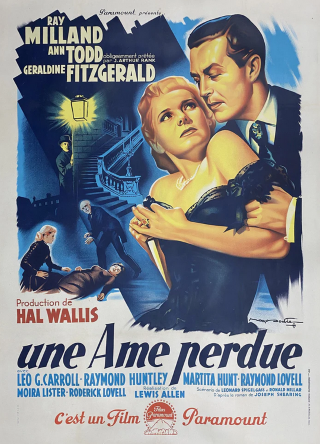
So Evil My Love

Guilt, corruption and obsession. That’s a heady mix for any movie, though it could be said to be nothing out of the ordinary for film noir. So Evil My Love (1948) is a kind of film noir, more Gothic melodrama I suppose yet it’s still dark and fatalistic enough, both visually and thematically, to just about make the cut as far as I’m concerned. It is something of a hybrid in more ways than one. Leaving aside any discussion of its noir credentials, the movie is one of those Hollywood funded and produced pictures that were made on location in the UK, and in this case making use of a cast of largely British and Irish actors – although all of the principals were working mainly in the US at this point. While there is much to enjoy and admire in the movie, there is a weakness which I feel ought to be mentioned. It has a marvelous visual sheen and well judged sense of atmosphere, but there’s also one central performance that I regard as deeply problematic, though fortunately it’s not as harmful overall as the issue that blighted Caught for me.
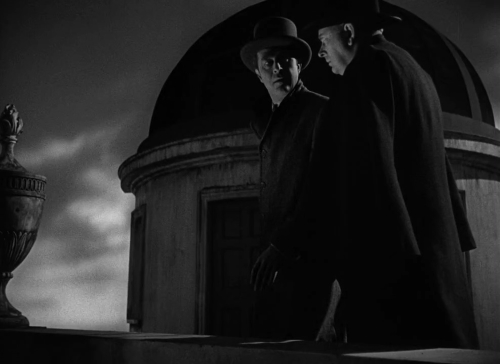
On a ship carving its way across the ocean from Jamaica to England a lone figure stands on deck, either oblivious to the spray on her face and the pitching deck beneath her or perhaps enjoying the experience. Olivia Harwood (Ann Todd) has been recently widowed, the death of her missionary husband leaving her with no option but to return home. She allows herself to be reluctantly coaxed into ministering to the ill on board the ship, chiefly one Mark Bellis (Ray Milland). On arrival in Liverpool it is immediately apparent to the viewer that Mark Bellis is perhaps not all he seems. He is ostensibly a painter, but his cautious probing to discover what, if anything, he revealed while in the throes of fever and then his determination to avoid the authorities set the alarm bells ringing. The fact is Mark Bellis (though that is merely one of the wide range of names he makes use of) is a genuine good-for-nothing, a swindler, a thief, a master manipulator, and apparently a murderer too. To such a man, a lonely, vulnerable and most likely gullible widow provides tempting game. And so it is he goes to work on Olivia Harwood, slowly worming his way into her heart while he sets about organizing his next robbery. However, the failure of that endeavor sees him altering his plans, and the beginning of his methodical and relentless corruption of Olivia. Under his tutelage, she finds herself not only taking advantage of an old friend, but also betraying and undermining her, taking a path that will inexorably lead to blackmail and murder.

The film has bags of atmosphere, with ponies clipping along cobbled thoroughfares, discharging their silken passengers outside addresses that might be mean and unforgiving or forbidding in their splendor. Wherever the characters go, their surroundings seem to crowd them regardless of whether they are immense or cramped. Somehow there is a sense of all the hypocritical baggage of the late Victorian era forever pressing and suffocating. This feeds into or fuels the feeling of fatalism that pervades the movie. Right from that first scene on the deck of the ship there is an unmistakable air of characters trapped or hemmed in by a destiny shaped by their own weakness and frailty. Mark Bellis is unquestionably a bad lot and that is never in doubt, but it is Olivia’s downward spiral that is the focal point of it all. Director Lewis Allen made only a relatively small number of movies (just 18 over a period of fifteen years) but there are some real gems in among them – The Uninvited, The Unseen, Desert Fury, Suddenly and Another Time, Another Place are all good or better in my opinion.
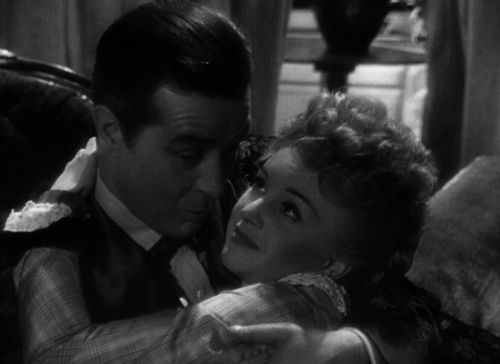
This is was a fairly productive and successful period for Ray Milland, coming only a couple of years after his Oscar winning turn for Billy Wilder in The Lost Weekend and he would follow this up with a pair of strong films noir for John Farrow in The Big Clock and Alias Nick Beal. This type of role, an oily and calculating charmer, was a good fit for Milland. He had the polish to carry it off convincingly and was also able to tap into a rich seam of desperation when the whispers of his typically dormant conscience grew more insistent. Geraldine Fitzgerald is characteristically fine too as Olivia’s ill-fated friend, brittle and foolish, quick to trust in her hunger for companionship and kindness, and touchingly meek in her willingness to accept her guilt.
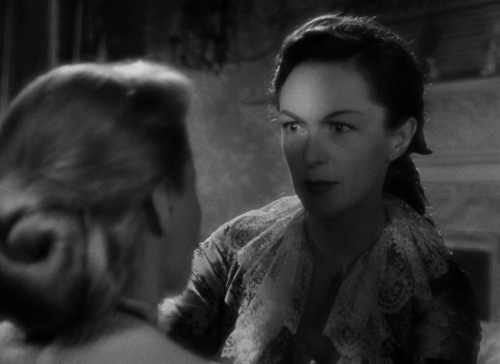
Nevertheless, as I alluded to above, there is an issue that damages the movie seriously. The behavior of Ann Todd’s character simply fails to convince me. She is right at the center of things, the heart of the movie in truth, and both her actions and the core characteristics need to ring true for it all to work. And for me this does not happen. I can accept that obsession and infatuation is capable of driving people to places they would not normally go, but I find Olivia’s sudden decision (remember, this is the widow of a Victorian missionary we’re talking about here) to betray her friend’s confidence and the consequent acceptance of the necessity for extortion to be so abrupt as to defy credibility. What’s more, there is then far too much inconsistency on display, the character’s morality and motivation shifting almost from scene to scene. This is a writing issue of course rather than an acting matter – the script is adapted from a story by Joseph Shearing (a pseudonym used by Marjorie Bowen) who also provided the source material for Blanche Fury and Moss Rose. The latter film does have some contrived or unrealistic elements, but there’s not that inconsistency which troubles me here.
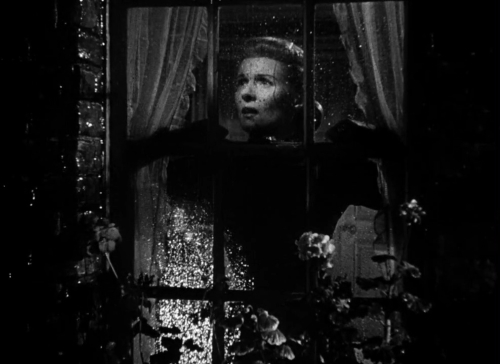
On the other hand, there are some excellent supporting turns to help restore the balance. Martita Hunt is chillingly intense as the overprotective grande dame. It is a bit of a stretch to see Raymond Huntley as her son – he was only four years her junior after all – but his cold lack of compassion is neatly done. Moira Lister sashays in and out of the tale as a trashy model whose vanity and vulgarity bring matters to a head. Leo G Carroll’s low-key detective lurks around and does his bit to draw the net tighter. And Maureen Delany, Hugh Griffith and Finlay Currie all have small yet memorable parts.

All told, So Evil My Love is a movie that works in places. There is no doubt that it has style, and some of the acting is excellent – Geraldine Fitzgerald rarely fails to impress me, for example. Still, Ann Todd’s role is an issue. That zigzagging from demure respectability to coquettish scheming and back again on the way to grim vengeance is something I just can’t buy into. Others may well regard this as less problematic. As it stands, I guess it amounts to two thirds of a good movie, or maybe three quarters if I’m in a more generous frame of mind.

X the Unknown

I’m going to have to confess that I’ve drifted away from contemporary Sci-Fi movies, or maybe they have drifted away from me. It’s a tricky genre in many respects; there is the obvious need to make movies that entertain, but in order to rise above mere popcorn fare it is necessary to have a story underpinning it all that asks questions or offers ideas for consideration. Now one could say that this applies to all genres and I’d tend to agree. Yet what sets Sci-Fi apart is the fact its inherent inventiveness and malleable boundaries allow for a more enticing examination of themes that might appear dull if presented in other genres. I guess it boils down to the need to strike a balance between the entertaining and thought-provoking aspects.

Growing up, I was entranced by classic Sci-Fi, and the entertainment quotient was what grabbed my attention back then. Later, I came to appreciate the way that many of these movies wove social and philosophical commentary in among the thrills. Of course filmmaking has changed a lot over the years, and the visual effects that enhance and enrich the wondrous nature of Sci-Fi have advanced impressively. Sometimes I think that this huge improvement also conceals behind its cloak of digital magic the seeds of my gradual dissociation from the genre. Has the balance shifted a little too sharply, and has the superabundance of visually startling imagery and whizz-bang effects obscured some of the thoughtfulness that once characterized the best of the genre? I found myself wondering about such things as I watched Hammer’s X the Unknown (1956) the other day, the type of cheaply made movie that fascinated my younger self, and still does in fact.

Paranoia fueled so many of the great classic era Sci-Fi movies with the concept of the enemy within growing out of the Cold War and the fears and misunderstandings that accompanied it. Often the enemy within was presented as an infiltration of society, either on an individual or communal level. X the Unknown takes a different path, one leading not to the heart of mankind but to the heart of our planet itself with the implication that our greatest threat comes not only from a fatalistic and seemingly unstoppable force of nature, but one which has been festering away deep below the surface, practically written into the DNA of our world. It’s a fine idea in itself and the execution offers a lesson in how to extract as much suspense and implied horror as possible on a shoestring. It all begins during a tiresomely routine military exercise, the random placement of a mildly radioactive object causing the sudden appearance of a mysterious fissure and the consequent death and destruction that is unleashed. The frequency of fatal encounters with whatever broke free of that fissure gradually picks up pace and even leads to the leveling of that old charge that scientific tinkering and dabbling lies at the root of it all. That notion, happily, is given short shrift, dismissed almost the moment it is uttered and both challenged and disproved by the close. I have an unpleasant feeling though that were this movie to be remade today, in a climate where quackery is all too often hailed while science is belittled, the reverse might actually be the case.

In all honesty, however, I don’t see how a movie like this would be made at all nowadays. The cast is almost exclusively male and middle-aged at that. There is nothing remotely glamorous about leads such as Dean Jagger and Leo McKern, but what they do bring is a sense of calm authority and a reassuring coziness (and I use that term without any pejorative undertones) amid all the mayhem. The source of the danger is kept out of sight for most of the running time, only glimpsed very briefly before the one hour mark and sparingly and sporadically thereafter. It works on the principle that what exists in the mind’s eye is apt to be more unsettling than full exposure to creaky effects. A modern version would feel obliged to conjure up and highlight some effect that would undoubtedly dazzle yet would also be less likely to capture the suspense that comes from dread unseen.

Hammer had just made and enjoyed success with their version of Nigel Kneale’s  The Quatermass Xperiment and so were looking to capitalize on that with a follow up. Kneale appears to have objected to the name of his lead scientist being used and so Jimmy Sangster’s script has Adam Royston rather than Bernard Quatermass desperately seeking a way to battle the terror seeping from the Earth. Had Kneale been involved, it seems likely the plot would have involved some kind of alien presence or interference. That would undoubtedly have been a literate and intelligent approach, but I have to say I rather like the fact that what we got is a wholly terrestrial and primal threat – somehow the notion of danger emanating from that which we know best and which is dearest to us adds an attractive twist to it all. If you’ll forgive the pun, it serves to ground the story. While I wouldn’t quite categorize it as an early Eco-thriller, it does raise questions about our symbiotic relationship with the planet itself. Leslie Norman directs efficiently and briskly enough, though it is tempting to wonder how it might have turned out had first choice Joseph Losey not dropped out. It has been said that the blacklisted Losey was removed at the insistence of Jagger, but there are also claims that it was actually down to a health problem suffered by the director.

X the Unknown was given a Blu-ray release in the US back in 2020. I’ve only seen some images from that version and they look appealing, sharp and in a 1.75:1 ratio. My own copy is a long out of print UK DVD that appears to be open matte. While it won’t have the crispness of the BD, it’s not a bad effort and, in my opinion anyway, remains perfectly watchable. This is the kind of Sci-Fi I adore, modest in scale yet expansive enough in vision and imagination to override its technical limitations.

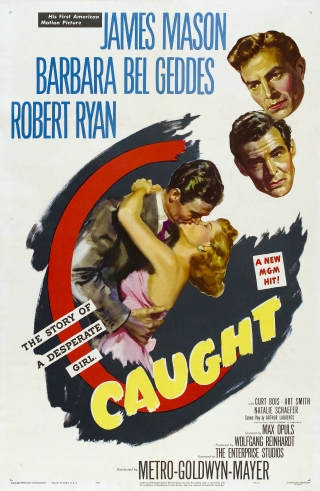
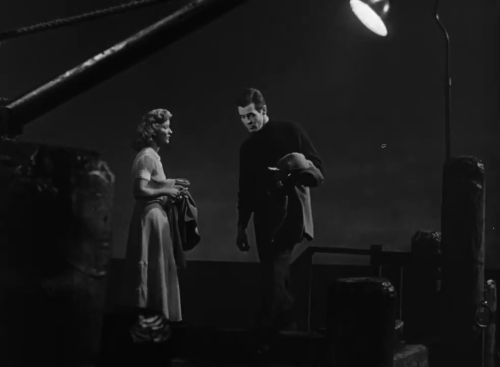
Caught

Seeing as Max Ophuls came up in some of the comments on the previous post, I decided to go back and have another look at one of his movies that I have struggled with in the past, namely the 1949 production of Caught. As a rule, I have enjoyed what I have seen of the director’s work, but this film has never worked for me. Anyway, with his name fresh in my mind, as well as the knowledge that the movie seems to be well regarded by many other viewers, I thought I should give it another chance. In brief, and this will be one of my shorter posts, I still have major issues with the movie. To be honest, the fact that I made it to the end was as much through a sense of obligation as anything.

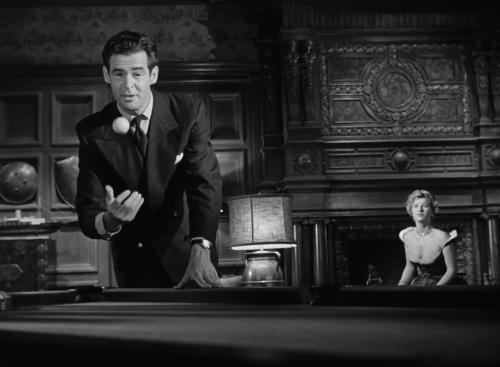
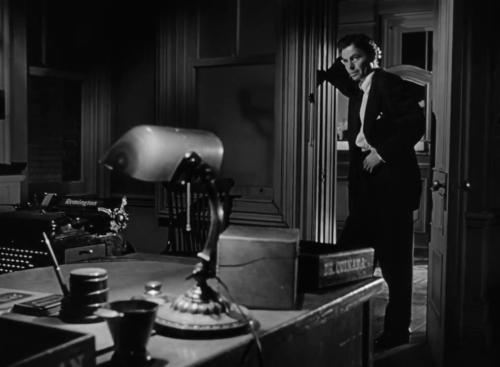
The whole thing is an examination of wish fulfillment and the consequent importance of being very careful indeed of what one wishes for. It opens with two sisters in a shabby tenement mooning over glossy magazines and browsing for dreams, a gem encrusted necklace here, a platinum bracelet there, and so on. As ever, money and the power it bestows matters very much to those who have little of it. Leonora (Barbara Bel Geddes) wants the security and the comfort that comes with wealth, and it does come her way as the result of an invitation to a party on a yacht, an invitation she very nearly turns down. This is the thing with Leonora – she wants things and then doesn’t want them when their real cost becomes apparent. When she makes the acquaintance of Smith Ohlrig (Robert Ryan), a tycoon with a deeply disturbed character, she is soon on the fast track towards the high life on Long Island. However, this is where it all goes wrong for just about everyone involved. Ohlrig is a domineering, controlling and cruel man, an obsessive soul at war with himself and the world in general. Leonora soon comes to see the stew she’s landed herself in and, wisely one would say, moves out and ends up working as a receptionist in a slum neighborhood for Dr Quinada (James Mason). From here the movie devolves into a series of sorties back and forth for Leonora as her indecision along with a deep-seated conviction that she has to “improve herself” at all costs winds up being a good deal more expensive in emotional and physical terms than she’d bargained for.

Max Ophuls’ direction is a pleasure – his camera swooping, swinging and panning, following his characters and sometimes sweeping past them to draw attention to the variously opulent or cheap surroundings while they debate, argue or simply muse out of shot. It’s a distinctive style and Lee Garmes’ cinematography adds to the eye-catching visuals. Attractive as all this may be, it’s not enough to paper over the paucity of genuine character at the heart of the movie. Robert Ryan’s Howard Hughes inspired sociopath is a showy piece of work, neurotic and foul and yet also somehow pitiful in his inadequacy. However, there’s a big hole in the middle of it all for me, and that’s the result of the role played by Barbara Bel Geddes. I started off feeling for her as she struggled to dig herself out of the poverty trap. The fact is though that she’s a playing a woman with essentially no character, a whiny, vacillating type who seems to revel in helplessness and indecision. This is the person who is the main focus and it’s very hard to like a movie where the central role presents such a moral vacuum. And the less said about the “happy ending” we’re asked to buy into, the better. James Mason’s first Hollywood starring role is fair, but he’s given little to do to stretch him –  he does have at least one good scene in the garage confrontation with Ryan and Bel Geddes. The support is mainly an attractively homespun turn from Frank Ferguson and a well observed peek at degradation and dissipation by Curt (“Tough, darling, tough.“) Bois.

Max Ophuls made far better films than this – The Reckless Moment, again with Mason, came shortly afterwards and is superior in every respect, and there are his great French movies such as  The Earrings of Madame de… and La Ronde. I honestly wish I could like this film more, but it just does not do it for me.