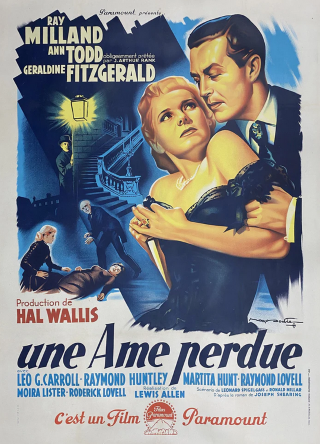
Guilt, corruption and obsession. That’s a heady mix for any movie, though it could be said to be nothing out of the ordinary for film noir. So Evil My Love (1948) is a kind of film noir, more Gothic melodrama I suppose yet it’s still dark and fatalistic enough, both visually and thematically, to just about make the cut as far as I’m concerned. It is something of a hybrid in more ways than one. Leaving aside any discussion of its noir credentials, the movie is one of those Hollywood funded and produced pictures that were made on location in the UK, and in this case making use of a cast of largely British and Irish actors – although all of the principals were working mainly in the US at this point. While there is much to enjoy and admire in the movie, there is a weakness which I feel ought to be mentioned. It has a marvelous visual sheen and well judged sense of atmosphere, but there’s also one central performance that I regard as deeply problematic, though fortunately it’s not as harmful overall as the issue that blighted Caught for me.
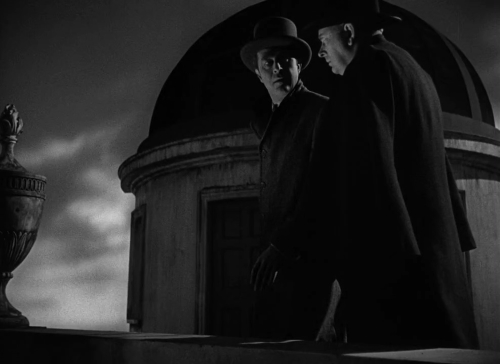
On a ship carving its way across the ocean from Jamaica to England a lone figure stands on deck, either oblivious to the spray on her face and the pitching deck beneath her or perhaps enjoying the experience. Olivia Harwood (Ann Todd) has been recently widowed, the death of her missionary husband leaving her with no option but to return home. She allows herself to be reluctantly coaxed into ministering to the ill on board the ship, chiefly one Mark Bellis (Ray Milland). On arrival in Liverpool it is immediately apparent to the viewer that Mark Bellis is perhaps not all he seems. He is ostensibly a painter, but his cautious probing to discover what, if anything, he revealed while in the throes of fever and then his determination to avoid the authorities set the alarm bells ringing. The fact is Mark Bellis (though that is merely one of the wide range of names he makes use of) is a genuine good-for-nothing, a swindler, a thief, a master manipulator, and apparently a murderer too. To such a man, a lonely, vulnerable and most likely gullible widow provides tempting game. And so it is he goes to work on Olivia Harwood, slowly worming his way into her heart while he sets about organizing his next robbery. However, the failure of that endeavor sees him altering his plans, and the beginning of his methodical and relentless corruption of Olivia. Under his tutelage, she finds herself not only taking advantage of an old friend, but also betraying and undermining her, taking a path that will inexorably lead to blackmail and murder.

The film has bags of atmosphere, with ponies clipping along cobbled thoroughfares, discharging their silken passengers outside addresses that might be mean and unforgiving or forbidding in their splendor. Wherever the characters go, their surroundings seem to crowd them regardless of whether they are immense or cramped. Somehow there is a sense of all the hypocritical baggage of the late Victorian era forever pressing and suffocating. This feeds into or fuels the feeling of fatalism that pervades the movie. Right from that first scene on the deck of the ship there is an unmistakable air of characters trapped or hemmed in by a destiny shaped by their own weakness and frailty. Mark Bellis is unquestionably a bad lot and that is never in doubt, but it is Olivia’s downward spiral that is the focal point of it all. Director Lewis Allen made only a relatively small number of movies (just 18 over a period of fifteen years) but there are some real gems in among them – The Uninvited, The Unseen, Desert Fury, Suddenly and Another Time, Another Place are all good or better in my opinion.
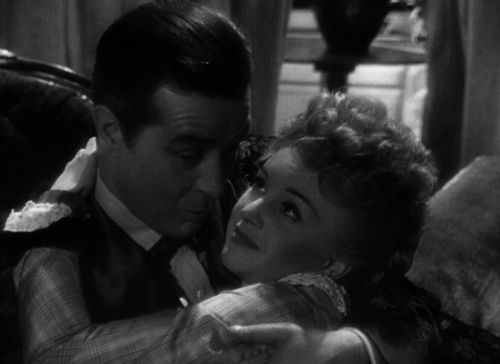
This is was a fairly productive and successful period for Ray Milland, coming only a couple of years after his Oscar winning turn for Billy Wilder in The Lost Weekend and he would follow this up with a pair of strong films noir for John Farrow in The Big Clock and Alias Nick Beal. This type of role, an oily and calculating charmer, was a good fit for Milland. He had the polish to carry it off convincingly and was also able to tap into a rich seam of desperation when the whispers of his typically dormant conscience grew more insistent. Geraldine Fitzgerald is characteristically fine too as Olivia’s ill-fated friend, brittle and foolish, quick to trust in her hunger for companionship and kindness, and touchingly meek in her willingness to accept her guilt.
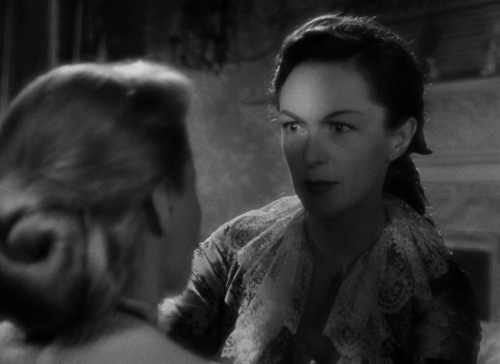
Nevertheless, as I alluded to above, there is an issue that damages the movie seriously. The behavior of Ann Todd’s character simply fails to convince me. She is right at the center of things, the heart of the movie in truth, and both her actions and the core characteristics need to ring true for it all to work. And for me this does not happen. I can accept that obsession and infatuation is capable of driving people to places they would not normally go, but I find Olivia’s sudden decision (remember, this is the widow of a Victorian missionary we’re talking about here) to betray her friend’s confidence and the consequent acceptance of the necessity for extortion to be so abrupt as to defy credibility. What’s more, there is then far too much inconsistency on display, the character’s morality and motivation shifting almost from scene to scene. This is a writing issue of course rather than an acting matter – the script is adapted from a story by Joseph Shearing (a pseudonym used by Marjorie Bowen) who also provided the source material for Blanche Fury and Moss Rose. The latter film does have some contrived or unrealistic elements, but there’s not that inconsistency which troubles me here.
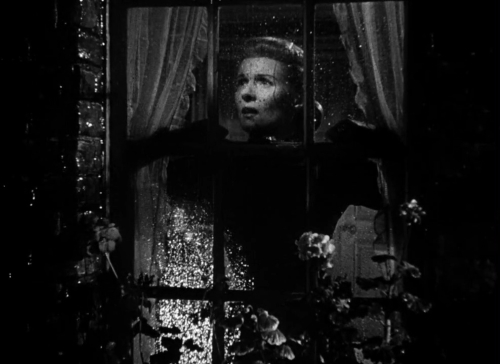
On the other hand, there are some excellent supporting turns to help restore the balance. Martita Hunt is chillingly intense as the overprotective grande dame. It is a bit of a stretch to see Raymond Huntley as her son – he was only four years her junior after all – but his cold lack of compassion is neatly done. Moira Lister sashays in and out of the tale as a trashy model whose vanity and vulgarity bring matters to a head. Leo G Carroll’s low-key detective lurks around and does his bit to draw the net tighter. And Maureen Delany, Hugh Griffith and Finlay Currie all have small yet memorable parts.
All told, So Evil My Love is a movie that works in places. There is no doubt that it has style, and some of the acting is excellent – Geraldine Fitzgerald rarely fails to impress me, for example. Still, Ann Todd’s role is an issue. That zigzagging from demure respectability to coquettish scheming and back again on the way to grim vengeance is something I just can’t buy into. Others may well regard this as less problematic. As it stands, I guess it amounts to two thirds of a good movie, or maybe three quarters if I’m in a more generous frame of mind.
 Riding the High Country
Must admit, I remember enjoying the atmosphere but not much else about it. Must look again – will dig my old DVD out. Allen ended up working a lot on TV as I recall and I don’t think he ever topped THE UNINVITED, the success of which, according to some sources, made him hard to work with at times.
LikeLike
Excepting that questionable and abrupt change of character by Todd, I liked most of what was on show. Of course I’m partial to these Gothic noir melodramas anyway.
As for Allen, I’d agree that The Uninvited is his finest hour. I’ve seen, I think half of his movies now and I’m generally positive about those.
LikeLiked by 1 person
Man, that’s a great title.
LikeLike
It’s certainly evocative.
LikeLiked by 1 person
I haven’t seen this film but I’ve read the book, which I loved. I guess I should try to track down the movie.
LikeLike
Yeah, I’ve no idea how the film compares to the book. It might prove interesting to see how they stack up.
LikeLike
Well, that’s an impressive supporting cast, for sure!
LikeLike
So Evil My Love as performed live on Lux Video Theatre in 1956 with Louis Hayward doing Milland’s part, and Marilyn Erskine in Ann Todd’s.
LikeLike
I can easily imagine Louis Hayward in that role, it’s the kind of thing that would have been right up his street.
It’s nice to see that Marilyn Erskine is still around at the age of 97.
LikeLiked by 1 person
True. The cast is deep and talented and it certainly represents one of the film’s major attractions.
LikeLike
HELP !!! HELP !!! HELP !!!
Is anyone so kind and so helpful to send me the lyrics of the western song WAGON WEST from the movie WAGON MASTER by John Ford (1950) so as sung by the SONS OF PIONNERS in the trail of that movie present at the address of YOUTUBE :
???????????????????????????????????????????????????????????????????????????????????????
I am DARIO, from Florence, Italy, I can speak some English, I can read and write English, but my english understanding is very deficient.
Many thanks in advance to the gentle person who will mail me at my address :
anuenkidu@alice.it
DARIO
LikeLike
No responses. I’m not surprised. The words and music of ‘Wagons West’ were credited to Stan Jones according to the opening credits of the movie WAGON MASTER. This unforgettable classic western song just sticks to me, even though I can only identify a hand full of the lyrics. The only thing I can figure, it was a time in western lore of 100 years ago. I’m with you Dario. I sure would like to know the song’s lyrics it would be part of living the experience in that era. For what ever the reason, the lyrics must be under some kind of copyright infringement law. By who? Can’t seem to find a lick of information who that may be.
Colin, I’m surprised you haven’t done a review of this classic John Ford western.
LikeLike
Yes, some of the lyrics are a bit difficult to pin down – maybe I’ll try another listen if time allows.
Scott, there’s a lot of Ford I maybe should have got round to. I guess I often feel that so much ha been said and written about his movies that I have nothing particularly useful to bring to the table at this stage. There is one in particular though that I would quite like to put down a few thoughts about. We’ll see.
LikeLike
Colin, you may want to think twice about another listen. I find it’s hard to remove from one’s mind. lol
LikeLike
Wow this film is beautiful!
LikeLike
Testing
LikeLike
I enjoyed reading your insights regarding this movie — I just saw it for the first time about a month ago. In fact, I’m planning to write about it for Noirvember! I enjoyed it more than you did, though, as far as Ann Todd’s character. Interestingly, I’d only seen Ann Todd in one other movie before this — The Paradine Case — and I couldn’t stand her in that!
LikeLiked by 1 person
I shall look out for your thoughts on it all when you get to write on it. Ann Todd always seemed somewhat chilly to me, a little remote and untouchable like a character behind glass. It’s a quality that can be used very effectively of course, and I don’t think the reservations I had regarding this movie were down to Todd the actress really. The part is written in such a way I had trouble buying into not just the leaps her character takes, but the inconsistency of it all too. Nevertheless, even if that doesn’t quite work for me, there are other positive aspects on show that make it worthwhile on balance.
LikeLike
I May be the only person who likes The Paradine Case. although on an intiial viewing I had a problem with Peck, no longer. As for Ann Tood, no problem either.
LikeLike
I wouldn’t say I actively dislike The Paradine Case. As I said when I wrote a bit on it, it has points to recommend it and it’s perhaps more a case of my being disappointed or frustrated by the film’s inability to make good on the potential it had.
LikeLiked by 1 person