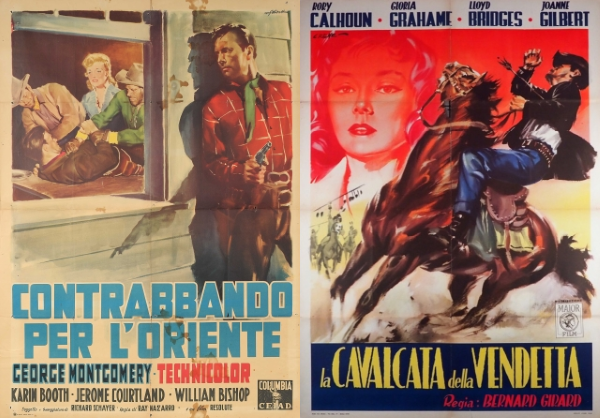
If one is to accept that the second string western, or the programmer or B movie depending on the terminology preferred, represented the bread and butter of the genre during its heyday in the 1950s (and I strongly believe that the assertion should be accepted) then it’s not unreasonable to assume those films would have much in common. Yet, leaving aside the personnel who turn up time again both in front of and behind the camera, there was in fact quite a wide variety on show. I recently watched Cripple Creek (1952) and Ride Out for Revenge (1957) back to back and was struck by how very different these two “lesser” westerns were. Both featured stars (George Montgomery and Rory Calhoun respectively) who are closely associated with such westerns and both work pretty well when taken on their own terms. Nevertheless, tonally, visually and with regard to aims, one might just as easily compare movies from two entirely different genres.
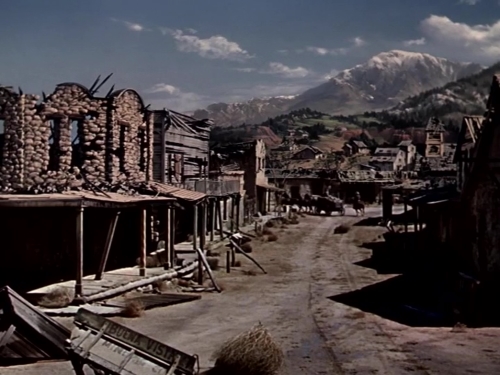
So what have these two pictures got in common? Well the 19th century setting and the locations (Colorado and the Black Hills) are fine for westerns, and both movies have the hunt for gold worked into their scripts. But that’s about as far as it goes. Cripple Creek is in essence a crime movie taking place against western backdrop, all about gold robberies, smuggling and intrepid Secret Service agents working undercover. And despite a few harder edged scenes, it has a lighter feel to it overall – I’d hesitate to say juvenile, but it does have the kind of cut and dried ethical simplicity about it that means it can be enjoyed by just about anybody regardless of age. I can’t say for sure if I saw the movie myself when I was a youngster but it is the kind of Saturday matinee fare that I tended to lap up at an impressionable age. George Montgomery is heroically square-jawed as the gutsy G-man while William Bishop and John Dehner never leave the viewer in the slightest doubt that they are up to no good. Only Richard Egan, gradually working his way up the billing towards stardom, shows a bit of shading in his characterization. Ray Nazarro serves up a colorful and broadly frothy concoction, a frank piece of lightweight entertainment that never tries to cajole the viewer into believing it’s anything more than that.
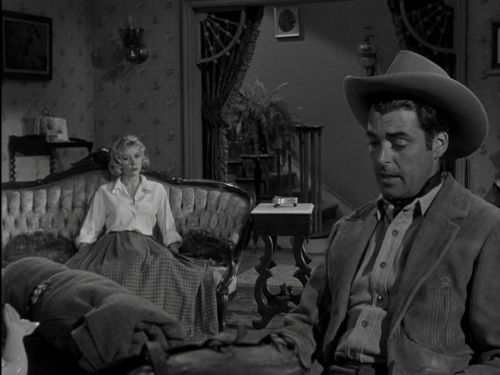
Conversely, Ride Out for Revenge is a much more serious affair. Bernard Girard is clearly shooting on a tight budget but making fine use of Floyd Crosby’s stark black and white cinematography. This is weightier stuff with conflicted marshal Rory Calhoun butting heads with a drunken and incompetent soldier played by Lloyd Bridges. The story explores greed, intolerance and the corrosive effects of unfettered hate on individuals and whole communities. There’s not much to smile about in this movie and there’s a hardness to it befits an exploration of the themes mentioned. There is an interracial romance which is central to the plot – sidelining Gloria Grahame, who appears so completely detached that hers is practically a non-performance – and has the guts to end on a far more hopeful note than is often the case with such storylines in westerns of the time. An early outing for Kirk Douglas’ Bryna Productions, Ride Out for Revenge challenges all types of prejudice and even the whole idea of manifest destiny.
So, there you have it: two westerns made just five years apart, both a step below the A list yet both radically different in look, theme and mood. The sheer malleability of the western in the classic era has always struck me and I guess I could have chosen plenty of other examples from this general time period to illustrate this.
 Riding the High Country
I agree that B-Westerns offered huge variety. Many of them were just as good as any A-Western in my opinion.
I’ve always loved that many B-films, regardless of genre, tend to look and feel more real and gritty.
Hope all good with you.
LikeLiked by 3 people
When it comes to movies I have a generally positive opinion about, I tend to divide them broadly into the good and the great. Few second level films can be termed great, the aims and ambitions tend to be set lower to begin with for one thing. However, many are indeed good or very good. With these two, I reckon Ride Out for Revenge is a bit better as it’s booth entertaining and has a point to make that is quite successfully achieved.
LikeLiked by 1 person
There are quite a few B-movies that I would consider to be truly great movies, as good as any A-pictures of their era. Cat People and Detour for starters.
LikeLike
Yes, there certainly are some great B pictures or programmers – Lewton’s output clearly qualifies.
I’m afraid I can’t go along with Detour – it has acquired a strong cult following over time but Tom Neal and the deep-seated misanthropy that underpins it rules it out of consideration for me.
LikeLike
Bingo on Detour.
LikeLike
I know this might be beating the same drum that everybody knows but the Boetticher-Scott-Brown cycle are ‘B'(hah!) pictures and yet ‘Seven Men from Now’, ‘The Tall T’, ‘Ride Lonesome’, and ‘Comanche Station’ are just so great especially. I find them just as lustrous as ‘the classics’ and to think they were once looked down as programmers then the work of genius they are. I will always treasure these ‘B’ films were made. “We’ll use Randolph Scott…He’s through”-John Wayne. How wrong the Duke was on that score.
LikeLiked by 2 people
Yes, I think the Ranown movies are more correctly referred to as programmers than out and out B movies. Your point is well made either way though. Those films are superior examples of the filmmaking art and a fine illustration of how gifted people could raise their game.
LikeLike
Exactly, programmers, not B pictures, because the B film era was over, and it was defined by budget and distribution. B’s films were sold to theatres at a fixed rate, A films by a percentage of revenue.
LikeLike
Thanks for the info on the specifics of that. A nice tribute to the B Western by the late Lloyd Fonveille: https://www.mardecortesbaja.com/2014/07/24/why-b-westerns/
LikeLiked by 1 person
Thanks for that link.
LikeLike
Barry when the B film era was over did the classifications of A-films change to Features films and Non-feature films became classified as Programmers? Or something to that affect? Also, were so-called feature films and programmers sold to motion picture exhibitors for a percentage of revenue and/or at a fixed rate depending on venue?
LikeLike
Great question and the answer feature films, with top stars and production values are always judged by their salablity, word of mouth, and reviews. A – films evolved, sold as A films, but to smaller venues. Let’s Rory Calhoun’s pictures. Sixity or seventy-minute films were a mixed bag, and that depended on exploitation value. The AIP and Roger Corman stuff, but Roger moved on. My thought is fifties television are where B features finished up, but by the sixties, production values and star power improved. Gene Autry andRoy Rogers were on television in the early fifties, and by fifty-three both were done in features. Bill Elliott hung on, so did Wayne Morris and other men went off to Britain to wind things up.
LikeLiked by 1 person
Al Adamson a very nice guy, hung in the exploitation field with stars like Scott Brady, Kent Taylor, and Brod Crawford. SamSherman was his executive producer and I believe he is still around. Someone needs to track him down. Kane Lynn at Hemisphere did better than average pictures in the Philippines. They were sold as better than average also, one of the best in my memory was TheWalls of Hell with Jock Mahoney top lining.
LikeLiked by 1 person
They were so well done. I doubt their budget would cover catering now.
LikeLike
We do not know that Wayne said that, but both men were in the top ten box office stars during the first four years of the fifties. Duke Wayne continued and Scott fell off.
LikeLike
Yes, I forgot the specifics of the B/programmer business, but I knew B movies were generally of an older vintage.
LikeLiked by 1 person
The term “B-movie” is like “film noir” or “pulp fiction” – it has largely lost the specific meaning it once had.
LikeLike
Not at all, the meanings are consistent, but people simply do not know them, so they add and subtract as required.
LikeLike
That’s true, but those terms have ceased to be useful because when people use them you can never be sure if they’re using them correctly.
LikeLike
Lost it s meanng by people who never understood it.
LikeLiked by 1 person
You are so right about the Ranown cycle and John Wayne was definitely wrong on Randolph Scott 🙂 You probably knew this already, but the reason Westbound is not talked about in discussions of Ranown is because it was not part of that cycle despite being a western directed by Budd Boetticher and starring Randolph Scott. Also, it was not written by Harry Joe Brown like the others were 🙂
LikeLike
Harry Joe Brown did not write any of them. He produced the Columbia pcctures.
LikeLiked by 1 person
My mistake Barrylane1939, I meant producer – I should know better, why did I say writer? 🙂 With the exceptions of Decision at Sundown and Buchanan Rides Alone (Westbound was not part of the Ranown cycle), Kennedy wrote all of the scripts 🙂
LikeLiked by 1 person
They were not B pictures. Neither was Cat People handled as one.
LikeLike
Would support features be a suitable catch-all label for such movies?
LikeLike
Sure. Or A – film. Remember this, The original Thin Man movie was shot in two weeks and came in under $200,000. Released as an A.
LikeLike
Yes, it’s a shady area in some respects with some movies on the periphery. Personally, I would never have considered The Thin Man as anything other than an A picture. The fact it had “One Take Woody” Van Dyke in the director’s chair means it was always likely to be a brisk production, he was a big time director and Powell and Loy were A list performers.
LikeLike
Not Loy and the studio did not want her, VanDyke did that..
LikeLike
I see.
LikeLike
It probably makes more sense just to describe movies as big-budget, mid-budget and low-budget productions. Rather than agonising over correct definitions of B-movies.
LikeLike
No, it does not make more sense,thsi is not entirely about budget but about how the films are sold to motiono picutre exhibitors. A pictures, as yu a ll kno w get a percentage of reenue, B films play at smaller venues at a fixed rate. not too tough is it? This is not about opinions.
LikeLike
But to a movie lover today watching a movie from the 40s the details of how the movie was originally distributed and how the revenue was obtained are entirely irrelevant to the enjoyment and appreciation of the movie.
Knowing whether it was made on a big budget, a modest budget or a low budget is more relevant. If a movie had a huge budget and it still managed to be dull and lifeless we will suspect that the director had no idea what he was doing. If a movie had a very small budget and it still managed to be dynamic and visually interesting we will suspect that the director had a great deal of talent.
LikeLike
Enjoyed this write-up, Colin — there’s another Rory Calhoun western, which I assume is in the B category, that happens to be one of my favorites — Massacre River (1949). I look forward to checking to checking out Ride Out for Revenge.
Karen
LikeLike
Karen, I watched Massacre River a few years ago and I found it very enjoyable, with both Calhoun and Guy Madison making their debut in westerns. Both would of course go on to make more.
LikeLike
I too like MASSACRE RIVER certainly for it’s Gay Subtext.
I’d like to see more of director John Rawlins Universal programmers sadly unavailable at the moment;especially the ones starring Irene Hervey. I stumbled across Irene in a harrowing “Crime Does Not Pay” short where she plays a thrill seeking young ingenue who transforms into a withered convict doing life, after a crime spree with her boyfriend.
I thought
WOW this gal can really act and with research (as I am wont to do) I found her career extended into the 1980’s and her last screen appearance was in PLAY MISTY FOR ME in which she was sensational.
Regarding Tom Neal I’ve never understood Colin’s dislike for Tom in DETOUR in which he was perfectly cast and the film in my book is a masterwqork; Ulmer at his considerable best. OK Tom by all accounts was not the nicest guy around but in his early MGM and Columbia pictures when he was being groomed as a major star he was often excellent and charming;life sadly took him down an entirely different route.
LikeLiked by 1 person
I don’t think I’ve seen anything else by John Rawlins.
Re Neal: It’s the old matter of separating the artist from the art, something I generally have no problems doing. In Neal’s case, it doesn’t work so well for me and I can only say that I find it hard to actually enjoy a movie that features him prominently. Mind you, even if someone else were cast in Detour, I would still struggle with a film that takes such a relentlessly sour view of humanity. But that’s just my own personal take on it. I have a similar, though not perhaps as strong reaction, to Lawrence Tierney. I won’t go so far as to say I don’t like or won’t watch any of his movies, but I find his presence disturbing and I can’t really enjoy them as a consequence. Probably none of that is especially logical, but there you go.
LikeLiked by 1 person
I don’t mind Neal, but I agree completely with your assessment of Detour.
LikeLike
There is a great little feature about Tierney on the ‘Reservoir Dogs’ DVD where the actors discuss working with him. Great stories but what a terror to deal with!
LikeLiked by 1 person
Is not the main point of Noir to take a “relentlessly sour view of humanity” often the more cruel and mean spirited they are the better I like ’em I often describe Noir in these terms which I mean people to take as a compliment.
I’m not all on a downer though, unlike Dee I also love “message” films I adore THE GLASS WALL which I admire as a gripping Noir with it’s mean streets and sleazy side alleys but I also like very much it’s message, and it’s humanity, which can even be found in a bump ‘n grind Burlesque show of the lowest order. A film to revisit more than ever now with several populist politicians gaining momentum everywhere right now, or to quote Dylan “Pity The Poor Immigrant”
LikeLike
I take your point with regard to film noir overall, but I think the ones that appeal to me more are those which, while not shying away from bleakness, offer some glimmer of redemption for some of the characters, or which suggest someone learnt something from the experience, even if it comes too late to allow a positive ending. If any of that makes sense…
LikeLike
Everything you say makes sense Colin.
I can recall many noirs that were spoiled for me at least, by positive endings BACKFIRE and DARK CITY to name but two without thinking about it too much.
I have of course seen Tourneur’s masterly CIRCLE OF DANGER before but never on digital media. The new Studio Canal Blu Ray is stunning and the set pieces-Billingsgate Market-The Welsh Colliery sequence- take on an entierly new diamension.,
But for me the “Happy Ending” is all wrong the film should have ended when Milland walks off the moors. This one time Ray should not have won the girl but others will beg to differ.
LikeLike
John, Re Circle of Danger. Either way, with or without Patricia Roc by his side, works, and as I relate to her, I feel good about it.
LikeLiked by 1 person
John, I haven’t seen the new Blu-ray of Circle of Danger but I certainly enjoyed the movie on DVD and wrote some thoughts on it earlier this year here. Personally, I can’t say I had an issue with the way it ended.
LikeLike
The whole point of film noir is bleakness and despair. Which makes it something that many people are just not going to enjoy. Which is fine. There’s no reason to watch movies you’re not going to enjoy.
For me the greatness of movies like Double Indemnity and Detour is that they don’t pull their punches. They don’t sugar-coat the existential despair.
Film noir is something to watch when you’re in the mood. Sometimes I’m in the mood for a movie like Detour and sometimes I’d much rather watch an Astaire-Rogers musical.
LikeLiked by 1 person
How about Noir just reflecting a pretentious disposition?
LikeLike
I don’t mind if a movie has something to say in very broad terms about things like freedom or human dignity or the necessity of love or the cost of revenge or the importance of forgiveness. But any hint of a political message has me running for the hills. Sadly the 50s was the decade in which politics started to ruin Hollywood.
For example Ride Out for Revenge sounds like a movie I’d steer clear of.
One of the reasons I dislike political movies is that almost without exception the political messages are trite and obvious and heavy-handed. Film directors, screenwriters and actors are on the whole shallow superficial people with embarrassingly simplistic views. When they dabble in politics you end up with narcissism combined with self-righteousness.
LikeLike
That’s unfair. Stating that countless people involved in cinema are possessed of the characteristics listed is such a massive generalization – there are people from all walks of life who will fit that bill, but many more who do not, the same will be true of people who contribute to the making of movies.
And heavy-handedness, triteness and so forth is not a natural consequence of a movie having a message to impart, it’s a flaw in the technique of the writer not the content, nor indeed the intent, of the writing itself.
Finally, I see no reason why a film which contains some political message, be that a hint or a more overt statement, cannot simultaneously refer to themes such as dignity, loss, love, revenge, forgiveness etc. None of these need be mutually exclusive.
LikeLike
Well said and eloquently put.
LikeLike
Actually I think that heavy-handedness, triteness and so forth really are natural consequences of a movie having a political message to impart. If you have a political message, become a journalist. Politics in a movie inevitably becomes simplistic and moralising.
If you’re dealing with themes of dignity, loss, love, revenge, forgiveness etc. those themes will be weakened and cheapened if you add politics to the mix.
LikeLike
I don’t think human experience, and politics is a part of that whether we like it or not, can be so neatly separated or compartmentalized. I would concede that movies about politics and characters pursuing a goal or end based on this can be dull affairs saddled with too much earnestness. Conversely, a movie with a standard dramatic plot or storyline which also happens to have a certain point or message to impart does not become dull as a consequence. If that happens, the fault lies in the execution and not in the aim.
LikeLike
I respond very badly to earnestness.
LikeLike
John Rawlins
As a director Rawlins’ most productive years was at Universal’s B Unit in the 30’s & 40’s he even directed one of the Rathbone Holmes series. Universal turned him loose on a whole series of B’s & serials and thought enough of him to bump him up to the occasional A like a couple of the Montez/Hall Technicolor epics. His Universal B’s are hard to track down I’d love to see things like BOMBAY CLIPPER and HALFWAY TO SHANGHAI both with Irene Hervey.
After a stint at RKO Rawlins more or less went freelance his later Western FORT DEFIANCE is also very good and well worth the effort to track down.
LikeLike
Ah yes, I’ve seen the Holmes movie of course. It slipped my mind, but I sometimes think the two or three Universal Holmes movies at the beginning of their cycle get forgotten by me partly because of the extraordinarily bad hair days Rathbone seemed to be experiencing.
LikeLike
B has a meaning, accepting it incorrectly is wrongheaded, and certainly not a signal one is informed correctly.
LikeLike
Speaking of westerns, who can forget the Ranown cycle from the 1950’s – the collaborations between director Budd Boetticher and star Randolph Scott? 🙂
LikeLiked by 1 person
For those of us who have an appreciation of Western movie making of that era………never. IMHO, there is not a more thoroughly discussed topic on RTHC.
LikeLiked by 1 person
I’d go a step further and suggest that those movies are valued by those who have an appreciation of great filmmaking in general.
LikeLiked by 2 people
I never forget. One of the reasons I mentioned them above.
LikeLiked by 1 person
In DECISION AT SUNDOWN Boetticher and writer Charles Lang could not see Scott’s totally wrong Bart Allison finding redemption-he rides out alone,bitter, having been responsible for the death of his only friend.
In CIRCLE OF DANGER Milland is wrong,at the end, but he gets the girl.
Am I a cynic for prefering the Boetticher/Lang ending.?
Charles Lang was a handsome young actor ceertainly a B Picture second lead at Warners and RKO. He became a successful screenwriter penning several Boetticher’s. I enjoyed seeing Lang and Craig Stevens (another Warner’s young hopeful) together in a Warners Spy B Flick years before BUCHANNAN RIDES ALONE with which they were both involved.
LikeLike
I don’t know that it’s a matter of right or wrong, just a question of personal preference.
Decision at Sundown has risen in my estimation over the years. I was none too fond of it at one time and even thought it might be the weakest of the Scott/Boetticher slate. Now I still feel it comes in below the heights of Comanche Station, The Tall T, Seven Men from Now and Ride Lonesome, but not by as much as I once thought. Those four represent a solid block of greatness, Decision at Sundown would claim the fifth spot on its own for me now.
LikeLike
I don’t care much for it either, but the cast is good and I understand despite the writer’s credit, Lang had signficant help.
Barry
LikeLike
Regarding Barry’s often made remarks as to folk (myself included) wrongly classing films as B Movies or indeed programmers I would like to clarify a few points wrongly or rightly.
Firstly major studios had B Movie departments even giants MGM;Universal, Fox and Paramount. The point is those films had A movie production values often using left over sets from A Movies-that’s why those films look a cut above efforts from PRC & Monogram
Perhaps I’m wrong certainly in Mr Lane’s point of view but normally films clocking in at just about 55 minutes to an hour I class as B Movies despite their production trimmings. Popular series like the Richard Arlen/Andy Devine movies I would class as B’s and also the Mr Moto movies from Fox as well as all of the East Side Kids/Little Tough Guys/Bowery Boys films from the various studios that released this long running popular series. It’s obvious these films had far better trimmings when they were made at Universal.
Dick Foran I class as a B Western star in the films he made for Warners and Universal but he also made A Movies as well especially for Warners. Richard Dix a major star in the silent days and certainly in the early 30’s never really downgraded into B Movies his RKO films I would mostly rate as programmers with the occasional A here & there. Dix’s WHISTLER series were a cut above the usual B’s certainly in overall terms of quality and his career in those movies more or less went out on a high note.
Richard Arlen another early 30’s superstar; up until the late 40’s jumped between A’s & B’s the aforementioned Andy Devine series and Arlen’s many Pine Thomas pictures I would class as programmers due to their production values alone. IDENTITY UNKNOWN an independent film released by Republic is a high quality film that could pass as an A or a programmer. Kristina gave the film a swell review on her blog recently. Arlen and Foran were mainly supporting players from the 50’s onwards but I still enjoy seeing them.
I doubt if any of this makes any sense but I just thought I’d give my opinion on what I class as B Movies.
LikeLiked by 1 person
John,
I like Foran too, but in A films he is in support.
LikeLike
HEARTS OF THE NORTH (1937) Technicolor & with tragic Gloria Dickson?
LikeLike
Not at all familiar with that one. Shall have to look it up…
LikeLike
LikeLiked by 1 person
An interesting attempt to restore color to the movie. It would be terrific if a proper restoration were undertaken and made available – I think I remember reading somewhere that a color negative for the film does exist, although what condition it might be in is another matter entirely.
LikeLike
Well……I thought just maybe Encore Westerns had found a somewhat worn original print. I did find the viewing pleasure being better than the B&W version.
LikeLike
I couldn’t say for sure, but it has the look (due to some flickering and fluctuation) of a print which has been run through an automated process.
LikeLiked by 1 person
Yes, Colin
I mentioned ages ago that a color neg does exist.
THE YELLOW TOMAHAWK was shot in a process called Color Corp Of America an upgrade from Supercinecolor but many films shot in that process seem to have faded,sadly. Too bad about the logo on the version above but sadly that’s probably all we are going to get, I feel.
I thought,perhaps Lee Van Cleef’s role might have persuaded Kino Lorber to take a chance. Sadly no Color elements exist for CAPTAIN KIDD & THE SLAVE GIRL and SABRE JET the latter I would love to see in Color as I really like the leads;Robert Stack,Coleen Gray,Richard Arlen & Julie Bishop. I have no objection to these lost movies being colorized digitally,considering what they can do these days.
The MGM/UA library is now owned by Amazon and heaven knows they have enough cash to restore all of the above……how about it Mr Bezos.
LikeLiked by 1 person
Is the right term for those kinds of projects color recovery? Something tells me that’s how I’ve seen it referred to before. Anyway, I wouldn’t raise any objection to it being done digitally by a professional team either, it’s realistically the only chance for relative obscurities such as those we’re talking about here.
LikeLiked by 2 people
I can’t see how you can do colour recovery or restoration or whatever if you only have a b&w print to work from.
LikeLike
Granted this is more properly applied to TV and video recordings, but the process does exist: https://en.m.wikipedia.org/wiki/Colour_recovery
LikeLike
That’s fascinating. It’s great news if it actually works.
LikeLike
Here you go John K…………………………………………………….. https://www.youtube.com/watch?v=XMuTJQg0Y1g
LikeLiked by 1 person
Thank you Scott.
The colorization is inferior to THE YELLOW TOMAHAWK and I hope both films get a proper restoration in Color.
LikeLiked by 1 person
For Colin McGuigan: I am doing a blog-a-thon and I would like to know If you would be interested in participating? – Here is the link below 🙂
https://cinematiccoffee.com/2024/09/17/blog-a-thon-your-65-70-mm-experience-september-26-30th-2024/
LikeLike
John, thanks for thinking of me and extending the invitation. However, I’ve not participated in a blogathon for some time now, not due to a lack of interest but simply as a result of a demanding schedule and other time pressures.
LikeLiked by 1 person
I hear ya Colin 🙂 When I post my own entry, I will let you know 🙂
LikeLike
You are quite welcome Colin 🙂
LikeLike
Retubition & Redemption & Walter Reed.
A fragile link to corral all of the above. Walter Reed,after all had a decent role in SEVEN MEN FROM NOW and indeed THE YELLOW TOMAHAWK.
One of the pleasures of being a common or garden “Film Buff” as opposed to Colin & Dee who I class as Cineastes, is discovering films I’ve never heard of.
Such a movie is THE SUN SETS AT DAWN (1950) directed by Paul H Sloane best known as the director of GERONIMO (1939) an interersting Western better than it’s reputation. THE SUN SETS AT DAWN has Walter Reed in one of his very few lead roles. Dee should aviod at all costs as sadly,the film is a bit too top heavy with religion for my liking. The religious stuff apart the film is an engrossing little Noir about a young man about to face death in The Chair and based on a real life case. The film is strikingly shot by Lionel Lindon. What I liked most about the film is it’s aspect of the journos covering the execution, the know it all pro,the nervous kid and so on. Towards the end the film is packed with twists and Retribution & Redemption appears in the strangest of ways.
LikeLiked by 1 person
Now, that’s one I have seen. I chanced upon it on a cheapo DVD (Alpha?) years ago and was quite impressed with it too.
LikeLike
It’s just come to my notice that Kathryn Grant has passed away. Bing Crosby’s widow, she appeared in a number of fine movies – Anatomy of a Murder, Reprisal, Mister Cory and Gunman’s Walk, her co-star in the latter James Darren predeceasing her by only a few weeks.
RIP
LikeLiked by 1 person
RIP Kris Kristofferson Actor , Poet, Rhodes Scholar.
Best ever performance as the Redneck Sherrif in John Sayles Neo Western LONE STAR
Spine Chilling.
LikeLike
Yes, this is very sad news. He was a fine Billy the Kid, but I probably agree with you that Lone Star saw him turn in terrific work playing a very unsympathetic character.
RIP
LikeLike