“Was you ever bit by a dead bee?”
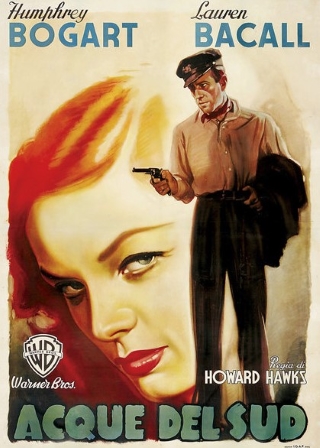
It’s tempting to use the more familiar, suggestive lines about matches, whistling and so on as an opener to the Howard Hawks adaptation of To Have and Have Not (1944). However, that business with the bee, uttered several times by Walter Brennan’s craftily befuddled rummy and later parroted by a smokily seductive Lauren Bacall feels like a better way in. Howard Hawks favored movies about tight knit groups, like-minded types who were bound together by a commitment to do whatever has to be done as well as holding some shared notion of personal honor. They should be people who live by their own code, and who recognize almost instinctively those who belong in their club. Well any such club ought to have a code word or phrase, one known to or capable of being interpreted correctly by their comrades. And so it is with Brennan’s bee shtick – the select band of “right guys” is neatly delineated as those who see the question for what it really represents and who in turn just know how to respond. There’s a lot of Hawks in that line and what it signals. As such, it seems apt to use it to lead into a movie which has more of Hawks in it than Hemingway.
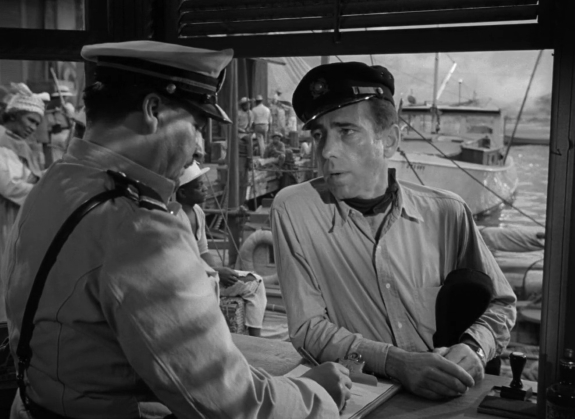
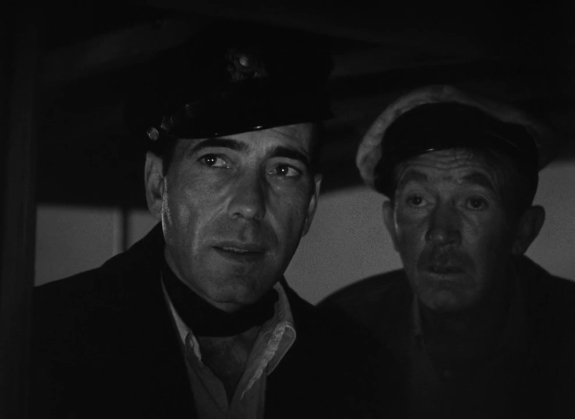
Is it noir? Is it a romantic thriller? Is it a slice of polished wartime propaganda? I guess To Have and Have Not is a little of all of these, but not only is it recognizably a Howard Hawks film, it’s also the movie that introduced Bogart to Bacall and the movie watching public to a cinematic partnership that transcended the silver screen. All of this would make it an important piece of work even if the film itself had been less than satisfactory. Fortunately though, that’s not the case as the whole concoction succeeds in checking every box. From the moment Franz Waxman’s instantly memorable score, dripping intrigue and danger, segues into the caption that informs us we’re about to descend on a delightfully ersatz Warner Brothers approximation of wartime Martinique we are hooked as fast as one of the marlins Harry Morgan’s clients pay big bucks to pursue. Morgan (Humphrey Bogart) is skipper of a charter fishing boat and our first glimpse of the man kind of sums up the classic Bogart persona – insolent, sardonic and independent, openly contemptuous of the pettiness of officialdom yet careful not to push what luck he has left too far.
Hemingway’s novel was a dark tale of a down on his luck man running anyone and anything that looked like turning a buck out of Cuba in the pre-war years. The story is that Hawks once told Hemingway that he reckoned he could make a successful movie out of the author’s worst book and he settled on To Have and Have Not to prove his point. Now I don’t know whether or not this was in fact Hemingway’s worst book – I tend to think nothing he wrote could be termed as objectively bad – but I can say it’s the one I enjoyed less than any of the others. It’s a short book, but the tone is largely grim and dour and I’ve not felt the urge to revisit it since I last read it perhaps a quarter of a century ago. Hawks’ movie, with a script that was worked on first by Jules Furthman and then later by William Faulkner, uses the novel as a jumping off point at best, where Morgan gets gypped out of a fee by a slippery client and a stray bullet fired by a Vichy gunman. It leaves him out of pocket and, having just made the acquaintance of fellow drifter Marie Browning (Lauren Bacall), of a mind to stick one in the eye of the Vichy collaborators.
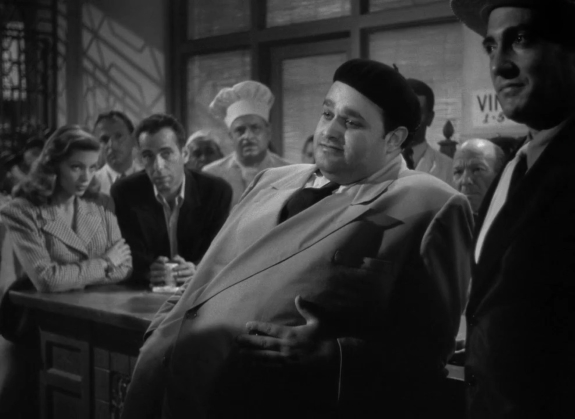
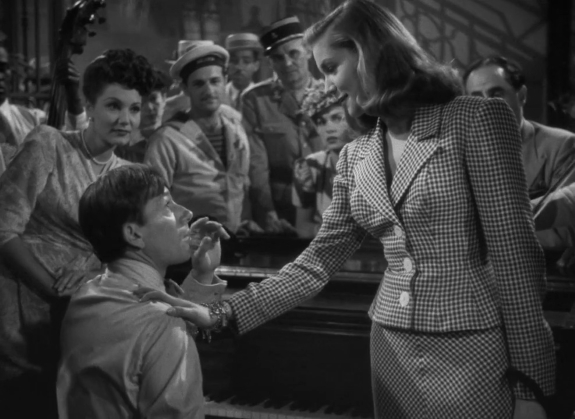
From this point on there’s not much of Hemingway in it but lots of Hawks, and of course the electric central pairing. It develops into a romantic adventure with a hint of Casablanca about it all – a totemic yet rather bland freedom fighter complete with attractive wife trying to stay a step ahead of the fascists, Axis villains, and a reluctant and essentially isolationist hero who comes to realize that this is an unsustainable position. Aside from an interlude on Morgan’s boat involving a near fatal encounter with a gunboat on a foggy night, most of the action takes place in the hotel, shifting from bedrooms to bar to cellar, all punctuated by a succession of provocative quips, as well as the shared ritual of lighting cigarettes and intermittently moody visuals, while Hoagy Carmichael tinkles away at How Little We Know in the background. There is that deeply satisfying feeling of convergence about it, watching an essentially ill-assorted group draw closer together and gel when faced with a common enemy. This was always attractive to witness, but nowadays it’s difficult not to feel even more wistful about a time when it was widely believed that the only decent thing to do was to oppose rather than lionize authoritarian bullies.
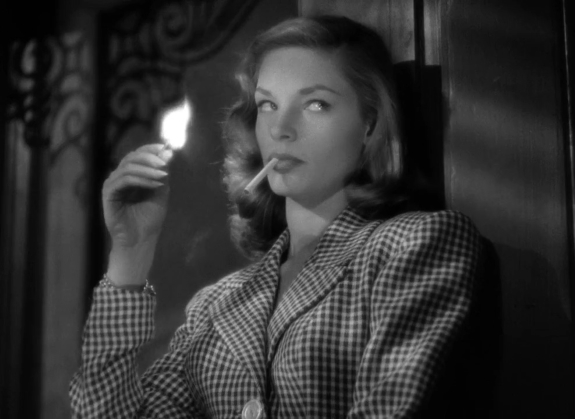
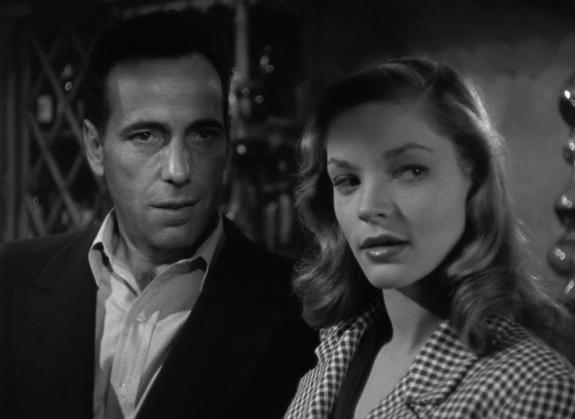
Bacall was, by her own admission, awed by the whole business and apparently hit on the “chin down, eyes up” pose she makes such effective use of as a means of holding those jitters in check. If so, it was a remarkably successful piece of improvisation and goes a long way to kindling those sparks struck whenever she shares the screen with Bogart. Her introductory scene, smouldering in the doorway, is as good as any actress ever got and I think it’s fair to say it followed her around for the rest of her life. Bogart was right at the top of his game at this point and probably at the height of his fame too. He displays such ease and composure in the front of the camera in this movie, every gesture timed to perfection, every beat of his dialogue struck – tough, lonesome and noble in spite of himself, this as much and maybe even more than Rick Blaine is his signature role.
The A pictures of the classic era all benefited enormously from the hugely experienced crews that worked behind the cameras. It’s one thing to have someone like Hawks in the director’s chair, but having people like Furthman and Faulkner working on the script, Franz Waxman providing the score, and safe hands such as Sidney Hickox looking after the cinematography provide a solid base. And then there were the character players, moving from picture to picture, largely unsung but helping to hold it all together. Walter Brennan was one of the greats, a three time Oscar winner, and his twitchy rummy, veering from wide-eyed wonder to something approaching a sly worldliness makes for a terrific foil to Bogart’s slouching hero. Marcel Dalio as the hotelier with underground connections feels like a first cousin of the harried croupier he played in Casablanca. Another alumnus from that movie, Dan Seymour, plays the secret police boss Renard as though Sydney Greenstreet had swallowed Conrad Veidt, sinister, bulky and malignant. The frequently loud and boorish Sheldon Leonard is more subdued as Seymour’s lieutenant, tossing in the odd line but mostly alternating between glowers and leers in the background. Hoagy Carmichael is a memorable presence too, the wonderfully named Cricket forever chewing soulfully on a toothpick and dispensing tunes and philosophical advice as the mood strikes him.
As this will be my last entry for 2024, I wanted to finish the year with a look at a movie that never gets old for me. Surely there are few better ways to spend one’s time than hanging round a waterfront bar in Martinique learning how to whistle. So thanks for stopping in over the last twelve months and here’s hoping everyone has a good 2025.
Other posts I have written on the Bogart & Bacall movies can be found here:
The Big Sleep
Dark Passage
Key Largo
 Riding the High Country