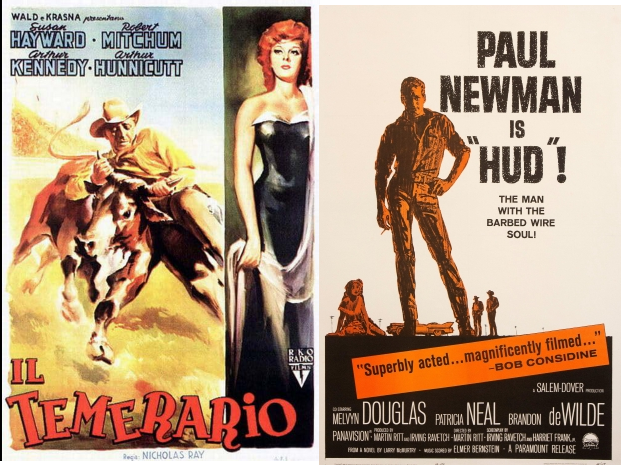
While my previous post arguably brought up the matter of the parameters one applies to the notion of the western, it was a few comments leading on from that which added some impetus and got me thinking a bit more. I guess I have my own idiosyncratic criteria which I wouldn’t expect to satisfy everyone. So be it, but that wasn’t the direction I now found my thoughts running in anyway. What I ended up contemplating was the course that the western as a genre charted after it had peaked in the late 1950s and on into the early 1960s. Reaching a peak means that some form of change is inevitable, but the path the genre adopted led to a sustained decline. That path essentially operated on two levels: one the one hand, there was that slightly desperate and ultimately unsatisfying effort to ape the nihilism at the heart of the spaghetti western, while on the other hand, there grew up a fruitless attempt to cling to the tropes of the classic form, one rendered stale by the crucial absence of thematic richness. Somehow these twin approaches converged at the artistic quagmire that came to be referred to as the revisionist western, where the myth was not merely deconstructed but practically obliterated. Yet what if an entirely different approach had been pursued instead, one which filmmakers had flirted with and dabbled in but failed to fully embrace?
I’m speaking here of what is sometimes called the modern or contemporary western, and I’m also well aware that there will be those who struggle to accept that such movies are “real” westerns at all. While I can’t say I share such reservations, I do understand them. Fairly recently, I happened to revisit a couple of movies that fall into this category, The Lusty Men (1952) and Hud (1963), with a view to maybe writing them up separately. Nevertheless, it now seems apposite to fold them into this piece on what I’ve been toying with for a while now, namely that the western might have been better served in the long run had filmmakers made a clean break and gone a different way. I guess it’s always easy to spot missteps when one has the benefit of hindsight to frame it all, but looking back at so many less than satisfactory westerns that were made from the mid-1960s on does create the impression of people trying to recapture lightning in a bottle. Instead of reaching for the unattainable, I can’t help but wonder if the people making westerns wouldn’t have been better off acknowledging that the way to secure the future of a genre so strongly rooted in the past was to allow it to naturally evolve into a recognizably modern form which still retained something of the spirit that made it great in the first place.
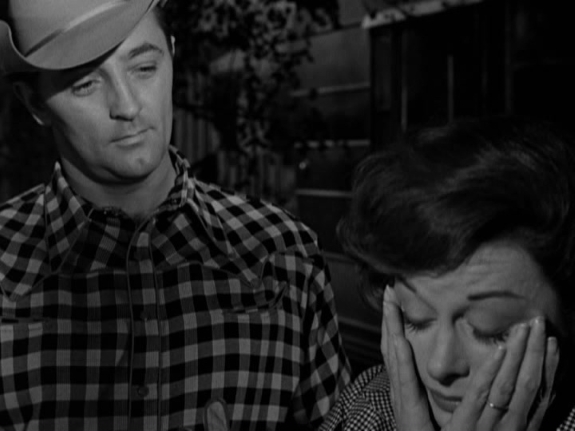
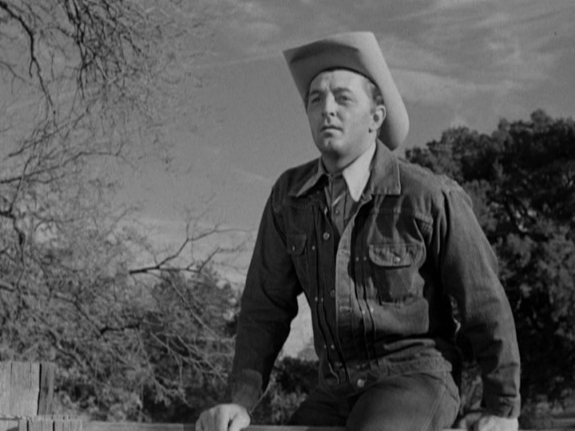
In The Lusty Men Nicholas Ray stirs together the doomed romanticism of Jeff McCloud (Robert Mitchum), a dwindling band of itinerant rodeo performers and one of his characteristically uneasy relationships. From the moment a limping and broken McCloud gazes with the kind of melancholic longing only Mitchum could impart so effortlessly at his childhood home, it’s clear he is meant to represent some bridge between a lost idyll and a world where skills once carefully acquired to tame the land itself are now of use primarily for display and entertainment. Wes Merritt (Arthur Kennedy), his protege, sees this the other way round – that the shows and spectacle may be a way to reconnect with the land. The whole movie traces McCloud’s slow reconciliation with the man he has now become, of the fact the world no longer holds a place for him. It also charts Merritt’s concurrent but bumpy journey back to his origins, aided by the tough earthiness of his wife (Susan Hayward) and by McCloud’s sacrifice. The world of Ray’s The Lusty Men is very much a contemporary one, and never tries to suggest otherwise, but by the time those still standing take stock of the lessons learnt and head back to the land which spawned them they are strengthened by their experience. The viewer too is fortified by the time spent tagging along on their journey, and that’s in no small part down to the way the essence of the classic western is transferred to the mid 20th century setting.
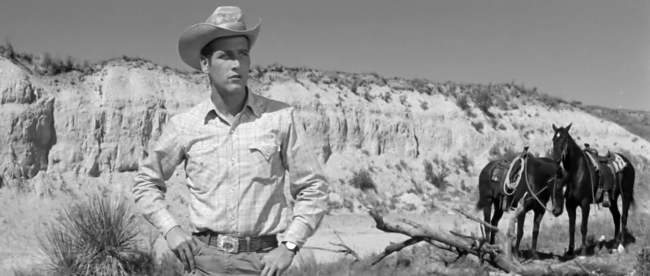
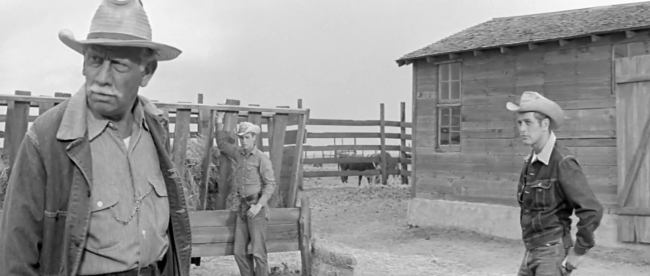
Martin Ritt’s Hud, adapted from a Larry McMurtry novel, came along a decade later and is a darker affair all told. It’s a film about change and passing, about a fractured family dealing with the notion of passing, of guilt and blame and principle. Paul Newman’s titular character is the new face of the west, amoral and self-absorbed, straining against ties to the past as represented by his father (Melvyn Douglas) and casually dismissive of a future hinted at by his nephew Lonnie (Brandon deWilde). Buoyed by two superb Oscar winning performances from Patricia Neal and Douglas, the former touching on a marvelous sense of resignation and regret, while the latter simply exudes pain and dignity, it scratches away at the mythology of the west. The culling of the herd is sobering in its matter of fact coldness, and Douglas’ subsequent putting down of his prized Longhorns, the last of the breed, is deeply symbolic and even more traumatic on a personal level – the hurt of the man is palpable. There is a bleakness to all this, yet the ending also looks to the resilience of the genre. If Hud’s shutting out of the modern world is indicative of a dead-end insularity, then Lonnie’s rejection of his uncle’s negativity and his striking out alone in the world looks toward a different horizon, an approach the genre itself is built upon.
While what I’m going to call ‘regular’ westerns made from the middle of the 1960s onward are very much a mixed bag for me – with far too many misses weighing down the hits – I don’t think I’ve seen a ‘modern’ western that actually disappointed me. The form continues to be made, and quite successfully too if TV shows such as Yellowstone are any kind of guide, but it still feels as though it is only visited from time to time. Admittedly, I’m doing no more than musing and hypothesizing here, spitballing something I’ve not yet reached a conclusion on myself. Increasingly though, I think Hollywood may have missed a trick by not abandoning the traditional western at some point in the late 60s, or at least by the 1970s, and turned the genre away from the static form it devolved into. Had this happened, had it become a contemporary rather than a historical form, perhaps we would be talking about the western in entirely different terms today, as a still thriving genre.
 Riding the High Country
Great post – just read a trio of books by McMurtry in fact (Last Picture Show, Texasville and Duane’s Depressed) who probably did a lot in this regard. There are also plenty of books and films that keep the archetypes without the historical trappings, like the Jesse Stone books and TV Movies.
LikeLike
Funny you should mention Jesse Stone as I just recently went through all nine of the Tom Selleck adaptations – I’d only seen the first two or three before that – and liked them very much. I hadn’t though of them in relation to westerns or being influenced by the genre – the eastern setting I suppose. That said, I can see where you’re coming from with that. Interesting.
McMurtry was certainly a big contributor to the contemporary western approach, and I think you could say something similar for Cormac McCarthy with No Country for Old Men.
LikeLiked by 2 people
Yes, the Jesse Stone movies are great! Glad to see them get some love. Robert Parker who wrote them did do proper Westerns in the Hitch and Cole series which one ‘Appaloosa’ was made with Ed Harris and Viggo Mortenson.
LikeLike
Yes, that was one of the more successful, in my opinion anyway, attempts to revive or sustain the classic western. From a wider perspective though, the fact movies like that get only a limited audience tells me the classic variety struggles to reach out beyond a well-defined group of viewers.
LikeLiked by 1 person
I am a big fan of the Stone TV Movies (prefer them to the books in fact). I need to go back to the McCarthy book as it was a bit too bleak for me. Not tried Blood Meridian yet.
LikeLike
No Country – both book and film – is an exceptionally fine piece of work, but you’re quite right that it is bleak and not the kind of thing you’d be scheduling regular returns to. I’ve not read Blood Meridian either – the synopsis/blurb suggested I’d need to be in the right frame of mind for that.
As for the Jesse Stone films, I liked the progression that takes place and Selleck is such a crafty and subtle performer in the role. I did miss the presence of Kathy Baker and Stephen McHattie in the last one though.
LikeLiked by 2 people
Yes, I agree about the last Stone film, they’re missed. A tenth film was announced but probably won’t happen now, which is a real shame.
LikeLiked by 1 person
Quite, I think it’s a little too late in the day now for that to happen. Sad, but then again I’m not going to complain as we did get a generally very strong run with those which were made.
LikeLiked by 2 people
Enjoyed your piece, Colin, as always very insightful. I wanted to add another title to the ones you mentioned, “Lonely Are the Brave” from 1962, said to be Kirk Douglas’ favorite movie, with a screenplay by Dalton Trumbo. The point of the movie is in line with what you’re describing, a marked change from the Old West to the New West or Western, exemplified in the one character played by Douglas trying to hold on to the past. It truly can be looked at as a ‘transition’ Western, for lack of a better term, harking back to an earlier time, or at least acknowledging it, while clearly outlining what things had become. I thought I’d mention it as another example of what you’re describing as to what the Western could’ve become with more insight in view of the times.
LikeLiked by 1 person
Thank you. I had Lonely Are the Brave in mind too as I was putting this together, but I hadn’t seen it for a while. I agree it fits the theme and point I was arguing here and I would have mentioned it specifically had I watched it more recently. As it is, I may well revisit it on its own at some point – that had been my intention with both Hud and The Lusty Men, but those comments that arose in the discussion prompted by the previous post altered those plans.
LikeLiked by 2 people
Perhaps “The Misfits” from 1961 could be added depending on your point of view of its merits, perhaps not as strongly as the ones already named, but nonetheless another possible example of what the Western could’ve become in the right hands.
LikeLiked by 1 person
Again, it is a film I would be happy to include. There is that focus on the themes that permeate the classic western, a certain wistfulness that proves to b very attractive and, for the time it was made, a milieu that offers a way in and a means of connecting more readily with contemporary audiences. Subsequent events lend it an added layer of melancholy of course, but it was a fine way for both Gable and Monroe to sign off.
LikeLiked by 3 people
No to Hud,Yes to The Lusty Men.
LikeLike
Well darn I was going to mention ‘Lonely are the Brave’ and ‘The Misfits’. For a later one I thought Eastwood did good with ‘Bronco Billy’ which gets at some modern day Western themes.
LikeLike
You know, I have never actually seen that Eastwood movie.
LikeLiked by 1 person
Of course the Rodeo westerns of the ’70s are extensions too. I really like Peckinpah’s ‘Junior Bonner’ and ‘Cliff Robertson’s ‘J.W. Coop’. Around the same time Widmark did ‘When the legends die’ and Coburn ‘The Honkers’.
LikeLike
Junior Bonner represents something of a change of pace for Peckinpah and I rather like it for that. I recently got my hands on a much better copy of the movie than I’d had before and hope to give it a watch soonish.
LikeLiked by 1 person
That’s good as I picked up the Kino a few years back before it disappeared. Nice to upgrade from the nonanamorphic version.
LikeLiked by 1 person
Junior Bonner, a nice film but not really a western, just about people like us who have seen many, and behaved accordingly.
LikeLike
Opinions will vary obviously, but I’m prepared to look at it as a western. It’s just the kind of movie, the kind of direction that might have been more productive, from a creative standpoint if nothing else, for filmmakers.
LikeLiked by 1 person
Westerns are about people who create a new world out of pasture. Junior Bonner is about people, generations later, who have been born and raised in the same or similar area. Like big kids playing cowboys and indians.
LikeLike
I understand that perspective, but I find myself increasingly convinced that sticking to the more rigid, more purist perhaps, definition of the western and what it represents cinematically led it up a creative blind alley. The genre is nothing if not malleable to my mind, and thus permitted and frankly demanded an exploration of so many themes that I feel it might have remained more relevant for longer had filmmakers taken a bolder approach and acknowledged that they had taken the classical form as far as it was possible to go. The revisionism and what might be termed the neo-western that grew out of the spaghetti influences and torpor of the post classic period is hardly more authentic after all.
LikeLiked by 2 people
I agree completely,especially re the spaghetti western.
LikeLike
I love all Italian genre movies, except spaghetti westerns. Spaghetti westerns are totally imbued with self-indulgent adolescent nihilism and pathetically naïve adolescent politics.
And yeah, that’s also why I despise revisionist westerns.
LikeLiked by 2 people
The essence of the western is to be found in its focus on change, development and progress, resistance to these elements by some, a welcoming by others, and of course the inevitability of it all in any case. This can be and was explored on an individual and communal level, sometimes with thought and conviction and at other times in an entirely incidental fashion. Either way, it’s always there and the fact that it is and that this is an indelible part of the human condition lends it a kind of subliminal appeal. It speaks to the heart of the audience.
Perhaps some of this could be applied to other genres too, but what sets the western apart, and elevates it in my eyes is the redemptive and hopeful path it typically follows. And this is also part of my beef with the course of the post-classical, revisionist, neo-western – label them as you will – that the sense of redemption and hope through making one’s peace with the past and embracing the present and future is too often overridden by a dourness, and sometimes a type of bleak nihilism. Sure some of that slips through into the modern/contemporary western in some cases, but the very fact these films take place in a world where the “Old West” has passed and the characters are compelled by circumstance to seek their own space in a world that continues to move forward negates some of the worst excesses.
LikeLiked by 2 people
Then let us not talk away the peasure of watching cowboys do their thing, and skip the sociology.
LikeLiked by 1 person
Junior Bonner is about people for whom the Old West is a living tradition, or at least they’re desperately trying to recapture or maintain that tradition. They’re not part of the Old West, but their identification with the Old West gives them their sense of identity. It’s both inspiring and tragic.
But at least they have something. Most people in the modern world have nothing. No sense of their history or of tradition, no sense of connection with their own country or people. They’re just office drones. Cogs in a machine.
I liked Junior Bonner the first time I saw it years ago but rewatching it recently it hit much harder. We now live in a society in which we’re even more alienated and isolated and disconnected than we were in the 70s.
It’s a western in the sense that it’s entirely about a man’s need to connect to the traditions of the Old West. We feel that he will probably fail, which gives the film a real sense of tragedy and despair.
LikeLiked by 1 person
Something that saddens me is the idea that serious grown-up movies should be bleak and despairing. It saddens me as much as the attitude that serious art should celebrate ugliness rather than beauty.
The classic-era westerns did not promote the childish idea that redemption was guaranteed or that the triumph of good was inevitable and straightforward. But such things were possible. Redemption wasn’t guaranteed, it wasn’t easy and there was a price to be paid, but it was possible.
Good can triumph, but often at a heavy price.
It’s a much more grown-up attitude than wallowing in adolescent nihilism.
LikeLiked by 1 person
I hear ya dfordoom 🙂 I think celebrating beauty is every bit as mature as gloom and doom. It seems that nobody has gotten over the cynicism that the 1960’s left in it’s wake.
I could not have stated your second paragraph any more eloquently 🙂
I think their is a market for nihilism, but at the same time, optimism is every bit as mature, just in a different way 🙂
LikeLike
I consider Junior Bonner to be Peckinpah’s best movie, and Steve McQueen’s best performance. Who knew that Steve McQueen could act?
A great movie, which naturally bombed at the box office.
From the late 60s onwards I find myself wildly out of step with both public and critical tastes. The more successful and critically acclaimed a movie is the less likely it is that I’ll enjoy it. There are exceptions of course.
LikeLiked by 1 person
If someone, anyone,is gettiing acting jobs on a regular basis, that is the message. Or even irregular.
LikeLike
Hey there dfordoom 🙂 Junior Bonner is one of my many favorite films of his (I love them all) and that would rank high 🙂 It does feature Steve McQueen’s greatest performance too.
Classical Hollywood cinema though is paradise to me though 🙂 Ironically enough, both the French New Wave directors and the New Hollywood directors were huge fans of Classical Hollywood cinema. Ain’t that something? 🙂
Btw, I love your website 🙂 I just discovered it a few days ago, but me and you have replied back and forth once on this website a month or two ago on our love of Douglas Sirk films 🙂
LikeLike
I agree on Peckinpah, but for me Ride the High Country is his greatest work, aamong many, and of course, I am a sucker for Randolph Scott.
LikeLiked by 1 person
I love the westerns of Randolph Scott as well Barry 🙂 He and Budd Boetticher were a great team 🙂
LikeLike
With or without Budd, Randy was a success for a long time and top ten box office in the early fifties.
LikeLiked by 1 person
Oh of course Barry – with or without Budd 🙂 I just wanted to stress how masterful their collaborations were 🙂 Limited to their collaboration alone, I would say Ride Lonesome is their magnum opus. What about you? 🙂
LikeLike
My wife,who rechristend it as LonesomeCowboy, would agree with you, I thought with the exception of Buchanan Rides Alone, they all worked well, althoughThe Tall T is a personal favorite.
LikeLiked by 1 person
I love them all too Barry 🙂 The Tall T would probably be my second favorite. I do not know If it is just me, but did you ever notice that the villains in Boetticher’s films are (explicitly) every bit as interesting as the heroes.
LikeLike
I would not have put it that way, because Richard Boone who is the best of them, is not ever as interesting or in command the equal of Scott. Boone plays th same kind of part with John Wayne too, while Scott and Wayne are equals on screen.
LikeLiked by 1 person
Of course not Barry 🙂 It is just a trope I have noticed with Boetticher’s westerns or at least most of them. Make no mistake, nobody can outshine Randolph Scott 🙂
LikeLiked by 1 person
Lee Marvin is immense in Seven Men from Now. The film would be a pale shadow of itself were it not for the three way interaction between Marvin, Scott and Russell.
LikeLiked by 1 person
You got that right regarding Lee Marvin in Seven Men from Now and Richard Boone was interesting in his own way in The Tall T 🙂
LikeLike
Boone was more than that, John. The character of Frank Usher has been acknowledged as a man whose admiration for his captive, Scott, ultimately leads to the kind of poor judgement that precipitates his downfall. I suppose a man can do that.
LikeLiked by 2 people
My top three is ‘Ride Lonesome’, ‘Tall T’, and ‘Seven Men from Now’. Those three have ‘Comanche Station’ nipping at them. These are immortal works. I was just watching yesterday ‘Albuquerque’ with Randy and Gabby Hayes on DVD. Enjoyable little film with great color on the print.
LikeLiked by 1 person
Hey Chris, great ranking their of the Budd Boetticher and Randolph Scott collaborations 🙂 I think mine would be similar to, though Ride Lonesome is still definitely my number one favorite 🙂
LikeLiked by 1 person
Yes, ‘Ride Lonesome’ I like everything about it. Pernell Roberts with James Coburn are so wonderful together.
LikeLiked by 2 people
This is my last warning. LOL!
Good movies tho.
LikeLiked by 2 people
Yes, it’s all your fault!
Seriously though, yours was one of the comments that set me mulling things over, that inspired me if you like, and I’m grateful to you for planting that seed.
LikeLiked by 1 person
Have a Great Christmas Colin – you and yout Family. That’s really what it’s all about.
LikeLiked by 2 people
Quite right, JC. These days, more than ever, it’s necessary to remember the good and important stuff like family, the constants in a decidedly dark landscape. So my best to you and yours too during Christmas and the holidays.
LikeLiked by 1 person
Great to see you on here jcalberta 🙂 Great films indeed 🙂
LikeLike
Similarly while reading this, Lonely But The Brave pop up in my mind. The most famous of such movies would be Bad Day At Black Rock?
LikeLike
Bad Day at Black Rock is without doubt one of the finest contemporary westerns. It’s got marvelous pace, a compelling and thought provoking story to tell, Sturges is masterful in his composition and mise en scene, and Tracy and Ryan are superb antagonists. I wrote a bit on it here long ago.
LikeLiked by 1 person
Yes, ‘Bad Day’ is superb. Great film and your write up was excellent.
LikeLiked by 1 person
Now thinking about it ‘Giant’ by George Stevens would be another ‘modern’ Western taking stock of what America and Texas had become by the mid 20th century. Like ‘The Misfits’ being legendary for being a last film for an icon too on top of everything.
LikeLike
Yes, I could go along with that, although it’s a real hybrid movie and blends in a number of genres.
LikeLiked by 1 person
Yes, I was reading today a James Dean book and it made the excellent point that Stevens basically invented the Western soap opera template with ‘Giant’ that show like ‘Dallas’ exploited years later.
LikeLike
Another neo-Western. The unforgettable thriller NO COUNTRY FOR OLD MEN (2007).
LikeLike
Yes, agreed. I briefly alluded to this in this earlier comment here.
LikeLike
Ah yes…….I forgot.
LikeLiked by 1 person
I would add the modern Western trilogy by Taylor Sheridan: ‘Sicario’, ‘Hell or High Water’, and ‘Wind River’. All excellent.
LikeLike
I’ve actually never seen anything by Sheridan apart from Yellowstone.
LikeLiked by 1 person
I highly recommend them. I really like ‘Wind River’. Great film.
LikeLike
Noted. I’ll look out for it.
LikeLike
Hey Chris Evans, I want to wish you a Merry Christmas 🙂
LikeLike
Merry Christmas! May everybody’s movie watching be fine. Something about watching films this time of year makes them even more special. Have a good New Year!
LikeLiked by 1 person
Great post Colin 🙂 So glad you mentioned Nicholas Ray’s The Lusty Men – that would rank somewhere within the top 5 of my favorite NIcholas Ray films and I love all of them 🙂 Along with They Live by Night, The Lusty Men is characteristic of Ray’s trademark theme of doomed romance. He was after all, the poetic outsider of Classical Hollywood cinema 🙂
LikeLike
I think the movie sometimes gets a bit lost among Ray’s other work, which is a shame. It is one of his best, riffing on those themes he handled so well – the outsiders, the imperfect relationships – and it’s so beautifully and credibly played by all the main actors.
LikeLiked by 1 person
I hear ya Colin 🙂 I do not how much you know about NIcholas Ray’s behind the scenes struggles when he was directing Hollywood films, but it has been said that he had experimented with alcohol and later on, drugs. Sometimes other people came in to direct when he was absent. Ray was in many ways, an ahead of his time director. For example, it has been said that 1956’s Bigger Than Life was (among other things) an indictment on the dangers of prescription drugs. Today, Big Pharma is often a negative term to describe the industry. Environmentalism was a theme of Wind Across the Everglades, which was ahead by at least a decade. Same applies for youth in Rebel Without a Cause. All of this is interesting isn’t it? 🙂
LikeLike
Nick Ray, a good filmmaker but pointlessly pretentious.
LikeLike
Barry, I love Nicholas Ray’s work 🙂 As for pretentious, I think that term is a bit much. Some great works of art are considered pretentious. Take Orson Welles Citizen Kane for example. Pretentious? You bet. A masterpiece? Without a doubt 🙂
LikeLike
Pretentions ae not positve because they are inherently false.
LikeLike
Personally, I am not a huge fan of the term Barry. I do find Stanley Kramer pretentious though.
LikeLike
He was.
LikeLiked by 1 person
Do you think that 1959 film On the Beach has aged terribly Barry? Because I do.
LikeLike
It was terrible to begin with and miscast in the top supporting parts.
LikeLiked by 1 person
You got that right Barry 🙂 I am glad that me and you have something to agree on 🙂
LikeLike
We can agree on Meet Me in Saint Louis as well.
LikeLiked by 1 person
How did you know I loved Meet Me in St. Louis Barry? 🙂
LikeLike
I did a quick survey of your Christmas movie apprecation list.
LikeLiked by 1 person
Aww nice Barry 🙂 I included an early sound western as you might have already deduced entitled Hell’s Heroes from 1929 and directed by William Wyler. A lot of people are more familiar though with John Ford’s 1948 remake entitled Three Godfathers 🙂
LikeLike
I’ve seen it and no problem but Ford’s work is first in my book.
LikeLiked by 1 person
I hear ya Barry 🙂 As much as I love director William Wyler’s early work, he can not top John Ford. I mean Ford is a cinematic poet. One of these days Barry, I am going to do a blog entry on my favorite John Ford films and it would basically include his entire resume (not counting the lost films of course) 🙂
LikeLiked by 1 person
My wife liked the Chester Morris — Richard Boleslwki variation,
LikeLiked by 1 person
Been a while since I saw that one Barry 🙂 I might need to rewatch it. I do not know If you knew this, but did you know that John Ford cited his 1950 western Wagon Master as the personal favorite of his westerns? 🙂
LikeLike
I did know that, and he msut have had a reason, but I do not. My Ford favorites begin with Gow Green Was My Valley, SheWore A Yellow Ribbon, Rio Grande, The Quiet Man, The Searchers and conclude withThe Man Who Shot Liberty Valance. Backing them up, Stagecoach and Donavan’s Reef, but NOT Mary of Scotland.
LikeLiked by 1 person
The Man Who Shot Liberty Valance feels like Ford’s eulogy for the archetypal John Wayne western. He did make Cheyenne Autumn after that, but that did not feature Wayne.
LikeLike
Two points about Cheyenne Autumn: It was awful,and Widmark replaled Wayne, who refused to work again with Ford after Donavan’s Reef. If you lsiten wo Widmark crefully you can here Wayne whose refusal was based on how he was presented in Donovans Reef, physically.
LikeLiked by 1 person
I actually loved Cheyenne Autumn Barry 🙂 But then again, I understand it is a very polarizing Ford film. I did know about all of that stuff regarding Widmark and Wayne.
LikeLiked by 1 person
On the Beach is another tedious Message Movie from the King of Tedious Message Movies.
LikeLiked by 1 person
I hear ya dfordoom 🙂 I am not saying that Stanley Kramer is the only one guilty of pretension (I am actually not a huge fan of the word), but how is it that all of his have aged badly? 🙂
LikeLike
They were no good initially,ergo they age badly, bu tKramer’s films were packed with great stars and evolved from what can only be described as an intersting topic sentence.
LikeLiked by 1 person
I guess the big name stars are what draw-ed audiences to Stanley Kramer’s films – am I correct Barry? 🙂
LikeLike
I’m not sure I’d say “all” of his films have aged badly. I would have thought Inherit the Wind, for example, is every bit as relevant as it was the day it was released, perhaps even more so given the turn of events of late.
LikeLiked by 1 person
There’s nothing worse than film directors who are clearly trying too hard.
Film directors who don’t want to make movies, they want to make cinema.
LikeLiked by 1 person
Very insightful dfordoom 🙂 You know what is ironic and I think I might have mentioned this to you before, but it is quite interesting to hear that a lot of the French New Wave filmmakers like Jean-Luc Godard and Francois Truffaut among others, were actually huge fans of Classical Hollywood cinema and yet, there films are the complete opposite of them. One might ask oneself, what is up with that? 🙂 Funny I know 🙂
LikeLiked by 1 person
My attitude about theFrench NEW WAVE — who needs it? Not me. Here is that word again, Pretentious.
LikeLike
Hey Barry Lane, I want to wish you a Merry Christmas 🙂
LikeLiked by 1 person
Right back at you. Merry Chjristmas and Happy New Year, my friend.
LikeLiked by 1 person
Pretentious means pretending to be greater or more important than one is. In artistic terms, this suggests work which has no real heart, no inherent meaning, an therefore an artificially inflated sense of worth. One may or may not respond positively to Welles’ Kane, or to the films of Ray, everyone will approach them differently, but they do not have the hollowness that would justify labelling them pretentious. They have a solid emotional and thematic core, a story to tell and points to make that are sincerely expressed.
LikeLiked by 1 person
Hey Colin, as I told Barry, I am not a huge fan of the term pretentious. Unlike Barry though, I am a huge fan of Nicholas Ray and Welles – in fact, I love every single film they made 🙂 Regardless, I do not find Ray or Welles pretentious at all. Speaking of Ray, he was a guy who often clashed with studios and it has been said that Bitter Victory and The Savage Innocents were his way of trying to go independent despite the fact that were still distributed by major companies. For the former, it was Columbia and the latter was Paramount. Ray was also as you probably mentioned before, a master of color 🙂
LikeLiked by 1 person
Nick Ray, a mediocre filmmaker and also pointlessly pretentious.
LikeLike
Oh no not you too dfordoom 😦 I love the films of Nicholas Ray. Well, at least you love Douglas Sirk 🙂
LikeLike
Hey dfordoom, I want to wish you a Merry Christmas 🙂
LikeLike
Now we are together.
LikeLiked by 1 person
Yes we are Barry 🙂
LikeLiked by 1 person
BTW, Colin 🙂 I just updated my Christmas Film Recommendations and I wondered, did you ever see this 1940 comedy-drama called Remember the Night with Barbara Stanwyck and Fred MacMurray? 🙂 I say this because did you know that Preston Sturges wrote the screenplay to it? Yes, that Preston Sturges 🙂
LikeLike
I certainly have seen it, and actually should have mentioned it when I was offering a selection of Christmas movies I like.
LikeLiked by 1 person
Hey Colin, I hope this is not a silly question, but what are some of your favorite things (Entertainment Related or otherwise)? 🙂 I ask because I did a blog entry on it recently and I am just curious because you always have insightful views 🙂
LikeLiked by 1 person
Let me think a bit…
LikeLiked by 1 person
I’m curiouser and curiouser….I reckon……..as Colin would say. 🙂
LikeLiked by 1 person
I am too Scott? 🙂 Do you remember a television painter by the name of Bob Ross? The reason I ask is because he would be one of my many favorite people. I mean whenever you hear him talk about what he is painting, his voice is just so soothing and I am far from the first person to say this, but you want to fall asleep and regarding Bob Ross, I treat that as a compliment 🙂 How many people can you say that about and treat as a compliment? The reason I do not mention westerns is because that is pretty obvious and requires a blog entry of it’s own as opposed to one about things oneself loves 🙂 For me, even though I mention this on my own website, they would be Jennifer Coolidge, Pamela Anderson: The Cinephile (yes you heard correctly), Danny Devito’s Jersey Mike’s Commercials and The Clovers song One Mint Julep 🙂
LikeLike
Btw, Scottpstorm, I would like to wish you and everybody on this blog a very Merry Christmas and in case you are interested reading the blog entry that incited me to ask that question to our most gracious host Colin, here it is below courtesy of my own website in case you are interested 🙂
https://cinematiccoffee.com/2024/12/21/some-of-my-many-favorite-things-entertainment-related-or-lack-thereof/
LikeLike
John Dickson Carr – one of the genuinely great mystery writers and yet a name possibly unfamiliar to many today. He was such a crafty and clever plotter, often cited as the master of the locked room, which is fair enough but his output goes further than that. He blended a touch of M R James style crawling dread with French Grand Guignol and injected that into some terrific, head scratching puzzles. I try to read or reread one of his books around Christmas every year – it’s just a little tradition of my own – and I’m currently returning to a medium but very enjoyable effort of his called Death in Five Boxes, written under his Carter Dickson pseudonym.
Pan Books paperbacks – I have a real thing for the painted covers of these books, especially the 50s editions. They are sometimes lurid, frequently evocative, and always hugely attractive. I’ve built up a fair collection over the years but I’m forever on the lookout for others to add.
Senza Fine – an achingly beautiful love song, written by Gino Paoli. I’m not sure if songs can be analyzed adequately with words, there is just a feeling they stimulate, and perhaps not the same feeling in all. Graceful and passionate, this has always touched a nerve with me and it can be found in many places – it is used and sampled extensively in Billy Wilder’s Avanti, for example.
Perfidia – another piece of music, and quite a well known one I’d have thought. Written by Alberto Dominguez, it has been covered countless times. I never tire of it though. Just the other day, I was watching Jean Negulesco’s The Mask of Dimitrios again, with Peter Lorre and Sydney Greenstreet gadding around the Levant and the Balkans in pursuit of a phantom-like Zachary Scott. At one point in a night club in Bulgaria a worn and jaded Faye Emerson recalls her experiences with Dimitrios to superb effect, and in the background the band plays Perfidia – it’s a perfect accompaniment.
LikeLiked by 1 person
Pingback: Lonely Are the Brave | Riding the High Country