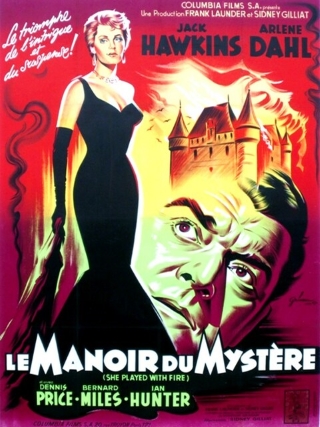
I sometimes think I spend far too much time on associations, images that recall other images, movies that bring to mind other movies, or names that automatically start me thinking of other people. Such is the case with Frank Launder and Sidney Gilliat, mention of whose names inevitably sparks thoughts of Alfred Hitchcock as a result of their having produced the script for The Lady Vanishes. That association feels a little stronger when viewing She Played With Fire (1957), which is also sometimes referred to as Fortune is a Woman, as it derives from a story by Winston Graham and he of course wrote the novel which formed the basis of Hitchcock’s last great film Marnie. This all sounds as though the movie has a wonderful pedigree, which I suppose it has even if the attractively packaged end product isn’t quite as satisfying as one might hope.

Some premises hook viewers early or even immediately in exceptional cases. Personally, I struggle to work up a huge amount of enthusiasm over plot devices like insurance fraud, a swindle can clearly make for an engaging and involving storyline but it’s usually when a human face is seen to suffer. That said, a good movie ought to be able to rise above the potentially mundane aspects of its plotting – it’s a visual medium after all and a touch of style in that area can gloss over a lot. She Played With Fire does display a degree of visual panache and the opening blend of dreams and reality by way of art sets everything up nicely. In brief, Oliver Branwell (Jack Hawkins) is an insurance man, one of those post-war types who has spent a good deal of his time overseas and always comes across as a bit of a square peg in the round hole he’s chosen to lodge himself in. An investigation into a fire and the resultant damage to some pictures at a stately pile in the country brings Branwell abruptly and unexpectedly face to face with his own past. The claimant is Tracey Moreton (Dennis Price), a vaguely decadent asthmatic, but the surprise from Branwell’s perspective is Moreton’s wife Sarah (Arlene Dahl). She is the woman he once romanced and then lost in the Far East and the embers of that fling have evidently not quite cooled. Everything remains very proper though despite the ever present temptation. In time however, the pair are drawn closer together, and then the possibility of a clever bit of fraud comes accidentally to the attention of Branwell. Without going into too many details, he is soon questioning the good faith of Sarah and then finds himself plunged into a truly messy affair as a nighttime investigation of the Moreton mansion coincides with a massively destructive conflagration and the discovery of the owner’s corpse just before everything goes up in flames. This all leads to some foolhardy deceit, a whirlwind romance, blackmail and the uncomfortable possibility that a supposedly dead man might actually be still alive.
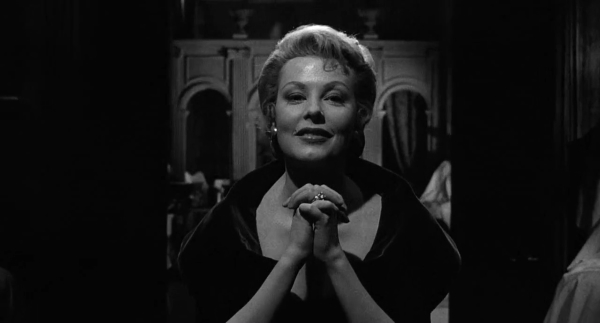
I have seen this movie labeled a film noir and while I can see how some of Gerald Gibbs’ striking high contrast cinematography, as well as the convoluted deceptions and tangled interpersonal relationships, are suggestive of this, I wouldn’t describe it as such myself. I can’t say I object to anyone categorizing the movie as noir but I tend to regard it as a classic mystery with a smattering of noir tropes. Does it succeed on those terms? To a point it does yet there’s an unevenness to it as a whole that weakens it. The tension arising out of the blackmail strand is dropped or allowed to slacken too early and this robs it of suspense and urgency. A bigger issue though is the fact the whole fraud and murder mystery which ought to underpin the film is frankly nowhere near as compelling as it needs to be.

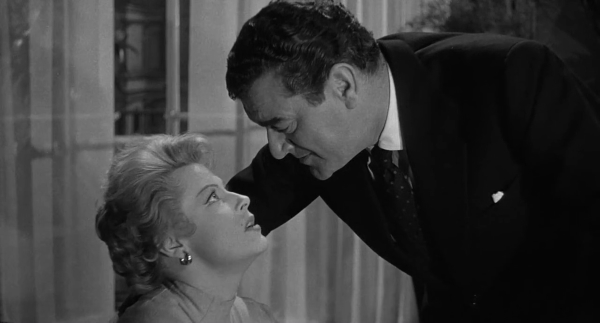
What does keep it all afloat is a combination of Gibbs’ lighting and some evocative composition and framing from director Gilliat. In short, this is a movie that looks good all the way through. The acting helps matters along too, especially from the ever reliable Hawkins. He could generally be depended on to produce a pained stoicism, earnest and honest but leavened with something of a twinkle in the eye that prevented everything from sliding into dourness. Arlene Dahl was highly decorative and has a hint of duplicity about her, enough to generate some suspicion though perhaps not enough to sustain it all the way through to the end. Dennis Price was born to play wastrels and does so effortlessly here, it’s just a pity he’s not given more screen time. Bernard Miles is a touch theatrical as the seedily adenoidal would-be extortionist, but it’s a memorable turn for all that. Greta Gynt seemed to be enjoying herself immensely as an incorrigible good time girl, a lovely piece of light comedic acting, while Christopher Lee pops up in a blink and you’ll miss him cameo as one of her unfortunate conquests. It was also a nice touch to cast father and son Malcolm and Geoffrey Keen as two generations of the insurance firm Hawkins is working for.
She Played With Fire was a Columbia film which was released first on DVD in the US by Sony as part of their MOD line and then later it was licensed out to Kit Parker Films and appeared on Blu-ray in one of the company’s multi-title film noir collections. I’ve often wondered why the film never made it to Blu-ray in the UK, especially when Indicator were releasing a lot of Sony/Columbia product not to mention the fact they like to highlight British cinema titles where possible. Perhaps the slightly odd fact the movie has the kind of plot that is simultaneously too convoluted and too slight discouraged them? Still, the deep cast of familiar British character actors and the inevitable if incidental links to Hitchcock would seem to invite the kind of analysis to be found among the supplementary features of many Indicator discs. All told, an enjoyable albeit imperfect movie.
 Riding the High Country
Another thoughtful, balanced review, Colin. I saw this movie some years ago and it didn’t make a big impression on me but your review has me searching for it again. A key point you make is that the movie’s shortcomings are offset by the great way it looks throughout thanks to the way it’s lit and shot. I want to see it again to weigh that up. And the strong cast is another attraction for me. Arlene Dahl’s beauty took my breath away when she initially appeared in the Western THE OUTRIDERS.
LikeLiked by 2 people
Well, it’s not a hugely impressive film, Steve. Even so, I think it’s an enjoyable watch, mainly due to the cast and stylish visuals.
Seeing as you mention it, The Outriders is a great little movie – incidentally, Claude Jarman Jr, the last surviving cast member of that film, passed way just a few days ago.
LikeLiked by 1 person
Thanks for the review. I always thought Jack Hawkins was good value. ‘The Cruel Sea’, ‘Zulu’, ‘Lawrence of Arabia’, and ‘Gideon’s Day for John Ford (an underrated film that I wouldn’t mind seeing you review). Amazing the amount of work he did after he lost his voice tragically including three I have to mention as favorites ‘Oh! What a Lovely War’, ‘Young Winston’, and ‘Waterloo’ (where he is memorable as General Picton). Oh and nearly forgot! ‘Bridge over the River Kwai’. “Madness. Madness”.
LikeLike
I usually enjoy Hawkins too, he did earnest and authoritative very well but could add a twinkle of humor when necessary. All being well, I should have something else in which he features, albeit a smaller role in an earlier movie, posted some time next month.
LikeLike
One of his big film roles I forgot to mention was ‘Ben Hur’. I thought he was good too in Hawks’ ‘Land of the Pharoahs’ with Joan Collins.
LikeLike
Jack Hawkins was excellent in Land of the Pharoahs. Not an obvious casting choice for an historical epic but it’s not your standard 50s Hollywood historical epic.
LikeLike
As so often I do, I watch the movie straightaway before reading Colin’s review. Then after, watch the movie back-to-back. My takeaway, the movie deserves a second viewing leading to a deeper appreciation.
LikeLike
Nice to know I spurred you to check out the movie. It’s not any lost classic or anything but it is fairly entertaining for the most part, worth a watch at the very least.
LikeLike
Colin, I should add that your review sums up quite nicely every aspect of the production.
LikeLiked by 1 person
Good ‘ol WordPress I’m back to my full name all lowercase which I cannot seem to change-at least my replies are getting through.
I’ve seen SHE PLAYED WITH FIRE and Ken Hughes’ WICKED AS THEY COME but only on TV years ago and I’m afraid I cannot remember much about either. As I recall I think I preferred the Hughes film.
The one Gilliat picture that I really like is LONDON BELONGS TO ME (aka Dulcima Street) with young Dickie Attenborough up for murder again. (EIGHT O CLOCK WALK) In the Gilliat picture young Dickie is a chirpy working class lad involved with the wrong dame and murder. The point of the film is the whole community grouping together to save the lad from the gallows. Gilliat’s film is an unheralded Brit Noir which blends heart wrenching moments with darkly comic tones worthy of Hamer at his best.
LONDON BELONGS TO ME seems to be stuck in p.d. hell (unless Colin,you know otherwise) but a very nice looking version is available from Trip Discs in Wales who sadly no longer ship overseas.
LikeLike
I haven’t seen it in a while myself but I too think Wicked As They Come is a better film overall.
As for Gilliat, I like State Secret quite a bit and it’s gratifying that Network managed to give us such a fine looking copy before they went out of business. I’ve not seen London Belongs to Me but it does sound like the kind of thing I might enjoy.
LikeLike
Chris mentioned GIDEON’S DAY but as far as I know only the 90 minute version is available,at least as far as UK TV goes. I’d love to see the complete 118 minute version which hopefully would make more sense,the 90 min version seems choppy to say the least.
If there is such a generic as The Jack Hawkins Crime Thriller then I’m very fond of THE LONG ARM far superior to Ford’s film, at least the abridged version. I love the way Hawkins’ tec refers to bad guys as “Chummy”
LikeLike
Yes, I remember liking The Long Arm too, I first saw it on TV when I was still at school, possibly an afternoon showing when I was off ill or something and I thought it was very well put together. In fact, I may well revisit it soon.
LikeLike
On ‘Gideon’ I think the 91 minute version is the full one. If you think that was choppy in America it was released as ‘Gideon of Scotland Yard’ and cut to something like 54 minutes to put on double bills plus black and white to boot removing all that wonderful color.
LikeLike
A Jack Hawkins movie that doesn’t get enough attention but is very much worth seeing is the slightly offbeat 1953 genre hybrid (part war movie and part crime thriller) The Intruder.
Plus Dennis Price is in it! And George Cole. Three delightful British actors all in top form.
LikeLike
Agreed, one of Guy Hamilton’s best movies.
LikeLike
Way off topic and I’m only doing this because of the low traffic on this thread;but I don’t know if you have seen my comments on Toby’s blog or checked into the French Westerns site recently-in any case the following might interest other readers.
Sadly the recent Sidonis releases of SEVEN MEN FROM NOW, ARROWHEAD and THE FAR HORIZONS are according to Vincent’s reviews ;are slight upgrades from old DVD masters with SEVEN MEN FROM NOW and ARROWHEAD being really disappointing with the latter being from a master 20 years old. The DVD of THE FAR HORIZONS was very good (in it’s day) and is the least essential of the three.
This all begs the question,what will Sidonis versions of THE MAVERICK QUEEN and BUGLES IN THE AFTERNOON look like as neither have had an official DVD release, surely these must be from new masters supplied by Paramount. There seems to be an embargo on Batjac titles being released in America so hopefully, maybe Arrow UK might release SEVEN MEN FROM NOW from a new 4K restoration-it certainly needs it.
Furthermore Kit Parker’s forthcoming Blu Ray of STRANGER ON HORSEBACK is from the same source as the DVD,sadly the only source that now exists. Let’s hope this new restoration is an improvement over the old DVD.
LikeLike
I hadn’t seen that info before, John. Very busy recently, and a few health issues to be taken care of as well so I’ve not been reading around.
Sadly, I’m not altogether surprised at the news of the ageing masters used. I suspected something like this might occur with the absence of upgrades in the US. As for a UK version, I wouldn’t hold out too much hope on that score right now as I’ve heard that Paramount titles seem to be practically inaccessible for licensing there at the moment. I don’t know why that is, but that would seem to be the case.
LikeLike
I’m glad the ‘Seven Men’ uprezzes as decently as it does on my player as it creates a most watchable picture still. Plus all those nice extras.
LikeLike
Agreed, Much as I’d enjoy a HD restoration, I can’t say the DVD displeases me. And the supplements are extensive and very worthwhile, something that is now a bit of a rarity on physical releases.
LikeLike
It was so nice when studios did such extra laden editions. The piece on Gail Russell on that disc is particularly thoughtful and moving.
LikeLike
Frenzy is a much netter Hitchcock than Marnie. I must check this one out
LikeLike
Thanks for the response, David. I’ve always regarded Frenzy as something of a bounce back to partial form after the low point of Topaz, but it has a coldness or detachment that distances me from it to an extent. The unlikeability of the lead character and some of the nods to more permissive trends in moviemaking contribute to this.
For me, Marnie is a much richer affair with a more stylisitc flourishes and more nuanced and compelling characters. I know it’s not to everyone’s taste but I rate it among Hitchcock’s very best.
LikeLike
I recently saw a passionate defence of Topaz on Trailers From Hell https://www.youtube.com/watch?v=IdlVIQxsIM4&ab_channel=TrailersFromHell
So I may have to give it an open minded try again. I still think Frenzy is all classic Hitch themes and Marnie is a bit of a dud. I’m biased because I saw it at the cinema as a youngster, getting into a X certificate film underage. I found it hair raising. Jon Finch is no Cary Grant though. Best wishes
LikeLiked by 1 person
Yes, opinions vary on all these films, which I think is a healthy situation. And I agree too that the timing and circumstances under which we first view something does tend to color how we feel about those movies.
LikeLike
Leonard Maltin has a brave defense of ‘Topaz’ on the Blu.
LikeLike
To be honest, and fair, it takes a brave person to even try to defend that movie.
LikeLike
It’s interesting that of the Hitch ‘problem’ pictures that ‘Marnie’ is the one that is a free for all in the opinions department. When I first watched it I was perfectly alright with it. The film and I got along perfectly well.
LikeLike
I think Marnie is simply frequently misunderstood and thus not appreciated as much as I’d say it ought to be. I liked it first time I saw it and my opinion of it has never dipped since. I regard it as a great movie, rich, visually and thematically stylish and very satisfying.
Topaz is just dull and uninvolving for the most part, not necessarily a bad film, possibly even a fair effort if anyone else had made it, but a weak and lackluster affair in the context of Hitchcock’s body of work.
LikeLiked by 1 person
A personal point of view s hared by many filmgoers. I did not like any Hitchcok film after North By Northwest. They became more complex, more boring, more pretentious and less successful.
LikeLike
These things are largely subjective of course. I don’t set much store by financial success or failure as an indicator of the quality of a movie, good movies lose money and plenty of genuinely rotten ones make a fortune after all. That’s something that is often affected by a range of factors and is of interest from a contemporary business perspective more than anything. Until very recently, superhero films were cash cows for studios, but I wouldn’t like to argue the end product represents the heights of filmmaking. That said, Psycho was extremely successful critically and financially so I don’t think Hitchcock was seen to be slipping at that stage. Topaz is the tipping point for me, where the artistic merit is severely lacking. Torn Curtain is weak overall too but it still has more going for it, enough to keep it watchable for me at any rate.
LikeLike
If a movie is a huge box-office hit and the critics love it it’s unlikely to be a great movie. The public and the critics don’t like to be challenged. They prefer the safe and the predictable.
Truly great movies mostly don’t get recognised as such at the time. Their reputations usually grow slowly over time.
And a lot of great movies cannot be fully appreciated until you’ve seen them several times, with a few years in between each viewing.
LikeLike
That one shot in ‘Topaz’ is still so wonderful when a character is shot she falls and the flowing dress is like blood.
LikeLike
A famous setup, and justifiably so. The opening sequence is well done too, as is the flower shop interval with Roscoe Lee Browne. However, that flat script, uninspiring cast and the general sense of just drifting along do too much damage.
LikeLike
Agreed. Do you like ‘Family Plot’? I enjoy it well enough.
LikeLike
I feel better about it now than I did when I first saw it. It has a bit of a TV movie vibe to it, which bothered me more in the past. However, it feels less exploitative than Frenzy, that film despite being a step up from the dullness of Topaz has a few downright nasty moments. I think I’m happier that Hitchcock ended his career with Family Plot.
LikeLiked by 1 person
I’m feeling wild and crazy today so I’m going to leap to the defence of The Trouble with Harry. Another example of critics bewildered by something they didn’t understand. By the late 60s the wicked outrageous black comedy of this movie would have delighted critics. In 1955 it had them heading for the fainting couches.
The Trouble with Harry is one of the great cinematic black comedies.
LikeLiked by 1 person
I like The Trouble With Harry, but that wasn’t always the case. I know that it did little for me when I first saw it. However, I was very young then, just into my teens, and the films great strengths – the clever humor, the beauty of the visuals and locations, and that touchingly mature romance between Mildred Natwick and Edmund Gwenn – just didn’t have the impact they do now.
LikeLiked by 2 people
I too love The Trouble with Harry dfordoom 🙂
LikeLike
I like it too. The color is so beautiful (the print used on the Blu is excellent), the humor good, and Shirley McClaine cute as a button.
LikeLiked by 1 person
I’m with you totally on this. Frenzy is entertaining but not quite top-tier Hitchcock.
Critics and fans reacted negatively to Marnie because it’s not a suspense thriller. It’s a complex tangled psycho-sexual melodrama. There’s no villain. Mark is not a villain. He’s a good man trying to figure out how to reach Marnie, how to convince her that she can trust him. She can trust him, but she won’t believe it.
Marnie is not a villain. She has a huge problem which she can’t even admit to much less confront.
The key to Marnie is the scene with the photograph of the jaguarundi.
Marnie is a fine example of a great movie destroyed by mindless vindictive critics.
LikeLiked by 1 person
dfordoom, I could not agree with you more regarding Marnie 🙂 It is actually my second favorite Hitchcock film 🙂
LikeLike