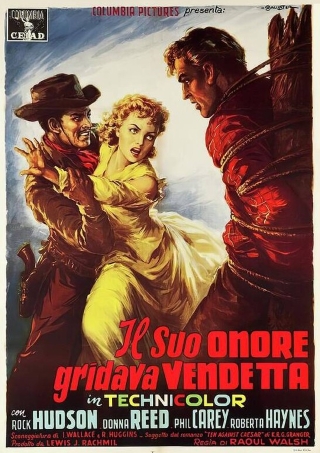
Every time I view a Raoul Walsh movie I find I’m struck by one thought: why don’t I watch more of his movies more often? It says something for a director whose work is so diverse and spread over so many decades that this should occur to me so consistently – in short, I don’t believe I’ve ever seen a Walsh movie that didn’t leave me thirsty for another. Gun Fury (1953) is a standard pursuit and revenge western, but it scrutinizes other themes such as pacifism, isolationism, the hold exerted by the past, and a flirtation with, as opposed to a full embrace of, the classic concept of redemption.
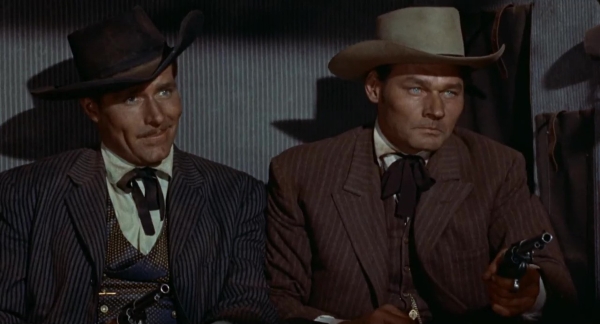
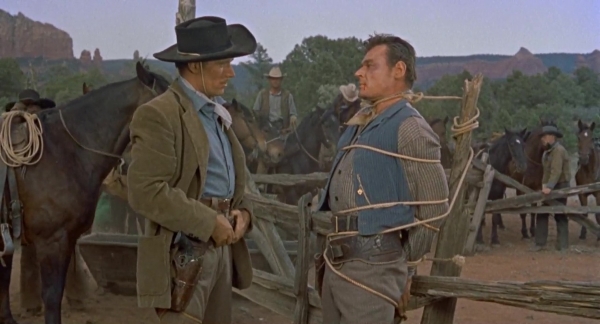
The setup is quite simple. A stagecoach headed west is carrying among its passengers one Jennifer Ballard (Donna Reed), a woman journeying to meet her fiance Ben Warren (Rock Hudson) in order to get married and then continue on their way to California and the prospect of a future ranching. They find themselves sharing space with several others, ostensibly traveling on business of one kind or another. Before long these supposed gentlemen are revealed to be Frank Slayton (Phil Carey) and Jess Burgess (Leo Gordon), a pair of outlaws making the journey simply to facilitate the robbery of the stagecoach by the rest of their gang. In the course of the holdup Warren is shot and while merely wounded he is mistakenly thought to be dead and so abandoned. Slayton has set his sights on Jennifer and brings her along as they set out on the run south to Mexico. The pursuit element is therefore set in motion as Warren goes off in search of his woman, while the revenge aspect is strengthened by the fact Slayton and Burgess quarrel over the decision to abduct the woman, resulting in the latter being bound and left to die in the shadow of circling vultures. His rescue by Warren leads to the formation of an initially uneasy alliance, one held together by the promise of taking Slayton as the prize. Support comes from an unlikely quarter, an Indian called Johash (Pat Hogan) who is also hungry for revenge on Slayton whom he blames for the death of his sister. And so the chase is on, with the outlaws unaware to begin that anyone is on their trail.
Gun Fury was written for the screen by Roy Huggins, the creator of Maverick, The Rockford Files and, more significantly, The Fugitive. The previous year Huggins had both written and directed the very fine Randolph Scott vehicle Hangman’s Knot, also starring Donna Reed as it happens. Gun Fury proves to be a pacy and surprisingly tough little western which utilizes the revenge motif well. All of the characters are essentially driven by a desire for revenge of one kind or another – Warren for the treatment of his woman, Burgess for his the grisly fate planned for him, Johash for his family honor, later a Mexican girl (Roberta Haynes) for her betrayal, and even Slayton himself seems bent on settling scores with life itself for the losses inflicted by the Civil War. As with the best written westerns, revenge for all of these characters is ultimately shown to be a hollow and unworthy goal. The redemption strand is mainly seen in the character played by Leo Gordon, although it has to be said this not as successfully executed as it might be. Personally, I feel this thread ends up being undermined by the developments that take place in the final act. Others may be less swayed by that though. While the script by Huggins offers much food for thought, the direction of Walsh powers it all along. There is never any sense of drift and, as ever, the director skillfully juggles the character development with regular bursts of action, and all shot against a primal Sedona backdrop.
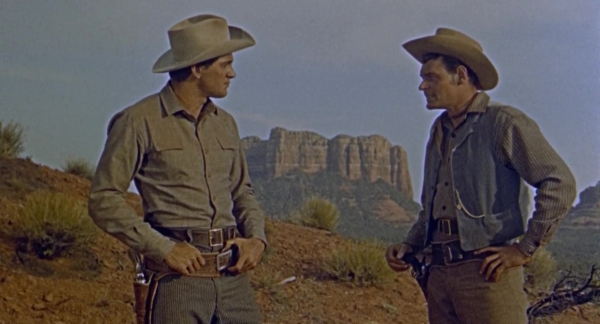
Rock Hudson is credible in the lead, catching something of the driven quality that Anthony Mann would coax out of James Stewart in their western collaborations, even if it doesn’t quite attain those levels of intensity. Hudson holds onto that hopefulness that defines his character, a feature that one would expect to find in a young man on the cusp of a new life in California. It is through Hudson’s Ben Warren that the pacifist and isolationist elements are explored. He has been strongly influenced by the recent Civil War, sickened by the wholesale killing and no doubt that would have struck a chord with audiences less than a decade after WWII and right at the tail end of the Korean War. His isolationist stance – he refers early on to his ranch being bounded on the west by the ocean and on the east by the river, and he claims to have no interest in anything happening on the other side of that river – is tested and thrown back at him as he seeks out allies in his race to catch up with the outlaws. Rebuffed time and again by people too scared or just apathetic and self-absorbed, he is left with no option but to face up to his own former beliefs and reassess them. Finding a way to reconcile a desire for peaceful coexistence with the realization that a civilized man cannot simply retreat behind the barricades of personal interest is a complex theme to examine; it’s to the credit of all involved that it is articulated so smoothly within the framework of the movie.
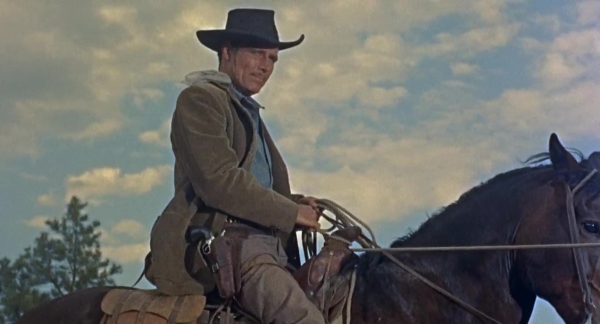
Phil Carey never quite made it as a lead player. Columbia was casting him in some pretty good pictures around this time, but mainly as the second lead and sometimes in rather unsympathetic parts. The character of Frank Slayton was not what anyone could term attractive – he’s not only a killer but a sadistic one to boot, leaving one man to perish horribly in the wilderness and having another of his gang staked out on the ground and trampled to death for an act of betrayal, and that’s before we get to his frankly abusive treatment of both Donna Reed and Roberta Haynes. The paradox of course is that he regards himself in a wholly different light, as a dispossessed gentleman craving only a return to the gracious living he believes he was robbed of and which is his due. The following year Donna Reed would star alongside Carey again in Phil Karlson’s They Rode West. Her role here is better than that unfocused effort and she would go on to do further good work in westerns over the next couple of years first in another Roy Huggins scripted movie Three Hours to Kill and also more impressively for John Sturges in Backlash.
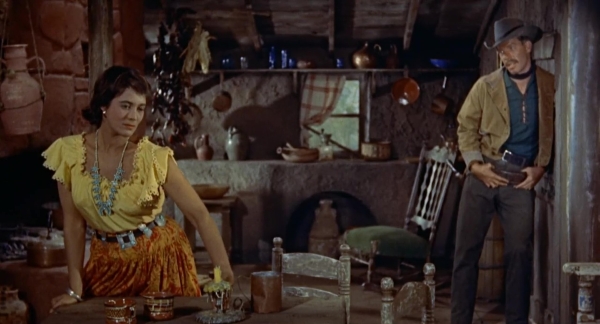
Leo Gordon is such a welcome presence in just about anything. Frequently cast as the one-dimensional villain, it’s a pleasure to see him given a more nuanced role. I’m not convinced that the character we have followed on screen would have behaved in the way he does in the final act, but that’s not the fault of the actor. Lee Marvin typically did a great deal with minor characters in small parts in his early films. Some actors have what it takes to make their mark on screen, something largely indefinable but instantly recognizable too. Marvin had that something. The movie business is rife with “what if” scenarios and always has been. There’s some irony in the fact that Roberta Haynes tested and apparently came close to being cast in From Here to Eternity, in the role which would ultimately go to Donna Reed and for which she would win an Oscar. That’s Hollywood for you! Also featured in a supporting role as one of the outlaw gang is perennial heavy Neville Brand.
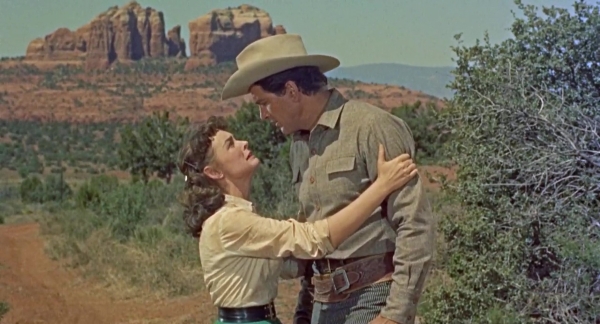
Gun Fury is a mid range Raoul Walsh movie in my opinion, which means it’s a good film by any standard. Plots which are relatively straightforward yet carry within them an abundance of ideas that are put forward in an intelligent and adult way are very appealing. I have always liked this film and I reckon it is the kind that should go down well with most fans of the classic western.
 Riding the High Country
Yep, good movie, good cast, good director. What I also found interesting was how the movie script departed from the book in ways to make it, I guess, more appealing to mass audiences (the fiancee character kills herself in the book, the Mexican girl becomes the real heroine, and the Indian character in the book is black) and perhaps sidestep racial issues.
LikeLiked by 1 person
Now that’s something I didn’t know, and it’s also provided me with a good reason to seek out the book Ten Against Caesar.
LikeLiked by 1 person
Riders of Skaith, what good information to have. I’m not at all surprised in the differences in the book and the movie, especially in 1953. Don’t give the ending away, but is the book ending different from the movie? I realize that the book and movie are two different entities, but which did you prefer? I think I would like to read the book.
Looks like the book is expensive on eBay, unless you get the used paperback.
LikeLiked by 1 person
I, um, will admit that I can’t remember the specifics of the ending. I read the book back in 2019 and my comment above summarizes what I remember off the top of my head about it. Overall, I think the book does have the edge relative to the movie but I’d have to review both of them again to be sure!
….oh, wow, it is *pricey*. I was able to get an interlibrary loan through my university back then. Not sure how I’d get it these days. Hm.
LikeLike
Riders, thank you for the TEN AGAINST CAESAR(1952) information. I think that most original source books do have the edge relative to the movie script, but as we know books and movies are two different birds of a feather.
Currently I’m digging around to find information on these three authors of this probably long forgotten Western Novel, which first appeared as a complete novel in the November 1952 issue of ZANE GREY’S WESTERN MAGAZINE and then as a paperback book in 1953.
LikeLiked by 1 person
Colin, good write-up of GUN FURY(1953), which if my memory serves me right, I first viewed it on Memphis, Tennessee’s WREC Channel 3 EARLY MOVIE in 1970. I liked it then and still do. It’s no great Western Movie by no means, but I think it’s “bread and butter” and a “darn good Western.” I think what keeps it from just being a routine one is the dialogue written by Irving Wallace and Roy Huggins, both good writers. I haven’t read the Granger’s novel TEN AGAINST CAESAR(1952) which the script is based on, so I don’t know if the dialogue came from there or not. It has a good cast, and I especially enjoyed Leo Gordon’s performance. He wasn’t the usual badman here, not all bad, but not all good either. When I see the names Leo Gordon, Lee Marvin, and Neville Brand, I just have to have a look see and all 3 are in this cast. I got this story from John K. some years ago concerning Gordon decking both Marvin and Brand during the filming of the movie. Gordon was a tough one.
Lester White’s photography was really good of the magnificent Red Rock region of Sedona, Arizona. I was impressed right from the beginning with the 6-up horse drawn stagecoach. In most Western Movies a 4-up horse drawn stagecoach is used because 4 horses are easier to handle than 6. Director Raoul Walsh and a really top-notch stage driver in this movie. I enjoyed watching the unnamed stage driver turn the 6-up horse pulled coach around and head out of town. GUN FURY was filmed in 3-D, and you can tell in a few of the scenes even viewing it in 2-D.
I agree totally with your statement, “I don’t believe I’ve ever seen a Walsh movie that didn’t leave me thirsty for another.” There are plenty of his movies to view over a career as a director from 1913-1964. I liked your statement that the movie is, “a standard pursuit and revenge western, but it scrutinizes other themes such as pacifism, isolationism, the hold exerted by the past, and a flirtation with, as opposed to a full embrace of, the classic concept of redemption.” I think this is so true and that’s why a Western Movie has such a broad canvas to use. Although, to me the movie is more anti-pacifist than pacifist, especially when it comes to the ride for revenge and the ending. I think you hit the nail on the head here, “Finding a way to reconcile a desire for peaceful coexistence with the realization that a civilized man cannot simply retreat behind the barricades of personal interest is a complex theme to examine; it’s to the credit of all involved that it is articulated so smoothly within the framework of the movie.” Yes, and I think that’s another reason GUN FURY is a cut above routine.
GUN FURY with Raoul Walsh at the helm is an entertaining traditional Western Movie with good pacing, exciting action, colorful characters, and a good cast with Leo Gordon and Phil Carey standing out. I think it’s well worth viewing.
LikeLiked by 2 people
I believe Marines Let’s Go has everything in it to be a failure, and in that, it is a high achiever. Without Gable, and his helper Sidney Poitier, it is a mess, but in the King and Four Queens, the star is alone.
Q
LikeLike
Somehow I omitted the title, Band of Angels…
LikeLike
I have not yet seen Marines, Let’s Go so I can’t make any comment on that. The King and Four Queens is, from memory, very thin fare, passably entertaining as one would expect of the director and stars but nothing more than that.
On the other hand, I firmly believe Band of Angels is a first class effort from all concerned. The script has far more complexity than it’s sometimes given credit for, Gable and Poitier in particular turn in strong and committed performances, and the whole movie is evocatively staged by Walsh.
LikeLiked by 1 person
Agreed about Gable and Poitier, but Yvonne DeCarlo fails for me. Add TorinThatcher on the strong side.
LikeLike
It’s a good, solid western, isn’t it. It gives most of the cast something to work with, which isn’t always the case, has a script that asks questions and is well directed. So it’s not a classic and nor is it Walsh’s best western movie, but that says more about the quality of the director’s work than it does about this film in particular.
LikeLiked by 1 person
Hi there Walter, I’m thinking the stagecoach driver may be the highly regarded stunt actor Al Wyatt Sr.. One would have thought he would merit an uncredited role with the Cast players. If it is indeed Al, the reason might be he was not included with the Cast players is because he was included with the Stunt players whom were all uncredited.
LikeLike
Scott, yes, I checked the stuntmen’s credits by way of IMDB, but it wasn’t Al Wyatt, Sr. I’ve seen photos of Wyatt and the stage driver wasn’t him. Wyatt would have been 36 years old at the time GUN FURY was filmed and the stage driver looked older. Anyway, I kept digging around and found out that it was a stuntman named Post Park, who is listed in the uncredited credits as Billy Whiskers. Custer Bland Park(1899-1955) was known as one of the most skilled stagecoach drivers in the movie business. His last movie credit was as the stagecoach driver in Raoul Walsh’s THE TALL MEN(1955). Park and Clark Gable had a humorous exchange of words regarding Jane Russell as a gold-digging prospector.
Post Park and others like him made movies look and feel authentic. My hat is off to him in tribute.
LikeLiked by 1 person
Custer Bland “Post” Park
https://www.findagrave.com/memorial/85924938/custer-bland-park#view-photo=317612153
https://www.findagrave.com/memorial/85924938/custer-bland-park#view-photo=317611940
https://www.findagrave.com/memorial/85924938/custer-bland-park#view-photo=252604485
LikeLike
Hi Walter, I like digging on the web for scarce information about the films same as you.
I should know by now that IMDb is not a trust worthy site much of the time when seeking out information like this.
Therefore, always a good idea to find additional reference sources to verify findings. I got to remember that.
LikeLike
Scott, this is some good information on Custer Bland “Park” Post. I think individuals like Park Post and others like him should finally receive the recognition they deserve but haven’t in the past. Hopefully we can contribute to this recognition in a small way. If you think Custer Bland Post is quite a name, well try his father’s name on for size, Knyphausan Ephus Park(1874-1954). Just guessing, but the name probably is German. Thanks for this information from the find a grave site. I like this stuff right down to the ground.
Yes, IMDB has a lot of misinformation, although I usually go there first and then link out from there.
LikeLiked by 1 person
Hi Walter. You can see a lot more of Post Park in the movie WOMAN THEY ALMOST LYNCHED (1953). In a bit role as a stagecoach driver he is very active in the first 18-minutes with a surprisingly large bit of dialogue. Lots of action in the driver’s box steering a 4-horse team. It’s very impressive.
The movie itself I had never seen nor even heard of. It’s during an era when Republic Pictures was going all in with A effort productions. It was packed with lots of familiar bit and extra players. I viewed the film in HD and it was clean and sharp. The pace of the movie easily keeps your attention.
The cast is impressive up and down the line. But, it is fourth billed Joan Leslie’s film. She’s never been more beautiful and is made for this movie. She lets you know just that by stealing every scene she’s in and there are lots of them to our delight. I’ve never seen her more skilled and motivated playing a role like this. The genre fits her well.
IMDb 6.5
https://www.youtube.com/watch?v=_wuaH9HLmpw
LikeLiked by 1 person
Scott, I first viewed WOMAN THEY ALMOST LYNCHED(filmed 1952, released 1953) during the cable-tv explosion of the 1980’s on the old Christian Broadcasting Network(CBN) in 1987. The movie is historical hooey, but I think it’s very entertaining and well made. Directed by Raoul Walsh’s good friend Allan Dwan, who also went back to almost the beginning of movie making history. Writer Steve Fisher wrote a lot of good Westerns over the years. It’s been a long time since I viewed this movie. Thanks for the link.
WOMAN THEY ALMOST LYNCHED is set in my neck of the woods, which is along the old middle border country of Arkansas/Missouri. This area was a wild and wooley country during the War of the Rebellion, War for Southern Independence, or the Civil War which ever you want to call it. I’ve read and studied about this era of History most of my life. The James/Younger Gang of outlaws stopped at my great-great grandfather’s farmstead in Stone County, Arkansas in 1874 after robbing a stagecoach near Hot Springs, Arkansas.
LikeLiked by 1 person
Testing.
LikeLike
“I don’t believe I’ve ever seen a Walsh movie that didn’t leave me thirsty for another.” … well said!
I think “Gun Fury” like some of the other budget productions that Raoul did, is an A programmer (an A film but a small budget one). Everything is there in plot, characters, acting, filming but in each there is something missing, or perhaps, a feeling that it is all a little abbreviated. I think Walsh looked at this film ore as a job than a passion project. But, that is not negative criticism. Raoul on any level is better than a lot of directors at their best. Gun Fury has a lot going for it. A interesting story, a great cast and what I love in Walsh westerns, great scenery. His emphasis on action (especially in his western and war films) is, as always, there up front. To paraphrase something Lee Marvin said (as quoted in “Raoul Walsh: The True Adventures of Hollywood’s Legendary Director” by Marilyn Ann Moss) “he didn’t seem to care too much about the dialogue scenes but paid a lot of attention to the action scenes”.
LikeLiked by 1 person
That Marilyn Ann Moss documentary, The True Adventures of Raoul Walsh, came up in conversation in the past here, though I can’t recall exactly when at the moment. For anyone who hasn’t seen it, it’s well worth viewing.
LikeLike
Colin, thanks for the link to YouTube’s print of this really good documentary by Marilyn Ann Moss. Well worth viewing.
LikeLike
Velebit, is RAOUL WALSH: THE TRUE ADVENTURES OF HOLLYWOOD’S LEGENDARY DIRECTOR(2011) a good biography of Walsh? I’d like to read it someday. So many books to read, so little time.
LikeLike
Excellent review. Saw this last year really enjoyed it. Always seeking out more Walsh films. I showed family the awesome Blu of ‘The Big Trail’ recently and everybody was impressed. Not just how young Wayne was but how good the movie was too and I kept pointing out Walsh’s mastery of the widescreen fame how special that was, that early. I think it is a great film and I just love its presentation on disc.
LikeLike
Quite right, The Big Trail holds up remarkably well and I think its reputation has, deservedly, grown over the years.
LikeLike
Testing………………
LikeLike
Sorry about the above Colin…I’ve had a heckava problem posting over at Kristina’s this morning.
Walter mentions my Gordon,Marvin & Brand confrontation that I mentioned some time ago.
It’s a good one so worth another go.
Back in the 90’s I believe I read a William Smith interview and I presume Smith got this tale from his LAREDO co star Neville Brand. The interviewer asked Smith regarding his reputation as “the Hardest Man In Hollywood” and Smith replied that reputation belongs to Leo Gordon.
While making GUN FURY Walsh had little time for Brand and Marvin but liked Gordon. Walsh during the filming had a beef with Gordon and decided to get back at all three of them knowing Gordon’s explosive temper. In the scene where Leo is asleep in the cabin Marvin & Brand are supposed to roughly wake him up. Walsh instructed the pair, no play acting I want total realism. As the duo went at it Leo exploded and knocked the crap out of the pair of them,remember all three were distinguished WWII combat veterans.
Perhaps Walsh’s dislike for Marvin & Brand might have been both were heavy drinkers.
LikeLiked by 1 person
Thanks for posting that again – did you post it here before or elsewhere? Either way, a terrific little vignette that is worth repeating.
LikeLike
In the same interview mentioned above Smith mentioned his co star Nigel Patrick in the early BBC/MGM UK TV series ZERO ONE where Smith was simply “Bill” Smith. Years later Smith was appearing in a play produced by his local community theatre group. Patrick,in The States, at the time, decided to pop in and visit his old pal. After watching the play Patrick quipped “your acting has improved considerably since we worked together, dear boy”
Intersting bit on imdb that Smith’s LAREDO co star Peter Brown was good friends with Sammy Davis Jr who invited Dean Martin along to Brown’s wedding. Smith mentioned that Martin was one of the nicest guys he had ever met. Laredo also featured GUN FURY’s Phil Carey.
LikeLiked by 1 person
John K, Leo Gordon guest starred in 2 episodes of LAREDO(1965-67). Leo Gordon was the real deal and quite a colorful individual in front of the camera and off of it. Gordon’s “Epic” fight scenes with Clint Walker are something to see. No stunt doubles used.
Clint Walker & Leo Gordon – Their Best Brawls
LikeLike
I have often felt that Walsh in the 50’s and his diverse range of pictures is what has caused many to not include him among “Major” directors: Ford, Hawks,Hitchcock,Stevens,Zinnemann……
Also I consider this unfair. As good as GUN FURY, THE LAWLESS BREED and SASKATCHEWAN are they seem minor for a Walsh movie. The blockbuster War Films BATTLE CRY and THE NAKED AND THE DEAD seem more like Walsh Movies considering what went before and the latter IMHO was Walsh’s last truly great movie.
I have never seen A PRIVATE’S AFFAIR and don’t really want to, but it does echo a time when certain veteran directors were trying to tap into the “Youth Market” The same can be said of Walsh’;s swan song A DISTANT TRUMPET a decent effort but,oh for a leading man.
The one 50’s Walsh film I really like,and I guess I’m in a minority is A LION IS IN THE STREETS a most unusual film but one that, for me repays with repeated viewings. A hard film to pull off but I feel Walsh and Cagney do it with great merit and I do like Cagney’s very flamboyant performance which is certainly not for all tastes. Furthermore I feel that it’s the most visually impressive of all of Walsh’s colour movies.
As hard as I try I still cannot engage the “like” feature both here and elsewhere.
LikeLike
I think the range of Walsh’s work all through his career may have counted against him with some critics – he can’t be pinned down to one or two genres and variety sometimes seems to be mistakenly equated with a lack of coherent vision or style.
I watched A Lion is in the Streets not all that long ago myself and liked it too. I thought its depiction of the rise of a lying populist charlatan was prescient to say the least.
LikeLike
I need to check out my WAC copy. Interesting that it is another take on the Huey Long story like ‘All the King’s Men’. Also, those interested should check out the 2006 ‘All the King’s Men’. I feel it was unjustly maligned. I’m sort of a one man cult for it in fact.
LikeLike
Chris, I’ve never viewed this version of ALL THE KINGS MEN(filmed 2004-2005, released 2006), but I do recall it being a rather huge flop at the box office. Also, I read where the idea for this version originated with political consultant James Carville and producer Mike Medavoy.
LikeLike
Carville and Medavoy are two guys with agendas.
LikeLike
I agree. Also, Walsh’s work with Flynn was excellent. ‘Objective Burma’ is a fairly amazing war movie despite the controversies at the time.
LikeLike
John K, as we know, regardless of the so-called critics, Raoul Walsh’s movies were popular with the ticket buying public. Anyway, I personally like his movies and when I started taking notice of who made the movies, I began noticing that the caption directed by Raoul Walsh appeared on a lot of the movies I enjoyed.
In regard to critics, in 1973 Richard Schickel movie critic for TIME MAGAZINE produced, wrote, and directed an 8-part series for USA public television(PBS) titled THE MEN WHO MADE THE MOVIES. Each episode featured a prominent movie director discussing his career in an on-camera monologue. The series lead off with Raoul Walsh and a lot of movie clips were used with narration by actor Cliff Robertson. The other directors in the series where: Frank Capra, Howard Hawks, King Vidor, Vincente Minnelli, William Wellman, Alfred Hitchcock, and George Cukor. As a youngster this series really impressed me and heightened my interest in who made the movies.
Referring to Walsh’s 1950’s output CAPTIAN HORATIO HORNBLOWER(filmed 1950, released 1951) was a major success at the box office, and I think a really good movie. THE TALL MEN(1955) is an excellent Western Movie and a hit. BATTLE CRY(filmed 1954, released 1955) and THE NAKED AND THE DEAD(filmed 1957-58, released 1958) both hits. I first viewed THE NAKED AND THE DEAD on Memphis, Tennessee’s WREC Channel 3 FRIDAY NIGHT MOVIE in 1966 and this movie stuck in my young head, especially Aldo Ray’s performance as Sergeant Croft. Sergeant Croft would cut out gold teeth from dead Japanese soldiers and carry them in a pouch around his neck. The mountain scene with Croft and Roth(Joey Bishop) is harrowing. If you like hard hitting gritty war movies, this is it, and I agree that this was Walsh’s last great movie.
I recall first viewing A LION IS IN THE STREETS(filmed 1952, released 1953) on Memphis, Tennessee’s WMC Channel 5 Saturday LATE MOVIE in 1973. I like the movie starring James Cagney as a manipulative charismatic populist or is he a lying populist charlatan using Colin’s description? It’s a story of betrayal and tragedy mixed in with a populistic challenge of corrupt leaders and the entrenched establishment. The movie is another thinly veiled Huey Long of Louisiana story. This movie falls in the shadow of ALL THE KINGS MEN(filmed 1948-49, released 1949) with Broderick Crawford’s memorable performance. I think A LION IN THE STREETS is worth viewing.
LikeLike
Interesting that Charles Laughton was going to do ‘The Naked and the Dead’ after ‘Night of the Hunter’. That might have been some picture.
LikeLike
Chris, I think it would have been a different one. I recall reading an interview with producer Paul Gregory about Charles Laughton writing a screenplay for THE NAKED AND THE DEAD and Gregory thought it was a really good script. He said that Laughton dropped out of directing the movie because he(Laughton) thought the project was getting too big for him and his health was beginning to fail him. Anyway, Denis and Terry Sanders rewrote the script. When Raoul Walsh was brought on board he brought in his writer for another rewrite. I’m not sure who that particular scriptwriter was, but it may have been John Twist, because Walsh and he collaborated a lot in the late 1950’s and early 1960’s.
Robert Mitchum said that the best director he ever worked with was Charles Laughton and that his favorite role was as preacher Harry Powell in THE NIGHT OF THE HUNTER(filmed 1934, released 1955).
LikeLiked by 1 person
Robert Mitchum said many smart things.
LikeLike
Walter, that Richard Schickel docu can be viewed on YouTube, but I think it may be a later edited down version.
LikeLiked by 1 person
Colin, yes, I saw that and it’s 36 minutes short of the original, which aired back in the 1970’s. Thank you for the link.
I wonder how Richard Schickel decided to choose those 8 particular directors. John Ford, William Wyler, George Stevens, Fritz Lang, and Charlie Chaplin were still alive in the early 1970’s.
LikeLike
They were all terrific craftsmen.
LikeLike
CAPTAIN HORATIO HORNBLOWER is very enjoyable. And Gregory Peck’s performance is spot-on.
LikeLike
Yes, speaking of Hornblower I really like the Ioan Gruffudd series. Well made like Jeremy Brett’s ‘Sherlock Holmes’.
LikeLiked by 1 person
Chris, thank you for reminding me that I need to view the Hornblower ITV series(1998-2003) with Ioan Gruffudd. I have the series on DVD and it’s time to view it. So many DVD’s and books and so little time and the time is now.
LikeLike
Walter, I’ll second Chris’s recommendation of that Hornblower TV series. I’m a big fan of the novels and the series captures the tone quite well.
LikeLiked by 1 person
Dee, I look forward to viewing the Hornblower TV series. Also, I like C. S. Forester’s Hornblower novels, such good reading.
Other Forester novels that I like are KILL THE FRENCH(1932), which here in the USA was titled RIFLEMAN DODD, THE GUN(1933), THE AFRICAN QUEEN(1935), and THE SKY AND THE FOREST(1948). I have a copy of THE CAPTAIN FROM CONNECTICUT(1941), which I haven’t read yet.
LikeLike
Dee, no friendly arguments there. CAPTAIN HORTIO HORNBLOWER is a good one for sure. I first viewed the movie on a Sunday afternoon on Memphis, Tennessee’s WREC Channel 3 afternoon movie in 1970. I recall that I missed the first part of the movie because of Church. It’s funny how you remember such things.
CAPTAIN HORATIO HORNBLOWER was my kind of movie and still is. I really like reading about the Napolean Bonaparte Era of History. As a youngster I recall looking and pouring over the CLASSICS ILLUSTRATED #135, featuring the book “Waterloo” written by Erckmann-Chatrian with artwork by Graham Ingels originally published in November 1956. I couldn’t read yet, but the artwork telling of the story fascinated me right down to the ground. I enjoyed it even more when I learned to read. This was the beginning of my interest in the Napoleonic Era.
Returning to the movie adapted for the screen by Cecil Scott Forester with movie screenplay by Ivan Goff, Ben Richards, and Aeneas MacKenzie, photographed by Guy Green, and produced and directed by Raoul Walsh. To me this movie is a Classic robust, exciting, action packed, colorful, sprawling sea saga based on the top-notch Hornblower novels of C. S. Forester. Starring two of my favorites Gregory Peck and Virginia Mayo. Also, I get a kick out of seeing young actors Christopher Lee, Stanley Baker, and Richard Johnson. The fighting scenes are outstanding and just watching the wonderful ships is a treat. I could talk about this movie and Forester’s books all day.
LikeLiked by 1 person
CAPTAIN HORATIO HORNBLOWER was the first film I vividly remember seeing in a cinema at the time of release,with my parents,of course.
LikeLike
John K, that’s a neat memory of yours about first viewing CAPTAIN HORATIO HORNBLOWER in a movie theater. I envy you in that regard. My parents never took me to see a movie in a theater.
LikeLike
My parents took me to see countless movies when I was a child, not that they were big movie fans – especially not my father. I saw all kinds of stuff on the big screen, a good deal of it would have gone completely over my head as the films in question were often not aimed at youngsters. However, that kind of eclectic exposure along with a steady diet of classic reruns on the TV, accompanied by new and old TV shows, meant I caught the bug at an early age.
LikeLike
Colin, I caught the movie “Bug” from a steady diet of movies that were shown on TV starting in 1963 when we finally acquired a TV. All kinds of movies from the 1930’s, ’40’s, ’50’s, and ’60’s. Also, silent movies that were aired on the Public Broadcasting System(PBS) during the 1970’s. Plus, all the new and rerun TV shows that aired at the time.
The first movie that I went to a movie theater to see was TIME TO RUN(filmed 1972, released 1973). It was January 31, 1973, at the Melba Theater in Batesville, Arkansas. The movie starred Ed Nelson, Randall Carver, Barbara Sigel, Joan Winmill, Gordon Rigsby, Alvy Moore and with a special screen appearance by Billy Graham.
TIME TO RUN was produced and distributed by World Wide Pictures, which was the film arm of the Billy Graham Evangelistic Association(BGEA). I went with our church group, which included my parents. The movie was filmed during the “Jesus Movement” years of the late 1960’s to the mid 1970’s. This movement was a religious counterculture movement of the time period that began in California and spread throughout the USA, North America, Europe, Central America, Australia, and New Zealand. This was a counterculture to the Hippie, Yippie, and Zippie counterculture of the time.
LikeLike
I see. I’d never heard of that movement before.
As for attending the cinema, I went exclusively with my parents up until my teens. It was then that I would have started going either alone or with friends. Up until then I had no other way to “go to the movies” than with my family as I grew up in a rural area with all the restrictions on transportation and facilities that involved.
LikeLike
Colin like you I grew up a rural area and there wasn’t a movie theater down the street. When I obtained a driver’s license, I began driving myself to see movies in a walk-in movie theater, which showed a double feature, cartoon, and coming attractions for $1.50.
Colin, I’m not surprised that you’ve never heard of the “Jesus Movement.” You’re probably too young to remember it. The mainstream media tried not to cover it, but by 1970-71 they couldn’t avoid it because the movement was so widespread. The cover of the June 21, 1971, issue of TIME magazine read “The Jesus Revolution” with a Pop Art psychedelic image of Jesus on the cover by Stan Zagorski. The inside cover stories were written by Mayo Mohs, religion section writer for TIME.
“The Jesus Movement” was a youth movement and a large number of Hippies also joined in by taking up religion. They were called “Jesus People,” “Street Christians,” and “Jesus Freaks.” These Hip Evangelists were very outside the mainstream religious denominations. They blended the counterculture with conservative religion.
LikeLike
Minus John Ford…?
LikeLike
Barry, that’s a good question and I don’t really know for sure. Although John Ford was known to be a tough interview, he was very sick with cancer during the time Schickel made his documentary. Ford died August 31, 1973.
LikeLiked by 1 person
He has to be on the list. At least an honorary mention.
LikeLike
Barry, I think that John Ford was at his best when directing Westerns. I can view any of his Westerns anytime and enjoy them. Ford will always be my favorite Western director.
LikeLike
Colin,
I do believe that I mentioned the Gordon,Marvin and Brand story here sometime back.
I totally agree with your comment regarding Walsh-it seems that directors that seem to “Cherry Pick” their projects (Stevens,especially) seem to get the most respect, as opposed to those who work on a more regular basis, I include Curtiz among the latter.
LikeLiked by 1 person
Curtiz is another who certainly falls into that category although his stock has risen considerably in recent times, due in no small part to his championing by Alan Rode and the latter’s bio of the director.
LikeLike
I think Curtiz was dismissed somewhat because it was impossible to fit him into auteurist theory. All he did was to make one extremely good movie after another.
Maybe the tide is finally turning against the auteur theory?
LikeLike
I d notbelieve Alan’s work has anything to do with Curtiz beingthrust forward; he was alays top notch.
LikeLike
I hope so.
LikeLiked by 1 person
As someone who has moved toward the auteur approach as opposed to away from it over the years, I don’t think any previous underestimation of the worth of Curtiz is any way linked to auteurism. After all, it’s an approach that essentially looks at the imprint or vision of filmmakers, the themes common to much of their work, rather than a simplistic the genres they specialized in. I cannot see how reduced critical attention in the past based on the breadth and range of genre work by Curtiz, or Walsh for that matter, could be laid at the door of the auteur theory. Other factors were at play, a degree of snobbery perhaps and maybe some academic blindness, but that’s a whole different matter.
LikeLike
Regarding the Rode Bio….a great point,very well made.
LikeLike
Testing….
LikeLike
Colin, I’m having a lot of trouble posting comments this afternoon and it’s frustrating. I would like to talk some more about Raoul Walsh movies, but I’m tired.
Have a good evening, Walter S.
LikeLike
Sorry to hear you’re experiencing difficulties, Walter. Unfortunately, I only become aware of issues affecting contributors when people like yourself mention this – the curse of WordPress strikes again, or so it would seem.
LikeLiked by 1 person
That sure can get frustrating. Are you losing your written content that you are attempting to post?
LikeLike
Scott, I think I’ve fixed everything so that I can continue to comment, for now. It’s like someone goes in and changes my settings at WordPress. Who knows.
LikeLike
Way off topic, but hey, wer’e still talking Columbia Pictures…….
Colin,as you have no doubt now seen Powerhouse/Indicator are releasing THE MAN INSIDE in February, I thought from previous conversations this might be on a Brit Nor 2 box set, anyway it’s good to have.
JAZZBOAT is an odd duck of a movie part serious part joking with a glaring jolt of violence that seems to belong in another movie, well worth viewing for the cast alone, and sharply shot and directed. Striking location work.
Here is a link to the Harvard Columbia Pictures retrospective that may interest you, at any rate it’s interesting that pristine 35mm prints of UNDER AGE and GIRLS UNDER 21 still exist.
https://harvardfilmarchive.org/calendar/under-age-2025-11
LikeLike
John, I was a bit disappointed that The Man Inside wasn’t included in the upcoming British Noir box, which I will be getting. I’m interested in the film, but not keen enough to pay for an expensive, limited edition stand alone release such as it’s getting. I understand the marketing strategy behind such moves, but, personally, I am not prepared to shell out that kind of money. For those who are, fine and good luck to them. I felt the same about the US noir titles from Indicator that are getting the same treatment – I’ll pick them up at some point, but well into the future when they are discounted either in a sale or released as standard editions. I guess the box set model hasn’t been as successful for the label – after all, the Universal Noir sets, both of them, were still not sold out when the recent sale was running.
LikeLike
That is a good strategy. I try to wait it out. Prices had become fairer I don’t want a return to how they were on VHS and Laserdisc. There can be a happy medium. If the don’t sell what’s the point? And now 4K people (and I enjoy 4K) want to hold their nose up at even Blu ray! Please!
LikeLike
I don’t know ow closely you follow these things, Chris, but the one that has had me scratching my head in bewilderment lately is the release of deluxe editions of some frankly minor and marginal Hammer Films titles at absolutely eye-watering prices. They appear to be selling too so I guess they know their market/customers.
LikeLike
Yes, I try now to get some idea of new releases and the price tags on them. Lots of times I can only go wow. They did a huge ‘blaxpoitation’ two volume set this year and the prices are just nuts even in 4K. I love Pam Grier but its all a little rich for my blood. You’re right about mediocre films now getting high price tags when I scan the new stuff. Just have to pick and choose until we all become millionares.
LikeLike
I was going to mention these deluxe Hammer editions. I wish they would also issue standard editions minus the packaging and all the extras,a trailer would suffice. I would be quiet happy to pay,say £13.00 for standard editions of MEN OF SHERWOOD FOREST and WHISPERING SMITH HITS LONDON both films I rather like. At least with Powerhouse you get standard editions later and even cheaper ones in their regular sales.
LikeLike
Yes, I’d be happy to buy Blood Orange if it were a standard edition and priced accordingly, but not the way it’s being offered now. These titles are clearly being pitched at the packaging/boxes of tat/multiple aspect ratio crowd, and I’m afraid that’s not me.
Indicator’s pricing and marketing strategy is indeed quite different and I find it much more attractive all told – even some limited editions can be had for a reasonable price in sales if one is prepared to wait.
LikeLiked by 1 person
Yes, I really like Indicator for decent prices recently I picked off some odds and ends like their wonderful editions of ‘Fat City’, ‘The Chase’, ‘Bunny Lake is Missing’, and ’10 Rillington Place’ among others. Wonderful work by them.
LikeLike
Physical media pricing is pretty crazy. There must be some very very rich movie fans out there!
LikeLike
Oh, it has. I’m glad for the labels that keep it within reason. Also glad I have built a decent collection between DVDs, Blu, and 4K.
LikeLike
Colin, it’s good that THE MAN INSIDE has finally got an official release, I guess there are enough Columbia Brit Noirs to make a second set. JOE MACBETH was an obvious ommision,plus the fact it’s a pretty good movie and I suppose that will eventually get a stand alone release.
What concerns me is the high cost of Warner Archive releases now especially with added postage and sales tax, and the £ is on the slide again.
LikeLike
It was directed by Raoul Walsh and written by Roy Huggins? OK, I have to see this one. And I loved Hangman’s Knot.
LikeLiked by 1 person
Yes, whenever Huggins’ name appears as writer, or producer, it’s generally a good sign. I recently watched a few episode of the Kraft Suspense Theatre which he produced and found them enjoyable. Now that’s an anthology series I’d like to see somebody release on a physical format.
LikeLiked by 2 people
Colin-you may be interested to see my detailed review of the new Via Vision Blu Ray double bill of THE WILD AND THE INNOCENT/SIX BLACK HORSES over at Toby’s Western blog.
LikeLiked by 1 person
I certainly am interested, John. That’s really good to know – others can access your comments on the movies from here.
LikeLike
John, based on your recommendation, I’ve just ordered this direct from Via Vision. Thanks again for bringing this to my attention.
LikeLike
I hope you enjoy it,I’m pretty sure that you will.
LikeLike
Well, I’ve been waiting for what seems like ages for someone to release a cleaned up edition of Six Black Horses in particular so that alone pleases me enormously, and the the fact there are two movies in this edition is the icing on the cake.
LikeLike
Can this be true?????
CINECOLOR ??????
https://www.fnac.com/a22202650/L-Homme-de-Kansas-City-Edition-Limitee-Combo-Blu-ray-DVD-Randolph-Scott-Blu-ray
LikeLiked by 1 person
Interesting. I’ll be interested to hear some feedback on how that turns out in due course.
LikeLike