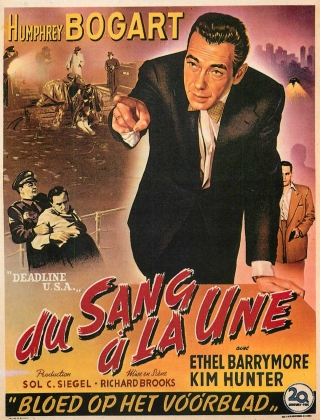
“…the right of the public to a marketplace of ideas, news and opinions. Not of one man’s, or one leader’s, or even one government’s.”
That eulogy to the Fourth Estate, not merely to its desirability but to its necessity as a vital pillar of a functioning democracy is delivered relatively late on in Deadline – U.S.A. (1952) by Humphrey Bogart’s committed and conscientious editor. It might come late in the movie yet everything has been building towards that and the narrative would already have led us to that conclusion even if the script had not spelled it out. If this point needed to be made back in 1952, it is arguably even more essential now where the current era of demagoguery sees the foundations of democracy chipped away at on a daily basis.
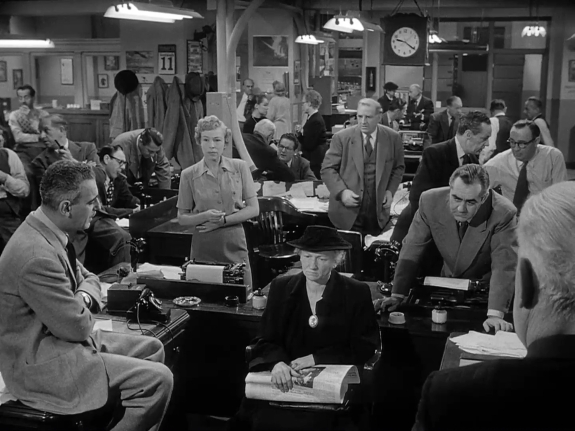
On various occasions throughout the film various characters refer to a murder, a wake and a funeral. It’s as though the shadow of death hangs heavily over the entire project. However, it’s not the death of person, even though there are a handful of those folded into the plot, but instead the demise of a newspaper which is alluded to. This sense of a paper as a living entity, with as much conscience and soul as a human being, pervades the movie. To be perfectly frank, the newspaper in question could be said to have more human characteristics than some of the individuals portrayed. Anyway, this anthropomorphism is key to understanding Deadline – U.S.A. and the points writer and director Richard Brooks seeks to hammer home. The paper in question is The Day, a publication which prides itself on its standards and its history. The editor Ed Hutcheson (Humphrey Bogart), as well as the staff, regards it as a newspaper as opposed to a purveyor of sensationalist yellow journalism. Despite that noble intent, or a cynic might posit because of it, The Day is on its way out. Life support is about to be unplugged and the owners, the detached and disinterested heirs of the founder, are in the process of selling off the carcass to a competitor whose primary interest is buying it in order to close it down and thus corner the market. The viewer is invited to follow the final days of this venerable institution where regardless of the sense of inevitability, there is also a resilience on show. Maybe it’s a losing battle but Hutcheson isn’t going down without a fight and the battlefield he’s chosen for the paper to stage its last stand is one reigned over by Tomas Rienzi (Martin Gabel).
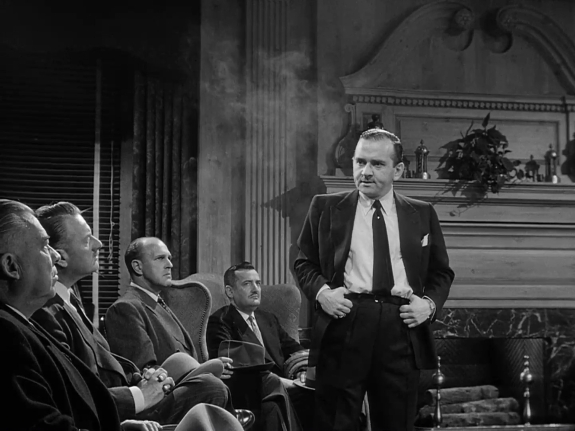
Rienzi is an old school hood, one of those guys where the patina of civilization is especially thin. He’s been investigated for corruption and graft but nothing seems to stick. This time may be different though – the body of a mink clad good-time girl has been fished out of the river and gradually a trail leading back to this Teflon don becomes apparent. In essence, a race takes place to see whether all the connections can be made before the courts put the seal on the sale of the paper, or before Rienzi’s enforcers can make enough witnesses and whistleblowers disappear. While there are other subplots touched on to varying degrees, it is here that the movie sets out its stall. Brooks wants to make the point that real journalism serves a vital civic purpose – “to comfort the afflicted and afflict the comfortable” if you like. Personally, I think his argument is both valid and worthwhile, maybe even more pronounced now than it was all those decades ago. If the printed press has gone into near terminal decline, the voice, function and long established ethics of the legacy media remain essential, even as they come under attack from a range of chiselers and charlatans.
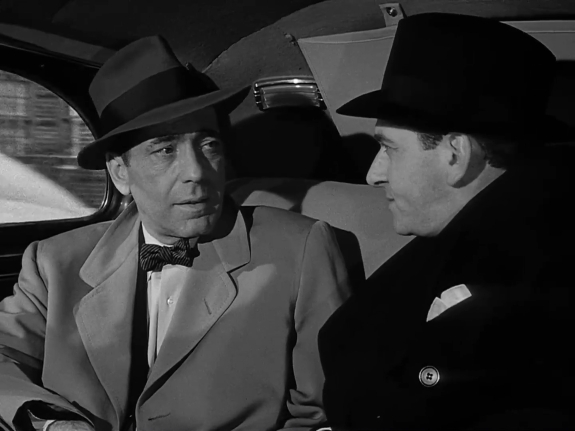
Movies about journalism, indeed the same could be said for that other subset movies about the movies themselves, seem to have their own special energy. That such productions should exhibit a vitality ought not to be much a surprise when one stops to think how many writers and filmmakers had a background in journalism. The accepted wisdom is to write about what you know and there’s plenty of evidence to suggest that this kind authenticity does lend an added touch of passion to proceedings. Richard Brooks was one of those writer/directors who started out working as a reporter and the latent respect for the trade colors what he puts up on the screen in Deadline – U.S.A. – that said, I do seem to recall seeing an interview he gave many years later where he expressed dissatisfaction with the title, feeling that it was meaningless in itself. Well if the title is somewhat awkward, the arguments underpinning the plot are not. Brooks keeps it moving along, capturing the noise and urgency of both the newsroom and the press room. There are a couple of instances of less convincing back projection but Milton Krasner has it looking attractive for the most part. Outside of the newspaper building itself, the most effective scene is that inside Rienzi’s car, where he and Hutcheson spar and both Bogart and Gabel make the most of Brooks’ snappy dialogue.
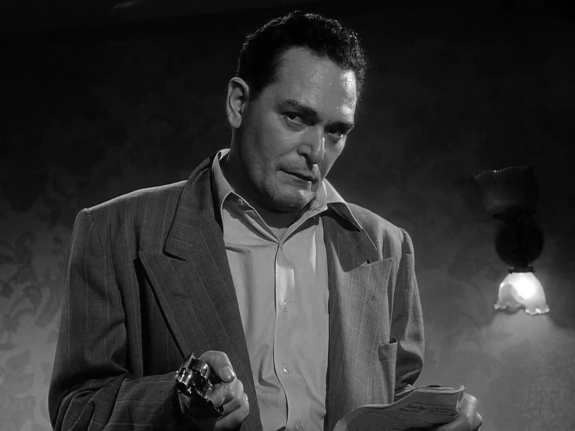
By this stage Bogart was an old hand at either playing it tough and cynical or tough and noble. He goes down the latter path here and his conviction is never in doubt whether he’s trading threats with a mobster or arguing ethics in the boardroom. The only less convincing aspect is his attempt to rebuild his marriage with his ex-wife Kim Hunter. She was an accomplished actress with successful work in A Streetcar Named Desire and A Matter of Life and Death behind her yet there’s a certain listlessness to her performance in this film which weakens that plot strand. On the other hand, Martin Gabel is a fine adversary for Bogart, desperate to convey respectability – “I’m in the cement and contractin’ bu’iness” – while his rough edges keep poking through the facade. There’s plenty of menace on display from Gabel, a man I’ll always associate with the role of Strutt in Hitchcock’s Marnie, but who also directed the atmospheric The Lost Moment.
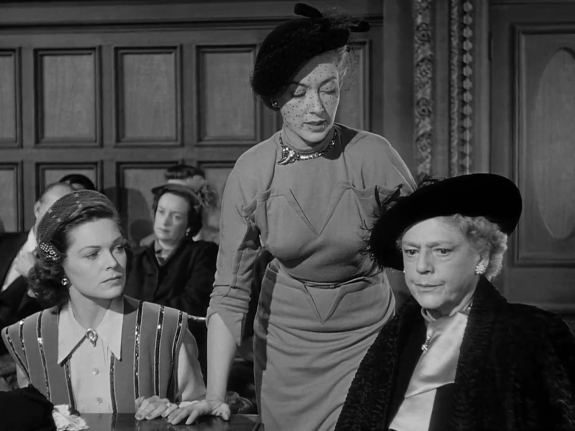
As is frequently the case with big studio productions of the era, there is strong support from a deep cast of familiar faces. Ethel Barrymore rolls out her wise old owl act once more, but she does it so well and so attractively that it’s a pleasure to watch. Ed Begley is comfortably solid, and Paul Stewart (someone else who could shift with ease between villainous and sympathetic parts) casts alternately weary and wary looks from beneath his ever expressive brows. Joseph De Santis has a ball as the scumbag brother of the murder victim, smirking and sweaty as he chisels his way to an undeserved payday before making a spectacular exit where he literally becomes front page news. Jim Backus, Tom Powers, Warren Stevens, Fay Baker, Joe Sawyer and Willis Bouchey among others drift in and out. Apparently, James Dean had a small uncredited part but I’ve never been able to spot him even after numerous viewings.
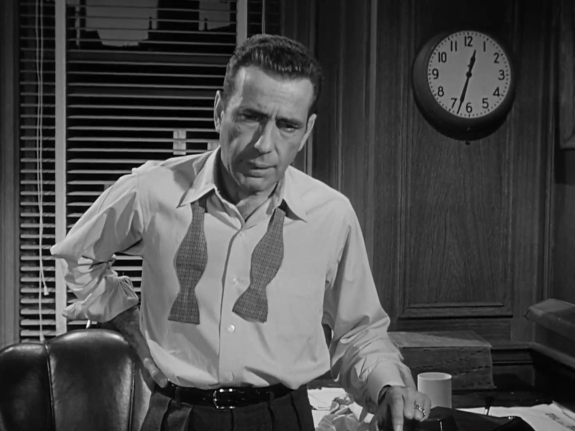
I’m not sure how well regarded Deadline – U.S.A. is or what kind of reputation it has. I do know I’ve always liked it, it has one of those roles which feel tailor-made for Bogart and the sentiments of the script appeal. I guess I’m something of a sucker for movies focused on newspapers and reporters. It should be easy enough to access in good quality these days; this was not always the case but there are high grade Blu-rays and DVDs of the movie available in most territories now – I have the German DVD myself. While the more venal sections of society endeavor to undermine public trust in the integrity of the mainstream media, it’s good to remind oneself of how important it was and is to all of us.
As an Amazon Associate I earn from qualifying purchases made through links on this page.
 Riding the High Country
Colin,
You wrote, “I’m not sure how well regarded Deadline – U.S.A. is or what kind of reputation it has. I do know I’ve always liked it”
I too enjoy “Deadline U.S.A”. I’m a strict grader when it comes to film and I rated “Deadline U.S.A.” a 7 out of 10. As far as I can tell, l the majority of critics are impressed with it. A consortium of 6 contemporary French critics rate it a “8” out of 10 and the British critic Derek Winnert gives it 4 out of 5 stars.
I think Francois Truffaut’s take on “Deadline U.S.A” is quite interesting.
“Here is a film that succeeds by force of talent in proving to us — and in making us believe — that journalism is “the finest trade in the world.”
Isn’t the task of a work of art to solve the drama rather than expose it?
That’s why I prefer this film to those films in which the baseness of journalism is painted with a . . . uh, journalistic objectivity inadmissible in art.
The screenplay of Deadline and the characters that it places on stage don’t lack for real greatness, but the merit of Richard Brooks lies more in his knowing that cinematography is the art of petty details that do not strike one, and in his proving it through constant invention.”
This excerpt is from “The early film criticism of Francois Truffaut” by Wheeler Winston Dixon.
Unfortunately, I can’t find Truffaut’s entire review in “Cahiers du Cinema” in which I think he may have some criticisms of Deadline. However, the above review shows that he was intrigued
by it.
LikeLiked by 1 person
Thanks for adding that Truffaut excerpt. I’d be interested in seeing an expanded version of it myself.
I find Brooks is someone whose work I return to fairly regularly, even if I don’t find all of it successful or satisfying. I think The Last Hunt is superb, with stellar work from Granger and Taylor. I’ve always enjoyed The Blackboard Jungle too, and I revisited Elmer Gantry within the last 12 months after not having seen it for a couple of decades – a very interesting and fine movie, although probably not one I’d want to watch frequently. I also saw Cat on a Hot Tin Roof again not long ago and liked it better than my previous viewing; it’s an odd title for me in the sense that I’ve seen it multiple times over the years and I find my opinion of it swings back and forth. Overall, I guess I’m fond of it or I wouldn’t return to it, but I also recognize that parts of it don’t really work all that well.
LikeLike
Yes, I find Brooks fascinating too. I really like ‘The Professionals’ and find it underrated as a film overall. ‘In Cold Blood’ has that stunning use of black and white with Conrad Hall’s amazing work and the actors inhabiting their roles to an eerie degree. I would also recommend his other Tennessee Williams work ‘Sweet Bird of Youth’ watered down a little like ‘Cat’ but Newman and Page are fun and Begley I believe won the Academy award for his role. Also, ‘Looking for Mr Goodbar’ with the late Diane Keaton that Brooks did is due for another look as it finally got a decent release.
LikeLike
I haven’t seen Sweet Bird of Youth in years so I probably ought to give that another look – Williams’ adaptations have never been entirely satisfactory, have they?
Actually, a lot of films by Brooks leave me with that feeling that they haven’t quite done all they might have. The aforementioned The Last Hunt, The Blackboard Jungle and Elmer Gantry achieve all they set out to, but others fall short in various ways.
Aside from what we’ve spoken about already, I also enjoyed The Last Time I saw Paris – Taylor and Pidgeon are excellent – and the challenging Something of Value, although neither one of those is wholly successful.
LikeLike
I thought Van carried The Last Time I Saw Paris.
LikeLike
I don’t dislike his work in it, it’s just that I found the other two made a greater impression on me.
LikeLike
I think the closest to William’s perfection is ‘Streetcar named Desire’ with Brando and Leigh so amazing. One of the great films.
LikeLike
Have you seen The Night of the Iguana, Chris?
LikeLike
Yes, I enjoy that one too. So many good performers in it and a really good Burton performance. Your reminder makes me want to check my copy out over the holidays. What superb women to have in it – Ava Gardner, Deborah Kerr, and Sue Lyon.
LikeLike
I sense that few here would agree with me, but I like Brooks’ reckless, bodacious adaptation of “The Brothers Karamazov.” Yeah, he completely alters the ending, but I enjoy the vitality of the film. Similarly, I find “Lord Jim” fascinating. James Mason is off the charts as Gentleman Brooks and Curt Jürgens turns in what I think is his best performance. Brooks may have missed the mark on both of these film, but I appreciate the risks he took in tackling these dense works.
LikeLike
I meant to say “Gentleman Brown” not “Gentleman Brooks!”
LikeLike
Frank, I shall have to own up to not having seen either of those. One of the more rewarding aspects of this place is these regular reminders of works that need to be caught up on.
LikeLiked by 1 person
Brooks worked almost exclusively at MGM through the 1950s, so I’ve always wondered how this Fox flick came about. Maybe something to do with his friend Bogart, who was independent. The two followed this with “Battle Circus” for Metro.
LikeLike
He had previously worked with Bogart, having collaborated with Huston on the script of Key Largo, so a connection was already established there.
LikeLike
As far as journalists are concerned Billy Wilder got it right in Ace in the Hole.
LikeLike
The public does not have the right to any thing but thought, and that they do not exercise this right intelligently is not my concern. I despise them.
LikeLike
Thought is a characteristic, perhaps developing into a skill depending on one’s environment, an innate ability that is neither granted nor denied as a right. Access to information, ideas and facts is a right, and a basic one at that in any society that regards itself as democratic. That we see ourselves now in the 21st century having to reassert this and remind ourselves of it in the face of seemingly relentless gaslighting and manipulation is as good an indication as any of its significance.
LikeLike
That’s a bit broad. It’s merciless critique of the yellow press and a certain kind of practitioner, but I don’t see it intended as a statement on the entire profession.
LikeLike
Quote Colin “Apparently, James Dean had a small uncredited part but I’ve never been able to spot him even after numerous viewings.”
In the movie Dean is a pressman at 33:23 – 33:28 getting a big smile from Bogart…….
https://jamesdeanlive.blogspot.com/2012/05/james-dean-deadline-usa-1952.html
LikeLike
Thanks, I never would have spotted that.
LikeLike
This is a terrific movie. As you say, its message – about the essentiality of quality journalism – is just as relevant today. These ‘message’ movies need to be careful to avoid becoming too preachy, turning characters into mere platforms and I think Deadline stays just the right side of that line. When the Bogart character starts his speech in the courtroom, I had a feeling that we had heard what he was about to say already several times in the movie. However, the script and the manner in which Bogart delivers it , makes for powerful drama and is one of the best scenes in the film . This is another gem to add to the long list of those you have pointed me towards, Colin. That has been such a gift.
LikeLiked by 1 person
Steve, I’m pleased to hear you liked the film. I know what you mean about the risks of preachiness in movies that carry a strong message and I think it can come about when a writer allows his or her passion about a given issue to overshadow the essentials of the drama. It’s a shame when that happens as it tends to weaken the movie’s impact in both departments and lays it open to easy criticism or dismissal by those who ought to have been stung by its message.
I don’t feel that’s the case at all here though as ideas underpinning the plot are woven successfully into the fabric. And of course Bogart was an ideal figure to carry this kind of material, the sincerity and integrity grounding the performance is never in doubt.
LikeLiked by 1 person
I also meant to say that the movie brilliantly conveys the bustle and pressure of a newsroom. The editor – and Bogart is superb here – is continually having to decide how big to go on stories, what page to put them on, what tone in the headline, a picture with it or no t and so on. I am sure the great All the President’s Men was influenced by the way Brooks depicted the news making process.
LikeLike
Indeed. There is a real feel of a living work environment about it, which of course makes the prospect of it’s being shut down all the more powerful.
LikeLiked by 1 person
Thanks so much for introducing me to this one. My local library has the Kino Lorber BD. Made for a wonderful evening, and the commentary track was great.
LikeLiked by 1 person
You’re more than welcome. I’m delighted to hear that the recommendation hit the spot for you.
Merry Christmas!
LikeLike
Colin, Merry Christmas and a very Happy New Year to you and your readers.
LikeLiked by 1 person
Merry Christmas to you too, Chris.
I haven’t had the opportunity to post anything closer to the holidays this year, but I’ll just echo your sentiments and send out Christmas wishes to everybody who visits here.
LikeLike
Merry Christmas and a Happy New Year to you and all your readers too! I already got some lovely early gifts ‘In a Lonely Place’ for my Bogie fix and ‘Seven Samurai’ because its awesome. Thankful for family this time of year. All the best and may everyone watch plenty of movies.
LikeLiked by 1 person
Colin, I wish you, the readers, and commentors of RIDING THE HIGH COUNTRY a very MERRY CHRISTMAS AND A HAPPY NEW!
There are so many wonderful movies to view this time of year. Here are just a couple of them: 3 GODFATHERS(1948) with John Wayne, Pedro Armendariz, and Harry Carey, Jr. along with HOLIDAY AFFAIR(1949) with Robert Mitchum, Janet Leigh, and Wendell Corey.
LikeLiked by 1 person
Merry Christmas to you too, Walter. I enjoyed my Christmas Eve watching a movie favorite of mine………a cleaned up HD version of CHRISTMAS EVE(1947).
LikeLiked by 1 person
I like the cast too.
LikeLiked by 1 person
Scott, MERRY CHRISTMAS AND A HAPPY NEW YEAR! I’m almost sure it’s not going to be a white Christmas in your neck of the world. Here in northern Arkansas twelve miles north of Buffalo River, it’s supposed to be 78 degrees Fahrenheit, which will be a record high.
CHRISTMAS EVE(filmed 1946-47, released 1947) too me, anyway, is sort of an oddball enjoyable movie. It’s not exactly a conventional Christmas movie in its three separate stories leading up to Christmas Eve. I agree with Barry that this movie has a likable cast, and I find it amusing that Ann Harding in real life is younger than the actors who portray her sons and nephew. Yes, I know that IMDb lists George Brent as two years younger than Harding, but some sources list him being born in 1899.
I recall first viewing CHRISTMAS EVE on Christmas Eve in 1974 on Memphis, Tennessee’s WHBQ Channel 13 DIALING FOR DOLLARS movie. I like the movie.
On another note, CHRISTMAS EVE was loosely remade as a TV movie in 1986 starring Loretta Young in her comeback performance after twenty-three years away from TV and movies.
LikeLiked by 2 people
Walter,
Bingo, and Merry Christmas to you and everyone.
LikeLike
This is a test.
LikeLike
This is a test.
LikeLike
Wrestling with Word Press for sometime so tried another server and that seemed to work with a new password but it was supposed to have my name and not what’s showing.
But at least I can post so maybe this is good enough for now and can fix it later.
If I post before that I’ll just indicate my name in the post.
Meantime, happy holidays…
Blake Lucas
LikeLike
You too, Blake. Good to hear from you.
LikeLike
Made one attempt to get the name right in “Profiles”
LikeLike
Hey, it worked! Great. So, in honor of the occasion, my favorite Richard Brooks movies (in preferred order):
The Last Hunt
In Cold Blood
Elmer Gantry
Take the High Ground
Blackboard Jungle
The Happy Ending
The first two definitively great, especially the first, the other four outstanding. Then I do like other of his movies including Deadline USA but he becomes very uneven going on and this goes for all both the MGM period of his career and the laster independent period. He is an impressive individual talent, all things considered, and consciously an artist. And I have a weakness for anyone who has made even one great Western. The Professionals and Bite the Bullet do share some themes and are enjoyable movies but are not as deep, maybe just above the middle level for Brooks.
Next step, figuring out why that list is double space; was meant to be single space. But good enough for today anyway,
LikeLike
Today we bid adieu to Brigitte Bardot.
RIP
LikeLike
Oh how sad! Two sex symbols gone this year between her and Claudia Cardinale. Their likes will not pass this way again.
LikeLike