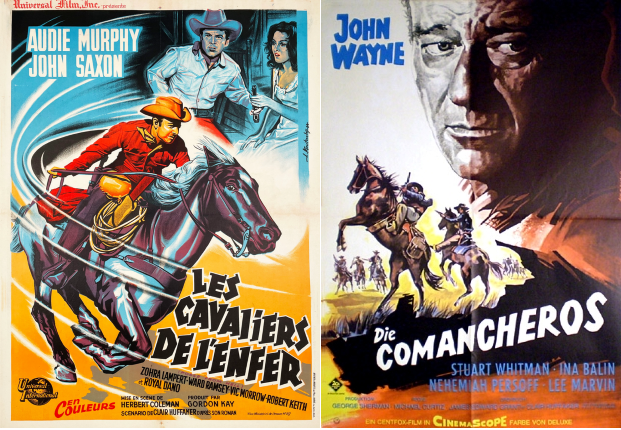
No, not The Last Hurrah, Ford’s peek behind the scenes at local politics, and not necessarily the last word from myself either. What I’m talking about here is the western and in particular that brief period of time when it was still recognizably classical in form and feel, and not long before the changes which saw it rapidly evolve away from its roots towards something quite different would begin to become more apparent. So, the beginning of the end, or the end of the beginning? The answer to that will of depend on how one regards the direction and impact of those changes.
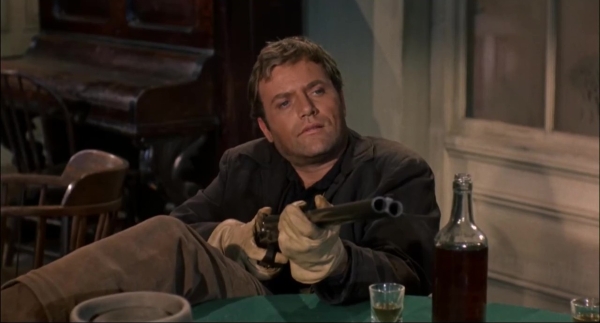
I have settled on taking a look at two movies from the same year, the date carries some significance in itself, which have at least one element in common. They also happen to be movies that I found myself watching as a result of recent revisits to a couple of others. The year in question is 1961, right on the cusp of the transition to the next stage of western filmmaking. That is not to say these films represent the end of the classical era of the western; that tends to be broadly accepted as coming about a year or so later, but they are poised (or teetering, if one feels less charitable about the subsequent years) on the edge of a major shift. The titles are Posse from Hell and The Comancheros and the most obvious link between the movies can be found in the writing: Clair Huffaker wrote both the original novel and then the screenplay for the former and produced the initial screenplay for the latter, before James Edward Grant finished it off. These films have something of the Janus aspect to them, casting wistful glances at the glories of the preceding years and simultaneously squinting ahead into the glare of a less certain future, even the characters within seem unsure in which direction they ought to be gazing.
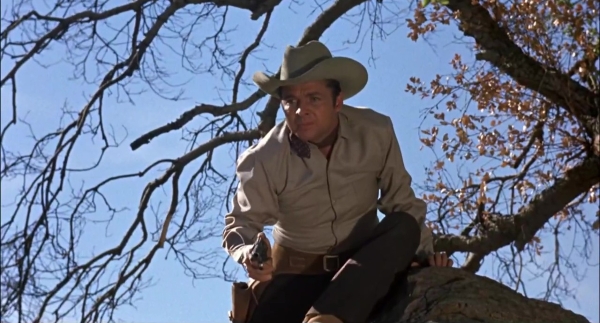
Posse from Hell is one of Audie Murphy’s better westerns from the 1960s, none of which are actually poor, and taps into the implacability that formed the core of the man. His reluctant deputy has a steely independence about him, a coldness he was able to slip into when required and which is always credible. His dogged pursuit of Vic Morrow’s gang of four fugitive killers reminded me of the similarly relentless way Gregory Peck went about tracking down four men (incidentally, one of whom was played Lee Van Cleef in both cases) in Henry King’s magisterial The Bravados. Perhaps the fact I’d seen that movie again not long before had planted the seed in my mind, but the driven determination they both feature struck me. And yet the contrast was apparent too; King’s film had a more personal vibe, and the solid moral point it successfully hammers home is more powerful. In Posse from Hell even the motives of Morrow and his companions is abstruse, they seem to do bad things simply because they can and with no particular goal in sight. That is not to say the script has no ethical aim, Murphy’s rejection of the puritanical judgements of others and the final realization by him and Zohra Lampert that intolerance isn’t necessarily universal refute that charge. Nevertheless, it all plays out like a less anchored and more sensationalized version of tales told before.
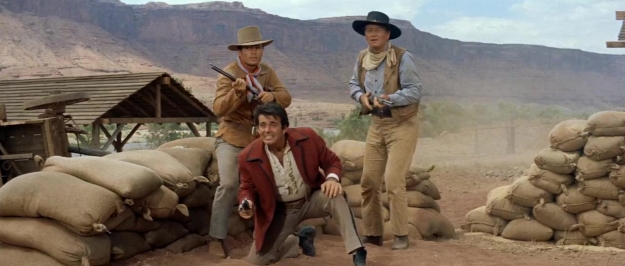
The Comancheros, quite literally the last hurrah for Michael Curtiz to the extent he was so ill that some of the director’s duties fell to John Wayne, while enjoyable enough was already starting to feel slightly dated. There’s an unevenness to its tone that jars occasionally and dilutes what is at heart a harsh story. The whole concept of arming people to allow them to carry out atrocities has a certain unpleasantness about it, and the process of hunting down those who indulge in this sits uneasily next to some of the knockabout comedy on show. Even having Wayne’s undercover Texas Ranger take part in one of those cartoonish brawls with Lee Marvin feels odd given the nature of the latter’s half-scalped renegade character. There are also scenes of the aftermath of a Comanche raid, replete with corpses strung up and these are juxtaposed with more semi-comedic actions by Stuart Whitman wielding a shovel. Similar criticisms can be leveled during the climax at the Comanchero hideout, with hideous punishments sitting side by side with scenes of comically drunken Indians. As such, the script feels indecisive, unable to make up its mind as to what kind of movie it wants to be. This is very likely down to the way it was started by Huffaker and then rewritten by Grant.
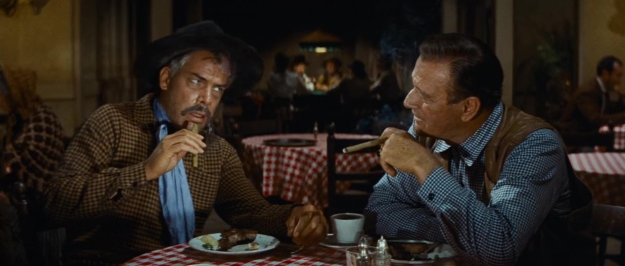
Another viewing of Rio Conchos, which adapts a Huffaker novel and tells a somewhat similar story, served to highlight these inconsistencies. That film of just a few years later maintains a much tougher and harder-hitting focus. Of course, by that stage, the redemptive nature of westerns was being increasingly challenged – not entirely wiped out but certainly infected with a strong dash of cynicism and hints of the full-blown nihilism that the influence of the Spaghetti western would allow to drift in. Looking at these films and the involvement of Huffaker in their production has me wondering whether, if one is prepared to accept them as part of the transitional process, the author himself here should be thought of as part of the transition that was underway in the the genre. Answers on a postcard…
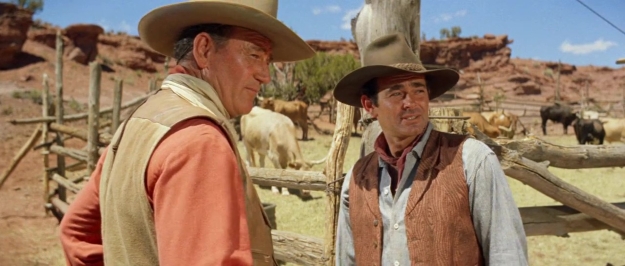
So there you have it, two quite different movies in theme and style yet both produced in the same year and from the same pen. That in itself makes them interesting to me, and then when you factor in how reflections of the past can be discerned alongside harbingers of the future it adds some further food for thought. The process of change is a fascinating one, it is after all the connecting fabric of life, and while the way it can be traced in westerns may not always be satisfying it is something which draws me back time and again.
Initially, I had intended to take a look at three movies here, including one more from the following year with the aim of examining the development underway and, hopefully, making some point about where things were heading in the genre. However, I found it was all growing far too long and the risk of boring readers led me to break it up into two separate posts. The other movie therefore gets its own entry, perhaps deservedly so, and will be posted in due course. As such, while this post can be read as a stand alone it can also be taken as the first of a two part look at a pivotal moment in the western genre.
 Riding the High Country
Most of john Wayne’s 60s films are entertaining. Posse from Hell is a terrific Audie movie but they ain’t no Fistful of Dollars. The US Western declined because the new Hollywood directors weren’t interested in the genre and didn’t understand it. Only Peckinpah and a few others kept it going. There were a few big budget flops (Halleluiah Trail, Mackenna’s Gold) which helped it start looking like your grandad’s cinema. At least Wayne bowed out gracefully with the Shootist
LikeLiked by 1 person
There were a lot of factors at play – established genre stars getting on in years, a certain meanness of spirit creeping into those westerns that were made (and I do think the Spaghetti influence drifted in gradually in that respect), overexposure due to TV, the torpor of the A C Lyles geezer movies, and I think audience expectations changed too.
LikeLike
is it just me, or does the finale of The Comancheros feel like a Bond film? The wheelchair-bound villain presides over his own vast criminal empire, which Duke enters undercover, and after being exposed, he escapes with the help of a beautiful woman. Then the cavalry arrives like the ninjas in the volcano at the end of You Only Live Twice.
LikeLiked by 1 person
Very good! That’s quite amusing actually and something I’d never thought of before.
LikeLike
Off topic: I always felt Murphy’s performance in Unforgiven (1960) – with Lancaster and Hepburn – Directed by John Huston – was superb. I don’t think he was offered much opportunity to show any Acting chops in up until that moment. Too bad.
LikeLiked by 1 person
That is a standout performance, challenging and gutsy. Some roles didn’t stretch him greatly but he still became quite an accomplished actor quite fast.
Before the film with Huston, I think his work in a number of films, particularly The Quiet American and No Name on the Bullet, is very impressive.
LikeLiked by 2 people
I feel that way too, but I just haven’t seen enough of his work.
LikeLiked by 1 person
The Kino Lorber Blu-Ray boxed sets of Audie Murphy westerns are very much worth buying.
LikeLiked by 2 people
Thank you for that dfordoom.
I was just checking and just about every Western by Audie Murphy made is watchable on YouTube. And in good shape.
LikeLiked by 1 person
The ease with which we can access so many movies, in typically excellent quality, is something we should all be grateful for.
LikeLiked by 1 person
Really unbelievable. A golden age of access to film history.
LikeLiked by 2 people
Sadly there are huge gaps. Silent movies are not easy to find. The availability of pre-code films is very spotty. An extraordinary number of French films by major directors are not accessible.
And lots of movies that were available on DVD are no longer available.
I don’t count streaming. Too many stories surfacing recently of movies being butchered by streaming services.
LikeLiked by 1 person
So much work can and should be done. We now have ’59 ‘Ben Hur’ for the 50th time it seems now on 4K and that’s fine but they dropped the ’25 version as an extra and have yet to put it in HD.
LikeLiked by 2 people
Dropping the ’25 version reads like a mistake.
LikeLiked by 1 person
It’s always great to have an earlier version of a film as an extra.
LikeLike
I suspect such decisions are mainly down to economics. Blu-ray was and is a relatively expensive format to produce in comparison to DVD and my understanding is that 4K is costlier again to prepare. We talk about a lot of fairly niche material here and it has to be said that silent cinema, for example, is an even more exclusive niche again with probably more limited potential for sales. I guess the fact has to be faced that not everything is going to be made available in optimal condition on physical media.
On the other hand, there’s much to be celebrated about our being able to access huge quantities either on DVD or via various online sources. I was always one who far preferred to have physical copies to view, but I have come around to the position where I’m happy to view via whatever means is available. I feel that particular genie is out of the bottle as far as movies are concerned.
LikeLiked by 1 person
Yes, I agree. I like both physical copies and streaming. Great access to lots of titles then. I do really like the extras on DVD/Blu/4K though informative commentaries being a favorite.
LikeLike
Colin, I’ll view a movie or TV show on YouTube, Tubi, Dailey Motion, and whatever if it’s a good print. Especially if it’s hard to find. I’m amazed at what can still be found.
LikeLike
Dee, this is sadly true about the streaming services, and it will probably get worse. Good ole physical media ownership is the best.
Here is an interesting article for anyone interested, “Streaming services are burying film history.”
https://www.nickschaden.com/2025/04/28/streaming-services-are-burying-film-history/#:~:text=Some%20research%20suggests%20that:%20*%20**Max%2C%20Disney,options%20like%20Apple%2C%20Criterion%2C%20and%20Arrow%20Films
LikeLike
And I think 4K will prove to be a disaster for classic movie fans as well. Expensive, so increasingly the more obscure titles will become unavailable.
LikeLike
Audie Murphy is superb in <I><b>No Name on the Bullet</I></b> – you couldn’t ask for a more complex and subtle performance.
LikeLike
Dee, Audie Murphy is a good actor and NO NAME ON THE BULLET(filmed 1958, released 1959) is one of my favorites of his movies.
I would much rather view an Audie Murphy movie that most of the tripe that today’s Hollywood pushes on us.
LikeLiked by 1 person
I recently watched a Video or 40 upcoming Westerns (?). I gotta tell ya that at least half of them don’t even qualify as Westerns in my opinion. A lot of the others are Horror movies or formula crap. I picked about 5 that have interest for me. Such is the state of things.
LikeLike
The only western made after the mid-60s that I have really loved is High Plains Drifter, and while it’s a great movie I don’t think it’s a real western. It’s a horror movie.
LikeLiked by 1 person
DF, I don’t know where or when somebody got the notion to make Western Horror movies? Not my cup of whisky. LOL! Unforgiven is my Favorite Eastwood Western. It demonstrated that killing isn’t a fun thing -without the horror.
LikeLike
JC, my favorite Clint Eastwood Western is THE OUTLAW JOSEY WALES(filmed 1975, released 1976). Eastwood has stated that the Western he is asked about most by fans is this one. He has noted in interviews that THE OUTLAW JOSEY WALES remains the movie people approach him about the most often. In 2004 Eastwood said this about the movie, “It addressed the divisiveness of war, and how it can tear at heart and soul. But it also dealt with the rejuvenation of a cynic, re-instilling his life with purpose, and with a surrogate family.”
THE OUTLAW JOSEY WALES is a Classic in my book.
LikeLiked by 2 people
Dee, there are several Westerns made after the mid 1960’s that I really like. I’ll name a few here: TRUE GRIT(filmed 1968, released 1969), MONTE WALSH(filmed 1969, released 1970), BIG JAKE(filmed 1970, released 1971), RED SUN(1971), THE COWBOYS(filmed 1971, released 1972), JEREMIAH JOHNSON(filmed 1971, released 1972), JUNIOR BONNER(filmed 1971, released 1972), ULZANA’S RAID(1972), WHEN THE LEGENDS DIE(filmed 1971, released 1972), MACINTOSH AND T. J.(1975), THE OUTLAW JOSEY WALES (filmed 1975, released 1976), and THE SHOOTIST (1976). I’ll stop at a dozen, but this list isn’t an end all by any means. I can name more and I didn’t even list any Western movies made for television and there is some good ones-LONESOME DOVE(filmed 1988, CBS-TV premiere February 5, 1989) anyone?
A unique horror Western movie is CURSE OF THE UNDEAD(filmed 1958, released 1959), which I think is a well-made fusion of Western and Horror from Universal-International Pictures. If any studio knew how to make top-notch Horror and Western movies Universal did. I think this was the first movie of its kind-a Gothic Horror Western.
LikeLike
WOW! Hell of a list Walter!
I can’t tell ya how many times I’ve watched Jeremiah Johnson, Monte Walsh, The Shootist … all Classic Westerns on my list. Seems the 60’s was the last great era for Westerns. But there seems to a revival right now – at least in quantity. ??
LikeLiked by 1 person
Various real-life issues have been keeping me from participating in the commentary, but I just wanted to briefly pop in to say that, in addition to those movies mentioned, any consideration of westerns in the mid to late 1960s ought to include Will Penny (1967) and Once Upon a Time in the West (1968).
If the latter is not regarded by some as a traditional western, then it really should. In tone, form and resolution it checks the requisite boxes.
LikeLike
Colin, I agree with you.
LikeLike
“Will Penny”! Another Classic! Gotta watch that again soon. Don Pleasence was sure an evil badguy. *Spoiler alert* I just wisht Will had stuck with the gal.
LikeLike
I wouldn’t want to be without ‘The Wild Bunch’, ‘Ballad of Cable Hogue’, and ‘Pat Garrett and Billy the Kid’ by Peckinpah. Post modern I would also add ‘The Long Riders’, ‘Duck you Sucker’, ‘Silverado’, ‘Tombstone’, ‘Dances with Wolves’, and ‘Wyatt Earp’ plus ‘Pale Rider’ to those mentioned. Duvall besides ‘Lonesome Dove’ was involved in some tremendous modern Westerns- ‘Geronimo An American Legend’, ‘Open Range’, and ‘Broken Trail’. Tom Selleck and Sam Elliot’s Westerns ought to be noted. Iconoclastic they may be but ‘Deadwood’ and ‘The Assasination of Jesse James by the Coward Robert Ford’ MUST be duly noted. Oh, I forgot ‘The Missouri Breaks’. No, I’m glad Westerns kept coming. We’re richer for it. I could go on…
LikeLike
Meant to add ‘Dead Man’ too.
LikeLike
When talking later stuff, I really like Ed Harris’ APPALOOSA (2008).
LikeLike
I’ve seen quite a few Audie Murphy westerns now. Some are superb, most are very good. Even the weaker ones are pretty good. He was an actor perfectly suited to the western genre.
LikeLiked by 1 person
I know its a mutilated film despite that a very good one- ‘The Red Badge of Courage’ that Murphy (and for that matter Bill Mauldin) are very good for Huston. Here is the most decorated American WWII soldier scared of battle and running. Of course Audie hated the character yet Huston gets a great performance and the panoply of Crane’s novel and the American Civil War is evoked despite the cuts.
LikeLiked by 1 person
Murphy was a good Actor I believe. I just wanted him to get the acknowledgement he deserves. But it sure doesn’t hurt to have Huston as your Director.
LikeLike
Chris, I’ve read where Audie reportedly struggled with the scene where his character, Henry Fleming, had to act like a coward and run from battle. He found it difficult to portray the required cowardice. When pushed by director John Huston, Audie reportedly told him that he didn’t know how to act scared or like a coward because, in his real-life experience, fear manifested as a cold, “animal cunning” or a “wave of panic” rather than the outward, dramatic displays expected in Hollywood. Audie Murphy was the real deal.
LikeLike
I went through a spaghetti western phase years ago and gave up on them because of that nihilism you mentioned. Nihilism in movies always comes across to me as rather adolescent.
Spaghetti westerns and (most) Hollywood revisionist westerns are like a teenager’s idea of grown-up movies. By comparison the westerns of the Golden Age seem genuinely grown up.
LikeLike
The consept of nihilism and adolescence works for me.
LikeLiked by 1 person
…concept…
LikeLike
Well…..the concept worked for me during my juvenile years growing up. As an example, the backdrop of the wholesome good versus the nihilistic evil in 30’s John Wayne matinees, in which depicted scores of human life (cowboys on horseback) so easily eliminated as if they never even existed. As a maturing adult, hard to take too seriously.
LikeLike
The older American weterns were essentially Kinights of the Range, an outgrowth of the Arthurian stories; I loved them.
LikeLike
Yes, the Western is America’s Myth Cycle. The heroes can be complex or even dark (in the way that Achilles is complex and dark) but they have to be Heroes and they have to be larger than life.
The revisionist westerns of the late 60s and 70s tossed all that out, which is why they don’t work.
A gritty realist western isn’t really a western. And a western that includes “social commentary” isn’t a real western – myths do not deal in such concepts.
LikeLiked by 1 person
Well said.
LikeLike
Barry, you got it. Augustus McCrae(Robert Duvall) and Woodrow Call(Tommy Lee Jones) Knights of the Range in LONESOME DOVE(filmed 1988, first premiered on CBS-TV in February 1989).
LikeLiked by 1 person
The John Wayne character should be seen as Lancelot.
LikeLiked by 1 person
The high level of physicality, Wayne the man, possessed and endured during the filming of those early matinees was absolutely remarkable. One could say a young Wayne was ideally suited to play the heroic figure in those matinees. Also, I would think Wayne was instrumental in keeping those ‘B’ and associated poverty row production studios afloat.
The man definitely earned his stripes.
LikeLiked by 1 person
I’m very choosy now when it comes to Spaghetti westerns as there is a strong sense of creative juvenilia in too many of them – Leone and a few other select titles for me.
The revisionist school is an area I eel I have to approach one title at a time, although that’s arguably an approach one ought to adopt for most cinema. My problem lies with those which removed all the positive aspects the genre offered – such as the sense of hope, the redemptive quest and the core focus on the ultimate futility and corrosive nature of revenge, violence etc. – and simultaneously drew all joy from the movies, often substituting miserabilism and cynicism in an effort to attain the illusion of reality, a doomed goal in itself in my opinion.
That said, the genre could not remain static and stagnant. Having gone about as far as was possible with the classical model, change was inevitable but I’m unconvinced about the wisdom of how that change was effected. To borrow the title from Frost, the road not taken continues to intrigue me.
LikeLike
For whatever i is worth, I dislike virtually all westerns produced abroad; charmless, violent and not english speaking.
LikeLike
Yep. Spaghetti westerns aren’t westerns. They’re crime films or gangster films.
LikeLike
Dee, in my opinion the Italian made ONCE UPON A TIME IN THE WEST(1968) from a story by Dario Argento, Bernardo Bertolucci, and Sergio Leone; screenplay by Sergio Donati and Sergio Leone; produced by Fulvio Morsella; music by Ennio Morricone; photography by Tonino Delli Colli; edited by Nino Baragli; Art/Set/Costumes by Carlo Simi; and directed by Sergio Leone is a Western Movie.
ONCE UPON A TIME IN THE WEST is a tribute to several of the Classic Westerns made from the silent era forward to the 1960’s. I find it fun to pick out all the references to Westerns that are, for the most part, considered Classics of the era. I even find a couple of references to THE COMANCHEROS(1961). Here are some others: THE IRON HORSE(1924), DUEL IN THE SUN(filmed 1945-46, released 1946), WINCHESTER ’73(1950), HIGH NOON(filmed 1951, released 1952), SHANE(filmed 1951, released 1953), JOHNNY GUITAR(filmed 1953, released 1954), THE SEARCHERS(filmed 1955, released 1956), THE LAST SUNSET(filmed 1960, released 1961), THE MAN WHO SHOT LIBERTY VALANCE(filmed 1961, released 1962), and others. This list isn’t an end all by any means.
Life intrudes at the moment, but I’d like to say a few other things on this subject, so I’ll be back later.
LikeLike
It would have been kinder to let the western die with dignity. Once you remove the core ingredients you no longer have a western. It’s like making a musical with no singing or dancing.
LikeLike
Dee, I understand your point about the removal of the core ingredients from many revisionist Westerns, but the Western movie will never die and personally I don’t want it to die.
LikeLike
Sadly, it is being reported that Robert Duvall has passed away at the grand old age of 95. A long and successful life and career.
RIP
LikeLike
Yes, one of the greats. Such range. Convincing in Westerns (Lonesome Dove is wonderful and talking of twilights who can forget him with The Duke in ‘True Grit’) and he could be a convincing ‘Stalin’! One of my favorites.
LikeLike
Excellent post. ‘The Man who shot Liberty Valance’ to me is one of those key statements on the Western. The stagecoach is in mothballs at the beginning! What a statement by Ford.
LikeLiked by 2 people
Absolutely, not only a great movie but a great end of the era western, ripe with symbolism, imagery and fine dialogue.
LikeLiked by 2 people
Excellent write up. Fans of ‘The Comancheros’ should seek out the really nice Blu ray which has really good picture and, plus an interesting commentary ported from the laserdisc, and neat documentaries on Wayne at Fox and the real history background. A worthy release.
LikeLiked by 1 person
Test Transmission………………….
LikeLike
I hate logging in via Facebook but I’ve had WordPress Blues all week, elsewhere and now here so sorry about that folks, and especially Walter who cannot bear the sight of me before breakfast which I hope he’s had by now. Whiskey (Canadian,Irish) before Breakfast OK Walter, but the sight of me NO.
Let’s get started……
Chapter 1
I much prefer POSSE FROM HELL to THE COMANCHEROS more my kind of movie.
THE COMANCHEROS saw Curtiz exiting on a high note, and a box office smash as well.
I much prefer the retread RIO CONCHOS and for me Stuart Whitman is the best thing in the picture. POSSE FROM HELL is certainly Murphy’s most violent Western with ARIZONA RAIDERS a close second. To me THE UNFORGIVEN is a Burt Lancaster/John Huston Western and I don’t like the film and neither do I like most of Huston’s movies with a couple of execptions and KEY LARGO being the one I like the most. Furthermore I did not like seeing Murphy playing second fiddle to the two superstars, a nothing role, I thought.
LikeLike
Murphy was certainly in a supporting role in The Unforgiven, but I’m of the opinion it was a strong supporting role. Not an easy part to take on and play but a crucial one in the development of the story and the theme, and I reckon Murphy met the challenges it posed with great aplomb.
Huston can be problematic, can’t he? His best films are great works, but his career is spotty. I like his films with Bogart with the exception of the risible Beat the Devil. Do we consider Across the Pacific a Huston film since it was completed by Vincent Sherman? I suppose so as he put in most of the work there – it’s a relatively slight movie as I recall. I should give it another look now that it’s come to mind.
LikeLike
I like Huston even if he could be variable and enjoy collecting (and watching his movies). I think ‘The Man who would be King’ was a great late career achievement. I think Thomson in his dictionary has the variable view of him. And John Wayne’s view after their awful relationship on ‘The Barbarian and the Geisha’ is pretty funny and bitter: “Huston’s a phony. He never did any good movies without Bogart or his Dad”.
LikeLiked by 1 person
I don’t consider Beat The Devil “risible”. It’s a very humorous meant to be a lark, and everybody in it is having such great fun –
LikeLike
Paul, I don’t want you to feel alone here. I like BEAT THE DEVIL(1953), which I first viewed on Memphis, Tennessee’s WREC Channel 3 LATE MOVIE in 1972. I liked Humphrey Bogart movies, and I didn’t expect what I got that night. I became a fan of this quirky delightfully dark comedy laced with sardonic humor and what a cast of performers, especially the conmen of the committee with Robert Morely, Peter Lorre, Ivor Barnard, and Marco Tulli. This rascal of a movie spoofed both John Huston and Bogart movies of the past and I think Huston and Truman Capote pulled it off rather well in their off the cuff writing. Although Capote for the most part lifted the dialogue from Claud Cockburn’s 1951 novel of the same name. Cockburn was a controversial British Communist journalist and agitator writing under the name James Helvick.
LikeLiked by 1 person
Beat The Devil is such an oddity. If you’re prepared to just go with its oddness it’s kinda fun.
LikeLike
Dee, it is a lot of fun and be sure, if you haven’t already, view the 93-minute restored version. I’m sure the censors freaked when they viewed the nude pinups mixed in with the Rita Hayworth photos on Ahmed(Manuel Serrano) the Arab interrogator’s wall. It wasn’t Hayworth but she looked similar. Also, did anyone recognize Peter Sellers’ voice used in the dubbing?
LikeLike
POSSE FROM HELL is next on my list of Audie Murphy westerns to watch. The Blu-Ray set arrived yesterday.
LikeLiked by 1 person
Chapter 2…………..More Sacred Cows slain
I don’t mean to upset anybody, especially Colin, but would it not be a boring World if we all liked the same stuff.
What i enjoy most about RTHC is the many different opinions we have regarding film.
The 1950’s saw three major directors all veterans from the silent era suffering a lack in overal quality from their 1930’s 1940’s glory days.
Curtiz made nothing to compare to say THE SEA WOLF or ANGELS WITH DIRTY FACES during the 50’s, some very good films and several smash hits with THE BREAKING POINT (which I have never seen BTW) being the only masterpiece, I guess.
Walsh In the 50’s made nothing to compare to HIGH SIERRA or THE ROARING TWENTIES, although he did make many very good movies but no masterpieces, with WHITE HEAT being his last truly great film.
Lang Now we get to the really contentious part. For me Lang’s overall work took a major dip during the 50’s especially compared to titles like SCARLET STREET and MINISTRY OF FEAR which were just not there. To me THE BIG HEAT is nothing more than an overblown programmer with sadism added, it would have been good Phil Karlson but it’s bad Lang. Oddly enough Karlson’s sublime SCANDAL SHEET with it’s themes of guilt and paranioa,would have suited Lang just fine. WHILE THE CITY SLEEPS with it’s poor production values is pretty tired stuff; the cast of stars all on the way down, apart from Price. I do enjoys Lang’s two color movies RANCHO NOTORIOUS and MOONFLEET enjoyable but certainly not great films.
LikeLiked by 1 person
John,
Two thoughst occur to me, rmaybe three. I totally agree about The Big Heat, good buy tnot good enough. And speakignof Lang, wha t is yur feeling re House by The River? My take,and I am closer to it than anyone esle still alive — good but not good enough.My fatherwas watching this thign an dimmediatley called me. “What made him play such a part’Th eonly thign I thuoght of,Louis wanted to work with Long. Asfor While the City Sleeps, p;rodutions valuses meanvrylittle when yu have such talent. Danacarried the p;icture beautifully, price meant nothing, just a weak somewhat effeminate guy groping his way into big business. Ida was grand and so was most of the rest.
LikeLike
Please excuse the typing. I wrote this ,unfortunately,while watching Manpower, which is Gable and Tracy turned inide out. but very interesting, especially Raft’s work .Marlene is hot, and Robinson over the top.
LikeLiked by 1 person
Barry, odd as it may sound I’m not a Lang completist, and for my sins I’ve never seen HOUSE BY THE RIVER. I’m sort of a Don Siegel completist, but don’t enjoy EVERY film that he made, overall,for me he’s one of the most consistent directors.
LikeLike
There is no true reason to see House By The River.
LikeLike
Chapter 3
Allan Dwan
In my weird Universe or Twilight Zone, if you will, I rate Dwan with the three gentlemen mentioned above. I have never seen any of Dwan’s silent pictures which I understand feature some of his finest work. Dwan’s 30’s and 40’s work could never compare to Curtiz, Walsh and Lang, yet on minor films his technique generally shines through. Certainly a host of minor films there but there are a few diamonds in the rough as well, as several obscure Fox programmers which will never see the light of day. THAT I MAY LIVE is a very impressive “innocent fugitives on the lam” type picture which sadly only exists in a 40 minute version of it’s original length. (80 min?) If some of these missing Fox gems were restored and released Dwan’s reputation might soar.
During the 50’s Dwan’s work had a considerable uplift with WOMAN THEY ALMOST LYNCHED, SILVER LODE, SLIGHTLY SCARLET and THE RIVER’s EDGE, all very fine films.
MONTANA BELLE was made in 1948 but released in the 50’s so I will not count that but it’s a very impressive film which needs restoring. ENCHANTED ISLAND filmed 1958 but released in the UK in 1963 I have fond memories of especially its striking use of color. That was a long time ago and was released in a double bill with FROM THE EARTH TO THE MOON another of those last gasp Benedict Bogeaus RKO movies. FROM THE EARTH TO THE MOON was a cheater as they never got to the moon as the film ran out/went over budget. At any rate I enjoyed ENCHANTED ISLAND much more.
Some good news in the rumor mill……SLIGHTLY SCARLET is being restored in 4K by Flicker Alley let’s hope SILVER LODE will not be too far behind.
LikeLiked by 1 person
In the US, Silver Lode is available on Prime, supposedly in HD, although the picture quality is still disappointing.
LikeLike
Dwan’s ‘uplift’ begins with ’49’s ‘Sands of Iwo Jima’. Why people think it is a rah, rah war film I have no idea. Wayne is excellent and war is shown as a nasty, brutish thing. John Ford told Dwan to concentrate on this one make it a cut above. He did.
LikeLiked by 1 person
Final chapter (final) Peckinpah and Huston (Walter not John)
One reviewer called RIDE THE HIGH COUNTRY the last of the old style Westerns and the first of the new revisionist type Westerns.
I agree more or less with that and it’s by far my favorite Peckinpah movie.
To go back to a couple of early Walter Huston movies.
LAW AND ORDER (1932) has Huston as Frame Johnson lawman for hire. Johnson is a drifting gunslinger who longs for a gun free America. Johnson is also a Puritan,of sorts.Edward L Cahn’s film is remarkable with it’s no frills depiction of The West and a ground breaker for what would follow but light years away from the Singing Cowboy antics of Autry & Rogers.
BEAST OF THE CITY (1932) also has Huston as a police chief trying to rid his city of crime,and much more a Puritan than Frame Johnson. Huston’s character is a family man, a man of morality and decency. Huston’s kid brother (Wallace Ford) who he adores lacks Huston’s work ethic he yeans for promotion the easy way. Ford’s quest for easy money leads him into the arms of mob floozie Jean Harlow and he becomes a tip off guy for the mob. This breaks Huston’s heart and the dynamic between the two actors is sensational. The only way to rid the city of it’s scum is a final shoot out, a team of straight arrow cops all family men with kids, to make the ultimate sacrifice. The final Pre Code shoot out is sensational and of course Harlow must be felled with a stray bullet in keeping with the tone of the film. Having seen the film I read Glenn Erickson’s review and he drew comparisons to THE WILD BUNCH futhermore stating BEAST OF THE CITY must have influenced Peckingpah’s film. I must admit I never got this connection while watching the film as I was so engrossed, why I never I just cannot tell you.
LikeLiked by 2 people
Thanks for the lengthy commentary, John. You make a number of interesting observations in that series of replies and I’d like to respond to just a couple at the moment.
Firstly, I too like Dwan’s late career work and I reckon it is deserving of attention. The news on Slightly Scarlet is most welcome. I was thinking about giving it a rewatch (it has been a long time since I last saw it) but the rather murky print we’ve had up to now has never been the most inspiring and I think I’ll maybe wait a bit longer and see if a restoration does appear.
On the decline of some of those big name directors, I agree that Curtiz did work of less interest during the 50s, but I have to also say that I very much enjoy White Christmas. Some say it’s a lesser movie all told than Holiday Inn, but I like it a lot and find it has great warmth. I also enjoy We’re No Angels and The Hangman, even if they are relatively minor films in relation to his earlier work.
Perhaps one of the more disappointing Curtiz movie from the 50 for me, arguably because it had been so highly anticipated, was The Scarlet Hour. I found Tom Tryon rather weak in the lead, although to be fair it was his debut and he did better work in the years ahead.
I don’t think you’re right to dismiss Walsh in the 50s though. He was certainly variable, and some the films from earlier in the decade are weaker. That said, I rate The Revolt of Mamie Stover, Band of Angels and The Tall Men as among his best movies, and I like Battle Cry and The Naked and the Dead very much as well.
As for Lang, I like all his Hollywood films and while the budgets tightened later, I very much enjoy all of them. That sparser look and feel he brought to a lot of his 50s work is actually very attractive to me.
LikeLiked by 1 person
Just recently got ‘Battle Cry’ and looking forward to the revisit. I agree with you Colin on the films you like of Curtiz from the ’50s and ‘The Big Heat’ is essential noir with a scalding pot of cofee. Also, Walsh’s ‘House of Wax’ that gave the horror genre Vincent Price is a good one too.
LikeLike
John K, I knew that you would like THE BEAST OF THE CITY(filmed 1931, released 1932) when we talked about this pre-coder on another site. It’s a winner in my book.
LikeLike
I actually really like THE SCARLET HOUR. I have yet to see MAMIE STOVER and BAND OF ANGELS. I did not mean to dismiss Walsh except I thought the quality of his overall work did dip and really THE LAWLESS BREED and GUN FURY and indeed SASKATCHEWAN were little more than programmers but I do really like all three. I have said before THE NAKED AND THE DEAD was his last really good movie. Many of Walsh’s 30’s & 40’s movies really hit you in the gut especially OBJECTIVE BURMA and COLORADO TERRITORY and that’s what I find lacking in his 50’s movies, each to his own.
LikeLiked by 1 person
I see. I didn’t know you hadn’t seen Mamie Stover or Band of Angels and now I wonder if you feel differently about his work in the the 50s overall should you get the chance to catch up with them.
LikeLike
John K, looks like you’re going on a tear today, but that’s okay, as we all know the world would be a boring place if we all believed and liked the same things in life whether it be in movies, TV shows, plays, games, the role of government, and so forth.
Let’s go and git to it. We’ll have to agree to disagree on John Huston’s THE UNFORGIVEN(filmed 1959, released 1960), because I think it’s a splendid Western drama adapted from the excellent 1957 Alan Le May novel of the same name. I think Le May’s novels THE SEARCHERS(1954) and THE UNFORGIVEN(1957) are top-notch companion pieces of Western literature. THE UNFORGIVEN is a really good story with a cast to ride the river with. Franz Planer’s photography of the Durango, Mexico landscape is beautiful and nightly eerie, especially with the scenes of the saber-rattling gray ghost of the lost Confederacy Abe Kelsey(Joseph Wiseman). The costuming was appropriate for 1874 Texas, although I wish Audie Murphy had worn his hat from NO NAME ON THE BULLET(filmed 1958, released 1959) or something similar. The pistols and rifles used were period appropriate, except a couple of lapses with Winchester Model 1892’s that hadn’t been forended to look like Henry rifles. I know that I’m being nitpicky here, but they had gone to the trouble to use Sharps carbines and rifles which were used in the Post Civil War Era.
The Zachery Family are excellently portrayed by Lillian Gish, Burt Lancaster, Audie Murphy, Doug McClure, and Audrey Hepburn. Was Hepburn miscast? Many think so, but I think she did just fine, but I do wonder how Rita Moreno or Debra Paget would have been in the role? Cash Zachery(Audie Murphy) a nothing role? I don’t think so. Yes, it’s a supporting role, but Audie makes the most of it and I agree with Colin that it’s a strong crucial role. I think Audie gives a startling performance. Also, I like the earthy enticing “not wannabe a spinster” performance of Kipp Hamilton as Georgia Rawlings, who is hopelessly in love with Cash. Their scenes together are electric, especially after a drunken Cash leaves his family and goes to the Rawlings ranch. Georgia gives her all to persuade Cash to stay with her. Is blood thicker than Georgia’s sensuality? I’ve read that the romantic development between Cash and Georgia was cut from to shift the movie’s focus toward the relationship between Ben(Burt Lancaster) and Rachel(Audrey Hepburn).
I’ve read that John Huston didn’t like THE UNFORGIVEN and this was because of the creative differences between producer Lancaster and director Huston. Similar to Audie and Kipp’s reduced film time, John Saxon’s role as Johnny Portugal was also heavily “butchered” in the editing room, with many of his scenes were also cut without Huston’s approval. Huston distanced himself from the movie afterward.
With all the troubles during filming and post-production I think THE UNFORGIVEN is an intense splendid Western drama.
I go along with Chris Evans in that THE MAN WHO WOULD BE KING(1975) is a late career achievement for writer/director John Huston. This epic story is another of my favorites of all-time. What a grand story by master storyteller Runyard Kipling from 1888. Huston read the story at age 14 and loved it. In 1954 it was reported that Huston would make the story into a movie for Allied Artists. 21 years later he finally made the movie. He originally wanted Humphrey Bogart and Clark Gable to star. I think it’s a magnificent spectacle with top-notch performances by Sean Connery, Michael Caine, Christopher Plummer, and Saeed Jaffrey. I’ll have to respectively disagree with Duke Wayne in that this grand movie directed by John Huston and co-scripted with Gladys Hill doesn’t have Humphrey Bogart and Walter Huston in it. I could talk about this movie all day.
LikeLiked by 1 person
Such a great film. Wonderful Blu too.
LikeLiked by 1 person
Chris, when I think of THE MAN WHO WOULD BE KING(1975) another 1975 released movie comes to mind, which is another favorite of mine. Writer/Director John Milius’ THE WIND AND THE LION(filmed 1974, released 1975) is a sweeping historical drama the like of which would never come out of today’s Hollywood, and I think today’s Hollywood movie industry is less for that. I think movies like THE WIND AND THE LION made people want to go see movies on the big screen theaters.
LikeLiked by 1 person
Really like ‘The Wind and the Lion’ too. Brian Keith is so convincing as Theodore Roosevelt. Honestly he deserved at least a nomination for it. I also like the Milius directed TNT miniseries ‘Rough Riders’. Tom Berenger is perfectly splendid as Roosevelt.
LikeLike
Chris, I agree with you about Brian Keith’s very memorable performance as President Theodore Roosevelt.
John Milius’ ROUGH RIDERS(filmed 1996, premiered on Turner Network Television July 20-21, 1997) is a really good miniseries and the last time Milius directed, which is a crying shame. I realize that Milius is out of step with today’s Hollywood, which is our loss. I wish that he had wrote and directed more movies.
LikeLiked by 1 person
John K, I know that you aren’t a fan of Jane Russell, but I enjoyed her in THE REVOLT OF MAMIE STOVER(filmed 1955-56, released 1956). I’ve always liked her brassiness style in movies. Her life is quite a story in itself. The movie had to be toned down from William Bradford Huie’s 1951 novel of the same name. I had quite a lot to say about the movie and Huie’s books four years ago on this site.
https://livius1.com/2022/04/26/the-revolt-of-mamie-stover/
LikeLike
Colin, good write-up of an interesting thought process, “The process of change is a fascinating one, it is after all the connecting fabric of life, and while the way it can be traced in westerns may not always be satisfying it is something which draws me back time and again.” Well said and it’s something that has dwelled in my mind ever since I was a youngster. Also, I’m glad that you didn’t use the term “end of the west,” for a “Changing Times Western,” like so many others. The West is still with us; it hasn’t gone anywhere; Western literature is still being written; and Western movies and TV shows are still being made. Are they different? Yes, they are and I for one am saddened that they have lost a lot of their redemptive power, although the classical form is still present.
“A Last Hurrah?” That is a good question and along with “A First Hurrah?” These are two good questions that I’ve been twirling around in my mind ever since youngsterhood. Anyway, I find your choices of POSSE FROM HELL(filmed 1960, released 1961) and THE COMANCHEROS(1961) interesting choices and with writer Clair Huffaker’s hand in both as novelist and screenwriter with James Edward Grant in the mix because he was John Wayne’s writer. Wayne said that Grant could write good John Wayne dialogue. I’ve read several of Clair Huffaker’s Western novels and he is a good writer in my opinion. Huffaker’s THE COWBOY AND THE COSSACK(1973) is a favorite of mine, and I think it’s his best. It’s a crying shame that it’s never been made into a movie. Ben Johnson had the movie rights in the beginning. Later on, producer Lance Hool acquired the rights and tried to get it made with Clint Eastwood and Charles Bronson, but no dice. Then Producer Albert R. Broccoli came along, and Omar Sharif’s name was mentioned. Robert Duvall and Arnold Schwarzenegger have shown interest in the past, but the rights are apparently so tied up in Gordian knots it will never get filmed. Although, you never know.
Just the other day I was going through some books that I’ve been meaning to read for decades and ran across Paul I. Wellman’s THE COMANCHEROS(1952). I’m finally going to read it after I finish DESTINY OF THE REPUBLIC: A TALE OF MADNESS, MEDICINE AND THE MURDER OF A PRESIDENT(2011). I remember first viewing(my first hurrah) THE COMANCHEROS on THE ABC WEDNESDAY NIGHT MOVIE in 1967 and I really liked it a lot. When I saw the movie in 1973 and again in 1975 on Memphis, Tennessee’s WREG Channel 3 LATE MOVIE I just couldn’t git over all the inaccuracies in period detail involving costuming, weaponry, and historical facts. The time period was 1843 in the Republic of Texas, not the 1890’s or later. Who to blame? I know it wasn’t novelist Wellman and I can’t hardly believe it was screenwriter Clair Huffaker. Screenwriter James Edward Grant? Grant wrote the screenplay for HONDO(1953), and he corrected some of Louis L’Amour’s mistakes form his short story “A Gift of Cochise”(1952), which HONDO was loosely based on. Who’s to blame for the script’s historical inaccuracies?? It would be nice to read Huffaker’s script before Grant got hold of it. Blame for the costuming and weaponry inaccuracies? Probably the studio 20th Century Fox using whatever was in Western wardrobe and not caring about period detail. After all of the above criticisms, I still like the story and the cast. It’s a fun entertaining well photographed(William H. Clothier) movie.
POSSE FROM HELL, which I first viewed on Memphis, Tennessee’s WREC Channel 3 EARLY MOVIE in 1971, is a bread-and-butter Audie Murphy Universal-International Western. That means it’s a good one and so is Clair Huffaker’s 1958 novel. This is a tough violent movie with a really good cast. Zohra Lampert handles a tough role and a scene between her and Audie is touching(no pun intended). The cast wears average Western clothing, although they could have used better hats. Lone Pine is beautifully photographed by Clifford Stine.
Look forward to Part 2. I think I know what 1962 released Western it will be.
LikeLiked by 1 person
A “bread and butter” Audie Murphy western is an interesting way of putting it. It’s apt in that the movie contains all the elements one would look for in one of Murphy’s films. And yet it gives the impression, to me at least, of something largely routine, which I think would be a disservice and probably not at all the sense you wanted to convey. It has its flaws, which I think I managed to allude to in the post but way the relationship between Murphy and Lampert develops and meaning that lends to the picture lifts it to another level in my opinion.
LikeLiked by 1 person
Colin, “bread and butter” to me is a good Western in the classical form that’s reaching for the higher plane, and I think POSSE FROM HELL does this in the character of Helen Caldwell(Zohra Lampert). Helen’s tragic experiences during her ordeal with Crip’s(Vic Morrow) gang of escaped convicts is dealing with the harsh violent crime of rape, although the word is never used because this is a 1961 movie. Helen is at first benumbed from shock, then enraged for what was done to her, and then goes into despondency, which could lead to suicide because now she will be seen as a ruined girl by the so-called good society. So, what is left for her to do, become a bad girl(prostitute)?
So, I probably shouldn’t have used the term “bread and butter” here and made myself more clearly understood. There’s a lot in POSSE FROM HELL to take in.
LikeLike
POSSE FROM HELL is a Western I especially like so wanted to add a few words about it. One thing that is unusual is that a movie like this usually wraps up pretty fast after the final round of action (here the final shootout with the remaining outlaws). But this film goes on after that for a full 10 minutes in the aftermath of this, a lot quieter, and it’s entirely about Audie Murphy’s character coming to terms with a change in his view of humanity, in which he had initially been so bitter and isolated–a kind of redemptive note just in his attitude, partly because of his admiration for the characters played by Acosta and especially Saxon but most of all, as you say, because he and Lampert share the need to go forward and are drawing something positive from each other at the end. So this is at thoughtful movie, meant to play as the dramatic Western it is but with a reflective side. I like that it doesn’t gloss over what happens to Lampert, feel the actress carries this believably (I never understood why there was not a lot more of her after her key role in SPLENDOR IN THE GRASS soon after this, in which she also did so well), while the hero is beautifully and subtly played by the eternally underrated Murphy.
You didn’t mention that this was the debut of Herbert Coleman as director (after this he did make one more movie with Murphy, BATTLE AT BLOODY BEACH, which is OK). The other Gordon Kay productions with Murphy in the 60s were all directed by veterans but not this one. I am guessing that Alfred Hitchcock, in the process of coming to Universal, got this opportunity for a man who was his associate producer on his recent films as part of the deal being worked out with Lew Wasserman then, but whatever the case, I believe that Coleman made the most of it and did an excellent job.
I will emphasize that I like all seven of those Kay/Murphy Westerns, even though the final GUNPOINT (1966) is almost derailed at the beginning by excessive stock footage and an appalling and badly delivered narration–after these are dropped it becomes a solid film, but Universal (changed back from Universal-International a few years before) was beginning to suffer from the new regime, at least in my view. Still, overall, that cycle of Murphy films at his longtime studio is the brightest note for this level of Westerns in the 1960s (the programmer/classy co-feature, B+ movie or whatever one wants to call it), and while some of the others have their own very positive qualities, I like this one best.
I don’t feel that way about THE COMANCHEROS–just never warmed up much to it, and this was in the midst of a run of wonderful movies with John Wayne, including all three of his best directors and with his unheralded flair for comedy much in play in some of them. With this film, I do think the much tougher RIO CONCHOS, made during the transitional years that followed, is so much better and I’m glad Huffaker came back to a similar subject in that thoroughly reimagined way.
I understand grouping several films together to talk about currents within a genre, or what we’d like to see in a genre, and like this piece for that. But like the one last year which argued a point I very strongly agree with–that Westerns now would be better off to be set in a West contemporary to their own time (well, it WAS true, but I’m not sure about this anymore), it can have the effect of cutting some of what you might write on the better film. In other words, not much to say about THE COMANCHEROS and I’d have liked to see POSSE FROM HELL get its own piece. I felt this much more with THE LUSTY MEN & HUD in that earlier piece because while HUD is a solid drama, THE LUSTY MEN is one of my three or four favorite movies ever and if it had been treated by itself, you could have said a lot more about it. That said, again, the points these pieces are making are very good ones, both for the history of the genre and about the films. Looking for a certain 1962 movie that could have been in either of these pieces and that it appears you haven’t written about, it looks like that could be the one coming up. If so, it’s another film I have always liked.
One final note–and it’s important–on a point that you made. No matter how we feel about what happened to the Western in the 60s, as classicism gave way to modernism, things do need to change. It’s inevitable and it always happens. But I’m with you on the “roads not taken” idea as the Westerns that I do especially like after 1962 so often do suggest that. But I guess the times just pushed things in another way. I’m accepting of that, because as I’ve said before, probably many times, I don’t need any more Westerns. The treasure trove we have from those great years is enough for me.
LikeLike
Yes, films such as The Lusty Men and Posse from Hell do deserve dedicated posts of their own, but I guess others have dissected them quite satisfactorily in the past. Actually, I did think of breaking these into discrete posts on the individual movies but then thought the pairing/grouping strategy might work better in light of the overarching point I wanted to make. Had I done so, then I probably could have said more about Ray and westerns in one instance – his identification with the deliberate yet misunderstood outsider is particularly fine fit for westerns after all – and maybe at least some acknowledgement of Coleman in the other would have been possible. I guess this draws something out of the pieces, but be that as it may, and for better or worse, it was the idea underpinning all these developments rather than the movies in isolation that I wanted to focus on.
I too don’t feel that much regret now with regard to how the genre developed, and for much the same reasons as yourself, even if I feel it missed a trick at this critical point. As for the film that will follow on from this, I think I might as well say what it is rather than tease the issue too far. It is Lonely Are the Brave and it will get its own separate post, or has done as I’ve already written it up, and it will be posted in due course.
LikeLike
Regarding Walsh, One film I missed was THE ENFORCER (1951) partly or mostly directed by Walsh, I did not include this film simply because it does not have his name on it. The film has Walsh’s fingerprints all over it with the pacing,the urgency and the punchy impact of the film.
I would consider it the last truly great Walsh movie.
The problem I have with Walsh’s 50’s films is the lack of one true classic among them all. They range from the very good, the good and the mediocre. BTW Chris,HOUSE OF WAX was directed by Andre De Toth, not Walsh.
William Wellman another Silent Film Veteran made fewer films than Walsh during the 50’s. His 50’s Classic was THE HIGH AND THE MIGHTY far and away the finest of the Airline Disaster Genre and a once in a lifetime cast as well. The film was a box office smash.
Wellman’s WESTWARD THE WOMEN is a tough realistic Western, not considered a classic sadly but wonderful all the same. Robert Taylor was never better. This is the sort of Western that I wish Walsh had made during the 50’s; THE TALL MEN is weak by comparison with it’s hokey dialog, and that Godawful song Jane sings. The film is fine as spectacle but weak as a really good film.
Wellman’s superb ACROSS THE WIDE MISSOURI is another very fine movie and Walter tells us there is an extended version in (hopefully) Warner’s vaults. On another blog Walter and I engaged in a Pioneer Westerns debate, films that show early settlers travelling further through the wilderness,sagas of brave men and women. Our choices ranged from hokey colonial adventures to classics like NORTHWEST PASSAGE. Somehow we missed ACROSS THE WIDE MISSOURI off the list.
LikeLike
There is only one rason to see The Tall Men, and that’s Gable. My wife observed,correctly believe, that Cary Grant was probably the best actor who ever lived, and that includes all of those who disappeared prior to film, but Clark Gable is apart.
LikeLike
Barry, your late wife had good taste. Clark Gable wasn’t called the “King” for nothing.
LikeLiked by 1 person
That’s right. Sorry, got my one eyed directors mixed up.
LikeLike
John K, we have talked about ACROSS THE WIDE MISSOURI(filmed 1950, released 1951) before and I agree even in its butchered by MGM status it’s still a good Western frontier drama. I wish this movie could be restored to William Wellman’s original 135-minute original length. It was cut down to 78 minutes and still stands as one of movie history’s outrageous slasher jobs thanks to the suits at MGM lead by Dore Schary. As far as I know the 57-minute footage is presumed lost. That’s a crying shame.
I like THE TALL MEN(1955) better than you do, so we’ll just have to agree to disagree on that one.
WESTWARD THE WOMEN(1951) is a wonderful movie, so we can agree on that one.
LikeLiked by 1 person
During the 50’s it was easier for directors who had such stature that they wre able to “Cherry Pick” their projects. Howard Hawks gave us RIO BRAVO now considered an all time classic.
George Stevens gave us SHANE another classic for the ages.
William Wyler gave us THE BIG COUNTRY, I guess it’s now considered a classic (not by me) and a smash hit as well.
Although not a veteran (at that time) Fred Zinnemann another cherry picker gave us HIGH NOON. All these directors made fewer films waiting for preferred projects.
John Ford (not really a cherry picker) made WAGON MASTER (my favorite) and THE SEARCHERS another all time classic and smash hit.
Henry King another veteran from silent days gave us the sublime THE GUNFIGHTER, is this considered an all time classic? it should be but it’s certainly one of the greatest Westerns ever made.
LikeLike
“it was the idea underpinning all these developments rather than the movies in isolation that I wanted to focus on.”
As I trust was clear, I understood this. Moreover you did that very well. What I said was more of an observation and not a criticism.
Lots has been written on THE LUSTY MEN (including by me–I’ve published on it twice), but never saw any serious consideration of POSSE FROM HELL. What you wrote was definitely a good start and gave it some attention it deserved.
Yes, as was probably clear, I guessed it would be LONELY ARE THE BRAVE. And it appears that I’m not the only one here who did. Something to look forward to.
LikeLiked by 1 person
Don’t worry, I quite understood and wasn’t taking it as a criticism, just clarifying what I was looking to do.
LikeLike
Test
LikeLike
I did give considerable thought to what I was going to write here,before commenting,really rather than considering the films themselves,I thought it would be interesting to concentrate on directors making Westerns in the 50’s who began in the silent era.
One director I missed was Henry Hathaway who for me made three key 50’s Westerns.
RAWHIDE should be considered a classic it has everything, Lone Pine, Susan Hayward, and Hugh Marlowe as a complex villain. The so called “Super Western” GARDEN OF EVIL also has Hayward and Marlowe and Cooper and Widmark. I’m so glad to have caught this in the 60’s in magnetic stereo in a large single sceen cinema. The wonderful FROM HELL TO TEXAS is arguably Hathaway’s finest Western, although he had to wait until 1969 for his all time classic TRUE GRIT although I prefer the three Fox films I mentioned over the Wayne classic.
My dislike for THE TALL MEN probably has something to do with my not being too keen on Jane Russell, to be kind I will say a little of Jane,for me,goes a long way. For spectacle THE TALL MEN is hard to beat but in the studio shot scenes the film falls apart,Robert Ryan totally wasted in this film.
LikeLike
Another Last Hurrah……………
Just viewed Sidonis’ France stunning new Blu Ray of THE MAVERICK QUEEN.
It does have “forced” subtitles but I do have a feature on my player that can raise or lower subs so that they are out of the frame.
The 4K restoration from Paramount Pictures is sensational, by far the best restoration I have seen so far of a Trucolor picture.
Republic spent a heap of cash on this picture and it shows. Their Naturama Widescreen process as short lived with this film being the only major title filmed in that process.
Someone called Joe Kane the John Ford of B Movies,they were wrong. Kane is the Raoul Walsh of B Westerns and this is none more evident in the A Movie THE MAVERICK QUEEN.
It has everything Walsh’s sense of pacing, use of landscapes and strident control of the quieter,dramatic scenes.
As history THE MAVERICK QUEEN is nonsense but as a wonderful Western it’s a total winner. Forget the old pirate copies of this film-this new Blu Ray will blow your socks off. Great cast, stunning locations and crammed with action, a top drawer 50’s Western from a beloved studio soon to bite the dust,sadly.
LikeLike
I agree with you John but the film has one enormous flaw, Barbara Stanwyck as an invincible beauty. Those days were over.
LikeLike
Actually,Barry, Mary Murphy was the beauty in this film and Stanwyck wisely,more or less played her age. I however would agree with your comment regarding FORTY GUNS, but I guess I’m alone in my opinion,I prefer Joe Kane’s film.
In THE MAVERICK QUEEN Stanwyck’s subtle,knowing performance shows that she will never win Bary Sullivan’s heart. BTW I would say Sullivans contributions to the Western and in particular Noir have been very overlooked.
LikeLiked by 1 person
We are on the ame page regarding Sullivan. He was always a welcome presence.
LikeLike
John K, this is good news about the new Blu-ray of THE MAVERICK QUEEN(filmed 1955, released 1956). It’ll be nice to see the beautiful Colorado locations in Naturama and in the proper ratio of 2.35:1. Republic Studios gave us a lot of good movies from 1935-1959. As a youngster and still today I like to see the Eagle come on the screen bringing us the Westerns, cliffhanger serials, small budget actioners, and prestige movies. Those were the days.
LikeLiked by 1 person