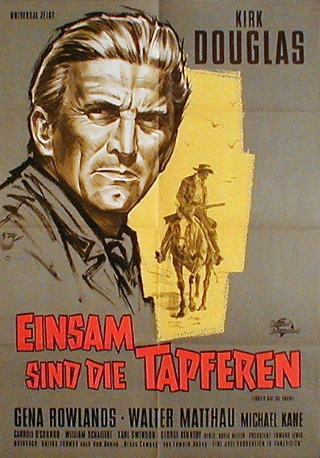
My previous post was a brief perusal of two westerns from just before what can be seen as the cut off point for the classic western era. As with most if not all the genre efforts from around that time, there’s that sense of trying to look in two directions at once. If we do take 1962 as marking the last year for the truly classical western, it’s also interesting to look at a movie from that year which not only retains a strong feeling for the legacy of the genre but is also one which cast ahead in a way I increasingly feel was the path that ought to have been followed rather than the self-defeating one that grew out of the Spaghetti and revisionist versions. The film in question? Lonely Are the Brave.
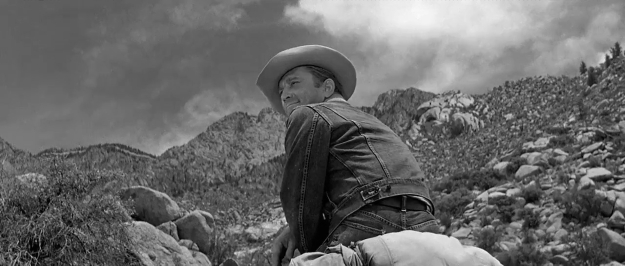
The opening scene perfectly encapsulates the paradoxical situation at the heart of the story. Is there anything more evocative of classical western imagery than that of a weary rider stretched out on the open plains, resting up after a hard ride and a long day, gently warmed by the glow of the camp fire he’s built next to him – a man at peace and to all intents and purposes practically a part of the landscape he inhabits and works? And then the jarring intrusion of the modern world, the boom and roar overhead, drawing our eyes and his upward to focus on vapor trails carved across the sky by a passing jet aircraft. The message is simple: the world has changed, inevitably so, morphing into one of noise and urgency, where the travails and pleasures of an earlier time have been supplanted by an updated variety, and the only frontiers still unconquered are those the marvels of technology haven’t quite reached yet. All of that raises a question too, namely whether these two perceptions of the world can co-exist, or whether one must naturally wipe away the other. By the end, the latter is very strongly indicated, but I’m not sure if Dalton Trumbo’s script has entirely closed the door on the former. Even in the ultimate tragedy lies a grain of hope, and perhaps no more than half a grain at that, reflected in the bittersweet admiration of a lawman who sees the futility and waste in the contemporary world’s need to impose itself on a free spirit. One could argue that the last shot heard in the movie represents the one which killed the western, a coup de grâce for a genre which was about to slip into sharp decline. I do think that is mainly what Trumbo was expressing, although I also reckon he left the door not quite ajar but still open just a crack.
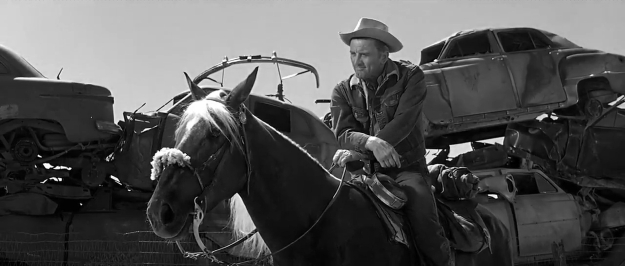
“A westerner likes open country. That means he’s got to hate fences. And the more fences there are, the more he hates them…Have you ever noticed how many fences there are getting to be? And the signs they got on them: no hunting, no hiking, no admission, no trespassing, private property, closed area, start moving, go away, get lost, drop dead!”
Whatever one’s opinion of the destination, the journey that gets us that point is a fascinating elegy to a myth. If the myth of the Old West had any meaning, it was as a celebration of freedom. Like all myths, however, this cannot be entirely true. Unfettered freedom is neither practicable nor possible once populations grow beyond a given point and societies, even on a rudimentary level, take hold. In the final analysis, there’s no getting away from the truism that one’s freedom extends only to the point where someone else’s begins. All of this is part of what makes the western such a compelling narrative vehicle. The entire concept has conflict built in, and conflict is the essential ingredient of drama after all. So many westerns have had as their foundation the idea of fences, be they physical or mental.
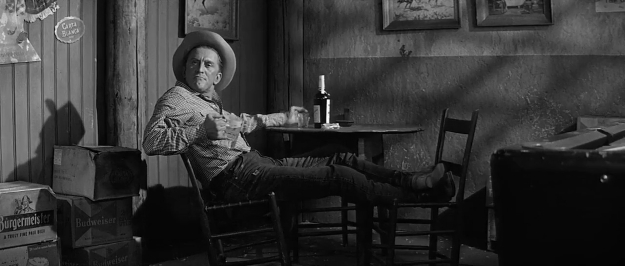
Jack Burns (Kirk Douglas) is one of the last holdouts against the relentless encroachment of contemporary life and the fences it brings with it. The first glimpse of the man confirms the impression of someone who is a walking anachronism. The attitude, appearance and lifestyle hark back to a time long gone, and his bemusement at the clamor and restrictions of the world around him makes the viewer wonder whether it’s one he has been dropped into rather than grown up with. His almost comical effort to navigate an insanely busy highway foreshadows the deeply unsettling conclusion of the picture, but it also serves to underline just how out of his depth this man is in the latter half of the 20th century. The film throws out these contrasts all the time – the way Burns is befuddled, abused and finally struck down by the brute force of modernity, juxtaposed with those scenes showing him in his element, resourceful and formidable in circumstances that favor his talents. Sure he sets himself up for difficulties in his efforts to make contact with his imprisoned friend (Michael Kane) but the way he falls foul of a bitterly aggressive one-armed man (Bill Raisch of The Fugitive) and then George Kennedy’s sour and sadistic jailer are more the result of his unfamiliarity with a world he shuns.
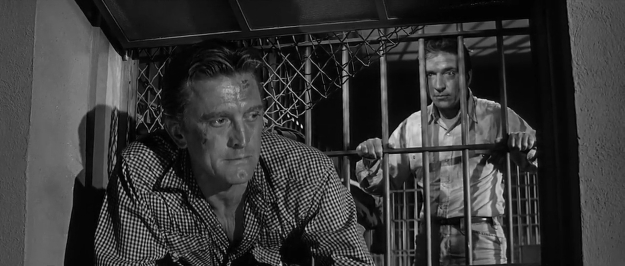
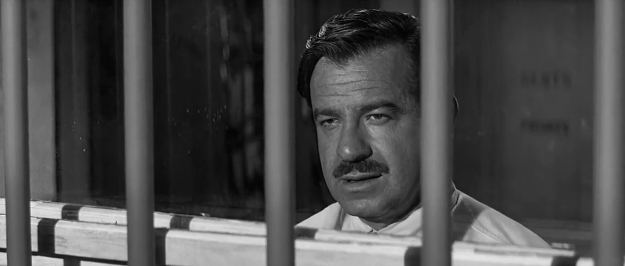
That world is one made up of prisons of various kinds. There is the literal one where his friend has wound up serving a two year sentence for trying to do the decent thing by some illegal immigrants, plus ça change indeed. Even Walter Matthau’s sheriff seems to spend a lot of time early on framed behind bars, albeit those set protectively into the walls of his own office. Always an immensely crafty performer, Matthau revels in the absurdity of life around him, musing on the enslavement of routine and regulation which even appears to extend to the neighborhood stray who marks his territory with near military precision on a daily basis. It’s a lovely character sketch, by turns dyspeptic and droll, and satisfyingly empathetic by the end.
Then there are the virtual prisons, those of their own making, which both Gena Rowlands and Kirk Douglas inhabit. She has locked herself into a marriage with a man who, by her own admission, she probably only half understands and from whom she is now unwillingly estranged due to his incarceration. Her affection, and maybe more, for Douglas is always apparent though in the little looks and gestures. The same applies to Douglas himself, the untamed loner who, like it or not, knows he’s beyond the point where he can change. In a movie ripe with poignancy, the touching little scene played out on the porch of Rowlands’ house before Douglas departs for the last time is superb – regret, longing and a love acknowledged and treasured yet still resisted all combine beautifully.
“Jack I’m gonna tell you something. The world that you and Paul live in doesn’t exist, maybe it never did. Out there is a real world and it’s got real borders and real fences, real laws and real trouble. And either you go by the rules or you lose. You lose everything.”
There is a great deal of loss in the film. At various points, dignity, freedom, and eventually even that tenuous hold we try to maintain on the past all are wrested from the grasp of the characters. This should mean it’s all relentlessly downbeat, but there are genuinely uplifting episodes sprinkled in among the grimmer ones. Douglas’ struggle up the rocky mountainside is an epic affair where his grit and cunning is put on trial repeatedly. It carries some of that Anthony Mann symbolism in the upward thrust, and the moment when he finally crests the peak and spurs “Whiskey”, his stubborn and recalcitrant mount, towards the treeline on the other side and the promise of salvation is truly joyous. What follows shortly afterwards is heartbreaking of course, but that neither negates nor dilutes the emotion captured in that instant.
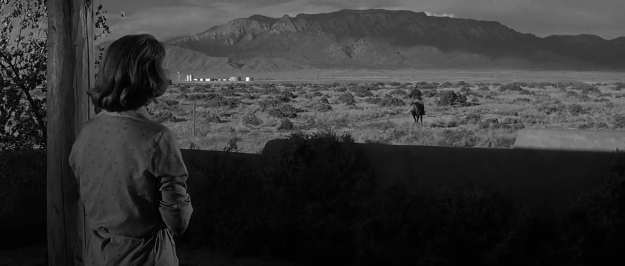
So where does all this leave the movie within the genre’s evolution? As with the other great westerns of 1962 – here I’m thinking specifically of Ride the High Country and The Man Who Shot Liberty Valance – a line is drawn beneath the genre, a sense of closure achieved. It makes its point about the doomed romanticism inherent in looking back, and if it doesn’t look ahead with positivity, it does underline the fact that progress cannot be halted. I found it interesting too to note that although the director of the movie David Miller was not someone associated with westerns – the only other he made was Billy the Kid decades earlier – it stands out as his best piece of work. I have wondered before now whether the western wouldn’t have been better served exploring its core themes in a contemporary setting once the classical era had passed, and it’s an idea I continue to find intriguing. Maybe the fact that recent years have seen the contemporary western enjoy considerable success via television, ironically the medium that once contributed to its slow demise, provides proof of that?
As an Amazon associate, I earn from any links to Amazon followed from the post or from comments below.
 Riding the High Country
Grrat post Colin – such a great film. I have a very decent German Blu-ray release but, must admit, really do need to be in the right mood for it.
LikeLike
Yes, I understand that. It’s a film that takes the viewer on something of a emotional roller-coaster and one does have to be prepared for that.
I probably have the same German BD as yourself – this one.
LikeLike
Possibly Kirk’s best film and a real gem. I’ve seen a number of times including at the BFI. My favourite “modern” western
LikeLiked by 1 person
It’s easily among his best, and he made a lot of good movies over the years. I’m rather envious of your having had the opportunity to view it theatrically.
LikeLike
Classic. Kirk made a few. Worthy of a rewatch any time it’s on.
LikeLike
Excellent review of this fascinating movie. I eventually need to upgrade my copy. I have it on a solid DVD collection that Universal put out which is a sort of instant Kirk set as it has this, ‘The Last Sunset’, ‘Man without a star’, ‘The War Wagon’, ‘Spartacus’, and ‘The List of Adrian Messenger’ plus a couple of others. Neat set.
LikeLiked by 1 person
This is another absolutely splendid review of one of the classic neo-westerns, Colin. The writing, direction, and cast bring it to top, matched only by your analysis of the film of why it stands up so well decades after its release. Well done, my friend.
LikeLiked by 1 person
Kudos, Colin, for a very eloquent and elegiac write-up for the Western as we once knew it.I saw “Lonely are the Brave” at a theater in 1962. That same year, I journeyed across the U.S.A. by car with my family. We traveled on a lot of two-lane roads, passed through small towns (“There’s a car from Massachusetts,” a kid in Iowa yelled), endless cornfields (the corn does get as high as an elephant’s eye), miles of salt flats, and over the Rockies. An elk sauntered in front of our car, and I saw a fish leap out of a river at twilight. I even saw and heard real cowboys bantering. There were no malls, no chain restaurants, and very little to obstruct one’s view. In a few short years, capturing this somewhat idyllic view of America would no longer be possible.
Not to put a stretch on it, but for me, it is interesting that 1962 marks the close of the era for classic Westerns. For in 1962, I personally witnessed the end of an era when one could travel 3,000 miles on mostly lazy roads, free from the blight of crass commercialism and the tyranny of speed.1962 was a lifetime ago. I think it’s time to watch “Lonely are the Brave” again.
.
LikeLiked by 1 person
Frank, I really enjoyed reading your on the road reminisce of what you experienced in 1962. Believe it or not there are still places out here in the hinterlands “free from the blight of crass commercialism and the tyranny of speed.” Of course, you have to get off the interstate highways. We still have a family-owned full-service grocery store in my neck of the woods. Beautiful scenery and wildlife galore can still be found here abouts. I feel fortunate in being able to live here north of the Buffalo River.
LikeLiked by 2 people
Thank you, Walter. I’d love to make the drive across country again.
LikeLike
Frank, your welcome. I would like to drive across country also, but you know how it is regarding age and health. Time waits on no one.
Times have changed even where I live. For good or bad we have Wal-Mart to thank for a lot of the changes and the Big Agri conglomerates Cargill, Archer Midland Daniels, Tyson, and ConAgra(we used to be independent contractors with that outfit). Of course Hi-Tech and its uses have changed our world forever. Our generation has seen a lot of changes since the end of World War II.
LikeLiked by 3 people
Well said, Walter.
LikeLike
If anyone wants a tremendous idea what America was like in the mid 20th century I would highly recommend John Gunther’s ‘Inside USA’. It is a fantastic book that covers the continent with fairness and facts plus good writing.
LikeLiked by 1 person
Chris, John Gunther’s INSIDE USA(1947) describes the 48 states from his travels from November 1944-December 1945. The USA has changed so much since those years and it’s a different world, especially just west of where I live. Northwest Arkansas has become a global economic powerhouse and currently it’s ranked as the number 1 best-performing large metro area in the United States by the Milken Institute, outperforming major areas like Austin, Texas and Raleigh, North Carolina. Gunther described the Ozark region of 1945 as, “one of the most mysterious and least known parts of the USA.” He went further to describe the region as a, “depressed area that lacked the industrial development and modern infrastructure seen in the rest of the USA.
Yes, things have changed fast and furiously since John Gunther’s book was published in 1947. Especially in my neck of the woods since the 1980’s.
LikeLike
48 states were the right size.
LikeLike
Barry, I see your point, but we wouldn’t want to lose Alaska, Hawaii, and the 14 territories that are under the USA Flag. Also, I think the Cuban people would have been much better off with the USA instead of being under the Hammer and Sickle.
Looks like I’ve ventured off the subject of LONELY ARE THE BRAVE and movies in particular.
LikeLike
As territories, yes, not states. Remember Dinah Shore and her Chevy Show? Every state in the forty-eight is great.
Barry
LikeLike
Barry, yes, we don’t need any more states. Fifty are a plenty and I remember Dinah Shore’s wonderful song “See the U.S.A. in Your Chevrolet.”
LikeLiked by 1 person
For me the best example of exploring core western themes in a contemporary setting is Peckinpah’s Junior Bonner. And unlike revisionist westerns it’s more than an exercise in self-pity or an adolescent attempt to deconstruct and trash the genre.
LikeLiked by 1 person
Dee, I agree with you about JUNIOR BONNER(filmed 1971, released 1972).
LikeLike
Well observed.
LikeLike
I’ve always loved this movie. And have seen it many times since first release, most often in a theatre through the 1960s where it would occasionally play and I’d go again.
Not as much in recent decades but I made a point to get back to this film and the other two 1962 movies mentioned in 2022 as a 50th anniversary celebration.
I’ll make one observation about those three. The elegiac tone and themes (at least in my memory) likely just seemed individual to those movies at the time. I don’t think we thought that “This is the year the classical Western is ending” and that the West itself, along with the genre, was crying out for this kind of soulful elegy. As the Western struggled on in the middle 60s in that transitional period and then could clearly be felt as different by the end of the decade, it probably all became clearer.
This is a thoughtful piece and I don’t feel I need to add much, but just a few comments. First, I especially liked this:
“…the moment when he finally crests the peak and spurs “Whiskey”, his stubborn and recalcitrant mount, towards the treeline on the other side and the promise of salvation is truly joyous. What follows shortly afterwards is heartbreaking of course, but that neither negates nor dilutes the emotion captured in that instant.”
The moment at the crest of the peak you describe is the moment of highest emotion for me in the movie–and was surely intended to be–it’s perfectly realized and what drew me back to it so much and I agree with you that it’s not diluted by the heartbreaking end.
So, along these lines, I just want to observe that I believe this is the movie that put composer Jerry Goldsmith on the map. He’d been around and done some good scores (including on an outstanding Western Face of a Fugitive in 1959) but there is something so haunting about the main theme (especially) of this because he is able to make it both exhilarating and plaintive depending on the scene (those two scenes especially show this) and that’s true from the beginning. He wound up with lots of good scores but for me this always remained the most memorable one.
A few other things: I love black and white cinemascope (meaning anamorphic–I know this is Panavision), a great format for this film.
David Miller–I’ve seen a lot of his films. I agree this is his best, by far his best. I’m an auteurist but one who feels that a director may be more engaged and the best part of their sensibility may come out with certain projects, so I feel that’s what happened. He is not great to me for his whole career but I give directors credit for their best work and will value them for it. He caught the mood of the landscape and gathering emotion of the action beautifully, understood the story well, and so was a fortuitous choice.
It’s pretty well known that Kirk Douglas liked this best of all his movies. That’s saying a lot because he is in a lot of memorable movies, including some wonderful Westerns before this–but I understand his feeling this way. He’s wonderful in it, loved the character and was still able to play him in a complex way. You like him, but understand that it may be a weakness of a kind not to adapt well to a changing world. That’s a weakness that I can understand and relate to. Perhaps many of us can.
***
Just will say also that among these comments I enjoyed Frank Gibbons’ reminiscence of his journey across America back in 1962.
LikeLiked by 2 people
The film is based on Edward Abbey’s second novel, The Brave Cowboy. Abbey — environmentalist, hellraiser, anarchist — put a lot of himself into his hero. His later and more famous novel, The Monkey Wrench Gang, might be considered a modern Western. It has often been mooted for filming. Since its theme — a plot to blow up the much-loathed Glen Canyon Dam — might be deemed ecoterrorism, there has been an understandable corporate resistance to the project.
LikeLiked by 1 person
Roza, have you read THE BRAVE COWBOY: AN OLD TALE IN A NEW TIME(1956)? I read it back in the 1990’s. The old unrepentant communist Dalton Trumbo actually toned the screenplay down from the novel. Both Jack Burns and Paul Bondi were anarchists in the novel. Trumbo made Burns a non-political rugged individualist rebelling against an encroaching modern world. Paul Bondi was going to prison for resisting the draft in the novel, but Trumbo changed that to helping illegal Mexican immigrants.
I haven’t read THE MONKEY WRENCH GANG(1975), which is an inspirational novel to the eco-terrorist movement, which Edward Abbey inspired, such as Earth First, because their tactics involve illegal acts of property destruction. Abbey called it eco-sabotage or Monkey wrenching.
LikeLiked by 2 people
Colin, a good, interesting, and thoughtful write-up of the contemporary Western movie LONELY ARE THE BRAVE(filmed 1961, released 1962). I first viewed LONELY ARE THE BRAVE in 1967 on the NBC SATURDAY NIGHT AT THE MOVIES. At the time, I really liked it because it was a contemporary Western and starred Kirk Douglas. I’ve always liked contemporary Westerns since I was a youngster watching TV shows like THE ROY ROGERS SHOW(1951-57), SKY KING(1952-53, 1956-59), THE SHERIFF OF COCHISE/U. S. MARSHAL (1956-60), and STONEY BURK(1962-63) in syndicated reruns during the 1960’s. Kirk Douglas was Doc Holliday in GUNFIGHT AT THE O.K. CORRAL(filmed 1956, released 1957) and I’ve been a fan ever since I first saw it on the NBC SATURDAY NIGHT AT THE MOVIES in 1965. After watching LONELY ARE THE BRAVE I liked Gena Rowlands and Walter Matthau.
LONELY ARE THE BRAVE was considered a box office failure in 1962, but when the movie had its television premiere February 18, 1967, on the NBC SATURDAY NIGHT AT THE MOVIES it placed #10 in the Nielsen ratings for that week, which meant that 14.45 million households tuned in to watch this very entertaining “Changing Times End of an Era Neo-Western.” So, how many is in an average household 3? 4? Anyway, that’s a lot of possible viewers. I think that this was probably the beginning of its resurgence and reappraisal. I caught it again when it was rerun on July 1, 1967. The movie was aired a lot on local TV stations thereafter, and I watched it when WREC Channel 3 would air it, which they did a lot from 1969 onwards. After a viewing in 1977 it was nine years before I saw it again in 1986. Good old WREC Channel 3 again, but this time around I taped it and it was a ragged print with white dots and lines, but back then you took what you could get.
I was now an adult viewer and watching it in a different way and probably because of my own personal life experiences, education(both academic and self), and common sense it now had a different meaning to me as an Individual. I still think it’s a well-made movie with wonderful black and white photography by Philip Lathrop. The acting performances are really good, and the dialogue is sharp within some memorable scenes. The music by Jerry Goldsmith is memorable. Also, I think Whisky(Bronze Star) the horse gave a good performance. When all is said and done, I think LONELY ARE THE BRAVE is an offbeat downbeat pessimistic story of a man out of his time rebelling against modern society in a western setting. I think the movie is about a loner non-conformist and the movie tells us this in a touching scene between Jerri(Gena Rowlands) and Jack(Kirk Douglas) where he explains to her what he is, “Know what a loner is? He’s a born cripple. He’s a cripple because the only person he can live with is himself.” So, John W. Burns, Jack, for short is a “tragic anti-hero” whose extreme independence makes him an “anachronism” with his “uncompromising” free-will spirit which makes for a “pessimistic modern western tale.” This leads to Jack riding Whisky over the mountain headlong into the modern world which crushes the extreme individual.
I like your statement pertaining to LONELY ARE THE BRAVE, “retains a strong feeling for the legacy of the genre but is also one which cast ahead in a way I increasingly feel was the path that ought to have been followed rather than the self-defeating one that grew out of the Spaghetti and revisionist versions.” I like your statement, but we’ll have to agree to disagree on the movie chosen for the pathway. LONELY ARE THE BRAVE is a masterly done subversive movie. I’ll have to agree with Dee in that JUNIOR BONNER (filmed 1971, released 1972) written by Jeb Rosebrook and directed by Sam Peckinpah is a better pathway. Too bad Peckinpah’s movie wasn’t made ten years or even five years before.
This is just my personal opinion, and I think it’s best left up to the individual viewer what to take away from LONELY ARE THE BRAVE.
LikeLiked by 1 person