Party Girl

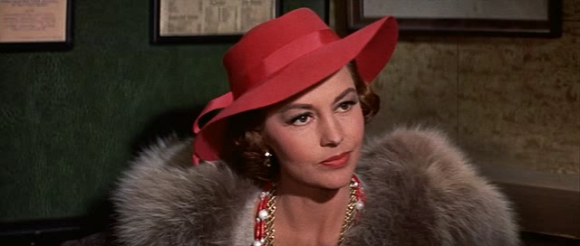
Last time, I had a look at a gangster/noir crossover movie, an early example of the emergence of a darker sensibility in crime movies in Hollywood. Let’s jump ahead almost two decades, to the point at which film noir was nearing the end of the classic cycle. Again, the film in question is something of a hybrid, a fusion of styles and influences, but the principal elements remain the gangster story and shadowy world of the dark cinema. A lot of film noir throughout the 1950s featured the involvement of organized crime so Party Girl (1958), despite abandoning the more usual contemporary setting, can be viewed as a continuation of that trend. Having said that, the movie could be classed as a marginal entry – it’s shot in lurid technicolor and at times resembles a hard-boiled variation of the classic studio musical. However, in spite of what sound like stylistic contradictions, Party Girl is categorized by many writers as a genuine film noir, and I guess its themes do have the requisite darkness and ambiguity to qualify it for inclusion.

Chicago in the early 30s – Tommy Farrell (Robert Taylor) is a mob lawyer, and a successful one. He’s respected and feared by judges and prosecutors not simply due to his connections but because he’s the top man in his line. Farrell is first glimpsed at a party thrown by crime kingpin Rico Angelo (Lee J Cobb) – actually it’s as much a wake as a party since Rico is laying to rest a broken heart on hearing the news that Jean Harlow, whom he’s adored from afar, is to be wed – and he’s surrounded by a group of city dignitaries hanging onto his every word. One might assume that Farrell has it made, but this is only the silver lining obscuring the cloud. Farrell is almost a cripple, his hip and leg twisted as a result of a youthful escapade gone wrong. It is often the case in movies that physical imperfections are mirrored by deeper psychological scars, and so it is with Tommy Farrell. This man who glides effortlessly through the powerful social milieu in spite of his pronounced limp is emotionally wounded. His beautiful but callous wife left him since she couldn’t overcome her disgust at his physical deformity, and Farrell has been unable to heal that emotional wound. However, his rehabilitation begins at Rico’s party when he agrees to escort home Vicki Gaye (Cyd Charisse), a dancer and one of the “party girls” hired for the evening. Although the evening ends with a rather gruesome discovery, Farrell and Vicki do make a connection that will blossom despite a few bumpy stretches along the way. The whole movie is principally concerned with Farrell’s rediscovery of his self-respect after years of loathing himself. Running parallel to the developing relationship with Vicki is the thread that follows Farrell’s attempts to distance himself from Rico and the corrupt and violent world he inhabits. Just when it looks like the hero may have achieved the spiritual peace he’s long been seeking, Rico’s machinations and threats haul him back to defend one of his paymaster’s psychotic associates. However, having had a taste of life beyond the cheap neon glamour of the underworld, Farrell is determined to get out for good. The trick is to find a way to protect Vicki, bring down Rico, and save his own skin at the same time.

Nostalgia for certain periods tends to come in waves, and the late 50s saw a resurgence of interest in the old gangster movies. Party Girl tapped into that vibe and director Nicholas ray added his own personal touch to it. Ray only made a handful of noir pictures altogether – all are interesting in their own way, and two (In a Lonely Place and On Dangerous Ground) are pure bred classics. All of Ray’s best movies dealt with those who were in some way removed from the mainstream of society, and Party Girl follows that template. Farrell is superficially a man at the heart of city life. Yet, he’s an outsider in every sense; a lawyer who essentially makes a mockery of the law, an apparent mob insider who is revolted by the crassness and brutality around him, and a man bedeviled by his own sense of inadequacy. Aside from the fact that the mobsters and hoodlums who populate the film are themselves social pariahs, Vicki is another character existing at the periphery of decency. The struggle which Farrell and Vicki undertake to break free of the dark influences that threaten to drag them down is classic Ray material. Another feature common to Ray’s work, and seen in abundance here, is the unrestrained use of color. Party Girl is a riot of technicolor hues that seem to allude to the heightened emotional state of the characters.

Even though I’m a great admirer of his work in general, I think it’s fair to say Robert Taylor gave an excellent performance as Farrell. As he aged, and his looks took on more character, he did some first-rate work in westerns, and the same can be said about his noir pictures. He brought a dour toughness to his role as the tortured lawyer, and worked well with Charisse. For her own part, Charisse adopted the right kind of world-weary air that befits a woman who has spent her time dodging unwanted passes and living off dubious handouts in seedy nightclubs. She was of course an immensely talented dancer, one of the greats, and the movie features a couple of set piece numbers designed to show off her moves. With the club setting, and her character’s profession, these sequences are blended seamlessly into the narrative. They may capture the look and feel of a musical yet they never have that jarring, artificial sense that such movies frequently evoke. The other big hitter in the cast was Lee J Cobb. This was an actor who could explode out of the screen at times, his inherent power always in danger of turning into bombast. In Party Girl, Ray managed to get the right kind of balance from Cobb for the most part. Sure there are instances where he drifts awfully close to scenery chewing, but there are some quietly effective moments too – his chat with Taylor where he blackmails the lawyer into cooperating under the threat of disfiguring his girlfriend is all the more chilling due to Cobb’s restraint. The supporting cast was headed up by the ever reliable John Ireland as Cobb’s slimy and dangerous right hand man. Also featured were Kent Smith – despite his long and varied career, I’ll always associate him with one of his earliest roles in Val Lewton & Jacques Tourneur’s Cat People – as the straight arrow prosecutor, and a manic Corey Allen as the unbalanced hood Cookie La Motte.

For a long time, Party Girl wasn’t the easiest movie to see. However, it has been released on DVD in France and Spain and as a MOD disc via the Warner Archive in the US. I have the old French Warner Brothers DVD which is pretty good. The film is presented in anamorphic scope and the print used for the transfer seems in good shape. There’s plenty of clarity, the colors are strong and quite vibrant, and damage (if there is any) is so slight I can’t say I noticed. There are no extra features on the disc – subtitles are optional and can be disabled via the setup menu. The blending of styles and genres just about works in the movie, drawing in elements of melodrama, the musical and a crime tale to create a fairly unique film noir. Aside from a trio of good performances, what holds the whole thing together is the direction of Nicholas Ray. In the hands of a lesser director, the disparate elements could well have pulled the movie apart. As it stands, Party Girl remains one of Ray’s interesting experiments which I feel more or less succeeds. Of course much of this depends on how one reacts to Ray as a filmmaker; as such, it’s another of those films that I’d cautiously recommend.

Johnny Apollo

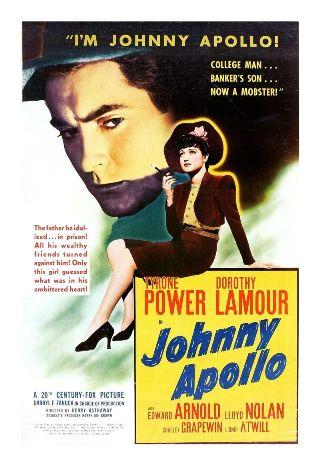
It seems that I’m drawn back, time and again, to what we can term transitional works, be they westerns or any other genre. I suppose that reflects my own interest in observing the general shape of cinematic development, and the progress of popular culture overall. The more hyperbolic aspects of marketing might like to encourage the perception that new styles or movements suddenly explode onto the scene without warning and forever change the face of entertainment. However, that’s not the case at all, and I doubt it ever will be. No, all things grow out of and build upon what came before, some in a more radical fashion than others. Film noir was the great game changer in Hollywood in the 1940s, and it’s evolution fits the trend I’ve mentioned here. The French critics of the post-war period may have noticed what looked to them like a dramatic new direction in cinema after years of being starved of new US movies. Still, that was just an altered perception resulting from a unique set of circumstances; film noir took form just as gradually as any other cinematic movement. Johnny Apollo (1940) is one of those movies that shows the transition happening, borrowing heavily from the socially aware gangster films of the 30s and blending in the makings of a darker, more fatalistic tone.

The film follows the ups and downs of Bob Cain Jr (Tyrone Power), a carefree member of the wealthy elite who sees his life take a dramatic downward turn. The opening is pure 30s, as a frenetic Stock Exchange suspends trading amid accusations that Cain Sr (Edward Arnold) is an embezzler. This fact, along with his father’s indictment and subsequent imprisonment, leaves the younger Cain in a spot. His privileged upbringing has left him unprepared for such a rapid downfall. His initial reaction is a combination of naivety and a kind of spoiled petulance – how could his father disgrace him and damage his social standing in such a way? At this point, we’re looking at a deeply unsympathetic character, and I think one issue with the film as a whole is the fact that this initial selfishness is never quite overcome. However, Cain Jr soon feels the chill wind of reality as his attempts to make his way in the world get scuppered again and again by his father’s new notoriety. It would appear that all those friends and contacts were all of the fair weather variety. In one curiously satisfying twist, Cain finds himself shown the door by a boss who finds his concealment of his identity particularly distasteful – his own old man having died a drunk in prison. So, with his options running out fast, Cain finds himself drawn into the shady underworld of Mickey Dwyer (Lloyd Nolan), a big-time gangster. It’s here that Cain undergoes a major transformation, adopting the pseudonym Johnny Apollo and using every illicit means at his disposal to rise through the ranks of the underworld, all in the hope of securing his father’s release from prison. Personally, my biggest problem with all this is the matter of plausibility. Gangster movies of the classic 30s period did see honest men drawn into a life of crime by a mixture of social pressure and a desire to strike it rich. The crucial difference though is that those 30s movies generally featured lower class guys whose choices were dictated by their poor backgrounds. Johnny Apollo asks the viewer to accept that such circumstances could lead the wealthy down a similar path. Frankly, I have a hard time buying into that idea, and although the incongruity does recede somewhat as the story moves along it’s difficult to shake it off completely.

Was Henry Hathaway one of the most versatile directors ever? Even a brief scan of his credits would suggest that he may well have been. Hathaway’s career was long, varied and successful, with examples of top class work in just about every genre. It seems that to be considered among the great director’s one needs to have either a recognizable motif, or to have concentrated in one particular genre. Hathaway was one of those thoroughgoing professionals whose dedication to his craft seemed to preclude any of the personal touches we associate with the more highly regarded figures in cinema. From a critical perspective, it was also his misfortune to be such an adaptable filmmaker – it’s much more difficult to put any kind of personal stamp on movies when the style varies so greatly. However, Hathaway remains one of my favorite directors, and I don’t think I’ve ever been completely disappointed by one of his movies. Johnny Apollo is well shot throughout, but the jailbreak finale is probably the real highlight and really ramps up the excitement. Unfortunately, from my point of view anyway, we get a coda tagged on which looks like it’s just there to provide a weak happy ending.

While I’ve admitted that I’m not altogether happy with the plausibility of the central character’s development, I can’t lay the blame for that at Tyrone Power’s feet. I feel he managed to nail the shift quite effectively – from fresh-faced enthusiasm to dismay, and finally a kind of ruthless single-mindedness. His interaction with Edward Arnold was well handled too, and this is crucial since the father son dynamic, and expectations of each, forms the basis of the story. Arnold had the more sympathetic part though; he may be an actor we don’t normally think of in such a light, but he brought a great deal of quiet dignity to his role as the fallen tycoon. However, as is often the case, Lloyd Nolan nearly steals the picture from under everyone’s noses. Nolan was a terrific actor, whose distinctive delivery and likeable demeanor, even when he was being vile, always adds something special to a film. In Johnny Apollo, Nolan was vicious, mean and hypocritical, but you can’t help rooting for him just a bit. I find it difficult to think of Dorothy Lamour without recalling her films with Bob Hope and Bing Crosby. She’s good enough as Nolan’s put upon moll, and Power’s object of desire, but the Hope and Crosby connection makes her seem a little out of place in a straight drama like this. I’ll add a word of praise too for fine supporting turns from Lionel Atwill, Marc Lawrence and, most particularly, Charley Grapewin.

I’m pretty sure Johnny Apollo was only ever released on DVD in the US as part of a Tyrone Power box set from Fox. I never picked up that set since the other movies contained didn’t especially appeal to me. Instead I bought the movie when Bounty in Australia put it out as part of their noir line. The film is licensed from Fox and boasts a very strong transfer – it’s sharp, clean and has good contrast levels. The disc is a bare bones effort though with no extra features at all offered. Even though Bounty have marketed the film as noir, as I said in the introduction, this is very much a transitional picture. Frankly, the whole thing has more in common with 30s movies, but the seeds of noir are there too, with the last third delving deeper into the ambiguities of dark cinema. If the film is approached purely as a film noir then it’s likely to prove disappointing. Viewed as a kind of bridge in the evolution of the thriller, it’s altogether more satisfying.

Powder River

Seeing as I’ve reviewed the majority of the movies which directly featured the character of Wyatt Earp, I thought I might as well have a look at Powder River (1953). Even though this film does not have any character by the name of Earp in it,  that’s where the inspiration comes from. Stuart N Lake’s book Wyatt Earp: Frontier Marshal is probably the most influential source helping to shape the legend which grew up around the famous lawman. Powder River is yet another adaptation of that book, and Lake is credited on screen as the author. However, for whatever reason, none of the real names of characters are used – perhaps Fox just didn’t want another Earp movie at that particular time. Anyway, the film represents another retelling of the Earp/Holliday story though it puts a slightly different spin on the central relationship, one that I’m not sure is altogether successful.

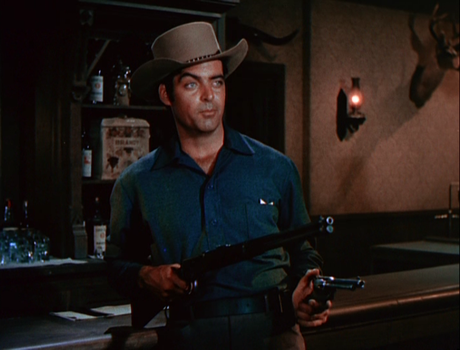
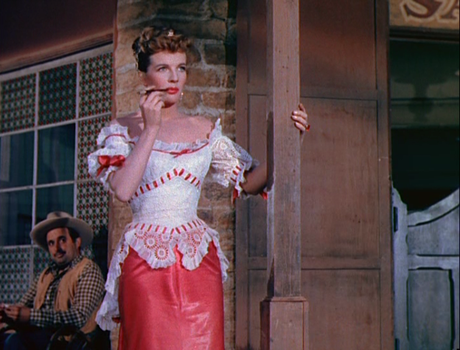
In this version of the story the Earp character becomes the colorfully named Chino Bull (Rory Calhoun). Chino – I’m sorry, but I’m not going to write a piece continually referring to a man as Bull – is a former lawman who has grown weary of the violence that goes along with that profession and has decided to try his hand at prospecting. A quick visit to town to pick up supplies leads to two events that combine to alter Chino’s chosen path. Firstly, some unplanned heroics connected to a can of peaches and a gun-happy drunk see him offered the job of town marshal. While he’s initially uninterested in putting on a badge again, a return to camp and the discovery of the fact his partner has been murdered and robbed brings Chino back to town, and back to his old life. As the newly appointed marshal, one of his first official acts is to crack down on crooked gambling and rigged tables. This means the temporary imprisonment of Frenchie Dumont (Corinne Calvet), the proprietor of one of the town’s saloons and gambling houses. This in turn sees the introduction of the Doc Holliday figure, here renamed Mitch Hardin (Cameron Mitchell). Hardin has a fearsome reputation as a drinker and a gunman, and also happens to be Frenchie’s man. Although Chino and Hardin butt heads to begin with, the former’s cool self-assurance wins over the gunman. As such, the central relationship, based on mutual admiration and respect, is established in a fairly familiar way. Now most Earp/Holliday films have concentrated on the friendship of the two men and how it is tested and then cemented by the feud with the Clantons. Powder River diverges from that formula somewhat by bringing in an insipid romantic triangle, the rivalry and distrust of a professional gambler (John Dehner), and a damaging secret which Hardin is harboring. I’d say that the extent to which the film works for the viewer is heavily dependent on how far one is able to buy into these aspects.

Anyone familiar with the Earp/Holliday movies will immediately recognize the characters of Chino and Hardin are only the thinnest of disguises. In addition there are sequences that directly mirror some of those in Dwan’s Frontier Marshal and Ford’s My Darling Clementine. Director Louis King had a long career, but he was no match for either Dwan or Ford. Having said that, King’s work on Powder River is by no means poor – it simply lacks the flair that Dwan or, more especially Ford, were able to achieve. Much of the action is confined to the town and interiors, but there are occasional scenes shot on outdoor locations. These exteriors are generally attractive, and one in particular, an attempted hi-jacking of a ferry carrying a stagecoach, is very well shot. The movie is largely a character driven piece, but King handled the action quite effectively whenever it does come along.

I like Rory Calhoun in westerns, and I think I’ve mentioned this before, he just seemed comfortable in the genre and frontier parts were a good fit for him. I feel the right word to describe his performance in Powder River is confident. Calhoun spends much of the running time unarmed, his character’s preference, and is never less than convincing as a man with enough self-belief and force of personality to keep the peace without resort to weapons. On the other hand, Cameron Mitchell is rarely seen without his custom rig. Again, this is entirely appropriate for a character living mainly on his nerves, and who has built a reputation for himself as a killer of men. Mitchell was a good enough actor, and gave some fine performances over the years, however, he didn’t have a huge amount of charisma. The Doc Holliday figure is one of the most interesting and, from an actor’s point of view, one of the more rewarding roles offered up by westerns. Almost all the performers who have played this part at various times have created something memorable. Of all those I’ve seen, Mitchell’s take on the role was among the least satisfactory, for me anyway. I can’t say he did poorly; he certainly got across the self-loathing aspects of someone who has witnessed his life take a route he had never intended. To some extent, the problem stems from the character arc Hardin goes through, but that’s not it all either. Ultimately, Mitchell’s performance never quite measures up to the other screen depictions of Doc Holliday – it may be a little unfair to compare performances in this way, but it’s hard not to. John Dehner was a man who always brought a touch of class to his parts and his name among the credits is something that I look forward to. He has a medium size role in Powder River, and I think the film would have benefited had he been given a bit more to do. There are two female parts in this production, those of Corinne Calvet and Penny Edwards. Of the two, Calvet did by far the most interesting work, coming across as tough, sexy and sassy from her very first appearance. In contrast, Penny Edwards just feels very colorless, and her romantic involvement with Calhoun and Mitchell never catches fire or is the least bit convincing.

Rory Calhoun hasn’t been all that well served on DVD, with the dearth of titles being especially noticeable in the US. Generally, he’s fared a bit better in Europe, and Powder River has been released on disc in Spain by Fox/Impulso. For the most part, the transfer is quite good. This is an extremely colorful movie and the Spanish release reproduces that aspect pretty well. It can appear a little dark at times, notably during interior scenes, and there is some mild flickering on occasion although none of that is particularly distracting. The disc allows the Spanish subtitles to be disabled via the setup menu, and extras are the usual gallery and a few cast and crew text pages. Powder River is a modest western, never straining to overreach itself and delivering reasonably satisfying entertainment. Personally, I’m always up for another version of the Earp/Holliday saga, and I do appreciate the fact that the filmmakers tried to bring something slightly different to the table with this movie. However, while the attempts to alter the dynamic of the relationship between the two leads is interesting, I don’t honestly think it works that well in practice. There are a handful of good performances and the film is worth checking out, but it never seriously challenges the better Earp movies.

Cattle Empire

poster55-1_zps9932ccc6

The trail drive, like the wagon train, is a regular feature of westerns. Long treks across hard, unforgiving territory where adversity must be challenged and overcome play a significant role in the romance of the old west. Such stories provide ample scope for a wide range of dramatic situations, typically involving hostile elements and/or natives. However, I’d argue that tensions resulting from the group dynamic in these kinds of stories is more compelling than any threat arising from without. The forced interdependence of those on the journey, paradoxically limited in their ability to act alone despite the apparent freedom afforded by the vast space around them, is what generates the drama. This dramatic potential is further heightened if the travelers already have some history of conflict prior to setting off. That’s the basic concept behind Cattle Empire (1958), a taut and edgy tale of a group of people asked, out of economic necessity, to put their mistrust and hatred of each other behind them in order to achieve something that will ultimately benefit them all. The layers of the plot are cleverly revealed in stages, drawing the viewer into the story in the process, and contain enough twists to keep one guessing.

When a film has a relatively short running time, it’s vital to grab the attention as early and as effectively as possible. Cattle Empire hits that target right from the opening shot. The residents of the town of Hamilton, hard-faced and embittered, are ranged in a circle on the main street. Lying in the centre of this circle of resentment is the figure of a man, hands bound by a rope that’s attached to the saddle of a horse. At a signal, the rider spurs his mount and the hapless victim is dragged over the rough ground. The punishment continues, the friction shredding the man’s clothes and slicing his flesh mercilessly. However, intervention arrives in the shape of a buckboard carrying three passengers. Ralph Hamilton (Don Haggerty), the man who gave the town its name, demands that the torture end before the victim is killed outright. It’s only with the greatest reluctance that the townspeople abandon their sport and the bloodied figure gains some respite. This half-dead man is John Cord (Joel McCrea), a former trail boss returning to town after spending five years in prison. But for the good citizens of Hamilton, five years of incarceration isn’t enough to repay Cord’s debt. When Cord was last in town the cowboys working under him went on a drunken rampage that left the both the place and its people deeply scarred. That damage is still visible: a business burned to the ground, a man who lost his child, another who lost an arm, and Ralph Hamilton who was robbed of his sight. Given all that had happened, why would John Cord come back to a town with plenty of reason to hate him. Well the reason is he was invited back, by Ralph Hamilton no less. Hamilton, and many of the townspeople, has everything tied up in a herd of cattle and faces financial ruin unless he can get his stock to sale ahead of a rival. And that’s his proposition for Cord, a trail boss of some considerable renown – get the herd to market first and, in so doing, wipe the slate clean. In this, we already have an interesting premise, but it grows ever more complex as the drive gets underway. In addition to the fact that Hamilton’s wife (Phyllis Coates) was once Cord’s girl, there’s the question of what the real motivations of these men are. And perhaps most important of all – whose side is Cord actually on?

Cattle Empire is very much concerned with the mystery of Cord and Hamilton’s past; right from the outset it’s clear that whatever happened in the town five years previously has effected these two deeply, to the point of leading both to objectively odd behaviour. The townspeople are forthright in their desire for vengeance, while Cord keeps us unsure as to how he plans to act and Hamilton initially seems positively sainted. That oddness suggests that there’s something lurking beneath the surface, and the script wisely keeps the viewer guessing for as long as possible. Ultimately, everything boils down to that staple of the western, and particularly those made in the 50s – the quest for a form of spiritual salvation. Virtually everyone in the movie is seeking atonement for their sins of the past, the shadows of a half-concealed guilt looming large in the hearts of all.

Charles Marquis Warren may not be a familiar name to many these days. However, his contribution to the western on both the big and small screen is significant. While his directing credits are modest in number, his work as a writer and producer does stand out, especially Gunsmoke and Rawhide on television. As the director of Cattle Empire, he did a fine job in my opinion. The film is well paced and packs plenty of incident into its tight running time. The action scenes have a strong sense of urgency about them, and Warren controls the camera carefully to ensure they have as much impact as possible. Generally, he handled the wide, scope lens effectively throughout. The early sequence in the town features some fine composition and placement, and the exteriors and location work that follow make the most of the wide open spaces. The climactic shootout among the boulders of Lone Pine is excellently staged and exciting.

In terms of performances, Cattle Empire is well and truly dominated by Joel McCrea. One of the film’s great strengths is the way the character of John Cord is introduced as a villainous figure, the subject of scorn and hatred. The ill-treatment he endures stoically and his subsequent actions indicate that he’s not an entirely bad man, perhaps even one that the viewer can sympathize with. Yet he remains somewhat ambiguous until the climax, and it’s hard to be sure of his real intentions. At every point though, McCrea exudes a kind of wounded nobility, a belief in himself which has you rooting for him even if you can’t completely dismiss the doubts. He also handles the romance angle well; it would be unseemly to lust too openly for the wife of a man you have blinded, even if that woman was once your own. McCrea conveyed the internal struggle that such a situation would be bound to provoke quite deftly, all the while coping with the growing affections of the young girl (Gloria Talbott) who has hero worshiped him all her life. Of the two women, Talbott has the smaller role but manages to create the more endearing and lovable character. In contrast, Phyllis Coates comes across as slightly cold and calculating in her dealings with both Cord and her husband. Of course, for Coates and Talbott, the script pretty much dictates how their respective roles had to be played. The other notable part is that of the blind cattleman played by Don Haggerty, and it’s an important one. If McCrea was to hold onto that air of suspicion that surrounded him, it was necessary to have him faced off against a man whose situation immediately drew sympathy. Without wishing to present any spoilers, I’ll just say that Haggerty’s performance was as considered and subtle as McCrea’s, and thus ensured that the suspense was maintained for as long as possible.

To date, Cattle Empire has not received a DVD release in either the US or the UK. However, there is a particularly fine edition available in Spain from Fox/Impulso. The film has been given an excellent anamorphic widescreen transfer which boasts fine colour. The print used was evidently in especially good condition, there’s no damage of any consequence to be seen and it’s consistently sharp. The disc allows subtitles to be disabled on the original English soundtrack, and extras are a short gallery and some text screens on the cast and crew. I don’t expect this is a particularly well-known film, but it is a very satisfying and entertaining one. It takes a fairly standard western situation, the trail drive, and puts an interesting spin on it. Contrived romances can drag a movie down, but Cattle Empire avoids that by artfully weaving its variation into the story in a convincing manner. However, the main attraction is the theme of a suppressed desire for revenge coming up against the search for redemption, and the presence of dark secrets bubbling just below the surface. Overall, this is a most interesting movie.


Wake of the Red Witch

poster75-1_zps2237c1f2

Mention John Wayne and the tendency for most people is to think of his western roles. He has become so strongly identified with that particular genre in the public consciousness that it’s easy to forget how wide-ranging his career was. The many years Wayne spent at Republic Pictures saw him cast in a variety of genre pictures, some more suited to his talents than others. Aside from westerns, he tended to do well in adventurous pictures, if the setting happened to be an exotic one then so much the better. Wake of the Red Witch (1948) was one of Wayne’s more enjoyable non-western films of the 1940s, emphasizing his strengths as a performer for the most part. The movie itself is a reasonable effort, but is perhaps a little too dense in its plotting, and melodramatic in style, to be considered a complete success.

The story is adapted from Garland Roark’s bestselling novel, and it mixes in romance, high adventure and some pretty low skullduggery. Everything takes place in the South Seas, and opens on board the titular ship, The Red Witch. The crew are gathered on the deck to watch two of their shipmates beat each other into a bloody pulp, supervised by the vessel’s master. This is Captain Ralls (John Wayne), a grim, harsh figure who has ordered the two men to slug it out until he sees fit as punishment for their starting a fight on his ship. Right away we can see Ralls isn’t going to be an entirely sympathetic figure, and that initial impression is backed up by his subsequent actions: conspiring to cast doubts on the sanity of one of his officers, and then deliberately scuttling his own vessel. But why is Ralls doing such inexplicable things? We witness his drinking and the black rages that descend upon him, we hear allusions to a troubled past, but it’s only after his acquittal by a board of inquiry that the pieces begin to fall into place. By means of a couple of flashback sequences, it’s revealed that we’ve been seeing the fallout of a doomed love affair and the rivalry and thirst for revenge it inspired. As viewers, we’re seeing the tale develop through the eyes of Rosen (Gig Young), Ralls’ first officer. Rosen thought everything revolved around the millions in bullion lying in the belly of the sunken Red Witch, and the pearls they are currently seeking. However, these turn out to be merely side issues, and the real source of the mystery is a romantic triangle from the past. The side of this triangle are formed by Ralls, his former employer Sidneye (Luther Adler), and Angelique (Gail Russell). The aforementioned flashbacks show how greed brought Ralls and Sidneye together, and how their mutual desire for Angelique subsequently drove a wedge between them. Still, it’s no simple tale of revenge and thwarted love; the relationship between Ralls and Sidneye is extremely complex, and makes it clear that they still respect each other, while treating their quest for vengeance as a kind of grotesque game.

£25

I think the biggest problem with Wake of the Red Witch is the complicated nature of the story, and the methods used to tell it. As a rule, I enjoy flashbacks in movies. They help reveal plot points to us slowly and allow a greater build up of mystery or suspense in the early stages. However, I feel they’re not always necessary, and can actually muddle a story. When you’ve got a fairly dense plot, with strong character interaction, there’s a good case for using simple and traditional linear storytelling. Honestly, this film has a lot going on, with various action sequences (including a fight with a giant octopus) running concurrent to the main drama. Now it’s all very entertaining, if a little heavy on the melodramatics at times, but it does tend to swamp you a little. The film was shot mainly on sets and in and around Californian locations but it still looks attractive. The lack of genuine location filming could be criticized, but movies with exotic settings were usually shot in this way at the time. Personally, I’m fond of these 40s pictures that recreate jungles and lost islands on the backlot; they have a look and charm all of their own and there’s a kind of artistry to their illusions. Edward Ludwig was never a top rank director despite a long list of credits and eventually moved into television. He does good enough work here though, especially in the action scenes. Also, Ludwig and his cameraman, Reggie Lanning, put together some nicely composed and atmospherically lit shots.

You still find plenty of people who will cheerfully declare that John Wayne wasn’t much of an actor, although that’s often accompanied by the sheepish admission that they haven’t seen that many of his films. I guess the whole larger than life persona of Wayne, the myth that seemed to grow up around the man is partially responsible for this. Of course he did make some eminently forgettable films too, but that’s something that can be said about almost any of the big stars of the studio system. Directors like Ford and Hawks were able to get the best out of Wayne, but it would be a mistake to think he only did good work for them. As important as the directors were, the quality of the role mattered too. In Wake of the Red Witch, Wayne got handed a strong part, and he ran with it. Ralls is a multifaceted character, a very three-dimensional figure. At times, he’s the expansive model of vigor – the kind Wayne could play with his eyes shut. And then there’s the darker side, the man of murderous rages and brooding intensity. It’s the ease with which Wayne managed to move between these contrasting aspects, and quite convincingly too, that makes his performance so memorable.

£26

Gail Russell had a very fragile quality on screen, and for a good reason. That fragility was no affectation, it was a reflection of her own insecurities. Her film career was a short one, curtailed by her drinking and the premature death that came as a result. Nevertheless, she made some great films, particularly in the 40s, before her demons finally ran her to ground. She had already starred alongside Wayne with success in the charming Angel and the Badman, and their chemistry stands out in this film too. Most of her scenes in the movie are played with Wayne, and he seemed to bring out her warmth and vulnerability. Russell’s beauty is unquestioned, but the naturalism she displayed around Wayne only enhanced her screen presence. Forming the final side of the triangle was Luther Adler, an excellent character actor whatever the situation. The best screen villains are always the interesting ones, those who are more than flat cartoon figures. Adler nailed the malevolence and obsessiveness of Sidneye, and managed to make him curiously pitiful at the same time. One of the most fascinating things in Wake of the Red Witch is dynamic between Ralls and Sidneye – despite their enmity, they admire each other and actually appear to take pleasure in their mutual hatred.

Wake of the Red Witch isn’t so hard to find on DVD, having been released in a number of territories. It had been released in the US by Artisan back when that company had distribution rights to the Republic library. Those Artisan editions were a hit and miss affair, with some transfers being acceptable while others were extremely poor. Wake of the Red Witch was one of their better releases, displaying some damage but looking sharp and clean for the most part. There are no extra features whatsoever on the disc. The Republic library is now being handled by Olive Films in the US and this title is due for release in April. It will be offered on DVD or Blu-ray, and I should imagine it will scrub up nicely for those seeking a HD copy. I like the movie quite a lot, in spite of its weaknesses. Apart from the fact it looks good and has that escapist quality that grabbed me when I first saw it on TV as a kid, there also a really fine performance by John Wayne to recommend it. Maybe it’s not a great film, but it certainly is great fun.

99 River Street

There are worse things than murder. You can kill someone an inch at a time.

I guess it’s no secret that I have a real fondness for low budget movies; there’s something fascinating about seeing how filmmakers are able to stretch their resources. There have been a fair few highly successful films noir that fall into this category, and that shouldn’t be all that surprising. Noir is arguably the type of movie best suited to budget filmmaking, relying less on location and high production values than almost any other style of picture. In truth, a clever director and cameraman can not only transcend the limitations of a tight budget, but can actually turn it to their advantage. Those directors who spent much of their early careers working in the B units were able to capitalize on their years of experience, and the better ones could make a virtue out of austerity. Phil Karlson was one of those who managed to make quality movies even when the finances were severely restricted. 99 River Street (1953) may be his best film noir, Kansas City Confidential would possibly challenge it for that honor though, and it’s certainly among his better films.

For Ernie Driscoll (John Payne) it wasn’t so much that he could have been a contender – he was. The opening sees Driscoll slugging it out in the ring during a world heavyweight title fight. He actually floors the champion and is just ten seconds away from glory. However, Driscoll is a classic noir protagonist – fate has got his number – so his opponent picks himself up, lands a lucky punch that opens a bad wound over his eye, and wins the bout on a TKO. Just to underline Driscoll’s fall from the big time, the camera pulls back to reveal that the fight scene we’ve been watching is in reality a syndicated rerun on TV. Driscoll’s sitting there, reliving every blow traded, torturing himself, as the pain flickers across his battle-scarred features. With his boxing career in tatters, Driscoll makes a living as a cab driver. He’s not exactly thrilled with this, but that’s nothing compared to the contempt felt by his disgruntled wife Pauline (Peggie Castle). Pauline is a former showgirl, bitterly disappointed at the way things have turned out and convinced that Driscoll is nothing but a loser. She may have a point too; not only is Pauline about to run off with a small time hood, Victor Rawlins (Brad Dexter), but Driscoll finds himself suckered into believing a melodramatic tale spun by an aspiring Broadway actress, Linda James (Evelyn Keyes). The point here is that Driscoll is one of those eternal fall guys, the kind of man who has bad things happen to him just because. As such, it’s no major surprise, least of all to Driscoll himself I guess, when he finds himself framed for murder and on the run. Nevertheless, he does have a few things in his favor – a kind of two-fisted toughness and never say die tenacity, and a couple of friends in his boss (Frank Faylen) and a repentant Linda. With the odds heavily stacked against him, and time running short, Driscoll has no option but to scour the city at night in pursuit of the real murderer in the hopes of catching up with him before he skips the country.

Lots of movies tend to get tagged as gritty, and not all of them deserve it. 99 River Street is the real deal though – positively brimming with lowlife characters, sudden and brutal violence, and the stench of hard luck. Driscoll is marked as a loser right from the first scene, but just about every character we meet fits that description to a greater or lesser extent. The strongest examples of film noir introduced viewers to a gallery of misfits, chiselers, cheats, and saps. 99 River Street seems to have nothing else but such people, and director Phil Karlson positively revels in the sordid, seedy world these guys inhabit. The movie studiously avoids any sense of glamor, telling its tale against a backdrop of run down stores, dingy back rooms and waterfront bars. The decrepit city setting was a staple of many a noir picture, and Karlson uses it well to evoke a world of lost hopes and broken dreams. He also keeps the pace brisk and that helps add to the sense of urgency of Driscoll’s quest. Stylistically, the film only intermittently features what could be termed classic noir visuals in the first half – the “confession” by Linda in a deserted theater being one example – but cameraman Franz Planer does turn it on as the climax approaches. The final chase and fight along the dockside makes use of a selection of long, medium and close-up shots, and bathes them all in atmospheric, inky shadows. Karlson was doing some great work in the 50s, and a movie like 99 River Street genuinely celebrates the meanness and toughness of film noir at its best. It’s also interesting to note the way the movie plays around with the viewer’s perceptions of reality – the opening sequence that turns out to be a television recording, and the theater scene that tricks both the audience and the lead character.

John Payne is something of a forgotten man these days, probably due to the fact that most of his best work was done in B movies and programmers. Starting with The Crooked Way in 1949 though, he made a series of tough and entertaining noirs and westerns, frequently working for Karlson or Allan Dwan. He had a rough, lived-in look about him that made him believable in these movies, and 99 River Street drew on that weary, beaten appearance. Payne gave a very edgy performance, full of rage, frustration and a kind of bitter misogyny. He completely convinced as a man who knew himself for a sap, who allowed himself to be strung along by the wrong kind of women all his life, and despised himself and them for it. His sudden bursts of violence when provoked too far had a ring of authenticity to them – whenever he landed a punch you could tell he meant it to do the maximum damage. Of course, a hard character like this needs something or someone to balance them, to ground them and stop them sliding too far into macho aggression. Evelyn Keyes was nearing the end of her big screen career, having hit the heights in Gone with the Wind, and so had just the right kind of faded disillusionment for her role. Initially, she comes across as slightly skittish and flaky, but soon proves her worth when the chips are down. There’s a common misconception that the only interesting women in film noir are those who play the femme fatale. However, I’m of the opinion that the frequently unsung Girl-Friday parts are every bit as significant. Keyes’ role here is vital in eliciting sympathy for Payne – without her presence and loyalty, there’s a danger of his less attractive qualities running out of control. That’s not to say the femme fatale, Peggie Castle in this case, is unimportant here. However, her role is much more one-dimensional and consequently less interesting. The film features a particularly strong supporting line-up: Frank Faylen is very likeable as Payne’s stoic boss, and Brad Dexter does a nice line in smarm and self-interest. Rounding out the cast is Jay Adler as a vindictive fence and Jack Lambert as his strong-arm sidekick.

There are a few options as far as DVD editions of 99 River Street are concerned. The film has been released as a MOD disc in the US via MGM, and it’s also available on pressed disc in Spain from Art House/Paycom. I have the Spanish release, and the transfer is pretty good. There are some instances of softness here and there, but it’s clean and sharp for the most part. One criticism I do have is that I found the sound a little low at times – not very poor, but noticeable. The disc has no extra features and subtitles are not forced – they can be disabled from the setup menu. All in all, I think 99 River Street is a fine example of early 50s film noir, exhibiting a harder edge than the usual 40s variety. It also shows off Karlson’s ability to shoot lean, tight little movies economically. He’s a director who’s not really known outside of film buff circles and I think his stronger films, such as this one, deserve a bit more attention. It’s worth checking out.

The Last Wagon

There she lies…as far into the west as your eyes can see, and then some – The Canyon of Death. The Indians say you can hear cries in the night down there that you’ll hear all your life…usually it’s only the wind.

The more I watch Delmer Daves’ westerns, the higher they rise in my estimation. As a body of work, they work on so many levels and manage to weave a variety of themes into their plots. In terms of basic structure, The Last Wagon (1956) has a simple and straightforward plot – a tough outsider uses his knowledge of the frontier to lead a group of greenhorns to safety. Yet within this fairly standard framework, there are a number of interesting elements vying for the viewer’s attention. The film can be enjoyed as a kind of outdoor survivalist epic; however, it’s also a critique of race and prejudice, a celebration of the positive influence of women, a revenge tale, and ultimately a journey towards redemption. Above all though, and this is the case with most of Daves’ pictures, there is an overriding sense of optimism that pervades the movie. In short, and characteristic of the best westerns of the 50s, it’s an affirmation of the essentially positive aspects of human nature, making it a very American film.

It’s Arizona in 1873, and a rider makes his way down towards a river. The camera pulls back to reveal another figure, a rifleman clad in buckskins concealed on the near bank. He calmly takes aim and drops the rider before wading across to confirm his kill. This dramatic pre-credits sequence introduces Comanche Todd (Richard Widmark) in ambiguous terms – is this silent, ruthless killer the hunter or the hunted? It’s soon established that he falls into the latter category, a fugitive being pursued by a relentless posse. Still, Todd is no hapless or helpless victim – he’s an accomplished survivor, having been raised by and lived among the Comanche for twenty years. Nevertheless, he’s not some invulnerable superhuman either, and soon finds himself the bound captive of a brutal sheriff (George Mathews), the last of the posse members. Now all this is just a build-up to the main events of the story, which kick in when the two men cross paths with a wagon train of settlers. In one of the most memorable images from the movie, Todd finds himself shackled to the spokes of a wagon wheel as the settlers reluctantly agree to allow the sheriff and his prisoner to accompany them. Todd’s presence stirs a mixed reaction; the hero-worship of a young boy (Tommy Rettig), a vague attraction in the kid’s elder sister and guardian (Felicia Farr), and bitter resentment among two half sisters – one of whom is part Indian (Susan Kohner) and the other (Stephanie Griffin) a spoiled and overt racist. All of these elements are explored and probed more deeply after disaster befalls the camp. While the young people sneak off for a midnight swim, an Apache raiding party descends on the settlers and kills everyone. Everyone except Todd, whose wagon they roll over a cliff with him still attached. Miraculously, the plunge doesn’t kill him and leaves him in a position to take charge of the frightened and confused group of young people. It’s now down to this wanted killer to lead his raw companions through the Canyon of Death, and on to safety. Aside from the ever-present danger, Todd’s progress is made more difficult by the suspicion of the group and their internal wrangling. What’s more, every step closer to salvation for the youngsters brings Todd nearer a date with the hangman.

As I said back at the beginning, one of the notable features of much of Delmer Daves’ work is its optimism. I’ve mentioned before a tendency in Daves’ films towards endings that can appear weak in relation to what has preceded. However, as a result of some discussions we’ve had on this site, I’ve been reassessing this position. If Daves’ films are viewed as pieces whose aim is to project a positive take on humanity, then the relatively upbeat endings make a lot more sense and actually fit the narrative thrust better. Additionally, and I’m referring particularly to the westerns here, Daves’ best films are all from the 50s, and this progression towards a positive resolution for his anti-heroic protagonists mirrors the general trend in the genre during that decade. In The Last Wagon, Todd starts out as a man driven on by his thirst for revenge against those who destroyed his family. Although he’s never fully drawn back to white society, he is offered a new perspective on life. It’s the combination of a boy’s devotion and loyalty, and the burgeoning love of a girl that maps out a more hopeful future for him. It’s only through his acknowledgment of these two factors that Todd is able to seek out and achieve the personal redemption that gives meaning to the story. From a purely technical point of view, Daves’ work on The Last Wagon is as good as anything he did. The director, along with cameraman Wilfrid Cline, shot the film almost exclusively on location in Arizona, and the use of landscape is spectacular at times. There are many instances of wide, long shots looking down on and across the vast expanses dotted with canyons and buttes. These shots emphasize both the freedom of the country, and also the isolation and relative insignificance of the characters. It all makes for a wonderful contrast with the tight, intimate feeling conveyed by the scenes showing the group interacting whenever they stop to make camp.

As far as performances are concerned, the film really belongs to both Widmark and Felicia Farr. What is most remarkable about Widmark’s playing in The Last Wagon is his physicality. For an actor whose distinctive voice and looks are such a large part of his repertoire, Widmark made less use of them here  than in his other movies. Instead, it’s his cat-like grace and spatial awareness that are to the fore. One would expect a man who has lived his adult life in harmony with the wilderness to appear comfortable and almost at one with his natural surroundings. Such is the case with Widmark as he pads round soundlessly and deftly skips across the rocks and sand. Widmark brought a genuine physical confidence to this role, and his fight scenes – especially his duel, using knife and manacle, with two Apache warriors – have a ring of authenticity to them. On top of that, there’s a raw frankness that Widmark achieves in his scenes together with Felicia Farr. The actress made three films for Delmer Daves, and the quality of the work she did makes me regret they hadn’t collaborated more. In westerns, femininity is seen as a civilizing force, balancing masculine individualism and aggression, and Daves was very good at highlighting this vital aspect. As in her other two films for the director, Farr plays a pivotal role in drawing out the hero and humanizing him. Daves seemed to have a knack for tapping into Farr’s strengths and mining her attractive vulnerability. Just like in Jubal and 3:10 to Yuma, Farr’s intimate scenes with the hero are poignant and beautifully memorable.

While the central character of Comanche Todd, and his deep respect for native ways, plays a large part in getting the anti-racist message of the movie across, it’s by no means the only one. Perhaps equally important are the roles of Susan Kohner and Stephanie Griffin. The latter’s open hostility towards her half-sister, based purely on her disdain for her Indian blood, exposes the ugliness that is only disguised by her superficial beauty. Again, the redemptive nature of the western story is emphasized through the gradual transformation of this hate fueled character into a more human and understanding figure by the end. In contrast to Griffin’s naked bigotry, Kohner is the very epitome of dignity and self-deprecation. If Griffin’s character develops in an interesting way, then Kohner’s goes on an equally fascinating journey. It’s through her character, more so even than Widmark’s, that the whole question of identity is addressed. The point being made in the movie is the importance of pride in oneself, and the crucial fact that one can be proud without allowing apparently conflicting social identities to displace each other.

The Last Wagon has been widely available on DVD in most territories for some time now. I have the US release from Fox, and it features a fine anamorphic scope transfer. The disc is one of those odd, from my perspective at least, ones which has the widescreen version on one side and a pan & scan copy on the other. Personally, I see 4:3 versions of scope movies as redundant and can’t really understand the need to include them. Extra features amount to a series of galleries and a selection of trailers for other Fox westerns. The movie comes from Delmer Daves’ strongest period, when he could hardly put a foot wrong, and has to rate among his best work. Like all the best films, The Last Wagon works fine if viewed simply as a piece of entertainment. However, its real strength is the way, as all great westerns do, it turns the focus on other issues and themes, and so encourages the viewer to think. The fact that both Jubal and 3:10 to Yuma are about to get released on Blu-ray by Criterion brought this film back to my attention –  I’d love to think those releases might lead to a critical and popular reappraisal of the strengths of Delmer Daves in particular and the western in general.

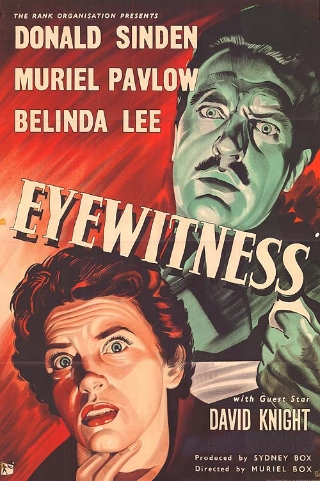
Eyewitness

poster71_zps72hqlekp

British attempts at producing noir thrillers have tended to be a hit and miss affair, the greatest stumbling block generally being an inability to strike the right tone. The nuts and bolts are easy enough to put in place: the city setting, the night, the shadows and key lights, some criminal enterprise to provide a framework. However, British movies of the classic noir period (the 40s and 50s) struggle to escape the rigid class structures that remained firmly in place at the time. American films benefited enormously from the more flexible social structure of the country, which allowed filmmakers to blend in characters from a variety of backgrounds. Despite its best efforts, British noir tends to be forever trapped in a middle-class world and, consequently, loses something of the edge of danger that helped elevate pictures from across the Atlantic.

Eyewitness (1956) opens in these typically middle-class surroundings, with a minor domestic spat involving a young couple.  Jay (Michael Craig) and Lucy (Muriel Pavlow) are two young suburbanites who have run into a bit of a crisis in their marriage. Jay is a guy who wants to live better than his income allows and has been accumulating a bit of debt buying stuff on credit. His latest acquisition, a brand new TV set, proves to be the straw that breaks the camels back though. Lucy is not at all impressed, such apparent profligacy failure to think of tomorrow going against the grain with her. In a foul temper, and threatening to leave for good, Lucy stalks out of the house to try to cool off.

While Jay sits home, toying with his new purchase and reflecting on the injustices of married life, Lucy’s wanderings take her to a movie theater. And it’s at this point the story starts to take shape. Jay’s feelings of frustration drive him out in search of a drink and some sympathetic male company, just at the moment Lucy’s conscience pricks at her and she decides to call him up. Getting no answer on the phone, Lucy is making her way through the theater when she chances upon a robbery in progress.

It’s Lucy’s misfortune to witness two men, Wade (Donald Sinden) & Barney (Nigel Stock), in the process of cracking the safe and roughing up the manager. Barney sets off in pursuit of the panic-stricken woman as Wade goes about settling matters with the ill-fated manager. Lucy’s terrified flight takes her out of the cinema, onto the street, and straight into the path of an oncoming bus. The situation leaves Wade and Barney in a quandary; is the unexpected witness going to live? And if she does, how much will she recall?

Wade reveals himself to be not only a cool customer, but a nasty piece of work to boot. His primary concern is his own self-preservation, and he coerces the meek Barney into falling in with his schemes. Wade has no intention of leaving any loose strands that may, in time, weave themselves into a noose to hang him. Following the ambulance that carries the comatose Lucy to a local hospital, Wade has in mind to dispose of this potential threat. Despite Barney’s protests, Wade takes it upon himself to stalk the now helpless Lucy and ensure nothing can be traced back to him. And so the bulk of the movie involves Wade’s attempts to gain entry to the communal ward where Lucy is taken. The suspense of the film derives from Wade’s determination, and increasing frustration, to silence this inconvenient witness. All the while, the net draws closer, time is running short and the opportunities grow fewer. Everything builds relentlessly towards a dramatic finale in a deserted and vaguely sinister operating theater.

Muriel Box was one of those rarities in classic era cinema, a female director. After writing some strong British movies – The Seventh Veil (1945) and The Brothers (1947) – she began directing in 1949. However, her career was closely linked to her husband, producer Sydney Box, and the break up of their marriage also signaled an end to her time behind the camera. Eyewitness sees Box making good use of the inherent suspense generated by the setting. A hospital at night is full of dramatic potential, the random comings and goings, the relative anonymity, that sense of disquiet aroused by the sight of mask-wearing professionals silently padding along starkly lit corridors. As the story progresses, Box ensures the tension grows in increments and the visuals reflect the increasing darkness of what we’re watching.

I think the biggest weakness stems from a basic flaw in the script. The success of pretty much any film, and especially a thriller, depends on having if not a hero then a recognizable figure that the viewer can identify with or root for. Eyewitness suffers in this respect; since it’s clearly intended that we should side with Lucy. However, she spends the bulk of the running time either unconscious or semi-conscious, effectively taking her out of the equation. There’s a similar problem with Barney, another whose presence ought to draw sympathy, but who ends up sidelined much of the time. In the end, we see things predominantly from Wade’s point of view, and he’s such a thoroughly bad lot, without a single redeeming feature, that it’s impossible to view him even in an anti-heroic light When it comes to the performances, Donald Sinden is pretty good as the twitchy killer with a slightly manic air. Still, the best work is probably done by Nigel Stock as the deaf safe-cracker whose dream of moving to New Zealand has seen him roped into a scheme that’s a whole lot more than he bargained for. Pavlow and Craig are so-so as the young couple whose marital tiff pitches them into a perilous situation, but there’s no great depth to their characterization.

In the final analysis, Eyewitness is a mid-range British crime thriller. The story is gripping enough but the lack of a sympathetic central character does damage it somewhat. The movie is available on DVD in the UK as part of a Donald Sinden box set from ITV. It’s a reasonably good transfer, presented in the correct 1.66:1 aspect ratio, though without anamorphic enhancement for widescreen TVs.

Note: I originally published an edited version of this piece as a Noir of the Week for The Blackboard.

Hombre

poster217-2

We all die, just a question of when.

I’m an unashamed fan of westerns from the 1950s, the genre’s golden years, but I’m also pretty fond of those from the following decade. By the end of the 60s, with the spaghetti western in the ascendancy, revisionism was in the air, though that movement wouldn’t come to full fruition until we pass into the 70s. For the classic Hollywood western these were the transitional years, a painful period in some ways, with the genre thrashing about in search of direction. Such times tend to bring about a combination of successes, throwbacks and misfires. When we view the era in this light, I think it’s fair to say that the 1960s was a decade that was simultaneously fascinating and frustrating for western fans. Ultimately, revisionism would strip the genre down to the bone and train a probing searchlight on its innermost workings. One could write an in-depth study on the effects of this process, and I have a hunch the conclusion would be that no genre, least of all one so firmly rooted in myth as the western, could emerge unscathed from such an intimate examination. But I’m not going to take on that task here; instead I’m going to look at one of those late 60s westerns that seemed to benefit from the turmoil of the time, Martin Ritt’s Hombre (1967). Here we have a movie that avoids the outright nihilism of the Euro western, retains the structure and moral complexity of the best 50s efforts, and looks forward to the bleak honesty of revisionism. In short, it becomes a kind of philosophical meditation on social responsibility.

The classic western hero has frequently been characterized as a loner, a man drifting along on the fringes of society for one reason or another. Such a ploy isn’t accidental of course; it allows us to connect with the spirit of freedom and individualism that’s a significant part of the western’s attraction, and also helps objectify the view of society and encroaching civilization. Generally though, the hero does feel himself drawn in some way towards the society he observes. Hombre presents us with John Russell (Paul Newman), a white man raised by the Apache who has categorically rejected the ways of his own race. He’s first seen in his preferred environment, rounding up wild horses, and has clearly been fully integrated into the Apache lifestyle. However, news of an inheritance – a beaten up boarding house – brings him back to white society, at least temporarily. Arriving in town, he’s adopted the outward appearance of his own people but retains the cool detachment of the Apache. Essentially, Russell has made it his business to mind his own business – to have as little contact with the white world he has rejected as possible. He sells up and books passage on the last stagecoach out. Yet, the interrelated nature of society doesn’t really work that way; all action, even calculated inaction, has its consequences. In a sense it’s Russell’s single-minded detachment that lays the groundwork for what follows.The sale of the boarding house, effectively acts as the catalyst that finally pushes at least one man towards crime, and Russell’s own determination to avoid intervention in the affairs of others ensures that a bullying outlaw, Grimes (Richard Boone), gets to ride the stage. The first hour of the film is a fairly sedate affair, concentrating on establishing the character of each passenger and offering some insight into their relationships. Collectively, they add up to a cross-section of frontier types: the outwardly respectable older man and his younger, disillusioned wife, a young couple coming to terms with the realities of married life, the veteran driver who’s long since bid farewell to his ideals, the woman who has been around and remains a survivor, the swaggering bully, and the enigma that is Russell. Locked within the confines of the bumpy stagecoach, the tensions, prejudices and fears of this disparate little group simmers away just below the surface. The pressure comes to a head when they are held up on a remote part of the trail, and the truth about each one emerges. Abandoned in the wilderness, and facing the very real prospect of perishing, they turn towards Russell to guide them out. But Russell is now in something of a quandary; apart from the fact he’d been shunned due to his Apache affiliations, he feels no obligation towards his fellow man anyway. He’s faced with a philosophical dilemma  – does he follow his head and leave these people to the fate he reckons they deserve, or does he listen to that still distant voice within that urges empathy.

If we count Hud, then Martin Ritt made three westerns with Paul Newman, and all of them have their points of interest. Adapted from the Elmore Leonard novel of the same name, Hombre is the closest to the traditional western. The basic structure owes much to John Ford’s classic Stagecoach, but it’s a much more cynical affair. The two films do share the vital element of spiritual redemption for their hero, but Ritt’s movie reaches that point in a more tragic and bitter way. The script raises interesting questions about how much we owe others, how far we should go for those we deem undeserving of our sympathy, and whether intervention or isolation is the correct approach. Bearing in mind the film was made while the war in Vietnam was still raging, I think that last issue must have been in the minds of the filmmakers. However, leaving that aside and looking at things from a purely personal perspective, the problems continue to be thorny. Russell not only knows that assisting the abandoned travelers will add to his own peril, but his years living outside of white society have meant that he no longer identifies with these people. Circumstances have resulted in his being caught in a kind of cultural no-mans-land, where his head and heart are in conflict. In cinematic terms, this is a reflection of the position the western itself was facing in 1967, with its soul and conscience pulling in one direction while social and economic factors were pressuring it to go another way. Visually, with the aid of James Wong Howe’s great cinematography and the Arizona landscape, it bears all the hallmarks of the classic western, but the existentialist undertones of its theme point to the future.


Mrs Favor: I can’t imagine eating a dog and not thinking anything of it.
John Russell: You even been hungry, lady? Not just ready for supper. Hungry enough so that your belly swells?
Mrs Favor: I wouldn’t care how hungry I got. I know I wouldn’t eat one of those camp dogs.
John Russell: You’d eat it. You’d fight for the bones, too.
Mrs Favor: Have you ever eaten a dog, Mr. Russell?
John Russell: Eaten one and lived like one.

Paul Newman was an adherent of the method style of acting. Now I’m no fan of the method and the frequently affected performances that it encouraged. I understand it is meant to help the actors dig deeper within themselves and find a truth in their role yet it often seemed to produce the polar opposite, a mannered performance that actually draws attention to itself. Some of Newman’s early roles are badly blighted by this in my opinion. However, by the time he came to Hombre he had moderated his acting style, and what we see on screen is far better, far more involving. As far as I can remember, and it’s been a few years since I read Leonard’s novel, Newman’s portrayal of John Russell is pretty close in spirit to how the character came across on the page. It’s a very quiet performance; I think the stillness of the man, the eternal patience of his Apache side is perfectly captured. There’s a great sense of his being aware of everything, absorbing the sounds, smells and moods around him and storing them away. When he’s aroused to action there’s a jarring abruptness to it that makes it all the more effective. The first instance takes place in a cantina where Russell sits and calmly watches and listens to his Apache companions being goaded by two ignorant redneck types. We’re expecting something, a reaction of some kind, maybe a rebuttal from this soft-spoken man. But the sudden swing of his rifle butt to shatter and drive the splinters of a whiskey glass into the face of the barroom lout is both shocking and satisfying. In a similar vein, the later eruption of aggression when he opens fire on Boone when he comes to parley is made more intense by the apparent calm that precedes it.

Richard Boone’s crafty and cunning Grimes is the ideal foil to Newman’s motionless and emotionless Russell. Boone gave countless performances that were straight out of the top drawer and Grimes has to rank up there among the finest. He had a real knack for conveying a quiet threat – there was always the feeling that here was a man it would be foolish to cross. His first scene in the station when he intimidates a soldier into turning the last ticket available over to him illustrates this quality well. There’s something in that craggy face and low-pitched voice that conveys his intent far more effectively than bluster and showboating; not an easy task but when it works, it works wonderfully. Of the three female roles in the movie, Diane Cilento had the most substantial and the one with the greatest significance. Generally, I feel she was an underrated performer who was always interesting to watch. She played the most down to earth of the three women on that stagecoach, and the one with the lowest social status. Russell’s decision to sell up saw her out of a job and on the streets but with her spirit unbroken. The script offered her several opportunities to shine and she took each one, displaying an earthy and attractive honesty. She was also fortunate to be playing the character whose mentality the average viewer could most readily identify with, providing a kind of bridge between Newman’s omnipotent aloofness and the self-interest of the others.

Fredric March had a nice little late career turn as the corrupt Indian agent, the one whose presence poses the greatest danger to the survival of the group. Basically, he represents all that’s wrong with the society that Russell has rejected – corruption, vanity, weakness and hypocrisy. Still, despite portraying a deeply unpleasant person, March manages to inject a good deal of pathos into his performance and leaves you feeling a little sorry for this man who has transitioned poorly from the successes of his youth; he did something similar in Inherit the Wind, where he tapped into the human frailty of another character who was essentially unsympathetic. Martin Balsam was a first-rate character actor who enriched many a great movie – 12 Angry Men & The Taking of Pelham One Two Three to mention just two – with his everyman persona. As the stagecoach driver who has come to terms with his own limitations and realizes that he can no longer fight the tide of progress, he’s another figure with whom the audience can connect.

As far as I can tell, Hombre has never been released on DVD in the UK, though it is readily available from both the US and continental Europe. I have the Dutch DVD from Fox, which presents the movie most satisfactorily. The film is presented in anamorphic scope and the transfer is very pleasing with good colour and definition to show off James Wong Howe’s location photography. The disc offers a wide selection of subtitle options and the only extra feature is the theatrical trailer. For me, Hombre is a highly successful piece of work that hits the mark on a number of levels: as an entertaining western movie, an examination of race and social cohesion, and also contextually, for the position it occupies in the development of the genre. I consider the latter to be the most fascinating aspect, and yet another link between what may superficially appear to be irreconcilable eras. Nevertheless, whatever way one opts to view the film, it makes for a rewarding and thought-provoking experience.


Tomahawk

poster209-1

Over the years I’ve tried to turn the spotlight where possible on those films which I reckon have either been unfairly maligned or, more commonly, just fallen between the cracks and slipped off the radar of movie fans. As a lover of westerns, I’ve found that the genre provides an especially rich vein to mine with respect to neglected gems. This is partly down to the sheer volume of pictures made during the western’s heyday, and also the gradual decline in interest in the genre, not least from a critical perspective. In my own small way, I’ve looked to draw a little attention back towards westerns and maybe encourage others to explore a little deeper. I particularly like the more socially aware pictures of the early 50s, those movies which did their best to offer entertainment and simultaneously encourage thought on the part of their audience. George Sherman’s Tomahawk (1951) is one such film – it’s a handsome looking, well paced work that not only contains a potted history lesson but also approaches the Indian Wars in a mature and intelligent way.

The film is bookended by one of those strident, self-important and frankly grating narrations that became fashionable in the documentary-style noir pictures of the post-war years. In many ways this is an inauspicious opening and one that doesn’t really blend in with the rest of the film. The time and context are established but I feel that this could have been achieved just as well, and with a good deal less piety, via the more traditional method of using rolling captions. Anyway, it’s Wyoming in 1866, at the time the Bozeman Trail is drawing in settlers and prospectors. The fact that this route west passes through Sioux hunting grounds, and violates previous treaty pledges, has the potential to spark off a major conflict with Red Cloud’s warriors. The problem is exacerbated by the government’s decision to build Fort Phil Kearny as a garrison to house an army detachment and offer protection to travelers. The construction proved a sore point with the Sioux, and the film concentrates on a compressed version of the bloody events that ensued, namely the Fetterman Massacre and the Wagon Box Fight. It includes all the major players in those battles and gives the story a new twist by adding in a revenge aspect. Everything unfolds from the perspective of Jim Bridger (Van Heflin), a trapper and former scout who allows himself to be coaxed back into service for personal reasons. Bridger is disparagingly referred to by some as a “Squaw Man” – a man who has taken an Indian girl as his wife – and it’s this status that forms the basis for his decision to return to scouting duties. The Sand Creek Massacre of 1864 is one of the most notorious atrocities to take place on the frontier, when Colonel Chivington led his irregular cavalry in a raid on a Cheyenne village, butchering and mutilating in the region of 150 of the inhabitants, the majority of whom were women and children. Bridger, who suffered a grievous loss in this massacre, has spent the intervening years hunting those responsible. When the young Cheyenne girl, Monahseetah (Susan Cabot), with whom he’s traveling believes she has recognized one of Chivington’s men among the troops detailed to the new fort, Bridger takes up the offer to scout for the army once again. At first, there exists an uneasy truce between the Sioux and the soldiers, Red Cloud being shown as a man willing to compromise so long as his people aren’t faced with aggression. However, the hotheaded hatred of the Indians by a young officer, Lieutenant Dancy (Alex Nicol), leads to an inevitable killing and matters start to spiral ever downward. The new fort soon finds itself under effective siege, with Dancy and Captain Fetterman (Arthur Space) seeking to discredit Bridger in the eyes of the garrison commander and downplay his estimate of the strength of Red Cloud’s forces. The movie covers the essentials concerning the build up to and aftermath of the Fetterman Massacre but alters some details for the purposes of storytelling – most notably by compressing the timeline and shifting some of the responsibility away from Fetterman himself.

£11

George Sherman has never really got his due as a director; he worked in a variety of genres but his westerns for Universal in the 1950s in particular constitutes a strong body of work. His movies tend to be well paced and, more often than not, play around with interesting themes. Tomahawk packs a lot of story into its 80 minutes yet, despite moving at a fair clip, never sacrifices coherence. Aside from the standard cavalry versus Indians stand-off at the heart of the tale, there’s a revenge story and a commentary on the dubious treatment of the Indians blended in too. I think it’s a credit to Sherman’s skill that all these elements are handled well, and that the finished film is never less than entertaining. The majority of the action takes place outdoors, with Sherman and cameraman Charles P Boyle making the most of the Dakota locations. Sherman manages to convey the beauty and expansiveness of the landscape, leaving the viewer in no doubt why men like Red Cloud were prepared to fight and die if necessary to safeguard their ancestral lands. The film makes no bones about where its sympathies lie; the character of Bridger is as much of a guide for the viewer as he is for the army. It’s through his eyes that we’re invited to see things, and this allows us to experience the personal conflict of a man torn by his love for and understanding of the Indian way of life, and his sense of duty to the country of his birth. As such, the film never shies away from depicting the duplicity and inherent racism of Indian policy at the time, yet does its best to address the complexity of the situation too. I feel it slots nicely into that cycle of early 50s westerns that tried to come to terms with a particularly tumultuous period of US history.

Van Heflin’s stoic presence is the glue that holds the picture together. He had that lived in look that was just right for playing a toughened frontier scout, and the necessary physicality to make the action scenes seem authentic. I think one of his strengths as an actor was the thoughtful, introspective quality that he was able to bring to his roles, and the character of Bridger allowed him to explore that. You could argue that the revenge motif that runs throughout the movie was a tacked on extra, but it’s very important in helping to flesh out the character of Bridger and explain his motivation. Without the whole Sand Creek back story, Bridger would be just another westerner with a fondness for Indians. The scene where he explains his background to Yvonne De Carlo not only provides something for Van Heflin to get his teeth into, but it also makes it clear to the viewer where his passionate advocacy of the Indian stems from. Heflin rarely gave a poor performance in any movie, and Tomahawk saw him touch on grief, compassion, love and fury convincingly – a real three-dimensional figure rather than a caricature or stereotype. Yvonne De Carlo always brought a kind of tough glamour to whatever part she played, and some of the technicolor movies she made in the late 40s and 50s really highlighted her beauty. Although she was essentially playing the love interest in this film, her character’s real purpose was to draw out Heflin. Therefore, the romantic aspects never actually overwhelm the main focus of the story, serving to complement it instead. The chief villain of the piece was Alex Nicol as the sneering racist. He always seemed at his best playing the bad guy (check out The Man from Laramie for another performance that’s certainly interesting), and Tomahawk gave him the chance to indulge in some great rodent-like nastiness. The film boasts an extremely strong supporting cast, including a small part as a trooper for a young Rock Hudson. Susan Cabot met a very tragic end in real life but she was a very attractive screen presence in her time. I thought she brought a really sweet allure to the role of Monahseetah. In addition, there are well-judged turns from Jack Oakie, Preston Foster and Tom Tully.

£10

Tomahawk is available on DVD in a number of territories, including the US (as part of Universal’s MOD programme) and the UK. Before those editions were released Mondo Entertainment in Germany put the title out as part of a licensing arrangement with Universal, and that’s the copy I have. I have to say that the transfer on that disc is fantastic – it’s sharp, clean and has the kind of eye-watering colours that show the cinematography off to great effect. The film is offered with a choice of the original audio or a German dub, and no subtitles of any kind are present. Extras are confined to text biographies of Yvonne De Carlo and Rock Hudson (Hudson’s name gets prominent billing on the cover too despite his minor role – no mention of Heflin at all) and advertisements for other titles in the range. All told, I feel Tomahawk is an excellent little film that rarely seems to get a mention. Sherman paints some lovely images, packs in the action, tackles tough themes, coaxes solid performances from his cast and entertains all the way. Frankly, this really ought to be better known and more widely seen. It’s definitely a movie to check out if you get the opportunity – I don’t think it will disappoint.