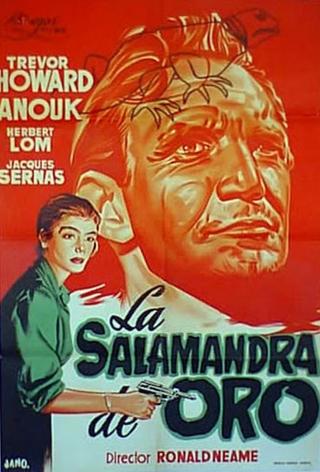
In the years following the war the British film industry was turning out some quality pictures. The best of them remain rightly celebrated and the poorer efforts have been all but forgotten. There is, however, a kind of murky middle ground crammed full of the kind of movies that were a cut above the average yet not quite top flight material either. I often find myself drawn to these films as there’s much to admire but, seeing as they’re largely off the radar of present day viewers, little or no critical analysis to be found. The Golden Salamander (1950) is a handsomely shot movie, well acted, engagingly plotted and filmed on location. All in all, it has a lot going for it – it should be better known but the fact is it’s something of an obscure film. If this blog has any purpose other than providing a platform for me to record my thoughts then it’s to be hoped that, from time to time, it also introduces someone, somewhere to the kind of picture they might never otherwise have heard of or thought about.
The movie kicks off strongly and initially looks like it’s going to play out like a noir picture. A car is making its way along a stretch of road in Tunisia in the middle of a violent storm. The rain is hammering down relentlessly and the darkness is closed in oppressively on all sides with only the headlights cutting a feeble path ahead. Hunched in the gloom, the driver squints through the rain-streaked windscreen and forges on. By sheer luck he avoids running slap into a landslide that’s taken out the road. As he gets out to try to discover a way round the obstruction, he comes upon a wrecked and abandoned truck. His good fortune in avoiding an accident is revealed to be one of those sneaky tricks of fate when he finds that the truck was apparently part of a gun running operation. This whole sequence takes place without a word of dialogue and the murkiness of a rotten night is only broken by the occasional flashes of lightning that draw attention to the important sights. That wonderful atmosphere is retained as the tired and muddy traveller makes his way to the nearest town, and the welcoming light of the local inn. It’s here that we learn his identity: David Redfern (Trevor Howard), a British archaeologist sent to catalogue and collect some ancient artifacts (including the golden salamander of the title) before overseeing their shipping. His close call on the washed out road has placed him in a perilous position though, with the gun runners suspecting (though at first not sure) that he’s seen something. What draws him deeper into danger is his becoming romantically involved with the young proprietress of the inn, Anna (Anouk Aimee), whose brother is part of the smuggling gang. The plot is a straight thriller that sees Redfern first wrestling with indecision before resolving to take action when a tragic turn of events forces his hand. Even then he has to face up to the fact that the town is a nest of corruption where it’s impossible to be sure who, if anyone, can be trusted.
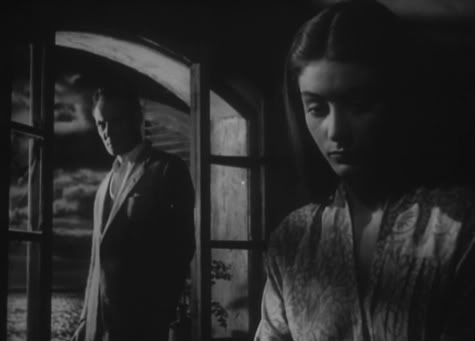
The two greatest strengths of the film are the visuals and the location work. This was one of director Ronald Neame’s earliest efforts and he, along with cameraman Oswald Morris, takes turns at bathing the screen first in deep, moody shadow and then in bright sunlight. For an up and coming director Neame shows great skill in his handling of composition and framing too, drawing the eye to the pertinent and subtly altering the mood with clever placement of characters and objects. The location shooting in Tunisia adds an air of realism that’s a big asset and lends a greater sense of openness to the exterior work. So much for the positives; the weakness lies primarily in the script, as is so often the case. While I understand that the romance between Redfern and Anna is a necessary ingredient and provides the motivation for the hero to finally act decisively, it has to be said that it’s never a convincing one and, furthermore, slows the story too much in the middle. It leads to that old problem of a strong opening and climax held together by a slightly stodgy and flabby middle section.
Of course, the fact that so much of this part of the story depends on the interaction between Trevor Howard and Anouk Aimee is a contributory factor too. Howard plays the role of Redfern with a slight stiffness, but in fairness I think that’s simply a part of the character and can’t really be taken as a criticism of the performance. The thing is he looked a good deal older than his years at that time and having him play off a teenage Anouk Aimee is a little disconcerting. Additionally, she was acting in only her first English language film and that does seem to have had an effect on her performance – her delivery is never natural and she looks vaguely uncomfortable throughout. Still, there are some fine supporting turns to shore matters up: Herbert Lom is first class as the main heavy, Miles Malleson downplays his comic side as the local policeman, and Wilfrid Hyde-White has a great little part as the slightly seedy pianist channeling Hoagy Carmichael.
I used to have a copy of Golden Salamander that I got as a freebie with a Greek newspaper years ago, and it was a fairly ropey transfer. However, the film has just recently been released in the UK on DVD by Odeon. The disc isn’t a perfect one, there’s a softness to the image here and there, and a few speckles. Having said that, there are also stronger sections where detail is much better defined and print damage is generally minimal. Extras are a selection of trailers for other Odeon titles, a photo gallery and a booklet of liner notes. I’m not going to claim that this movie is a classic just waiting to be rediscovered; there are the issues with scripting and structure to take into account. Still and all, it is a good mid-range effort that has more than enough plus points in its favour to earn it a recommendation.