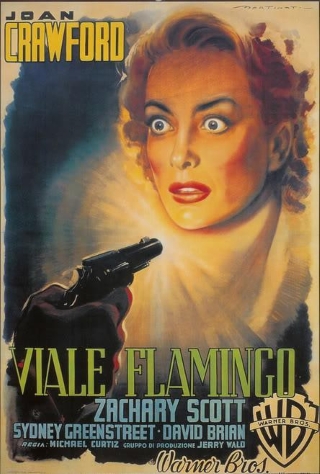
“He’s the only man I know that can make a sow’s ear out of a silk purse. Somehow I always hate to see it happen.“
Graft, greed, ambition , manipulation, betrayal… and that’s just a representative sample of the themes and ideas explored in Flamingo Road (1949). The list of descriptors that could be applied to the plot machinations and gyrations of prime melodrama is practically an endless one, all of which goes some way toward explaining how endlessly fascinating the genre tends to be, not to mention how compatible it is with other genres and styles of filmmaking.
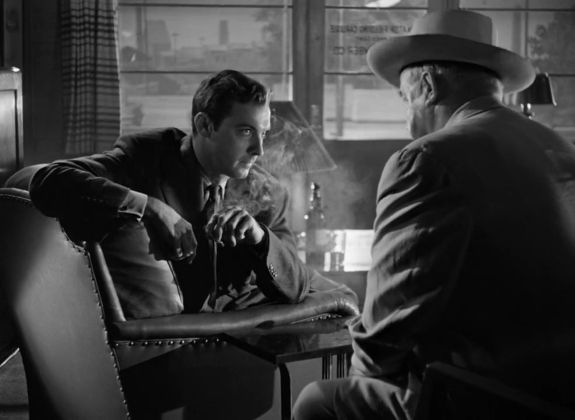
The familiarity we all have with those aforementioned themes is part of what makes melodrama such an identifiable form; even if the status of those portrayed is far removed from that of the viewer, the core principles that drive the narrative have that everyman quality that allows an almost intuitive understanding of how the characters act and react. The opening lines of the movie reinforce that sense, reminding us that every town, big or small, has its Flamingo Road, one of those thoroughfares where those with money, power and influence reside. And all the other areas that make up a typical settlement, from civic centers to fleshpots, are to be found in the town of Boldon City. After dangling the promise of easy, gracious living on that titular street, we are transported to “the wrong side of the tracks” to the patch of ground occupied by a traveling carnival, one replete with freak shows and exotic dancers. Lane Bellamy (Joan Crawford) is eking out an uncertain living as one of those dancers, going through the moves under the dispassionate gaze of gum-chewing adolescents. With the show hastily being given the bum’s rush, she finds herself high and dry, so to speak.
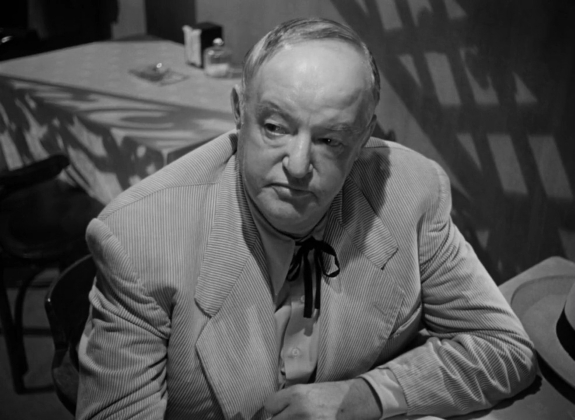
When the reluctant and unmotivated sheriff’s deputy Fielding Carlisle (Zachary Scott) is sent to ensure the carnival has upped stakes and left, he finds only Lane reclining on her bunk in a shabby tent listening to the radio. Probably more out of pity than anything else at that stage, he takes her into town, buys her some food and even manages to wangle a job for her as a waitress in the local diner. None of this escapes the attention of the calculating sheriff Titus Semple (Sydney Greenstreet). Gross and glowering, this seersucker-clad kingmaker has lined Carlisle up as rising star in the local political landscape and seeing him mixed-up with a lowly carnival dancer is decidedly not part of the plan. To cut to the chase, the burgeoning romance is nipped in the bud, Lane is not only fired but also tossed in prison on a trumped up charge of soliciting, and the sheriff presses ahead with his ambitions. Yet Lane is made of sterner stuff and she gradually claws her way back into society, latching onto and marrying political boss Dan Reynolds (David Brian). Amid the occasional slights and the snobbery of a small town, Lane continues to butt heads with Titus and both of them warily circle each other as wheels turn within wheels in the background and the scene is relentlessly set for a zero sum game of revenge where the biggest casualties are likely to be Reynolds and Carlisle.
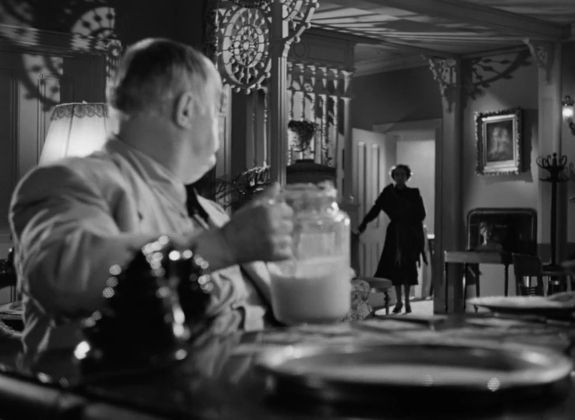
The screenplay of Flamingo Road was adapted from his play of the same name by Robert Wilder. While I’ve not seen the source material, I think it’s safe to say some alteration had to be made and euphemisms put in place to tiptoe around the inevitable production code objections to some of the developments. As I watched this I couldn’t help wondering whether Shakespeare’s Titus Andronicus was at least a partial inspiration for the naming of the sheriff. Did Wilder have that tale of implacable and terrible revenge and rivalry between Titus and Tamora in mind when he came up with the character’s name? Either way, the film does descend incrementally into ever deeper darkness as the protagonists cut and parry at each other in their personal arena. The longer it goes on the more it shifts toward film noir. Michael Curtiz had already worked to great acclaim with Joan Crawford and Zachary Scott on the classic noir melodrama Mildred Pierce and leans into some of the same ideas here. He employs tried and tested noir imagery and techniques – reliance on shadows, blinds and frequent deep focus composition, particularly in the last act.
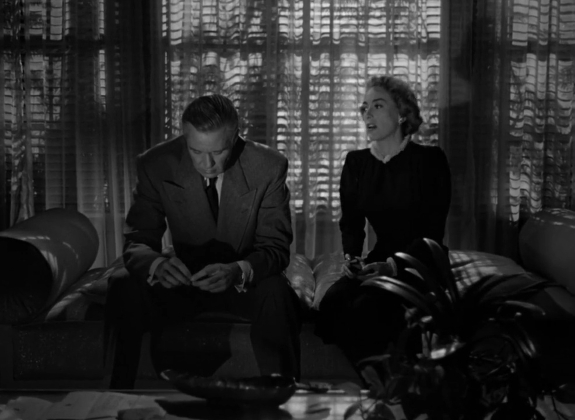
One of the great strengths of the studio system was its ability to make use of a pool of stars and cast them in roles that fit them like a glove. Of course that didn’t always come off and we can all probably think of instances of poorly judged casting. However, a movie such as Flamingo Road clearly demonstrates how successful it could be. The role of Lane Bellamy would have been meat and drink to Joan Crawford in the wake of her career resurgence in Mildred Pierce. The part offered plenty of scope to exploit the persona of style, grit and personal integrity she had honed by that stage. She was a powerful screen presence and needed someone equally strong to act as a foil – step forward Sydney Greenstreet. He was fast approaching retirement but his relatively short cinema career saw him grow into characters where his bulk and brooding threat was never less than memorable. He’s a superb villain, Machiavellian and dangerous with not even the faintest trace of a scruple. Zachary Scott was able to easily occupy roles defined by weakness and dissipation, and if his character’s downward spiral is not charted in as much detail as one might like, that’s down to the constraints of the script rather than any deficiency on the part of the actor. The tragically short-lived Gladys George played the roadhouse owner in that style of hers characterized by a toughness born of personal honor. Maybe she doesn’t attain the level of pathos she did in The Roaring Twenties but she still turns in a performance that feels very credible. David Brian is terrific in his debut, fully invested in his part and with none of the stiffness that he could occasionally display.
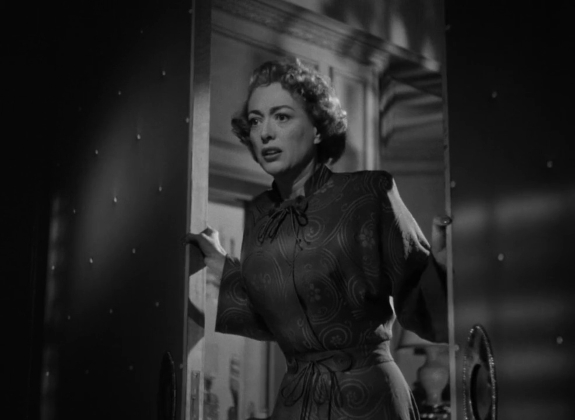
Flamingo Road was available as a good DVD from Warner Brothers and has since been issued on a very attractive Blu-ray by the same studio. The movie is a wonderfully entertaining blend of melodrama and noir that is packed with interesting themes and developments, as such it’s not hard to see why it was picked up and expanded into a TV series in the early 1980s. Recommended viewing.
As an Amazon associate I will earn a small commission on any purchases completed via clicks on the link above.
 Riding the High Country
👍
(I don’t have an intelligent comment to make)
LikeLiked by 2 people
one of my favorites! Joan and Zachary are great together just as they were in Mildred.
LikeLiked by 2 people
Damn good drama…….drenched in noir.
LikeLiked by 2 people
It gets somewhat overshadowed by the other Curtiz/Crawford/Scott noir Mildred Pierce, which is understandable but unfair too.
LikeLiked by 1 person
Although, both noirs are directed by Curtiz. I think the noir visuals are noticeably different in Flamingo Road because of the lensing style of Director of Photography Ted McCord.
LikeLike
True, both those cinematographers bring their own style to the films. That said, I do think Curtiz’s sense of pacing and structure are very much in evidence in both.
LikeLiked by 1 person
Sounds like a must-watch, Colin – I’ll see if I can track down an affordable Blu. The cast is top notch. I can’t get enough of Greenstreet.
LikeLike
It’s an easy recommendation as far as I’m concerned. Greenstreet was marvelous, that voice and the expressive features convey so much so succinctly.
The Warner Blu-ray is a fine presentation and well worth picking up.
LikeLike
How would you compare this to The Damned Don’t Cry? (And have you reviewed that one here?) For whatever reasons, that one didn’t work especially well for me. I guess I’m not a huge fan of Joan Crawford, though I did like both Mildred Pierce and Sudden Fear a lot.
LikeLike
I haven’t watched that in a while and haven’t written anything on it. I do know I liked it well enough and it’s the best of the movies Vincent Sherman made with Crawford, but I’d place it below the two Curtiz films. Sudden Fear is another I’ve not seen for a while now but I’d consider it of similar quality, although thematically they are quite different, to The Damned Don’t Cry. Sherman made some good films but his work was nowhere near as consistently compelling as that of Curtiz.
LikeLiked by 1 person
Funny you should mention Vincent Sherman, I just watched The Hard Way (1943) this evening, also directed by Sherman. I was actually just a little disappointed in it: I like Ida Lupino quite a lot, and she’s good here, but the movie is very much in the Warner Brothers style of the time (fast paced, quickly delivered dialogue, a certain quality to the music score, etc.), in this case, I thought, somewhat to its detriment. Of the four main lead performances (Lupino, Joan Leslie, Dennis Morgan, and Jack Carson), I actually thought Carson gave the most engaging, moving performance. At any rate, I now hope to check out Flamingo Road sometime in the near future. And I’d love to see you review The Damned Don’t Cry and Sudden Fear at some point. Like I said, the former didn’t work so well for me, but somewhat to my surprise (since I don’t seem to hear it mentioned quite so much), I thought Sudden Fear was a banger.
LikeLiked by 1 person
Sudden Fear has a really fine cast, which gives it a big boost.
Regarding Sherman, I like his two 1947 noirs Nora Prentiss and The Unfaithful, the latter being an interesting redo of Wyler’s The Letter.
LikeLiked by 1 person
Re: Sudden Fear, yeah, Crawford is really pretty great in this one, and Jack Palance is at his reptilian best. He also has a great line (heard by Crawford over her Dictaphone) addressed to his lady friend/co-conspirator Gloria Grahame: “I could break your bones!” (And I’m the guy who doesn’t necessarily remember dialogue lines from movies.)
I haven’t seen The Unfaithful (yet), but I also liked Nora Prentiss quite a lot. I guess both Sudden Fear and Nora Prentiss also share a San Francisco setting (in part), and that’s always fun for me as a native Northern Californian.
LikeLike
The old DVD of The Unfaithful is underwhelming and it could use an upgrade.
In the past, Nora Prentiss looked frankly poor but the Blu-ray, which I picked up recently is a revelation in comparison.
LikeLiked by 2 people
Without Bruce Bennett there is no one to like
LikeLiked by 1 person
Has to be one of the best thrillers ever made. Still trying to figure out what makes my skin crawl the most. Palance or just the movie itself.
LikeLike
I think Nora Prentiss deserves a lot more attention. Another of those noir melodramas (or women’s noirs if you prefer) that I love so much. And Ann Sheridan is terrific.
LikeLike
I think the fact it can now be viewed in much better condition might earn it a few more fans. I’d like to think so anyway.
LikeLiked by 1 person
Carson was, of course,by far the most talented person in the cast.
LikeLike
“By far” — you don’t have a high opinion of Ida Lupino? At any rate, yes, Carson was really good in this role.
LikeLike
Ida would never by her lonesome attract me.
LikeLiked by 1 person
Of course, Jack Carson is the best actor; he almost always is in anything.
LikeLiked by 1 person
Flamingo Road and The Damned Don’t Cry are my favourite 1940s/50s Joan Crawford movies. They’re such perfect vehicles for her.
Although overall Rain is still my favourite Joan Crawford film.
LikeLike
I wasn’t always a fan of Crawford’s work overall but she grew on me gradually over the years and I find there are now very few of her films I don’t enjoy, apart from the 60s grotesques that I can happily live without.
LikeLike
The Damned Don’t Cry is based on the lives of Virginia Hill, Bugsy Siegel, and Joe Adonis is highly fictionalized as all of these people, except Siegel was still alive. I met two older ladies, sisters, working with or for Jilly Rizzo, and then the name of Siegel came up. They knew him and said the following: ‘He protected people. Quite interesting to search online for his family, and his daughters felt years later, more or less the same way.
LikeLiked by 1 person
A bit like the earlier Marked Woman in some ways, with fictionalized versions of Dewey and Lucky Luciano.
LikeLike
I can certainly happily live without Whatever Happened to Baby Jane?
LikeLike
Joan! What can one say? Excellent review of this one making me want to get out my DVD again. I have those two excellent box sets Warner put out on her in the good old days and the three on rival Bette because well one just has to. Truly forces of nature. Thanks for the insights.
LikeLiked by 1 person
Those old WB box sets for Crawford were uniformly excellent, the only genuinely dud title on either of them being Torch Song.
LikeLiked by 1 person
One of my favorite Crawford movies. I think she found at Warners what MGM was never really willing to give her: meaty roles in hard-edged melodramas. This one is a lot of fun, and I remember enjoying the short-lived TV adaptation from the ’80s, which actually managed to capture the spirit of the original ’40s film quite well.
LikeLiked by 1 person
I have only hazy memories of the TV show but the whole setup of the original story is full of potential.
Working at MGM made Crawford a star and gave her some fine parts, but I too like the movies she made at Warner Brothers a lot. Definitely some of her best work.
LikeLiked by 1 person
She was a big star at MGM, for example, Crawford worked 8 times with Clark Gable, and that is as big as anyone could get.
LikeLike
I was a kid back then, so I don’t remember much, only that I enjoyed the show. What does stand out in my memory is Howard Duff, who was excellent in the old Sidney Greenstreet role.
LikeLike
Yes, I like Duff in most roles I’ve seen him play. The TV show had an appealing cast overall, with prominent roles for Barbara Rush and Kevin McCarthy too.
LikeLiked by 1 person
MGM should have given her more films like A Woman’s Face which I think is as good as anything she did later at Warners.
LikeLiked by 1 person
MGM remained focused (or the most part anyway) on a different style of movie around that time. It would be a few more years before the tone and emphasis started to change. Had she stayed put, she may have eventually found such roles there but I think she calculated right and the move to Warner Brothers, and the different parts that brought, was a good one for her at that stage.
LikeLiked by 1 person
Exactly. In my opinion, A Woman’s Face was the finest film Crawford made during her years at MGM. Despite being one of the studio’s biggest box-office stars, she was rarely given roles that fully showcased her dramatic abilities. The problem was that MGM chief Louis B. Mayer reportedly disliked gritty, hard-edged films of that kind. Crawford ultimately found better opportunities at Warner Bros. and later Columbia Pictures, studios that were far more receptive to the stark melodramas in which she excelled.
LikeLike
Personally, I find the Warner Brothers material more appealing overall, and most of the Columbia movies too. The other post-MGM titles for Universal, RKO, Republic and 20th Century Fox are very worthy too.
Going back to MGM for a moment though, have you seen Strange Cargo? I like it quite a lot. It’s unusual, compelling and has a good deal of Frank Borzage’s sensibility on display.
LikeLiked by 1 person
Strange Cargo was MGM.
LikeLike
Yes, that’s why I said: “Going back to MGM for a moment though,..”
LikeLike
I did not make my point correctly. MGM and Mr. Mayer were the leaders in the sound era.
LikeLike
We’re in total agreement here. Crawford was a glamorous star, and MGM exploited that aspect of her beautifully, but Mayer, who liked everything nice and pretty, never seemed to understand that she had grit underneath the polished exterior. You’d have to be blind not to see that interesting dynamic. That’s why I think her best performances at MGM were in The Women (she plays the bad girl), A Woman’s Face, and yes, Strange Cargo, which I, like you, enjoyed a lot.
LikeLiked by 1 person
Now I will have to pull out my DVD of ‘Strange Cargo’ for a spin!
LikeLiked by 2 people
Well there are worse ways to spend two hours or thereabouts.
LikeLike
Gable who is usllally execllent, in Strange Cargo he is just sensational.
LikeLike
Yes, it was a good part for him and he handled it well. The spiritual journey he undertakes is portrayed very credibly. Actually, everybody working on that movie did exceptionally well, there are no weak links.
LikeLiked by 1 person
I was thinking the same thing. I have the Crawford DVD set, of course!
LikeLiked by 1 person