Coogan’s Bluff

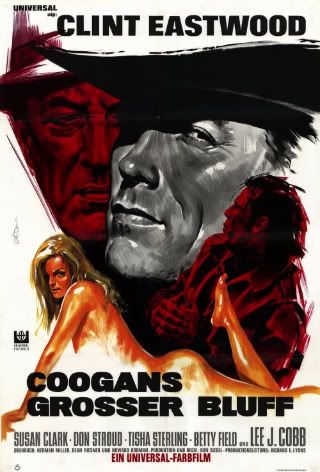
Poster

As the 60s were drawing to a close the western (at least the traditional variety) was a genre in decline. By the mid-70s it had been more or less supplanted by the hard-nosed urban cop movie. At first glance you might think there’s little common ground, but scratch the surface a little and the similarities are there – men operating alone with their own brand of personal integrity, a hostile and lawless environment, a society that is simultaneously repelled by and in desperate need of the services of those accustomed to violence. Strip away the time and place and those themes could be applied to any number of westerns and 70s cop films. Coogan’s Bluff (1968) can be viewed as a bridge between these two genres, not least because of the presence of Clint Eastwood.

Coogan (Eastwood) is an Arizona deputy who we first see running down a fugitive from a Navajo reservation. This opening establishes not only that he’s a capable and ruthless hunter of men, but he’s also master of his harsh desert environment. A temporary slip on his part lands him in hot water with his superiors and he’s dispatched to New York to complete the seemingly mundane task of escorting an extradited prisoner back home. The thing is though that Coogan is very much a man of then west, and he’s plunged into a world that’s entirely alien to him. When he gets his hands on his prey he allows himself to be duped into a situation that leaves him hospitalized, and without either the prisoner or his gun. His pride refuses to let him take this lying down, and there follows a relentless man hunt through the city’s mean streets. Along the way, Coogan clashes with the local police in the person of Lt. McElroy (Lee J Cobb), and encounters an assortment of hippies, junkies, freaks and low-lifes that are as dangerous as they are strange. Coogan’s the product of a hard place, but the grimy streets he finds himself roaming are every bit as lethal as his desert home. While the scenes of our hero pursuing his quarry through the night spots of the counter-culture offer up a snapshot of the hedonistic late-60s, they also date the film quite badly. Those paisley-shirted kids passing round the spliff, talking in riddles, and chilling to Indian music in psychedelic apartments with beaded curtains seem as far away in time now as the west that Coogan is supposed to embody. In the end, of course, he gets his man, and there’s a nice little coda on the helicopter back home that suggests he may have learned something during his trip to the big city. Where he callously ground his cigarette into the dirt before the imploring eyes of the shackled fugitive at the beginning, he now seems to have learnt a little pity and offers a smoke to his latest prisoner.

The Man With No First Name - Clint Eastwood in Coogan's Bluff.

Eastwood’s Coogan is very much a halfway house between The Man With No Name and Harry Callaghan – in the early scenes the trademark squinting eyes are hidden behind black RayBans and a simple cigarette stands in for the cheroot. However, the western sensibility remains and has not yet been wholly replaced by the full scale urban brutality. Mind you, although he’s playing a fish out of water, there’s no wide eyed innocence about Coogan. Eastwood plays him as a man with quick wits who learns life’s lessons fast. He’s also no superman, taking two beatings in the course of his investigation – the second being particularly rough – yet has the requisite toughness to survive unarmed for the most part. While Eastwood almost always brings some of his dry humour to his roles he pretty much meets his match in Lee J Cobb. The veteran actor deadpans his way through the movie as the world weary cop who recognizes Coogan’s presence as just the source of another headache. Don Siegel’s direction is as lean and efficient as usual, capturing the seedy atmosphere of the inner city perfectly and handling the action scenes like the old pro he was – the pool hall fight being especially well done.

Universal’s UK DVD of Coogan’s Bluff is a very basic affair, with not one extra in sight. The transfer is anamorphic 1.78:1 but it’s a very grainy one, and I’m not usually given to griping too much on the grain issue. Still, it’s very much a budget release so I suppose we can’t expect too much. The film itself remains entertaining throughout, though it’s really only in the mid-range of both Eastwood’s and Siegel’s work. It was the first film the director and star made together, and they would both go on to better things individually and collaboratively. Generally, we’re looking at a good solid piece of filmmaking that acts as an interesting link between genres.

The Clay Pigeon

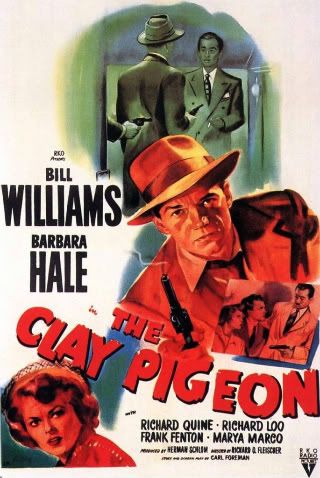
Poster

The issues faced by returning war veterans have been tackled by more than a few film noirs. Generally, the difficulties related to an inability to settle back into civilian life or the fact that the old familiar things had changed in their absence. The hero of The Clay Pigeon (1949), however, is presented with a set of circumstances that are of an altogether different nature. This movie falls into the nightmare/amnesia sub-genre, wherein a character has no memory of a crucial period and thus finds himself confronted by the consequences of actions that he has blocked out. This kind of storyline has enormous potential of course, but The Clay Pigeon never exploits it to the full.

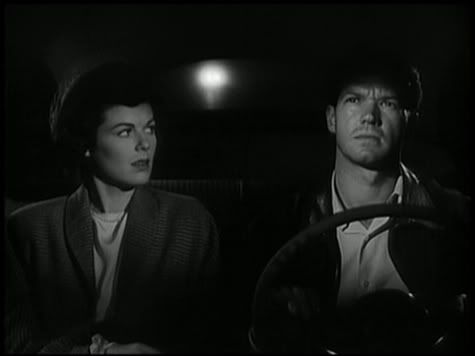
Jim Fletcher (Bill Williams) is a sailor, waking up in hospital after sustaining a bad head injury. He knows his name and most of the details about his past life, but he can’t recall what led to his being in hospital. And there’s the rub: Fletcher has been accused of treason during his time in a Japanese POW camp. What’s even worse is that his actions apparently led to the torture and subsequent killing of his friend. Knowing that he’s faced with a court martial at which he has little chance of clearing himself, Fletcher decides that his only alternative is to duck out and try to get to the bottom of it all by himself. Naturally, a penniless fugitive isn’t likely to make much headway without some assistance, so he takes a chance on contacting his friend’s widow. Unsurprisingly, this lady, Martha (Barbara Hale), is both suspicious and hostile initially. She grudgingly agrees to go along to Los Angeles though when a call to another old buddy, Ted Niles (Richard Quine) promises further help. Whatever doubts Martha may have had are gradually eroded on that long drive, particularly when an unknown car tries to force them off the road to their death. Their arrival in LA reveals just how complex and deadly a mess Fletcher has blundered into – a lethal conspiracy involving counterfeiting, war criminals and personal treachery. The whole thing culminates in a chase through Chinatown, followed by a train journey that exposes the real traitor.

Barbara Hale and Bill Williams spot danger looming.

The Clay Pigeon is a genuine B picture, coming in at little over an hour in length and never really pausing for breath. As such, there’s no time for any kind of character development amid the chasing and dodging. If anything, that’s probably the biggest weakness of the film: in these kinds of stories the audience needs to be kept guessing as to whether or not the hero is really as clean cut as he’d like us to believe. As it is, neither the audience nor the character of Fletcher has the least suspicion that he may indeed be the villain of the piece after all. I can’t honestly say that the fault lies with Bill Williams’ amiable playing as the part was written that way for him. I’d be more inclined to place the blame on Carl Foreman’s script (whose dearth of characters makes it pretty obvious who the traitor is right from the off) and the cheap-jack production values. That’s not to say there’s nothing positive to take away; Williams and Hale play well off each other, and the location filming is very welcome. This was one of Richard Fleischer’s earliest directorial efforts and he manages to create some nice angles and images, and does his best to create tension from a script that seems bent on draining away every vestige of suspense. The opening, the night drive to LA, and the Chinatown sequence are all ably handled and point to better things ahead for the director.

The movie comes to DVD from French distributor Montparnasse (I think there are Spanish and Italian editions out there too) and the transfer is one of their more typical efforts. It’s not especially bad, but there’s a slightly heavy-looking image that may have some contrast boosting, and it appears to be interlaced. Extras are confined to an eminently missable introduction. However the disc is certainly passable and the subs are not forced on the English track. It’s probably worth bearing in mind too that this film is likely to be a candidate for the Warner Archive in R1, so a vastly improved transfer isn’t something I’d be holding my breath for. All in all, The Clay Pigeon is pacy little B noir that passes the time painlessly. I just feel that a bit of fine tuning to the script might have added some much needed ambiguity and resulted in a more memorable film.

The Wonderful Country

I often find myself at a loss to understand why certain films get shunted aside and miss out on the attention that others seem to attract effortlessly. And I’m not talking about trite, derivative time wasters here, I mean quality movies that just get passed over and forgotten. One such case is The Wonderful Country (1959) which quite possibly contains some of Robert Mitchum’s best work. Actually, maybe I’ve answered my own question there; the 50s positively overflow with so many classy westerns it’s hard to keep count of them, and Mitchum was the kind of actor for whom the phrase “undervalued performer” might have been specially coined.

Martin Brady (Mitchum) is a gunman, an enforcer, in the employ of the Castros, a powerful Mexican family. On a rare sojourn across the border to purchase arms for his masters he meets with an accident and finds himself laid up with a broken leg. It’s during this convalescence that we learn a little about Brady’s past, and how he came to be a hired gun south of the border. This is his first time back in the US since his youth, having gone on the run following the killing of his father’s murderer. By this time Brady has become Mexican in all but name, dressing, speaking and acting like those with whom he has chosen to live. The kindness shown him (by the local doctor, a German immigrant, the local commander of the Texas Rangers, and most especially the wife of the garrison commander) causes Brady to reflect on his life thus far. Two things in particular colour his perceptions – the first being the fact that the Ranger captain informs him that he’s no longer considered a wanted man; the second, and more influential, is the attention he draws from Mrs Colton (Julie London), a woman trapped in an unsatisfactory marriage to a stiff-necked soldier. However, life’s never that simple, is it? When an argument with a local roughneck leads to a fatal shooting, Brady finds himself back at square one. There’s a nice piece of filming at this point as the camera zooms in on Brady’s face to catch the moment when he realizes he’s thrown it all away again – great naturalism and reaction from Mitchum. So, he’s left with no choice but to hightail it back to Mexico, the wonderful country, again. But if he thinks he’s left his troubles behind he’s mistaken. His return plunges him into a deadly power struggle between the two Castro brothers that will finally force this former drifter to decide where true allegiance lies. This, the question of where a man really belongs, constitutes the core of the film, and I’m not sure it’s completely resolved by the end. Throughout the movie, those from both sides of the border lay claim to Brady and try to entice him back. Brady himself professes to have no home, and at one point his enraged patron screams at him that he belongs nowhere. Surely that’s not true though – doesn’t every man have the right to find some place that he might reasonably call home? In the end, Brady makes his choice but, as he sets off on foot towards his new life, there’s still a lingering doubt as to whether he’s taken the right path.

The Wonderful Country is a real slow burner, beautifully directed by Robert Parrish. The contrast between the US and Mexico is highlighted by the filming styles adopted for the respective locales. While the scenes based in the US are framed tighter and more cramped, as soon as the action moves to Mexico the aspect opens out and thus gives a sense of freedom and space. The location work around Durango not only looks good but also adds to the feeling of realism and grit. Mitchum (who also served as executive producer) found in Martin Brady a role that fitted him like a glove. The character of Brady is a quiet, introspective one – an essentially lonely man (as I think all the great western heroes are) trying to find his place in the world. Mitchum was often, and to an extent still is, unfairly criticized for his apparent non-acting, but he was a master of underplaying and everything is there in the eyes and face. Brady isn’t a character given to showing off or expansiveness, and Mitchum subtly conveys all of his melancholy and uncertainty. I never thought Julie London was anything exceptional as an actress and she doesn’t really have much to do here beyond looking sultry and hungry, but she carries that off satisfactorily. Gary Merrill, as her husband, has a pretty one dimensional part as the cold fish army commander. Pedro Armendariz, on the other hand, gets one of the choice roles as Cipriano Castro, the initially sympathetic brother. In his few scenes he brings a marvelous urbanity to his part that seems at odds with his true ruthless nature. It’s also worth mentioning that Charles McGraw appears in what amounts to little more than a cameo role – a pity since it’s always a pleasure to see him rasping and swaggering his way through any film.

To the best of my knowledge, The Wonderful Country has only had two releases on DVD, one in Spain and one in Australia. I once owned the Australian disc but binned it, from memory it was a drained and blurry P&S mess. The Spanish disc from Suevia, however, presents the film quite nicely. The transfer is widescreen 1.66:1, though unfortunately not anamorphic. There isn’t any noticeable damage, colours are generally very good, and the image is sharp except for a very few shots. Oh, and subtitles are not forced on the English track. All in all, this release is acceptable and, bearing in mind this is a MGM/UA property, probably as good as the film is going to look on DVD in the foreseeable future. I’d rate this movie very highly as one of the top westerns of the 50s – in other words, we’re looking at a top-flight production here.

Shadow of a Doubt

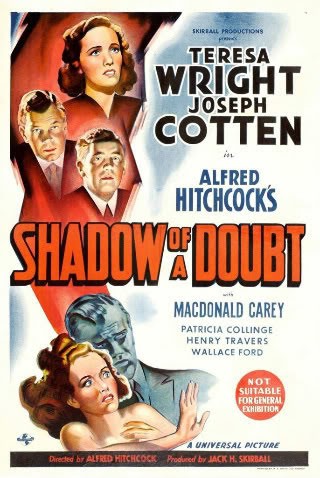
There are people who will tell you that Hitchcock never made a true film noir, and they cite the presence of countless personal motifs littering his work as evidence that what we’re watching is a “Hitchcock movie” as opposed to noir. That’s a point of view I can understand, even sympathize with to some extent, but I still feel that there are a number of Hitch’s movies that do fit snugly into that category. Shadow of a Doubt (1943) is a prime candidate for inclusion due to the dark heart that beats beneath the deceptively bright surface, and the ambiguous attitude it displays towards the villain.

The opening is typical Hitchcock, starting with a cityscape and then zeroing in shot by shot to the window of a grotty tenement. Charlie Oakley (Joseph Cotten) is reclining on his bed, but is interrupted when his landlady comes to inform him that two strangers have been asking for him. It’s made clear that Charlie is being sought in connection with criminal activities. The exact nature of these crimes are only alluded to at first, but the viewers suspicions are allowed to build gradually until it’s finally revealed that Charlie is the killer of a series of wealthy widows – The Merry Widow Murderer. Of course, this isn’t just a standard did-he-or-didn’t-he, hunt-for-a-killer picture; the doubt of the title refers not so much to the viewers as to the villain’s family, and to his niece in particular. In order to find some respite from the relentless manhunt underway, Charlie goes to stay with his sister’s family in Santa Rosa, California. This unexpected arrival is a source of celebration for the sister and especially the niece, also called Charlie (Teresa Wright) in his honour. Young Charlie is on the cusp of adulthood, and bemoaning the fact that her family’s life has descended into a monotonous series of drab non-events. The appearance of the Uncle whom she idolises promises to inject some energy and excitement into her sleepy, small town existence. This certainly seems to be the case at first, as she parades her uncle around town like a trophy or a returning hero. Gradually though, this innocent adulation begins to be eroded by the seemingly insignificant occurrences that begin to pile up. When two detectives masquerading as reporters (Macdonald Carey and Wallace Ford) turn up Young Charlie has her suspicions confirmed. In a marvellously filmed sequence in a deserted public library, the full extent of Uncle Charlie’s crimes is revealed as his niece reads the truth in a newspaper, the camera standing in for her eyes as she has the ground yanked out from under her – the camera pulling back and away to leave her small, isolated and burdened with knowledge in this shrine to learning. The dilemma facing Young Charlie is that she cannot act upon this information without destroying her family, and especially her emotionally fragile mother (Patricia Collinge). The situation is complicated even further when she realizes that her outwardly affectionate uncle can’t afford to let her walk around knowing what she does.

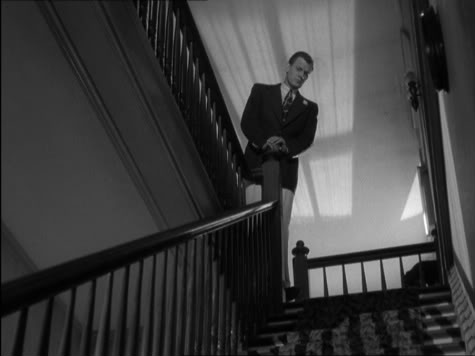
Shadow of a Doubt is commonly referred to as Hitchcock’s favourite film, and it’s easy to see why that would be the case. It’s a dark ode to Americana that’s reminiscent of Capra, an outsider’s view of an idealized world. Hitchcock’s Santa Rosa is not, as I’ve heard it suggested, the home to dark secrets but a wholesome community into which darkness steals (from it’s true origin, the urban center) before being duly expelled. Most of Hitchcock’s trademark visual style is on view, from high tracking shots to zooms and unnerving close-ups. The whole movie is chock full of memorable scenes and shots so it’s hard to pick out favourites. However, two sequences stand out for me: the first is Uncle Charlie’s arrival in Santa Rosa, the train rolling into the spotless station and pumping out a huge cloud of noxious black smoke to represent the evil it carries within; the other (less frequently mentioned) scene takes place when Uncle Charlie has just heard that the authorities have effectively cleared him. As the relieved man struts into the house and bounds up the stairs with a renewed vigour, he pauses halfway up, turns slowly, and sees the slight figure of his niece framed in the doorway below. It’s at this point that we know he’s going to kill her, he has no other alternative – it’s a subtle yet chilling moment that never fails to make the hairs on the back of my neck stand up, even after countless viewings.

Joseph Cotten had that kind of easy charm that meant he wasn’t chosen to play the heavy in too many films. He uses his natural affability to good effect here and is entirely believable as a man who seems to make friends everywhere he goes. It also makes our knowledge of his true nature all the more shocking and adds some real punch to those moments when he lets his mask slide a little. All in all, you can’t help but have a sneaking admiration for him – sure he’s evil, but his evil has such an urbane and attractive sheen that it almost wins you over. Playing against that and holding onto viewer sympathy is a big ask, but Teresa Wright pulls it off. She matures perfectly as the story progresses and the threats to her safety escalate. By the end the viewers are faced with their own dilemma, not really wanting to see harm come to either uncle or niece. The main support comes from Patricia Collinge as the vulnerable and trusting mother. It’s her trust in and deep adoration for her rotten brother that gives real substance to the film, and it’s to her credit that the part retains the requisite emotional pull without becoming cloying. Henry Travers and Hume Cronyn are cast mainly as a kind of macabre comic relief, needling each other of an evening about the best way to bump the other off. If I have any real criticism to make it relates to Macdonald Carey’s detective. It just feels like padding in a film that doesn’t require any; if his budding romance with Teresa Wright was included to strengthen the notion of her growing up then it’s unnecessary, that aspect being more than adequately covered by the meatier sections of the picture.

Universal’s UK release of Shadow of a Doubt on DVD is a very satisfactory one, showing little damage and staying sharp and clear for the most part. There’s a nice selection of extras including the trailer and galleries. Best of all is a half hour documentary on the making of the film that has contributions from Teresa Wright, Hume Cronyn and others. I won’t try and argue that this is Hitchcock’s best film, but it is a very accomplished work. It serves as a study on the loss of innocence and the darkness that lurks behind a polished facade – and it’s a highly entertaining movie.

Key Largo

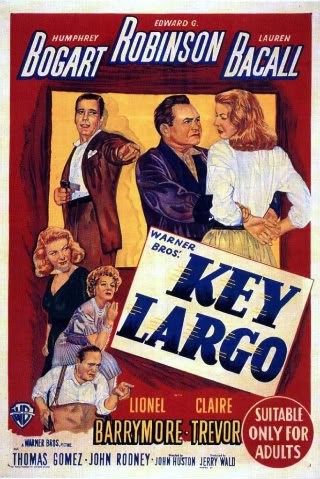
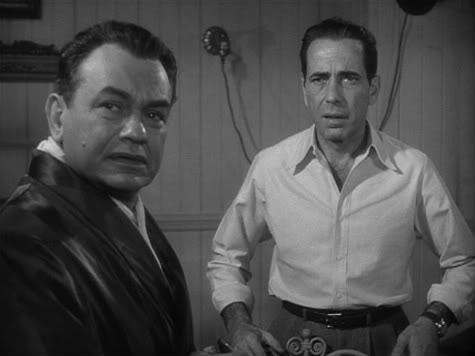
It’s hard to watch a film like Key Largo (1948) without being reminded of endings; it represented the final screen collaboration of Humphrey Bogart with both Lauren Bacall and Edward G Robinson, and it was one of the last movies he would make for Warner Brothers. Not only that, but it was also one of the last hurrahs for the old style gangster picture – but more about that later. It’s also a production that can be viewed from a number of angles: as a character driven drama, a gangster/noir mash-up, a commentary on the situation facing returning veterans, or as an allegory on fascism. Now this kind of multi-faceted approach can either lead to an unfocused piece or add to the rewatch value. I think the latter wins out here.

If the title and written prologue weren’t enough then the opening helicopter shot establishes the fact that the action takes place along the Florida Keys. As the camera zooms in on a bus making its way along the linking causeway we get our first glimpse of Frank McCloud (Bogart), a WWII veteran paying a visit to the relatives of a fallen comrade. McCloud’s destination is a hotel that, owing to the fact it’s the off-season, is virtually closed down. There is, however, one group of guests in residence when he gets there. None of these people seem especially friendly or anxious to welcome another visitor, and one of thier number, a Mr Brown, is conspicuous by remaining closed in his room. By and by, it emerges that McCloud’s companions are actually criminals, although that fact was unknown to the hotel owner, Temple (Lionel Barrymore), and his daughter-in-law Nora (Bacall). If McCloud had any suspicions, they are confirmed by the appearance of Mr Brown. Mr Brown isn’t his real name of course – he is one Johnny Rocco (Robinson), a one-time mob kingpin bent on rebuilding his criminal empire. At this point the already oppressive atmosphere grows heavier, both figuratively and literally, as an approaching hurricane threatens to tear up everything in its path. In the midst of all this, a duel develops between Rocco and McCloud – one that will finally be resolved on a motor launch bound for Cuba.

Key Largo was made at what was arguably the height of John Huston’s career, and its success is due to a combination of top class scripting (with Richard Brooks), photography, and acting. Bogart and Robinson occupy centre stage and their war of wills is what drives the whole thing forward. Eddie G’s Rocco is a devious and bullish creation, yearning for past glories that he must surely know in his heart are unattainable. Rocco and his cohorts are seen cowering before nature’s primal force and attempting to brass it out with a show of transparent bravado, pronouncing with unconvincing confidence that prohibition must surely come back and how things will be different this time. But these men are aware that they’re living out of time and it’s interesting to note that Al Capone, on whom Rocco was clearly based, was dead a year at that point. Bogart’s weary vet is one of his more complex characters, and could be compared to his Rick from Casablanca. Both men are initially reluctant to get involved or “stick their neck out” but do so eventually for the right reasons. The difference, however, is that Rick’s passivity was motivated by considerations of profitability whereas McCloud’s was the result of a deep disillusionment. That should have struck a chord with contemporary audiences: a whole generation of young men had marched off and risked their lives (and seen others lose theirs) in order to rid the world of oppression and fascism, only to return home and be confronted by a domestic version.

There are two key scenes that help define McCloud’s character. The first is a wonderfully photographed series of close-ups that show Rocco whispering suggestively into Nora’s ear (not a word is heard, but the inference is clear enough) before she spits contemptuously into his outraged face. With an unspoken dignity, McCloud moves across and quietly puts an arm around her shoulder before gently leading her away. I remember hearing Richard Brooks refer to this scene in a documentary as a moment of simple decency that everyone would like to emulate, and that’s hard to argue with. A similar situation takes place when Rocco humiliates his woman (Claire Trevor) by forcing her to sing unaccompanied as the price for the drink she craves. When he then goes back on his word, McCloud again does the right thing by pouring a whisky for the devastated woman despite the danger to himself. This is not a man who avoids confrontation due to cowardice or fear of personal injury but one who has grown apathetic and merely needs a prod to show his true colours. The aforementioned Claire Trevor deservedly won an Oscar for her role as the faded, alcoholic singer whose pride and self respect have been pushed into the background. That scene where she degrades herself in front of strangers through desperation is toe-curlingly effective and probably clinched the award for her. Lauren Bacall, in the only other significant female role, is much more subdued and is called on to do little more than gaze soulfully at Bogart. Of the four films Bogart and Bacall made together, this one is markedly different. The two Howard Hawks pictures had that director’s breezy playfulness about them, while Dark Passage was almost a study in bizarre coincidence. Key Largo has a grim, downbeat tone throughout that may surprise, or even disappoint, those hoping for a rerun of the couple’s previous work together.

Key Largo has been out on DVD for a long time now but the transfer still holds up well enough. I have the Warner UK version and the image is hard to fault, being pretty crisp all the way. I thought the dialogue levels were a little low but that’s probably just a feature of the film as there are a number of hushed conversations, and anyway Max Steiner’s atmospheric scoring doesn’t suffer. Extras are almost non-existent and are limited to the film’s trailer. The movie itself is a good example of how well Bogart and Huston worked together (it may come up wanting for those seeking out another Bogart/Bacall pairing though) and is the kind of picture that rewards multiple viewings. It gets the thumbs up from me.

Yellow Sky

spmzuhf


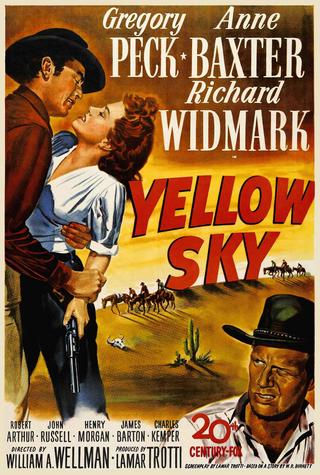
OK, so I’ve taken a break from this thing for a while now. I’ve generally found that I need to take a step back from time to time and allow myself a chance to recharge the batteries before starting anew. My last post was on a western, and my latest one is also another oater – for the sake of continuity if nothing else. Yellow Sky (1948) is a typically stylish William Wellman movie that trades on those perennial themes of greed and honor.

The film opens with a bank raid in a small town and concludes, with a quirky twist, in that same town. However, the robbery plays only a small part in the story; it’s the events that it leads to that form the core of the movie. Stretch Dawson (Gregory Peck) is the laconic leader of a band of outlaws who think they’ve just made an easy killing. While their initial getaway appears to have been clean there is a troop of soldiers on their trail, and the outlaw gang find themselves forced onto a barren and punishing expanse of salt flats in an effort to elude capture. From this early stage the first cracks appear in the group. Stretch is the acknowledged boss but his authority begins to be challenged by Lengthy (John Russell) and especially by Dude (Richard Widmark). As these men haul themselves painfully across the hellish landscape they are driven to the very limits of human endurance. Just as they are about to succumb to the effects of exhaustion and dehydration they stumble into the abandoned former mining town of Yellow Sky, and this is the point at which the story becomes most interesting. The old ghost town is not all it seems – for one thing it’s not strictly a ghost town at all. There are two inhabitants, an old half-crazed prospector and his daughter ‘Mike’ (Anne Baxter). Even in their weakened state the outlaws are not so dumb as to believe these two are living there for the good of their health. Putting two and two together, they decide that there’s only one reason anyone would choose to live in a dead town – gold. What remains to be seen is how far each individual is prepared to go in order to satisfy his craving for riches, and whether or not the notion of honour among thieves has any basis in truth. Like all the best westerns, it raises questions about one’s word of honour and, in this case, if that has any value for those who live outside the law.

£19

William Wellman’s direction offers a lesson in style, utilizing close-ups, long shots, deep focus, shadows and high contrast. There’s also an especially notable shot down the smoothly rifled barrel of a gun (see pic. above) which foreshadows the famous 007 pre-credits sequences. I’d also like to mention the climactic shootout between Peck, Widmark and Russell that takes place in the gloomy ruins of the town saloon – all the gunplay is unseen by the audience with only the bloody aftermath revealed. The location photography is another positive feature, with the inhospitable Death Valley occupying the first half before the action moves to Lone Pine for the scenes around the titular town. When looking at the characters, the first thing that jumps out is that every single one is known only by a nickname from beginning to end – the sole exceptions being Peck and Baxter, whose full names are revealed to the viewer. Peck handled his leading role competently as the reluctant hero who eventually finds a kind of redemption. John Russell and Richard Widmark make for a worthy couple of adversaries, the former consumed by pure animal lust and the latter with a hunger for wealth and the power to visit retribution on those he feels have slighted him in the past. Widmark in particular is the epitome of villainy, still at that stage in his career when he tended to get typecast as nasty pieces of work for the hero to vanquish. Anne Baxter’s role called for her to be a kind of self-sufficient tomboy who still remains sexually provocative. To her credit, she managed this balancing act and emerged as a fully rounded character that you can believe in. Throughout the film she proves herself the equal of the male cast members and her only concession to the traditional image of femininity comes at the very end when she dons a frivolous little hat that Stretch has brought her as a gift.

The R1 DVD from Fox presents Yellow Sky in a handsome full frame transfer that’s clean and sharp for the most part. Extras on the disc consist of galleries of advertising material and a selection of trailers. The film itself is absorbing and well paced and it was only at the end that I realized how little violence is present, and how even that takes place off screen. This is one of those late-40s westerns that helped usher in the more complex works that dominated the following decade. Recommended.


El Dorado

poster208

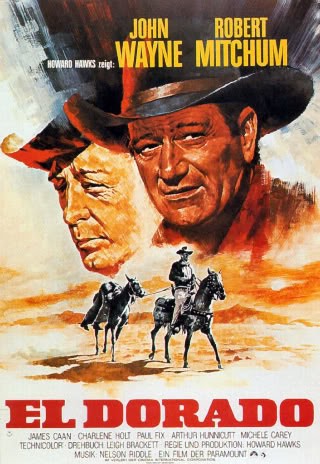
A while back I mentioned directors remaking their own movies, citing Hitchcock and Walsh at the time. However, they’re not the only ones; Howard Hawks reworked the same material that he originally used for Rio Bravo no less than three times. In this case, I think the law of gradually diminishing returns applies – although I’m aware that there are those who might disagree. Hawks’ second trip to the well resulted in El Dorado (1966), a film that improved on its predecessor in one or two ways but ultimately remains a less satisfying work. Ok, it’s not a straight remake of Rio Bravo since it opens the story up a little more in terms of people and locations but it does use the same core situation and characters. There’s the tough professional, the drunk, the old coot and the green kid all holed up in a dingy jailhouse and under siege.

Cole Thornton (John Wayne) is a professional gunman who hires his skills out to the highest bidder. After accepting an invitation from one of the parties involved in a range war he discovers that the job would mean facing off against an old friend. Sheriff J.P. Harrah (Robert Mitchum) is the lawman caught between the feuding factions, and it’s his presence that dissuades Thornton from signing any contract. However, before Thornton can take his leave an accidental shooting leads to an ambush that results in his getting a bullet lodged perilously close to his spine. When he returns some months later he finds that Harrah has taken to the bottle in the wake of an ill-judged love affair. To make matters worse, the nearly incapacitated sheriff is in no position to cope with the ongoing range war that’s about to come to a head. Therefore, it’s left to Thornton to take charge of a rapidly deteriorating situation provoked by an attempted murder and the subsequent arrest of one of the feud’s main players. Up to this point the plot has its own reasonably unique slant. However, once Thornton, Harrah et al find themselves barricaded in the jail it’s Rio Bravo all over again. Where the original had a gentle humour, a gradually built sense of camaraderie and a frisson of sexual tension (thanks to Angie Dickinson), El Dorado rushes things a bit and lays the humour on too thick. Actually, it’s the comedic elements that do the most damage in my opinion. Much of this is based around the character of Mississippi (James Caan) – in particular, his incompetence around firearms and his questionable taste in hats. What’s worse, though, is a cartoonish fight between Thornton and a drunken Harrah that wouldn’t have looked out of place in a Three Stooges short. The climax is also disappointing, the pyrotechnics of Rio Bravo being replaced with a contrived showdown that’s not much more than a damp squib.

In a sense, if you’ve seen one Howard Hawks picture you’ve seen them all. The same themes crop up again and again, namely professionalism and loyalty to one’s comrades. El Dorado is no exception in this respect, we have the tight knit group defying the odds and getting moral support from no-nonsense women. However, there’s a certain flatness to El Dorado, both in the visuals and the reworking of a tried and tested story. The areas where it does score over Rio Bravo are a few of the performances. I can’t honestly fault Dean Martin’s Dude, but Mitchum does bring more weight to his take on the broken down drunk if only because he’s Robert Mitchum. The biggest improvement is the casting of James Caan as the young man taking his first steps in the presence of the big boys. Although the forced jokiness of his character does tend to grate a little after a while he is certainly an actor, something that couldn’t be said for Ricky Nelson. Wayne, of course, is Wayne and it matters not a jot whether he’s playing the sheriff or the hired hand, his star quality ensures that he dominates proceedings. It is interesting to note though that the plot device concerning the bullet in his back was a convenient way to make allowances for the effects of the passage of time and the major health problems he had endured. As for the others, let’s just say that Arthur Hunnicutt, Charlene Holt and Ed Asner were no match for Walter Brennan, Angie Dickinson and Claude Akins. While I’m drawing comparisons, I might just add that Nelson Riddle’s score isn’t a patch on Tiomkin’s – although the title song played over Olaf Wieghorst’s paintings is very memorable.

El Dorado got a 2-disc release not long ago in the US as part of Paramount’s Centennial Collection. I never bothered to pick that one up so I can’t comment on the picture quality, but I do know it offered a variety of extras. The old UK R2 that I have presents the film 1.78:1 anamorphic and it’s not a bad transfer. The image could, I suppose, be a little sharper but there’s really not much to complain about. Image quality aside, the big difference between the old and new releases relates to bonus features, with the earlier disc boasting nothing but a theatrical trailer. Reading back through this, I might seem a little hard on El Dorado. The truth is it’s not at all a bad western and makes for entertaining viewing – the problem is that it’s damned near impossible not to compare it to Rio Bravo, and that’s where it comes up short.

The Omega Man

£7

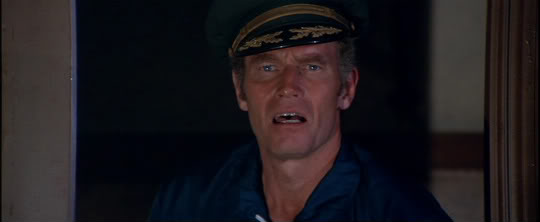
Up to now I haven’t touched on science fiction on this blog. The reason for that isn’t that I have any beef with the genre, rather that it tends to get plenty of attention elsewhere. The truth is I’m quite fond of sci-fi, at least the movies from the 50s through to the 70s, and watch a reasonable amount of it. One of my all time favourites in the genre has to be The Omega Man (1971), a film that’s not without its faults but whose strengths raise it up high. To the best of my knowledge, the story by Richard Matheson has been filmed three times now with The Omega Man being the second effort. It’s a movie very much of its time, but Charlton Heston’s central performance and a fantastic score by Ron Grainer power it on and help to divert attention from the weaknesses.

The story is pretty straightforward: a Sino-Russian conflict spreads westward and eventually engulfs the whole world, resulting in germ warfare that essentially wipes out humanity. The film opens with Robert Neville (Charlton Heston), a former army scientist, driving through a barren urban landscape. This scene, which never fails to give me goose bumps, has Neville cruising down deserted streets to the accompaniment of Percy Faith’s A Summer Place blasting out from the car stereo. For an instant, everything seems almost idyllic – but the illusion of an early morning spin in a still sleeping city is shattered violently as Neville stamps on the brakes and produces a machine pistol to rake the windows of a building where he’s just spotted a dark figure flitting silently by. From this point on it becomes clear what the real situation is; Neville is the last healthy human in a world of corpses and photo-sensitive mutants. The first three quarters of an hour are spent establishing the near hopeless situation Neville finds himself facing. He commands the city by day, hunting mutants and searching for their hive, but the nights belong to the black robed Family. It’s clear that the strain of his solitary existence and nights spent holed up in his fortress-like brownstone have begun to take their toll on Neville’s psychology. He spends his time conversing with himself and playing chess with a bust of Caesar, and he’s beginning to crack up. Were any person forced to live in such isolation and fend off regular night time assaults and taunts from the sinister Family, it’s not unreasonable that they’d start to imagine they could hear phones ringing and begin to question their own sanity. Neville has spent two long years ploughing this lonely furrow, until he catches a glimpse of what he thinks might be another normal human being. It’s only when a slip on his part leads to his being captured by the Family that he finds out he’s not as alone as he thought. That whole first half of the movie carefully builds up a picture of Neville’s world and the horror of living within it. The second part takes us in a new direction as we see him regain hope and perspective. The question is whether that new hope can be sustained, and the answer is left open when the movie reaches its conclusion with one of the most memorable (and touching) final shots and fade outs in cinema.


£5

I started off by pointing out that The Omega Man is not without its faults, and I’ll try and address those first. The thing that will strike any modern audience is that this is a 70s movie, and proudly so. The imagery and many of the themes are rooted firmly in that decade. The problem is that this lends it an air of kitsch that may be off-putting to some. The presence of Rosalind Cash and Lincoln Kilpatrick results in a curious mix of jive talking blaxploitation and more serious questions about race relations, and they don’t really sit comfortably together in retrospect. However, that stuff is more a matter of personal taste and could be seen as part of the movie’s charm. A bigger issue is the Family (this is probably the main weakness of all three versions of the story) who never come across as threatening as they should. They do attain a cult-style creepiness, and their malice is never in question, but there’s also a slightly comical air about them – not helped by a hammy performance by Anthony Zerbe as their leader Matthias – that dilutes the danger somewhat. On the other hand, Heston’s take on Neville really anchors the picture. He does very well in the opening half when he basically has no one to play off and has to earn the viewers’ sympathy and support single handed. I thought he brought the right balance of tough resilience and increasing despondency to the role. The other major plus is a score by Ron Grainer that evokes the mood of both the story and the characters beautifully. I think it would be fair to say that Grainer’s music plays a significant part in ensuring the movie remains eminently watchable – this is probably among the best pieces of film composing the decade offered.

The Omega Man is one of the gradually increasing number of classic films that’s made it onto Blu-Ray. Having said that, I’ve yet to buy into the format myself (partly because of a lack of attractive titles but mainly because I’m satisfied enough with the quality of the DVDs I own – but that’s a discussion for another time) so I’ll confine myself to saying that I’ve no doubt the BD adds to the overall visual presentation. The old Warner DVD was one that never gave me any cause for complaint, with a strong and detailed anamorphic scope image. For me, the film is an old favourite whose failings can be easily ignored when there’s the pleasure of seeing Heston near his best and hearing Ron Grainer’s haunting melodies.

Shanghai Express

£8

You’re in China now, sir, where time and life have no value.

Style over substance, that’s a term that’s often levelled at some movies as a form of criticism; however, it doesn’t always have to be taken as such. On occasion, the humdrum, the trite and the unoriginal can be elevated by the presence of stylised techniques and images. Shanghai Express (1932) is a film where this is certainly the case – the story is pure, overblown melodrama but, in the hands of Josef von Sternberg, it manages to transcend the limitations of its plot and approach art.

Events take place during the Chinese Civil War, with a rag-tag assortment of characters boarding the titular train. The main topic of conversation is the presence of a notorious prostitute called Shanghai Lily (Marlene Dietrich) who has been involved in a series of scandals up and down the Chinese coast. The reactions tend to vary from the outraged disapproval of a missionary to the more pragmatic acceptance by an American gambler and a disgraced French soldier. All the passengers know Shanghai Lily only by reputation, all but one that is. Captain Harvey (Clive Brook) is a British army surgeon travelling to Shanghai to perform an operation on a high ranking government official. Harvey and the woman were once lovers until an indiscretion on her part drove a wedge between them. From then on she embarked on a series of affairs and liaisons that earned her that colourful name. The rub is that these two people are still in love, but their pride and past histories prevent them from bridging the gap of mistrust that has grown up between them. The simmering sexual tensions are brought to a head when one of the passengers, a Eurasian by the name of Chang (Warner Oland), reveals himself as a Maoist rebel and hijacks the train. Chang’s aim is simply to hold the passengers, Harvey in particular, hostage until the government agrees to release one of his close lieutenants. In the end, it comes down to whether or not Shanghai Lily will sacrifice her new found honour to save the man she loves – and whether or not he will understand her motives. As I said, this is melodrama of the ripest and tawdriest variety. The whole thing works, and works very well, due to von Sternberg’s skill in evoking an atmosphere of decadence and exoticism that is dreamlike in its allure. The train itself is one of those inter-war extravagances that contrasts with the ramshackle station where the hostages are held. There are a number of notable sequences, but the one that made the greatest impression on me was the night-time assault on the train by Chang’s rebels. Bathed in expressionistic shadows and hissing steam, the rebels swarm over the stalled locomotive and dispose of the government troops. Those not killed immediately are rounded up and, as a heavy machine gun filmed in silhouette chatters into life, butchered on the platform. The camera angles and movements in this scene, and throughout the whole movie, are much more inventive and fluid than one normally expects in early sound pictures.


£6

While von Sternberg clearly revelled in the theatrical oriental atmosphere, more than anything the film was an ode to Dietrich. It’s the way that Von Sternberg and cinematographer Lee Garmes lit and shot Dietrich that gives the film its power. He never misses an opportunity to zoom in on her, and Garmes’ setups are designed to accentuate that famous bone structure as the camera lingers. Her performance is nothing special in itself, but she oozes that languid, provocative sexuality that was her trademark. The dialogue that she (and all the cast members for that matter) is handed is delivered in a slow, deliberate, almost stilted fashion that actually works within the dreamy and unreal world that von Sternberg weaves. The role of Captain Harvey went to Clive Brook, and that damn near derails (sic) the whole show. He gives one of the most wooden and po-faced performances it’s been my misfortune to witness – although it could be argued, generously, that this actually serves to emphasise the priggishness of his character. Still and all, it’s hard to see how Dietrich’s character could possibly have carried a torch for this stuffed shirt for five years. The support cast led by Warner Oland and Anna May Wong are thankfully much better and help paper over the deficiencies of the leading man. Oland in particular does fine work as the charming but embittered Eurasian who compensates for his resentment of his mixed blood by indulging in torture and cruelty.

Shanghai Express was released a couple of years back in a 6-disc Dietrich boxset in the UK, although it’s since been made available individually. Universal have presented the film well considering its age, there are speckles and such, and some moments of softness, but it generally looks very good. Detail is quite strong at times and contrast is always good, the latter being especially important for a movie like this. The disc itself is completely barebones, which is a little disappointing but at least it can be bought for next to nothing. For a pre-code film it does seem a little coy in not coming right out and stating exactly how Shanghai Lily earns her keep, but it doesn’t exactly hide the fact either. Although the story is not going to blow anyone away, the intoxicating atmosphere is a real visual treat. Also, considering the weakness of the leading man, it’s a testament to the abilities of Dietrich, Garmes and von Sternberg that the end product is so good. I give it a big thumbs up.

Journey into Fear

I mentioned recently how films set on trains or in creepy old houses are some of my favorites, I should have also included ships and boats while I was at it. Mysteries and thrillers benefit enormously from these confined settings: the sense of claustrophobia is heightened, and then there’s the knowledge that the hero can only run so far. Journey into Fear (1943) has its hero boxed up on a decaying old freighter in the middle of the Black Sea, surrounded by a gallery of grotesques and living in fear of his life. For a film that runs only a little over an hour it’s packed full of memorable scenes, images and characters that tap into a strong noir vibe.

Howard Graham (Joseph Cotten), an engineer employed by an American armaments company, is in wartime Turkey on business. He’s a typical everyman character and, by his own admission, not a very exciting person. When the company’s local rep decides to take him out for a night on the town, Graham finds himself abruptly swept away into a world of intrigue, assassination and terror. It all begins in a night club where Graham narrowly avoids death. The local man, a fawning and obsequious type by the name of Kopeikin (Everett Sloane), has dragged the reluctant Graham into this slightly seedy cabaret, plying him with liquor and women. During an illusionist’s act, for which he has ‘volunteered’, a shot rings out in the darkness and the magician takes the bullet surely meant for Graham. Before the outraged and confused engineer even has time to draw breath he’s hauled off to a meeting with the chief of the Secret Police, Colonel Haki (Orson Welles), who has him bundled aboard a stinking old tub to spirit him safely out of the country. This is the pattern the movie follows, there’s always someone else making decisions for the increasingly bewildered Graham. Of course he tries to wrest the initiative but, in classic noir fashion, he’s always a victim of fate rather than a master of his own destiny. The scenes aboard the ship are full of menace, emphasised by the low angle shots and the deep, dark shadows that seem to follow Graham everywhere. The threat looms even larger when a short stopover allows the assassin Banat (Jack Moss) to come aboard. This character hasn’t one line of dialogue throughout the film but it’s that chilling silence and the bland countenance masked by pebble glasses and a vaguely ludicrous hat that add to his creepiness. When Graham finally disembarks he makes a break for freedom, but fails to get very far. This does, however, set up a thrilling climax atop a hotel ledge in the pouring rain that ties up most of the loose ends.

Journey into Fear is an adaptation of one of Eric Ambler’s finest novels with the screenplay credited to Joseph Cotten. Being a huge and unashamed admirer of Ambler I’m always pleased to see his work represented on the screen, and this movie retains much of the flavor of his writing. Aside from the scripting credit, Joseph Cotten turns in a good performance as the baffled engineer who’s always on his guard but never quite sure who to trust. His plight is one that’s frankly hard to swallow, and there’s a nice little scene where he tries to convince the ship’s captain of the danger he’s in only to have the grizzled old codger laugh in his face. Dolores del Rio (who had a relationship with Welles) first appears as a leopardskin clad dancer in the early night club scene and maintains that feline aura throughout as she slinks around sexily in pursuit of our hero. The rest of the cast (largely drawn from the Mercury players) mainly turn in small but memorable cameo roles. In particular, Jack Moss, who was in fact Welles’ accountant, turns the blood cold every time his ungainly bulk lumbers into the frame and his impassive assassin remains one of the highlights of the movie. Orson Welles plays another of those larger than life figures that seemed an extension of his own personality to great effect in the few scenes where he appears. His trademark slow-quick-slow delivery and the darting eyes that twinkle mischief one minute and glower thunderously the next are ideal for the shady yet menacing Colonel Haki – incidentally, the character of Colonel Haki is one that showed up again in Ambler’s The Mask of Dimitrios. In truth, Welles’ massive presence dominates the film and his fingerprints are to be found all over the production. Although Norman Foster is credited as director it’s clear to anyone familiar with his work that Welles, at the very least, exerted a huge influence over the shooting. For example, the climactic chase along the slick hotel ledge in the storm uses the kind of dizzying overhead angles that Welles was fond of.

For a number of years now Warners have been promising that a DVD with a restored print of Journey into Fear is on the way in the US, however it still remains a no show. The French company Montparnasse have released the movie in R2 though, and there’s really not much wrong with that edition. The print used is actually in pretty fair shape with good contrast and sharpness, sure there’s the odd scratch and speckle here and there but nothing to fret over. There aren’t any extras save a brief introduction (in French naturally), but if it’s a good print of the movie itself you’re after then the Montparnasse release is very definitely acceptable. Journey into Fear is a stylish little noir film that benefits from the Welles touch and has the quirkiness that’s often found in films he graced with his presence. The pace may feel a little rushed at times but I prefer to think of that as emphasizing the urgency of the situation and the danger the hero finds himself in. It certainly gets my recommendation.